Can I Do Herculaneum And Pompeii In One Day?
Yes, Pompeii and Herculaneum can be combined in one long day from Naples or Sorrento: how long each site needs, 2026 ticket prices, the order that works, and how to travel between them.
The plan works best from a Naples base with an early start, a firm decision about what to skip at Pompeii, and tickets bought in advance. This page lays out the timing, the 2026 ticket prices, the order that suits different travellers, and the closures and crowds that can quietly eat your day.
Can I Do Herculaneum And Pompeii In One Day?
Yes. Pompeii and Herculaneum can both be seen in a single day, provided you start early, give Pompeii the larger share of the time and treat Herculaneum as the tighter, smaller second half. Visitors who try to see everything at Pompeii and then "pop in" to Herculaneum run out of daylight; visitors who plan each site around a fixed exit time succeed comfortably.
The honest framing is this: Pompeii is an entire Roman city, with an excavated area of 44 ha, and no one sees all of it in a half day. Herculaneum is a smaller seaside town buried far deeper, and its compact footprint is exactly why the pairing works. A day that gives Pompeii the morning and Herculaneum the mid-afternoon, with a generous buffer for the train between them, is the shape that succeeds.
The main failure mode is not distance but decision fatigue. Pompeii's grid of streets invites wandering, and the 16 March to 14 October schedule, with last entrance at 17:30 and closing at 19:00, gives a false sense of surplus time. Herculaneum in the same season stops selling entry at 18:00 and closes at 19:30. If you leave Pompeii too late, you arrive at Ercolano with the doors effectively shut. Set your Pompeii exit time before you enter.
For a full route worked out stop by stop, the site's Pompeii and Herculaneum one-day itinerary is the detailed companion to this answer, and the broader question of whether Pompeii works as a Naples day trip covers the base-city logic.
How Long Do You Need At Each Site?
Plan on three to four hours inside Pompeii and around two hours inside Herculaneum, plus transit and ticket lines at each end. Those figures assume a highlights-first walk at Pompeii rather than a full-city circuit, and a steady loop of Herculaneum's terraces and boat sheds. Anything less at Pompeii and you are visiting a handful of corners; anything more and you will not make Ercolano before last entry. Two hours is genuinely enough at Herculaneum, which is a third the walking scale of its neighbour.
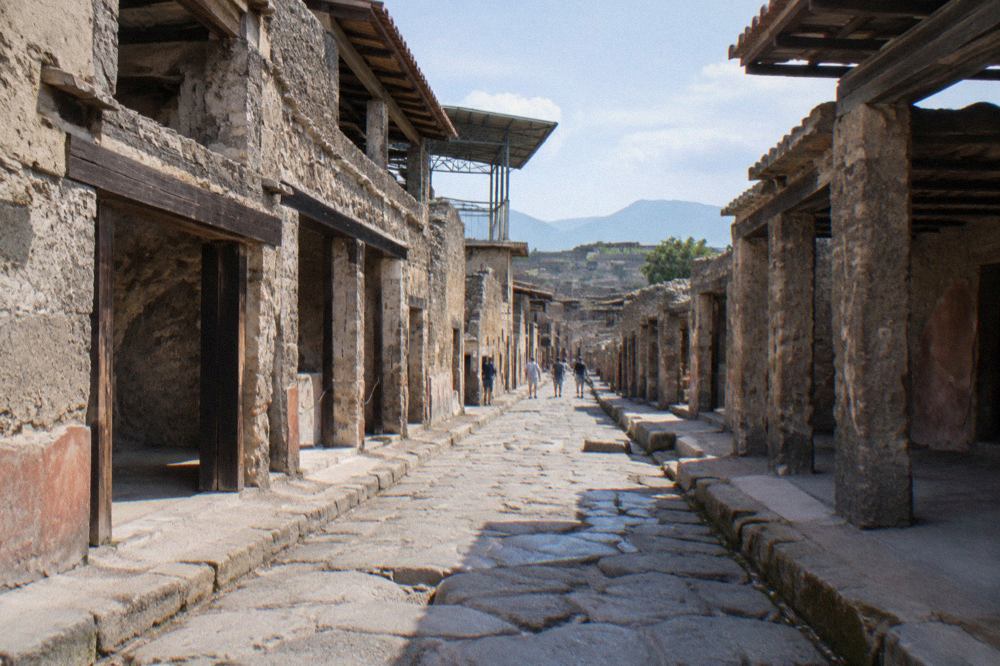
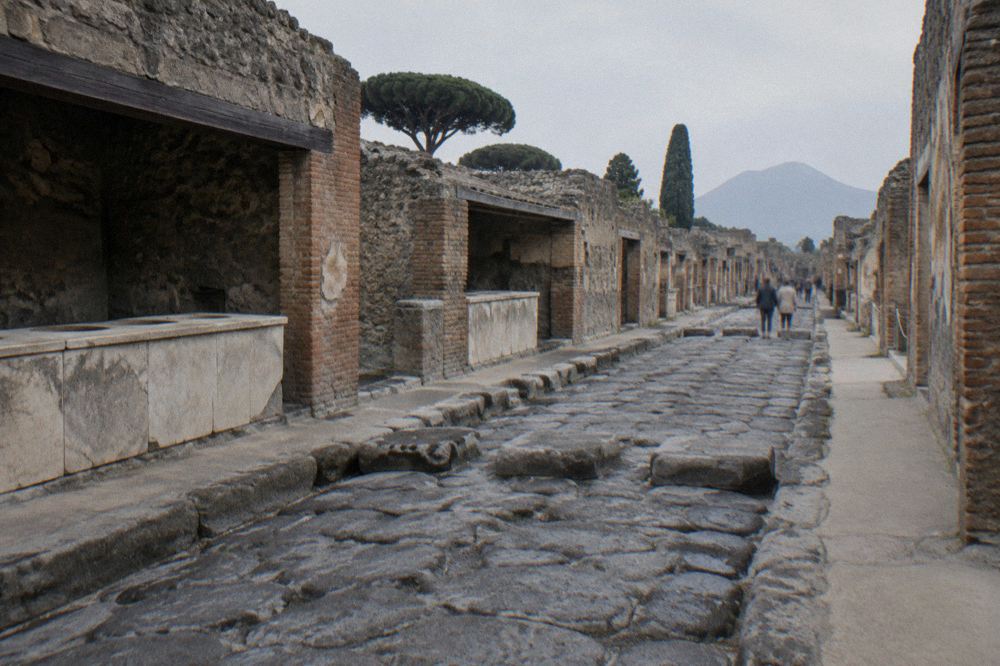
The asymmetry surprises people who have not seen both sites. Pompeii's streets run for kilometres and the shade is scarce; Herculaneum is a sunken box you view partly from the rim above, then descend into, and its houses sit almost shoulder to shoulder. The physical effort is different too: Pompeii's ancient basalt paving is rutted and uneven underfoot, while Herculaneum's excavated level is flatter and more forgiving, which is why many families put it second, when legs are tired.
| Site | Realistic visit | 2026 season (16 Mar to 14 Oct) | Last entry | Closing |
|---|---|---|---|---|
| Pompeii (ancient city) | 3-4 hours for highlights | 9:00 to 19:00 | 17:30 | 19:00 |
| Herculaneum (Ercolano) | about 2 hours | 8:30 to 19:30 | 18:00 | 19:30 |
Herculaneum deserves its two hours, and travellers asking is 2 hours enough for Herculaneum get the same answer given here in more detail: yes, provided the two closed structures, the Villa dei Papiri and the Ancient Theatre, are not on your list, because both are shut for works until further notice. Build your expectation around the houses, the thermopolia and the boat sheds, all of which are open.
If your instinct is that two sites plus a volcano is a bridge too far to self-manage, an organised alternative exists: the day trip from Naples covering Pompeii, Herculaneum and Vesuvius handles the sequencing, the transfers and the entry logistics in one package, which removes the single biggest risk of a DIY double header, the late arrival.
Which Order Works Best: Pompeii Or Herculaneum First?
The reasons are practical rather than aesthetic: Pompeii absorbs energy and rewards fresh legs, its bigger footprint makes an early start more valuable, and finishing at Herculaneum keeps your options open, because Ercolano's compact layout can absorb a slightly late arrival, while Pompeii cannot absorb a rushed one. Cruise passengers and Sorrento-based visitors should check their own timings against this default.
There is a counter-argument worth hearing. Herculaneum in the early morning is quieter, cooler and faster to clear, so some travellers knock it out by late morning, lunch at Ercolano, and give Pompeii the entire afternoon. That order can work in the summer schedule, when Pompeii admits until 17:30, but it leaves no margin for a delayed train or a long Pompeii queue, and a delayed start to Pompeii is the day-killer. The Pompeii-first order loses less when things go wrong.
| Order | Best for | Main risk |
|---|---|---|
| Pompeii then Herculaneum | First-time visitors, hot days, cautious planners | Tired legs at the smaller site |
| Herculaneum then Pompeii | Confident repeat visitors, early risers, photographers | No buffer if the afternoon slips |
Whatever order you choose, buy entry in advance. The case for advance booking, covered in full in should you buy Pompeii tickets in advance, is reinforced by the park's daily cap of 20,000 visitors, in force since 15 November 2024, with time bands that split entries between 9:00 to 13:00 and 13:00 to 17:30 in the current schedule. Turning up ticketless at midday in high summer is how a two-site day becomes a one-site day.
A private archaeologist-led slot pairs naturally with a self-guided Herculaneum afternoon: the big site gets the expert narrative, the small site gets your own pace, and the fixed end time of a booked tour enforces the discipline that a free-roaming Pompeii visit quietly abandons.
What Do The Tickets Cost In 2026?
In 2026 Pompeii's Express ticket, covering the ancient city, is EUR 20, the Pompeii+ ticket is EUR 25 and the 3-day ticket is EUR 30, while Herculaneum is EUR 16 full price, with EUR 2 reduced rates at both parks for EU citizens aged 18 to under 25. Those Pompeii prices are dated: from 1 January 2027 a single EUR 25 ticket covers all park sites. Under-18s enter free everywhere, and the first Sunday of the month is free for everyone, which also means the biggest crowds.
The two parks sell tickets separately; there is no combined Pompeii-Herculaneum pass, because they are separate institutions. The 2026 structure is the last of its kind: the park's release of 14 September 2026 confirms that from 1 January 2027 one EUR 25 ticket, valid 30 days with one entry per site, replaces the Express/Plus/3-day ladder, while the smaller satellite sites (Oplontis, the Stabiae museum and Boscoreale) stay EUR 8 individually and the MyPompeii Card stays EUR 45. A one-day double header is unaffected by the change in practical terms, since you only need the ancient city at Pompeii.
| Ticket (2026 prices) | Price | Covers |
|---|---|---|
| Pompeii Express | EUR 20 | Ancient city of Pompeii only |
| Pompeii+ | EUR 25 | City plus suburban villas, Villa Regina, Boscoreale Antiquarium, shuttle |
| Pompeii 3-day | EUR 30 | Pompeii+ plus Oplontis, Stabiae villas and museum, Boscoreale |
| Herculaneum full | EUR 16 | Herculaneum site, Ercolano |
| Reduced (both parks) | EUR 2 | EU citizens aged 18 to under 25 |
For the full breakdown of tiers, free days and the 2027 switch, see the site's Pompeii ticket guide. One trap specific to the double header: Herculaneum's free first-Sunday entry is collected at the ticket office on the day, with no reservation, so a free double day is possible but should be treated as the most crowded version of the plan.
How Do You Travel Between The Two Sites?
The Circumvesuviana railway connects the two sites directly: Pompeii's station is Pompei Scavi-Villa dei Misteri, beside the Porta Marina entrance, and Herculaneum's is Ercolano Scavi, a short downhill walk from the site's gate. Both sit on the same Naples to Sorrento line, so a one-change-at-worst journey links them, and the same line returns you to Naples at the end of the day. No ferry, bus or taxi is needed to make the pairing work.
The practical detail that matters most is orientation, not the train itself. From Pompei Scavi you enter Pompeii at Porta Marina; from Ercolano Scavi the walk to the Herculaneum gate is downhill on the way in, uphill on the way out, and both station names are signposted along the route. Within Naples the line starts at Napoli Garibaldi, under the main central station, and the schedule times computed from the operator's own data put Napoli Garibaldi to Pompei Scavi at 29 to 35 minutes, which anchors how early a Naples-based traveller can realistically begin.
Give the transfer a generous margin rather than a theoretical one. Allow time for buying or validating tickets, for platform changes, and for the possibility of a crowded train in high season. A gap that feels wasteful at 14:00 is the buffer that saves the Herculaneum half at 15:30. If the rail detail feels like friction, the buying process is explained step by step in how to buy Circumvesuviana tickets.
One transport fact deserves a date stamp: the Campania Express, the premium air-conditioned service on the same network, has been suspended since 1 October 2026 until further notice. Any itinerary published before that date describing a Campania Express ride between the two sites is out of date, so plan around the standard Circumvesuviana trains and the operator's own timetable.
What Could Quietly Break The Plan?
Three things derail Pompeii and Herculaneum double headers: arriving at Pompeii too late to clear the highlights before the afternoon, underestimating the transfer and ticket lines between sites, and building the day around structures that are closed, above all Herculaneum's Villa dei Papiri and Ancient Theatre. The daily cap of 20,000 at Pompeii adds a fourth, seasonal risk on free first Sundays and holiday weekends, when the park has recorded more than 36,000 visitors in a single day.
Closures first. At Pompeii itself, the Praedia of Julia Felix has been closed to the public since 7 September 2026 for maintenance, and any route that promises it needs adjusting. At Herculaneum, the Villa dei Papiri and Ancient Theatre are both shut for works. None of these closures removes the case for the double header; they simply mean the day should be built around what is open, and the wider comparison of the two sites explains why Herculaneum's open houses alone carry the visit.
Then heat and daylight. Pompeii's excavated streets hold almost no shade, and the climate normals for Pompei put the average daily maximum at about 29.4 C in August against about 12.2 C in January; November is the wettest month of the year at about 180 mm of rain and July the driest at about 16 mm. A summer double header wants the earliest possible Pompeii entry and water carried in, while a winter one is bounded by the 15 October to 15 March schedule, where Pompeii's last entrance falls at 15:30 and closing at 17:00, a schedule that makes both sites in one day tight but still feasible with a morning start.
Finally, the bag rule. Pompeii permits bags only up to 30x30x15 cm, with larger items left at the left luggage desk, a constraint worth remembering if you are carrying a full day's gear between sites. Checking the park's visitor regulations before you pack saves an unwelcome moment at the gate, and the fuller set of practical constraints lives in the planning material on Pompeii Travel Guide.
Common Questions About Combining Pompeii And Herculaneum In One Day
Can I do Herculaneum and Pompeii in one day?
Yes. Both sites sit on the same Vesuvian railway line in Campania, southern Italy, and a day built as three to four hours at Pompeii plus about two hours at Herculaneum, with a buffered transfer between them, is a well-tested plan. Start at Pompeii at opening time and leave for Ercolano by mid-afternoon at the latest.
Which one should I see first?
Pompeii first is the safer default, because it needs your energy and rewards an early start, while compact Herculaneum tolerates a slightly late afternoon arrival. Confident early risers sometimes reverse the order, but that version has no margin for delay.
Is one day enough to see both properly?
One day is enough for the highlights of both, not for a deep visit of either. You will see Pompeii's forum, baths, major houses and streets, and Herculaneum's houses, boat sheds and terraces, at a steady pace rather than an exhaustive one.
Do I need separate tickets for each site?
Yes. In 2026 Pompeii's Express ticket is EUR 20 and Herculaneum's full ticket is EUR 16, sold separately by the two parks, with EUR 2 reduced rates at both for EU citizens aged 18 to under 25. From 1 January 2027 Pompeii moves to a single EUR 25 ticket covering all its own park sites, which does not include Herculaneum.
Can I add Mount Vesuvius to the same day?
It is possible as an organised tour, and the Vesuvius crater uses online-only timed tickets sold up to 30 days ahead.
What if I only have time for one site?
Choose Pompeii if you want the scale of a whole Roman city and Herculaneum if you want richer preserved interiors in a shorter visit, and read the full comparison before deciding. Both are open daily except 25 December and 1 January.
A final word on expectations. The double header is a long, physical, hot-and-happy day, not a leisurely one, and the travellers who enjoy it are the ones who decided in advance which streets of Pompeii they will never reach and made peace with that. Choose your hours, buy the tickets ahead, ride the Circumvesuviana with a buffer, and the two buried cities of the Bay of Naples will both be yours before the gates close.