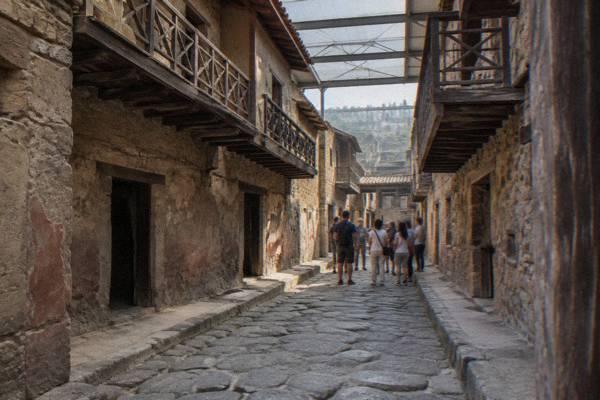
Pompeii And Herculaneum Tour
Pompeii and Herculaneum are two Roman towns buried by the same eruption of Mount Vesuvius in AD 79, and they sit roughly twenty minutes apart by train on the Bay of Naples in Campania, southern Italy. This page lays out how a single day covers both, which tickets to buy and where the timing gets tight.
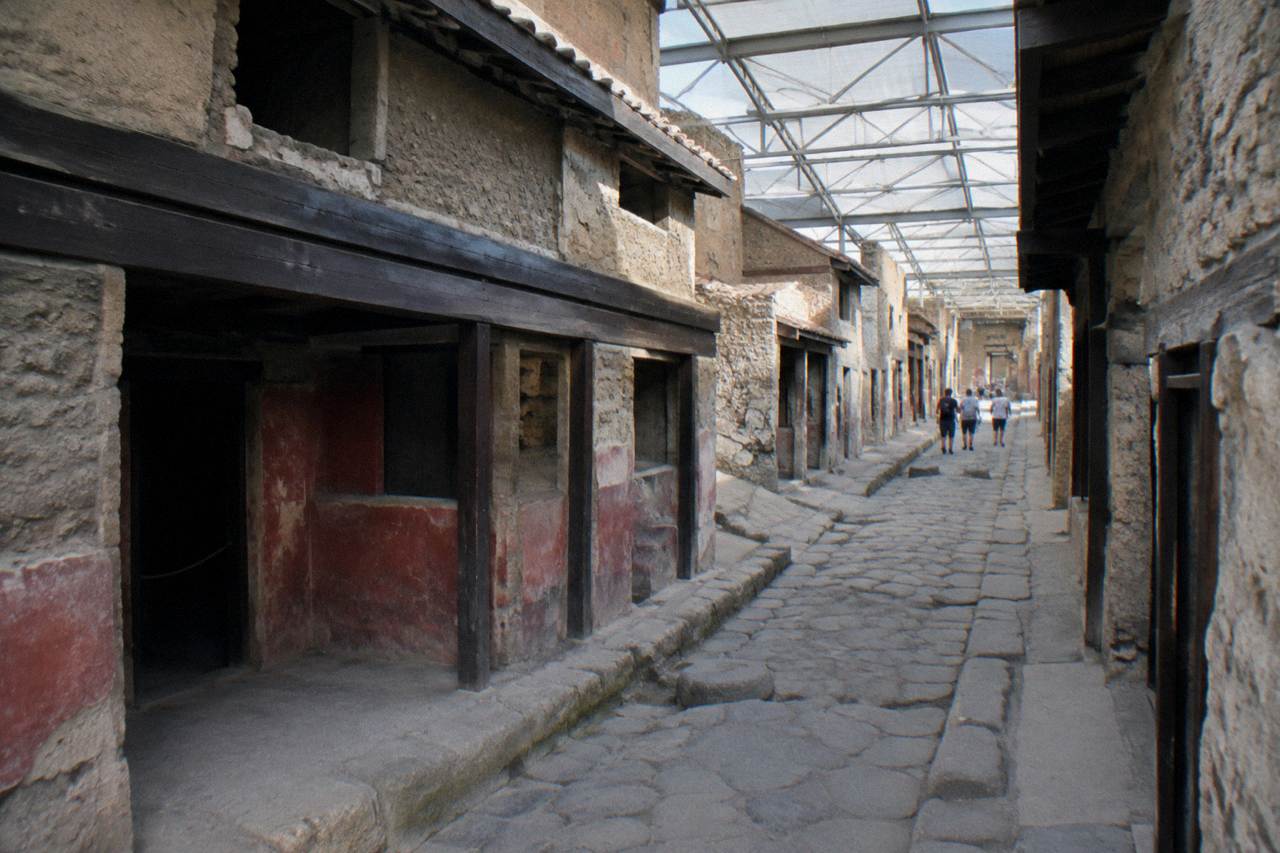
Short answer
Yes, one day covers both sites: a morning at Pompeii (about 3 hours) and an afternoon at Herculaneum (about 2 hours), travelling between them on the Circumvesuviana line. In 2026 Pompeii entry is EUR 20-30 depending on ticket and Herculaneum is EUR 16. From 1 January 2027 a single EUR 25 ticket covers all park sites.
Pompeii and Herculaneum are the two anchors of any Vesuvius-region trip: an entire Roman city frozen mid-life, and its smaller, richer neighbour, both buried by the eruption of Mount Vesuvius in AD 79, traditionally dated to 24 August. The park of Pompeii lies beside the modern town of Pompei in Campania, southern Italy, about 24 km by road from Naples; Herculaneum sits at Ercolano, a short hop further along the Circumvesuviana railway toward Naples. Doing both in one day is not only possible, it is the shape of trip that a large share of visitors to the region actually take, and with 2026's ticket structure it is easier to budget than ever. This page walks through the decision: guided versus independent, which ticket to buy, how the train connection works, and an hour-by-hour plan that keeps you ahead of the crowds and the afternoon heat.
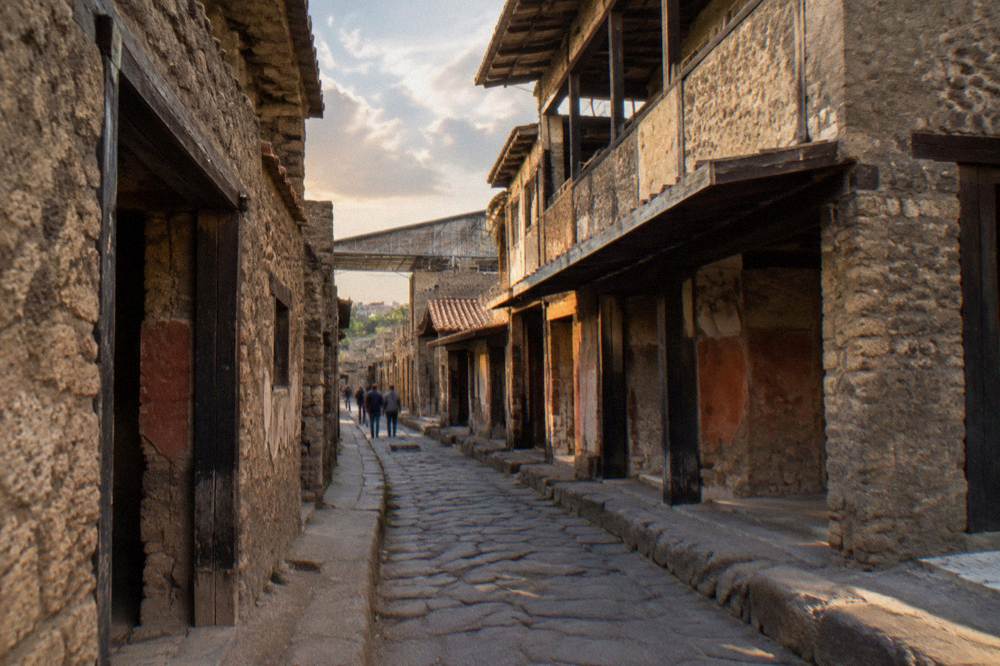
Can You See Pompeii And Herculaneum In One Day?
The two excavations lie on the same Circumvesuviana railway line, on the Naples to Sorrento route, with a direct connection between Pompei Scavi-Villa dei Misteri and Ercolano. One day does mean hard choices at Pompeii, a 44-hectare excavated area, but it does not mean a rushed or shallow visit at either site.
The reason the pairing works is scale. Doing both on the same day gives you the civic breadth of Pompeii and the domestic intimacy of Herculaneum in a single, contrasting picture of AD 79.
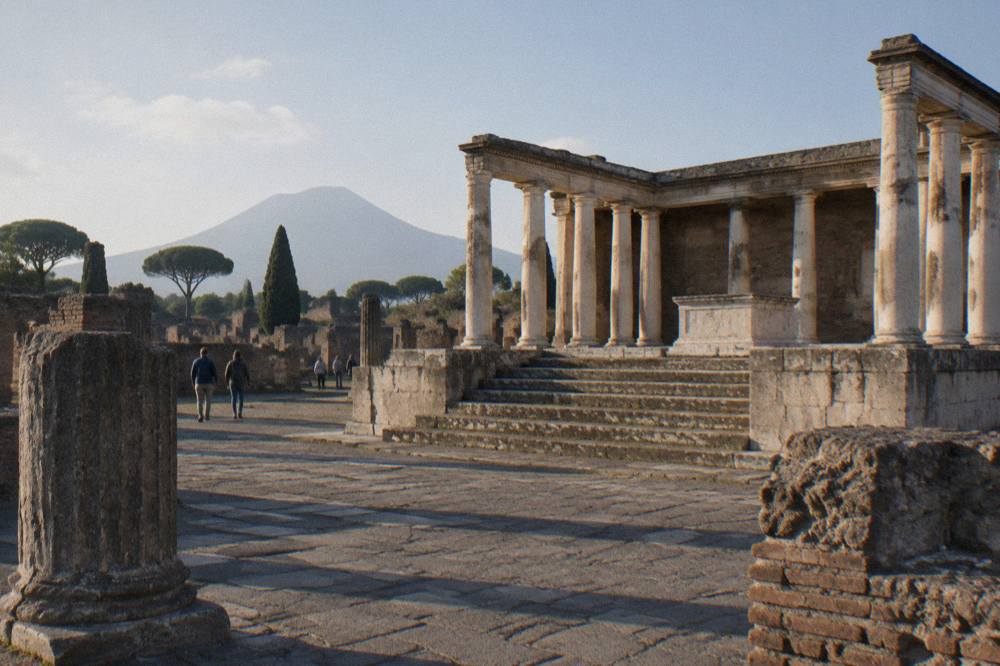
Order matters. Pompeii opens at 9:00, fills fastest in the first time band, 9:00-13:00, which carries a daily ceiling of 15,000 entries, and its stone streets offer very little shade by midday. Herculaneum's hours run later in summer, last entrance 18:00 between 16 March and 14 October, and much of it can be walked in shade-conscious loops. Morning Pompeii, afternoon Herculaneum is therefore the standard and sensible plan. If you are still weighing whether the pair beats a Vesuvius climb instead, the two-day alternative at two days across Pompeii, Herculaneum and Vesuvius spreads all three across a slower pair of days.
One practical note for timing your weeks: since 15 November 2024 Pompeii has operated nominative tickets and a cap of 20,000 visitors per day, and in the peak season window, 16 March to 14 October, entry slots split at 13:00, with 15,000 places in the morning band and 5,000 in the afternoon. None of this blocks a two-site day, but it makes pre-booking at Pompeii the single most useful thing you can do the night before.
Which Pompeii And Herculaneum Tour Should You Book?
A guided day trip is the right call if you want tickets, transport and an expert in one purchase, and the strongest single option is a three-site excursion from Naples that pairs Pompeii and Herculaneum with Mount Vesuvius. If your base is Sorrento or you are already sleeping near the park, an independent day on the Circumvesuviana with a small-group archaeologist tour at each site usually costs less and gives more schedule freedom. Both approaches are covered below with prices rendered on the cards.
The headline guided option on this site is the Day Trip to Pompeii, Herculaneum and Vesuvius from Naples, an eight-hour excursion that moves you between the buried cities and the volcano in one organised sweep, with the practicalities handled. For readers starting in Naples, especially anyone on a short city break, it removes the two failure points of an independent day: missing the train connection and misjudging the Pompeii time bands. The tour's own listing carries its price, rating and current availability, and it pairs naturally with the itinerary later on this page: everything the excursion covers, it covers in the same order.
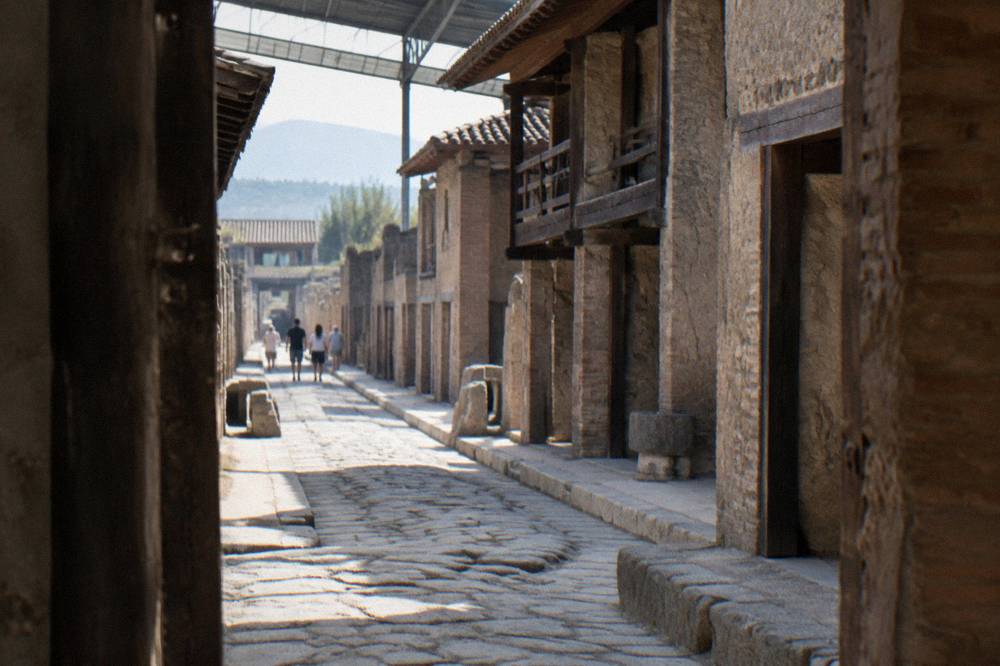
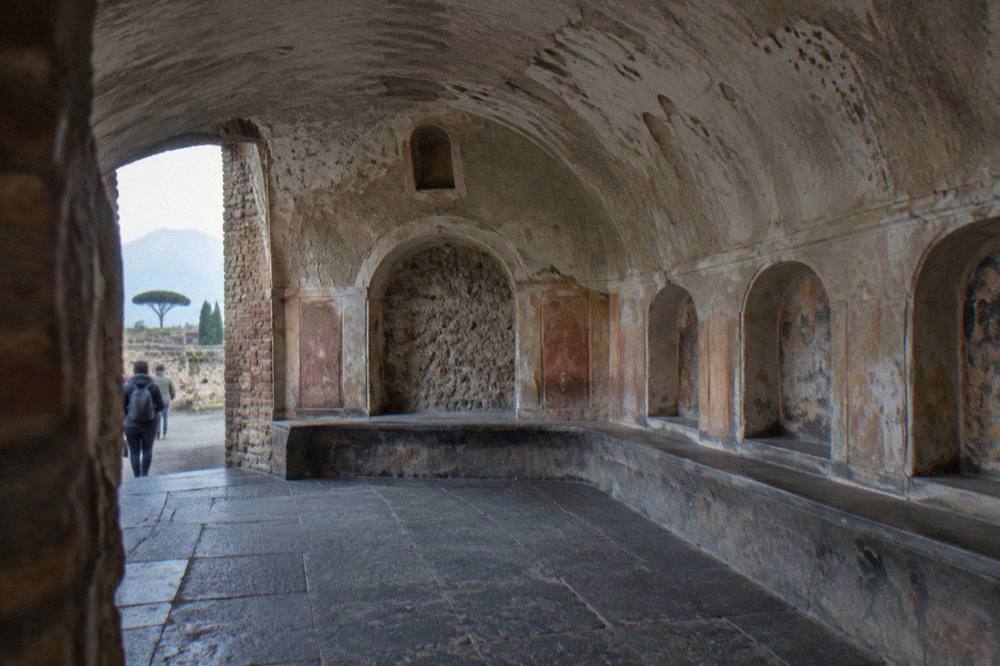
The independent route works differently. You buy your own entry tickets, ride the Circumvesuviana between the sites, and optionally bolt a two-hour small-group walk onto each one. The Pompeii Small Group Tour with an Archaeologist, which departs inside the park, is the pairing this site recommends for the Pompeii half, because an archaeologist can read a site like the thermopolium counters and the bathing complexes in a way a general guide cannot. Two hours is the right bite of Pompeii for a two-site day; the fuller question of how to split a whole day inside the park alone is handled by the complete one-day Pompeii itinerary.
For Herculaneum, the same logic holds at smaller scale, and the Herculaneum small-group tour with an archaeologist starts in Ercolano and includes the entry ticket, which removes one queue. A fuller discussion of the two towns' characters, and which one suits a first-time visitor better, is in the comparison of Pompeii against Herculaneum; a two-site day lets you refuse to choose.
How Do You Get From Pompeii To Herculaneum?
You take the Circumvesuviana railway, the narrow-gauge Naples to Sorrento line that links both sites directly. From Pompei Scavi-Villa dei Misteri, the station at the Pompeii park entrance, scheduled running times toward Naples run between 29 and 35 minutes to Napoli Garibaldi, and Ercolano, the station for Herculaneum, is an intermediate stop on the same stretch. The trains are frequent local services; the operator EAV publishes the timetable, and its own schedule data confirms the travel-time band above.
There is no direct walking or cycling route between the parks worth your day, and driving is the option only tour coaches use well. The railway is the plan. One warning for anyone who has read older guides: the Campania Express, the comfort-tier alternative on the coastal stretch, has been suspended since 1 October 2026 until further notice, so every plan built in 2026 and after should assume the standard Circumvesuviana service. EAV's own page carries the suspension notice and refund instructions for anyone holding affected tickets.
Direction of travel matters more than the timetable. From Pompei Scavi you ride toward Naples, and Ercolano is on the way, so a mistake means doubling back through the same stations rather than a disaster. The Herculaneum entrance is a downhill walk from Ercolano station, through the modern town of the same name; the area guide to Ercano's modern town covers what else sits around the station, from the Vesuvius-bound buses to the long staircase down to the excavations. The spelling rule in this region trips people up: "Herculaneum" is the English name of the ancient town, "Ercolano" is the modern town and station, and "Pompei" with one "i" is only ever the modern town beside the ancient "Pompeii".
For the broader transport picture, including the four road distances from the facts file, the table below collects the numbers in one place. Note that road figures come from routing on OpenStreetMap, not an official source, and should be read as planning estimates rather than promises.
| Route | Distance | Time | Source basis |
|---|---|---|---|
| Naples to Pompei Scavi by road | 24 km | about 22 min | Route calculation on OpenStreetMap |
| Sorrento to Pompei Scavi by road | 26 km | about 37 min | Route calculation on OpenStreetMap |
| Salerno to Pompei Scavi by road | 31 km | about 30 min | Route calculation on OpenStreetMap |
| Rome to Pompei Scavi by road | 234 km | about 159 min | Route calculation on OpenStreetMap |
| Napoli Garibaldi to Pompei Scavi by train | scheduled 29-35 min | median 29 min | EAV timetable data |
| Pompei Scavi to Sorrento by train | scheduled 34-40 min | no median given | EAV timetable data |
What Tickets Do You Need For Both Sites In 2026?
In 2026 you buy two separate tickets: a Pompeii ticket from the park's own ladder, EUR 20 for the Express ancient-city ticket, EUR 25 for Pompeii+ or EUR 30 for the three-day version, plus Herculaneum at EUR 16 full price. Under-18s enter both free, and EU citizens aged 18 to under 25 pay EUR 2 at each site. From 1 January 2027 the Pompeii ladder collapses into a single EUR 25 ticket covering all the park's sites.
The Pompeii ladder needs one careful read before you buy, because the middle rung matters for this itinerary. Pompeii Express, at EUR 20, covers the ancient city only. Pompeii+, at EUR 25, adds the suburban villas route at the Porta Ercolano / Street of the Tombs entrance, the Villa of the Mysteries and Villa Diomedes among them, plus the Villa Regina and the Antiquarium at Boscoreale with the connecting shuttle. The three-day ticket at EUR 30 extends to Oplontis, the Stabiae villas and museum, and Boscoreale. For a two-site day that includes Herculaneum, the plain Express ticket is the right purchase unless you specifically want the Mysteries villa, in which case Pompeii+ earns its extra EUR 5. The full ticket guide unpacks each rung.
Herculaneum is simpler: EUR 16 full price, EUR 2 for EU citizens aged 18 to under 25, free for under-18s, and free for everyone on the first Sunday of each month plus 25 April, 2 June and 4 November, with no reservation needed on those free days, you collect the ticket at the office. The Herculaneum ticket guide carries the details and the closure notes. Note that one ticket question, whether Herculaneum can be added to a Pompeii ticket, has a firm answer: no, they are separate organisations, the archaeological park of Pompei and the separate Herculaneum park, and no combined official ticket exists in 2026.
| Ticket | Pompeii 2026 | Herculaneum 2026 |
|---|---|---|
| Full adult | EUR 20 Express / EUR 25 Pompeii+ / EUR 30 three-day | EUR 16 |
| EU citizens 18 to under 25 | EUR 2 | EUR 2 |
| Under 18 | Free | Free |
| Free days | First Sunday of each month, year-round | First Sunday plus 25 Apr, 2 Jun, 4 Nov |
| Booking | Online in advance, nominative | On the day or in advance |
The 2027 change deserves a paragraph of its own because search results will show stale numbers for years after it lands. From 1 January 2027, per the park's release of 14 September 2026, one EUR 25 ticket covers every site in the Pompeii park system, valid 30 days with one entry per site; the three smaller sites, Oplontis, the Stabiae museum and Boscoreale, remain EUR 8 individually; the MyPompeii Card stays at EUR 45. Nominative tickets and the 20,000-a-day cap are retained. Herculaneum is not part of the Pompeii park system, so the two-ticket reality of a two-site day survives 2027 unchanged.
| Item | In force during 2026 | From 1 January 2027 |
|---|---|---|
| Ancient city only | EUR 20 (Express) | Replaced by single ticket |
| All park sites | EUR 30 (three-day) | EUR 25, valid 30 days, one entry per site |
| Oplontis, Stabiae museum, Boscoreale | EUR 8 each, or via three-day | EUR 8 each |
| MyPompeii Card | EUR 45 | EUR 45 |
| Daily cap and nominative tickets | 20,000 per day, nominative | Retained |
Two closures shape what your tickets buy right now, both dated and both official. At Pompeii, the Praedia of Julia Felix has been closed to the public since 7 September 2026 for maintenance, with no reopening date announced. At Herculaneum, the Villa dei Papiri is closed for works and the Ancient Theatre is closed until further notice, so neither appears on any current route, however many older guidebooks send you looking for them. The Villa of the Papyri attraction page explains what the villa is and why its closed state still matters to anyone interested in the buried library.
What Are The Opening Hours At Each Site?
Pompeii runs 9:00 to 19:00 between 16 March and 14 October, with last entrance at 17:30, then 9:00 to 17:00 from 15 October to 15 March with last entrance at 15:30. Herculaneum runs 8:30 to 19:30 in the summer window with last entry at 18:00, and 8:30 to 17:00 in winter with last entry at 15:30. Pompeii closes only on 25 December and 1 January; Herculaneum the same two days.
The asymmetry works in your favour. Herculaneum opens half an hour earlier and shuts its gates later, which is exactly why the standard two-site plan runs Pompeii first. On a summer day you can enter Pompeii at 9:00, walk until about 12:30, catch the train to Ercolano after a lunch break, and still have four full hours at Herculaneum before its 18:00 last entry. In winter the maths tightens: Pompeii's last entry at 15:30 and Herculaneum's at 15:30 mean you want to be leaving Pompeii by 13:00 at the very latest, and earlier is safer.
| Site | 16 Mar to 14 Oct | 15 Oct to 15 Mar | Closed |
|---|---|---|---|
| Pompeii | 9:00-19:00, last entry 17:30 | 9:00-17:00, last entry 15:30 | 25 Dec, 1 Jan |
| Herculaneum | 8:30-19:30, last entry 18:00 | 8:30-17:00, last entry 15:30 | 1 Jan, 25 Dec |
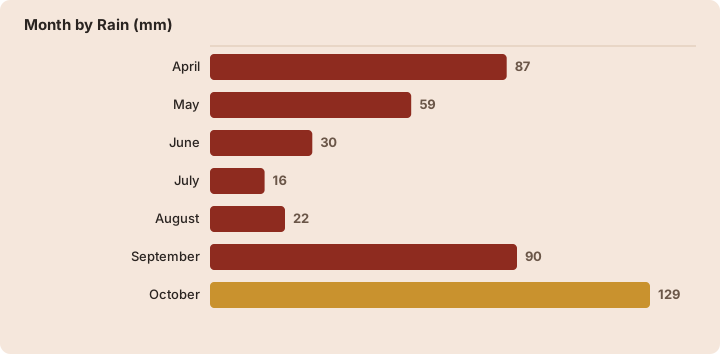
Weather should shape the day as much as the clock. The Pompei grid point's 1991-2020 normals, computed from the Open-Meteo historical archive, show July averaging a daily maximum of about 28.7 C and August about 29.4 C, with November the wettest month at about 180 mm of rain and July the driest at about 16 mm. A summer two-site day should treat midday Pompeii as the thing to finish before, not start; the summer heat plan for Pompeii is built around exactly that problem.
| Month | Mean daily max (C) | Mean daily min (C) | Rain (mm) |
|---|---|---|---|
| April | 17.7 | 10.4 | 87 |
| May | 21.6 | 14.1 | 59 |
| June | 25.8 | 18.2 | 30 |
| July | 28.7 | 21.1 | 16 |
| August | 29.4 | 21.8 | 22 |
| September | 25.3 | 18.6 | 90 |
| October | 21.3 | 15.1 | 129 |
An Hour-By-Hour Plan For The Two-Site Day
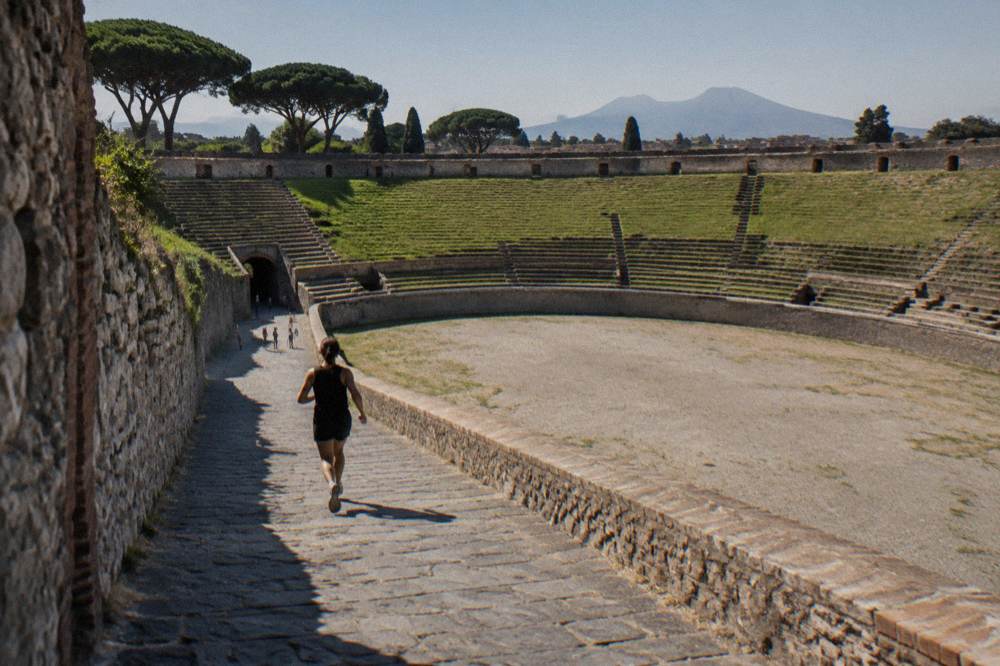
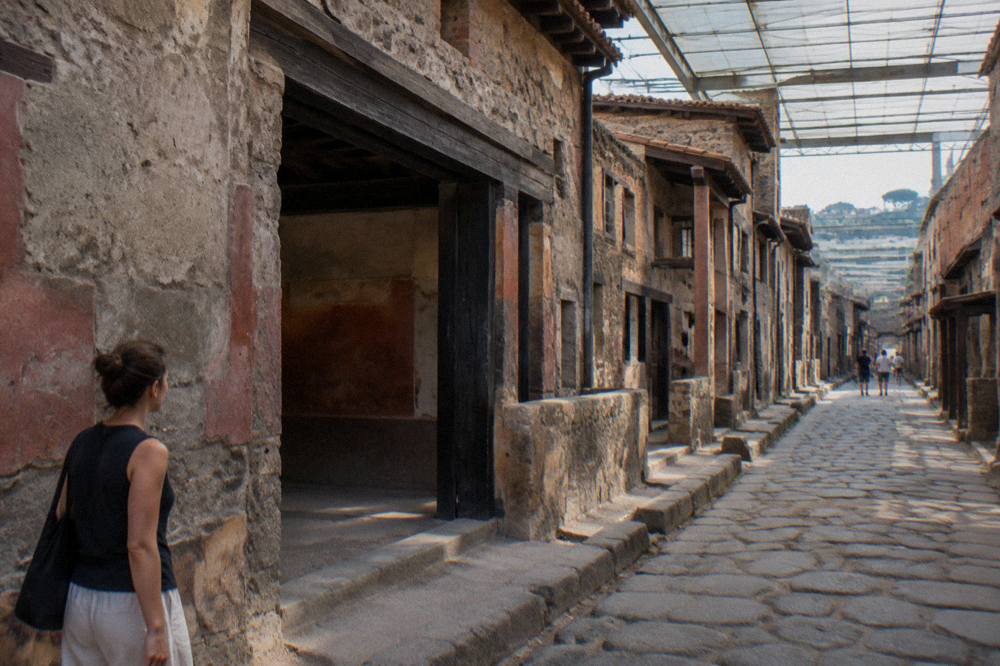
Enter Pompeii at Porta Marina at 9:00, give the forum, the baths and one major house your first ninety minutes, then push along Via dell'Abbondanza toward the amphitheatre area and exit by about 12:30; after lunch and the train to Ercolano, tour Herculaneum's boat sheds, Villa of the Deer, carbonised houses and terraces from roughly 14:00 to 17:00, a schedule that fits the 16 March to 14 October hours and needs compressing by two hours in winter.
The skeleton below is deliberately conservative. Times assume the summer schedule and a fit walker; anyone moving more slowly, or visiting with children, should cut the amphitheatre leg and keep the forum core, which is the same advice the short Pompeii route gives for people with even less time.
| Time | Where | What you do |
|---|---|---|
| 8:45 | Pompeii, Porta Marina | Queue for the 9:00 opening, tickets pre-bought |
| 9:00-10:30 | Pompeii core | Forum, Temple of Apollo, Basilica, Forum Baths |
| 10:30-11:45 | Eastern city | Via dell'Abbondanza, Large Theatre, Lupanar, one house |
| 11:45-12:30 | Amphitheatre quarter | Amphitheatre, Large Palaestra, exit at Piazza Anfiteatro |
| 12:30-13:30 | Pompei town | Lunch near the Piazza Anfiteatro side, then Circumvesuviana from Pompei Scavi |
| 13:30-14:00 | Ercolano | Train to Ercolano, walk down to the site |
| 14:00-16:30 | Herculaneum | Boat sheds, Villa of the Deer, House of the Wooden Partition, terraces |
| 16:30-17:00 | Herculaneum | Museum area, exit at leisure |
Choosing an exit matters at Pompeii because the ticket gates are named and far apart. Leaving at Piazza Anfiteatro puts you on the quiet side of the modern town with a walk back to the Pompei Scavi station, so if the train matters more than the amphitheatre, reverse the loop and exit where you entered. The entrances and their characters are covered in detail by this site's explainer on the park's entrances, including the Porta Ercolano / Street of the Tombs gate used for the suburban villas route.
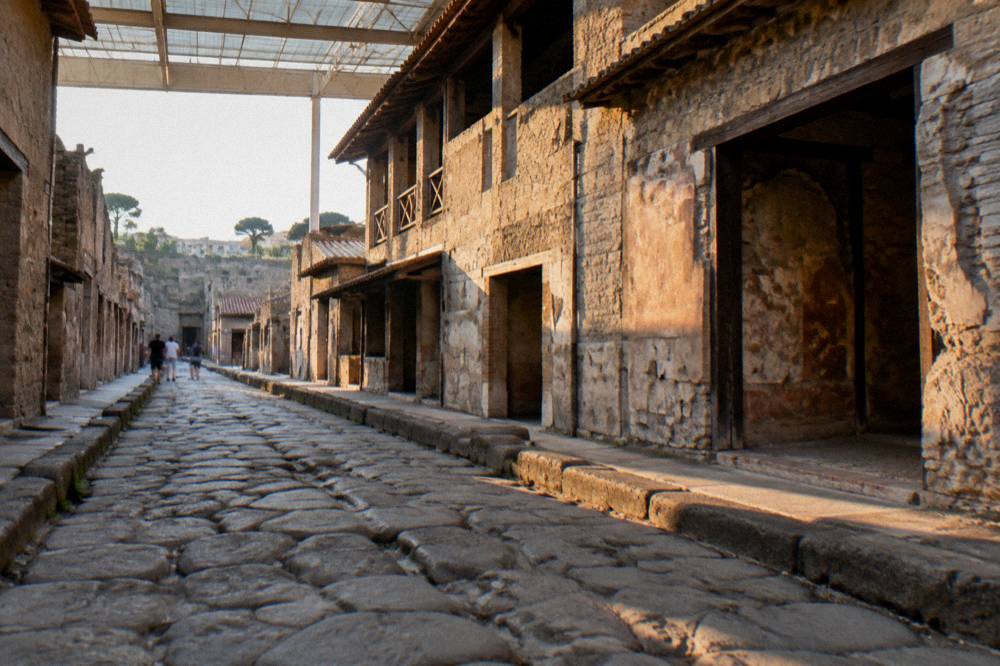
At Herculaneum, the shape of the visit is vertical: the modern town sits above, the excavations sit in a deep pit below, and you descend into a Roman seafront that is now well inland. Two hours is the commonly asked question and the answer is yes, comfortably; the site's compactness is exactly why the two-site day works. The boat sheds, holding the skeletons of people sheltered from the eruption, are the emotional core of the visit, and their story is told fully on the Herculaneum boat sheds page.
What Do You Sacrifice By Combining The Two Sites?
You sacrifice depth at Pompeii and any chance of a leisurely lunch. Three hours at Pompeii covers the forum core, one theatre and the amphitheatre, but skips the suburban villas, the Villa of the Mysteries among them, unless you buy Pompeii+ and re-route; and it leaves nothing for the quieter houses that reward lingering. Herculaneum loses less, since two of its headline spaces, the Villa dei Papiri and the Ancient Theatre, are closed for works in any case.
The honest trade is this: a two-site day converts Pompeii from an exploration into a route. That is a fair deal for a first-time visitor with one day in Campania, because Herculaneum answers the question Pompeii cannot, what did the interiors, the wood, the food, the fabric of ordinary Roman life actually look like. A visitor with two days should not make the trade; the two-day Pompeii, Herculaneum and Vesuvius itinerary exists precisely for that case, and this Pompeii Travel Guide site's homepage collects the full range of options by trip length.
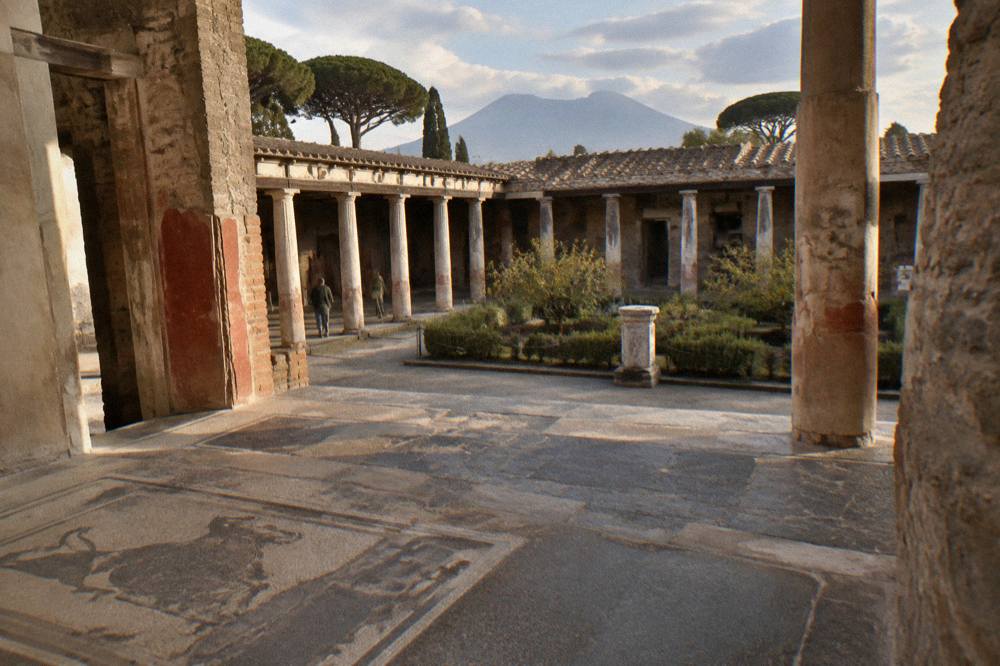
Families should weigh one more factor: shade and surfaces. Pompeii's streets are uneven basalt with high kerbs, and the Pompeii with kids itinerary plans around them, while Herculaneum's smaller footprint means less walking overall and a shorter fuse for tired legs. The mobility question has its own answer too: the park's "Pompeii for All" route enters at Piazza Anfiteatro and allows exit at Piazza Anfiteatro or Piazza Esedra via the Antiquarium lift, which makes the Pompeii half of a two-site day possible for visitors who cannot manage the full ancient street grid.
If, after all this, the independent day still feels like logistics you would rather outsource, the guided three-site excursion discussed above remains the cleanest packaged answer, and you can compare it against the other options at any time. Check availability before locking your dates, since the 20,000-a-day Pompeii cap binds tour groups as well as individuals.
Common Questions About Visiting Pompeii And Herculaneum In One Day
Can I do Herculaneum and Pompeii in one day?
Yes. In summer both sites' hours support it easily; in winter, with last entries at 15:30 at both parks, the plan needs a 9:00 start at Pompeii and a departure by early afternoon.
Is 2 hours enough for Herculaneum?
Yes. Note that two of its headline spaces, the Villa dei Papiri and the Ancient Theatre, are closed for works, which slightly shortens the realistic circuit.
Why is Herculaneum not as famous as Pompeii?
Herculaneum's deeper burial preserved wood, food and fabric that Pompeii lost, which is exactly why pairing the two in one day works so well.
Which site should I visit first, Pompeii or Herculaneum?
Pompeii first. It opens at 9:00, its morning time band carries the day's larger entry allocation, and its streets are at their hottest and most crowded at midday. Herculaneum's later last entry, 18:00 in the summer season, absorbs the afternoon comfortably.
Do I need to book Pompeii and Herculaneum tickets in advance?
Book Pompeii in advance. The park caps entry at 20,000 visitors a day and tickets are nominative, so a pre-booked timed slot protects the whole plan. Herculaneum tickets can usually be bought on the day at the office, though pre-buying saves the queue in peak season.
A final word on expectations. The two-site day is a marathon of stone, sun and stairs, but it is also the single most efficient way to understand what Vesuvius did in AD 79: one eruption, two towns, two entirely different kinds of preservation. Start at 9:00, carry water, buy the Pompeii slot the night before, and let the train do the rest.