Was There A Kissing Couple Found In Pompeii?
The short, honest answer to the famous question about a kissing couple found among the Pompeii bodies, plus how the casts were made and what you can see today.
Pompeii, the ancient Roman city buried by the eruption of Mount Vesuvius in AD 79, lies in Campania, southern Italy, beside the modern town of Pompei and about 24 km by road from Naples. Among the many questions the internet asks about its dead, one keeps returning: was there a kissing couple found in Pompeii? The honest answer is that no such pair appears in the Archaeological Park of Pompei's published record of finds, while several genuine embraces between victims have been documented and cast in plaster. This page separates the folklore from the casts, explains how those haunting figures were made, and covers what a visitor to the park can actually see today.
Was There A Kissing Couple Found In Pompeii?
No. The Archaeological Park of Pompei, the body that runs the site and publishes its excavation findings, records no couple found kissing. The phrase circulates as internet folklore: photographs of real plaster casts, typically of two people lying close together, are captioned as lovers caught in a final kiss. Some pairs of victims were found in genuine embraces, and those are documented. But a kiss, specifically, is a detail no official description of the casts supports, and any page stating otherwise is retelling a caption rather than the archaeology.
The confusion is easy to understand once you stand in front of the casts. The bodies of people who died in the eruption left voids in the hardened ash, and early excavators learned to pour plaster into those voids. The result preserves a person's final posture with unsettling precision: curled against the heat, arms folded over a face, or turned toward someone lying beside them. When two victims lie close together, a photograph flattens the space between them, and a caption does the rest.
The tradition of romanticising the dead of Pompeii is almost as old as the excavation itself. Victorian writers in particular framed the city as a stage for love and tragedy, and that framing survives in novels, films and, later, social media. The kissing couple belongs to that lineage: a real place, real casts, and an invented detail that makes the grief easier to carry. It is a small invention with a long shelf life, because the true story requires more explanation than a caption allows.
The eruption itself is traditionally dated to 24 August AD 79, from the oldest manuscripts of Pliny the Younger's letters. The park's own e-journal states that the alternative date of 24 October has no evidentiary basis, while acknowledging that 24 August is not settled either. What is settled is what the eruption did to the people who stayed: a surge of heat and ash that killed quickly, a subject covered in detail in how fast death came at Pompeii. The people in the casts did not have time to choose a pose. The postures we see are the ones collapse and heat produced.
What Have Excavators Actually Found In The Ash?
Excavation has uncovered the remains of victims, many preserved as plaster casts, together with the city they died in: houses, frescoes, bread in ovens, graffiti on walls. The excavated area open to study covers 44 ha within a UNESCO-inscribed property of 98 ha, shared with Herculaneum and Torre Annunziata. The casts are the finds that grip visitors, and several show people holding one another. None is described by the park as a kissing couple.
The excavated city is enormous by any standard, and the casts come from it in small numbers compared with its buildings. Each one is an individual: a person who made a choice in the final hours about whether to flee or shelter, and whose body, sealed in ash, kept the shape of that choice. For the full story of how the city was lost and then found, the companion page on when Pompeii was discovered carries the timeline, and recent finds are tracked in what was recently found in Pompeii.
What the numbers below show is scale. Pompeii is not a single villa but a whole Roman city, and its visitor figures reflect that: over four million people walked it in 2024. The dead, by contrast, are counted in the casts and skeletal remains the park has documented, and the park publishes its excavation record rather than a folklore version of it.
| Measure | Figure |
|---|---|
| Excavated area of Pompeii | 44 ha |
| UNESCO-inscribed property (with Herculaneum and Torre Annunziata) | 98 ha |
| Pompeii visitors, 2022 | 2,972,159 |
| Pompeii visitors, 2023 | 3,985,424 |
| Pompeii visitors, 2024 | 4,069,377 |
| Pompeii visitors, 2025 | 4,000,090 |
| Daily visitor cap, in force since 15 Nov 2024 | 20,000 |
The 20,000 daily cap and nominative tickets were introduced on 15 November 2024, after a free first Sunday drew more than 36,000 people in a single day. That is the modern Pompeii: a site so visited that its management is now a logistics problem as much as an archaeological one. For anyone planning to see it, the practical pages are which ticket to buy and whether to buy Pompeii tickets in advance, both of which matter more than the folklore does.
How Were The Pompeii Casts Made?
Ash from the eruption hardened around bodies, which decayed over centuries and left human-shaped voids. Excavators poured liquid plaster into these voids, let it set, and chipped away the ash to reveal the person's final form, clothing folds and all. The technique turns an absence into a presence: what you look at is plaster where a body once was. It works only where ash preserved a cavity, which is why some victims are casts and others are skeletal remains.
The detail that startles visitors is not the technique but its fidelity. A cast can preserve the shape of a sandal, the drape of a tunic, a hand raised against the heat. Two people found lying entwined cast as two people lying entwined, and that physical closeness is real. The leap to a kiss is made afterwards, by observers, not by the ash. It is worth being precise about the difference, because the genuine casts are moving enough without decoration.
Not every victim at every Vesuvius site was preserved this way. Herculaneum, buried deeper in a different material, yields bone rather than body-shaped voids, which is part of why its dead look different in museums. The reasons are laid out in why no bodies were found in Herculaneum, a companion question that clears up the other half of this misunderstanding. Pompeii's ash and Herculaneum's surge produced two different kinds of evidence from one eruption.
If the story of the casts is what draws you, a guided walk brings it with context. The Pompeii Express Guided Tour by Train from Sorrento runs two hours with a guide and reaches the site by rail, and the same article's homepage companion, this site's Pompeii Travel Guide, compares it against every other format. You can also Check availability for the express tour directly.
Can You See The Casts When You Visit Pompeii Today?
Yes. Casts of the eruption's victims are displayed within the archaeological park, and they are part of why four million people a year come. In 2026 a Pompeii Express ticket costs EUR 20 for the ancient city alone, with last entry at 15:30 and a 17:00 close from 15 October to 15 March. Entry is free for under-18s and for everyone on the first Sunday of the month.
Seeing a cast in person is different from seeing a photograph. The room goes quiet. The posture, the smallness of a person, the ordinary clothes, all of it lands at once, and the question of whether any two of them were kissing stops mattering. What you are looking at is a city's final hours, preserved at the scale of individual people, and no caption improves it.
Ticketing is worth getting right, because the structure is about to change. The table below sets out the 2026 prices and the single-ticket system that starts on 1 January 2027. Nominative tickets, meaning tickets issued in your name with ID possibly checked at entry, and the 20,000 daily cap continue under both systems. The full breakdown lives on the Pompeii ticket prices page.
| Ticket | 2026 price | Notes |
|---|---|---|
| Pompeii Express | EUR 20 | Ancient city only |
| Pompeii+ | EUR 25 | Adds suburban villas, Villa Regina, Boscoreale antiquarium and shuttle |
| 3-day ticket | EUR 30 | Adds Oplontis, Stabiae villas and museum, Boscoreale |
| Oplontis / Stabiae museum / Boscoreale individually | EUR 8 | Each site |
| MyPompeii Card (annual) | EUR 45 | EUR 10 reduced |
| Single ticket from 1 Jan 2027 | EUR 25 | All park sites, 30 days, one entry per site |
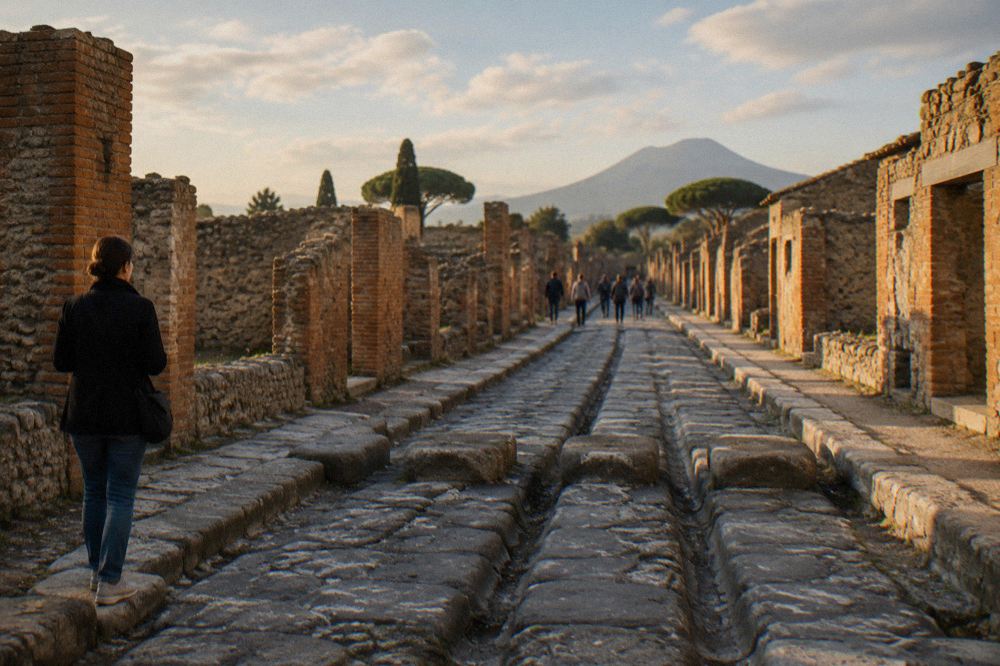
Reduced entry of EUR 2 applies to EU citizens aged 18 to under 25, and under-18s enter free. If you would rather see the site with someone who can point at the ground and tell you whose house you are standing in, the choice between going alone and taking a guide is weighed in touring Pompeii on your own and the best tour for Pompeii. Walking the stones is hard going in places, so the difficulty guide at how hard it is to walk in Pompeii is worth a minute before you commit to a route.
Common Questions About The Kissing Couple At Pompeii
Was there a kissing couple found in Pompeii?
No such pair appears in the Archaeological Park of Pompei's published record. Embracing pairs of victims were found and cast in plaster, but the park describes no couple kissing. The kissing version is internet folklore built on real casts.
What did the bodies found at Pompeii actually look like?
Many were preserved as voids in hardened ash, later filled with plaster to recreate their final postures. The casts show curled limbs, covered faces and, in some cases, people holding one another, in the postures collapse and heat produced.
Did anyone survive the eruption of Pompeii?
The casts represent those who stayed too long. The question of what the city's residents knew in advance is covered elsewhere on this site.
Are the casts at Pompeii real bodies?
No. The bodies decayed inside the hardened ash, leaving cavities that excavators filled with plaster. What is displayed is a plaster reproduction of the space a body occupied, sometimes alongside skeletal remains.
Can you visit Pompeii and see the casts yourself?
Yes, the casts are displayed within the park. A Pompeii Express ticket in 2026 costs EUR 20, entry is free on the first Sunday of the month, and from 1 January 2027 a single EUR 25 ticket covers all park sites.
The folklore will keep travelling because it is a better story, but the real one is larger: a Roman city stopped mid-motion, and individual people preserved in their last moments, exactly as the ash left them.
The story of the lovers is a caption; the casts are the evidence. Go and stand in front of them, with a guide if you can, and let the ash speak for itself.