Why Were No Bodies Found In Herculaneum?
Why Herculaneum preserved skeletons rather than the body casts of Pompeii: burial conditions, pyroclastic surges and what archaeologists actually found in the boat sheds.
The eruption is traditionally dated to 24 August AD 79 in the oldest manuscripts of Pliny the Younger, though the Archaeological Park's own e-journal notes that the alternative date of 24 October has no evidentiary basis and that the traditional date is itself not settled. Where Pompeii is famous for the plaster casts of its dead, Herculaneum is famous for the opposite: rooms full of intact skeletons. That contrast, casts in one town and bare bones in the other, is not an accident of excavation. It follows directly from how each town was buried.
Why Were No Bodies Found In Herculaneum?
Bodies were found at Herculaneum, but not as bodies in the Pompeian sense: the victims' flesh was destroyed by the heat and force of the pyroclastic material that buried the town, leaving skeletons instead of the hollow voids that, at Pompeii, were later filled with plaster to make casts. Herculaneum was struck and sealed in a single overwhelming phase, so organic material carbonised rather than slowly decaying inside an ash shell. The remains are real, numerous and visible, but they are bone, not the shaped forms visitors associate with Pompeii.
The confusion usually begins with the word "bodies". At Pompeii, excavators noticed that human remains had rotted away inside hardened ash, leaving cavities shaped like the person who died. By pouring plaster into those cavities they produced casts that preserve posture, clothing folds and, in some cases, facial features. Herculaneum never offered that raw material in the same way, because its dead met a different physical end before the burial hardened around them.
The distinction matters for anyone planning to see both parks. The remains at Herculaneum are studied and displayed as skeletal material, and the story they tell, of people waiting in sheltered places near the shore, is one of the site's defining features. The boat sheds along the ancient waterfront, where dozens of victims were found crowded together, are among the most visited spots in the excavation, and the site dedicates space to explaining what was recovered there. For how the two parks compare in practical terms, from size to crowds to ticketing, the Pompeii or Herculaneum comparison guide covers the decision in detail.
What Killed The Victims Of Herculaneum?
The people who died at Herculaneum were almost all killed by the pyroclastic surges and flows that swept down from Vesuvius during the night and early morning after the main eruption column collapsed. These clouds of gas, ash and rock fragments were far hotter and denser than the falling pumice that had been raining on Pompeii for hours. Death at Herculaneum came quickly, and the same heat that ended life also transformed the remains, driving off moisture and soft tissue so thoroughly that bone survived while flesh did not.
Pompeii and Herculaneum sat on different sides of the mountain and caught different phases of the eruption. Pompeii, further from the vent, was first showered with lighter fall material over many hours, which buried the town gradually and gave some residents time to flee. Herculaneum, closer to Vesuvius, was struck by the first pyroclastic surge after the column collapsed, and then sealed under a far deeper, denser mass of material. The town was effectively smothered in one overwhelming sequence rather than dusted layer by layer. The full index of guides sits on Pompeii Travel Guide.
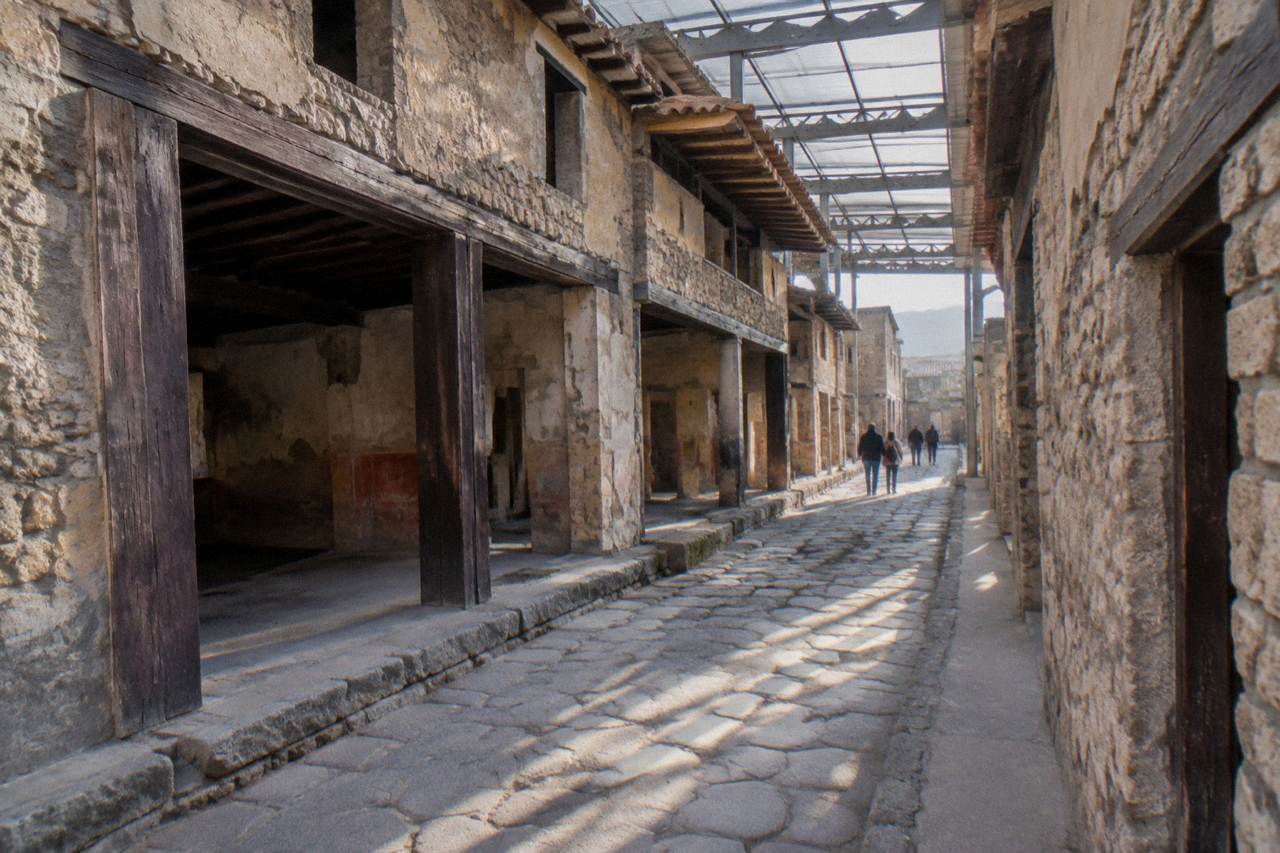
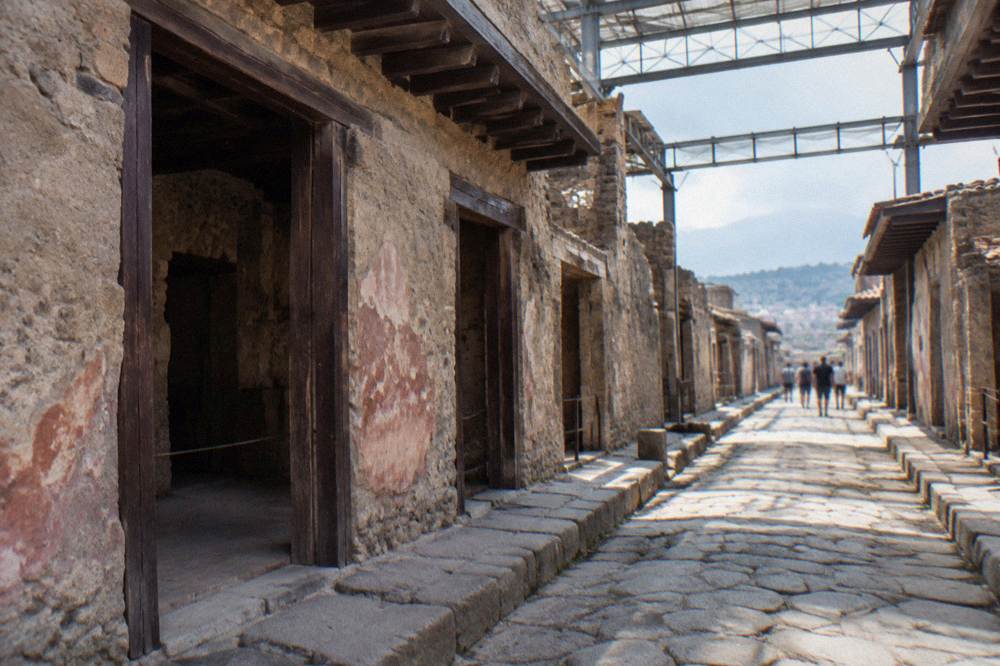
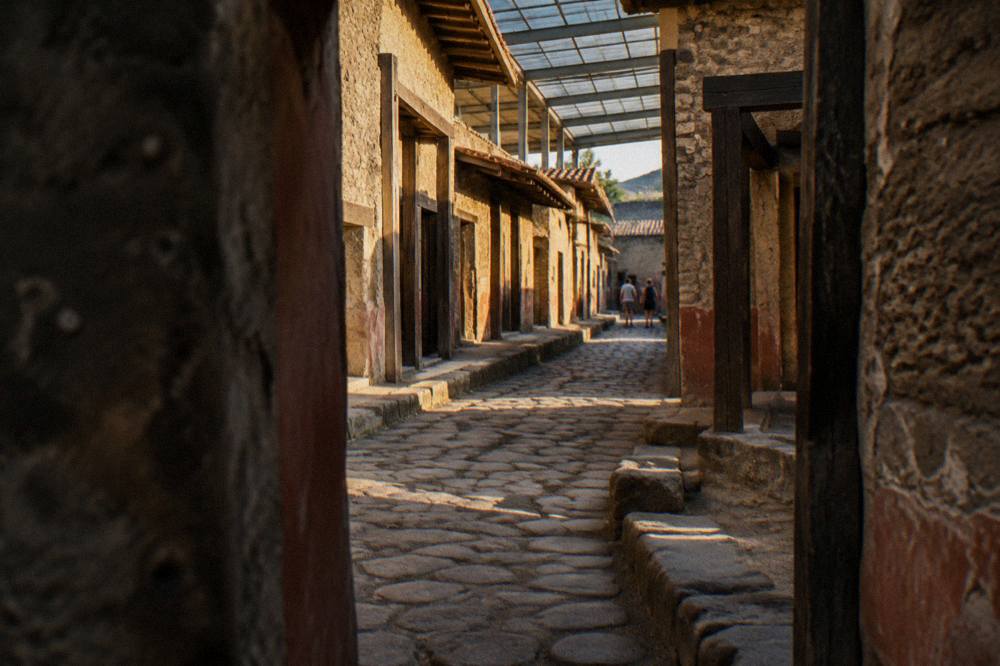
That difference shaped everything that followed, both for the people and for the buildings. Herculaneum's deeper, hotter burial carbonised organic matter: wooden doors, beams, furniture and food survived as charcoal, and human soft tissue was likewise destroyed rather than left to decay slowly in place. The same process helped preserve the town's upper storeys and rooftops at heights rarely seen at Pompeii, which is part of why Herculaneum feels like a town squeezed whole out of the ground. The site's main excavation overview describes what is standing today and what is open.
There is a second point that visitors often miss. At Pompeii, many victims died outdoors or in the open during the falling pumice, and their bodies lay in ash that hardened into a mould around them. At Herculaneum, victims gathered indoors and in the vaulted shelters near the waterfront, and the material that reached them arrived as a destructive flow rather than a gentle fall. A mould needs a body that survives long enough, in place, to shape it. Herculaneum's dead largely did not, and so the excavators of the early dig found bone chambers and voids without the Pompeii-style shells. The question of what the victims were wearing, and why woollen clothing survived on some Pompeii casts, is covered separately in why Pompeii victims were wearing wool.
| Aspect | Herculaneum | Pompeii |
|---|---|---|
| Main burial agent | Pyroclastic surges and flows after column collapse | Sustained pumice fall, then surges |
| Depth of burial | Deep, sealing the town under a dense mass | Generally shallower ash and pumice layers |
| Effect on human remains | Flesh destroyed rapidly, skeletons left | Bodies decayed inside hardened ash, leaving shaped voids |
| Result seen today | Skeletal remains displayed on site | Plaster casts made by filling the voids |
| Organic survival | Wood and foodstuffs carbonised to charcoal | Organic material mostly lost, imprints preserved |
For travellers weighing a guided visit, the two-site small-group option paired with an archaeologist is the natural fit for this story: the guide explains the burial difference where you can see it, in both towns on the same day. The Pompeii and Herculaneum in one day itinerary is the self-guided alternative, and it works well if you would rather move at your own pace between the boat sheds and the forum.
Where Were The Skeletons At Herculaneum Actually Found?
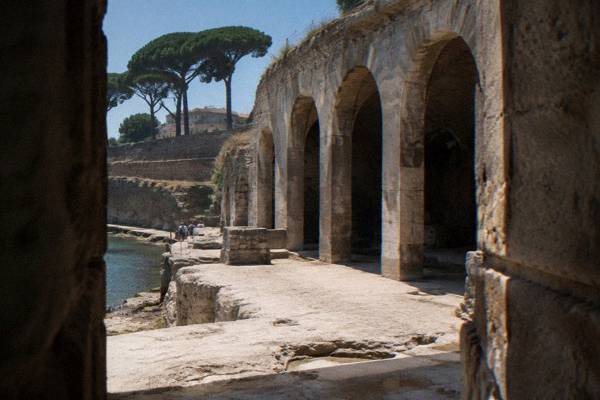
The single largest concentration of victims came from the boat sheds: a row of vaulted chambers right on the ancient shoreline, where people sheltering from the eruption were found crowded together, apparently waiting for a rescue by sea that never came. Further remains were recovered inside houses and along the waterfront area as excavation advanced. These finds established that Herculaneum's dead were present in number, contrary to early reports that the town had been evacuated.
The boat sheds are now one of the defining features of a Herculaneum visit. The stone arches open toward what was the Roman beach, and the excavation has been laid out so that visitors can read the space for themselves: shelters meant for storing boats became the last refuge for families who had moved down toward the water, luggage and valuables with them, when the surges arrived. The Herculaneum boat sheds page covers what you see there today.
What the skeletons told archaeologists changed the understanding of the eruption's human toll. Their placement showed that the residents had not simply vanished or escaped en masse; they had organised themselves near the shore and been overcome where they stood or crouched. The remains also carried personal effects, jewellery and coins among them, which helped researchers reconstruct who was in the shelters and what they chose to carry. Whether the skeletons you see are originals or reproductions is a fair question with a specific answer, handled in are the skeletons in Herculaneum real or fake?
For context on where the Pompeii casts ended up after excavation, including the museums that hold them, where the bodies from Pompeii are now gives the fuller picture of what happened to each site's dead after they left the ground.
Can You Still See The Remains When You Visit Herculaneum?
Yes. Skeletal remains and their display context are part of the Herculaneum visit, most famously at the boat sheds on the ancient waterfront, and the site presents them with interpretation on the spot. Entry costs EUR 16 full price, EUR 2 for EU visitors aged 18 to under 25, and is free for under-18s; note that the Villa dei Papiri is closed for works and the Ancient Theatre is closed until further notice, so neither can be part of a current visit.
The practical details for 2026 are straightforward, and a couple of closures matter for planning. The ticketing page of the official site lists the prices above, free first-Sunday entry (plus 25 April, 2 June and 4 November), and the two closures. Hours follow the same seasonal split as the wider Vesuvian park network: from 16 March to 14 October the site runs 8:30 to 19:30 with last entry at 18:00, and from 15 October to 15 March it runs 8:30 to 17:00 with last entry at 15:30, closed on 1 January and 25 December. The Herculaneum tickets guide walks through the buying options.
A guided two-site day is the format that suits this subject best, because the contrast between the cast-free skeletons of Herculaneum and the casts of Pompeii only fully lands when you see both on the same day with someone who can explain the sequence. If you would rather build the day yourself, the question of whether two hours is enough for Herculaneum has a direct answer, and the train connections are simple: Herculaneum sits on the Circumvesuviana line between Naples and Sorrento, with the modern station at Ercolano a short walk above the excavation. The town itself is covered in the Ercolano area guide.
| Item | 2026 detail |
|---|---|
| Herculaneum full ticket | EUR 16 |
| Reduced ticket (EU citizens 18 to under 25) | EUR 2 |
| Free entry days | First Sunday monthly, 25 April, 2 June, 4 November |
| Summer hours (16 Mar to 14 Oct) | 8:30-19:30, last entry 18:00 |
| Winter hours (15 Oct to 15 Mar) | 8:30-17:00, last entry 15:30 |
| Villa dei Papiri | Closed for works |
| Ancient Theatre | Closed until further notice |
Why Does Pompeii Have Casts But Herculaneum Does Not?
The casts at Pompeii exist because excavators there worked out that hollows in the hardened ash were moulds left by decayed bodies, and filled them with plaster. At Herculaneum the burial medium and the cause of death left no such moulds: the victims' bodies were largely consumed by heat and pressure before or as the flow hardened, so the dig found bones sitting in dense volcanic deposit rather than person-shaped voids. Different physics, different remains, no casts.
This is the point where the two sites diverge most sharply in the visitor experience. At Pompeii you stand in front of forms that read as people: a crouching figure, a curled sleeping shape, the folds of a tunic. At Herculaneum you stand in front of anatomy: rows and clusters of bones that read as evidence, studied for age, diet and injury. Neither display is more or less authentic than the other. They are two documentary records of the same catastrophe, written by two different burial processes, and archaeologists use them to answer different questions.
The casts themselves are an excavation technique layered onto the aftermath of the eruption, which is worth remembering when you see them. They show the shape of the void, and the void shows the position of the body at the moment the ash set around it. Herculaneum's skeletons, by contrast, were never mediated that way: they came out of the ground as they were left. Whether you can visit Pompeii and see the bodies and casts today is answered in can you visit Pompeii and see the bodies, and the broader fate of the abandoned ground is traced in why no one has lived in Pompeii for almost 2000 years.
If a single-guided-visit format suits you better than a two-site day, an entry ticket with an archaeologist-led tour at Pompeii itself is the strongest single option, and it pairs naturally with a later independent morning at Herculaneum using the ticket details above. For help choosing across every format, what is the best tour for Pompeii compares the approaches honestly.
Common Questions About Bodies At Herculaneum
Why were no bodies found in Herculaneum?
Bodies were found, but as skeletons. The pyroclastic surges that struck Herculaneum were hot and violent enough to destroy soft tissue, so the dead left bone rather than the decay-in-ash voids that became Pompeii's plaster casts.
Where exactly were Herculaneum's victims found?
The largest group was found in the vaulted boat sheds on the ancient shoreline, sheltering as if awaiting rescue by sea, with further remains recovered from houses and the waterfront area as excavation progressed.
Are the skeletons at Herculaneum real?
Skeletal remains recovered at Herculaneum are real and are displayed on site with interpretation, most visibly in the boat sheds area. The specifics of what is original and what is reproduction are covered in the dedicated answer on this site.
Could Herculaneum's dead have escaped by sea?
The arrangement of the remains in the shoreline shelters suggests people gathered there expecting evacuation by boat, and the rescue never arrived before the pyroclastic surges reached the town.
Can I see the remains on a day trip from Naples?
Yes. Herculaneum lies on the Circumvesuviana line between Naples and Sorrento, with the Ercolano station a short walk from the excavation, and the site's hours run 8:30 to 19:30 in summer and 8:30 to 17:00 in winter.
Why does Pompeii have body casts instead of skeletons?
At Pompeii many bodies decayed slowly inside hardened ash, leaving person-shaped voids that excavators filled with plaster. Herculaneum's hotter, more violent burial consumed the flesh, leaving bone instead of moulds.
Herculaneum's dead were never missing; they were simply transformed by a burial that left bone instead of a cast. Standing in the boat sheds arches, with the skeletons' story explained beside you and Pompeii's casts a train ride away, is the clearest way anyone has yet found to understand what one night in AD 79 did to two towns on opposite flanks of the same volcano.