When Was Pompeii Discovered
There is no single day on which Pompeii was discovered. The city, buried by Mount Vesuvius in AD 79 beside the modern town of Pompei in southern Italy, came back into the light piece by piece, and the process has never stopped.
Short answer
Pompeii, the Roman city buried by Vesuvius in AD 79 in Campania, Italy, was never discovered on a single date. Finds resurfaced over generations, and excavation continues today: the excavated area covers 44 ha of a 98 ha inscribed property. The park recorded 4,000,090 visitors in 2025, capped at 20,000 per day since 15 November 2024.
Pompeii, the ancient Roman city in Campania, southern Italy, about 24 km by road from Naples and beside the modern town of Pompei, was destroyed by the eruption of Mount Vesuvius in AD 79, a date traditionally given as 24 August and still debated by scholars. The question of when it was "discovered" is harder than it looks, because the city was never found in one moment. It resurfaced gradually, through accidental finds, tunnels and then open excavation, and the recovery is still unfinished: the excavated area covers 44 ha inside an inscribed UNESCO property of 98 ha, with a buffer zone of 1,788.79 ha shared with Herculaneum and Torre Annunziata.
When Was Pompeii Rediscovered?
Pompeii has no discovery date, and any page that hands you one is simplifying. The city was buried entire in AD 79, and knowledge of its location faded over the centuries before scattered finds, wells and tunnels brought walls, frescoes and objects back to the surface. Those finds grew into organised digging at the buried city, and digging grew into the modern archaeological park, the Parco Archeologico di Pompei, which recorded 4,000,090 visitors in 2025. The honest answer to the question is a process, not a year.
That process lives alongside a second uncertainty. The eruption itself is traditionally dated to 24 August AD 79, because the oldest manuscripts of Pliny the Younger give nonum kal. Septembres. The park's own e-journal states that the rival date of 24 October "has zero evidentiary basis" and results from a 1929 misreading, while adding that 24 August is not necessarily correct either. A charcoal graffito found in 2018, which many scholars date to mid-October, reopened the debate, but the park's position on that graffito is not settled. Anyone tracing the story from buried city to modern park has to hold both dates loosely.
The scale of what came back out of the ground is measurable. UNESCO's listing for the property describes an excavated area of 44 ha within the 98 ha inscribed property, under criteria (iii), (iv) and (v). Pompeii is not a ruin picked clean; it is a landscape partway through a very long excavation, which is why the discovery question keeps generating news. Every season of digging adds houses, inscriptions and objects, and every addition nudges the story forward.
Why Was Pompeii Lost For So Long?
Vesuvius buried Pompeii under metres of pumice and ash in AD 79, and the survivors and scavengers who followed took what they could before the site sealed over. Without a standing city to mark the spot, memory of the location faded, and the buried town survived only as a name in ancient texts. Resurfacing therefore began by accident, with finds struck during wells, farming and building work in the countryside that had grown over the city. Our companion piece, Why Was Pompeii Lost For So Long, takes the burial itself step by step.
The depth and nature of the burial explain both the loss and the extraordinary preservation. Volcanic material smothered the city quickly enough to seal frescoes, mosaics, wooden doorframes, bread in ovens and graffiti in place. The same seal made the city invisible from above. What erased Pompeii from the map is exactly what kept it intact for the excavators who eventually worked their way back down.
The re-emergence ran through the neighbouring sites too. Herculaneum, today the modern town of Ercolano, and the villa sites at Oplontis in Torre Annunziata and Stabiae at Castellammare di Stabiae were buried by the same eruption and resurfaced through the same pattern of accidental finds. They now form part of the same wider story, and visitors often compare them: our guide to Pompeii Versus Herculaneum lays out the differences.
Visitors arriving from Sorrento by train today step off at Pompei Scavi-Villa dei Misteri, a station named after the Villa of the Mysteries, one of the suburban villas that came back to light on the western edge of the city. The Sorrento: Skip-the-Line Pompeii Express Tour by Train uses that same rail line and pairs the ride with a guided walk of the ruins; Check availability on the operator's live listing, and see the full description on its tour page.
How Did The Digging Turn Into The Modern Park?
Early finds led to tunnels driven into the ash in search of statues, marble and valuables, a treasure-hunting phase that damaged what it touched, and only later did excavation become systematic, open and documented. Over time the work shifted from stripping objects to conserving buildings, frescoes and even the voids left by victims, and management passed to the state archaeological park that runs the site today. The park's own visitor statistics, published on its official data page, show how complete that transformation is.
The numbers make the point plainly. A site once looted through tunnels now admits the public under a daily cap of 20,000 visitors, in force since 15 November 2024, with nominative tickets that are checked against identity at entry. During the 16 March to 14 October season, entry runs in two time bands with separate ceilings.
| Season | Time band | Daily cap | Split by ticket |
|---|---|---|---|
| 16 Mar to 14 Oct | 9:00-13:00 | 15,000 | 12,000 Express / 3,000 Pompeii+ |
| 16 Mar to 14 Oct | 13:00-17:30 | 5,000 | 3,000 Express / 2,000 Pompeii+ |
| Whole season | Daily total | 20,000 | Nominative tickets, ID check |
The cap exists because demand is real and measurable. The park's data page records more than 36,000 visitors on a single free first Sunday, the peak that prompted the daily limit. Managing that flow, not finding new treasure, is the park's daily job now.
If you would rather have someone translate those excavated walls into lives and events on the spot, an archaeologist-led small group walk is the natural fit for this story. Check availability for the guided option and read more on its tour page.
The park has also learned to close things properly, which is part of modern stewardship. The Praedia of Julia Felix, one of the site's large properties, has been closed to the public since 7 September 2026 for maintenance, and a side access to the park at the Polverificio from via P. Vitiello in Scafati was closed temporarily from 1 to 10 October 2026. Check the park's own communications before a long-planned visit.
How Much Of Pompeii Is Still Buried?
More than half of Pompeii still lies buried, because less than half of the ancient city has been excavated to date. The ruins that visitors walk through today represent only a portion of the city as it once stood, and large areas of Pompeii remain untouched beneath the ground, preserving remains that have yet to be uncovered by archaeologists.
What that means for a visitor is simple: Pompeii is unfinished by design. Whole neighbourhoods remain sealed, and each extension of the excavated area is news. Our article on What Was Recently Found In Pompeii collects the current finds, and the ongoing work in Regio V, the most recent large excavation area, has its own explanation in Pompeii Regions Explained.
The buried share also protects the site. What stays underground stays stable, while what is excavated needs constant conservation, roofing and monitoring. The park balances opening more against keeping what is already open in good condition, which is why some buildings rotate through closure for works, as the Praedia of Julia Felix is doing now.
Among the finds that made Pompeii world-famous are the voids left by victims, filled with plaster to create the body casts. How those casts are made and where they are displayed is covered in our guide to the Pompeii Body Casts, and the human story behind them, including questions like How Fast Was Death At Pompeii and Was Jesus Alive When Pompeii Was Destroyed, sits at the centre of why the site matters.
What Do The Latest Discoveries Look Like?
**The park's recent output is documented in its own e-journal and press releases rather than in legend: newly cleared houses, frescoes, graffiti and everyday objects from areas such as Regio V, plus technical studies that revisit old assumptions, including the eruption-date debate.
That eruption-date debate deserves its own paragraph, because it is the clearest example of discovery still in motion. The oldest Pliny manuscripts say 24 August; the park's e-journal dismantles 24 October as a 1929 misreading with, in its words, zero evidentiary basis, yet declines to certify 24 August; and the 2018 charcoal graffito keeps the question open without settling it. A city whose destruction date is still being argued after centuries of excavation is a city still being discovered.
The everyday finds are what visitors remember. A bakery's carbonised loaves, election notices painted on walls, the guard dog cast, the tavern counters of the thermopolia: each one turned up during the long recovery and now anchors a corner of the visit. Two of the most-asked-about finds, the dog and the so-called embracing pair, have their own answers in What Was The Purpose Of The Dog In Pompeii and Was There A Kissing Couple Found In Pompeii.
When Can You See The Excavated City Yourself?
The park is open daily except 25 December and 1 January, with no weekly closing day for Pompeii itself: from 16 March to 14 October it opens at 9:00 with last entrance 17:30 and closes 19:00, and from 15 October to 15 March last entrance falls at 15:30 with closure at 17:00. Tickets are nominative, ID may be checked at every entry, and bags are limited to 30x30x15 cm. Ticket offices sit at Porta Marina, Piazza Esedra and Piazza Anfiteatro.
| 2026 ticket | Price | Covers |
|---|---|---|
| Pompeii Express | EUR 20 | Ancient city only |
| Pompeii+ | EUR 25 | City, suburban villas, Villa Regina, Antiquarium Boscoreale, shuttle |
| 3-day ticket | EUR 30 | Pompeii+ plus Oplontis, Stabiae villas and museum, Boscoreale |
| Other sites individually | EUR 8 | Boscoreale, Oplontis, Stabiae museum |
| My Pompeii Card | EUR 45 | Annual pass (EUR 10 reduced) |
From 1 January 2027, one EUR 25 ticket covers all park sites, valid 30 days with one entry per site, while the three smaller sites stay EUR 8 individually and the MyPompeii Card stays EUR 45. Concessions are stable across the change: entry is free for under-18s and for everyone on the first Sunday of the month, and EU citizens aged 18 to under 25 pay a reduced EUR 2. Express holders can add the suburban villas route for EUR 8, card only, at the Porta Ercolano / Street of the Tombs entrance. Full detail lives in our Pompeii Tickets Guide.
Weather shapes the visit more than the ticket does. Pompei has a Mediterranean climate, and Open-Meteo 1991-2020 normals for the local grid point show the pattern: about 29.4 C mean daily maximum in August against about 12.2 C in January, with November the wettest month at about 180 mm of rain and July the driest at about 16 mm. Planning around those numbers is easier with our Pompeii Weather And Best Time To Visit guide.
| Month | Mean daily max (C) | Mean daily min (C) | Rain (mm) |
|---|---|---|---|
| Jan | about 12.2 | about 6.6 | 119 |
| Apr | about 17.7 | about 10.4 | 87 |
| Jul | about 28.7 | about 21.1 | 16 |
| Oct | about 21.3 | about 15.1 | 129 |
Getting there has one important change to know. The Campania Express has been suspended since 1 October 2026 until further notice, so the working rail option is the Circumvesuviana line to the Pompei Scavi-Villa dei Misteri station; scheduled Napoli Garibaldi to Pompei Scavi times computed from the operator's own timetable data run 29 to 35 minutes.
How Busy Is The Rediscovered City?
Pompeii received 4,000,090 visitors in 2025, 4,069,377 in 2024 and 3,985,424 in 2023, with the wider park's all-sites totals reaching 4,118,926 in 2025, all figures from the park's official visitor data page. Those numbers are why the 20,000 daily cap and the time-band system exist, and why free first Sundays can be the most crowded days of all. A city lost for centuries is now one of Italy's most visited places.
| Year | Pompeii site visitors | All park sites |
|---|---|---|
| 2023 | 3,985,424 | 4,079,235 |
| 2024 | 4,069,377 | 4,177,753 |
| 2025 | 4,000,090 | 4,118,926 |
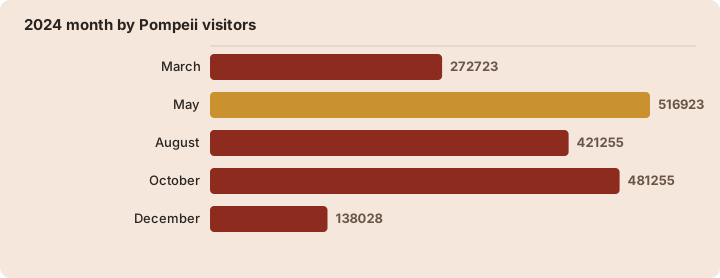
The monthly pattern inside 2024 shows when the crowds actually come.
| 2024 month | Pompeii visitors |
|---|---|
| March | 272,723 |
| May | 516,923 |
| August | 421,255 |
| October | 481,255 |
| December | 138,028 |
The practical response to those crowds is timing and routing. Entering at 13:00 rather than 9:00 puts you in the smaller afternoon band, the perimeter entrances at Piazza Esedra and Piazza Anfiteatro usually feel quieter than Porta Marina, and a planned route beats wandering: our Pompeii In One Day and Pompeii In 2 Hours itineraries do that planning for you, and the Pompeii Map Guide keeps the geography straight.
Visitors with mobility difficulties have a dedicated option: the "Pompeii for All" route enters at Piazza Anfiteatro and can exit at Piazza Anfiteatro or Piazza Esedra via the Antiquarium lift, per the park's visitor regulations. Details and further planning help are in Pompeii Accessibility.
How Do You Turn The Discovery Story Into A Day Trip?
You turn the discovery story into a day trip by treating its timeline as your itinerary: start at the place where the discovery began, follow the landmarks connected to what happened next in the order it happened, stop for a break somewhere tied to the tale, and finish where the story reaches its end, so the route itself retells the events from first finding to final chapter.
Herculaneum makes the sharpest companion visit, and it carries its own discovery-and-closure story: the site is open daily, EUR 16 full and EUR 2 reduced for 18 to under 25, free on the first Sunday plus 25 April, 2 June and 4 November, but its Villa dei Papiri and Ancient Theatre are closed for works. The practicalities are in Herculaneum Tickets, and the entry-and-audio option on the operator's listing is below.
For the eating and sleeping ends of the day, our Where To Eat In Pompeii and Where To Stay In Pompeii guides cover the modern town on either side of the visit. The wider region, from Naples to the Amalfi Coast, rewards anyone who turns the day trip into two.
Common Questions About The Discovery Of Pompeii
When was Pompeii discovered?
There is no single discovery date. The city, buried by Vesuvius in AD 79 near the modern town of Pompei in Italy, resurfaced gradually through accidental finds and then organised excavation, and the work continues: 44 ha of a 98 ha inscribed property have been excavated so far.
Is the eruption date of Pompeii settled?
No. The traditional date is 24 August AD 79, from the oldest manuscripts of Pliny the Younger. The park's own e-journal says the rival 24 October date has zero evidentiary basis and stems from a 1929 misreading, while adding that 24 August is not necessarily correct either. A 2018 charcoal graffito keeps the debate open.
How much of Pompeii is still buried?
UNESCO lists a 44 ha excavated area within a 98 ha inscribed property, so a large share of the ancient city remains underground.
Are new things still being found at Pompeii?
Yes. Excavation, conservation and study continue, and the park publishes finds in its e-journal and press releases. No newly opened or reopened domus was confirmed on an official page for 2026, so treat specific reopening claims with care.
Can you see what was found at Pompeii today?
Yes. The park is open daily except 25 December and 1 January, with last entrance at 17:30 in the summer season and 15:30 in winter. Some structures close for works, including the Praedia of Julia Felix, closed since 7 September 2026.
Whether you come for the frescoes, the forum or the simple strangeness of a city frozen mid-life, this Pompeii Travel Guide exists to help you see it well.