What Was Recently Found In Pompeii?
The recent finds and official announcements from Pompeii, the Roman city buried by Vesuvius in AD 79, from the charcoal note that reopened the eruption date debate to new ticket rules and closures.
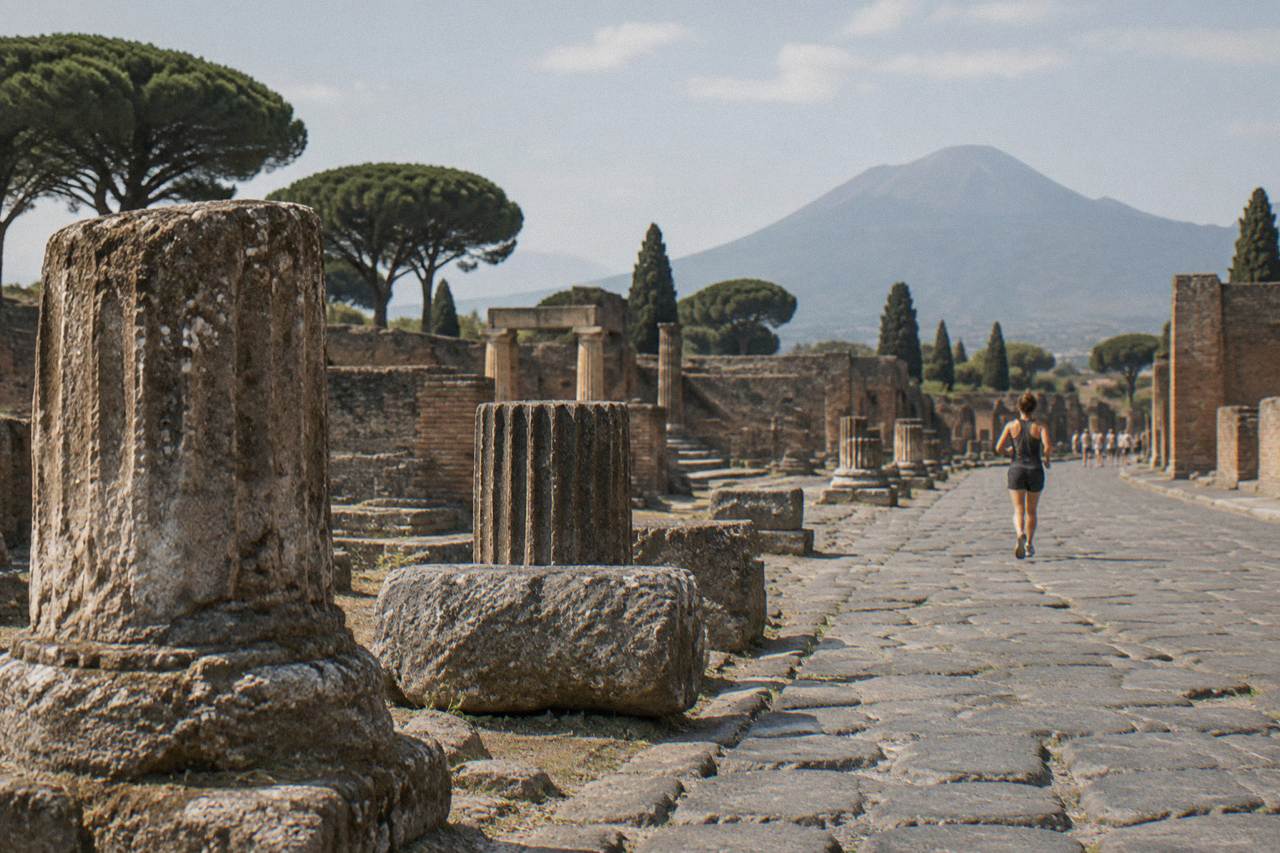
Pompeii, the ancient Roman city buried by the eruption of Mount Vesuvius in AD 79, lies beside the modern town of Pompei in Campania, southern Italy, about 24 km by road from Naples. Excavation has never stopped there, and every few months a fresh discovery makes headlines. Separating what the park itself has announced from what circulates on unofficial blogs is harder than it should be, because the gap between the two is wide. This page sets out the finds and dated announcements that can actually be traced to the park's own pages, in the park's own words.
What Was Recently Found In Pompeii?
The park's own e-journal, edited by its director, states that the 24 October alternative that grew from this debate has no evidentiary basis, while also conceding that 24 August is not necessarily correct. The honest answer is that the eruption date is an open question.**
That charcoal note deserves a careful explanation, because it is the most consequential recent find at Pompeii even though it contains no treasure. Written in charcoal, fragile and fleeting by design, it appears to record a date in mid-October of AD 79. If the reading holds, the person who wrote it did so after the date on which, according to the oldest manuscripts of Pliny the Younger's letters, the city was already buried. Pliny's manuscripts give nonum kalendas Septembres, 24 August, as the day of the eruption.
The park's position, published in its own e-journal, is more nuanced than the headlines suggested. The article traces the 24 October date to a misreading of the evidence published in 1929 and states plainly that 24 October has zero evidentiary basis. Yet the same article does not simply reaffirm 24 August: it frames the whole question as an open debate, in which the charcoal graffito is a find that reopened the argument rather than a proof that settles it. A page about what was recently found in Pompeii therefore has to report both the find and the uncertainty.
One thing worth flagging, because it confuses readers who cross-check the park's material: the park's own children's guide still states the eruption happened on 24 October. That page contradicts the park's e-journal. Where the two disagree, the e-journal, aimed at scholars and published by the park itself, is the weightier source, and this page follows it. For the wider story of how the city met its end, see how fast death came at Pompeii and whether the residents knew Vesuvius was going to erupt.
Which Dated Discoveries And Announcements Can Be Traced To Official Pages?
The announcements the park has actually published on dated pages since 2024 are: nominative tickets and a 20,000 visitors-per-day cap from 15 November 2024, a new ticket price structure from 12 January 2026, the Praedia of Julia Felix closed to the public from 7 September 2026 for maintenance, and a single EUR 25 all-sites ticket announced on 14 September 2026 to take effect from 1 January 2027. No newly opened or reopened domus has been confirmed on an official page, so this page names none.
That last sentence matters. Plenty of travel content claims a specific house "reopened in 2026" after restoration. The park's rule for itself, visible across its announcements, is that a reopening is announced with a date and a page. Anything without both is a rumour travelling under a headline.
The table below lists the dated items this page is willing to stand behind, each attached to its own subject and date.
| Date | What was announced | Subject |
|---|---|---|
| 15 Nov 2024 | Nominative tickets introduced, daily cap of 20,000 visitors | Whole park |
| 12 Jan 2026 | New prices: Express EUR 20, Pompeii+ EUR 25, 3-day EUR 30 | Whole park |
| 7 Sep 2026 | Praedia of Julia Felix closed until further notice | One building, maintenance |
| 14 Sep 2026 | Single EUR 25 all-sites ticket announced for 1 Jan 2027 | Whole park |
| 1 Oct 2026 | Campania Express rail service suspended until further notice | Transport, not the park |
The 2027 change deserves a sentence of explanation because it reaches every visitor. From 1 January 2027 the Express, Pompeii+ and 3-day structure ends, replaced by one EUR 25 ticket covering all park sites, valid 30 days, one entry per site. Oplontis, the Stabiae museum and Boscoreale remain EUR 8 individually, and the MyPompeii Card stays at EUR 45. The nominative ticket and the daily cap are retained. Until then the 2026 prices above remain in force, and the full detail sits on the Pompeii tickets explained page.
Closures affect itineraries more than headlines suggest. The Praedia of Julia Felix, one of the largest houses in the city, has been closed since Monday 7 September 2026, so a route planned around it before that date no longer works. At Herculaneum, a separate site towards Naples, the Villa dei Papiri and the Ancient Theatre are both closed for works. Checking the park's pages in the week you travel is the only reliable protection against planning around a shuttered building.
A guided visit is the practical way to meet the excavations as they stand today, closures included, because a licensed guide works the site week in and week out and plans around what is open. The featured option on this page, the Sorrento Skip-the-Line Pompeii Express Tour by Train, runs from Sorrento by rail to the excavations with a guide; the details and live price sit on Check availability.
Why Does A Charcoal Note Change What We Know About AD 79?
Because the eruption date underpins the reading of every find from that autumn: harvest remains, brazier placement, clothing evidence and the sequence of the destruction layers. If the city was alive in mid-October, material previously read as late-summer residue becomes autumn residue. The park's e-journal keeps the debate open rather than closing it, which is why this page reports the graffito as a find that reopened a question, not as a new official date.
The reason scholars care so much about a few charcoal words is the sheer weight of interpretation resting on a calendar. Wine fermentation, the state of fruit found in carbonised stores, the woollen clothing worn by victims: each of these has been used, at one time or another, as seasonal evidence for one date or the other. The debate over why some victims were wearing wool is covered in its own article, and it turns partly on this same seasonal question. A mid-October eruption makes woollen clothes unremarkable, an August one makes them a puzzle.
There is also a lesson in how fragile the evidence is. Charcoal inscriptions were never meant to last: they were the dry-erase boards of the Roman world, written and rubbed out within days. That a note survived the eruption at all is luck, and its reading depends on the condition of a surface scorched and buried for nearly two millennia. The park's e-journal article is careful on exactly this point, which is why the 2018 find is presented here as a discovery that reopened a debate rather than a verdict. Anyone wanting the everyday side of written Pompeii can read what the graffiti actually said, and the more awkward material is gathered in the embarrassing finds page, while the question of what was recently found in Pompeii in less flattering categories is answered there.
Visitors cannot see the charcoal note itself, and this is worth saying plainly. Finds of that kind are documented, studied and usually conserved away from the visiting route. What a visitor meets on site is the consequence of excavation: streets, frescoes and plaster that have come out of the ash in one season and opened the next, wherever the park confirms an opening on a dated page. Until such a page exists, this page names no reopened house.
How Much Of Pompeii Is Still Buried And Still Being Excavated?
The excavated area covers 44 ha within a UNESCO inscribed property of 98 ha, so a substantial share of the ancient city still lies under the modern ground, and excavation continues in targeted areas rather than across the whole buried mass. The long story of how the city stayed lost for so long explains why two and a half centuries of digging have still not finished the job, and why new finds keep surfacing.
Excavation at Pompeii is not a single continuous project but a series of campaigns, each with its own priorities. The practical consequence for a visitor is that the open city changes at the edges: a block closes for conservation, a previously studied house reopens, a new trench reaches a decorated room nobody has seen since AD 79.
The visitor numbers give a sense of the pressure all this operates under. The park counted 2,972,159 visitors in 2022, then 3,985,424 in 2023, 4,069,377 in 2024 and 4,000,090 in 2025. Four million pairs of feet a year on ancient paving is itself an argument for slow, careful digging over fast spectacle, and the 20,000-per-day cap introduced on 15 November 2024 is part of that same balancing act between access and preservation.
| Year | Visitors to the Pompeii site |
|---|---|
| 2022 | 2,972,159 |
| 2023 | 3,985,424 |
| 2024 | 4,069,377 |
| 2025 | 4,000,090 |
For readers whose curiosity runs to the macabre end of the record, the same excavations produced the casts and skeletons that fill the museum cases, and the question of where the bodies from Pompeii are now is answered alongside the death sequence in a separate article. The neighbouring site raises its own version: why no bodies were found at Herculaneum in comparable numbers, and the answer lies in the different way the two cities were buried.
How Do You Actually See The New Work On A Visit?
You see it by walking the streets nearest the active excavation areas with a guide who knows which openings are confirmed, by accepting that some named buildings will be closed, and by checking the park's own pages in the week you travel. The entrances to use are Porta Marina, Piazza Esedra and Piazza Anfiteatro for ticket offices, and the Porta Ercolano / Street of the Tombs entrance for the suburban villas route; no other entrance names exist to plan around.
Planning around closures is simpler than it sounds once you know the pattern. The Praedia of Julia Felix closure of 7 September 2026 was announced in advance on a park page. The 2027 ticket change was announced on 14 September 2026, more than three months ahead. The park gives notice; the failure is usually on the planning side, when an itinerary copied from an older article meets a notice the copier never read. The practical advice is to treat any article, including this one, as a snapshot and the park's pages as the live record.
Time of year shapes what a visit feels like. About 119 mm of rain falls in an average January at Pompei against about 16 mm in an average July, per the 1991-2020 climate normals for the local grid point, and August has the highest mean daily maximum at about 29.4 C. Those figures argue for spring or autumn for a long walking day among the trenches. The rules are stable year round: bags are limited to 30x30x15 cm, tickets are nominative with ID possibly checked at every entry, and the park closes on 25 December and 1 January unless otherwise communicated, with no weekly closing day for Pompeii itself.
For a day built around both the city and the volcano that ended it, the pairing of a Pompeii guided tour with horse riding on Vesuvius and lunch covers the excavation and the crater slope in one outing from the Pompeii area. Travellers with more time sometimes ask whether the finds change the itinerary at all, and the honest answer is that they change details, a closed house here, a reopened room there, while the core route through the forum, the baths and the main streets holds steady. The surrounding towns have their own draws, and the modern town beside the excavations is covered in the guide to modern Pompei, while the wider region is introduced from the homepage of Pompeii Travel Guide.
Common Questions About Recent Finds In Pompeii
What was recently found in Pompeii?
The headline find of recent years is a charcoal inscription recorded in 2018, apparently dated to mid-October AD 79, which reopened the debate over the eruption date. The park's own e-journal states that the rival 24 October date has no evidentiary basis while also treating 24 August as not necessarily correct. No newly reopened domus has been confirmed on an official page.
Is the 24 October eruption date now official?
No. The park's e-journal traces 24 October to a 1929 misreading and says it has zero evidentiary basis. The traditional manuscript date of 24 August is likewise not affirmed as settled. The park treats the date as an open scholarly debate.
Can visitors see the charcoal graffito?
No. Fragile charcoal inscriptions are documented and conserved away from the visiting route. What visitors see is the consequence of excavation: streets, houses and frescoes that open to the public once the park confirms an opening on a dated page.
Why is the Praedia of Julia Felix closed?
No reopening date has been published, so itineraries built before September 2026 need adjusting.
Has anything new opened in Pompeii in 2026?
No newly opened or reopened domus has been confirmed on an official park page, so this site names none. Confirmed 2026 announcements concern tickets and closures: new prices from 12 January 2026, the Julia Felix closure in September, and the single EUR 25 all-sites ticket announced for 1 January 2027.
How much of Pompeii is still buried?
The excavated area covers 44 ha inside a UNESCO inscribed property of 98 ha, so a large share of the ancient city still lies beneath the modern ground, and targeted excavation continues, which is why finds keep surfacing.
The short version for anyone skimming: the real recent record at Pompeii is a charcoal note that reopened an old argument, an excavation area that keeps producing rooms unseen since AD 79, and a set of dated official announcements about tickets and closures that any itinerary should be checked against. Anything grander than that, at least until the park publishes it on its own pages, belongs to the rumour pile.