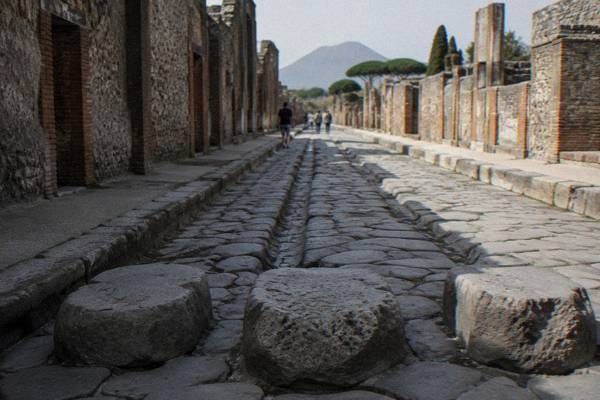
Stabian Baths
The Stabian Baths are the oldest of the bath complexes uncovered in the ancient Roman city of Pompeii, in Campania, southern Italy, about 24 km from Naples. Here is how to find them, what a ticket costs in 2026, and what to look for inside.
Short answer
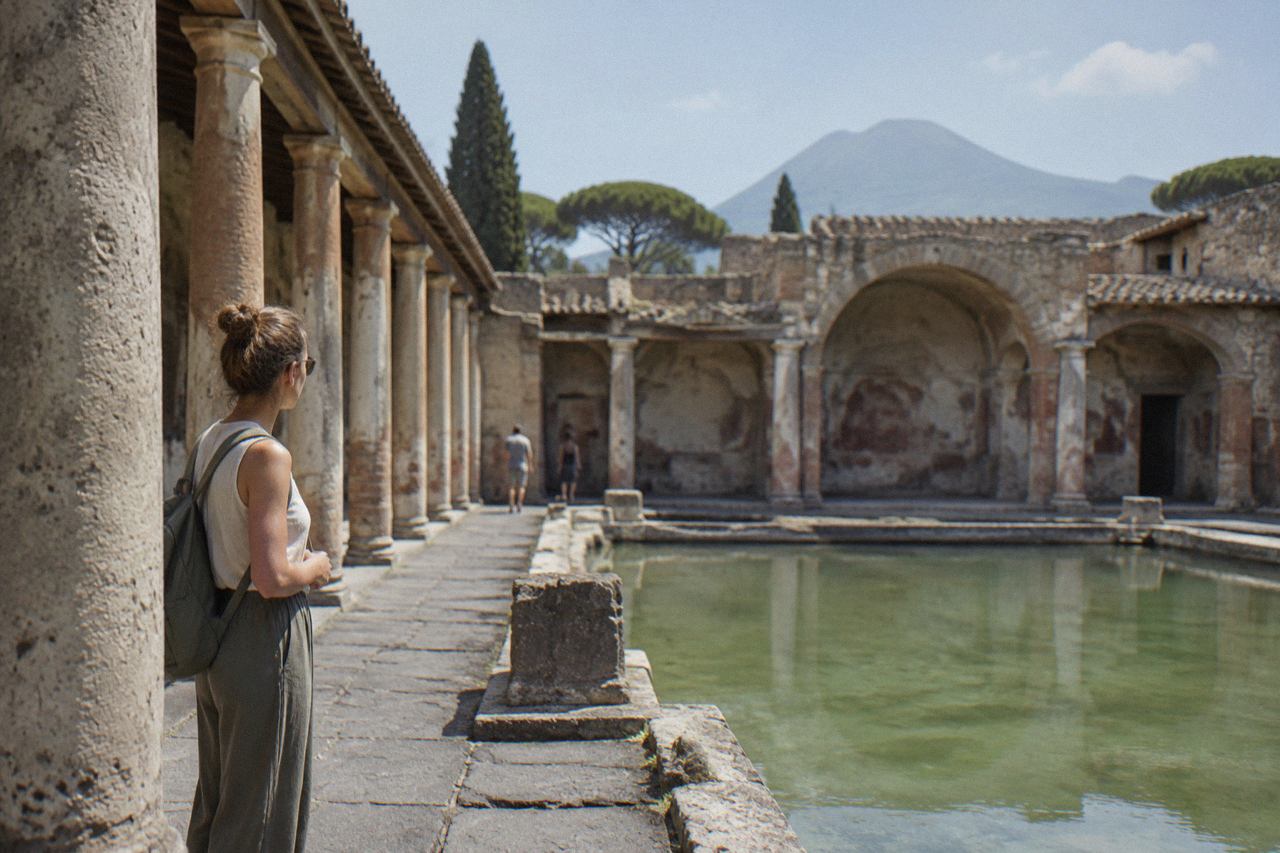
The Stabian Baths sit in the ancient city of Pompeii, Italy, reached on a Pompeii Express ticket costing EUR 20 in 2026 (EUR 25 for all park sites from 1 January 2027). Enter at Porta Marina, Piazza Esedra or Piazza Anfiteatro between 9:00 and a 17:30 last entry in summer; free entry applies on the first Sunday of each month and for under 18s.
The Stabian Baths are the oldest bath complex excavated in the ancient Roman city of Pompeii, an archaeological park in Campania, southern Italy, beside the modern town of Pompei and about 24 km by road from Naples. Buried by the eruption of Mount Vesuvius in AD 79, traditionally dated to 24 August, the complex preserves the dressing rooms, warm and hot bathing halls and underground heating passages that made Roman public bathing a daily social ritual. This guide covers what the baths are, which park entrance serves them best, what a ticket costs in 2026, and how the visit fits into a day at the park.
What Are The Stabian Baths Of Pompeii, Italy?
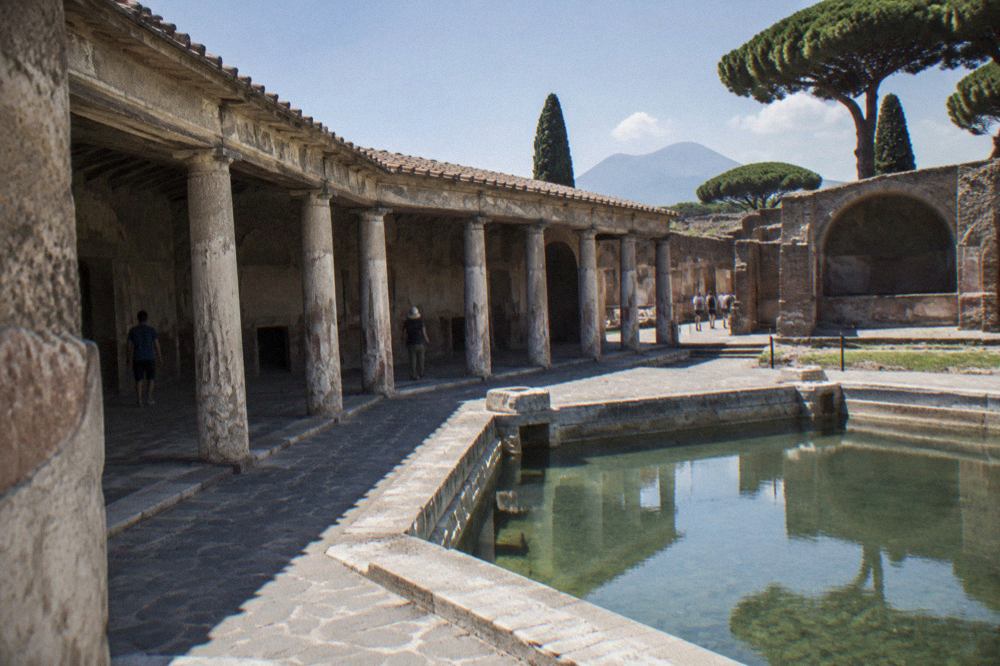
The Stabian Baths are a public Roman bath complex inside the archaeological park of Pompeii, in Campania, southern Italy, and they are the oldest of the bath buildings uncovered in the city. Like everything else here they were buried by the AD 79 eruption of Mount Vesuvius, a date traditionally given as 24 August, though the park's own e-journal notes the competing October reading has no evidentiary basis and the debate remains open.
Roman baths of this kind were not simply places to wash: they combined hot, warm and cold rooms in a set sequence, and they worked as a neighbourhood meeting point where people exercised, talked business and caught up on news before dinner. The complex grew in stages over the city's life, and it is precisely that layering, an older core repeatedly renovated, that makes it interesting to compare with the smaller and more uniform Forum Baths closer to the civic centre.
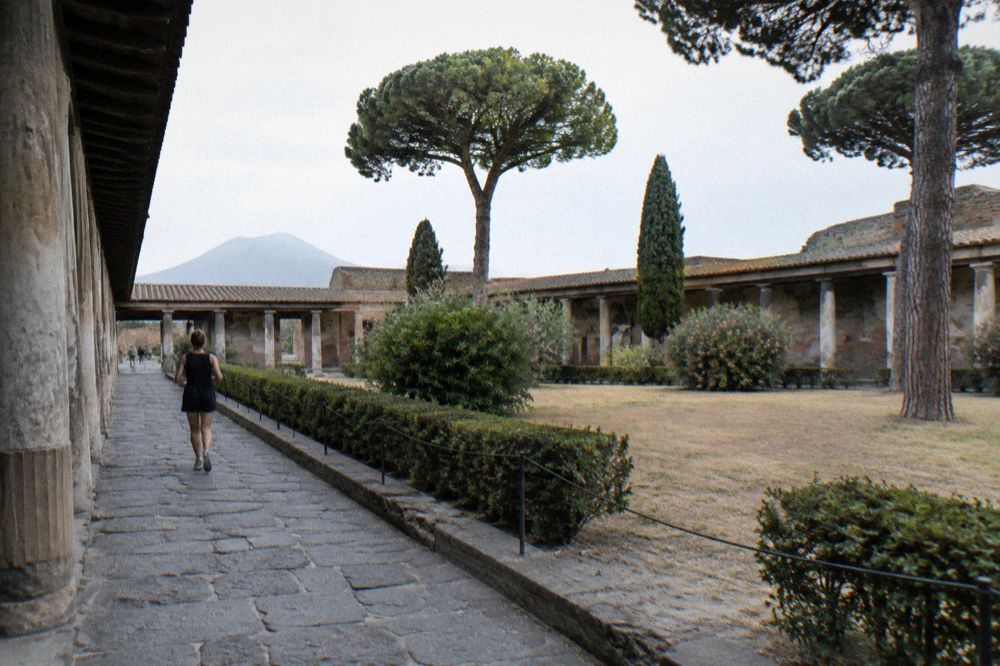
For visitors, the attraction is the legibility of the engineering. You can still trace how hot air from the furnaces circulated under the raised floors and inside the walls of the warm rooms, keeping the bathing halls at different temperatures. The layout of the changing rooms, with their numbered seat niches, survives well enough that the ritual of arriving, undressing and moving through the sequence of rooms is easy to picture. The baths sit a short walk from the Forum and from the grand houses along the same streets, which makes them a natural mid-route stop rather than a destination of their own.
Because the park is large, 44 ha excavated within a 98 ha inscribed UNESCO property shared with Herculaneum and Torre Annunziata, planning matters. The full site map shows the baths in relation to the entrances and the other landmarks, and it is worth a look before you set out.
Where Are The Stabian Baths And Which Pompeii Entrance Serves Them Best?
The best entrance depends on your route: Porta Marina for those arriving from the Circumvesuviana station, Piazza Esedra for a north-to-south walk, and Piazza Anfiteatro if you start at the amphitheatre end. There are only these three ticket offices, so the choice is really about which end of the city you begin from.
The Pompei Scavi-Villa dei Misteri station on the Circumvesuviana line sits beside the Porta Marina entrance, which makes that gate the practical default for anyone arriving by train from Naples or Sorrento. From Porta Marina the walk runs up through the Forum quarter to the baths. Visitors starting at Piazza Anfiteatro, at the eastern end, work back westwards past the amphitheatre and the Palaestra before reaching the same streets. The named entrances are fixed: Porta Marina, Piazza Esedra and Piazza Anfiteatro are the ticket offices, while the Porta Ercolano / Street of the Tombs entrance exists specifically for the suburban villas route, which is a separate itinerary covering the Villa of the Mysteries.
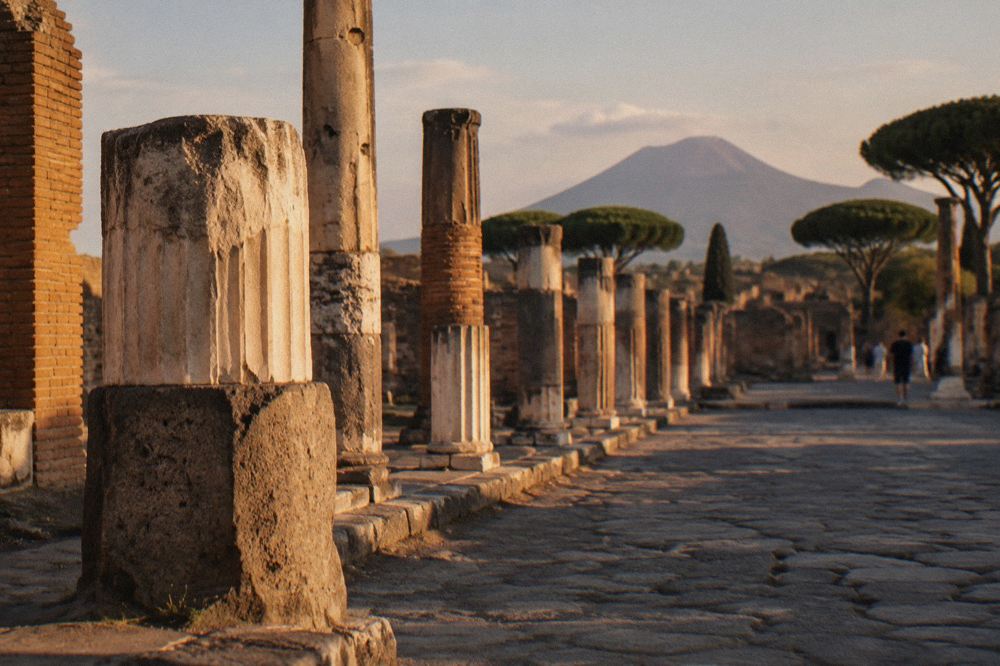
For anyone with reduced mobility, the park's "Pompeii for All" route begins at Piazza Anfiteatro, and visitors using it may exit at Piazza Anfiteatro or Piazza Esedra via the Antiquarium lift. The ancient paving throughout the site is uneven, stout shoes help everywhere, and the bath building's thresholds and steps are no exception. The entrances and orientation guide covers the practical detail of each gate if you are still deciding how to structure the day.
To see the baths with an archaeologist rather than piecing the heating system together alone, these options cover the park from different starting points:
| Pompeii entrance | Ticket office | Best for | Notes |
|---|---|---|---|
| Porta Marina | Yes | Train arrivals | Closest to Pompei Scavi-Villa dei Misteri station |
| Piazza Esedra | Yes | Central start | Links to the Antiquarium lift exit on the accessibility route |
| Piazza Anfiteatro | Yes | Amphitheatre-first routes | Start of the "Pompeii for All" route |
| Porta Ercolano / Street of the Tombs | Route entry | Suburban villas | Express holders add this route for EUR 8, card only |
How Much Does It Cost To See The Stabian Baths In 2026?
There is no separate ticket for the Stabian Baths: they are included in every Pompeii park ticket. In 2026 the Pompeii Express ticket costs EUR 20 for the ancient city, the Pompeii+ ticket EUR 25 adds the suburban villas, and a 3-day ticket costs EUR 30. From 1 January 2027 this structure ends and a single EUR 25 ticket covers all park sites, valid 30 days with one entry per site.
That 2027 change was announced by the park on 14 September 2026 and is the single most important thing to know when reading any price list, because the 2026 figures expire on 31 December 2026. The three smaller outlying sites, Oplontis, the Stabiae museum and Boscoreale, cost EUR 8 each individually under both systems, and the annual MyPompeii Card stays at EUR 45. Reduced entry of EUR 2 applies to EU citizens aged 18 to under 25, and entry is free for everyone under 18 and for all visitors on the first Sunday of each month.
Tickets are nominative, introduced with a daily cap of 20,000 visitors on 15 November 2024, and identification may be checked at every entry. Bags larger than 30x30x15 cm must go to left luggage. Time-slot capacity between 16 March and 14 October is capped at 15,000 entries from 9:00 to 13:00 and 5,000 from 13:00 to 17:30, which is why an afternoon entry is often the calmer choice for the baths and the houses near them.
| Ticket | 2026 price | Covers | From 1 Jan 2027 |
|---|---|---|---|
| Pompeii Express | EUR 20 | Ancient city only | Replaced |
| Pompeii+ | EUR 25 | City, suburban villas, Boscoreale, shuttle | Replaced |
| 3-day ticket | EUR 30 | Pompeii+ plus Oplontis, Stabiae sites, Boscoreale | Replaced |
| Single park ticket | not sold in 2026 | none | EUR 25, all park sites, 30 days, one entry per site |
| Oplontis / Stabiae museum / Boscoreale | EUR 8 each | Single outlying site | EUR 8 each |
| MyPompeii Card | EUR 45 (EUR 10 reduced) | Annual pass | EUR 45 |
| Category | 2026 entry price | Notes |
|---|---|---|
| EU citizen aged 18 to under 25 | EUR 2 | Also non-EU holders of an Italian residence permit |
| Under 18 | Free | No ticket price |
| Everyone, first Sunday of the month | Free | Park recorded over 36,000 visitors on one such day |
| Visitors with disabilities | Free per park regulations | Accompanying person free where documented |
What Can You See Inside The Stabian Baths?
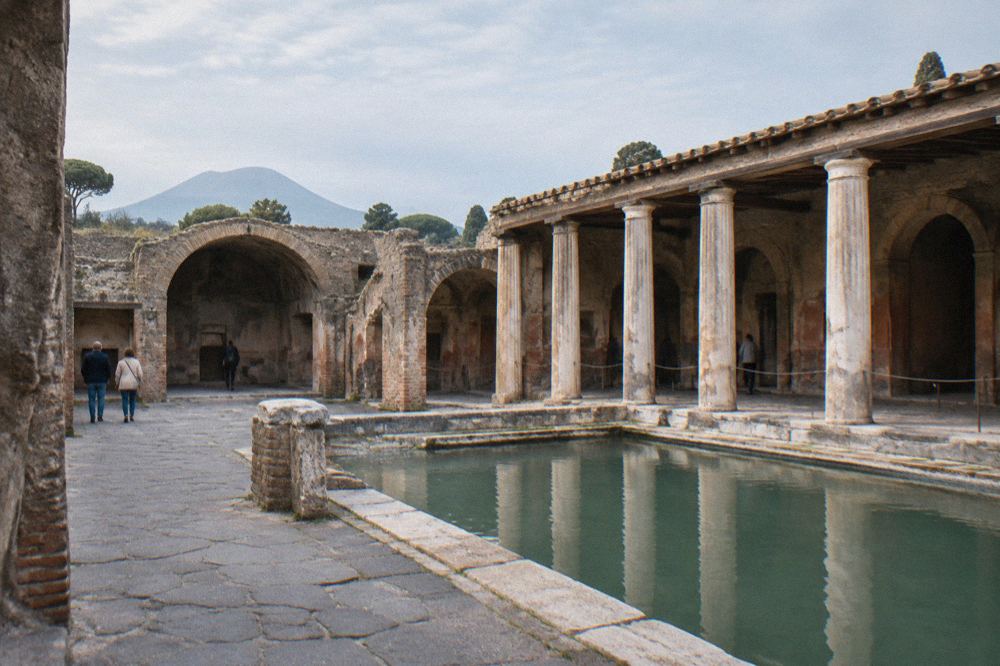
Inside you walk the full Roman bathing sequence: the changing room with its seat niches, the cold plunge hall, the warm room and the hot room, with the furnace channels and floor supports that heated them still visible. The complex also preserves a large exercise yard and the service corridor where the furnace slaves worked. It is the clearest place in Pompeii to understand how a bath building actually functioned.
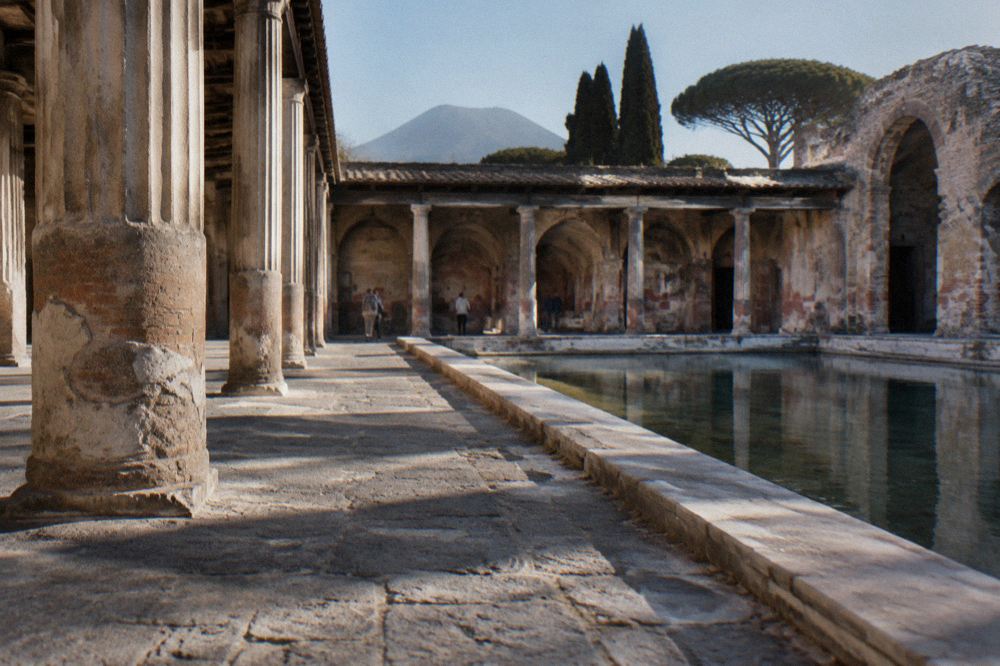
Begin in the changing room, the apodyterium, where the niches cut into the benches show where bathers left their clothes. From there the sequence runs through the frigidarium with its cold pool, the tepidarium kept moderately warm, and the caldarium closest to the furnaces. In places the raised floor supports survive, the small brick pillars that held the bathing floor above the hot air, and with them the wall ducts that carried heat upward. The exercise yard on the south side, ringed by porticoes, shows the sporting half of the complex.
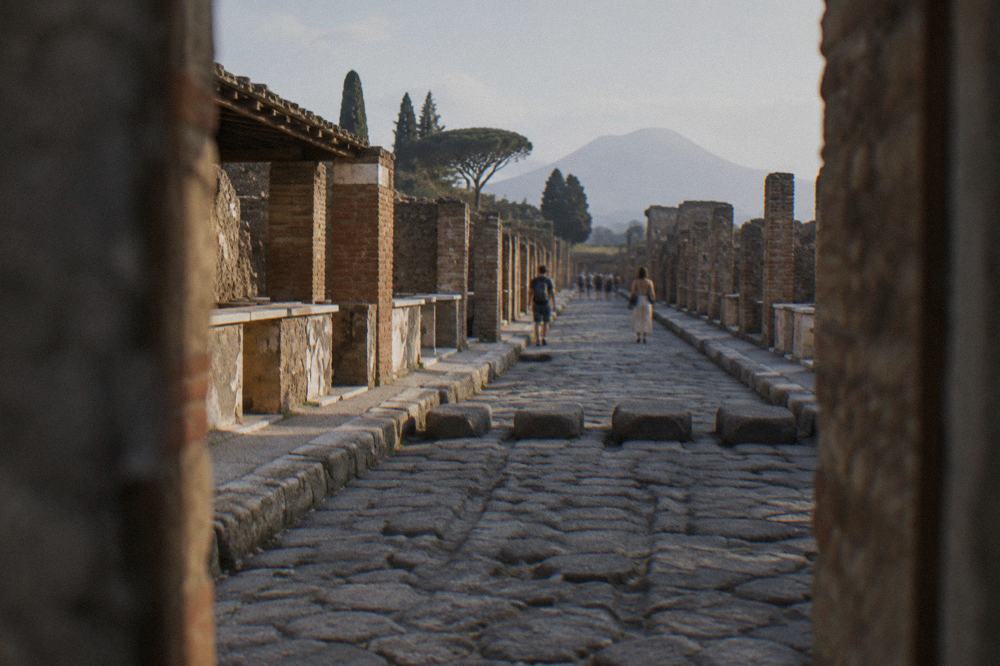
Two habits of Roman daily life become obvious here. First, the separation of men's and women's bathing suites, which in this building ran side by side with their own entrances from the street. Second, the social function: the baths stood on a busy commercial street, a few minutes from the thermopolium counters where food and drink were sold over the counter, so a visit was squeezed between errands rather than treated as spa leisure in the modern sense.
Do not rush the outside walls. The masonry itself carries the building's story of repeated repair and enlargement, and comparing the rougher early work with the later renovations gives a sense of how the complex evolved while the city grew around it.
How Do The Stabian Baths Compare With The Forum Baths Of Pompeii?
The Stabian Baths are the larger and older of the two main complexes, laid out around a central exercise yard on a working commercial street; the Forum Baths are more compact, more centrally placed beside the civic centre, and more uniform in their later design. Both are on the same entry ticket and both fit easily into one day, so the choice is about route rather than either-or.
Practically, visitors arriving at Porta Marina reach the Forum Baths first, within the first fifteen minutes of most standard routes, while the Stabian Baths fall mid-route after the Forum and the main north-south streets. If time is short, say a two-hour visit built around the Pompeii in 2 hours itinerary, one complex is enough to understand Roman bathing, and the Stabian Baths repay the extra walking with their clearer heating arrangements and larger footprint. With a full day, do both, and notice how the smaller Forum Baths pack the same sequence of rooms into a tighter block.
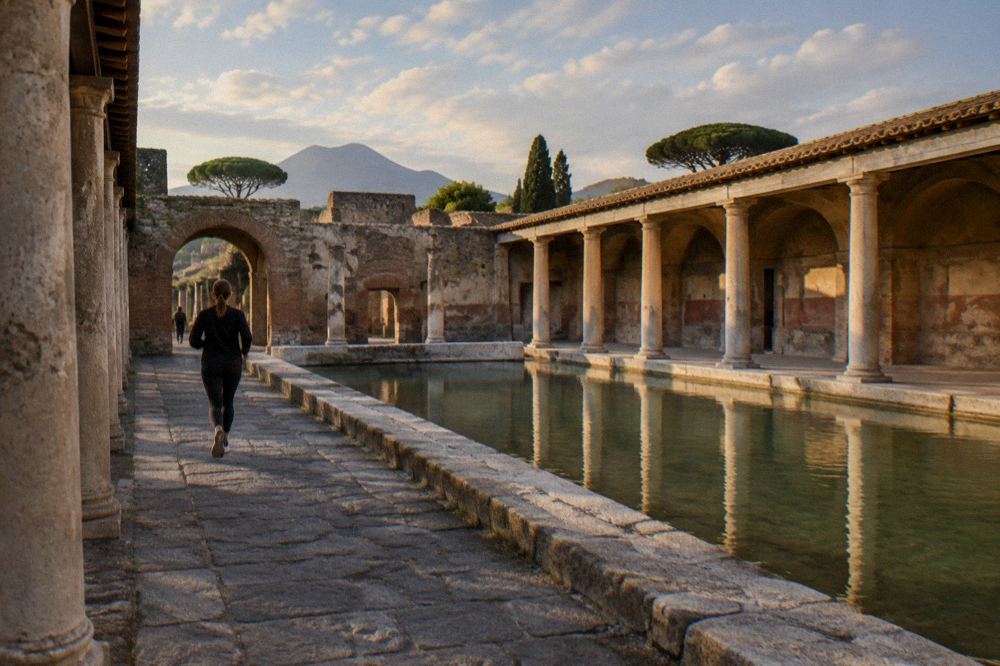
The comparison also matters for photographers. The Stabian Baths offer wider interior views and stronger geometry in the halls, while the Forum Baths deliver tighter, more atmospheric corners. If heat is a concern, both complexes offer stretches of shade, a genuine mercy in a site whose streets hold the summer sun; the summer planning guide covers timings in depth.
A small-group tour with an archaeologist, with the entry ticket included, pairs well with this section of the park because the guides open the engineering in a way signage alone does not:
When Is The Best Time Of Year To Visit The Stabian Baths?
The best months to visit Pompeii are April, May, June, September and October, when daytime highs run about 17.7 to 25.8 C, rainfall is lower than the winter peak, and the November-to-August visitor spread is at its most forgiving. July and August bring mean daily maxima of about 28.7 and 29.4 C, and November is the wettest month with about 180 mm of rain.
Those figures come from the 1991-2020 climate normals computed for the Pompei grid point from the Open-Meteo historical archive, so they are averages, not forecasts. The practical reading is simple: the interlaced indoor and outdoor spaces of the baths give both sun and shade, but the streets between the entrance and the complex do not, so in midsummer the later 13:00-to-17:30 entry window, capped at 5,000 visitors, combines a calmer site with the cooler end of the day. In winter, from 15 October, last entry pulls back to 15:30 and the park closes at 17:00, which shortens any itinerary that includes the villas as well.
| Month | Mean daily max (C) | Mean daily min (C) | Rain (mm) |
|---|---|---|---|
| Apr | 17.7 | 10.4 | 87 |
| May | 21.6 | 14.1 | 59 |
| Jun | 25.8 | 18.2 | 30 |
| Jul | 28.7 | 21.1 | 16 |
| Aug | 29.4 | 21.8 | 22 |
| Sep | 25.3 | 18.6 | 90 |
| Oct | 21.3 | 15.1 | 129 |
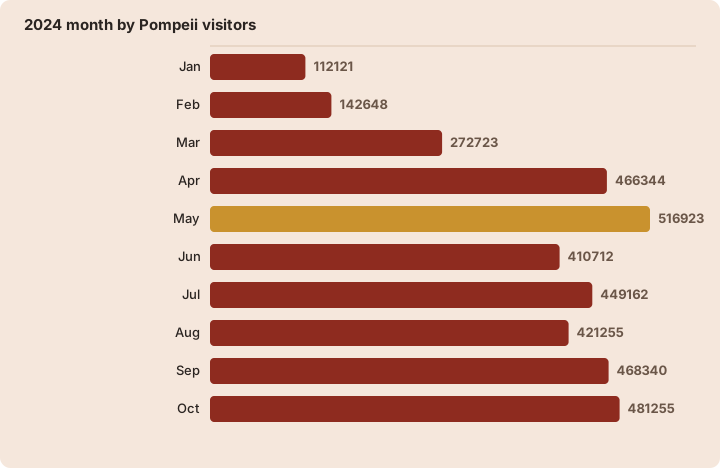
Crowd data tells the same story from another angle. The park counted 4,069,377 visitors to Pompeii in 2024, and the monthly figures peak in May at 516,923 and October at 481,255, with the November-to-February trough dropping as low as 112,121 in January. October's popularity pairs with a 21.3 C mean maximum, which is why early autumn remains a favourite window for the bath buildings and the whole south-central city.
| 2024 month | Pompeii visitors |
|---|---|
| Jan | 112,121 |
| Feb | 142,648 |
| Mar | 272,723 |
| Apr | 466,344 |
| May | 516,923 |
| Jun | 410,712 |
| Jul | 449,162 |
| Aug | 421,255 |
| Sep | 468,340 |
| Oct | 481,255 |
| Nov | 189,866 |
| Dec | 138,028 |
If your dates are fixed by a cruise call at Naples, the shore excursion guides cover the timing arithmetic of a five-hour port day; otherwise, a relaxed train-and-guide combination such as this one keeps the afternoon free:
Can You Visit The Stabian Baths Without A Guide?
Yes, the baths are fully accessible on a standard entry ticket with no guide required, and the sequence of rooms is readable on your own. A guide adds real value here because the heating system, the separate men's and women's suites and the phases of construction are easy to walk past unexplained. Audio guides and small-group archaeologist tours both close that gap.
Independent visitors should photograph the park's own orientation signage at the entrance, then walk the main street grid south from the Forum; the baths announce themselves by the exercise yard's porticoes. The site's official audio-guide option covers the landmark buildings and suits travellers who prefer to move at their own pace. What a guide reliably adds at the baths specifically is the mechanics: pointing at the floor supports and explaining the hypocaust, tracing the furnace corridor, and dating the renovation phases by their brickwork. This Pompeii Travel Guide recommends a guide particularly for first visits of under four hours, when unexplained ruins blur together.
Groups travelling from Sorrento or the coast can fold the visit into a full-day itinerary that pairs the ancient city with Vesuvius; the pairing guide at Pompeii and Vesuvius in one day explains the sequencing, and the entry-plus-audio option below suits the self-guided approach:
What Should You Know Before You Go?
Before you go, pack water and wear closed shoes, and keep your bag within the 30x30x15 cm limit, since anything larger must be left at left luggage. Bring identification too, as it may be checked against your nominative ticket at any entrance.
The daily rhythm matters more here than at a museum. Between 16 March and 14 October the site opens at 9:00, last entry falls at 17:30 and closure at 19:00; from 15 October to 15 March those become 15:30 and 17:00. The first Sunday of every month is free, which draws the biggest crowds of all: the park has recorded more than 36,000 visitors on a single free Sunday. If your dates allow, any other day of the month buys you a quieter bath complex.
Two closures elsewhere in the wider park are worth knowing as you plan a multi-site day: the Praedia of Julia Felix in Pompeii has been closed to the public since 7 September 2026 for maintenance, and at Herculaneum the Villa dei Papiri and the Ancient Theatre are closed for works. Neither affects the Stabian Baths, but both have caught out visitors who built an itinerary from older articles. The Herculaneum guide carries the current detail for that site.
| Period | Opens | Last entry | Closes |
|---|---|---|---|
| 16 March to 14 October | 9:00 | 17:30 | 19:00 |
| 15 October to 15 March | 9:00 | 15:30 | 17:00 |
| Closed days | none weekly | none weekly | 25 December and 1 January |
Common Questions About The Stabian Baths In Pompeii
Do I need a separate ticket for the Stabian Baths?
No. The baths are part of the ancient city of Pompeii and are included in every park ticket, from the EUR 20 Pompeii Express in 2026 to the single EUR 25 park ticket that replaces the range from 1 January 2027.
How long should I spend at the Stabian Baths?
Allow twenty to thirty minutes to walk the changing room, the bathing sequence and the exercise yard at a reading pace, longer if you want to study the heating ducts. A two-hour small-group tour of the whole city typically spends part of that time here.
Which entrance is closest to the Stabian Baths?
Porta Marina is the usual choice, reached from the Pompei Scavi-Villa dei Misteri station, with the baths lying mid-route after the Forum. Piazza Esedra and Piazza Anfiteatro also work; all three are the park's only ticket offices.
Are the Stabian Baths suitable for visitors with reduced mobility?
The park's "Pompeii for All" route starts at Piazza Anfiteatro and offers an exit at Piazza Esedra via the Antiquarium lift. The baths themselves are ancient structures with thresholds and uneven floors, so the accessible route is the safer frame for any visit.
Are the Stabian Baths the oldest baths in Pompeii?
Yes, they are the oldest of the bath complexes excavated in the city, built in stages and repeatedly renovated, which is why their masonry shows several construction phases compared with the more uniform Forum Baths.
Is entry free on the first Sunday of the month?
Yes, entry to the whole park including the baths is free for everyone on the first Sunday of every month. Those days draw very large crowds; the park has recorded more than 36,000 visitors on a single free Sunday.
However you build the day, the Stabian Baths deserve more than a glance through the doorway. They are the clearest single lesson in how ordinary Pompeiians spent an afternoon, and ten unhurried minutes among the seat niches and heating ducts will explain the city's daily life better than any single grand house.