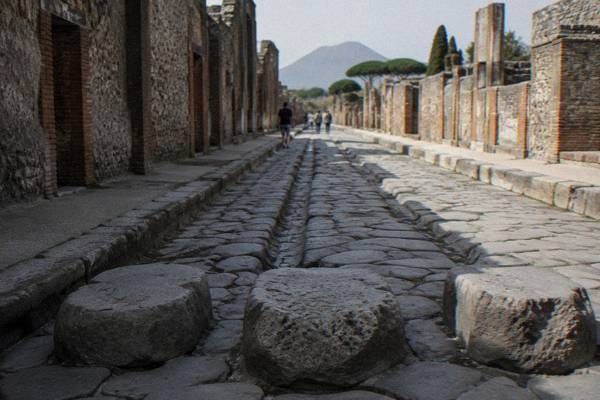
Forum Baths Pompeii
The Forum Baths are the compact bathing complex standing a few steps from the Forum of Pompeii, the ancient Roman city buried by Vesuvius in AD 79 and now an archaeological park in Campania, southern Italy.
Short answer
The Forum Baths of Pompeii sit directly north of the Forum, inside the archaeological park about 24 km from Naples. A 2026 Pompeii Express ticket costs EUR 20 and covers them. Opening is 9:00 daily, with last entry at 17:30 and a 19:00 close from 16 March to 14 October, and last entry 15:30, close 17:00, from 15 October to 15 March.
The Forum Baths are the smaller of the two great public bathing complexes of ancient Pompeii, the Roman city buried by the eruption of Mount Vesuvius in AD 79 and now the Parco Archeologico di Pompei in Campania, southern Italy, beside the modern town of Pompei and about 24 km by road from Naples. Wedged into a tight block immediately north of the Forum of Pompeii, they packed the full Roman bathing sequence, changing rooms, cold bath, warm room and hot bath, into a space far more cramped than their older sibling, the Stabian Baths, and that compression is exactly what makes them rewarding to read: every vault, every light well and every heating duct is doing visible work.
The complex is usually called the Central Baths or Forum Baths in guidebooks, and you will hear both names from guides on site. Because it stands at the civic heart of the city rather than out on one edge, it is one of the easiest major structures in Pompeii to fold into a walking route, and this page covers everything needed to plan that: what the building was, where the entrances are, what to look at inside, how it compares with the other baths in the park, and the practical questions of tickets, hours and timing.
What Were The Forum Baths In Pompeii?
The Forum Baths were one of ancient Pompeii's public bathing complexes, standing beside the city's Forum and serving residents and visitors alike. Inside, bathers moved through the classic Roman sequence of hot, warm, and cold rooms, mixing bathing with exercise, gossip, and business. Decorated with stucco and fitted with clever underfloor heating, the complex remains one of Pompeii's best-preserved and most evocative spaces today.
Public baths in the Roman world were closer to a community centre than a swimming pool. A visitor undressed in the apodyterium, the changing room, then moved through the frigidarium for a cold plunge, the tepidarium for a warm transition, and the caldarium for the hot bath, with the whole sequence ending back where it began. The floors of the hot rooms were raised on small pillars, and hot air from a furnace circulated beneath them and up through hollow wall tiles, an arrangement a visitor to Pompeii can still trace in the brickwork. The Forum Baths deliver all of this in dense, well-preserved form, which is why nearly every guided walking route of the city passes through them.
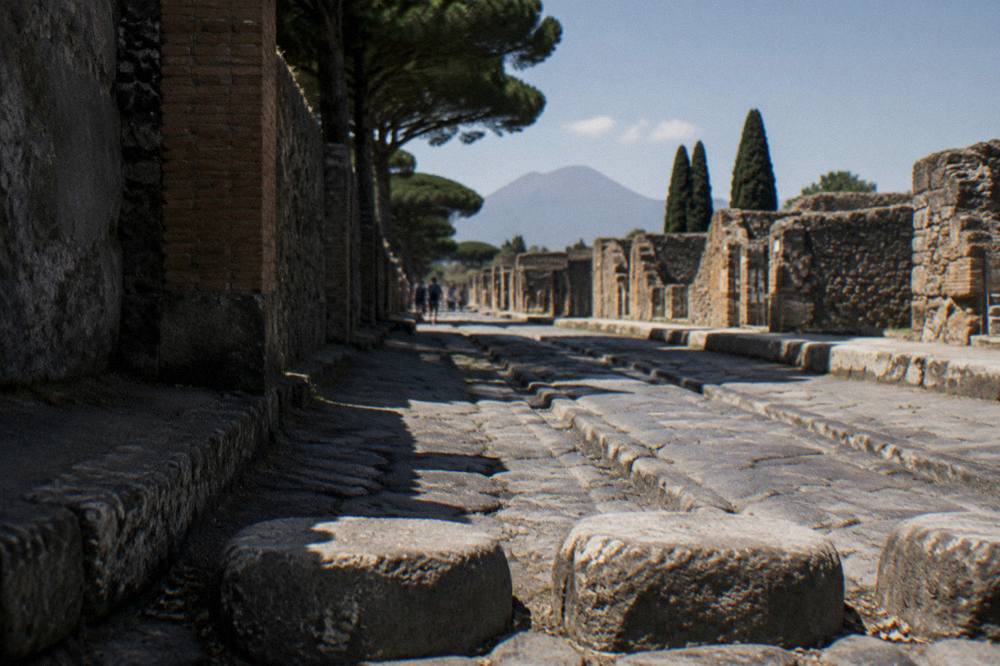
It helps to hold two names apart. The Stabian Baths on the other side of the old city at the crossroads of the Via dell'Abbondanza are older and larger, and the park also contains the Suburban Baths near Porta Marina and the unfinished Republic Baths. Bathing culture cut across classes in Roman Pompeii, and bath houses stood beside temples, markets and the Basilica of Pompeii as ordinary furniture of daily life, which is a useful corrective to the idea that they were luxury venues.
The date of the city's destruction is traditionally placed on 24 August AD 79, from the oldest manuscripts of Pliny the Younger's letters. The park's own e-journal states that a competing 24 October date has no evidentiary basis and stems from a 1929 misreading, while noting that 24 August is not guaranteed either, so the honest framing is a debated date with an ancient manuscript tradition behind the summer reading. Nothing about visiting the baths depends on settling that question, but a guide who raises it is reflecting a genuine scholarly argument rather than improvising.
Where To Find The Forum Baths And How To Enter
The Forum Baths sit immediately north of the Forum of Pompeii, and visiting them simply requires entering the archaeological park through one of its three ticketed entrances: Porta Marina, Piazza Esedra or Piazza Anfiteatro. There is no separate entry for the baths themselves, so once inside the park you can walk straight to them from the Forum. From Porta Marina, the walk runs up through the city toward the civic centre; from Piazza Anfiteatro at the far end, the Forum sits at the opposite, western side of the excavated area, so the complex fits naturally at the turn-around point of a walk across the city. Allow time for the distances involved, as the excavated site is genuinely large.
The three entrances are not interchangeable for planning. Porta Marina is the historic entrance closest to the Pompei Scavi-Villa dei Misteri Circumvesuviana station. A fourth named access, Porta Ercolano and the Street of the Tombs, is where holders of the cheaper Express ticket can add the suburban villas route for EUR 8, card payment only, if the Villa of the Mysteries is on the itinerary. The table below sets out the entrances and what each is for.
| Entrance | Ticket office | Best for |
|---|---|---|
| Porta Marina | Yes | Arriving by Circumvesuviana from Naples or Sorrento |
| Piazza Esedra | Yes | The eastern half of the city and the Antiquarium lift |
| Piazza Anfiteatro | Yes | The amphitheatre end and the "Pompeii for All" accessible route |
| Porta Ercolano / Street of the Tombs | Add-on sales point | Adding the suburban villas route to an Express ticket, EUR 8 |
Accessibility planning matters at Pompeii because the ancient paving is uneven throughout. The park's published accessible route, "Pompeii for All", enters at Piazza Anfiteatro and may exit at Piazza Anfiteatro or Piazza Esedra via the Antiquarium lift, and the regulations page describes this in full. The Forum Baths themselves, like nearly every Roman structure in the park, involve thresholds and steps at doorways. Visitors with mobility difficulties should treat the published route as the backbone of the visit and check current conditions with the park before counting on entering the bath building itself.
One transport fact worth flagging before any rail planning: the Campania Express service has been suspended since 1 October 2026 until further notice, with refunds handled through the operator EAV's complaints form or the original seller. The ordinary Circumvesuviana line from Napoli Garibaldi to the Pompei Scavi-Villa dei Misteri station still runs, with scheduled times computed from the operator's own published data giving a journey of roughly 29 to 35 minutes from Naples. Consult EAV's timetable by name for current departures rather than relying on anything read elsewhere, and see the park's own pages for anything time-sensitive.

What To See Inside The Forum Baths Of Pompeii
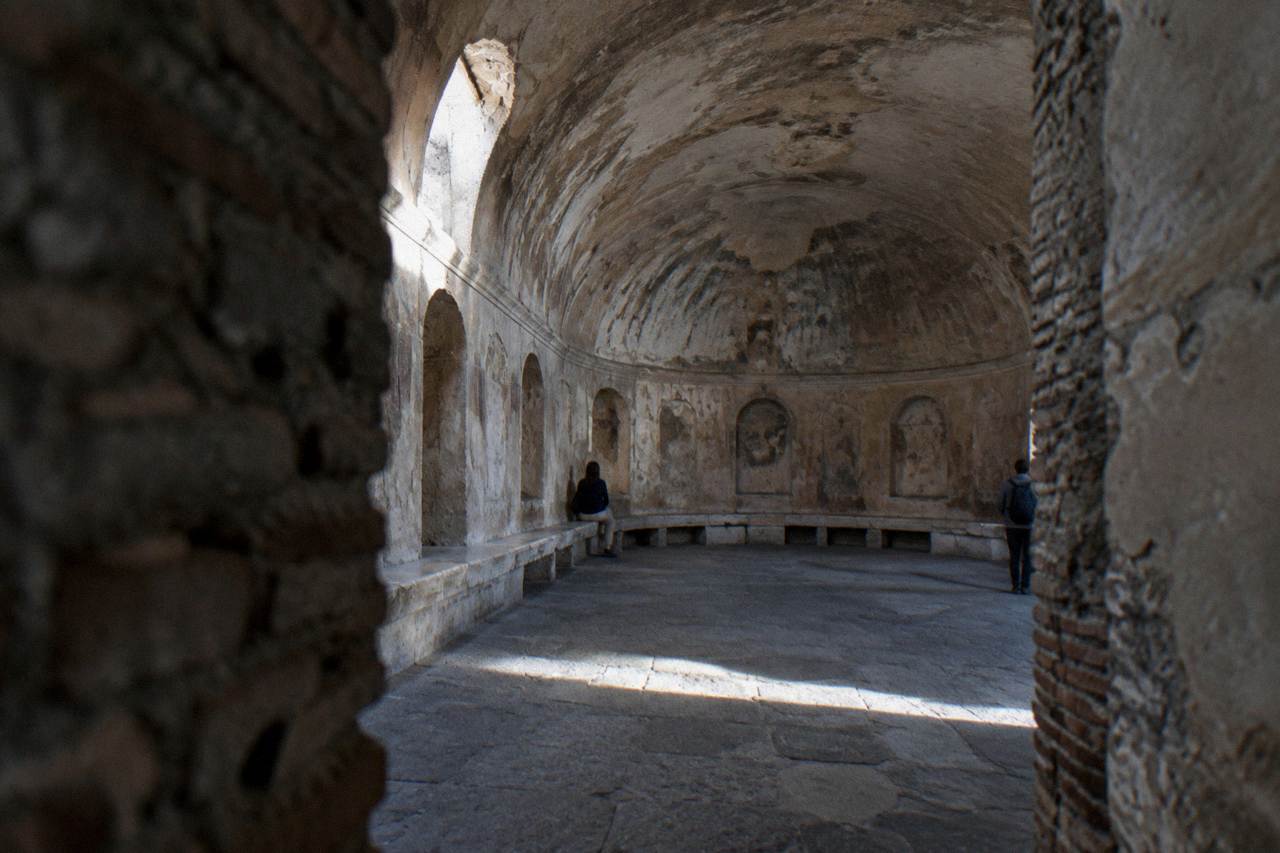
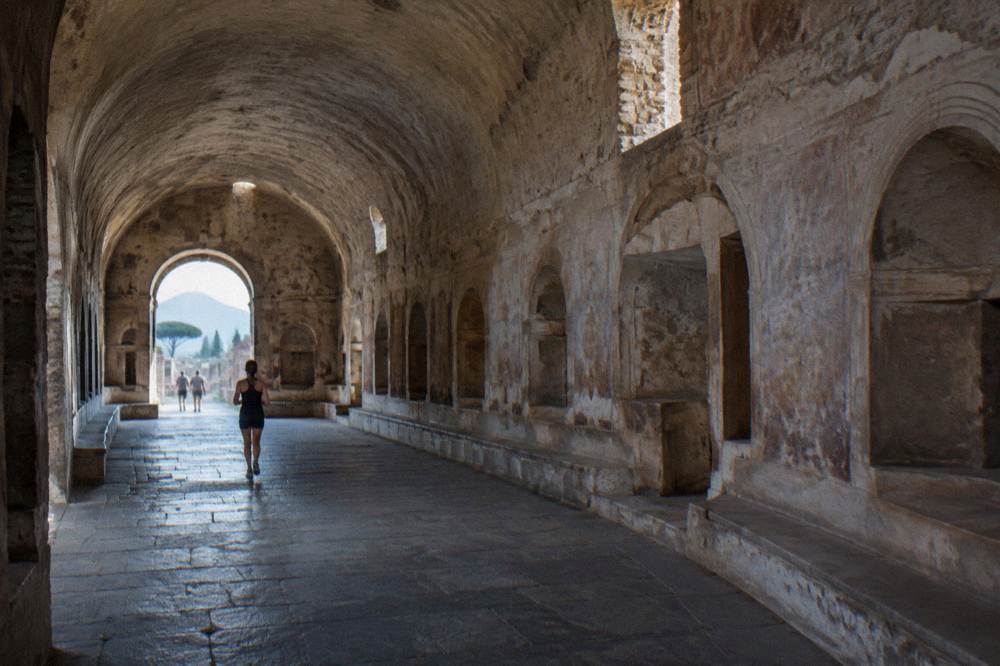
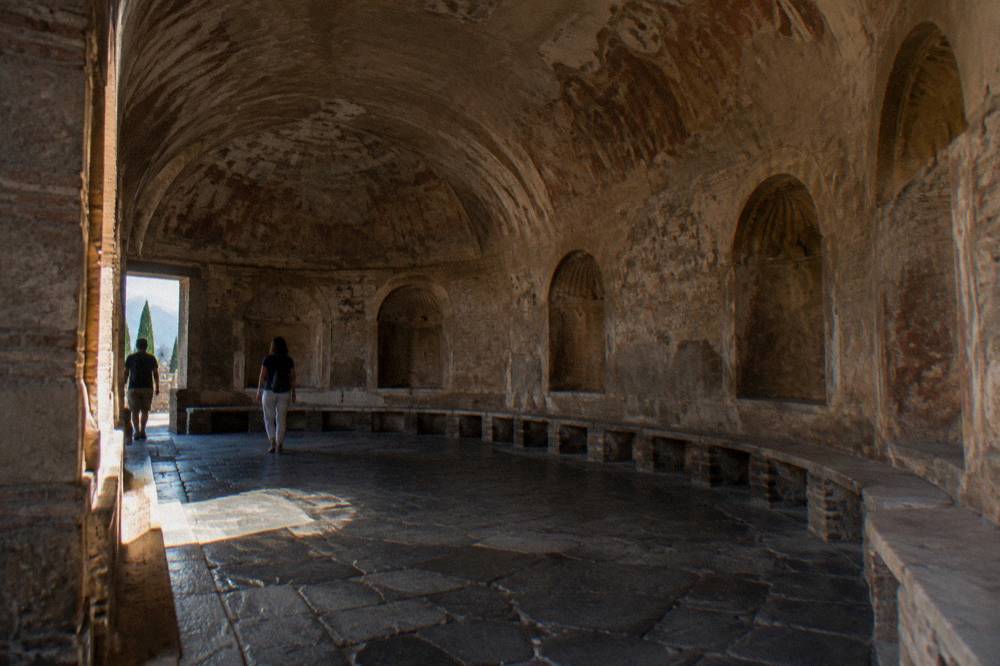
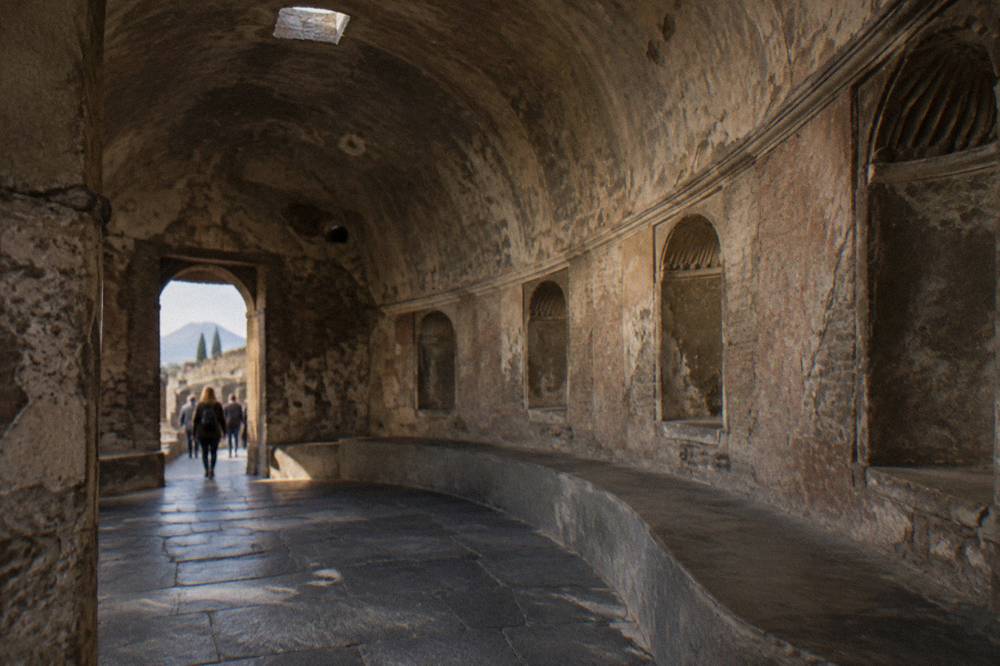
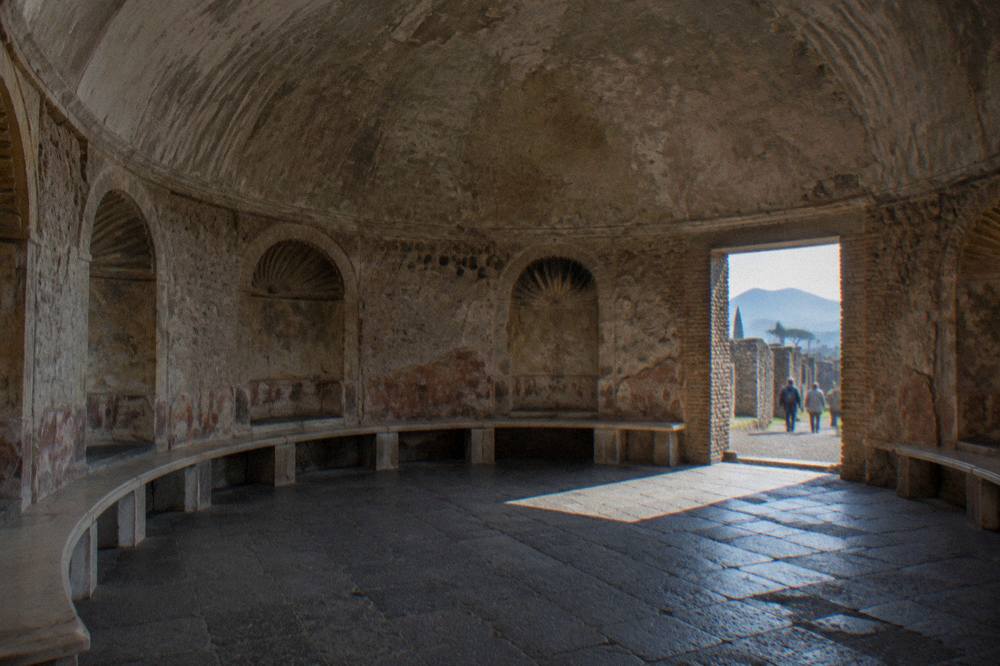
Inside, the sequence to follow is the changing room, the cold plunge, the tepidarium and the caldarium, read together with the furnace space and the hollow wall tiles that carried hot air, and the vaulted ceilings with their light wells are the single visual payoff worth pausing for. The stucco decoration of the warm room is among the building's admired features, and the compression of the whole plan means a visitor standing in one spot can often take in several stages of the bathing sequence at once. Signs of the heating engineering, the raised floors and the flues, are visible in the masonry.
Walk it in order and the architecture explains itself. The changing rooms flank the entrance sequence. The cold bath room held a plunge basin. The tepidarium, the warm room, acted as the hinge of the visit, warm enough to open the pores without shock, and in the Forum Baths it is a room whose decorative treatment repays a slow circuit. The caldarium at the hot end sat directly above the furnace system, with a basin and a marble-lined tub, and its curved vault is pierced by small glazed openings that threw light down into the steamy room, an effect the modern visitor still catches on a sunny day.
The engineering is the quiet star. The floor of the hot rooms rested on short brick pillars, leaving a cavity where furnace-heated air flowed before rising inside box tiles set into the walls, so the rooms were heated from both below and around. That system, the hypocaust, is visible at Pompeii in a completeness few sites match, and at the Forum Baths the compact plan makes the mechanics easy to grasp: furnace at one end, hottest room nearest it, temperature falling room by room toward the cold bath and the street. A visitor who understands that gradient understands every Roman bath house from Hadrian's Britain to Syria.
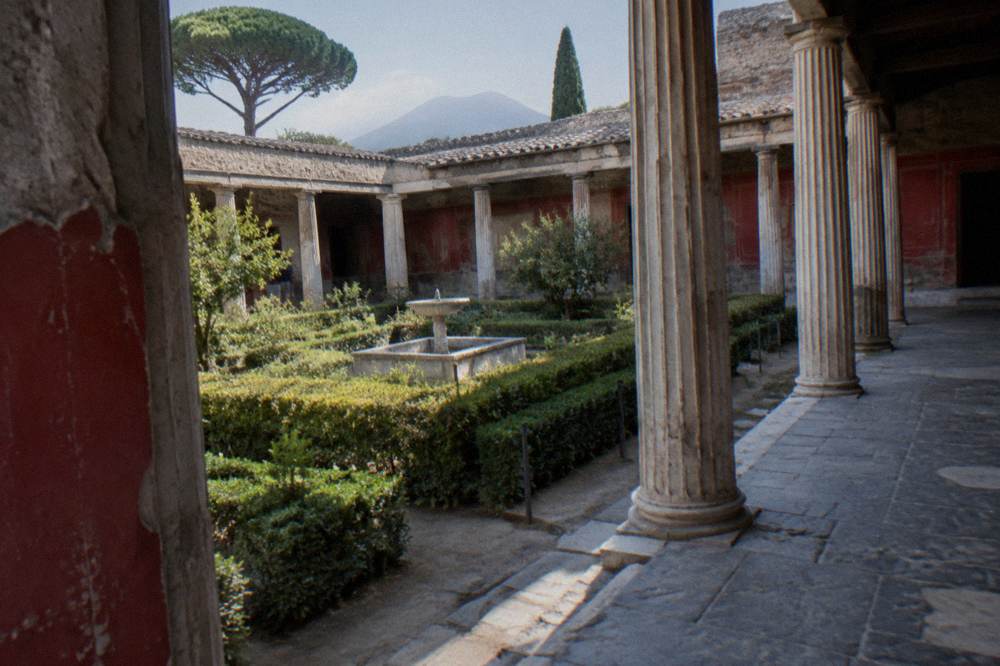
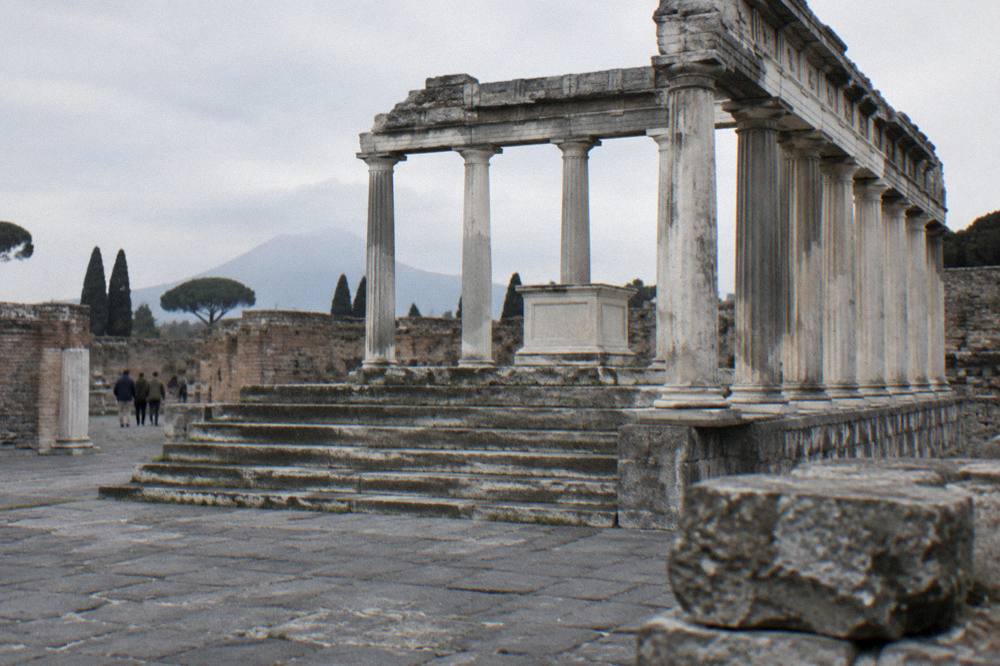
Because the baths stand beside the civic centre, the surrounding block rewards the extra minutes. The Forum itself, with the Temple of Apollo and the basilica, is a one-minute stroll, and the Pompeii Antiquarium exhibit space sits nearby for context and, usefully, shelter. Visitors pairing the baths with the city's most famous private houses, such as the House of the Faun or the House of the Vettii, should simply work west to east or the reverse rather than zig-zagging, since the ancient street grid makes distances deceptively long in the midday heat.
For a first visit or a short one, a guided walk makes a measurable difference at exactly this kind of structure, where the interest is in reading rooms rather than spotting a single landmark. The Skip the Line Guided Tour of Pompeii Led by an Archaeologist is this site's featured recommendation for the Baths and the Forum quarter, since an archaeologist's commentary turns brick flues and stucco vaults into a functioning machine. Check availability on the operator's live listing for current departures.
Those three options frame the realistic choice: a focused small-group archaeologist walk of Pompeii itself, a three-site day trip that adds Herculaneum and Vesuvius from Naples, and a full-day Pompeii and Vesuvius itinerary with lunch included. Travellers basing themselves in Naples for the Vesuvian sites can read the wider Herculaneum and Mount Vesuvius pages before committing to a multi-site day.
How The Forum Baths Compare With The Stabian Baths
The Stabian Baths are the older, larger and more sprawling complex at the southern edge of the old city, while the Forum Baths are the more compact and more richly finished neighbour of the civic centre, and seeing both on one visit is entirely practical. They sit at opposite ends of the main axis of the city, so a walk down the Via dell'Abbondanza from one to the other doubles as a tour of Pompeii's principal street. Neither requires a separate ticket beyond ordinary park admission, and the contrast between the two tells the story of Roman bathing better than either does alone.
The comparison table below holds what the two complexes offer in qualitative terms, since the park publishes no room-by-room measurements to quote.
| Feature | Forum Baths (Central Baths) | Stabian Baths |
|---|---|---|
| Location in the city | Beside the Forum, civic centre | Southern edge, off the Via dell'Abbondanza |
| Scale | Compact, tight urban block | Larger, with palaestra exercise ground |
| Character | Ornate finishes, dense sequence of rooms | Older, more spacious, more engineering on show |
| Ease of routing | On nearly every Forum-centred walk | Pairs with the Via dell'Abbondanza route |
| Combined visit | Both covered by the same park ticket | Both covered by the same park ticket |
The other bath buildings complete the picture. The Suburban Baths near Porta Marina sit close to that entrance and make a convenient first or last stop for anyone entering there. Between them, Pompeii offers a survey of Roman bath architecture that few single sites can match, and the Stabian Baths page on this site carries the detail for that complex.
For visitors deciding how to allocate a single day, the practical advice is simple: the Forum Baths belong on every route, because they sit on the natural path between the Forum and the northern streets, while the Stabian Baths are worth the detour only if the southern half of the city is already on the plan. A visitor combining the baths with the Large Theatre and Odeon or the Pompeii Amphitheatre in the east should budget a full day rather than a half, and the free site map at the entrances, plus the park's own map resources, make the distances clear before setting out.
How Long To Spend At The Forum Baths And Best Time Of Day
Plan on fifteen to thirty minutes inside the Forum Baths themselves, set within a Pompeii visit of at least half a day, and aim for early morning or the last two entry hours, when the light comes low through the vault openings and the walking routes are quieter. The park opens at 9:00 year-round. From 16 March to 14 October the last entrance is at 17:30 and the site closes at 19:00; from 15 October to 15 March the last entrance is at 15:30 and closing is 17:00. Pompeii has no weekly closing day, and closes only 25 December and 1 January unless otherwise communicated.
Crowding follows the time-slot system. The park's current slotting, in force from 16 March to 14 October, allows a maximum of 15,000 entries between 9:00 and 13:00 and 5,000 between 13:00 and 17:30, inside the overall cap of 20,000 visitors per day in place since 15 November 2024. The afternoon is therefore the structurally quieter window, and a 13:00 or later entry is the single most effective crowd tactic available. On the free first Sundays of the month the park has recorded more than 36,000 visitors in a single day, so those dates trade a saved ticket fee against the busiest conditions of the month.
| Period | Opens | Last entry | Closes |
|---|---|---|---|
| 16 March to 14 October | 9:00 | 17:30 | 19:00 |
| 15 October to 15 March | 9:00 | 15:30 | 17:00 |
Weather shapes the day more than many visitors expect. The site is almost entirely open-air, with the baths among the few buildings offering real shade. Open-Meteo's 1991-2020 climate normals for the Pompei grid point show a Mediterranean pattern: about 28.7 to 29.4 degrees as the mean daily maximum in July and August against about 12.2 to 13.2 degrees in January and December, with November the wettest month at about 180 mm of rain and July the driest at about 16 mm. The shoulder months of April, May and October, with mean daily maxima of about 17.7, 21.6 and 21.3 degrees respectively, offer the kindest walking conditions.
Inside the baths, timing changes what you see. The small light wells in the caldarium vault work best when the sun is high, throwing bright shafts into a dim room. Late afternoon, the light warms the stucco of the tepidarium and the building empties as tour groups head back toward the entrances. Either window rewards the visit; the hour to avoid inside the baths is the midday crush of passing groups between 11:00 and 14:00, when the compact rooms fill and clear in waves. Step out, take the shade by the Forum, and return ten minutes later.
Forum Baths Pompeii Tickets And Opening Hours For 2026
In 2026 the Pompeii Express ticket at EUR 20 covers the ancient city including the Forum Baths, the Pompeii+ ticket at EUR 25 adds the suburban villas and the three-site ticket at EUR 30 adds Oplontis, the Stabiae sites and Boscoreale, and all of these prices end on 31 December 2026. Entry is free for everyone under 18 and for all visitors on the first Sunday of the month, and EU citizens aged 18 to under 25 pay a reduced EUR 2. From 1 January 2027 a single EUR 25 ticket replaces the whole structure, valid 30 days with one entry per site.
The coming change is worth planning around. The park's release of 14 September 2026 sets out the new tariff system: one EUR 25 ticket covering all park sites, the three smaller sites, Oplontis, Stabiae and Boscoreale, staying at EUR 8 each when bought individually, and the annual MyPompeii Card staying at EUR 45, with nominative tickets and the 20,000-per-day cap retained. Anyone holding a 2026 ticket for the free partner sites should also note those tickets are valid 30 days from issue. The full ticket structure is covered in detail on the park tickets guide, including where the Villa Poppaea at Oplontis and the Boscoreale Villa Regina fit.
| Ticket (2026 prices) | Price | Covers | Validity |
|---|---|---|---|
| Pompeii Express | EUR 20 | The ancient city, including the Forum Baths | Same-day, 2026 structure |
| Pompeii+ | EUR 25 | Express plus suburban villas route, Boscoreale and shuttle | Same-day, 2026 structure |
| 3-day ticket | EUR 30 | Pompeii+ plus Oplontis, Stabiae sites, Boscoreale | Three days, 2026 structure |
| Single EUR 25 ticket from 1 Jan 2027 | EUR 25 | All park sites | 30 days, one entry per site |
| MyPompeii Card | EUR 45 | Annual pass | Annual, EUR 10 reduced |
Practical rules attach to every ticket. Tickets are nominative, non-transferable and non-refundable except in extraordinary closure, and identification may be checked at every entry. Bags larger than 30x30x15 cm must go to left luggage, a rule that catches travellers with cabin-sized cases, and the regulations also bar drones without authorisation. Ticket offices sit at Porta Marina, Piazza Esedra and Piazza Anfiteatro, with online sales through the vivaticket platform linked from the park's own ticketing page. Booking ahead is sound practice in the high-slot morning window and essential on free first Sundays.
Guided Tours That Include The Forum Baths
Yes, most guided tours of Pompeii include the Forum Baths, because the complex sits beside the Forum on the standard circuit, so most small-group guided walks route through or at least past it. For this particular building, archaeologist-led tour options are the strongest fit. Tour prices, ratings and durations are listed on each operator's live listing rather than printed here, and free-cancellation terms are common across the roster, so checking the live listing before the travel date is the reliable way to compare. The choice that matters is between a Pompeii-only walk and a combined day with Vesuvius or Herculaneum.
For a two-hour focused visit, the Pompeii Small Group Tour with an Archaeologist starts inside the park and covers the highlights with a ticket included, an option that suits travellers already staying near Pompei or arriving independently by train.
Travellers who want the baths and a fuller day together have two natural extensions. The Pompeii Tour and Lunch with Wine Tasting Experience pairs the ruins with a meal and tasting on the slopes of Vesuvius, a slow-paced full-day format. The guided Vesuvius wine pages on this site cover the vineyard context in more depth.
Cruise passengers face the tightest clock, and the shore-excursion formats from Naples are built around port timing; the site's shore-excursion guide walks through the trade-offs. Families have their own considerations, and the children's itinerary page lists what holds a child's attention, with the baths' vaults and furnace spaces ranking well with children old enough to enjoy the engineering.
One honest note on guidance quality: the park's own trained guides and the external archaeologist-led tours consistently outperform audio-only visits at bath houses, because the building's interest is structural rather than object-based. The audio guide and apps comparison on this site covers the self-guided route for travellers who prefer it, and the entry ticket with audio guide is the budget format for that approach. Whichever format wins, book the earliest or latest slot available and let the midday hours belong to lunch in modern Pompei.
Tips For Visiting And Photographing The Baths
Wear closed shoes with grip, carry water, and bring a bag that fits within the 30x30x15 cm limit. For the best photos, go early or late in the day, when shafts of light pour through the light wells, fill the caldarium, and illuminate the vaults at their most striking. The paving inside and around the baths is ancient stone, worn and uneven, and the surfaces are slippery when wet, which matters in the wetter months from October onward when around 129 to 180 mm of rain falls per month in the November-to-December stretch. There is no shade queue and no shelter inside the walking circuit beyond buildings like the baths themselves.
Photography rewards patience here. The compact plan means midday groups clear the rooms in waves, so standing back for ten minutes often delivers an empty vault. The raised hypocaust pillars and the box-tile flues photograph well in raking light, and the stucco reliefs of the warm room read best with a long lens from the doorway rather than a wide angle pressed close. Tripods and drones fall under the park's regulations, with drones barred without authorisation, and the usual etiquette applies: do not climb the masonry, do not touch the stucco, and leave every stone where it lies.
Facilities are basic but findable. The site's own page on toilets and facilities maps what exists and where, and the advice is to use the facilities at the entrances before setting out, since the walking circuit is long. Food inside the park is limited; the where-to-eat page covers the realistic options in modern Pompei on either side of the visit. In summer, the mean daily maximum runs about 29.4 degrees in August, and the baths are one of the few interiors on the circuit that stays cool, a small mercy worth scheduling into the hottest hours.
A final word on pacing. Arrive with the sequence in mind, changing room to cold bath to warm room to hot bath, and read the building backwards from the furnace, and the structure will explain itself. That is the whole trick of Pompeii, learned best in a building small enough to hold in one view.
Common Questions About The Forum Baths In Pompeii
Do I need a separate ticket for the Forum Baths in Pompeii?
No. The Forum Baths are inside the main excavated city and are covered by ordinary park admission: the EUR 20 Pompeii Express ticket in 2026, or the single EUR 25 ticket for all park sites from 1 January 2027. Entry is free for under-18s and for everyone on the first Sunday of the month.
How long does a visit to the Forum Baths take?
Allow fifteen to thirty minutes for the baths themselves. Set within a wider Pompeii visit, plan at least half a day for the city, since the excavated area covers 44 hectares and the baths sit at the Forum end of the site.
Are the Forum Baths and the Stabian Baths the same thing?
No. The Forum Baths, also called the Central Baths, stand beside the Forum and are the more compact and richly finished complex. The Stabian Baths are the older, larger complex on the southern edge of the old city, off the Via dell'Abbondanza. Both are on the same park ticket.
What were the rooms of a Roman bath house used for?
Visitors undressed in the apodyterium, took a cold plunge in the frigidarium, warmed through in the tepidarium and finished in the hot caldarium, whose floor and walls were heated by furnace air circulating under raised floors and inside hollow wall tiles.
When is the best time of day to see the Forum Baths?
Early morning at opening, 9:00, or the afternoon window from 13:00, when the park's slot system caps entries at 5,000 against 15,000 in the morning. Midday brings the heaviest flow of passing tour groups through the compact rooms.
Are the Forum Baths accessible for visitors with mobility difficulties?
The park's published "Pompeii for All" route enters at Piazza Anfiteatro and may exit at Piazza Anfiteatro or Piazza Esedra via the Antiquarium lift, but the bath building itself involves ancient thresholds and steps, so check current conditions with the park before planning to enter.
The Forum Baths are the quiet climax of any walk through the civic heart of Pompeii: small enough to grasp in one visit, engineered in plain sight, and standing a minute from the Forum that gave them their name. Pair them with the Stabian Baths if time allows, book the afternoon slot if crowds matter, and let the vaults do the rest.