Boscoreale
Boscoreale preserves a working Roman farm, Villa Regina, buried by the same AD 79 eruption of Vesuvius that destroyed Pompeii, together with an antiquarium of finds from the villas of the Vesuvian countryside.
Short answer
Villa Regina at Boscoreale is a rustic Roman farmstead buried by Vesuvius in AD 79 and reopened as an archaeological site in Campania, southern Italy. In 2026 a Boscoreale ticket costs EUR 8 on its own, or the site is included in the Pompeii+ ticket at EUR 25 and the 3-day ticket at EUR 30, both of which cover the shuttle.
Boscoreale is the quiet countryside chapter of the story that Pompeii tells. The ancient city of Pompeii, in Campania, southern Italy, beside the modern town of Pompei and about 24 km by road from Naples, was buried by the eruption of Mount Vesuvius in AD 79, and so was the farmland around it. At Boscoreale, a short drive inland from the excavations, that buried countryside survives: Villa Regina, a modest Roman wine-producing farmstead, still stands with its dolia, its presses and its storage rooms, much as the eruption left them. This guide covers what the site is, what tickets cost in 2026 and what changes from 2027, how to get there, and how it compares with the other satellite sites of the Vesuvian park.
What Is Boscoreale Within The Archaeological Park Of Pompeii?
Boscoreale preserves Villa Regina, a working farm of the Roman period, plus an antiquarium displaying finds from the rural villas of the Vesuvian plain. It is not part of the ancient city itself and has its own entrance and its own ticket.**
The site answers a question the ruins of Pompeii cannot: what did the land around the city look like, and how did its people actually make a living? The plain north of Pompeii was wine country, and Villa Regina was built for that economy. The eruption of Vesuvius, traditionally dated to 24 August AD 79, sealed the farm under volcanic material in the same hours that buried the city, and the depth of that burial preserved organic and everyday material that city ruins rarely keep.
The name Boscoreale belongs to the modern town in the Vesuvian countryside; the archaeological site sits in its territory. In English-language visitor information the park lists the site as Boscoreale, and pairs it with the Antiquarium of Boscoreale, the museum building at the same location. The park's visitor regulations and ticketing page treat Villa Regina, the Antiquarium and the surrounding excavated farm buildings as one destination.
For orientation, the park's other satellite sites are covered in depth elsewhere on this site: Oplontis and its villa, the villas of Stabiae, and Herculaneum. Together with Boscoreale they make up what the park calls the "other sites", each covered in detail on its own page, and each reachable from the ancient city in well under a day. The unifying theme is the Vesuvian catastrophe of AD 79, whose eruption date remains a scholarly debate the park itself has addressed in its own e-journal.
How Much Do Boscoreale Tickets Cost In 2026?
In 2026 a Boscoreale ticket costs EUR 8 on its own, under the park's price list in force from 12 January 2026. The site is also included in two multi-site tickets: Pompeii+ at EUR 25, which adds the suburban villas route and the shuttle, and the 3-day ticket at EUR 30, which adds Oplontis, the Stabiae villas and museum, and Boscoreale. From 1 January 2027 the structure changes to a single EUR 25 ticket covering all park sites.
The park's ticketing page sets out the 2026 ladder clearly, and it ends on 31 December 2026. The table below reproduces it, with the suburban villas addition and the annual card alongside.
| 2026 ticket | Price | What it covers |
|---|---|---|
| Pompeii Express | EUR 20 | The ancient city of Pompeii only |
| Pompeii+ | EUR 25 | City, suburban villas route, Villa Regina and Antiquarium Boscoreale, shuttle |
| 3-day ticket | EUR 30 | Pompeii+ plus Oplontis, Villa Arianna, Villa San Marco, Stabiae museum, Boscoreale |
| Other sites individually | EUR 8 | Boscoreale, Oplontis or the Stabiae museum, one site |
| My Pompeii Card (annual) | EUR 45 | Annual park pass, EUR 10 reduced |
| Express holders adding the villas route | EUR 8 | Card only, at the Porta Ercolano / Street of the Tombs entrance |
Two concessions matter for families and younger travellers. Entry is free for everyone under 18, and free for all visitors on the first Sunday of the month. EU citizens aged 18 to under 25 pay a reduced EUR 2. Tickets are nominative, identity may be checked at every entry, and the park caps visitors at the ancient city at 20,000 per day, a limit in force since 15 November 2024.
The change coming on 1 January 2027 deserves a line of planning thought now: a single EUR 25 ticket, valid 30 days, one entry per site, will replace the whole Express/Plus/3-day ladder, while the three smaller sites, including Boscoreale, stay EUR 8 individually and the My Pompeii Card stays EUR 45. If a 2026 trip includes Pompeii plus two or more satellites, the arithmetic already favours Pompeii+ or the 3-day ticket; from 2027 the choice makes itself. The park's ticketing page carries the detail, and our guide to Pompeii's ticket types works through the combinations.
Whether a guided product makes sense at Boscoreale itself is a fair question. No tour in the current roster visits Villa Regina as its headline stop; the bookable guided products concentrate on Pompeii, Herculaneum and Vesuvius. A practical pattern is a guided morning in the city or at Herculaneum, then an independent afternoon at Boscoreale under the Pompeii+ ticket, using the shuttle the park lists as part of that ticket.
How Do You Get To Boscoreale From Pompeii Or Naples?
The Pompeii+ and 3-day tickets include the shuttle the park operates between the ancient city and Villa Regina with the Antiquarium at Boscoreale, which is the transport method the park itself bundles. The Circumvesuviana railway serves Pompei Scavi but Boscoreale is not on it.
The practical takeaway: reach the ancient city first, then use the shuttle or a short drive. The Circumvesuviana line from Napoli Garibaldi to Pompei Scavi-Villa dei Misteri takes 29 to 35 minutes on scheduled times computed from the operator EAV's own timetable data, and the line continues to Sorrento, with Pompei Scavi to Sorrento taking 34 to 40 minutes. EAV's own pages carry the current timetable, and one recent change matters: the Campania Express, the premium rail alternative, has been suspended since 1 October 2026 until further notice, so the regular Circumvesuviana services and road transport are the options that exist.
| Route | Scheduled time | Source basis |
|---|---|---|
| Napoli Garibaldi to Pompei Scavi-Villa dei Misteri | 29-35 min | EAV timetable data |
| Pompei Scavi to Sorrento | 34-40 min | EAV timetable data |
| Pompei Scavi to Boscoreale site | Shuttle included in Pompeii+ / 3-day | Park ticketing page |
| Naples to Pompei Scavi by road | 24 km | Road network data |
| Sorrento to Pompei Scavi by road | 26 km | Road network data |
A rental car or taxi covers Pompei to Boscoreale easily, and visitors combining the crater should note that Vesuvius's Gran Cono is online-booking only. Our Circumvesuviana guide covers the rail side in full, and the parking guide handles the driving side.
One pattern that suits Boscoreale well is a two-site day built around a guided product. A small-group archaeologist tour covering Pompeii and Herculaneum leaves Boscoreale as the independent third stop, and because the Pompeii+ ticket already includes the shuttle, the marginal cost of the farm visit is the ticket you may already hold. The operator's live listing states the meeting point and inclusions before payment.
What Can You See At The Villa Regina Site?
Villa Regina shows a complete Roman farmstead: the press room with its wine press, the cellared dolia sunk into the floor for storing the vintage, the torcularium where grapes were crushed, courtyard and storerooms, and the excavated remains of the working buildings around them. Unlike the urban houses of Pompeii, the villa reads as a production site, compact, functional and arranged around the wine year rather than around reception rooms and display.
The dolia are the signature sight: large clay vessels, embedded in the cellar floor, each holding a season's wine. Their number gives a sense of the farm's output in a way no city ruin does. Around them stand the fittings of the trade, the press, the crushing floor and the storage jars, and the buildings' modest finishes make the contrast with Pompeii's decorated townhouses instructive rather than disappointing.
| Feature at Villa Regina | What it is | What it tells the visitor |
|---|---|---|
| Press room | Housing for the wine press | The farm's industrial core |
| Dolia cellar | Clay storage vessels set in the floor | Scale of wine production |
| Torcularium | Grape-crushing area | The processing sequence |
| Courtyard and storerooms | Service buildings of the farmstead | Daily working layout |
| Antiquarium finds | Objects from Vesuvian rural villas | Domestic and agricultural life |
The villa also carries the human story of the eruption. Pliny the Younger's letters describe the catastrophe his uncle, Pliny the Elder, died in, and the farm's burial belongs to the same hours. The date is traditionally given as 24 August AD 79 from the oldest manuscripts; the park's own e-journal states that the alternative 24 October date has no evidentiary basis, while conceding that August is not certain either, so honest signage-reading here keeps an open mind.
For readers weighing the city's own highlights against the countryside, the decorated houses, the House of the Vettii or the House of the Faun, Villa Regina offers the opposite register: no frescoed reception rooms, but a business, preserved mid-season. The two experiences together give a fuller picture of Roman Campania than either alone.
What Is The Antiquarium Of Boscoreale?
The Antiquarium of Boscoreale is the museum at the Villa Regina site, displaying finds from the farm and from the rich rural villas of the Vesuvian plain, including the household, agricultural and carbonised material that survived burial. It exists because Boscoreale's villas, unlike the crowded city, preserved organic remains, seeds, wood, foodstuffs and farming equipment, in conditions that kept them legible. It is included in the same EUR 8 ticket as the villa.
The museum's role in the park is specific: it carries the countryside's evidence. Where the Antiquarium at Pompeii presents the city, and the Naples museum holds the fine art, Boscoreale's antiquarium holds the plain's working life, the tools, the storage ware, the remains of crops and animals, and the casts and fittings that show how a Roman farm was run.
| Museum in the area | Focus | Where it stands |
|---|---|---|
| Antiquarium of Boscoreale | Rural villas, farming, organic finds | At the Villa Regina site |
| Pompeii Antiquarium | The ancient city's own story | Inside the archaeological park |
| Naples National Archaeological Museum | Fine art and mosaics from the Vesuvian sites | Naples |
Boscoreale's villas have a further claim on art history: the plain's great luxury villas yielded famous wall paintings and treasure now held in museums outside Italy, a story of excavation and dispersal that the antiquarium frames. This guide leaves that chronology to the museum's own panels and points instead to what a visitor actually sees: the farm, its objects, and the agricultural world the eruption froze.
A useful pairing is with the Villa of the Mysteries, the suburban villa at Pompeii's edge, which shows the luxury end of the same villa culture that Villa Regina shows at the working end. Read together they explain why the Roman elite built in the Vesuvian countryside and how the whole district, city and farm alike, shared one fate in AD 79.
How Does Boscoreale Compare With Oplontis And The Stabiae Villas?
Boscoreale, Oplontis and the Stabiae villas are the park's three satellite sites outside Pompeii and Herculaneum, each EUR 8 individually in 2026 and each covered by the 3-day ticket. Oplontis, at Torre Annunziata, is a grand villa associated with Nero's wife Poppaea, all frescoes and pools; Stabiae, at Castellammare di Stabiae, pairs two cliff-top villas with a museum; Boscoreale is the working farm. They suit three different moods.
The park's timetable page is explicit that the Tuesday closure attaches to Oplontis and to the Stabiae villas and museum, while the ancient city of Pompeii has no weekly closing day.
| Satellite site | Location | Character | 2026 individual ticket |
|---|---|---|---|
| Boscoreale (Villa Regina) | Boscoreale, inland plain | Working wine farm plus antiquarium | EUR 8 |
| Oplontis | Torre Annunziata | Luxury villa, frescoes, Poppaea association | EUR 8 |
| Villa Arianna and Villa San Marco | Castellammare di Stabiae | Cliff-top pleasure villas | EUR 8 (with the museum) |
| Stabiae museum | Castellammare di Stabiae | Finds from the Stabiae sites | EUR 8 |
Choosing between them is mostly a matter of time and appetite. A visitor with one full day and a 3-day ticket can take the city in the morning, then choose one satellite; the wine-country plain suits travellers interested in agriculture and everyday life, Oplontis suits those who came for the painting, and Stabiae suits those who want the view as well as the walls. The comparison between the two big buried towns is covered separately in Pompeii versus Herculaneum, a decision that comes before this one in the itinerary.
Season matters more than visitors expect. The plain is hot in summer: Open-Meteo's 1991-2020 normals for the Pompei area show July and August with mean daily maxima of about 28.7 and 29.4 degrees, while November is the wettest month at about 180 mm of rain and July the driest at about 16 mm. Villa Regina's outdoor courtyard and the walk between buildings are best in the shoulder months, when the numbers read about 21.6 degrees in May and about 21.3 in October.
Should You Visit Boscoreale With A Tour Or On Your Own?
Boscoreale works well on your own, because the site is compact, the antiquarium carries the explanation, and no guided product in the current roster makes Villa Regina its centrepiece. The guided tours that help are the ones covering Pompeii and Herculaneum: an archaeologist-led small group, or a private guide for your own party, adds the context the farm assumes. The pattern that fits best is a guided morning in the city, then an independent afternoon at Boscoreale on a ticket you already hold.
The small-group archaeologist tour of Pompeii and Herculaneum is the natural companion, and it is the product this site features alongside Boscoreale. You can read the full description on the tour's own page, and Check availability on the operator's live listing before finalising the itinerary.
A private alternative suits families and small parties who want the pace set for them.
For visitors based in Naples who want the crater in the same day, the Pompeii-and-Vesuvius day trip with a pizza lunch is the format that leaves a workable afternoon, though it does not call at Boscoreale; pairing it with a separate shuttle-based visit to the farm, on a later day or the day before, is the realistic plan.
Independent visitors need very little: a ticket bought at the site or held as part of Pompeii+ or the 3-day ticket, identification for the nominative check, and sensible shoes. The park's regulations apply here as at the city: bags larger than 30x30x15 cm go to left luggage, drones need authorisation, and tickets are non-transferable and non-refundable except on extraordinary closure. The free first-Sunday entry applies park-wide.
How Should You Plan A Day Around Boscoreale?
Start your Boscoreale day at the ancient city when the park opens, then take the included shuttle to Villa Regina in the early afternoon, allowing about an hour at the farm plus another at the antiquarium. If you visit between 15 October and 15 March, last entrance is 15:30 and closing is 17:00, so the winter schedule leaves no slack for a same-day satellite visit.
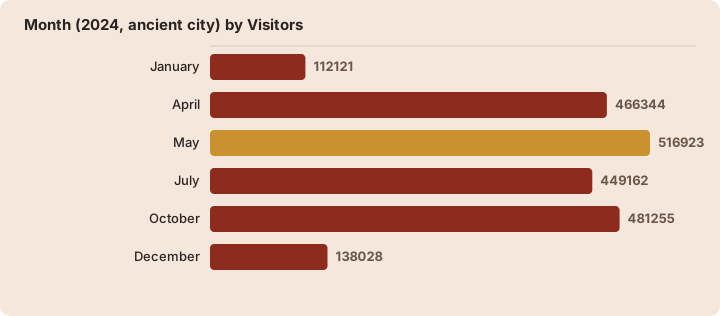
The longer season, not the winter one, is when the two-site day works, so plan Boscoreale for the months between mid-March and mid-October or give the farm its own morning. The park's own visitor numbers show why timing matters beyond the clock, too: the ancient city received 4,000,090 visitors in 2025, and the monthly pattern for 2024 peaks in May at 516,923 and October at 481,255, against 112,121 in January.
| Month (2024, ancient city) | Visitors |
|---|---|
| January | 112,121 |
| April | 466,344 |
| May | 516,923 |
| July | 449,162 |
| October | 481,255 |
| December | 138,028 |
Build the day around the entrances that exist. The ancient city's ticket offices are at Porta Marina, Piazza Esedra and Piazza Anfiteatro, and the suburban villas route uses the Porta Ercolano / Street of the Tombs entrance, where Express holders can add the villas for EUR 8 by card. Boscoreale is reached from the city side, not from a Pompeii entrance, so the shuttle or a vehicle is the bridge between the two.
A final packing note follows from the park's rules rather than from the weather: the 30x30x15 cm bag limit applies, and the farm site has open ground between buildings, so the same footwear advice as the city applies. Our page on what to wear to Pompeii covers the details, and the map page ties the entrances, the shuttle and the satellites together.
Common Questions About Boscoreale
How much does Boscoreale cost in 2026?
A Boscoreale ticket costs EUR 8 individually in 2026. The site is included in the Pompeii+ ticket at EUR 25 and the 3-day ticket at EUR 30, both of which include the shuttle. From 1 January 2027 a single EUR 25 ticket covers all park sites, with Boscoreale still EUR 8 on its own.
Is Boscoreale included in the Pompeii ticket?
The basic Pompeii Express ticket at EUR 20 covers the ancient city only. Boscoreale is included in Pompeii+ (EUR 25) and the 3-day ticket (EUR 30); Express holders can add the suburban villas route for EUR 8 at the Porta Ercolano entrance, though the simplest route to Boscoreale is Pompeii+ with its shuttle.
How do you get from Pompeii to Boscoreale?
The park operates a shuttle to Villa Regina and the Antiquarium that is included in the Pompeii+ and 3-day tickets. By road the site lies inland from Pompei in the Vesuvian countryside; the Circumvesuviana railway does not serve Boscoreale directly, so the shuttle, a taxi or a hire car completes the trip.
Is Boscoreale worth visiting?
For visitors with a second half-day and an interest in Roman daily life, yes: Villa Regina is the best place in the Vesuvian park to see a working farm, its wine presses and its storage dolia, and the antiquarium holds the organic finds the city sites rarely preserve. Travellers with only one day usually do better spending it inside Pompeii itself.
What was Villa Regina at Boscoreale?
A modest Roman farmstead built around wine production, with a press room, a cellar of dolia sunk into the floor, and service buildings around a courtyard. It was buried by the eruption of Vesuvius in AD 79, traditionally dated to 24 August, and excavated as part of the exploration of the Vesuvian plain.
When is Boscoreale free?
Entry to the park's sites is free on the first Sunday of every month, and free at all times for visitors under 18; EU citizens aged 18 to under 25 pay a reduced EUR 2. The same concessions apply across the Parco Archeologico di Pompei.
Boscoreale will never have the crowds of the Forum or the Amphitheatre, and that is precisely its value: it is where the Roman Vesuvius district stops being a spectacle and becomes a working landscape, one that the same eruption of AD 79, whatever exact summer or autumn day it fell on, preserved down to the wine in the cellar. Give it the spare half-day your itinerary can find, and the whole story of Pompeii, city and country, clicks into place. This page is part of Pompeii Travel Guide, where the ticket, transport and itinerary decisions around the park are covered in full.