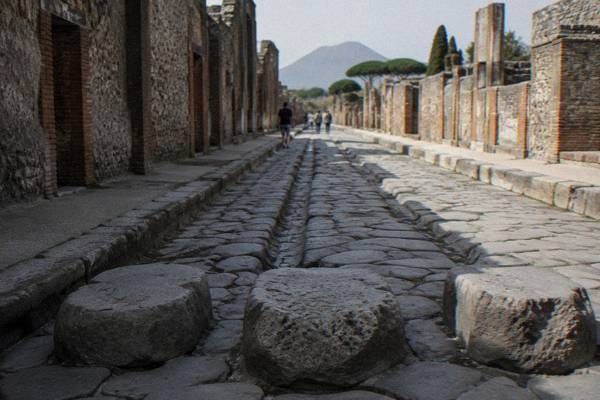
Thermopolium Pompeii
The Thermopolium of Vetutius Placidus is one of the best-preserved Roman snack bars in Pompeii, the ancient city buried by Vesuvius in AD 79 and now an archaeological park in Campania, southern Italy, about 24 km from Naples.
Short answer
The Thermopolium of Vetutius Placidus is a Roman street-side food counter in Pompeii, the archaeological park in Campania, Italy, about 24 km from Naples. Its masonry counter still holds the large clay jars that once kept hot food and drink, and its painted lararium and shop signs survive on the walls. Park entry in 2026 costs EUR 20 for the ancient city, and a single EUR 25 ticket for all park sites starts on 1 January 2027.
The Thermopolium of Vetutius Placidus is a Roman street counter for hot food and drink, standing in the ancient city of Pompeii in Campania, southern Italy, about 24 km by road from Naples. Vesuvius buried the city in AD 79, and the ash that ended its life preserved the shop exactly as it stood, from the masonry counter to the painted figures on the shrine behind it. For visitors, it is one of the clearest windows in the whole park onto how ordinary Romans ate when they were out and about: no grand villa, no temple, just a busy commercial counter on a main street, with the jars that held the day's cooking still set into its top.
What Is The Thermopolium Of Vetutius Placidus In Pompeii?
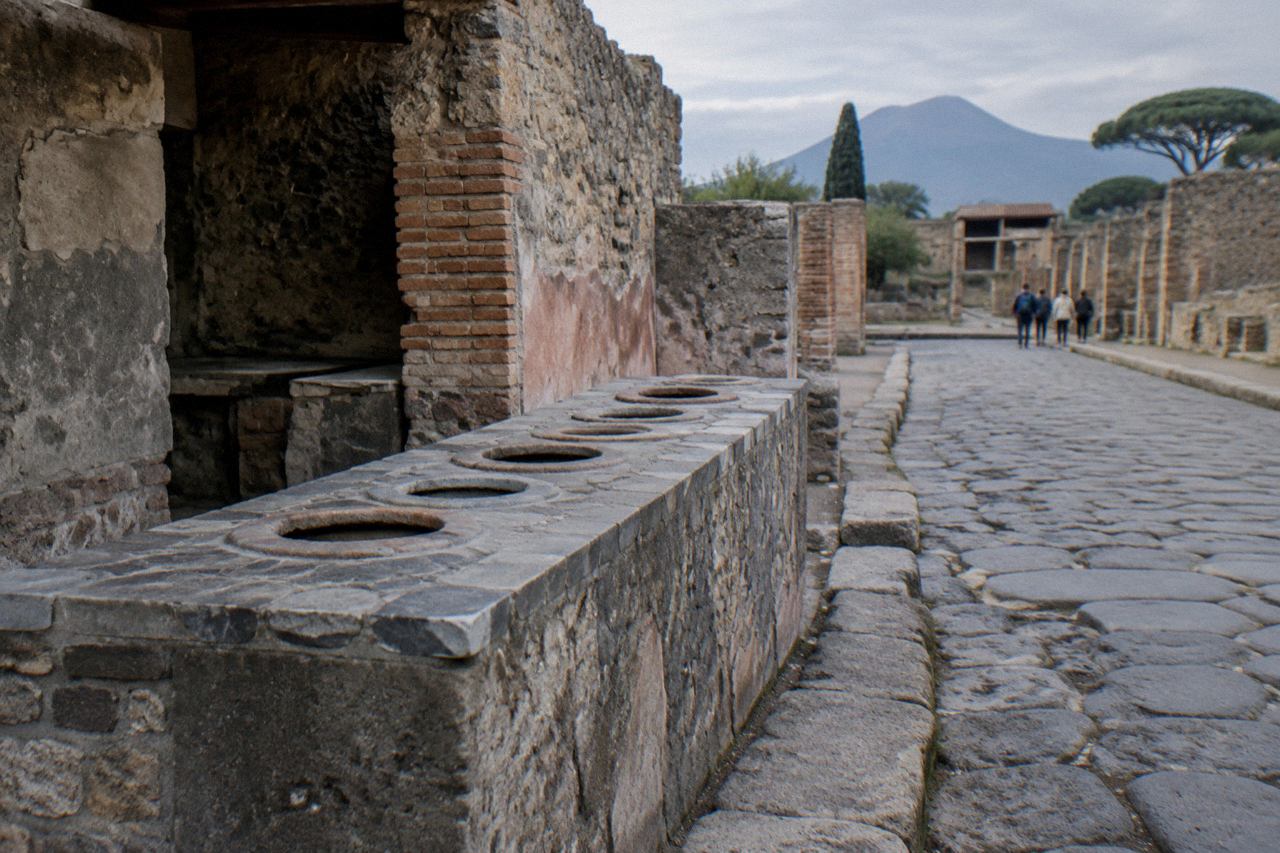
A thermopolium was the Roman equivalent of a snack bar or takeaway: a masonry counter opening onto the street, with large clay jars called dolia sunk into its top to hold hot dishes, and the Thermopolium of Vetutius Placidus in Pompeii, Italy, is among the finest surviving examples anywhere. Its counter, its painted decoration and its household shrine were sealed by the eruption of AD 79, traditionally dated to 24 August, and excavated intact. The name comes from an inscription and from the painted signs on the premises, which advertise the shop's goods to a passing trade of residents, travellers and workers who had no kitchen of their own. The building combines the food counter with the owner's house, a pattern repeated across Pompeii wherever foot traffic justified it. The park's excavated area covers 44 hectares of the ancient city, and food counters like this one appear on street corners throughout it, which tells you how everyday this kind of eating was.
The word itself comes from Greek: thermos means hot, and polein means to sell. A thermopolium sold warmed wine, spiced drinks, soups, stews, olives, cheese and baked goods, served over the counter in the jars set into the top. Nothing about the concept is foreign to a modern traveller. It is a hot-food kiosk, run by an owner who lived behind or above it, serving customers who ate standing up or carried their food away.
What sets this particular counter apart is the completeness of the decoration. Behind the counter a painted lararium, a household shrine, shows the guardian spirits of the household alongside gods of commerce, and the shop's painted advertisements name the proprietor. The combination of a working food counter with a devotional image gives the site its personality: commerce and religion sharing one wall, exactly as they did in daily Roman life. The Pompeii Travel Guide editorial desk covers the practical side of the park in a separate article on Pompeii tickets and entry options, which explains the current pricing in full.
Where To Find The Thermopolium Inside The Archaeological Park
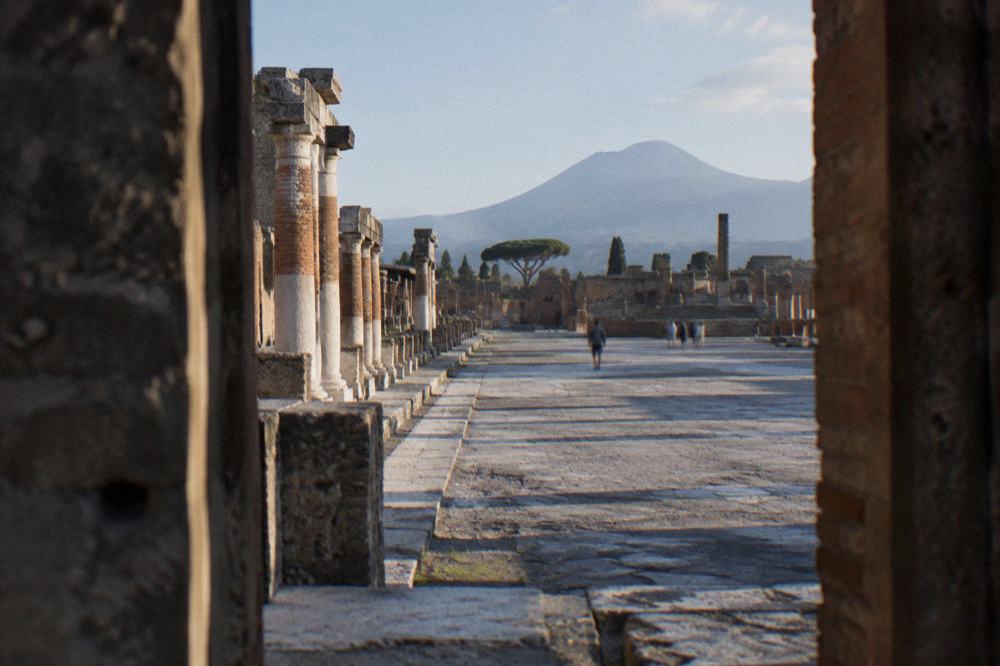
The Thermopolium of Vetutius Placidus stands on the Street of Abundance, Pompeii's main east-west thoroughfare, a short walk from the Forum, inside the archaeological park in Campania, Italy; it is a standard stop on guided routes and easy to reach from the Porta Marina entrance. The park has three ticket offices, at Porta Marina, Piazza Esedra and Piazza Anfiteatro, and the site lies in the central block of streets, so it fits naturally into a route that takes in the Forum, the baths and the residential streets. Visitors arriving by train at Pompei Scavi-Villa dei Misteri come through Porta Marina and walk the decumanus toward the centre.
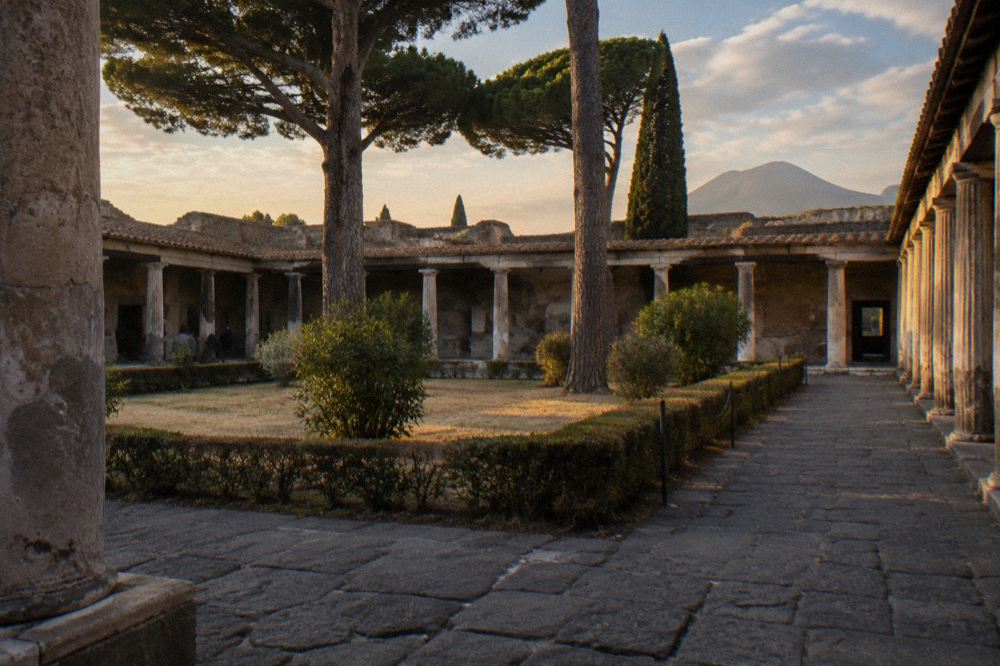
Planning the walk matters, because the park is large and the midday heat is real. The excavated area of 44 hectares holds hundreds of buildings, and a route that wanders without a plan can double the distance walked. The Street of Abundance runs from near the Forum toward the amphitheatre end of the city, and a thermopolium crawl along it pairs well with the Bakery of Modestus, where the ovens and millstones of a commercial bakery survive, and with the Forum of Pompeii, the civic heart of the city. The park map page shows the layout and the entrances before you set off.
For travellers basing themselves in Naples, the counter is a short train ride away, and for those combining the ruins with the region's food culture, the same day can hold both the ancient fast food and the living version. The Naples food walk with a local expert is the site's featured pairing for this page, and Check availability if the pairing appeals. The thermopolium itself needs only ten or fifteen minutes at the counter, which makes it an easy add-on to any central route rather than a destination in its own right.
How A Roman Thermopolium Worked
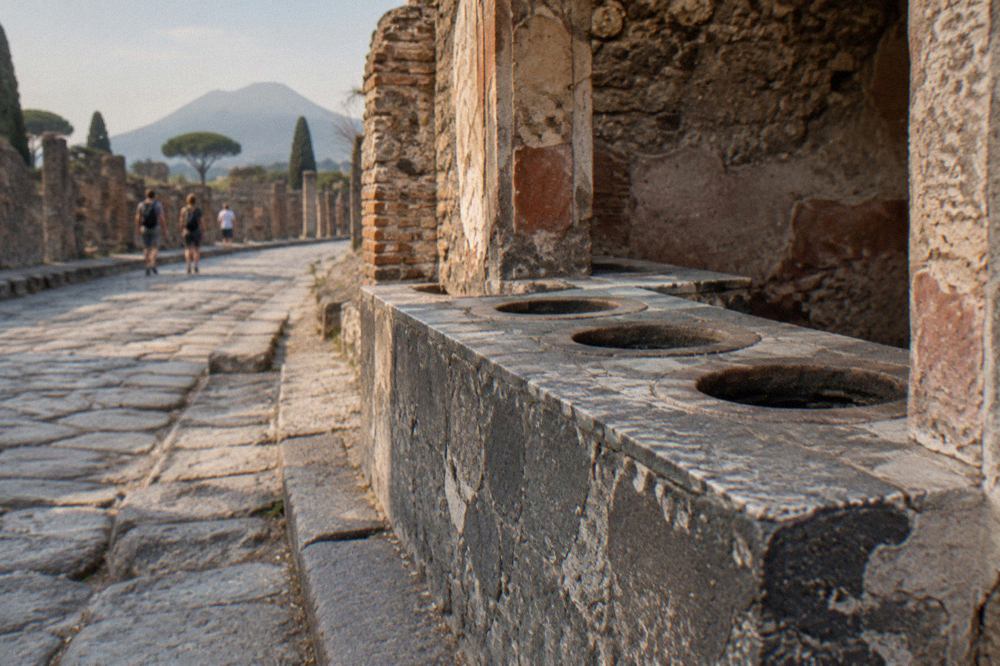
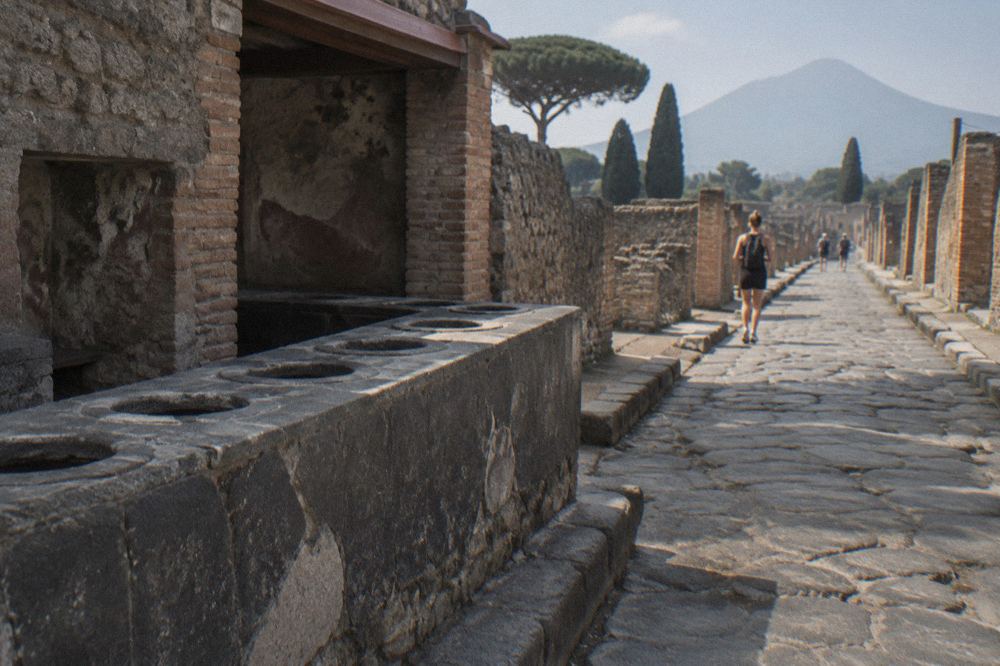
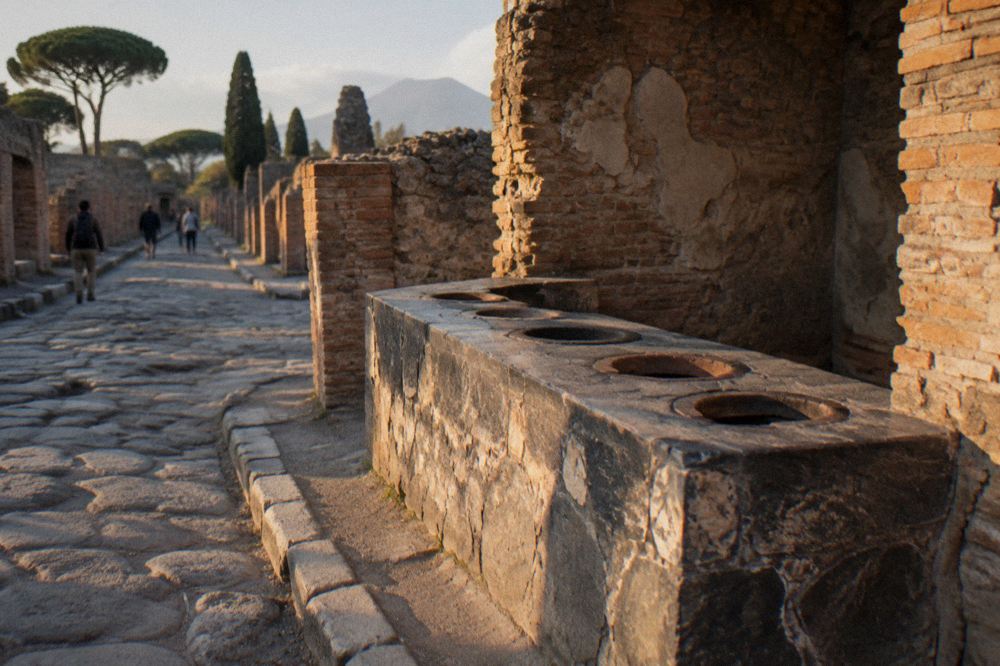
A thermopolium worked like a masonry version of a modern hot-food counter: dishes cooked elsewhere in the building were ladled from wide-mouthed jars sunk into the counter top, drinks were warmed and mixed behind it, and customers ate standing at the street face or took food away in their own containers. The jars, called dolia, were set deep into the masonry so their contents held heat, and their rims sit flush with the counter today, exactly as they did in AD 79. The counter faces the street with a wide serving opening, and the painted images and inscriptions on the walls advertised what was on offer, the Roman answer to a menu board.
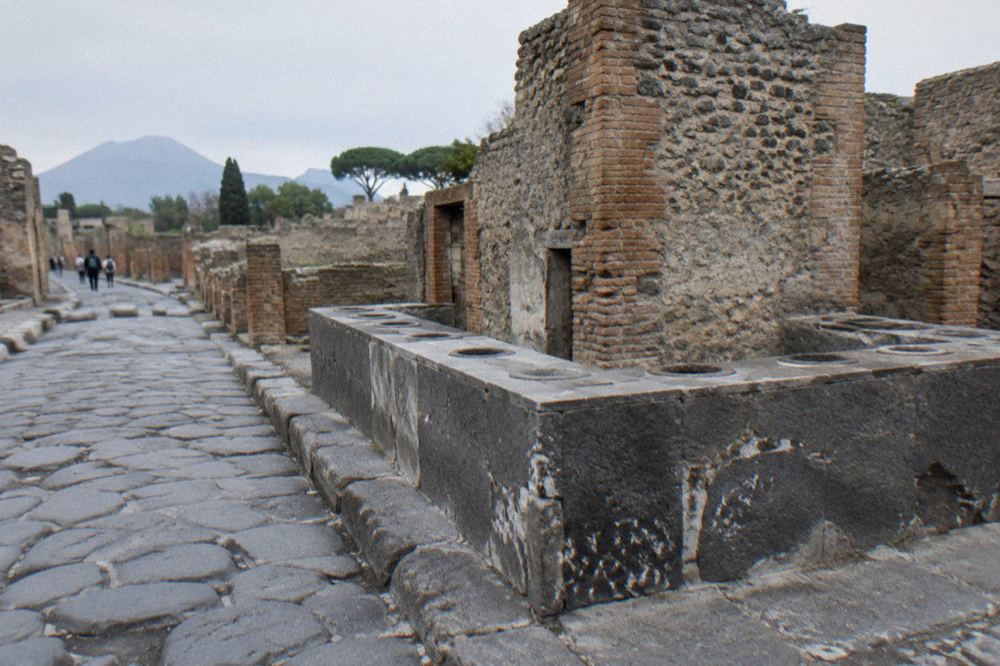
The people who used these counters were, in the main, those without a domestic kitchen: lodgers, workers, sailors and travellers in a port town of shops and workshops. Hot food out was not a novelty in Roman Pompeii, it was a necessity for a large slice of the population, and the density of thermopolia across the excavated streets shows the demand. The shop also sold drink, warmed wine among it, spiced and watered to taste, drawn from the vessels behind the counter.
Behind the commercial front, the building was also a home, and the painted lararium shows the devotional side of the household. The shrine depicts the protective spirits of the proprietor alongside Mercury, the god of commerce, a pairing that tells you precisely what this household cared about: protection and trade. That single wall image is why the site earns a place on routes: it compresses Roman commercial life, domestic religion and advertising into one small room. Visitors who want the deep context of the city's religious corners can read the companion guide to the Temple of Apollo, and those drawn to the city's commercial street life can continue to the Lupanar, the purpose-built brothel a few streets away, whose graffiti record the same street-level world.
What You Can Still See At The Counter Today
Visitors today see the full masonry counter with its jar rims intact, the painted lararium with its guardian figures and Mercury, and the painted shop signs naming the proprietor, all in one compact room on the Street of Abundance in Pompeii, Italy. The counter is the centrepiece: a solid block of masonry with the circular openings of the dolia clearly visible along its top, facing the street where customers once queued. The paintings above and behind it survive in strong colour, and the painted inscriptions that gave the site its modern name remain legible.
The details reward a slow look. The lararium figures wear the pointed hoods of the household spirits, the genius of the proprietor stands between them, and Mercury carries the attributes of trade. The shop signs, painted directly onto the plaster, promote the business to the street. Together they are a complete commercial identity, preserved by the eruption that ended it. Guides typically spend several minutes here on small-group routes, because the counter explains itself once you know what the jars held.
| Feature At The Counter | What It Is | What To Look For |
|---|---|---|
| Masonry counter | Serving block facing the street | Circular jar openings set flush into the top |
| Dolia | Large clay jars sunk into the counter | Deep rims that once held hot stews and drinks |
| Painted lararium | Household shrine on the rear wall | Hooded guardian spirits flanking the central figure |
| Mercury image | God of commerce within the shrine | Trade attributes painted beside the spirits |
| Shop inscriptions | Painted advertising on the plaster | The lettering that gives the site its name |
Around the counter, the surrounding streets hold the rest of the commercial picture. The House of the Vettii shows the domestic wealth that trade could buy, and the Garden of the Fugitives preserves the casts of victims caught by the eruption, a sobering reminder of what ended the city. A route linking these with the thermopolium covers commerce, homes and the catastrophe in a single walk.
Pompeii Tickets And Opening Hours For Your Visit
Park entry in 2026 costs EUR 20 for the Pompeii Express ticket covering the ancient city, EUR 25 for Pompeii+ with the suburban villas, and EUR 30 for the 3-day ticket, and from 1 January 2027 a single EUR 25 ticket covers all park sites, valid 30 days with one entry per site. The smaller sites at Oplontis, the Stabiae museum and Boscoreale cost EUR 8 each under both systems, and the MyPompeii Card annual pass stays at EUR 45. Entry is free for under-18s and for everyone on the first Sunday of the month, and EU citizens aged 18 to under 25 pay a EUR 2 reduced rate.
| 2026 Ticket | Price | What It Covers |
|---|---|---|
| Pompeii Express | EUR 20 | The ancient city only |
| Pompeii+ | EUR 25 | Ancient city, suburban villas route, Villa Regina and Antiquarium at Boscoreale, shuttle |
| 3-day ticket | EUR 30 | Pompeii+ plus Oplontis, the Stabiae villas and museum, Boscoreale |
| Smaller sites individually | EUR 8 | Oplontis, the Stabiae museum, Boscoreale, each separately |
| MyPompeii Card | EUR 45 | Annual pass, EUR 10 reduced |
The 2026 prices end on 31 December 2026. From 1 January 2027 the single EUR 25 ticket replaces the three-tier structure, and the nominative ticket requirement and the 20,000-visitors-per-day cap both remain in force. Tickets are nominative, ID may be checked at entry, and the permitted bag size is 30x30x15 cm, with larger bags going to left luggage. The full detail, including the free first-Sunday arrangement, is on the Pompeii tickets guide.
| Season | Opening | Last Entrance | Closing |
|---|---|---|---|
| 16 March to 14 October | 9:00 | 17:30 | 19:00 |
| 15 October to 15 March | 9:00 | 15:30 | 17:00 |
Pompeii has no weekly closing day, and the park closes only on 25 December and 1 January unless otherwise communicated. Visitor numbers are high: the park recorded 4,069,377 visitors in 2024 and 4,000,090 in 2025, so arriving at the 9:00 opening is the reliable way to see the central streets, the thermopolium included, before the crowds thicken.
Food And Drink Around Pompeii Today
The modern town of Pompei, beside the archaeological park in Campania, Italy, offers cafés, pizzerias and restaurants within walking distance of the entrances, and the park itself provides limited refreshment points, so visitors should plan lunch either side of their hours inside the ruins. The ancient city has little shade and the walking is constant, which makes water and a planned meal the two practicalities that shape a visit. Eating in the modern town is the easiest option, and the sanctuary draws its own café trade a short distance from the excavations.
The continuity is the pleasure of it. The thermopolium sold hot food over a counter to people on the move; the pizzeria around the corner from the park does the same, with a different menu. Travellers who want to take that idea further can read the site's guide to where to eat in Pompeii, and those based in Naples can build a whole day around the city's food with the street food walk led by a local guide, which explores the old town's markets and counters. The thermopolium makes a fine opening argument for the tradition.
| Eating Option Near The Park | Where | Best For |
|---|---|---|
| Cafés at the entrances | Porta Marina and Piazza Esedra approaches | Coffee and a quick pastry before entry |
| Pizzerias in modern Pompei | The town centre, a short walk from the station | A proper sit-down lunch after the ruins |
| Refreshment points inside the park | Limited points within the site | Water and light snacks mid-visit |
| Sanctuary area cafés | Near the Sanctuary of Pompei | A quieter break away from the crowds |
Best Ways To Tour Pompeii Around The Thermopolium
The thermopolium appears on the standard guided routes through the central streets, and the choice for visitors is between a self-guided walk with an audio guide, a small-group tour with an archaeologist, or a private guide, with the counter reachable on any route that includes the Street of Abundance. Independent visitors can see it freely with an ordinary park ticket, reading the interpretive material at the spot; guided visitors get the counter explained in context, which is where the site earns its keep, because the painted shrine rewards explanation.
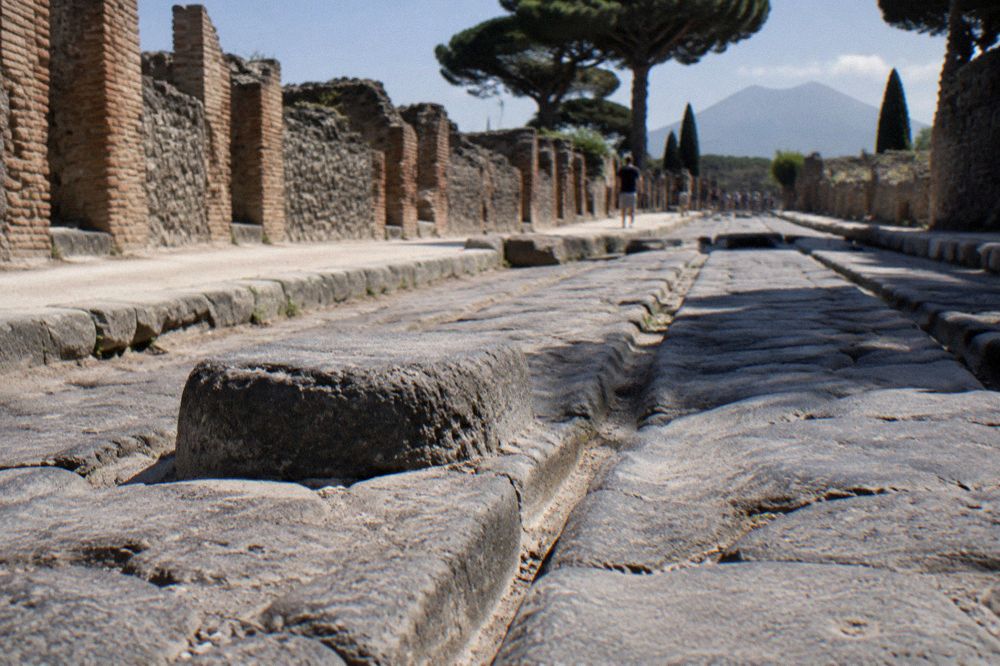
The self-guided option suits travellers who like to set their own pace and read as they go. The audio-guide ticket covers the whole park and lets a visitor linger at the counter as long as they like. Guided small-group tours move faster through the highlights and make sure the counter is not missed among the hundreds of buildings competing for attention. Private groups get the most from a specialist guide, and families with children often find a guide keeps the younger ones engaged where a map does not; the site's Pompeii with kids itinerary covers that angle in detail.
| Way To Visit | What It Involves | Who It Suits |
|---|---|---|
| Self-guided walk | Ordinary ticket, park signage and a good map | Independent travellers on their own schedule |
| Audio-guide visit | Ticket plus an audio device covering the main sites | Visitors who want commentary at their own pace |
| Small-group guided tour | A guide leading a set route through the highlights | First-time visitors who want context and efficiency |
| Private guide | A dedicated guide for your group only | Families, specialists and tight schedules |
Travellers arriving from further afield have well-trodden options. From Naples, a half-day trip with skip-the-line tickets and a guide handles the train and the entry in one booking, and the Naples to Pompeii transport guide covers the independent alternatives. From Sorrento, the Sorrento to Pompeii guide explains the train route via the Circumvesuviana, whose Pompei Scavi-Villa dei Misteri station sits beside the Porta Marina entrance. Note that the Campania Express rail service has been suspended since 1 October 2026, so the Circumvesuviana is the train option for that journey.
When To Visit Pompeii For Comfortable Walking
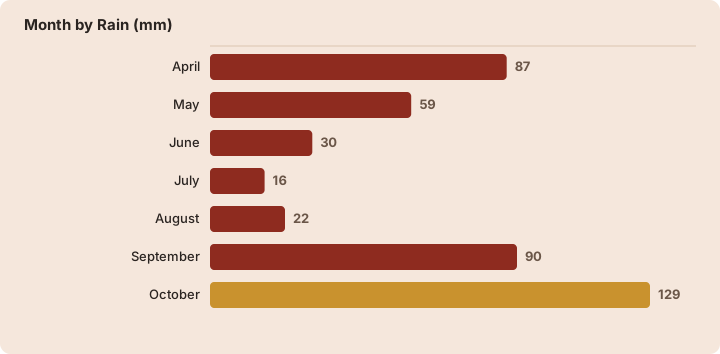
The comfortable months for walking Pompeii's streets are April, May, June, September and October, when the Pompei area's 1991-2020 climate normals show mean daily highs of about 17.7 to 25.8 degrees Celsius and monthly rainfall of about 30 to 129 mm, while July and August average about 28.7 and 29.4 degrees and November is the wettest month at about 180 mm. The thermopolium sits on an exposed street with little shade, and the whole park is an outdoor walk on stone, so the seasonal figures matter more here than at an indoor museum.
| Month | Mean Daily High (C) | Mean Daily Low (C) | Rain (mm) |
|---|---|---|---|
| April | 17.7 | 10.4 | 87 |
| May | 21.6 | 14.1 | 59 |
| June | 25.8 | 18.2 | 30 |
| July | 28.7 | 21.1 | 16 |
| August | 29.4 | 21.8 | 22 |
| September | 25.3 | 18.6 | 90 |
| October | 21.3 | 15.1 | 129 |
These figures are 1991-2020 climate normals computed from a reanalysis archive for the Pompei grid point, so they describe the long-run pattern rather than any specific day. Winter visits are perfectly practical, with the shorter hours noted above, and the site's Pompeii weather and best time to visit guide works through the trade-offs month by month. Whatever the season, water, a hat and shoes with grip are the standing advice for the stone streets.
Pairing The Thermopolium With Other Pompeii Highlights
The thermopolium pairs naturally with the Forum, the baths, the bakeries and the villas on a single day's walk, and travellers with two days can add Herculaneum and Mount Vesuvius, the two other headline sites of the AD 79 eruption around the Bay of Naples. Within the ancient city, a route from Porta Marina through the Forum and along the Street of Abundance takes in the counter with minimal detour. Beyond the city, Herculaneum offers a compact, roofed-in alternative buried by the same eruption, and Vesuvius gives the view that explains everything.
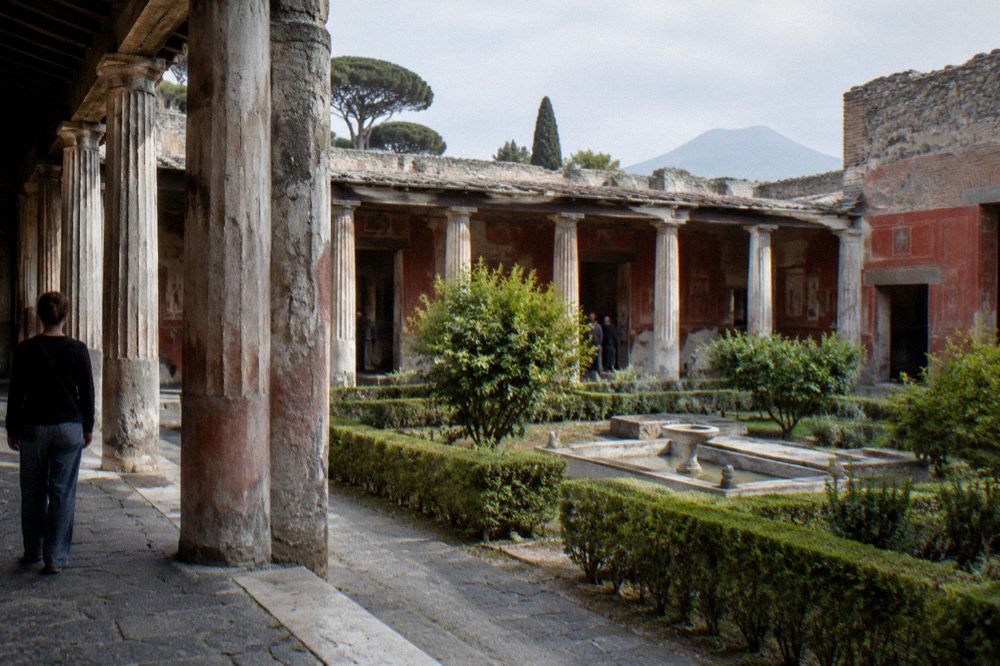
Herculaneum deserves the comparison. It is smaller, better preserved at the level of wooden fittings and upper storeys, and its own Herculaneum guide covers the differences; note that Herculaneum's Villa dei Papiri and Ancient Theatre are closed for works, so plan around the main townhouses and the boat sheds. Vesuvius, covered in the Mount Vesuvius guide, sells timed tickets online only, with access hours that shift by month, and the crater path closes automatically on orange weather alerts. The Villa of the Mysteries, reached through the Porta Ercolano end of Pompeii, rounds out the suburban villas side of the story for holders of the Pompeii+ ticket.
| Nearby Site | Distance By Road From Pompei Scavi | What It Adds |
|---|---|---|
| Herculaneum (Ercolano) | Within the Vesuvian sites area | Wooden fittings and upper storeys preserved by the eruption |
| Mount Vesuvius | Within the Vesuvian sites area | The crater and the view over the buried cities |
| Oplontis (Torre Annunziata) | Within the Vesuvian sites area | A luxury villa with frescoes, EUR 8 entry in 2026 |
| Stabiae (Castellammare di Stabiae) | Within the Vesuvian sites area | Cliff-top villas and the museum, EUR 8 entry in 2026 |
For a two-day plan that stitches the sites together, the site's two days Pompeii Herculaneum Vesuvius itinerary sets out a workable order, and the Pompeii and Herculaneum in one day guide covers the tighter version for visitors short on time.
Common Questions About The Thermopolium Of Vetutius Placidus In Pompeii
What is a thermopolium in Pompeii?
A thermopolium was a Roman street counter selling hot food and warmed drinks, with large clay jars sunk into the masonry top to hold the dishes. Pompeii, the ancient city in Campania, Italy, preserves many of them, and the Thermopolium of Vetutius Placidus is one of the best preserved, with its counter, painted shrine and shop inscriptions all intact.
Where is the Thermopolium of Vetutius Placidus located?
It stands on the Street of Abundance, the main east-west street of the ancient city, a short walk from the Forum inside the archaeological park of Pompeii in Campania, southern Italy. It is reachable from any of the three ticket-office entrances at Porta Marina, Piazza Esedra and Piazza Anfiteatro.
How much does it cost to see the Thermopolium of Vetutius Placidus?
There is no separate fee: the counter is inside the archaeological park, so the park ticket covers it. In 2026 the Pompeii Express ticket for the ancient city costs EUR 20, and from 1 January 2027 a single EUR 25 ticket covers all park sites. Entry is free for under-18s and for everyone on the first Sunday of the month.
Can you buy food at the Thermopolium of Vetutius Placidus today?
No, it is a protected archaeological monument and nothing is served there. The jars in the counter are empty and the room is viewed from the street and doorway. For actual food, the modern town of Pompei has cafés and pizzerias within walking distance of the park entrances.
How long should I spend at the Thermopolium of Vetutius Placidus?
Ten to fifteen minutes is enough to take in the counter, the painted lararium and the inscriptions, longer with a guide. It works best as one stop on a wider route through the central streets rather than as a destination on its own.
Is the Thermopolium of Vetutius Placidus included on guided tours of Pompeii?
Yes, it is a regular stop on guided routes that follow the Street of Abundance, and small-group tours with an archaeologist typically explain the painted shrine and the counter in some detail. Independent visitors can see it freely with an ordinary park ticket.
The Thermopolium of Vetutius Placidus compresses the whole argument of Pompeii into one small room: a working business, a household shrine and a painted advertisement, all frozen on the day the city fell. Visit it early, read the paintings slowly, and let the counter set the tone for everything else the park holds.