How Hot Is Pompeii In September?
September temperatures at Pompeii, the ancient Roman city near Naples in Italy: climate averages, how the heat feels on the stones, and how to plan a day at the archaeological park.
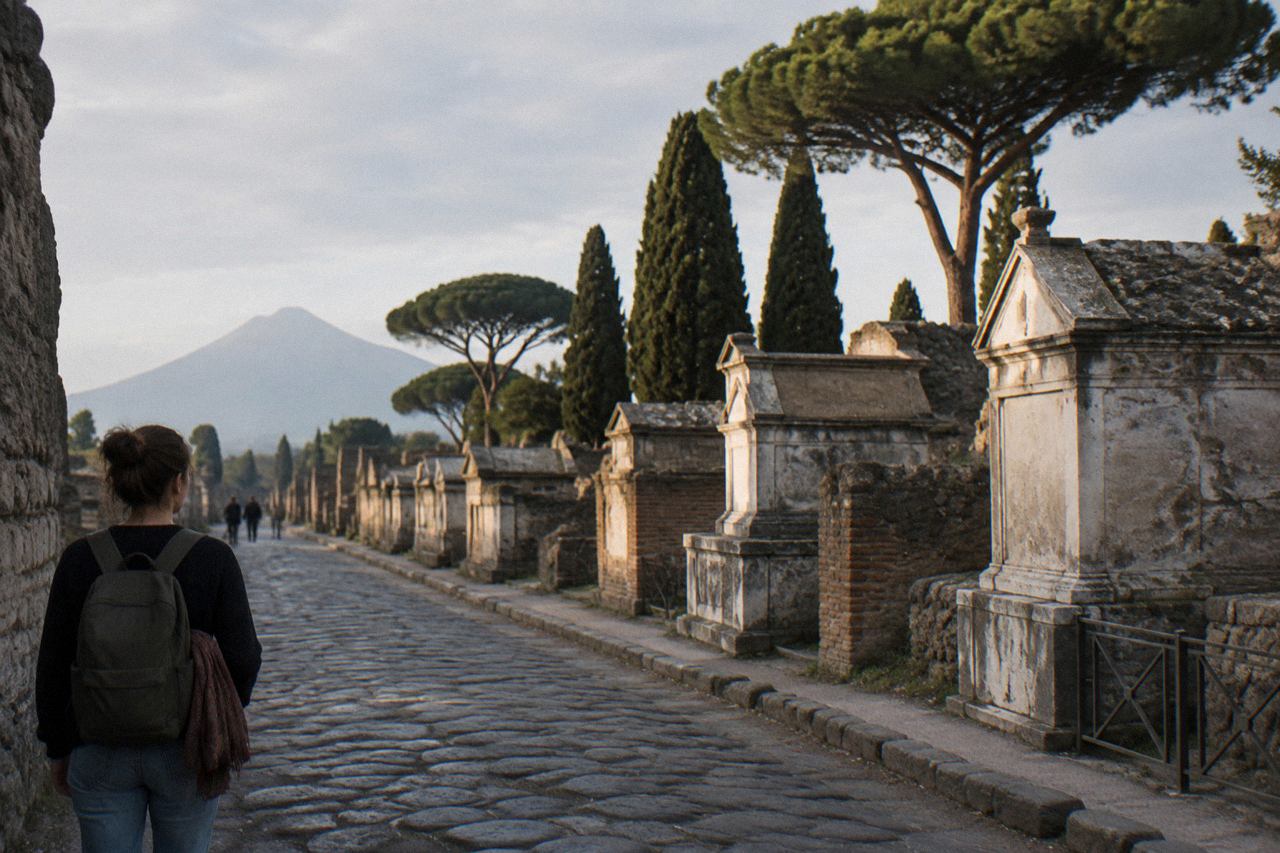
Pompeii, the ancient Roman city buried by the eruption of Mount Vesuvius in AD 79 and now an archaeological park in Campania, southern Italy, stands beside the modern town of Pompei about 24 km by road from Naples. In September the site leaves its hottest weather behind. The 1991-2020 climate normals for the Pompei grid point, computed from the Open-Meteo historical archive (an ERA5 reanalysis grid, not a weather station), put the mean daily maximum at about 25.3 C and the mean daily minimum at about 18.6 C, with about 90 mm of rain across the month. For visitors, September is a month of warm, workable heat rather than furnace heat, and it rewards an early start.
How Hot Is Pompeii In September?
In September Pompeii is warm rather than scorching: the mean daily maximum is about 25.3 C and the mean daily minimum about 18.6 C, with roughly 90 mm of rain across the month. These are 30-year averages (1991 to 2020) from the Open-Meteo reanalysis grid for Pompei, so treat them as a guide to a typical month, not a forecast; any single day can run hotter or cooler, and the exposed stone still holds the afternoon sun.
Those figures deserve a little unpacking, because "mean daily maximum" is not the same as the hottest moment of a hot day. The nights rarely fall below the high teens on average, which matters for anyone planning a long day: there is little overnight cooling, so the ancient stones are already warm by mid-morning.
The 90 mm of monthly rain is the third-driest figure of the autumn transition and compares with about 30 mm in June, 16 mm in July and 22 mm in August. September is when the first Atlantic-type disturbances usually start reaching Campania after the dry core of summer, so rain arrives in a few heavier episodes rather than steady drizzle. Storms that do occur tend to be short, and the site drains and dries quickly on the open basalt paving.
One planning figure belongs alongside the temperature: opening hours. From 16 March to 14 October the park opens at 9:00, takes its last entrance at 17:30 and closes at 19:00, so a September day gives roughly ten and a half hours of possible site time. The entrance ticket offices are at Porta Marina, Piazza Esedra and Piazza Anfiteatro, and the 2026 Pompeii Express ticket costs EUR 20 for the ancient city alone, a price that ends on 31 December 2026, when a single EUR 25 ticket for all park sites takes over on 1 January 2027. The full ticket picture is covered in detail on the Pompeii tickets and prices guide.
How Does September Heat Feel On The Site Itself?
On the ground, September at Pompeii feels like a warm late-summer day with almost no shade: afternoons average around 25 C in the air, but the treeless streets of dark volcanic stone absorb and re-radiate the sun, so the heat you feel on the paving runs several degrees above that reading. There is no air conditioning and little seated shelter inside the site, so carry a bottle from the entrance despite the fountains on the main routes.
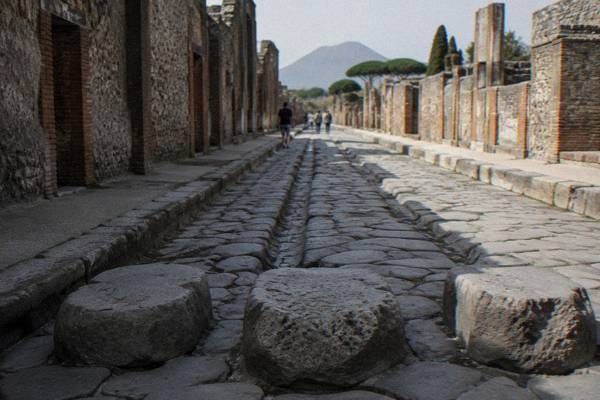
The geometry of the site is the reason visitors underestimate the heat. The Via dell'Abbondanza and the other decumani run as straight, unshaded cuts between ruined walls; the Forum is a wide open platform; and the amphitheatre palaestra is a sun trap. In July and August, when the mean maximum is about 28.7 C and 29.4 C respectively, that exposure is punishing. In September the same streets are far more forgiving, and the two-hour drop in average maximum from August is the single biggest comfort change of the year between consecutive months.
footwear matters as much as timing. The ancient paving is uneven, rutted by Roman cartwheels and polished by two millennia of feet, and the difficulty of walking in Pompeii is a real question for anyone with mobility limits or thin-soled shoes. Stout shoes with grip, a hat, and a refillable bottle solve the September version of the problem. The "Pompeii for All" accessible route enters at Piazza Anfiteatro and can exit at Piazza Anfiteatro or Piazza Esedra via the Antiquarium lift, which is worth knowing on any warm day.
Timing within the day is the other lever. The 9:00-13:00 entry band carries a cap of 15,000 visitors and the 13:00-17:30 band a cap of 5,000, so the park's own crowd management already pushes the first half of the day toward busier conditions while the afternoon is quieter. In September the afternoon heat is mild enough that a 13:00 entry is a genuinely good trade: fewer people, comfortable walking, and closing time not until 19:00.
For travellers who would rather have someone else manage the route and the pacing, the Villa of the Mysteries tour with an archaeologist is a strong September choice, since it covers the suburban villa beyond the Porta Ercolano / Street of the Tombs entrance as well as city highlights, and a moving guided route copes with midday warmth better than independent wandering. It can be checked on the operator's live listing via Check availability.
How Does September Compare With The Rest Of The Year?
September marks a clear turning point in the year: with 90 mm of rain, it is roughly triple August's 22 mm yet far below November's 180 mm, the wettest month. Rainfall climbs steadily after the summer, so September offers only a short comfort window, warm days paired with rainfall that is just beginning to recover, before the wetter months arrive.
The table below sets out the full 1991-2020 normals for the Pompei grid point, so the September figures can be read in context. The numbers come from the Open-Meteo historical archive (ERA5 reanalysis) at coordinates 40.75 N, 14.49 E and are 30-year monthly averages, so "about" applies to every figure.
| Month | Mean Daily Max (C) | Mean Daily Min (C) | Monthly Rain (mm) |
|---|---|---|---|
| Jan | 12.2 | 6.6 | 119 |
| Feb | 12.6 | 6.5 | 103 |
| Mar | 14.9 | 8.1 | 104 |
| Apr | 17.7 | 10.4 | 87 |
| May | 21.6 | 14.1 | 59 |
| Jun | 25.8 | 18.2 | 30 |
| Jul | 28.7 | 21.1 | 16 |
| Aug | 29.4 | 21.8 | 22 |
| Sep | 25.3 | 18.6 | 90 |
| Oct | 21.3 | 15.1 | 129 |
| Nov | 16.9 | 11.5 | 180 |
| Dec | 13.2 | 8.0 | 147 |
Read down the rain column and the shape of the Campanian year is obvious: a dry core from June to August, a sharp step up in September, and a wet peak in November.
Two practical notes follow from the climate data. First, the same September warmth that makes Pompeii pleasant applies to Mount Vesuvius above it: the Gran Cono trail operates 9:00-17:00 in April, May, June and September, with online-only timed tickets sold at vesuviopark.vivaticket.it and the path closing automatically on an orange weather alert or higher. Second, a September storm can end a Vesuvius hike abruptly; the park refunds automatically when weather closes the trail.
Is September A Busy Time To Visit Pompeii?
Yes, September is a busy time at Pompeii, not a quiet shoulder month: the park logged 468,340 visitors in September 2024, close behind May (516,923) and October (481,255), and the site topped four million visitors in both 2024 and 2025. A 20,000-per-day visitor cap and nominative tickets apply year-round, so arrive at the 9:00 opening or enter after 13:00 to avoid the densest hours.
Those monthly figures come from the park's own visitor-data table, and they reframe what "shoulder season" means on this site. The summer months were actually no busier: August 2024 saw 421,255 visitors and July 449,162, both below September. Everything else covered here is indexed on Pompeii Travel Guide.
| Month (2024) | Visitors to Pompeii |
|---|---|
| May | 516,923 |
| Jun | 410,712 |
| Jul | 449,162 |
| Aug | 421,255 |
| Sep | 468,340 |
| Oct | 481,255 |
| Nov | 189,866 |
The implication for a September visit is straightforward: book ahead. Tickets are nominative and tied to an identity document that may be checked at every entry, and they are non-transferable. The question of whether to buy Pompeii tickets in advance answers itself in September; the related question of whether you can just show up at Pompeii has a more conditional answer, since a same-day ticket is possible on a cap day only if the daily allocation is not exhausted.
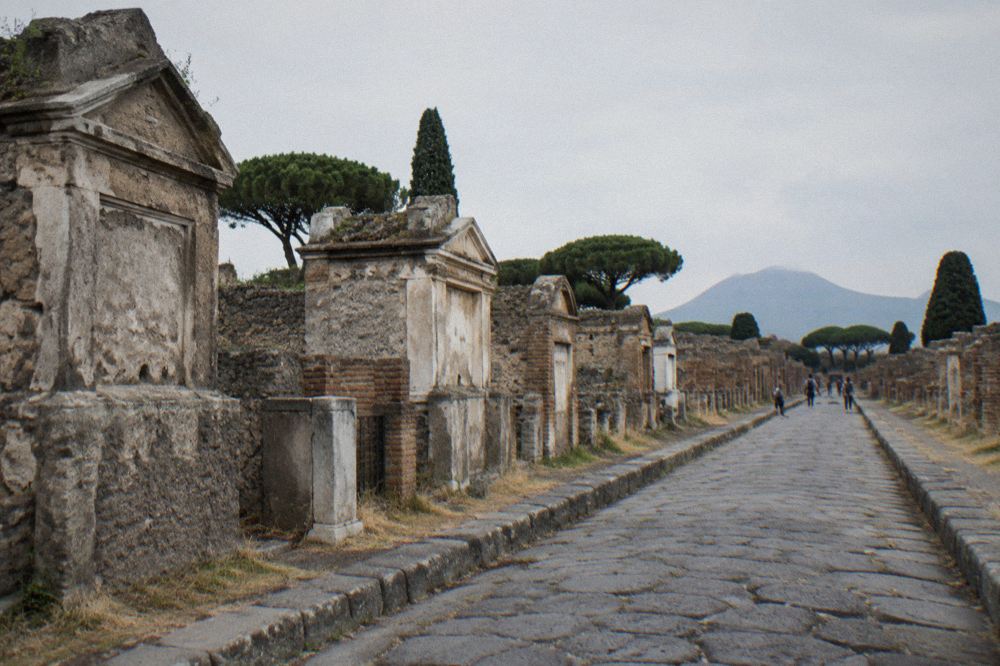
Free entry applies on the first Sunday of every month, and the park's own release recorded more than 36,000 visitors on a single free first Sunday, a figure that dwarfs the ordinary daily pattern. In September's warm but not extreme weather those crowds are manageable physically, just dense. Under-18s enter free every day, and EU citizens aged 18 to under 25 pay a reduced EUR 2.
What Should You Wear And Carry In September?
For September, dress for a warm late-summer walking day: breathable clothing, a hat with a brim, and grippy closed shoes for the uneven Roman paving, with a light layer for the evening once the mean minimum falls to about 18.6 C. Carry more water than feels necessary, since shade inside the excavated city is scarce and the average afternoon reaches about 25 C. A compact bag within the permitted 30x30x15 cm limit avoids the left-luggage queue.
The bag rule is enforced, not theoretical: the park's visitor regulations state the permitted maximum size of 30x30x15 cm, with larger items left at left luggage. That size fits a one-litre bottle, a sun hat and a light jacket, which is the September kit. There is no dress code at Pompeii beyond ordinary public decency and the explicit ban on bare chests, and the fuller discussion of what clothing rules apply at Pompeii is a short one.
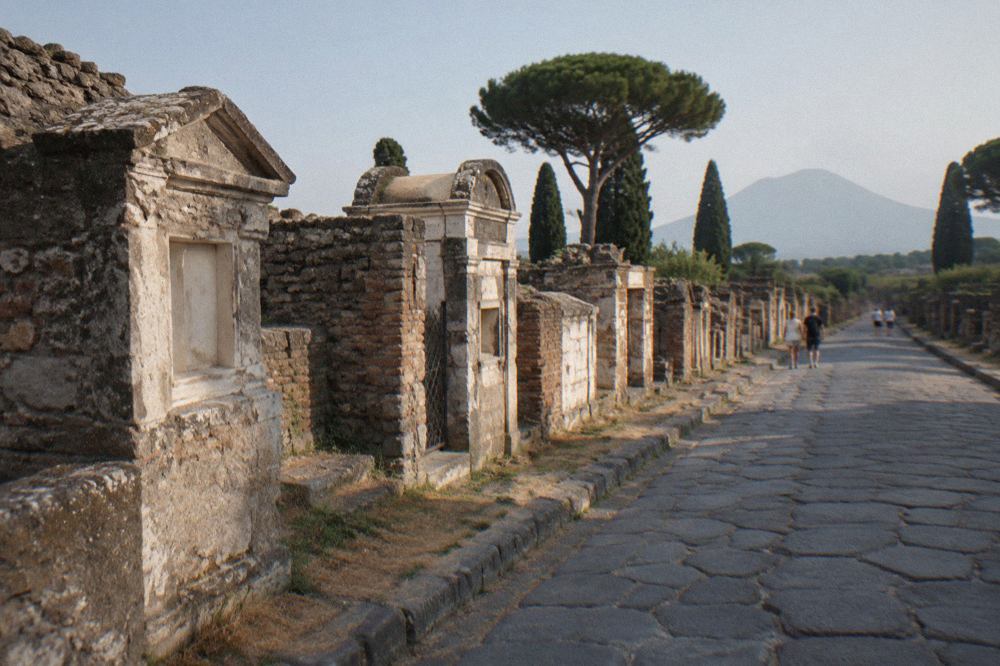
Sun protection deserves more emphasis in September than visitors expect, because the air temperature is moderate while the sun angle is still high. The stones of the Via dell'Abbondanza and the Forum reflect heat upward, and the two or three hottest hours of a September day, between 13:00 and 16:00, are exactly when the site is emptiest under the afternoon entry cap. Splitting the day, forum and main streets in the morning, shaded museum time or lunch at the midpoint, and the amphitheatre end in the late afternoon, uses both the climate and the crowd pattern well. The Pompeii Travel Guide site's homepage carries a fuller seasonal overview for anyone weighing September against other months.
Rain deserves one sentence of kit planning: with about 90 mm across the month, a compact umbrella or light shell is a reasonable addition on days when the forecast shows an Atlantic front, though the odds on any given September day still favour dry walking.
Can You Combine Pompeii With Vesuvius Or A Tour In September?
Yes, September is well suited to combining Pompeii with Mount Vesuvius on one day, because the Gran Cono trail runs 9:00-17:00 in September with a return excursion of two to three hours on foot, and the average 25 C afternoon makes the climb far more comfortable than in July or August. The same applies to organised combinations out of Naples, Sorrento or Rome, and to longer Pompeii itineraries, since the site's 19:00 close in this season leaves long daylight for a two-stop day.
The Vesuvius side of the pairing has its own ticketing system, entirely online through vesuviopark.vivaticket.it, with 50 tickets released per 10-minute slot up to 30 days ahead and 10 nominative last-minute tickets per slot from 30 minutes before, a rule in force since 11 April 2026. The trail and ticket office close automatically at orange weather alert or above, with automatic refunds, which in September's changeable month is a real consideration rather than a footnote. The cost of going up Mount Vesuvius and the length of the walk up Vesuvius are covered on their own pages.
For the Pompeii half of the day, a guided option keeps momentum in the warmest hours.
Rome-based travellers face the longest version of the question, since the road distance from Rome to Pompei Scavi is about 234 km. A day trip from Rome with optional Vesuvius in September is feasible because the site stays open to 19:00, but the heat argument for September is weaker for anyone facing a door-to-door day; comfort belongs to those who sleep nearer the Bay of Naples. Visitors weighing bases can weigh up Naples against staying in Pompei separately.
What Are The Closures And Changes To Know For A September Visit?
September travel comes with a handful of adjustments: some attractions begin trimming hours or wrap up summer operations, certain services and tours run on lighter schedules, and shoulder-season weather can occasionally close outdoor offerings, so build flexibility into your itinerary and confirm current hours for anything on your must-do list before you head out.
Its suspension since 1 October 2026, with refunds through the EAV complaints form or the original seller, means the practical rail option is the Circumvesuviana Napoli-Pompei Scavi-Sorrento line; scheduled running times computed from EAV's own timetable data put Napoli Garibaldi to Pompei Scavi-Villa dei Misteri at 29 to 35 minutes. EAV announced new trains and a new Vesuvian-lines timetable on 16 September 2026, but the detailed figures in that announcement are not yet published, so no times beyond the schedule above should be assumed. The station and walking question is covered on the page about walking from the station to the ruins.
Common Questions About Pompeii In September
How hot is Pompeii in September?
The mean daily maximum at the Pompei grid point is about 25.3 C in September and the mean daily minimum about 18.6 C, from 1991-2020 normals in the Open-Meteo historical archive. The stones of the excavated city feel several degrees warmer in full sun, and individual days can exceed the average.
Is September a good month to visit Pompeii?
It is also a busy month, with 468,340 visitors recorded in September 2024, so advance booking matters.
Does it rain in Pompeii in September?
September averages about 90 mm of rain across the whole month, a sharp rise from August's 22 mm but well below November's 180 mm. Rain tends to arrive in short episodes, and the open stone paving dries quickly.
Is September too hot for children or older visitors at Pompeii?
At about 25 C on average, September is far more manageable than July or August, but shade and seating are scarce inside the excavated area. The accessible "Pompeii for All" route enters at Piazza Anfiteatro, and an early start or a post-13:00 entry, when the daily cap drops from 15,000 to 5,000, eases both heat and crowds.
Can you visit Mount Vesuvius in September?
Yes. The Gran Cono trail operates 9:00-17:00 in September, with online-only timed tickets and a two to three hour return walk. The trail closes automatically on an orange weather alert or above, with automatic refunds.
What should you wear in Pompeii in September?
Breathable clothing, a brimmed hat, grippy closed shoes for the uneven paving, and a light layer for evenings near 19 C. Bags must fit within 30x30x15 cm or go to left luggage.
September at Pompeii is, in the end, a month of balance: the averages say about 25 C by day and 19 C by night, the rain gauge says the first storms of autumn are possible, and the turnstiles say it is one of the site's busiest months of the year. Plan around the heat with an early or late entry, book the nominative ticket ahead, and the ancient city under Vesuvius is at its most walkable since spring.