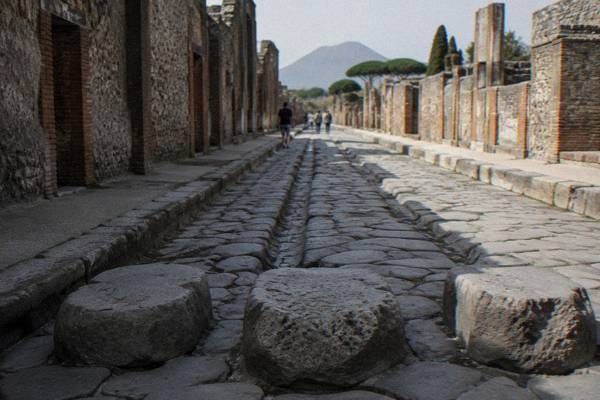
Via Dell Abbondanza
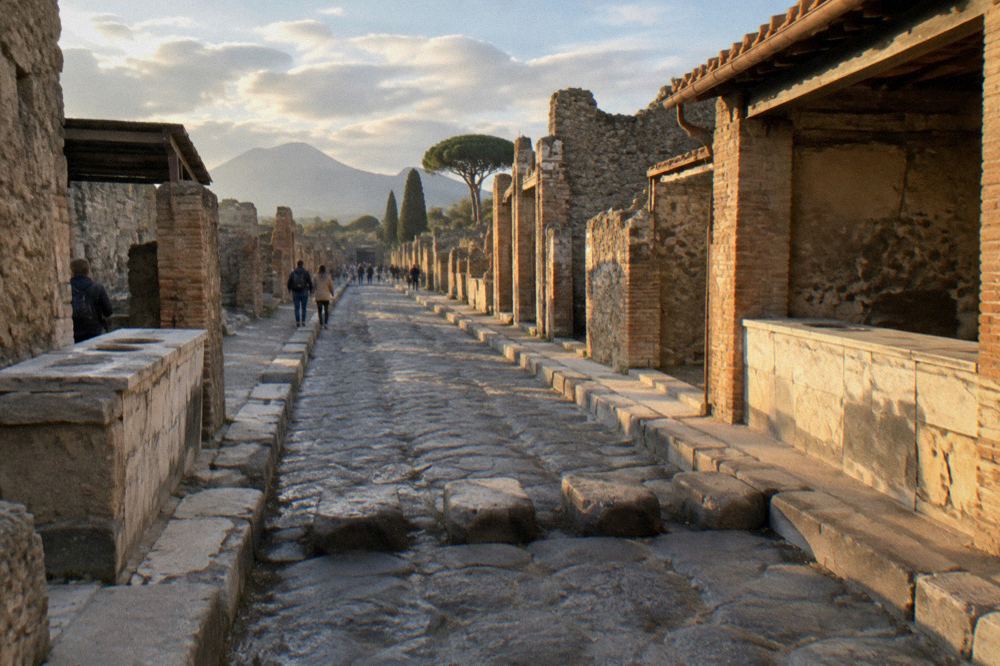
The Via Dell Abbondanza was the main east-west street of Roman Pompeii, running from the Forum towards the amphitheatre past shops, baths, houses and painted election notices.
Short answer
The Via Dell Abbondanza is the ancient main street of Pompeii, the Roman city buried by Vesuvius in AD 79, now an archaeological park in Campania, southern Italy, beside modern Pompei about 24 km from Naples. A 2026 Pompeii Express ticket costs EUR 20 and covers the street; from 1 January 2027 one EUR 25 ticket covers all park sites.
The Via Dell Abbondanza was the principal street of Pompeii, the ancient Roman city in Campania, southern Italy, buried by the eruption of Mount Vesuvius in AD 79 and now the Parco Archeologico di Pompei, beside the modern town of Pompei about 24 km by road from Naples. In Roman times it ran from the Forum, the civic heart of the city, downhill towards the amphitheatre and the Palaestra, and every visitor to the park today walks at least part of it. The modern name, meaning "Street of Abundance", comes from an inscription found nearby, and the street it labels served the same role in AD 79 that a high street serves now: a corridor of commerce, politics, bathing and daily life, lined with the shopfronts, painted signs and stepping stones that survived the eruption.
What Is The Via Dell Abbondanza In Pompeii?
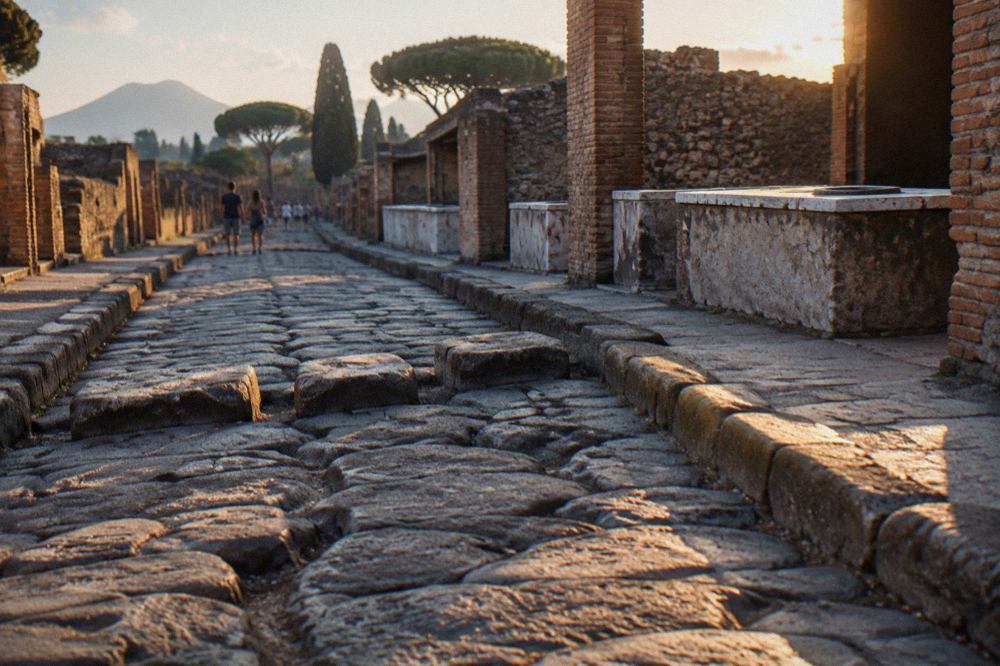
The Via Dell Abbondanza is the main east-west decumanus of ancient Pompeii, the Roman city buried by Vesuvius in AD 79 and now an archaeological park in Campania, southern Italy, beside the modern town of Pompei about 24 km south-east of Naples on the Bay of Naples. It connected the Forum with the eastern quarter near the amphitheatre, and its excavated length is lined with shops, houses, baths and painted election notices. It is the single street every route through the park crosses.
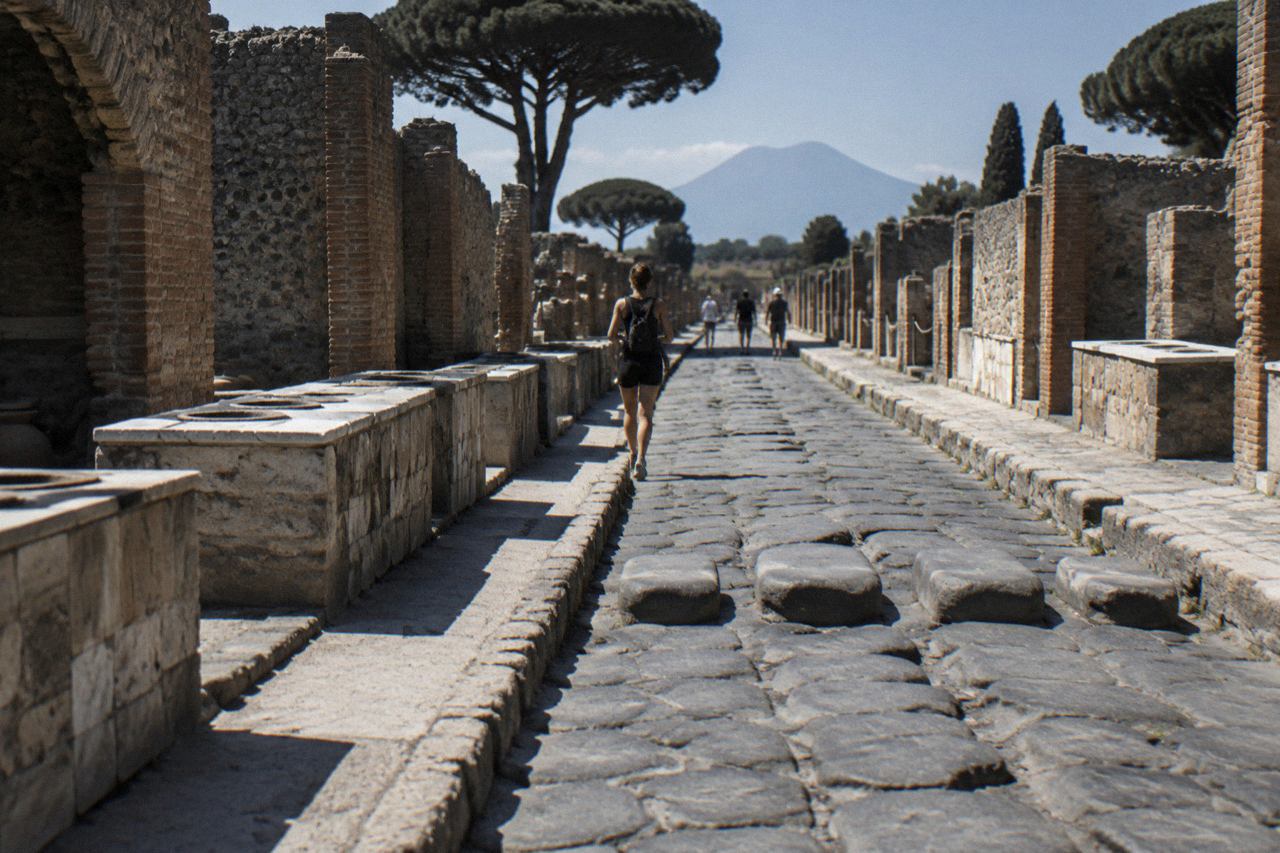
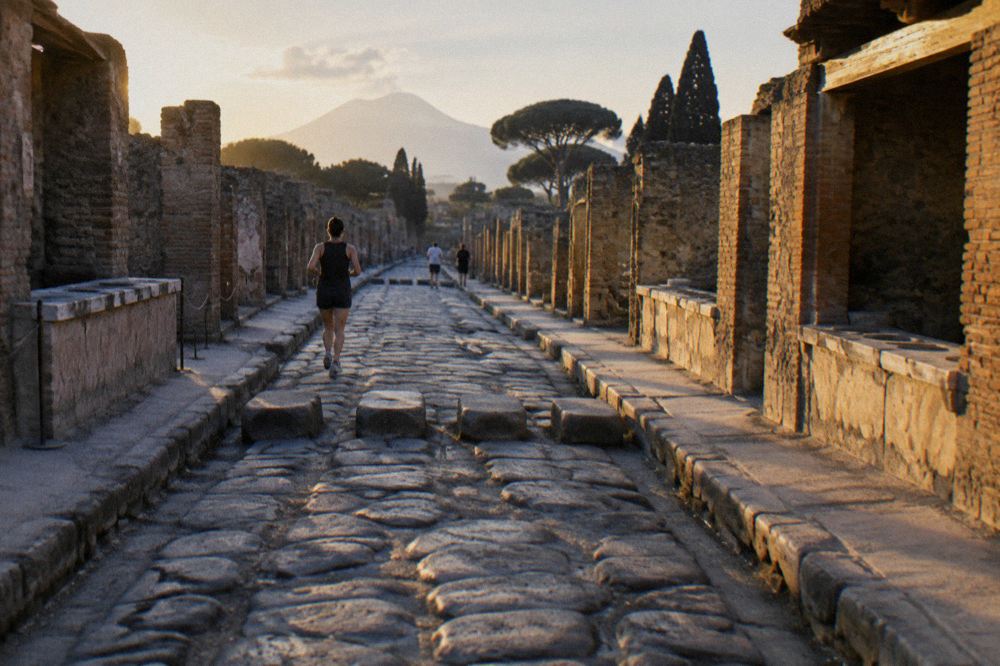
The street's Roman name is debated among scholars, but its function is not: it was the artery along which trade, politics and foot traffic moved. The basalt paving survives, worn into deep ruts by cart wheels, and at the crossings pedestrians used large stepping stones that let them cross without treading in the water and waste that ran along the roadway. Those stones are among the most photographed features of the whole site, and they tell you two things at once: Roman streets drained through them, and carts with standard axle widths passed between them.
The painted notices on the walls along the route are another signature. Hundreds of electoral slogans, painted in red and black by professional sign-writers in the months before the eruption, urge voters to support named candidates for office. The walls also carry the painted shop signs that gave the street its modern reputation for commerce, including notices for thermopolia, the snack bars where hot food was served from counters set into the pavement. One famous example on this street, with its painted goods and coins frozen mid-transaction, is covered in the thermopolium of Vetutius Placidus guide.
For orientation, the street intersects the two main north-south streets of the city, and one of those intersections gives access to the Forum of Pompeii at the western end. Walking the full excavated stretch is the simplest way to understand the city's grid, because the street keeps a consistent line from the civic centre to the entertainment quarter in the east.
How To Walk The Via Dell Abbondanza Route
Start at the Forum end, near the steps by the Temple of Jupiter, and walk east with the amphitheatre as your goal, entering the park through Porta Marina, Piazza Esedra or Piazza Anfiteatro, the three ticket offices. The 2026 Pompeii Express ticket at EUR 20 covers the street and the whole ancient city; from 1 January 2027 it is replaced by a single EUR 25 ticket valid 30 days with one entry per site. Allow at least half a day if you want the street plus its side attractions.
The classic direction is downhill from the Forum. Entering at Porta Marina, the oldest entrance to the park, you reach the Forum first, and the Via Dell Abbondanza leaves its eastern side. From there the street drops gently through the old commercial quarter, past the Stabian Baths, the thermopolia, the houses that open directly onto the pavement, and the intersections that branch north to the House of the Faun and the House of the Vettii. The far end delivers you to the quarter around the Pompeii Amphitheatre and the Large Palaestra.
Walking the other way, from Piazza Anfiteatro back to the Forum, works just as well and has one practical advantage: the Piazza Anfiteatro entrance is also where the "Pompeii for All" accessible route begins, so visitors with mobility difficulties can enter there and exit at Piazza Esedra via the Antiquarium lift. The street itself is ancient paving, uneven in places and crossed by those stepping stones, so sturdy shoes matter; the difficulty of walking in Pompeii question comes up constantly for good reason.
A sensible plan is to walk the street once end to end without detours, then walk it again selectively. The first pass gives you the city's shape, the gradient, the density of shopfronts and the sheer width of the urban grid. The second pass is for the doors you noticed on the way: a bath complex, a bakery, a grand house entrance, a painted political slogan at eye level. This two-pass method is the same one used on the Pompeii in one day itinerary, and it suits the street better than any attempt to see everything in a single sweep.
| Route stage | What you pass | Where it connects |
|---|---|---|
| Forum end | Temple of Jupiter steps, civic buildings | Forum of Pompeii |
| Upper street | Shops, painted signs, thermopolia | Thermopolium of Vetutius Placidus |
| Mid street | Stabian Baths, cross-streets north | Stabian Baths |
| Lower street | More dwellings, the Praedia of Julia Felix entrance (closed since 7 September 2026) | Large Theatre quarter |
| Eastern end | Amphitheatre and Large Palaestra | Pompeii Amphitheatre |
Which Landmarks Sit Along The Via Dell Abbondanza?
The street's headline landmarks are the Stabian Baths, the thermopolium with its painted counter, the entrance to the Praedia of Julia Felix (closed since 7 September 2026), and, at its far end, the Pompeii Amphitheatre and the Large Palaestra. Side streets lead north to the House of the Faun, the House of the Vettii and the Lupanar, and west to the Forum and the Basilica. Each of these deserves its own stop rather than a glance from the kerb.
Begin at the west with the Forum, the paved civic square enclosed by colonnades, where the street effectively begins. Steps lead up from the street level into the square, and from the square's north side stands the Temple of Jupiter with Vesuvius framed behind it, a view that has become the park's signature photograph. Back down on the street, the Basilica of Pompeii sits just to the north of the Forum, the oldest known basilica structure in the Roman world of its type and the building that gave later church architecture its name.
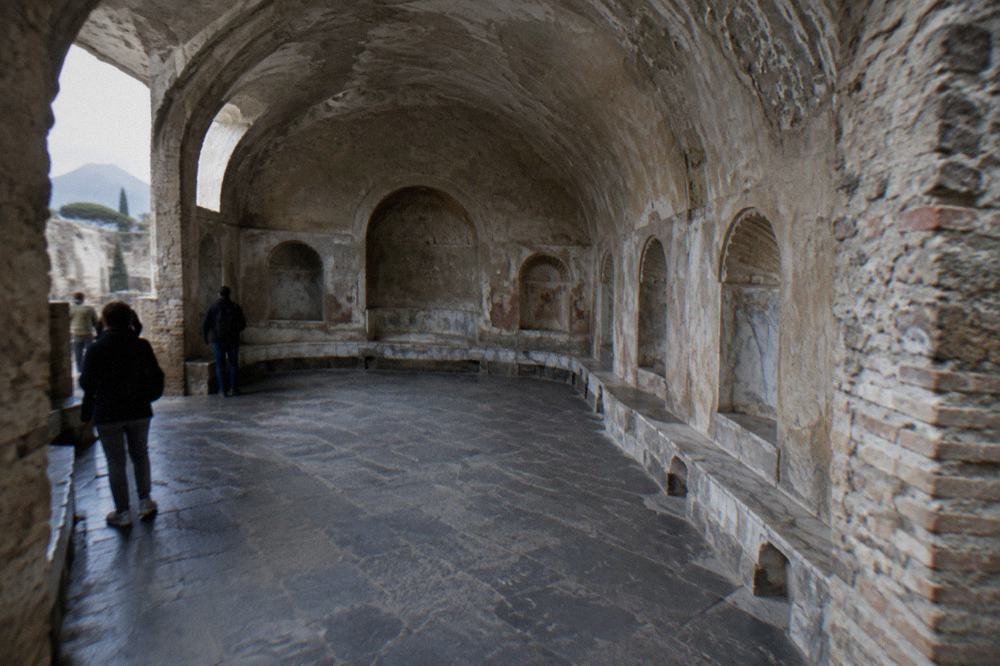
East of the Forum the commercial stretch begins. The painted shop signs cluster here, and the Thermopolium of Vetutius Placidus is the best known of the snack bars, its counter pierced with dolia, the deep jars that held hot food. Further along, the Stabian Baths occupy the block at the crossing with one of the north-south streets: they are the oldest bath complex in the city and among the most complete, with changing rooms, a warm room and a cold plunge all visible.
The Lupanar, the purpose-built brothel with its famous wall paintings, lies one block north of the street, and the queue outside it is the clearest sign of which buildings draw the crowds. North again stand the twin attractions of the House of the Faun, the grandest house excavated at Pompeii, and the House of the Vettii, the house of two freedmen packed with frescoes.
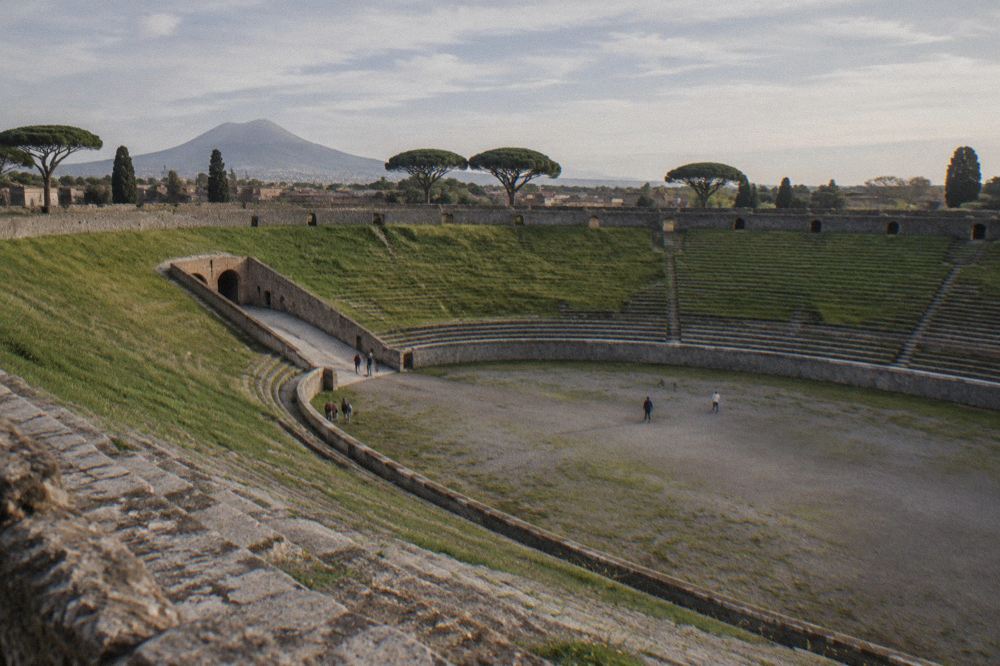
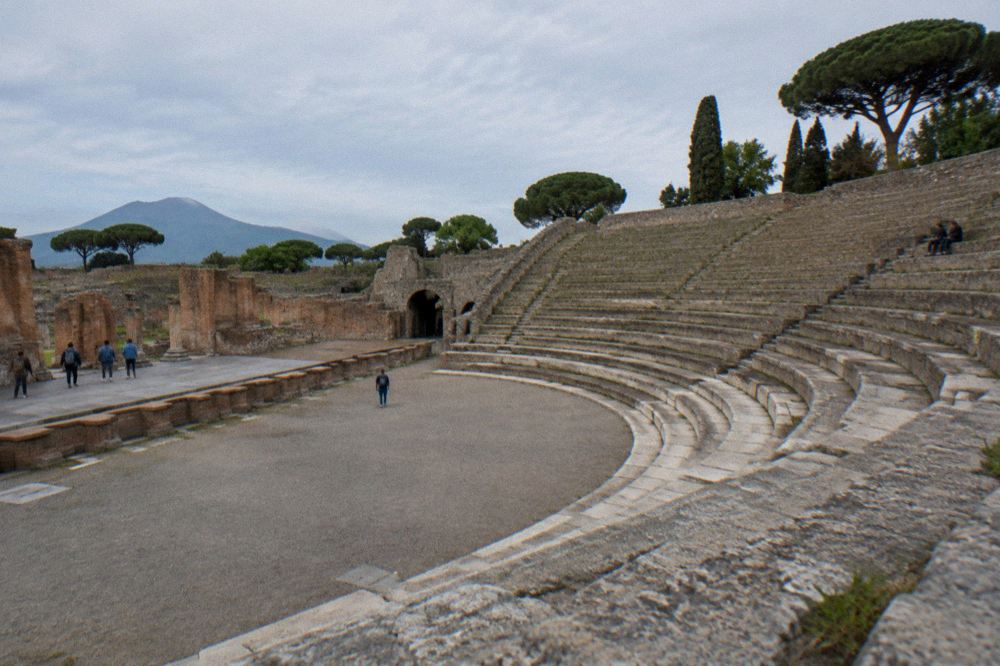
The amphitheatre end of the park is quieter than the Forum end, and it rewards the walk with space to sit and a view back along the street you have just covered.
One closure to plan around: the Praedia of Julia Felix, a grand complex of gardens and commercial units that opens along this street, has been closed to the public since 7 September 2026 for maintenance, with no reopening date announced. Visitors who remember it from earlier trips should not build a route around it until the park confirms it has reopened.
| Landmark | Where it stands relative to the street | Type |
|---|---|---|
| Temple of Jupiter and Forum | Western end, up the steps | Civic and religious centre |
| Basilica | Just north of the Forum | Law court |
| Thermopolium of Vetutius Placidus | On the upper street | Roman snack bar |
| Stabian Baths | Mid-street crossing | Bath complex |
| Lupanar | One block north | Purpose-built brothel |
| House of the Faun | A short walk north | Grand residence |
| House of the Vettii | A short walk north | Frescoed residence |
| Large Theatre and Odeon | South-east of mid-street | Theatres |
| Large Palaestra and Amphitheatre | Eastern end | Sport and spectacle |
What Do The 2026 Pompeii Tickets Cover For This Street?
In 2026 the Pompeii Express ticket at EUR 20 covers the ancient city, including the whole Via Dell Abbondanza; Pompeii+ at EUR 25 adds the suburban villas route; and the 3-day ticket costs EUR 30. From 1 January 2027 the three-tier structure is replaced by a single EUR 25 ticket covering all park sites, valid 30 days, one entry per site, with Oplontis, the Stabiae museum and Boscoreale remaining EUR 8 individually and the MyPompeii Card at EUR 45.
Under-18s enter free, and everyone enters free on the first Sunday of the month. EU citizens aged 18 to under 25 pay a reduced EUR 2. Nominative tickets and the 20,000 visitors-per-day cap, both in force since 15 November 2024, are retained under the 2027 structure announced by the park on 14 September 2026.
| Ticket (2026, ends 31 December 2026) | Price | Covers |
|---|---|---|
| Pompeii Express | EUR 20 | The ancient city, including the Via Dell Abbondanza |
| Pompeii+ | EUR 25 | Adds the suburban villas route, Villa Regina and the Boscoreale Antiquarium, with shuttle |
| 3-day ticket | EUR 30 | Pompeii+ plus Oplontis, the Stabiae villas and museum, Boscoreale |
| Other park sites individually | EUR 8 | Oplontis, Stabiae museum or Boscoreale |
| My Pompeii Card (annual) | EUR 45 (EUR 10 reduced) | Annual pass |
Express holders who decide on the day to see the suburban villas can add them for EUR 8, card payment only, at the Porta Ercolano / Street of the Tombs entrance. Tickets are non-transferable and identity documents may be checked at any entry. The park's visitor regulations also set the bag limit at 30x30x15 cm, with larger bags going to left luggage, a detail worth knowing before you arrive with a full daypack.
The full ticket picture, including where to buy and how the timed slots work, is covered in the dedicated Pompeii tickets guide; the Pompeii entry ticket and guided tour with an archaeologist bundles entry with a guided walk, and you can Check availability if that format suits your group.
| 2027 single ticket (from 1 January 2027) | Detail |
|---|---|
| Price | EUR 25 |
| Coverage | All park sites |
| Validity | 30 days from issue |
| Entries | One entry per site |
| Smaller sites | Oplontis, the Stabiae museum and Boscoreale remain EUR 8 individually |
| MyPompeii Card | EUR 45 |
| Cap and nominative tickets | Both retained |
When Is The Best Time Of Day To Walk The Street?
Arrive for the 9:00 opening and walk the Via Dell Abbondanza early, when light is soft and the coach groups have not yet arrived. In the 16 March to 14 October season the park admits up to 15,000 visitors between 9:00 and 13:00 and only 5,000 between 13:00 and 17:30, so an afternoon entry is far quieter. In winter, 15 October to 15 March, last entrance is 15:30 and the site closes at 17:00.
The time-slot split is the key planning fact. The morning band carries the bulk of the day's admissions, including coach groups from Naples, Sorrento and Rome, and the street between the Forum and the Stabian Baths carries the heaviest foot traffic of the whole site. An afternoon entry, after 13:00, buys you the same stones with a fraction of the crowd, at the cost of less time before the 17:30 last entrance in the summer season.
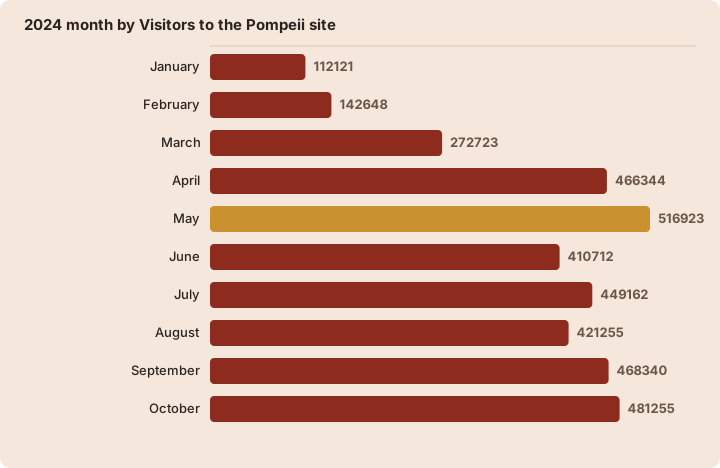
Monthly visitor numbers show when the pressure lands. The park's own data for 2024 records May as the busiest month at 516,923 visitors to the Pompeii site, followed by September at 468,340 and October at 481,255, against 112,121 in January and 138,028 in December. Late autumn and winter mornings on the street are a different experience entirely: quiet, cool and slow.
| 2024 month | Visitors to the Pompeii site |
|---|---|
| January | 112,121 |
| February | 142,648 |
| March | 272,723 |
| April | 466,344 |
| May | 516,923 |
| June | 410,712 |
| July | 449,162 |
| August | 421,255 |
| September | 468,340 |
| October | 481,255 |
| November | 189,866 |
| December | 138,028 |
A guided walk changes the arithmetic again, because a guide moves a group against the flow rather than with it. The small group archaeologist tour of Pompeii is one of the formats that keeps group sizes low while still covering the main street.
What Was Life Like On The Street In AD 79?
The Via Dell Abbondanza in AD 79 was a working high street: shopfronts and snack bars opened directly onto the pavement, election notices crowded the walls, bathers crossed to the Stabian Baths, and carts ground along the basalt between the stepping stones. The eruption that ended it is traditionally dated to 24 August AD 79, though the park's own e-journal states that the alternative 24 October date has no evidentiary basis, leaving the question an open scholarly debate.
The painted texts are the street's most direct window onto its people. Electoral programmata, commissioned by candidate and neighbour alike, recommend named individuals for the city offices, sometimes with occupational tags, a fuller supporting a fuller, a goldsmith backing a magistrate. Elsewhere the walls advertise gladiatorial games, carry everyday insults and jokes, and record prices and debts. The Pompeii graffiti guide gathers what the walls actually said, in the inhabitants' own words.
The eruption sequence that sealed the street is described in the letters of Pliny the Younger, whose uncle, Pliny the Elder, died in the rescue attempt; their story is told in the Pliny the Elder and Vesuvius guide. The traditional manuscript date, drawn from the oldest copies of the letters, reads as 24 August; a 1929 misreading popularised 24 October, and the park's e-journal article on the destruction date states plainly that the October date rests on nothing, while conceding that August is not proven either. A charcoal inscription found in 2018, dated by many scholars to mid-October, has reopened the debate without settling it, and this page follows the park in not settling it either.
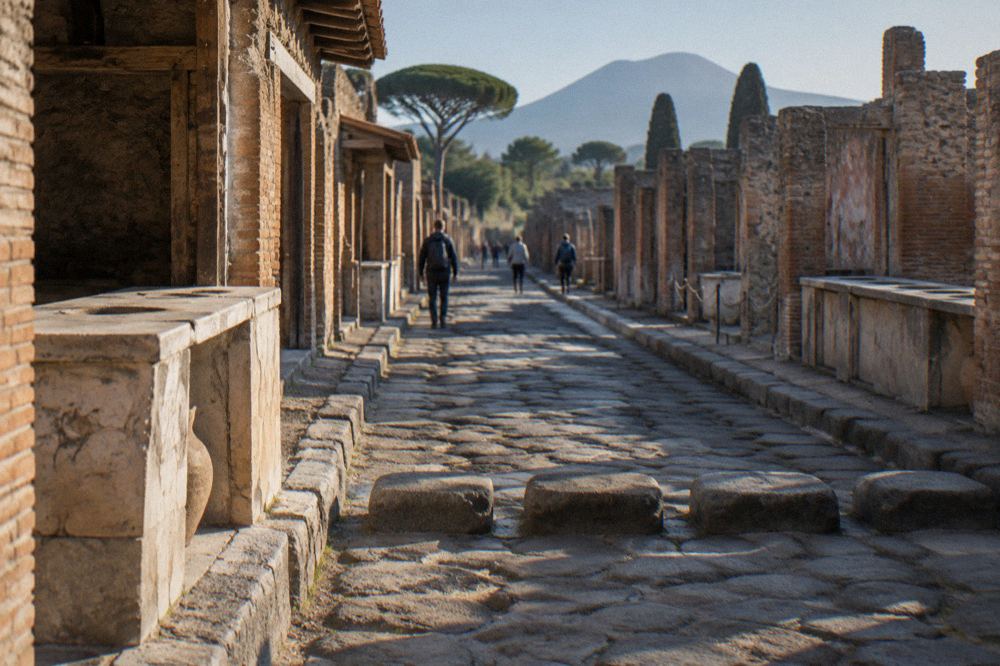
After the eruption the street lay buried under metres of pumice and ash, and it stayed that way for centuries; the when was Pompeii discovered guide traces the excavations that eventually brought it back to light. What the diggers found along this street, shop counters still in place, frescoes still coloured, bread still carbonised in ovens, is what makes it the most legible Roman high street surviving anywhere.
How Do You Get To The Via Dell Abbondanza?
The nearest rail stop is Pompei Scavi-Villa dei Misteri on the Circumvesuviana Napoli-Sorrento line, with scheduled times from Napoli Garibaldi of 29 to 35 minutes, and the park's three ticket offices are Porta Marina, Piazza Esedra and Piazza Anfiteatro. Driving distances are about 24 km from Naples, 26 km from Sorrento and 31 km from Salerno. The Campania Express train service has been suspended since 1 October 2026 until further notice.
The Circumvesuviana is the route travellers ask about, and the operator EAV's own timetable data gives scheduled journey times from Napoli Garibaldi to Pompei Scavi-Villa dei Misteri of between 29 and 35 minutes, with a median of 29. From Sorrento the same line takes 64 to 75 minutes to Naples, and Pompei Scavi to Sorrento takes 34 to 40 minutes. EAV announced new trains and a new timetable for the Vesuvian lines on 16 September 2026, so live schedules deserve a fresh look close to your travel date.
| Journey | Scheduled time | Source |
|---|---|---|
| Napoli Garibaldi to Pompei Scavi-Villa dei Misteri | 29 to 35 minutes | EAV timetable data |
| Napoli Garibaldi to Sorrento | 64 to 75 minutes | EAV timetable data |
| Pompei Scavi-Villa dei Misteri to Sorrento | 34 to 40 minutes | EAV timetable data |
| Road, Naples to Pompei Scavi | 24 km, about 22 minutes | Route calculation on OpenStreetMap |
| Road, Sorrento to Pompei Scavi | 26 km, about 37 minutes | Route calculation on OpenStreetMap |
| Road, Salerno to Pompei Scavi | 31 km, about 30 minutes | Route calculation on OpenStreetMap |
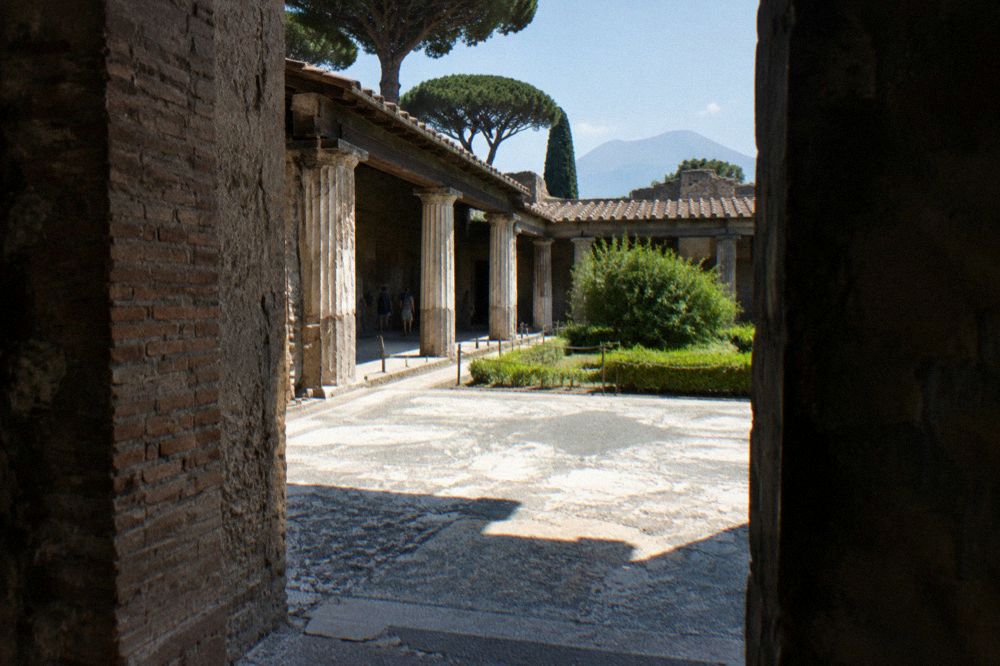
The Campania Express, the premium alternative that once linked Naples, Pompei and Sorrento, has been suspended from 1 October 2026 until further notice, with refunds available through the operator's complaints form or the original seller. Travellers who planned around it should treat any claim that it is running as out of date. The Circumvesuviana train guide covers the line in full.
Drivers should plan around the named entrances rather than a general "Pompeii car park": parking near Porta Marina serves the Forum end of the street, while the Piazza Anfiteatro side serves the amphitheatre end. Cruising visitors have a tighter calculus still, and the Pompeii cruise ship day guide works it through.
What Weather Should You Expect Walking The Street?
Pompei has a Mediterranean climate: at the Pompei grid point, Open-Meteo 1991-2020 normals show about 29.4 C average daily maxima in August, about 12.2 C in January, with November the wettest month at about 180 mm of rain and July the driest at about 16 mm. The street is unshaded stone for stretches, so summer afternoons are hot work and winter mornings can be damp underfoot.
The monthly picture matters more than a seasonal average, because the street offers almost no shelter in either direction. Rain in November at about 180 mm and October at about 129 mm means wet basalt and slick stepping stones, while July and August at 16 mm and 22 mm mean dry heat radiating off the paving by early afternoon. April, May and October sit between the extremes, which is one reason the spring and autumn months dominate the visitor table above.
| Month | About, mean daily max C | About, mean daily min C | About, rain mm |
|---|---|---|---|
| January | 12.2 | 6.6 | 119 |
| February | 12.6 | 6.5 | 103 |
| March | 14.9 | 8.1 | 104 |
| April | 17.7 | 10.4 | 87 |
| May | 21.6 | 14.1 | 59 |
| June | 25.8 | 18.2 | 30 |
| July | 28.7 | 21.1 | 16 |
| August | 29.4 | 21.8 | 22 |
| September | 25.3 | 18.6 | 90 |
| October | 21.3 | 15.1 | 129 |
| November | 16.9 | 11.5 | 180 |
| December | 13.2 | 8.0 | 147 |
Practical consequences follow. In the hot months, water, a hat and the 9:00 opening are not optional courtesies, they are the plan; the Pompeii in summer heat plan is built around exactly this. In the wet months, the stepping stones that thrill photographers become the puddle-crossing system they were designed to be, and shoes with grip earn their place. What to wear in every season is covered in the what to wear to Pompeii guide.
Which Side Trips Combine Well With The Street?
The strongest pairings from the Via Dell Abbondanza are the Forum and Basilica at its west end, the amphitheatre at its east end, and, beyond the city, Vesuvius itself, reached by road from the modern town. Herculaneum, Oplontis and the Stabiae villas are separate park sites a short rail hop away, each covered by the higher 2026 ticket tiers or, from 2027, by the single EUR 25 ticket. The Vesuvius Gran Cono trail sells timed tickets online only, at EUR 11.68 full price.
Vesuvius is the natural companion, because the volcano that destroyed the street is the best viewpoint over the whole Bay of Naples, and the Mount Vesuvius guide covers tickets, caps and access hours in detail. The crater's ticketing runs on 10-minute slots with 50 tickets each, bookable 30 days ahead, plus nominative last-minute tickets released 30 minutes before each slot, and the trail closes automatically on an orange weather alert with automatic refunds. The excursion itself runs two hours return on the shortest route, three on the longest.
For a slower afternoon after the street, the wine country on Vesuvius's slopes produces the Lacryma Christi wines from vines grown on the volcanic soil, and an organic lunch and wine tasting inside the national park is the bookable way to combine the two.
Herculaneum, the wealthier seaside town buried deeper and preserved differently, makes the sharpest contrast with Pompeii: timber, doors and upper floors survive there. Its Villa dei Papiri and Ancient Theatre are currently closed for works, so plan around the rest of the site; the Herculaneum guide has the current picture. Oplontis and the Stabiae villas, the other villas of the eruption, reward travellers with a second or third day, and the villas of Vesuvius route strings them together.
Common Questions About The Via Dell Abbondanza
What Is The Via Dell Abbondanza In Pompeii?
The Via Dell Abbondanza is the main east-west street of ancient Pompeii, running from the Forum towards the amphitheatre. It was the city's principal commercial street in AD 79 and is today the spine of the archaeological park in Campania, southern Italy.
Is The Via Dell Abbondanza Covered By The Pompeii Ticket?
Yes. Every Pompeii ticket covers the street: the EUR 20 Pompeii Express in 2026, and from 1 January 2027 the single EUR 25 ticket that covers all park sites for 30 days with one entry per site.
How Long Does It Take To Walk The Via Dell Abbondanza?
The street itself can be walked end to end in under an hour, but the houses, baths, theatres and shops that open off it are the point, and a realistic visit including the street and its landmarks takes at least half a day.
When Is The Best Time To Walk The Via Dell Abbondanza?
At the 9:00 opening, or after 13:00. The park's time-slot system admits up to 15,000 visitors in the 9:00 to 13:00 band and only 5,000 between 13:00 and 17:30 in the 16 March to 14 October season, so afternoons are far quieter.
Is The Via Dell Abbondanza Suitable For Wheelchairs?
The street itself is ancient basalt paving with deep ruts and stepping stones, so it is difficult. The park's "Pompeii for All" route starts at Piazza Anfiteatro, where visitors with mobility difficulties enter, and allows exit at Piazza Anfiteatro or Piazza Esedra via the Antiquarium lift.
The Via Dell Abbondanza rewards a little planning more than any other single feature of the park, because it is both a destination in itself and the corridor between everything else. Time the walk against the slot system, buy the ticket tier that matches your side trips, wear shoes that can handle Roman paving, and the ancient city's high street delivers what no museum case can: a Roman street, still at street level, still running in the direction its builders gave it. Everything on this page, from the Pompeii Travel Guide homepage to each landmark guide linked above, exists to make that walk pay off.