Circumvesuviana Train
The Circumvesuviana is the local narrow-gauge railway that links Naples with Pompei, Sorrento and the towns around Mount Vesuvius, and it is the way travellers reach the excavations of Pompeii, the ancient Roman city in Campania, southern Italy.
Short answer
The Circumvesuviana runs from Napoli Garibaldi to Pompei Scavi-Villa dei Misteri in 29 to 35 minutes (median 29), and the station sits beside the Porta Marina entrance of the archaeological park. Timetable data from EAV's own feed, dated 30 September 2026, gives these scheduled times. The Campania Express has been suspended since 1 October 2026.
The Circumvesuviana is the narrow-gauge commuter railway that threads the plain around Mount Vesuvius, connecting Naples with the modern town of Pompei, Sorrento and the villages between, in Campania, southern Italy. For visitors to Pompeii, the ancient Roman city buried by the eruption of AD 79 and now an archaeological park about 24 km by road south-east of Naples, this little railway is the everyday workhorse: it stops at Pompei Scavi-Villa dei Misteri, the station beside the excavations, and it does so without any interchange from Napoli Garibaldi. This guide sets out what the timetable data actually shows, what the station names mean, how the arrival works, and where the train fits against the other ways of reaching the park.
One piece of housekeeping before anything else. The Campania Express, the premium limited-stop service that once ran the same corridor, has been suspended since 1 October 2026 until further notice, with refunds handled through EAV's complaints form or the original seller. Every piece of advice that still recommends it is out of date. The Circumvesuviana is the train that is actually running, and this page is about how to use it well. For the fuller background on the suspended service, see the companion page on the Campania Express and its suspension.
What Is The Circumvesuviana Train?
The Circumvesuviana is a group of narrow-gauge local railway lines operated by EAV, Ente Autonomo Volturno, radiating from Naples across the Vesuvian plain to towns including Pompei, Sorrento and Poggiomarino. It is not a high-speed railway and not a tourist service: it is the commuter network the region runs on, with the excavations of Pompeii served by the stop called Pompei Scavi-Villa dei Misteri on the Naples to Sorrento route. Trains start at Napoli Garibaldi, the station connected to Naples Centrale.
That origin matters for planning. Anyone arriving in Naples by high-speed rail steps off at Napoli Centrale, walks through the interchange to Napoli Garibaldi downstairs, and boards there. There is no other change of train needed to reach the excavations. The line then runs south through the densely built towns on the seaward slopes of Vesuvius before reaching the modern town of Pompei, whose two stations serve different purposes: Pompei Scavi-Villa dei Misteri for the archaeological park, and the town's sanctuary station for the modern town and its pilgrimage basilica, which is covered in the guide to the modern town of Pompei and its Sanctuary.
Because it is a commuter network, the experience is a commuter experience. Trains are basic, they fill up at peak hours with people going to work and school, and in summer they fill with visitors carrying daypacks. None of this is a problem if it is expected. The essentials of buying tickets and reading the network are covered in plain question form in How Do I Buy Tickets for the Circumvesuviana Train?
Frequency questions deserve their own honest answer, and the page How Often Does the Circumvesuviana Train Run? addresses what is and is not published about the timetable. For arrival logistics, the dedicated guide to Pompei Scavi station and the walk to the ruins picks up where this page ends.
For travellers who would rather not ride a commuter train at all, there are booked alternatives, and the choice is worth weighing before committing.
How Long Does The Circumvesuviana Take To Pompeii?
Scheduled journey times computed from EAV's own timetable data, feed dated 30 September 2026, give Napoli Garibaldi to Pompei Scavi-Villa dei Misteri as 29 to 35 minutes, with a median of 29. The same feed gives Napoli Garibaldi to Sorrento as 64 to 75 minutes (median 69), and Pompei Scavi-Villa dei Misteri to Sorrento as 34 to 40 minutes. These are scheduled running times, not door-to-door trip times, and they allow no margin for boarding or delays.
Those three figures answer the questions visitors actually ask: how long from Naples, how long from Sorrento, and how long between the two end-points of a Bay of Naples day. They come from the operator's own GTFS feed, which is the same data that feeds journey planners, so they are as reliable as the published schedule itself. What they do not include is the walk through the Centrale to Garibaldi interchange in Naples, finding the correct platform, or the queue at the barrier on a busy morning in high summer.
| Journey | Scheduled time | Median |
|---|---|---|
| Napoli Garibaldi to Pompei Scavi-Villa dei Misteri | 29 to 35 minutes | 29 |
| Napoli Garibaldi to Sorrento | 64 to 75 minutes | 69 |
| Pompei Scavi-Villa dei Misteri to Sorrento | 34 to 40 minutes | not stated |
For comparison, road routing on OpenStreetMap gives driving distances to Pompei Scavi of 24 km and about 22 minutes from Naples, 26 km and about 37 minutes from Sorrento, and 31 km and about 30 minutes from Salerno. These are driving estimates, not official figures, and Naples traffic can easily double them. The point of the comparison is scale, not a recommendation to drive: on paper the train and the road are close from Naples, while from Sorrento the train's 34 to 40 minutes compares with about 37 minutes of driving.
| Origin | Road distance to Pompei Scavi | Driving estimate | Circumvesuviana scheduled time |
|---|---|---|---|
| Naples | 24 km | about 22 minutes | 29 to 35 minutes |
| Sorrento | 26 km | about 37 minutes | 34 to 40 minutes |
| Salerno | 31 km | about 30 minutes | not stated on this route |
| Rome | 234 km | about 2 hours 40 minutes | no direct service |
Rome deserves its own sentence, because it is the source of frequent confusion. For the fuller day-trip arithmetic from the capital, including booked coach options, see the Rome to Pompeii day trip guide.
Not every traveller wants to manage commuter rail on a short visit, and for a day built around the excavations rather than around transport, a guided option that bundles the train ride with a guide has real appeal. The skip-the-line express from Sorrento does exactly that on the same railway.
Where Does The Train Stop For The Pompeii Excavations?
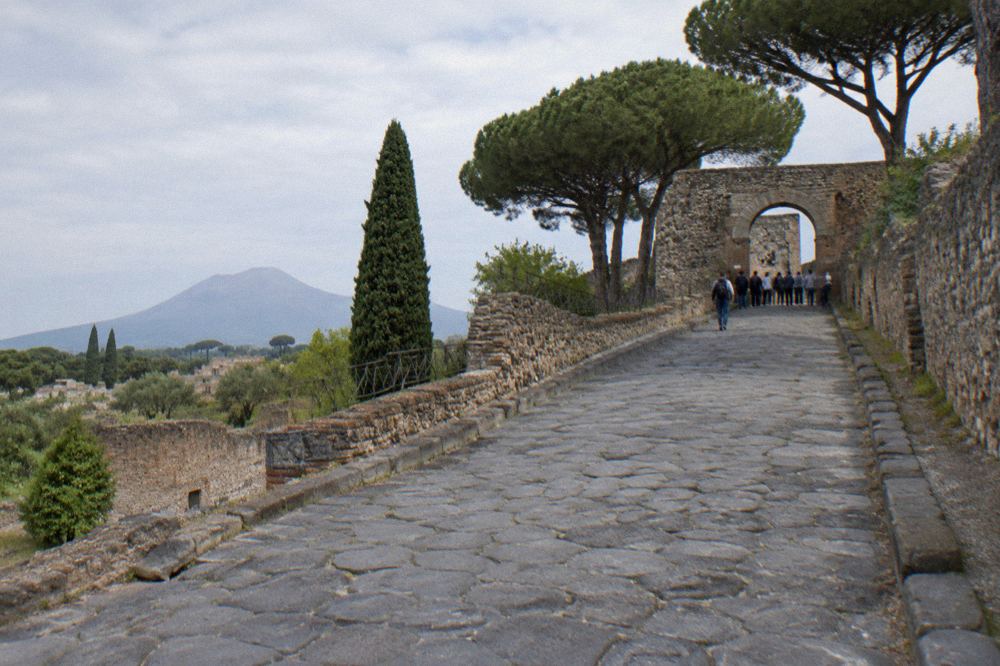
The station for the excavations is Pompei Scavi-Villa dei Misteri, stop 6049 on the Naples to Sorrento route, and it sits beside the Porta Marina side of the archaeological park. Visitors arriving here walk only a few minutes to the Porta Marina entrance. Do not alight at the town's sanctuary station, which serves the modern town of Pompei and its pilgrimage basilica rather than the ruins.
The station name carries both spellings on purpose. "Pompei" without the second i belongs to the modern town, per the standard orthography of this site, while "Villa dei Misteri" refers to the Villa of the Mysteries, the suburban Roman villa that lies a short distance north-west of the Porta Marina entrance and is one of the park's celebrated buildings. The station predates mass tourism to the site and its name reflects its two nearest landmarks: the excavations and the villa.
On arrival, the practical question is where to enter, and the answer is fixed: the park's ticket offices are at Porta Marina, Piazza Esedra and Piazza Anfiteatro, and there is a further entrance at Porta Ercolano / Street of the Tombs for the suburban villas route. Train arrivals are closest to Porta Marina. The walk itself, and everything about the station building and its surroundings, is covered in detail at Can You Walk from Pompeii Train Station to Ruins?
| Entrance | Role | Notes for Circumvesuviana arrivals |
|---|---|---|
| Porta Marina | Ticket office, main entry | Closest to Pompei Scavi-Villa dei Misteri station |
| Piazza Anfiteatro | Ticket office | Eastern side, also the entry point for the Pompeii for All accessible route |
| Porta Ercolano / Street of the Tombs | Suburban villas route | Where Express holders add the villas route for EUR 8, card only |
For visitors connecting onward to Herculaneum, a different station on the same network serves the town of Ercolano, and that journey, with its own station choice and walking directions, is covered in the comparison guide Pompeii vs Herculaneum. The two sites reward different styles of visit, and the train reaches both.
For anyone who decides mid-planning that the commuter railway is more friction than they want, the booked alternatives are genuine. The round-trip shuttle from Naples is the simplest of them, and it is this page's featured alternative to the train.
Which Tickets Do You Need Once You Arrive?
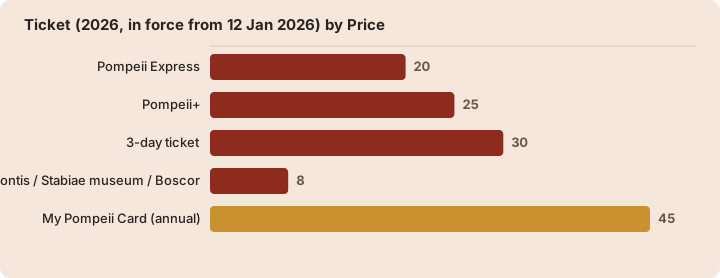
Once there, you pick from the EUR 20 Pompeii Express, the EUR 25 Pompeii+ and the EUR 30 three-day ticket in 2026, with Oplontis, the Stabiae museum and Boscoreale at EUR 8 each and the annual My Pompeii Card at EUR 45; from 1 January 2027 a single EUR 25 ticket covers every park site, valid 30 days with one entry per site, while Oplontis, Stabiae and Boscoreale stay EUR 8 and the card stays EUR 45.
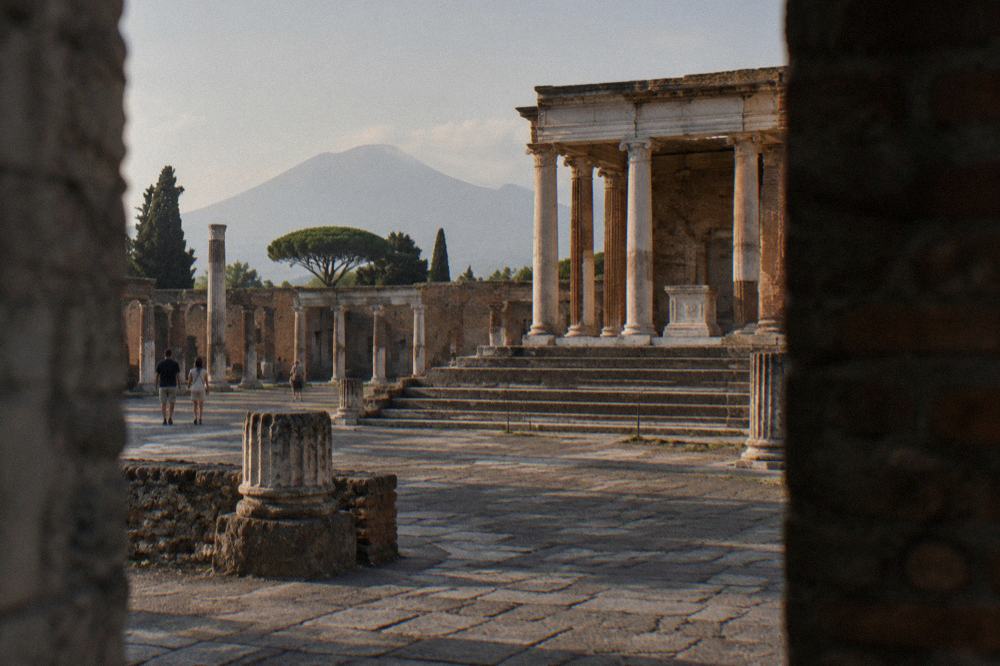
The 2026 structure is a ladder. Express buys the ancient city alone. Pompeii+ adds the suburban villas of Mysteries and Diomedes, Villa Regina and the Antiquarium at Boscoreale, plus the shuttle between them. The 3-day ticket extends Pompeii+ across Oplontis, the Stabiae villas of Arianna and San Marco, the Stabiae museum and Boscoreale. Reduced admission of EUR 2 applies to EU citizens aged 18 to under 25, and entry is free for under 18s and for everyone on the first Sunday of the month. The annual My Pompeii Card carries a reduced price of EUR 10.
| Ticket (2026, in force from 12 Jan 2026) | Price | Covers | Ends |
|---|---|---|---|
| Pompeii Express | EUR 20 | Ancient city only | 31 December 2026 |
| Pompeii+ | EUR 25 | City, suburban villas, Villa Regina, Boscoreale Antiquarium, shuttle | 31 December 2026 |
| 3-day ticket | EUR 30 | Pompeii+ plus Oplontis, Stabiae villas and museum, Boscoreale | 31 December 2026 |
| Oplontis / Stabiae museum / Boscoreale | EUR 8 each | Single smaller site | continuing at EUR 8 in 2027 |
| My Pompeii Card (annual) | EUR 45, reduced EUR 10 | Annual pass | continuing at EUR 45 in 2027 |
The 2027 change was announced by the park on 14 September 2026 and it simplifies the ladder into one product: from 1 January 2027 the single EUR 25 ticket covers all park sites, is valid 30 days, and allows one entry per site. Named, nominative tickets are retained, as is the 20,000 visitors per day cap in force since 15 November 2024. Tickets are non-transferable and non-refundable except in extraordinary closure, and identification may be checked at any entry.
Tickets can be bought at the three park ticket offices or online through the park's official ticketing page. The fuller decision guide, including which ticket suits which itinerary, is the dedicated page on Pompeii tickets, and the buying-in-advance question is answered at Should I Buy Tickets to Pompeii in Advance? Two further rules matter at the gate: bags are limited to 30x30x15 cm, with larger items going to left luggage, and time-slot capacity splits the day between 9:00-13:00 (up to 15,000 entries) and 13:00-17:30 (up to 5,000) during the summer season from 16 March to 14 October.
Many visitors fold the entry ticket into a guided product so that gate logistics, timing and explanation arrive as one package. The small-group archaeologist tours are the strongest of these on this site's roster.
What Are The Opening Hours That Shape Your Train Times?
The park opens at 9:00 year-round. From 16 March to 14 October the last entrance is at 17:30 and the site closes at 19:00; from 15 October to 15 March the last entrance is at 15:30 and closing is at 17:00. Pompeii has no weekly closing day, and the site is closed only on 25 December and 1 January unless otherwise communicated.
These hours dictate the shape of any Circumvesuviana day. A winter arrival from Naples that leaves after midday will struggle: the 29 to 35 minute ride plus the walk and the ticket check leave little of the site after a 15:30 last entry. In summer the arithmetic is generous, with a morning train from Napoli Garibaldi delivering visitors before 10:00 and a full day available. The companion question of how long to spend is its own topic, treated in the guide to how long to spend in Pompeii.
| Season | Opens | Last entrance | Closes |
|---|---|---|---|
| 16 March to 14 October | 9:00 | 17:30 | 19:00 |
| 15 October to 15 March | 9:00 | 15:30 | 17:00 |
The 20,000 daily cap is not an abstraction. The park's own figures record more than 36,000 visitors on a single free first Sunday, and annual attendance at the Pompeii site ran at 4,000,090 in 2025, following 4,069,377 in 2024 and 3,985,424 in 2023. Those numbers are why the nominative ticket and the slot split exist, and why an early Circumvesuviana train is the more comfortable plan: monthly figures for 2024 show May peaking at 516,923 visitors and October at 481,255, while the quietest months were January at 112,121, February at 142,648 and December at 138,028.
What Is The Ride Actually Like?
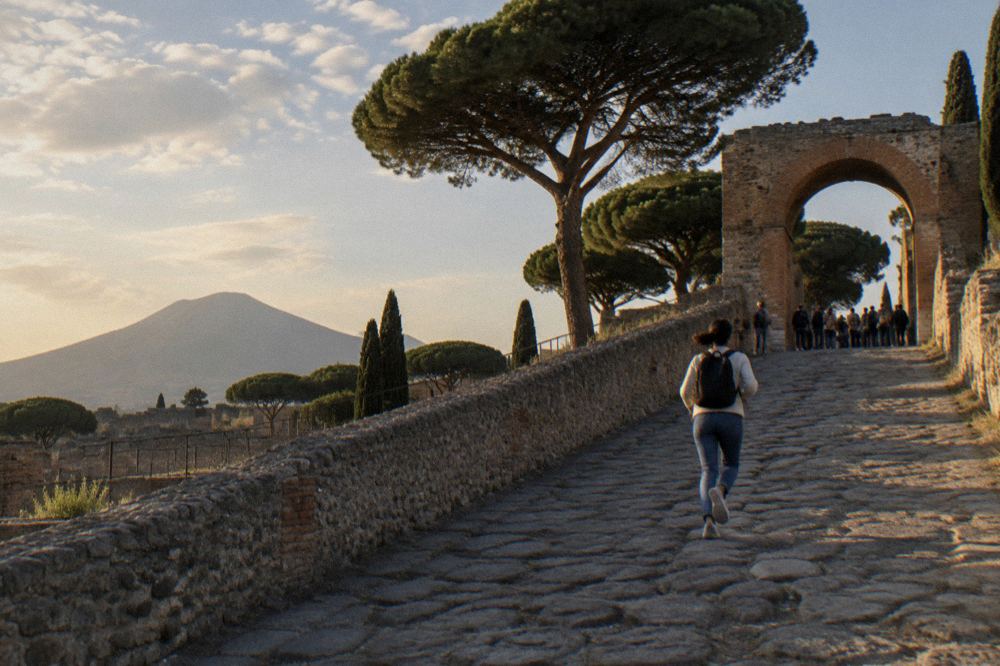
The Circumvesuviana is a crowded, un-airconditioned-in-parts commuter railway with narrow cars, frequent stops and standing room at peak times, and in high summer it is hot. It is also direct, cheap in character and, on the Naples to Sorrento route, genuinely scenic in stretches where the line runs along the coast below the volcano. None of its discomforts are dangerous, but they are real, and packing light is the single best mitigation.
Honesty about the ride serves visitors better than romance. The cars date from various eras, the windows may or may not open, and graffiti is part of the scenery. The peak problems are about crowding rather than safety: the site's own safety and scam guidance, in the guide to Pompeii safety and scams, treats the railway as ordinary urban transport, worth the same care as any city train. Luggage is the other recurring friction, and the park's own bag rule compounds it: anything larger than 30x30x15 cm goes to left luggage at the site, so a suitcase that rode the train must be deposited before entry, a subject with its own page on luggage storage at Pompeii.
The compensations are concrete. The line climbs out of the Naples conurbation and threads towns that sit directly under the volcano's shoulder, and the seaward stretches open onto the Bay of Naples. For anyone basing in Sorrento, the same train that carries commuters also carries the whole day-trip economy of the coast, a connection explored in the guide to Sorrento to Pompeii, while visitors coming the other way from the coast are served by the page on the Amalfi Coast to Pompeii.
Weather shapes the day on both ends of the ride. Pompei's climate is Mediterranean, and the grid-point normals for 1991-2020 show about 29.4 C mean daily maxima in August against about 12.2 C in January, with November the wettest month at about 180 mm of rain and July the driest at about 16 mm. A summer train day wants water and a hat; a November one wants a layer and an eye on the sky. The full seasonal picture is in Pompeii weather and the best time to visit.
| Month | Mean daily max (C) | Mean daily min (C) | Rain (mm) |
|---|---|---|---|
| January | about 12.2 | about 6.6 | 119 |
| April | about 17.7 | about 10.4 | 87 |
| July | about 28.7 | about 21.1 | 16 |
| October | about 21.3 | about 15.1 | 129 |
How Does The Train Compare With A Guided Tour?
A Circumvesuviana ticket buys transport and nothing else: the ride, the arrival and self-guided time inside the park, with the entry ticket bought separately. A guided product folds transport, entry and explanation into one booking, starts from a fixed meeting point, and costs more as a result. Neither is objectively better; the choice turns on whether the reader values independence or wants the site interpreted, and the trade-offs are laid out in the guide to guided versus self-guided visits.
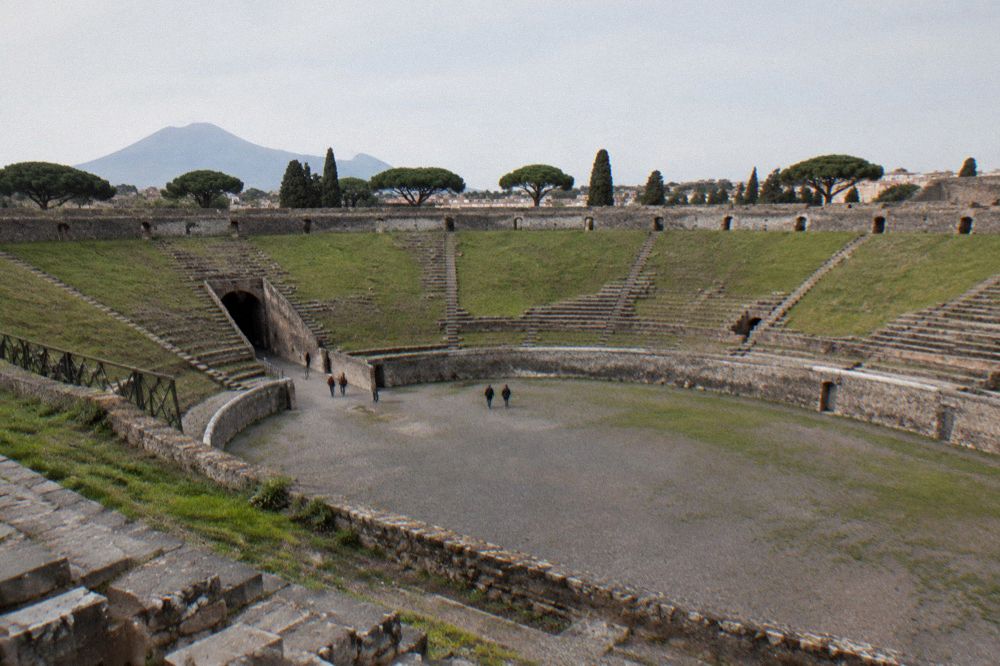
The self-guided ceiling is high. Pompeii rewards preparation, and this site's itinerary pages, among them Pompeii in one day and the half-day highlights route, exist because the site is large: an excavated area of 44 hectares within a 98 hectare inscribed property, shared with Herculaneum and Torre Annunziata under the UNESCO listing. An audio guide product is the middle path, and its pluses and minuses are weighed at Pompeii audio guides and apps.
The guided floor is equally real. An archaeologist-led small group turns walls into evidence, and reviews of the guided products on this site's roster consistently reward that depth. The entry-ticket-plus-archaeologist product is the most booked of them on this roster and suits first-time visitors who arrive by train and want the explanation to begin at the gate.
For a second site on the same railway, the two-archaeologist product covering both Pompeii and Herculaneum is the strongest combined option, and it suits visitors who want the network to do the connecting.
Which Base City Works Best For A Train Day Trip?
Naples is the natural Circumvesuviana base: the 29 to 35 minute ride from Napoli Garibaldi is the shortest verified journey to Pompei Scavi on this line, and Sorrento follows at 34 to 40 minutes from Pompei Scavi or 64 to 75 minutes from Naples. Salerno and the Amalfi Coast connect by other means, and Rome works as a day base only with a full-day commitment. The trade-offs between Naples and Sorrento as bases have their own comparison page.
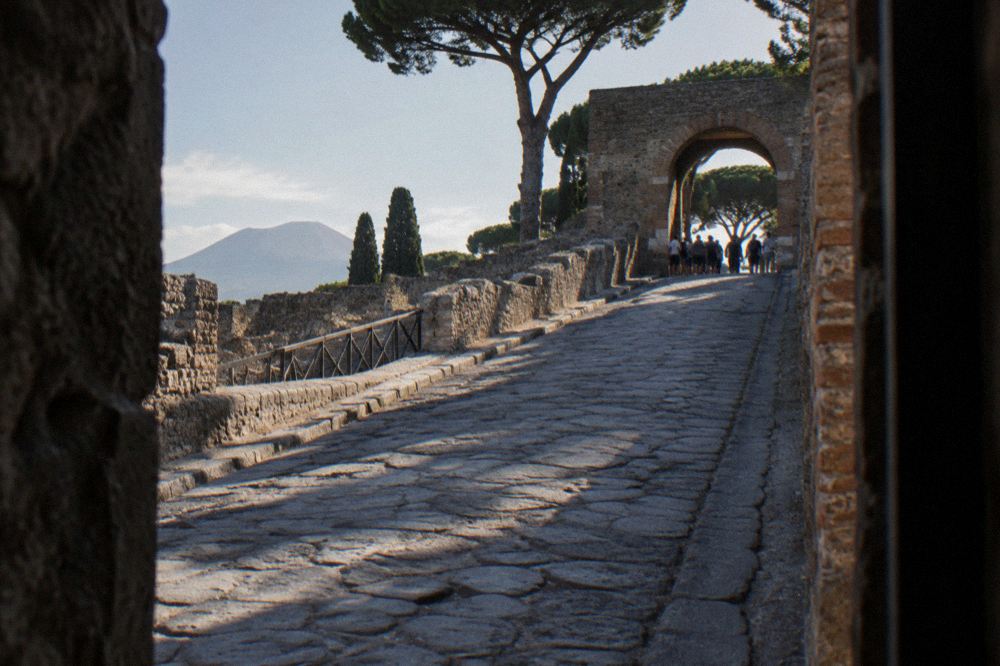
Naples rewards the train traveller twice over: the shortest ride, and the fullest day, since an early start from Napoli Garibaldi can be combined with the city's own archaeological museum, whose relationship to a Pompeii visit is covered in the guide to the Naples National Archaeological Museum. The overnight question, staying in modern Pompei itself versus Naples, is argued at Is It Worth Staying Overnight in Pompei? and in the practical guide to where to stay in Pompei
Sorrento visitors ride the same line from the far end. The express guided product from Sorrento pairs the train with skip-the-line entry, and it is the strongest booked option from that base; the shuttle and private alternatives from Rome suit travellers who want the coast and the ruins in a single booked day.
Common Questions About The Circumvesuviana Train
Can you walk from Pompei Scavi station to the ruins?
Yes, the station sits beside the park on the Porta Marina side, and the walk to that entrance is a few minutes. The detailed arrival walkthrough is at walking from the train station to the ruins.
How long is the train from Sorrento to Pompeii?
The scheduled time from Pompei Scavi-Villa dei Misteri to Sorrento is 34 to 40 minutes, per EAV's timetable data dated 30 September 2026. From Napoli Garibaldi to Sorrento the scheduled range is 64 to 75 minutes.
Do you need to buy park tickets in advance when arriving by train?
The park caps entries at 20,000 per day with named tickets and a season slot split, so advance purchase through the park's official ticketing page is the safer plan in peak months. Admission in 2026 is EUR 20 Express, EUR 25 Pompeii+ or EUR 30 for the 3-day ticket, changing to a single EUR 25 ticket on 1 January 2027.
Which train station is best for Pompeii?
Pompei Scavi-Villa dei Misteri is the station for the excavations. The choice between it and other stations on the network is argued in the dedicated answer page on which station is best for Pompeii.
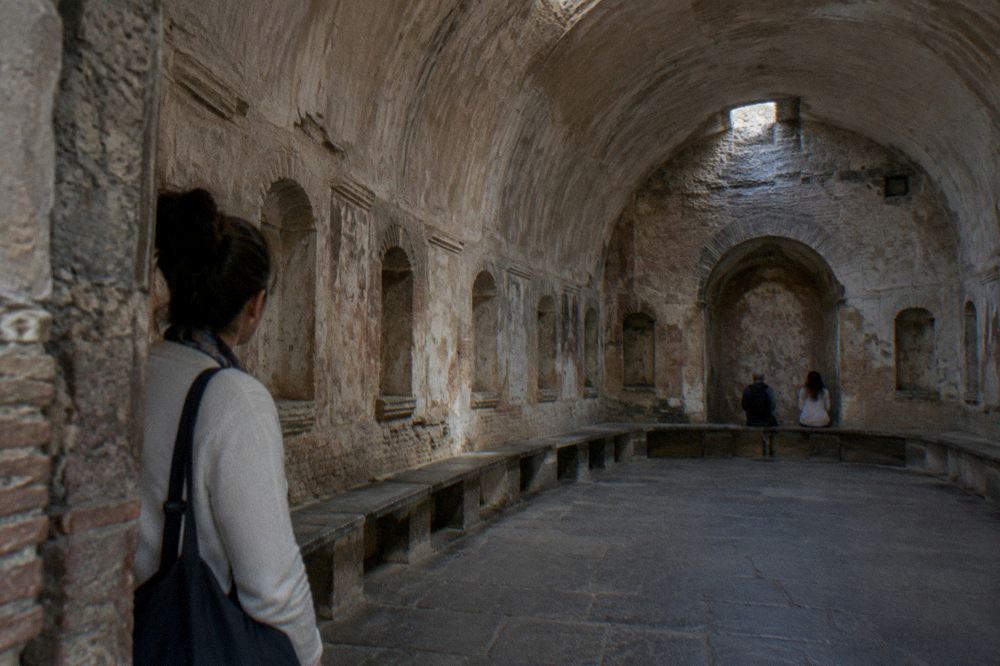
The Circumvesuviana is not the most elegant railway in Italy, but it is the one that delivers visitors to the gate of the most extraordinary archaeological site in Campania in under half an hour from Naples. Plan around the published scheduled times, respect the park's slot system and bag rule, and the train becomes the simplest part of the day. For everything that happens after the barrier, from the Forum to the Villa of the Mysteries, the rest of this Pompeii Travel Guide picks up the story, and the interactive map of the site turns the plan into a route.