How Difficult Is It To Walk In Pompeii?
How hard is walking the ancient city of Pompeii in Italy? Surfaces, distances, footwear, accessibility and route difficulty, explained with park facts.
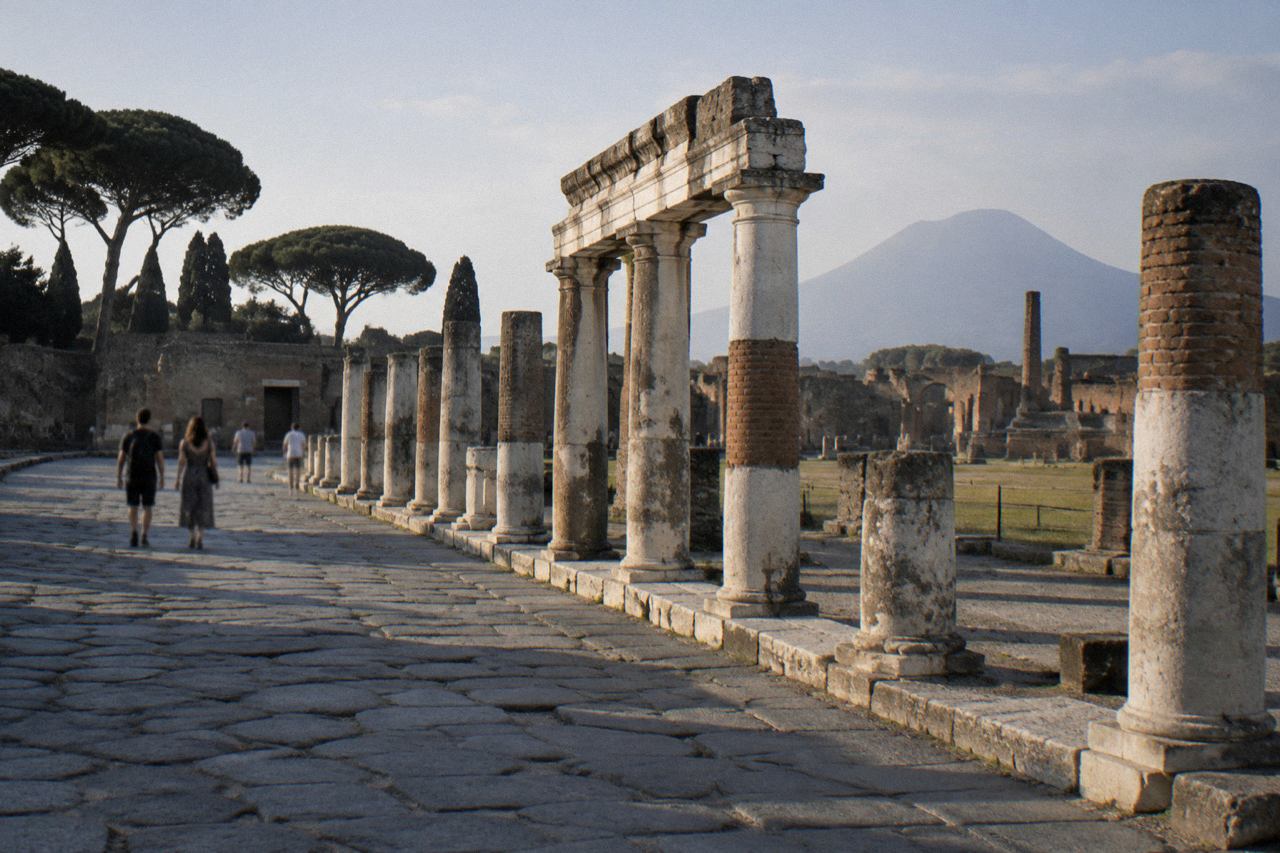
Pompeii, the ancient Roman city buried by the eruption of Mount Vesuvius in AD 79, sits beside the modern town of Pompei in Campania, southern Italy, about 24 km by road from Naples. It is an enormous open-air site, an excavated area of 44 hectares inside a UNESCO-inscribed property of 98 hectares, and the honest answer to whether it is hard to walk is: moderately, in a very specific way. The site is almost entirely flat, but the ground underfoot is two thousand years old. Roman streets are paved with basalt slabs worn smooth and split by age, the footpaths are raised and stepped, and the shade is scarce in summer. Nothing here is technically demanding; everything here punishes the wrong shoes.
How Difficult Is It To Walk In Pompeii?
Walking Pompeii is moderately difficult underfoot but not physically strenuous: the site is close to flat, with no climbs inside the walls, yet roughly 44 hectares of excavated streets are paved in worn, rutted basalt, crossed by raised stepping stones, and laced with loose gravel and cobbles. Visitors with ordinary mobility and closed shoes manage the main routes without trouble; sandals, wheelies and hurry are what turn a good walk into a hard one.
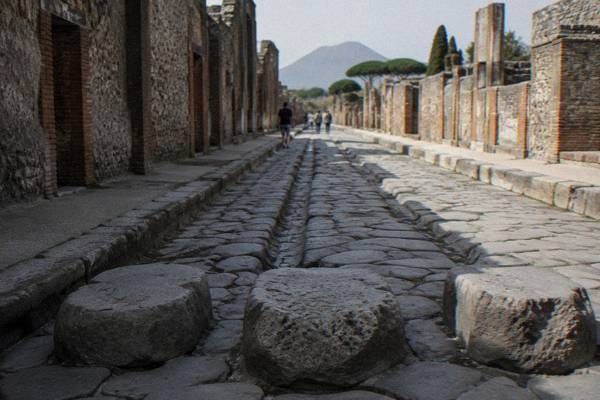
The difficulty people remember afterwards is almost always the surfaces, not the distance. A Roman street was built for cart wheels, not for trainers: deep ruts were cut into the basalt by centuries of iron-rimmed traffic, and the gaps between slabs have widened with age. Where the Romans crossed their flooded streets they set stepping stones, big rectangular blocks spaced for cart wheels, and you step up and over them, one after another, exactly as they did. Between the stones the surface dips, holds puddles after rain and hides ankle-turning edges.
Add the practical realities of a working archaeological park. Sections close without notice for maintenance, as the Praedia of Julia Felix has been closed since 7 September 2026, which pushes walkers onto alternative, sometimes rougher, streets. The park also operates a daily cap of 20,000 visitors, in force since 15 November 2024, and on the busiest free first Sundays it has recorded more than 36,000 people in a single day, days when even wide streets feel congested and slow.
What Surfaces Will You Actually Walk On In Pompeii?
Four surfaces dominate: worn basalt paving with deep cart ruts, raised pedestrian footpaths and stepping stones to climb, compacted earth and gravel in unexcavated or restored areas, and modern walkways near the entrances and the Antiquarium. Expect repeated short steps up and down all day, the biggest single reason comfortable, supportive footwear is the standard advice for this site.
The paved decumani and side streets are the roughest part. The basalt is honest but unforgiving, polished in the middle of each slab and broken at the joints, and the ruts that chariot wheels cut into it run across your path at ankle height. The raised footpaths along each side help pedestrians, but their edges are irregular stone blocks, so crossing a street means two steps down, a hop across the stepping stones, and two steps back up.
| Surface in Pompeii | What it feels like | Main difficulty |
|---|---|---|
| Worn basalt street paving | Hard, polished, rutted | Cart ruts and broken joints catch the foot |
| Stepping stones and raised footpaths | Blocks 10-30 cm high, irregular spacing | Repeated small steps up and down |
| Gravel and compacted earth paths | Loose in dry weather, muddy after rain | Slipping and unstable footing |
| Modern walkways near entrances and the Antiquarium | Even, engineered surfaces | None beyond ordinary crowds |
Gravel appears wherever the park has laid paths through less-formal areas, and it behaves like gravel anywhere: loose and skiddy when dry, clinging and slick after rain. Rain itself is worth planning around, and the site's own climate numbers show why. Open-Meteo's 1991-2020 normals for the Pompei grid point show about 180 mm of rain in November, the wettest month, against about 16 mm in July, the driest, with mean daily highs of about 21.3 C in October and about 28.7 C in July.
A tour led by an archaeologist follows a planned line through the site, which means less backtracking across the roughest streets in search of the famous houses. This page's featured option is a skip-the-line guided tour of Pompeii led by an archaeologist, which has its own page on the archaeologist-led Pompeii tour, with Check availability on the live listing. If you are weighing that against going alone, the comparison in can you tour Pompeii on your own covers the trade-offs directly.
How Much Ground Does A Pompeii Visit Cover?
There is no forced distance: a focused circuit of the Forum, a bath complex, a granary and two or three famous houses can be done at a relaxed pace, while completists who work from Porta Marina to the Amphitheatre and back cover several kilometres of streets, all of it on foot. The variable is your route, not the site's demands, because vehicles cannot drive the ancient streets.
The shape of the city decides your day. The three ticket offices sit at Porta Marina, Piazza Esedra and Piazza Anfiteatro, and the suburban villas route leaves from the separate Porta Ercolano / Street of the Tombs entrance. Someone entering at Porta Marina, walking the length of the city to the Amphitheatre, and returning by a parallel street has, by the geometry of a 44-hectare excavation, put in a serious shift, on surfaces far worse than any city pavement.
What is documented is what surrounds the walk: the modern town and station context is covered in can you walk from Pompeii train station to ruins, and the sizing above, 44 hectares excavated within 98 hectares of inscribed property, is the UNESCO record of the site itself.
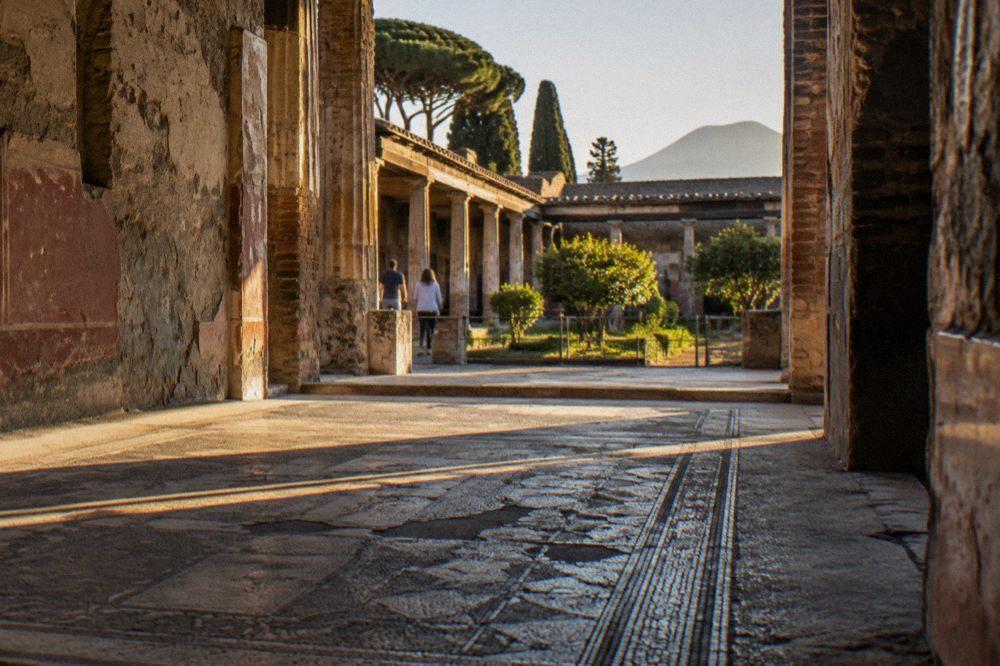
The honest planning move is to halve your ambition and double your enjoyment. Pick one entrance, three or four headline sights, and one long street to stroll for the atmosphere. Visitors cramming Pompeii and Herculaneum into a single day face a harder version of the same question, examined in can I do Herculaneum and Pompeii in one day, and the answer starts with realistic walking budgets at each site.
Tours solve the distance problem by logistics. The three options shown above span the realistic formats: an archaeologist-led small-group walk inside the city, a full-day Pompeii and Vesuvius combination from Naples with lunch, and a long-haul day trip from Rome pairing Pompeii with Sorrento and the Amalfi Coast. Every price, duration and rating sits on the operator's live listing rather than in this text, and the free-cancellation terms on each listing are worth a look before you commit to a full-day option.
Which Parts Of Pompeii Are Easiest And Hardest?
The easiest ground is around the Forum and the modern entrances, where surfaces are consolidated and the famous buildings cluster close together; the hardest is the network of narrow residential streets on raised footpaths, the long open decumanus stretch toward the Amphitheatre, and the suburban villas route beyond Porta Ercolano, which adds distance and full sun exposure.
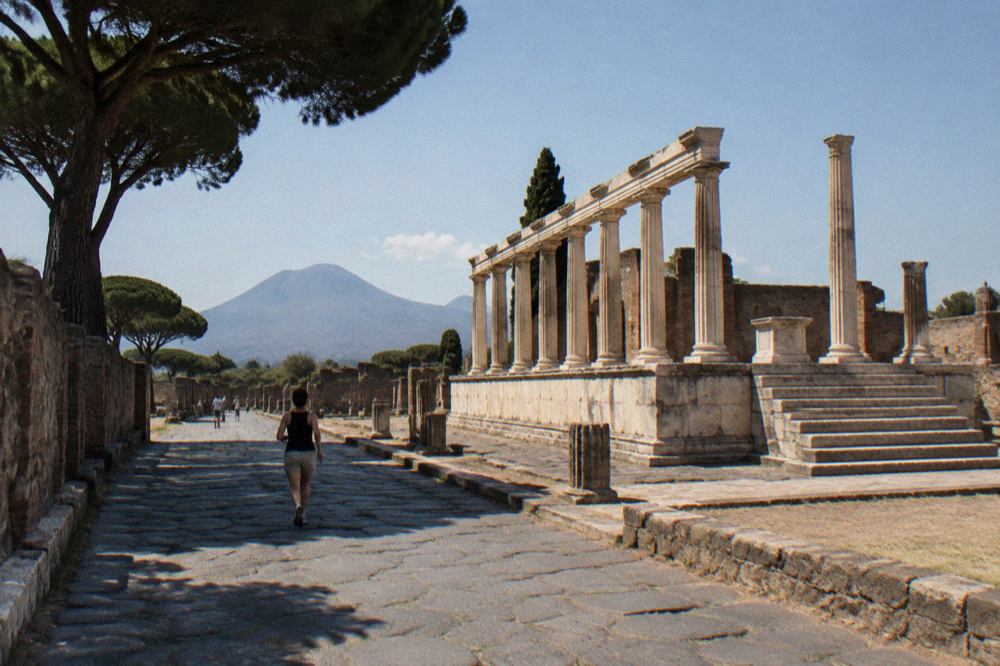
The Forum end of the city gives you the biggest sights on the gentlest walking. From Porta Marina the path rises very gradually to the Forum terrace, and the Forum, the basilica and the temple precincts are arranged in a compact line, so a slow loop here delivers an enormous return per step. The Antiquarium nearby sits on engineered surfaces. In high summer this is also where the shade of standing columns and reconstructed structures helps earliest in the day.
The eastern half of the city is where the walk earns its reputation. Streets run long, straight and unshaded toward Piazza Anfiteatro, and the Large Palaestra and the Amphitheatre sit at the far end, so the return leg doubles your distance on the same tired feet. The famous houses in between, the House of the Faun among them, sit behind narrow doorways reached off cobbled side lanes, and each visit adds steps up thresholds and along raised walkways inside.
| Area of the site | Surface character | Exposure | Effort relative to the rest |
|---|---|---|---|
| Forum and Porta Marina approach | Consolidated paths, gradual rise | Partial shade | Light |
| Central residential streets | Rutted basalt, stepping stones, footpath edges | Sun and shade mixed | Moderate |
| Long decumani toward the Amphitheatre | Long unbroken paving runs | Largely unshaded | Moderate to hard |
| Suburban villas route from Porta Ercolano / Street of the Tombs | Extended street walking outside the walls | Fully exposed | Hard, for distance and sun |
Timing matters as much as routing. Between 16 March and 14 October the park opens at 9:00 with last entrance at 17:30, and the last two hours of admission put you on hot stone in the hottest part of the day; from 15 October to 15 March last entrance is 15:30 with a 17:00 close. An arrival at opening time buys cooler stone and thinner crowds on the rougher eastern streets.
What Should You Wear On Your Feet For Pompeii?
Closed, broken-in walking shoes with grippy soles are the right footwear for Pompeii: trainers or light hiking shoes handle rutted basalt, stepping stones and gravel far better than sandals, which the surface gaps and ruts actively work against. Thin-soled shoes transmit every stone edge, and anything with a heel is unwise on two thousand years of split paving.
The case against sandals is mechanical, not stylistic. The ruts in the paving run exactly where a sandaled foot wants to land, the gaps between slabs swallow straps, and the stepping stones demand a firm plant of the foot at a height sandals were never built to secure. Visitors who wear them anyway usually finish the day with bruised soles, the most common complaint the site generates. The wider clothing question, including summer heat and sun protection, is handled in is there a dress code for Pompeii.
Beyond shoes, three habits carry more weight than any gear purchase. Carry water, because the shadeless streets and summer normals, mean daily highs of about 29.4 C in August, dehydrate walkers fast. Plan a toilet and rest stop, a practical question answered in detail in are there toilets in Pompeii. And respect the park's bag rule: permitted bag size is 30x30x15 cm, with larger bags going to left luggage, which is itself a reason to travel light and walk light.
Is Pompeii Accessible For Wheelchairs And Limited Mobility?
Partly, by design: the park maintains a dedicated route, Pompeii for All, on which visitors with mobility difficulties enter at Piazza Anfiteatro and may exit at Piazza Anfiteatro or Piazza Esedra using the Antiquarium lift, giving step-reduced access to a meaningful stretch of the city. The full street network, with its stepping stones and raised footpaths, is not wheelchair-friendly, so the accessible route is the realistic plan.
The Pompeii for All route exists precisely because the original streets are the obstacle. It is the park's own answer, documented in its visitor regulations, and it is the right starting point for anyone planning a visit with a wheelchair, a walker or a companion who cannot manage repeated steps. Entering at Piazza Anfiteatro also shortens the day, since the accessible circuit begins at the eastern end rather than committing you to the long walk from Porta Marina.
For visitors who tire rather than cannot, the same advice that serves everyone serves them doubly: one entrance, a short list of sights, water, and an early start within the opening hours above. A tour can also absorb the planning burden; the small-group archaeologist format mentioned earlier moves at the group's pace on a fixed route, and the full question of guided versus independent is weighed in is it worth getting a guided tour of Pompeii.
For a second-day plan that spreads the walking across two sites, a combined Pompeii and Herculaneum small-group tour with an archaeologist alternates the long city streets with the smaller, more compact Herculaneum excavation, where the ground is different and the distances shorter. Note that at Herculaneum the Villa dei Papiri and the Ancient Theatre are closed, so that visit currently centres on the open excavated blocks.
Common Questions About Walking In Pompeii
How difficult is it to walk in Pompeii?
Moderately: the site is essentially flat, but roughly 44 hectares of excavated streets are paved in rutted, worn basalt crossed by raised stepping stones, plus gravel paths and repeated small steps up and down. Closed, grippy shoes and a realistic route make it comfortable for most visitors of ordinary mobility.
Can you walk Pompeii in sandals?
You can, and many do, but sandals are the wrong tool: the cart ruts and slab gaps in the paving catch straps and thin soles all day, and bruised feet are the site's most common complaint. Closed, broken-in trainers or light hiking shoes are the standard recommendation.
How long does it take to walk around Pompeii?
There is no single published walking time, and it depends entirely on your route. A focused highlights circuit of the Forum and a few famous houses is a relaxed half-day; working the full length of the city from Porta Marina toward Piazza Anfiteatro and back, on the same surfaces twice, is a long day on your feet.
Is Pompeii accessible for wheelchairs?
Partly. The park's dedicated Pompeii for All route lets visitors with mobility difficulties enter at Piazza Anfiteatro and exit at Piazza Anfiteatro or Piazza Esedra via the Antiquarium lift. The wider ancient street network, with its stepping stones and raised footpaths, is not wheelchair-accessible.
Does Pompeii involve a lot of stairs or hills?
No hills of consequence: the ancient city sits on a nearly flat plateau, and the rise from Porta Marina to the Forum is gradual. What feels like climbing is the constant small-scale stepping, up onto footpaths, over stepping stones and through doorway thresholds, repeated all day.
For walkers who want the site plus a proper rest afterwards, a Pompeii tour with lunch and wine tasting builds the break into the day, finishing the walk at a table rather than on the return train. Every figure for it lives on the live listing.
The full picture, from tickets to entrances, is gathered on Pompeii Travel Guide, the site's home page, if you want the walking question set inside a complete plan.
Pompeii is a walk, not a hike: flat, sun-exposed and rough underfoot, generous to anyone who arrives early in closed shoes with a short list of things to see, and honest about punishing everyone else. Choose the entrance that shortens your day, treat the stepping stones as part of the attraction rather than an obstacle, and the two thousand year old streets will feel exactly as walkable as the Romans intended them to be.