Is It Safe To Visit Pompeii Now?
Yes, the ancient Roman city of Pompeii in Campania, Italy is safe to visit. This guide covers the Vesuvius risk question, park rules, heat, transport and everyday precautions.
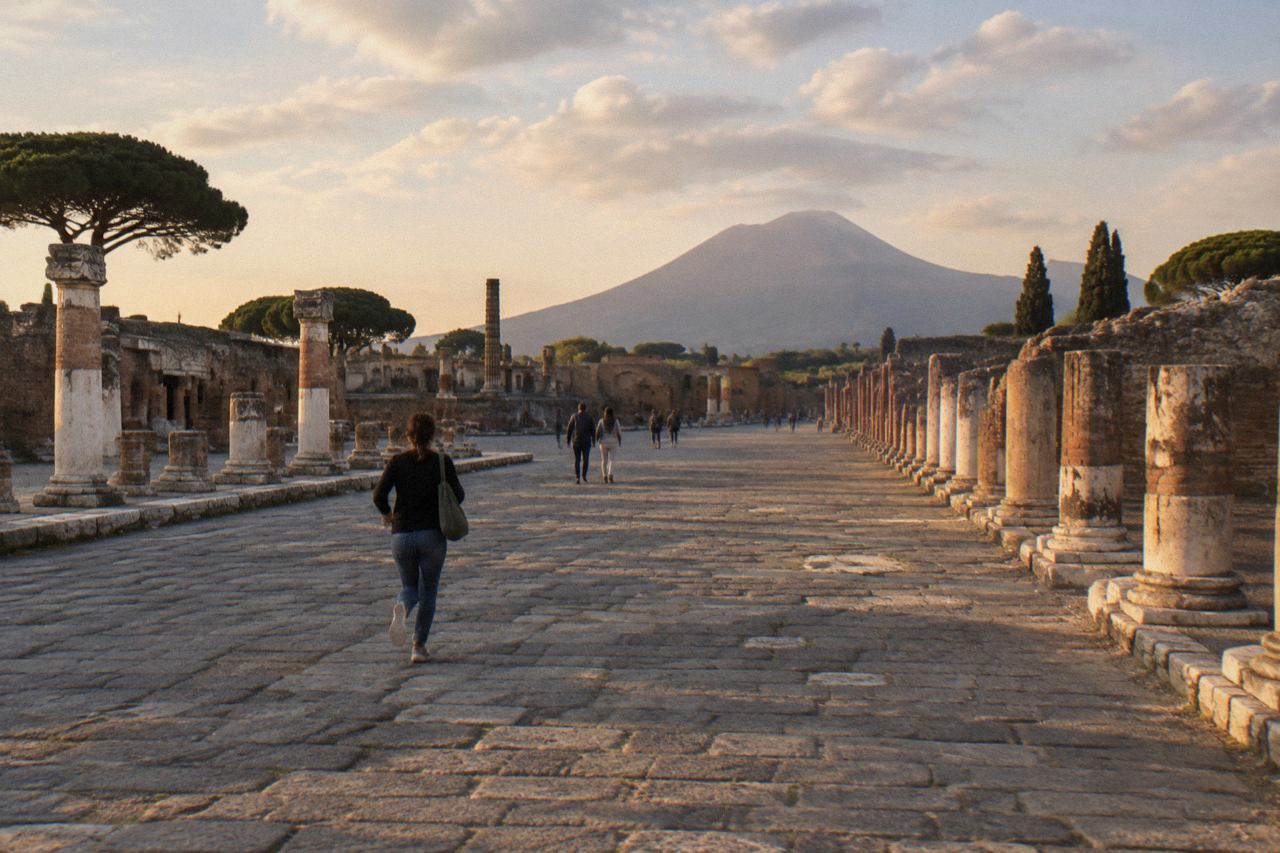
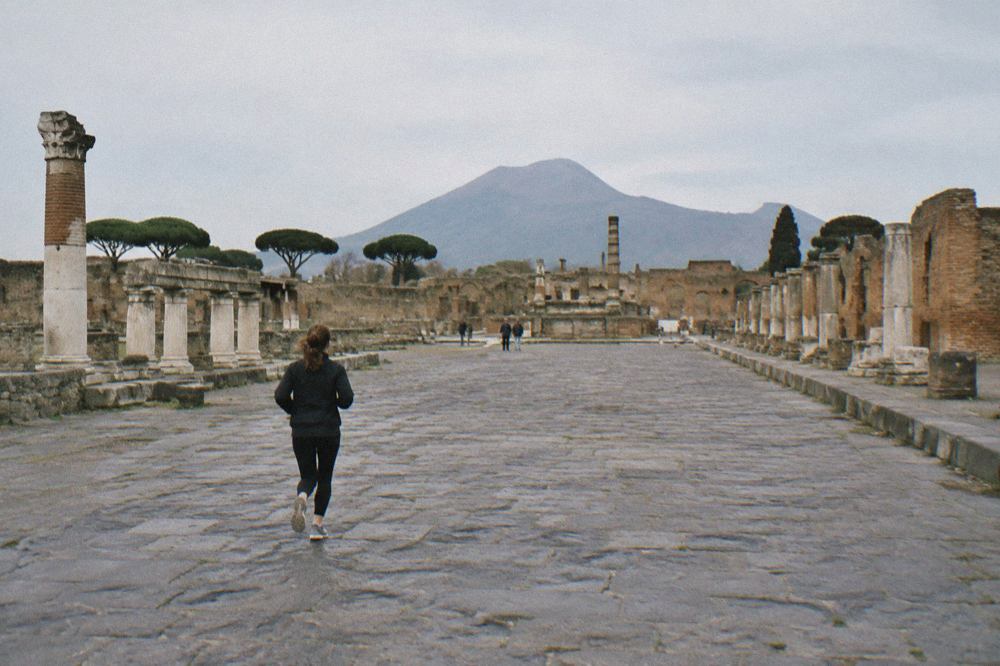
Every year, millions of people walk the excavated streets of Pompeii, the ancient Roman city buried by the eruption of Mount Vesuvius in AD 79 and now an archaeological park in Campania, southern Italy, beside the modern town of Pompei and about 24 km by road from Naples. The visitor count published by the park itself, 4,000,090 people in 2025, tells you the essential thing: this is one of the busiest and best-managed heritage sites in Europe, and a visit is safe for an ordinary healthy traveller. The questions worth asking are practical ones, about heat, uneven Roman paving, crowds and sun, and this page answers them with the park's own published rules and figures rather than reassurance.
Is It Safe To Visit Pompeii Now?
Yes, Pompeii is safe to visit now, and the genuine risks are environmental rather than criminal: summer heat, sun exposure and uneven ancient paving, plus ordinary pickpocketing precautions at Naples stations. All of these are easily manageable with simple planning, so safety concerns should not deter you from visiting the site.
Treat that answer as a starting point rather than a full safety plan. The park is a large open-air site, with an excavated area of 44 hectares, very little shade and long stretches of original Roman paving that is worn, stepped and uneven. Nothing about that is dangerous in the way a hazard is dangerous, but it catches out travellers who arrive in sandals with one small bottle of water in July. The sections below take the real questions in turn: whether Vesuvius itself poses a threat, what the risks inside the park are, how to get there safely, and what everyday precautions make sense around the modern town of Pompei.
One structural point matters for peace of mind. Since 15 November 2024 the park has issued nominative tickets and enforced a daily cap of 20,000 visitors, with entry split into time bands. That cap exists partly to protect the site and partly to keep the experience, and the crowd density inside it, within safe and comfortable limits. On the record free first Sundays, when entry costs nothing, the park has counted more than 36,000 people in a single day, which is exactly why the cap and the timed bands are worth respecting if a quiet, comfortable visit is the goal. The practical side of buying entry is covered in detail in the site's ticket guide.
Is Mount Vesuvius Still A Danger To Visitors?
No working volcanologist treats Vesuvius as an immediate threat to a day visitor in Pompei. The volcano is monitored continuously by Italy's national institute of geophysics and volcanology, an eruption would be preceded by measurable warning signs over weeks or months, and the park and the surrounding towns operate published evacuation procedures. No alert level, eruption forecast or monitoring claim is stated on this page, because the official bulletin is the only honest source for it.
What can be stated plainly is the managed, official side. The Vesuvius Gran Cono trail, the path to the crater itself inside the Vesuvius National Park, is run on online-only timed tickets, with 50 tickets released every 10 minutes and bookable 30 days ahead. The trail and its ticket office close automatically whenever the weather alert reaches orange or above, and tickets are refunded automatically when that happens. That is the clearest possible evidence of how risk is handled around this volcano: thresholds are set in advance, closures are automatic, and nobody is invited onto a mountainside in conditions that are not safe.
It also helps to be precise about geography. The excavated city of Pompeii sits well away from the crater, on the plain near the modern town of Pompei, and a visit to the ruins involves no ascent, no crater rim and no trail. If you choose to add the crater trail on the same day, that is a separate decision with its own rules, covered in the site's guide to visiting Mount Vesuvius. Some visitors prefer a combined day built and run by an operator, which handles the transfer between the two sites, and the selection below shows the options that do this well.
For travellers weighing the volcano question honestly, the historical record is the right frame. The eruption that destroyed Pompeii happened in AD 79, and the date itself is still debated by scholars: the traditional manuscript date is 24 August, while the park's own e-journal states that the alternative 24 October date has no evidentiary basis. The modern risk picture is a matter of continuous instrumental monitoring and civil protection planning, not of a volcano quietly filling up while nobody watches.
What Are The Real Risks Inside The Pompeii Park?
The three real risks inside Pompeii are heat and sun, uneven ground, and disorientation in a 44-hectare site with limited shade and facilities. There is no crime problem inside the park, there are drinking water points and toilets, and the park publishes a specific access route, Pompeii for All, for visitors with mobility difficulties, entering at Piazza Anfiteatro with an exit option at Piazza Esedra via the Antiquarium lift.
Heat is the headline. The climate in Pompei is Mediterranean, and the 1991-2020 normals computed from the Open-Meteo historical archive put the average daily maximum in August at about 29.4 C, with July close behind at about 28.7 C and almost no rain, about 16 mm in July. Stone streets radiate that heat back up all afternoon, and shade inside the excavated city is scarce. Water, a hat, covered shoulders and morning timing are not optional extras in summer, they are the safety equipment. The numbers below show how the heat and the rain distribute across the year.
| Month (Pompei, 1991-2020 normals) | Average daily max | Average daily min | Average rain |
|---|---|---|---|
| May | about 21.6 C | about 14.1 C | 59 mm |
| June | about 25.8 C | about 18.2 C | 30 mm |
| July | about 28.7 C | about 21.1 C | 16 mm |
| August | about 29.4 C | about 21.8 C | 22 mm |
| September | about 25.3 C | about 18.6 C | 90 mm |
| October | about 21.3 C | about 15.1 C | 129 mm |
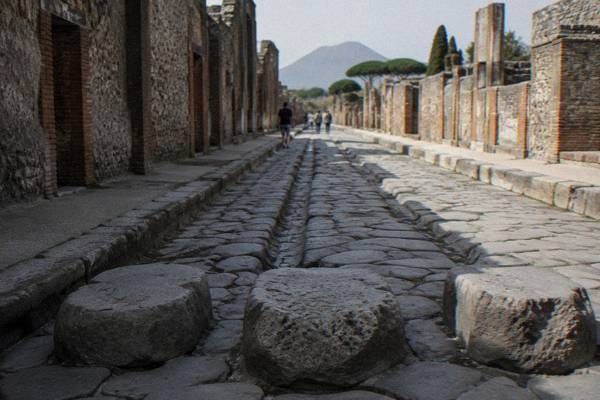
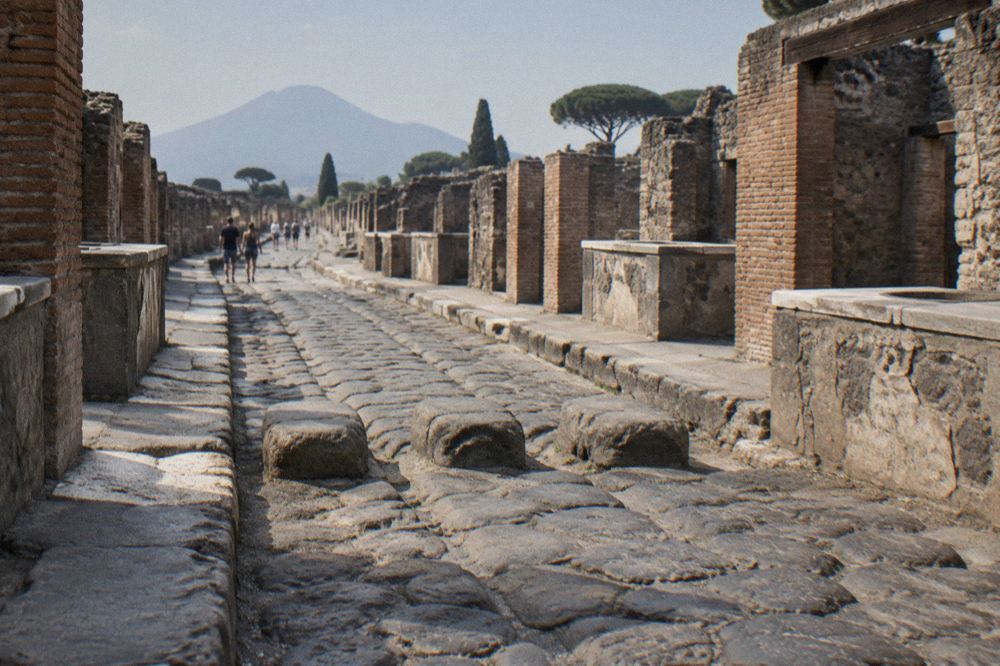
The ground is the second risk. Roman streets were built with raised stepping stones, deep wheel ruts and cambers, and two thousand years of wear has not smoothed them. Ankles turn here every week of the year, and sturdy closed shoes are the single most effective piece of safety equipment a visitor can bring. The question of footwear and clothing has its own page, on what to wear to Pompeii, and the broader walking question, how demanding the site is on foot, is covered in how difficult it is to walk in Pompeii.
The park's own regulations close the remaining gaps. Bags larger than 30x30x15 cm must go to left luggage, identity may be checked at entry because tickets are nominative, and tickets are non-transferable and non-refundable except in the case of extraordinary closure. Two closures are in force and worth knowing before you plan a route: the Praedia of Julia Felix has been closed to the public since 7 September 2026 for maintenance, and at Herculaneum, the separate site to the north-west, the Villa dei Papiri and the Ancient Theatre are closed for works. A closure is not a safety problem for you, but arriving expecting a house that is shut is its own small misadventure.
A guided entry solves a surprising amount of the safety picture at once. The featured option on this page is an archaeologist-led guided tour with the entry ticket included, which means the ticketing and time-band logistics are handled for you, and the guide's route decisions naturally account for conditions on the ground, where the shade is, which streets are open, where the water points sit. It starts at the park itself, in the city rather than as a day trip, so nothing depends on a morning transfer. For travellers who want the fuller story of guided versus independent options, the site's comparison page works through the trade-offs.
Is It Safe To Travel To Pompeii From Naples Or Sorrento?
Yes, the transfer to Pompeii from Naples or Sorrento is safe and simple, and the standard route is the Circumvesuviana railway to the Pompei Scavi-Villa dei Misteri station, scheduled at 29 to 35 minutes from Napoli Garibaldi. The only recent change is that the Campania Express service has been suspended since 1 October 2026 until further notice, so travellers who had planned on it should use the ordinary line instead.
The Circumvesuviana is a busy suburban railway, and the standard advice on it is the standard advice for any crowded city train: keep bags in front of you, keep phones off the table-height window ledges, and treat the stations at Naples as the places where attention pays. The operator, EAV, publishes its timetables and its strike notices on its own site, and checking the strike category before a travel day is a two-minute habit that removes the main genuine disruption risk. The last strike notices actually published for the Vesuvian lines were dated 13 April 2026 and 9-10 May 2026.
By road, the driving distances are short: about 24 km from Naples, 26 km from Sorrento and 31 km from Salerno to the Pompei Scavi station area, per routing data on OpenStreetMap. Parking and driving questions have their own treatment in the site's guide to parking at Pompeii, and the question of which station and which entrance to aim for is settled in which train station is best for Pompeii. For anyone still assembling the wider day, can Pompeii be a day trip from Naples answers the feasibility question directly.
One dated transport fact deserves its own sentence, because it changes plans. The Campania Express, the premium limited-stop service that many older articles recommend for this journey, has been suspended since 1 October 2026 until further notice, with refunds handled through the operator's complaints form or the original seller. If a guidebook in your bag praises it, the book is out of date, not wrong about safety, just behind the timetable.
Is Pompeii Safe For Families, Solo Travellers And Older Visitors?
Yes, with route planning matched to the visitor. Families do well with the shaded rest points, the water points and a two-hour core route rather than a full day; solo travellers face no specific risk beyond ordinary urban care at Naples stations; and older visitors can use the published Pompeii for All accessible route, entering at Piazza Anfiteatro, with an exit at Piazza Esedra available via the Antiquarium lift.
The honest variable is stamina, not safety. The excavated area covers 44 hectares, the walking surface is original paving, and the combination defeats visitors who plan a full circuit on a hot afternoon. Shorter, smarter routes fix this, and the site's two-hour Pompeii route and half-day highlights route exist precisely for this. Toilets and facilities have their own page, are there toilets in Pompeii, and knowing where they are before you enter is a small thing that makes a big difference with children or older relatives.
The eruption story itself is what brings many families, and it can unsettle younger children when they first meet it. The bodies question, handled honestly in where the bodies from Pompeii are now, is better prepared at home than discovered mid-visit. Nobody lives inside the ancient city today, a fact with its own answer page, and the modern town of Pompei beside it is an ordinary working Italian town with a famous sanctuary, covered separately.
What Everyday Precautions Make Sense Around Pompei?
Ordinary tourist precautions are enough around the modern town of Pompei and the park entrances: watch belongings on the Circumvesuviana and at Naples stations, use the park's left luggage for oversize bags rather than carrying them, carry water and sun protection in every season from May to September, and book timed entry rather than arriving speculatively on a free first Sunday, when crowds peak past 36,000 people.
None of this is specific to Italy, let alone to Pompei, and it is worth saying plainly that the panic some articles generate around Neapolitan petty crime is not supported by anything in the park's own published material. The site's dedicated page on safety and scams at Pompeii collects the practical detail, and the question of whether you can simply arrive unannounced, rather than booking ahead, is answered in can you just show up at Pompeii. The park's own regulations are short, readable and worth two minutes: nominative tickets, the 30x30x15 cm bag limit, no drones without authorisation, and identification that may be checked at entry.
Booking in advance is the last piece. Timed entry spreads arrivals, keeps the daily count under the 20,000 cap, and removes the queue-and-guess element from the day. Whether pre-booking makes sense for your dates is argued in should you buy Pompeii tickets in advance, and whether an escorted option fits your travelling style is the subject of what the best tour for Pompeii is.
Between the trio above, the escorted Vesuvius day with lunch included is the one that changes the safety arithmetic most for a cautious traveller, because the transfer from Naples, the crater timing and the meal stop are all handled by the operator rather than assembled from timetables. For a visitor who wants only the city, the archaeologist-led entry tour remains the simplest safe start.
Common Questions About Visiting Pompeii Safely
Is it safe to visit Pompeii now?
Yes. The real risks are heat, sun and uneven paving, all manageable with water, proper shoes and a morning start.
Is Mount Vesuvius dangerous for tourists?
No institution treats it as an immediate danger to visitors. The crater trail runs on timed online tickets, closes automatically on an orange weather alert or above, and refunds automatically when it closes. This page states no alert level, because the official monitoring bulletin is the only honest source.
Is it safe to walk around Pompeii at night?
The excavated city keeps published opening hours, closing at 19:00 with last entry at 17:30 from 16 March to 14 October, and closing at 17:00 with last entry at 15:30 from 15 October to 15 March. No evening opening is confirmed, so night visits are not a plan.
Are there dangerous animals or stray dogs in Pompeii?
The park's published regulations cover bags, drones and dress, and state no animal hazard.
What should I wear to stay safe in Pompeii?
Closed, sturdy shoes for the worn Roman paving, a hat, covered shoulders and a refillable bottle for the water points. In summer, average daily maxima reach about 29.4 C in August, and shade inside the site is scarce.
Is the area around Pompei station safe?
Pompei Scavi-Villa dei Misteri is a small, busy tourist station beside an entrance. Ordinary care with bags and phones, the same as on any urban railway, is the whole of the advice; no crime figure for the area is published here.
The overall verdict stands: Pompeii in Campania, Italy is safe to visit now, and has been through every one of the four million visit years the park has just recorded. Bring water, bring closed shoes, book a timed entry, respect the sun, and the hardest part of the day will be choosing which house to see first, a problem the Pompeii Travel Guide homepage is built to solve next.