Pompei Town
The modern town of Pompei sits beside the excavations of ancient Pompeii in Campania, southern Italy, about 24 km by road from Naples. It is a working Italian town with a pilgrimage Sanctuary, a shrine basilica, and the practical services, stations and restaurants that a day among the ruins depends on.
Short answer
Pompei is the modern town in Campania, southern Italy, that grew up beside the buried Roman city of Pompeii, about 24 km by road from Naples. Its centre is the Pontificia Basilica of the Madonna of Pompei, one of Italy's major Marian shrines. The town holds the Circumvesuviana stations, including Pompei Scavi-Villa dei Misteri at the excavations, plus hotels, restaurants and services for visitors.
The modern town of Pompei, in Campania, southern Italy, is not the archaeological park, though the two share a boundary and, confusingly, almost a name. The ancient city buried by the eruption of Mount Vesuvius in AD 79 is spelled Pompeii; the living town that grew up around and beside the excavations is spelled Pompei, and it deserves to be understood on its own terms. It is the place where your train arrives, where your luggage can be stored, where pilgrims walk to a famous basilica, and where the ordinary Italian businesses that make a visit workable are found. Treat it as a destination with its own identity and the whole day gets easier.
What Is The Difference Between Pompei And Pompeii?
The difference is spelling and substance: Pompeii with a double i is the ancient Roman city buried by Vesuvius in AD 79 and now an archaeological park, while Pompei with one i is the modern Italian town beside it, about 24 km by road from Naples. The two are neighbours but separate: the park has its gates, tickets and hours, and the town has shops, churches, hotels and the train stations that serve the whole complex, as in Pompei Scavi-Villa dei Misteri, the stop at the excavations.
The spelling convention matters more than it looks. Italian uses Pompei for the modern comune and for the archaeological park's Italian name, Parco Archeologico di Pompei, but English-language writing separates the ancient city as Pompeii. Every sign, timetable and ticket in the area can be read correctly once you know the rule: two i's for the dead Roman city, one i for the living town.
Geographically the arrangement is simple. The excavations run along the western edge of town, the Sanctuary and the modern centre sit a short walk inland, and the Circumvesuviana rail line stitches them together with two stops: Pompei Scavi-Villa dei Misteri next to the Porta Marina entrance to the park, and Pompei Santuario near the basilica in the town centre. A traveller who confuses the two stops adds a walk of roughly twenty minutes, uphill on the return.
The town also anchors the wider Vesuvian constellation. Herculaneum lies toward Naples at modern Ercolano, covered in the guide to Herculaneum and modern Ercolano; Oplontis is at Torre Annunziata; the Stabiae villas belong to Castellammare di Stabiae. Each is a separate site with its own story, and the map of the whole Pompeii area shows how tightly they cluster around the volcano.
Where Is Pompei Town And How Do You Get There?
Pompei is in Campania, southern Italy, about 24 km by road from central Naples, roughly a 22-minute drive, and 26 km, about 37 minutes, from Sorrento; Salerno is 31 km away, about 30 minutes, and Rome 234 km, about two hours and forty minutes of driving. The rail link is the Circumvesuviana from Napoli Garibaldi, with scheduled runs to Pompei Scavi-Villa dei Misteri taking 29 to 35 minutes. The Campania Express has been suspended since 1 October 2026, so the Circumvesuviana is the practical rail option.
Those road figures come from OpenStreetMap routing and are driving estimates rather than official travel times, but they describe the geography accurately: Pompei is genuinely close to Naples, Sorrento and Salerno, which is why the area supports so many day trips. Rome is far enough that a day trip consumes the whole day, and travellers planning that version should read the dedicated Rome to Pompeii day trip guide for the trade-offs involved.
| Route | Road distance | Approximate driving time |
|---|---|---|
| Naples to Pompei Scavi | 24 km | about 22 minutes |
| Sorrento to Pompei Scavi | 26 km | about 37 minutes |
| Salerno to Pompei Scavi | 31 km | about 30 minutes |
| Rome to Pompei Scavi | 234 km | about 2 hours 40 minutes |
On rail, the Circumvesuviana's Sorrento line is the backbone. Scheduled journey times computed from EAV's timetable data, feed dated 30 September 2026, give 29 to 35 minutes from Napoli Garibaldi to Pompei Scavi-Villa dei Misteri, and 34 to 40 minutes onward from Pompei Scavi to Sorrento. EAV announced new trains and a new timetable for the Vesuvian lines on 16 September 2026, so check the operator's own timetable pages for the schedule that applies on your travel date.
For travellers who prefer not to manage trains and timetables themselves, a pre-booked transfer product removes the navigation question entirely. The round-trip shuttle from Naples is the site's featured transport option for this area: Check availability on the live listing for dates and departure points.
Why Do Pilgrims Come To The Sanctuary Of Pompei?
Pilgrims come for the Pontificia Basilica della Beata Vergine del Santo Rosario, the Sanctuary of Pompei, a Marian shrine in the town centre that became one of southern Italy's major pilgrimage destinations through the spread of the devotion of the Madonna of Pompei associated with Bartolo Longo, whose tomb lies in the basilica. The church dominates a large square, Piazza Bartolo Longo, and pilgrims arrive year-round by train, coach and on foot, mixing freely with tourists passing between the stations and the excavations.
The Sanctuary sits near the Pompei Santuario Circumvesuviana stop, which is the practical reason the town has two stations: one for the ruins, one for the church. The basilica's scale surprises first-time visitors who expected only a small votive church. Its campanile is among the tallest in Campania, and the painted interior follows the devotional programme of the rosary that gave the shrine its name.
The pilgrimage economy shapes the town in visible ways. Religious goods shops, cafes and modest hotels cluster around the basilica, and the tone of the centre is quieter and more local than the strip of tourist restaurants that hugs the excavations. Visitors with an interest in the religious history of the area can read the site's longer treatment in the Sanctuary of Pompei guide, which covers the shrine's history and how it fits a visit.
A practical note on rhythm: the Sanctuary and the excavations pair naturally in one day because they sit a short distance apart on foot. Start at the park in the morning while the heat is gentle, then walk into the town for lunch and the basilica in the early afternoon, when the excavations are at their most punishing. The one-day Pompeii itinerary shows how to sequence the park itself.
What Services Does Pompei Town Offer Visitors To The Excavations?
Pompei town supplies nearly everything a day among the ruins needs: two Circumvesuviana stations including Pompei Scavi-Villa dei Misteri at the park's Porta Marina side, luggage storage near the entrances, restaurants both at the excavations' edge and in the centre, pharmacies and shops, and hotels for travellers who stay overnight rather than commute from Naples or Sorrento. The town's practical layer is why a self-guided visit works without a car, and it is where the park's rules, such as the 30x30x15 cm bag limit, meet real-world solutions.
The bag rule deserves emphasis because it is enforced. The park regulations permit bags up to 30x30x15 cm, and anything larger must go to left luggage, so travellers carrying suitcases between stations rely on the town's storage services. The site's page on luggage storage at Pompeii covers the options near the entrances and at the stations.
Food is the other big service. The strip closest to the Scavi station and the entrances caters to the park's four-million-a-year flow, while the town centre a little inland serves a more local menu at gentler prices. The official visitor numbers show the scale: 4,069,377 people visited the Pompeii site in 2024, and 4,000,090 in 2025, so the hospitality trade here is not seasonal window dressing but a year-round industry. The site's where to eat in Pompei guide goes dish by dish.
| Service | Where in Pompei town | Why it matters |
|---|---|---|
| Circumvesuviana stations | Pompei Scavi-Villa dei Misteri and Pompei Santuario | Scavi stop serves the Porta Marina park entrance |
| Luggage storage | Near the park entrances and stations | Park bag limit is 30x30x15 cm |
| Restaurants | Entrance strip and town centre | Centre is quieter, with a more local menu |
| Hotels | Town centre and Scavi side | Enables overnight stays beside the park |
| Parking | Around the entrances | Serves drivers from Naples, Sorrento, Salerno |
Overnight stays are worth considering seriously. The Naples or Pompei base comparison weighs the options, but the short version is that sleeping in Pompei puts you at the gates before the crowds build and turns the evening into an ordinary Italian town evening rather than a train ride back to a city.
Which Train Station In Pompei Should You Use?
Use Pompei Scavi-Villa dei Misteri if your destination is the excavations, because that station stands beside the Porta Marina entrance; use Pompei Santuario if your destination is the Sanctuary basilica in the town centre. Both sit on the same Circumvesuviana Sorrento line, roughly twenty minutes' walk apart, and the naming, Scavi meaning excavations, is the reliable clue on any timetable or platform display. From Napoli Garibaldi the scheduled journey to Scavi is 29 to 35 minutes.
The Scavi station, stop 6049 in EAV's data, is small and gets crowded at peak times because nearly every visitor arriving by rail passes through it. Coming from Napoli Garibaldi the scheduled journey is 29 to 35 minutes; coming from Sorrento it is 34 to 40 minutes in the other direction. The Circumvesuviana train guide covers tickets, wayfinding and what the trains are actually like, and the answer-page on walking from the station to the ruins settles the common first-timer question.
One trap needs naming plainly. The Campania Express, the premium limited-stop service that once linked Naples, Pompei and Sorrento, has been suspended since 1 October 2026 until further notice, with refunds available through EAV's complaints form or the original seller. Any itinerary, app or blog that still recommends it is out of date. The Circumvesuviana is the running rail option.
| Station | Serves | Line | Scheduled times from EAV data |
|---|---|---|---|
| Pompei Scavi-Villa dei Misteri | Excavations, Porta Marina entrance | Circumvesuviana Sorrento line | 29-35 min from Napoli Garibaldi |
| Pompei Santuario | Sanctuary basilica, town centre | Circumvesuviana Sorrento line | Between Scavi and the town centre stops |
| Pompei Scavi toward Sorrento | Sorrento onward travel | Circumvesuviana Sorrento line | 34-40 min Pompei Scavi to Sorrento |
How Does The Town Fit Around The Park's Entrances And Rules?
The park's three ticket offices are at Porta Marina, Piazza Esedra and Piazza Anfiteatro, and the town wraps around them: Porta Marina faces the Scavi station side, Piazza Anfiteatro sits toward the modern town's northern edge near the amphitheatre, and Piazza Esedra lies between, while the suburban villas route uses the Porta Ercolano and Street of the Tombs entrance. The town's street grid, restaurants and services grew up against these gates, so the choice of entrance effectively chooses which slice of Pompei town you experience.
Rules the park enforces, and the town helps you meet, include nominative tickets and identity checks at entry, a 20,000-visitors-per-day cap in force since 15 November 2024, and time-slot bands in the summer season, 16 March to 14 October, of 9:00 to 13:00 with up to 15,000 entries and 13:00 to 17:30 with up to 5,000. The full price structure, 2026's Pompeii Express at EUR 20, Pompeii+ at EUR 25 and the 3-day ticket at EUR 30, with free entry for under-18s and for everyone on first Sundays, is covered in detail on the Pompeii tickets page rather than repeated here.
One dated change matters to anyone planning into next year: from 1 January 2027 the current ticket structure ends and a single EUR 25 ticket covering all park sites, valid 30 days with one entry per site, takes its place, while the three smaller sites, Oplontis, Stabiae and Boscoreale, remain EUR 8 individually and the MyPompeii Card remains EUR 45. The park's release of 14 September 2026 confirms the nominative ticket and the daily cap are retained. Nothing about the town changes, but the ticket decision you make at a Pompei ticket office will.
What Is There To See And Do In Pompei Town Itself?
Pompei town itself offers the devotional Piazza Bartolo Longo beside the Sanctuary basilica, a genuine southern-Italian cafe and pasticceria culture, and the everyday rhythms of an ordinary Campanian town that happens to sit beside a wonder of the world, with easy rail hops from the Villa of the Mysteries at the excavations' edge to Oplontis at Torre Annunziata and the villas of Stabiae at Castellammare di Stabiae; its pleasures are modest food-and-atmosphere pleasures rather than sights, rewarding travellers who linger after the ruins close.
The Villa of the Mysteries deserves special mention because, though it belongs to the ancient site, you reach it through the town's north-western edge: it sits outside the Porta Ercolano gate along the Street of the Tombs, and Express-ticket holders can add it for EUR 8, card payment only, at the Porta Ercolano entrance. The dedicated Villa of the Mysteries guide explains what makes the villa's fresco cycle extraordinary.
Rail hops widen the menu further. The Amalfi Coast day trip guide and the Naples day trip guide cover the two big magnets either side of Pompei, and both work because the town sits between them. Closer to home, the suburban and regional villas, covered in the villas of Vesuvius route, give a second day a completely different character from the first.
For visitors who want the ancient city explained rather than just reached, a guided product based in the area is the alternative to self-guiding. The private option among this site's featured picks puts an official guide at your group's disposal:
When Is The Best Time Of Year To Visit Pompei?
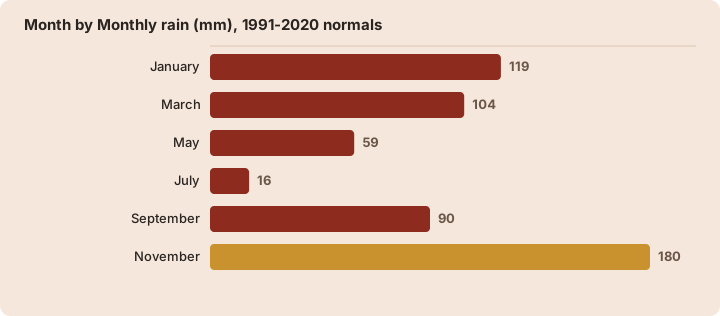
The best time to visit Pompei is May, June, September or October, when warm days, mean daily maxima of about 21.3 to 25.8 C, pair with far less rain than the wet November peak of 180 mm per month, according to the Open-Meteo 1991-2020 climate normals for the Pompei grid point. Avoid July and August if heat is a concern, since mean maxima there reach about 28.7 and 29.4 C.
Those figures are reanalysis-grid averages, not station measurements, so treat them as "about" numbers for planning rather than forecasts. The pattern they describe is classic Mediterranean: a dry, hot summer core, a sharp rain peak in late autumn, and gentle winters that make a Pompei visit entirely reasonable in January if you bring a layer for the 6.6 C mean minimum.
| Month | Mean daily max (C) | Mean daily min (C) | Monthly rain (mm), 1991-2020 normals |
|---|---|---|---|
| January | 12.2 | 6.6 | 119 |
| March | 14.9 | 8.1 | 104 |
| May | 21.6 | 14.1 | 59 |
| July | 28.7 | 21.1 | 16 |
| September | 25.3 | 18.6 | 90 |
| November | 16.9 | 11.5 | 180 |
The visitor data backs the weather logic. In 2024 the park's monthly counts peaked in May at 516,923 and stayed high through June, July and August, while November fell to 189,866 and December to 138,028. In other words, the town and its services are stretched in summer and breathing easily from November, so a winter or late-autumn visit trades heat and crowds for shorter days and the park's winter hours from 15 October, last entry 15:30, close 17:00. The full planning picture is in the weather and best time to visit guide.
Should You Base Yourself In Pompei Or Just Pass Through?
Base yourself in Pompei if you want first-entry access to the excavations, an easy second day at Herculaneum or the Vesuvius slopes, and evenings in a real Italian town, and pass through if your trip is anchored in Naples, Sorrento or Rome and you only have one day for the area.
The honest case for passing through is strong. With 4 million visitors a year, Pompei's infrastructure is built for exactly that, and the two-station setup means a day tripper can be inside the park within minutes of stepping off the train. The site's comparisons, Naples versus Sorrento as a base and whether an overnight stay in Pompei is worth it, set out the trade in detail.
| Base option | Rail time to Pompei Scavi | Best for |
|---|---|---|
| Naples | 29-35 min scheduled | City break plus one or two Vesuvian days |
| Sorrento | 34-40 min scheduled | Combining the ruins with a coastal stay |
| Pompei itself | at the gate | First entry, two-day and three-site plans |
| Rome | high-speed rail to Naples, onward by Circumvesuviana | A single long day trip, planned carefully |
For that group an organised day product makes sense, and the Rome-coast combination is this site's featured pick for the segment:
How Do You Combine Pompei Town With Vesuvius And The Other Sites?
Combine Pompei with Vesuvius by treating the town as your lowland anchor and the volcano as a half-day ascent: take the Gran Cono trail, run by Vesuvius National Park, which needs online-only timed tickets (EUR 11.68 full, EUR 9.55 reduced) bookable 30 days ahead, lasts two to three hours return, opens 9:00 to 15:00 in January, February, November and December and up to 9:00 to 18:00 in July and August, and closes automatically on an orange weather alert or above.
The practical sequencing question, ruins first or volcano first, has a dedicated answer on this site, and the honest answer depends on the season and your legs: the excavations have almost no shade, so in summer the crater early and the city later is the kinder order. The full method is in the Pompeii and Vesuvius in one day itinerary and the how to visit Mount Vesuvius guide.
| Vesuvius Gran Cono detail | Figure from the park's own page |
|---|---|
| Full ticket as sold | EUR 11.68 |
| Reduced ticket as sold | EUR 9.55 |
| Booking window | 30 days ahead, online only |
| Tickets per 10-minute slot | 50 |
| Excursion time | 2 h return shortest route, up to 3 h longest |
| Automatic closure | orange weather alert or above, refund automatic |
Herculaneum makes the richest third site. Its own ticket is EUR 16 full, EUR 2 reduced for EU citizens aged 18 to under 25, and it is open daily with hours that shift seasonally, but two of its headline features, the Villa dei Papiri and the Ancient Theatre, are closed for works, so plan around them. The Herculaneum tickets guide and the two-site plan in the Pompeii and Herculaneum in one day itinerary cover it fully.
What Should You Know About Pompei Town Before You Go?
Before you go, know that modern Pompei is a lively working town in southern Italy, separate from but sitting right beside the famous ancient ruins of Pompeii. Expect a relaxed local pace, straightforward access to the archaeological site, practical amenities like hotels and restaurants, and a noted pilgrimage basilica at its center, all within easy reach of Naples and the surrounding Campania region.
For depth on the ancient city that gives the town its reason to exist, this Pompeii Travel Guide homepage gathers every guide, itinerary and answer page in one place, including the comparisons and planning tools referenced throughout this article.
For a final word on guided depth inside the park itself, the entry-plus-archaeologist option is the site's featured pick for travellers who want the ruins interpreted by a specialist:
Common Questions About Pompei Town
Is Pompei town the same place as the Pompeii excavations?
No. Pompeii with two i's is the ancient Roman city buried by Vesuvius in AD 79, now an archaeological park. Pompei with one i is the modern Italian town beside it in Campania, about 24 km by road from Naples, where the stations, hotels and the Sanctuary basilica are found.
Can you walk from Pompei town to the Pompeii excavations?
Yes. The Circumvesuviana station Pompei Scavi-Villa dei Misteri stands beside the Porta Marina entrance to the excavations, and the walk from the town centre around the Sanctuary to the park gates takes roughly twenty minutes on town streets.
Is Pompei town worth visiting in its own right?
For an hour or two, yes. The Pontificia Basilica of the Madonna of Pompei is a major Marian shrine with a striking interior, and the town's cafes and restaurants are more local and generally gentler than the strip by the excavations. Treat it as a rewarding complement to the park rather than a destination on its own.
What is the best way to reach Pompei town from Naples?
The Circumvesuviana from Napoli Garibaldi to Pompei Scavi-Villa dei Misteri, a scheduled 29 to 35 minutes per EAV's timetable data. The Campania Express has been suspended since 1 October 2026, and driving is about 24 km, roughly 22 minutes, depending on traffic.
Are there places to eat and store luggage in Pompei town?
Yes, both. Restaurants and pizzerias cluster near the park entrances and again around the town centre, and luggage storage services operate near the entrances and stations, which matters because the park permits bags no larger than 30x30x15 cm, with larger bags sent to left luggage.
Is Pompei town safe for tourists?
Pompei is an ordinary working Italian town whose economy depends on welcoming visitors, and the areas around the stations, the gates and the Sanctuary are busy through daylight hours. Standard travel caution applies, as anywhere on the Bay of Naples, and the site's safety overview covers the common scams and pitfalls in detail.
Pompei town is easy to under-rate: it arrives in itineraries as a station name and leaves as the place where the whole day actually ran. Give it the hour it asks for, at the basilica, at a long lunch, or simply on the walk between gates and platform, and the ancient city next door becomes easier to visit, not harder.