Did Pompeii Know Vesuvius Was Going To Erupt?
The people of Roman Pompeii, in Campania southern Italy, left no record suggesting they expected the AD 79 eruption of Mount Vesuvius. What the evidence shows, and how to see the volcano today.
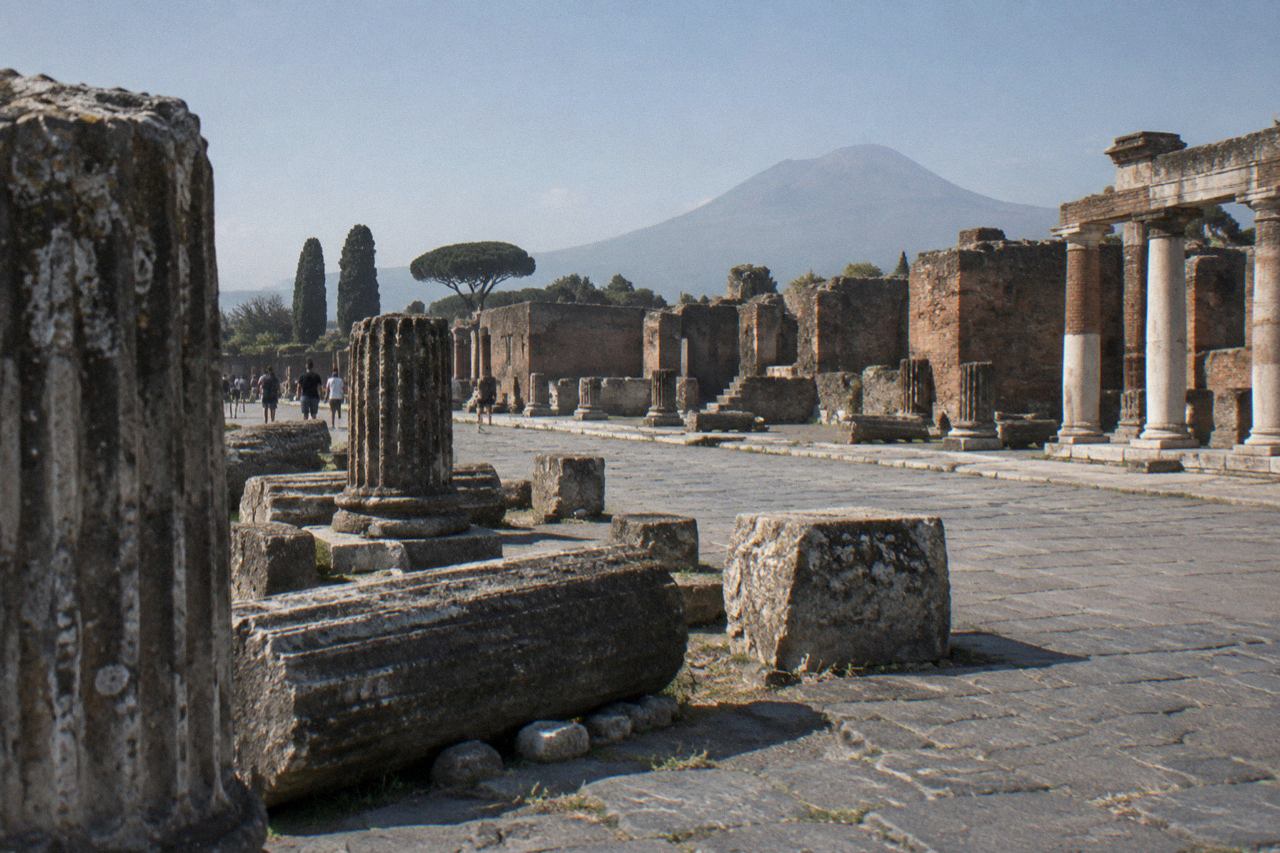
The city of Pompeii, the ancient Roman town now an archaeological park in Campania, southern Italy, was buried by Mount Vesuvius in an eruption traditionally dated to 24 August AD 79, a date scholars still debate. The question people keep asking is simple and haunting: did anyone in the city see it coming? The honest answer, from every source that survives, is no. Nothing written in Pompeii before the destruction, no inscription and no graffiti, records an expectation that the mountain would erupt, and the one eyewitness account that has come down to us, the letters of Pliny the Younger, describes a catastrophe that surprised the entire Bay of Naples, including his uncle, the fleet commander Pliny the Elder, who sailed toward it and died there. This page sets out what the evidence does and does not support, why the date debate matters to the question, and how you can see both the buried city and the volcano for yourself today.
Did Pompeii Know Vesuvius Was Going To Erupt?
No surviving evidence shows that the people of Pompeii knew Vesuvius was going to erupt. The city stands about 24 km by road south-east of Naples in Campania, Italy, beside the modern town of Pompei, and in AD 79 its residents left no recorded warning, no evacuation order and no sign of alarm before the eruption buried them. The only eyewitness letters, written by Pliny the Younger, describe total surprise, on the part of the population and of the Roman officials closest to the event alike.
The strongest evidence is an absence. Pompeii is one of the best-documented ancient cities in the world precisely because the eruption preserved it, including its written records painted and scratched on walls. Scholars have published those texts for generations, and the Pompeii Travel Guide editorial desk can point to a dedicated piece on what the graffiti in Pompeii says: the walls carry election notices, greetings, jokes and advertisements, but not a single message suggesting fear of the mountain. If a writer wants the fuller picture of the city's daily life, the graffiti of Pompeii are the closest thing to a community bulletin board the ancient world has left us.
The eyewitness account agrees. Pliny the Younger watched the eruption from Misenum across the bay and wrote two letters to the historian Tacitus describing it. His uncle, Pliny the Elder, commander of the Roman fleet at Misenum, saw the cloud and sailed toward it, not to flee the disaster but to rescue people and, by the younger Pliny's account, to observe the phenomenon closer. That is not the behaviour of a society that understood what the mountain was about to do. Whether the elder Pliny survived is answered on a page of its own, did Pliny survive Pompeii.
What Pliny The Younger Actually Wrote About The Eruption
Pliny the Younger's two letters to Tacitus describe a pine-tree-shaped cloud rising from the mountain, tremors that frightened but did not instruct, and a population that debated whether to stay indoors or flee, with nobody, including his mother, his uncle's officers or the fleet's sailors, recognising the eruption in advance. The oldest manuscripts of those letters give the eruption date as nonum kal. Septembres, that is 24 August AD 79. They record surprise, not foreknowledge.
The letters are the anchor of everything modern writing claims about the eruption, and they deserve careful handling. The younger Pliny was seventeen at the time, and his description of the cloud's shape, of daylight turning to darkness, and of his uncle's fatal rescue voyage is the only surviving eyewitness narrative of a major Plinian eruption, the type volcanologists now name after his uncle. For how quickly the event killed those caught in it, the record supports a separate answer at how fast was death at Pompeii.
| Element of the account | What the letters record | What it suggests about foreknowledge |
|---|---|---|
| The cloud | A shape like an umbrella pine rising from the mountain | Described as novel and strange, not as expected |
| Pliny the Elder's response | Sailed the fleet toward the danger to rescue people | Treated as a curiosity and an emergency, not a feared outcome |
| Ground tremors | Frequent shaking during and after the eruption began | Not linked in the text to any prior alarm |
| The date | Oldest manuscripts give nonum kal. Septembres, 24 August AD 79 | The traditional date, still debated by scholars |
One caution belongs here. The eruption date is an open scholarly question. The park's own e-journal states that the alternative date of 24 October has zero evidentiary basis and results from a 1929 misreading of the manuscripts, while also noting that 24 August is not necessarily correct either. The question is examined in full in when did Vesuvius erupt, and this page does not settle it, because nobody can.
What The 2018 Charcoal Graffito Adds To The Debate
A charcoal inscription found in 2018, which many scholars date to mid-October, reopened the question of when the eruption happened, and it is best understood as evidence that fuelled a debate, not as a verdict. The park's own journal dismisses the 24 October reading entirely as a 1929 misreading.
The logic of the argument is easy to follow even at a distance. If a charcoal note was written in the city in mid-October AD 79, then the destruction must have come after that date, which would rule out 24 August. Charcoal, though, fades and survives poorly, so dating the writing rather than the surface is genuinely difficult, and specialists disagree. The park has not committed to the graffito in any statement this site has been able to read, so an honest page reports the find and stops there.
None of this touches the question of foreknowledge. Even if the eruption came in October, no source from the city shows anticipation. The debate is about the calendar, not about what anyone knew in advance. For newer finds from the excavations generally, what was recently found in Pompeii collects the material, and for the scientific work on the victims themselves, what the DNA revealed about Pompeii covers it.
It is worth being equally careful about a related myth, the idea that victims died mid-embrace in pairs, which is examined at was there a kissing couple found in Pompeii. The cast evidence supports its own careful reading, not the romantic one.
Why Nobody In AD 79 Recognised The Warning Signs
The people of Pompeii lived beside a mountain that had not erupted within living memory or recorded history, and no surviving Roman text from before AD 79 identifies Vesuvius as the dangerous volcano it is. The region was famous instead for its wine and its fertile slopes, which is a poor preparation for reading a Plinian cloud as a death sentence. Surprise, not ignorance alone, is what the sources record.
It helps to remember what the Bay of Naples looked like to a Roman of Pliny's day. The slopes of Vesuvius were cultivated, the bay was a resort coast for the Roman elite, and villas clustered at the mountain's foot, including the grand suburban villas of the Pompeii area such as the Villa of the Mysteries. Nobody was building on a site they understood as an active hazard, because nothing in their experience or their records told them it was one. The tremors that preceded the eruption were read by the sources only in hindsight.
That gap between appearance and reality is the reason the site pairs so naturally with the volcano itself. Standing on the crater rim, looking across at the excavation, the scale of the misreading becomes physical rather than abstract. The Pompeii & Mt. Vesuvius Elite Tour & Lunch From Naples combines both halves of the story in a single day from Naples, with the excavated city in the morning, the crater in the afternoon and lunch between; Check availability. If your time is shorter, or you are based on the Sorrento side, the question of whether to do Pompeii or Vesuvius first has its own answer page.
How To Stand On The Crater That Buried The City
The Gran Cono trail is the standard visitor route to the Vesuvius crater rim, with online-only timed tickets, EUR 11.68 full and EUR 9.55 reduced as sold, daily visitor caps of 2,160 to 3,240, and a walk of about 2 hours return by the shortest route or up to 3 hours by the longest. The trail closes automatically on an orange weather alert or higher, with an automatic refund.
Access is deliberately controlled, and the numbers explain why. Tickets are released in 10-minute slots, 50 standard tickets per slot bookable up to 30 days ahead, plus 10 last-minute tickets per slot issued in the visitor's own name since 11 April 2026, with groups of 60 admitted per slot. Children under 6 go free, and reduced rates apply to visitors under 25 and residents of the 13 Park municipalities. Whether you can simply turn up and buy on the day is answered at can you buy Mount Vesuvius tickets on the day, and the cost question is handled in full at how much does it cost to go up Mount Vesuvius.
| Months | Trail access hours | Daily cap |
|---|---|---|
| January, February, November, December | 09:00-15:00 | 2,160 |
| March and October | 09:00-16:00 | 2,160 to 3,240 |
| April, May, June, September | 09:00-17:00 | up to 3,240 |
| July and August | 09:00-18:00 | up to 3,240 |
The walk itself is a real hike, and people reasonably ask how long the walk up Vesuvius is, whether it is cold at the top, and whether you can drive up Mount Vesuvius. In summer the combination of heat and altitude deserves respect; in the colder months the exposed rim can be bitter, which the answer page on the temperature at the top of Vesuvius sets out. Whether the view rewards the effort is a fair question too, and whether it is worth going up Mount Vesuvius gives the case both ways.
What The Eruption Means For Visitors Today
Modern monitoring, not ancient prediction, is what stands between the Bay of Naples and the next event, and the modern park manages both sites with named entrances, timed tickets and a 20,000 visitors-per-day cap.**
The 1944 eruption is covered separately, with its own figures, at how many people died when Mount Vesuvius erupted in 1944, and the long question of whether Vesuvius is ever going to erupt again has its own page. For the planning side of a visit, the Pompeii tickets explained guide covers the current structure and the 2027 change, and the map of the site helps with orientation before arrival.
A few practical anchors for the park side of the day: tickets are nominative, with entry capped at 20,000 visitors per day, ticket offices sit at Porta Marina, Piazza Esedra and Piazza Anfiteatro, and bags are limited to 30x30x15 cm. Entry is free for under-18s and for everyone on the first Sunday of the month, and EU citizens aged 18 to under 25 pay a EUR 2 reduced rate. The Praedia of Julia Felix has been closed to the public since 7 September 2026 for maintenance, so itineraries built around it need adjusting.
If one day has to hold both halves of the story, the wine country on the volcano's slopes offers a gentler version of the pairing than the pure crater hike, and the pairing of Pompeii and Herculaneum in one day is a different route to the same depth. For the town beside the ruins, where to stay near the excavations covers the modern Pompei options.
Common Questions About The Pompeii Eruption
Did Pompeii know Vesuvius was going to erupt?
No. No surviving text, inscription or graffito from the city records any expectation of an eruption, and the eyewitness letters of Pliny the Younger describe complete surprise, including his uncle Pliny the Elder's fatal decision to sail toward the cloud rather than away from it.
What Warning Signs Did The People Of Pompeii Miss?
The sources that survive record tremors and the rising cloud itself, described as a strange and novel sight rather than a feared one. Nothing in the surviving record shows anyone interpreting those signs as the approach of a catastrophic eruption before it began.
When Exactly Did Vesuvius Erupt?
The eruption is traditionally dated to 24 August AD 79, from the oldest manuscripts of Pliny the Younger's letters. The park's own e-journal states that the alternative 24 October date has no evidentiary basis and comes from a 1929 misreading, while adding that 24 August is not necessarily correct either, so the date remains an open scholarly debate.
Did Anyone In Pompeii Understand That Vesuvius Was A Volcano?
No verified Roman source from before AD 79 identifies Vesuvius as an active volcano in terms that show local awareness of the danger. The slopes were famous for vines and villas, and the Bay of Naples was a resort coast, which the sources present as settled countryside rather than a known hazard zone.
Can You Visit Both Pompeii And Vesuvius Today?
Yes, in one long day from Naples or Sorrento. The Pompeii excavations run on timed, nominative tickets with a 20,000 visitors-per-day cap, and the Vesuvius Gran Cono trail runs on online-only timed slots, EUR 11.68 full and EUR 9.55 reduced as sold, closing automatically on an orange weather alert or higher.
The question of foreknowledge is what keeps this story alive: a city of thousands, living in the shadow of a mountain whose danger nobody had the tools to name, recorded in the letters of a seventeen-year-old who watched it from across the bay. The ruins and the crater together, one buried and one hollow, are the closest a visitor can come to understanding how completely the impossible can arrive unannounced.