Did Pliny Survive Pompeii?
One Pliny survived the eruption of Vesuvius in AD 79 and wrote the only eyewitness account; the other sailed into the disaster and died. Here is what actually happened to each of them.
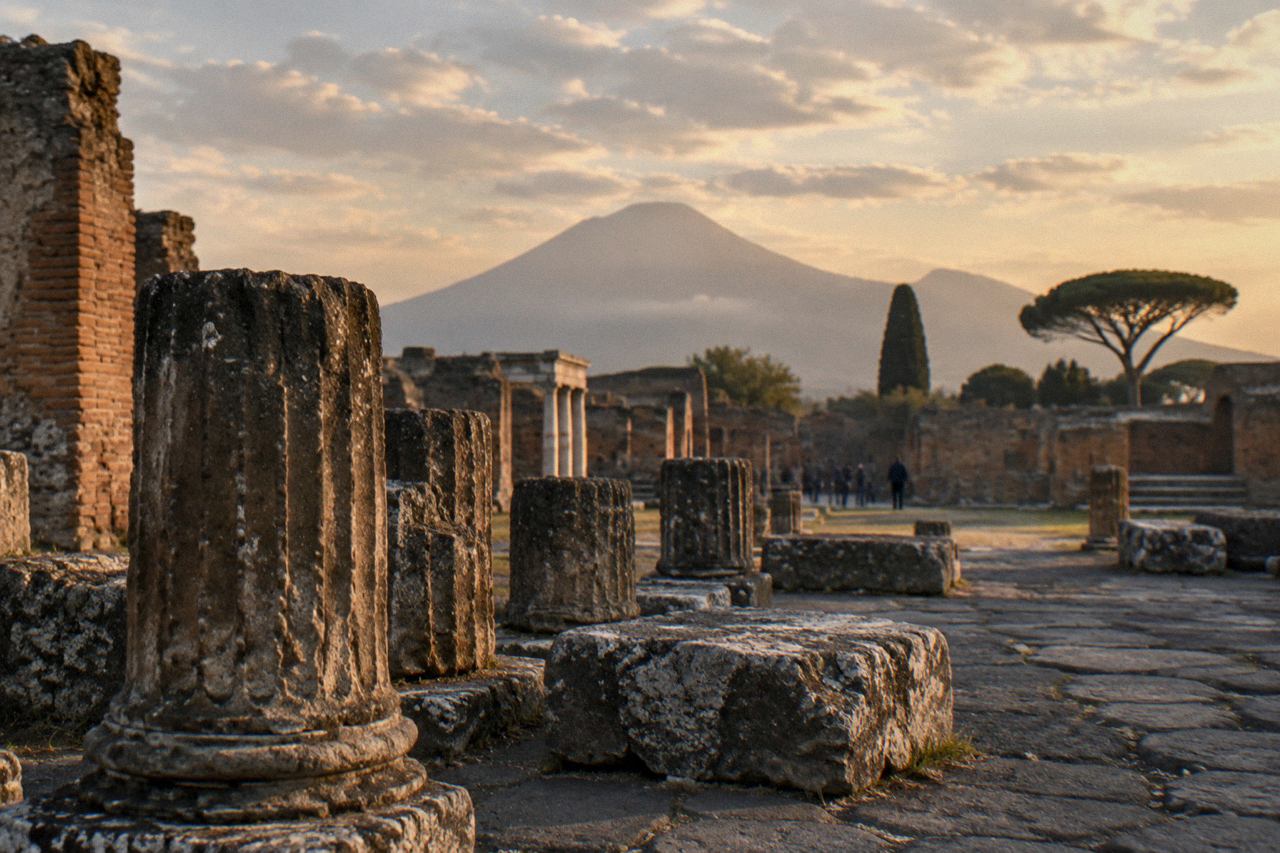
The eruption of Mount Vesuvius in AD 79, traditionally dated to 24 August, buried the ancient Roman city of Pompeii in Campania, southern Italy, and it also produced the only eyewitness account of a volcanic disaster to survive from the ancient world. That account exists because one of the two Romans named Pliny lived through the catastrophe. The other did not. The question "Did Pliny survive Pompeii?" therefore splits in two, and this page answers both halves: what happened to Pliny the Elder, who commanded the Roman fleet on the Bay of Naples and sailed straight toward the eruption, and what happened to his nephew Pliny the Younger, whose letters describing the disaster are still read today beside the ruins, about 24 km from Naples.
Did Pliny Survive Pompeii?
Yes, Pliny the Younger survived the eruption of Vesuvius in AD 79, but Pliny the Elder did not. The younger man watched from a safe distance across the Bay of Naples, fled as the danger grew, and lived to write the two letters preserving the only surviving eyewitness narrative of Pompeii's destruction, while the Elder sailed toward the eruption to rescue people, landed at Stabiae, and died there during the disaster.
The two men shared a name but not a fate, and confusing them is the single commonest error in the whole Pliny story. The uncle, Gaius Plinius Secundus, is the one people usually mean when they ask whether Pliny "went to Pompeii": he was a senior naval officer, a naturalist, and the author of an enormous encyclopaedia of the natural world. The nephew, Gaius Plinius Caecilius Secundus, was a teenager at the time of the eruption, a lawyer and later a provincial governor, and it is his letters that tell the story on which everything else rests.
Neither Pliny was in the city of Pompeii itself when the destruction began. The uncle approached by sea and never entered Pompeii; the nephew stayed at the family's house across the bay and then fled inland. The city they are associated with today is the one that re-emerged from under the volcanic debris, the site the modern traveller reaches from the station at Pompei Scavi-Villa dei Misteri. For the fuller story of the uncle's final voyage, the site's own guide page on Pliny the Elder and Vesuvius traces the rescue attempt in detail.
| Person | Where he was on the first day | What he did | Outcome |
|---|---|---|---|
| Pliny the Elder | At the fleet's base across the Bay of Naples | Sailed toward the eruption to rescue people and observe it, landed at Stabiae | Died during the eruption |
| Pliny the Younger | At his mother's house across the bay, at Misenum's side of the water | Watched the cloud, then fled inland with his mother as the ash fell | Survived, wrote two letters describing the eruption |
The younger Pliny's survival matters for reasons beyond biography. Without his account, written years later at the request of the historian who had asked him for material, the modern understanding of the AD 79 eruption would rest almost entirely on archaeology. With it, the excavated city of Pompeii gains a narrative voice: a description of the pine-tree-shaped cloud, the day that turned to darkness, the shaking ground, and the sea that could not be sailed. Volcanology even borrowed his family name: sustained explosive eruptions of the kind that destroyed Pompeii are called Plinian eruptions in honour of the man who first described one, the uncle who died in it.
Where The Elder Pliny Died During The Eruption Of AD 79
Pliny the Elder died at Stabiae, a coastal town on the Bay of Naples several kilometres from Pompeii, during the second phase of the eruption of AD 79. He had sailed there with the fleet's galleys to evacuate residents trapped by the falling pumice, went ashore, and was overcome on the following morning, traditionally dated to 25 August AD 79, a date scholars still debate. His body was found on the shore, unmarked, two days after his death.
The chain of events that killed him is the heart of the story. From the naval base he commanded, the eruption cloud over Vesuvius was visible across the water, and a call for help had reached him from friends whose villa lay under the ash fall. He ordered the warships launched, remarking, according to his nephew's letter, that fortune favours the bold, and steered for the danger rather than away from it. The sea was choked with floating pumice, the shore shallowed unpredictably, and the falling debris darkened the air until helmsmen steered by feel.
He landed at Stabiae, where friends urged him to escape as the villa's courtyard filled with ash and pumice. He stayed, apparently calmer than the household around him, and next morning the ground shook, the buildings swayed, and the darkness deepened until it was lit only by torches. He collapsed on the shoreline, his breathing blocked by the thick air and, as his nephew's account suggests, by his own large frame and the exertion of the escape, and the companions who fled with him left the body under a cloth. Rescuers recovered it later, looking, the letter says, more like a sleeper than a dead man.
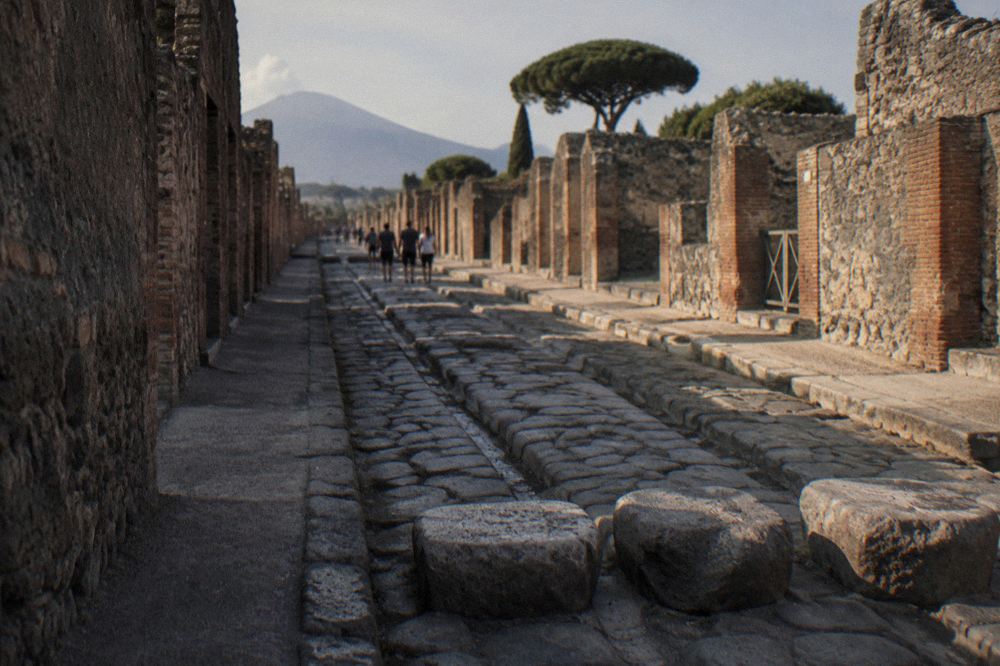
Stabiae itself is not a myth: it is one of the ticketed satellite sites of the modern archaeological park, on the hillside above modern Castellammare di Stabiae, and it can be visited with the park's multi-site tickets. The buried villas there are quieter than Pompeii and stand within sight of the water the elder Pliny's ships could not safely approach. For the wider story of who else got out alive, the companion page on survivors of the Pompeii eruption gathers what the evidence supports.
How Pliny The Younger Lived To Describe The Disaster
Pliny the Younger survived because he stayed put at first, then fled inland on foot with his mother when the ash and the shockwaves made staying impossible. He was about seventeen, living at the fleet base across the bay from Pompeii when the eruption began, and his letters describe both the first dark hours and the panic of the exodus. He lived into his fifties and became one of the best-known letter writers of the Roman world.
His own account is oddly calm in tone. He and his mother noticed the cloud only after a visitor pointed out that its size and shape could not be explained away, and the lad asked whether he should fetch his uncle's books rather than run. The famous detail is that he carried on with his schoolwork while the crisis gathered across the water. That composure collapsed in the night, when the shaking of the ground became so violent that carts in the courtyard shifted and could not be held steady even with stones against their wheels.
The pair left at first light, or what passed for it: total darkness had settled over the coast, and the fugitives moved through a crowd of people screaming that the gods were gone and the world was ending. Ash and pumice fell on them, and at one point the crowd's light went out and the darkness became complete, broken when the cloud thinned and grey daylight returned. His mother urged him to run ahead and save himself, being young and fast; he refused to leave her. They turned off the main road, left the crush of people behind, and waited for the darkness to lift.
Two details from his letters carry the weight of modern science. He describes the sea sucking back on itself, leaving sea creatures stranded on the sand, and he describes a cloud rising to a great height and then spreading out like the crown of a pine tree, which is how volcanologists still teach the shape of a Plinian eruption column. The conditions he recorded, the darkness at midday and the suffocating air that killed his uncle, match the picture built from the excavations at Pompeii and Herculaneum. For what the hot surge actually did to the people it caught, the page on how hot Pompeii got during the eruption sets out the physical evidence.
What The Letters Say, And When The Eruption Happened
Pliny the Younger's two letters, written years after the event at a historian's request, are the sole surviving eyewitness account of the eruption that buried Pompeii, and they pin it, in the oldest manuscripts, to 24 August AD 79. That date is traditional rather than settled: the park's own e-journal states the rival date of 24 October has zero evidentiary basis and arose from a 1929 misreading, while adding that 24 August is not necessarily correct either. A charcoal graffito found in 2018 reopened the debate without resolving it.
The manuscripts of the younger Pliny give the Latin phrase nonum kal. Septembres, which counts back to 24 August. For centuries that was simply the date of the eruption, printed in guidebooks and school texts without a second thought. Then the argument began to wobble.
The e-journal of the Archaeological Park of Pompei stepped into this argument squarely: it accepts the traditional manuscript date as the anchor, rejects 24 October outright as a date with no evidentiary basis at all, and still concedes that even 24 August cannot be called certain. That is why careful writing says "traditionally dated to 24 August AD 79, a date scholars still debate," and nothing firmer. The eruption itself, its phases and its consequences, are not in doubt; only the calendar day is.
| Evidence | What it says | Where it stands |
|---|---|---|
| Oldest manuscripts of Pliny the Younger | nonum kal. Septembres, counted as 24 August AD 79 | The traditional date, still the anchor |
| Park e-journal, citing Foss 2022 | 24 October has zero evidentiary basis, a 1929 misreading | Rejected as a date; 24 August not declared certain either |
| Charcoal graffito, 2018 find | Read by many scholars as mid-October of AD 79 | Reopened the debate |
| Archaeological layers at Pompeii | Autumn-style finds have been argued for decades | Evidence is contested on all sides |
Visitors who want the letters in the ground rather than on the page have a concrete itinerary. The practical pages on Pompeii tickets and the 2026 prices and on when Vesuvius erupted cover the modern mechanics of getting in and the full timeline of the disaster.
For travellers arriving by sea, a private guided walk of the city turns the letters into a route: the private archaeologist tour of Pompeii, a visit led by a specialist guide, is the kind of experience that pairs the sites Pliny named with the account he wrote. Check availability
Was Anyone Warned Before Vesuvius Erupted?
The Pompeians had no meaningful warning that Vesuvius was going to erupt in AD 79. Pliny the Younger's letters record tremors in the days before the catastrophe, but they were frequent enough in Campania that nobody treated them as a danger sign, and the inhabitants of Pompeii had no word for volcano. Nobody in the city knew the mountain was a volcano until it erupted, and that gap in understanding, not complacency, is what kept them in their houses.
The letters note something else that modern readers find chilling: the region's earthquakes were so routine that people did not connect them to the mountain. The question of whether the disaster was foreseeable, and how the Romans explained the tremors, is covered in full on the page asking whether Pompeii knew Vesuvius was going to erupt. What the letters add is the human texture: a boy doing his homework under a sky that had gone strange, a mother urging her son to run faster than she can, an uncle finishing his bath and his lunch while ash gathers outside.
The elder Pliny's own instinct, as his nephew presents it, was curiosity. He asked for his sandals, called for the ship, and kept taking notes on the cloud's shape and height as the fleet rowed into the falling debris. His death made him the eruption's best-known casualty; his nephew's survival made him its only chronicler. Between the two of them, one family produced both the disaster's witness and its victim, which is why the pair are inseparable from the site's story.
Common Questions About Pliny And Pompeii
Did Pliny survive Pompeii?
Pliny the Younger survived the eruption of Vesuvius in AD 79 and later wrote the only surviving eyewitness account of it. Pliny the Elder did not: he sailed toward the eruption to rescue people, landed at Stabiae, and died there during the disaster.
Was Pliny the Elder inside the city of Pompeii when he died?
No. He approached by sea and landed at Stabiae, a separate coastal town west-south-west of Pompeii above modern Castellammare di Stabiae. He never entered the city of Pompeii during the eruption.
How old was Pliny the Younger during the eruption?
He was about seventeen at the time of the eruption in AD 79, living at the naval base across the Bay of Naples where his uncle commanded the fleet. His letters describing the disaster were written years later, at the request of a historian collecting material on the event.
What did Pliny the Younger see from his house?
He saw the eruption cloud rising to a great height and spreading like the crown of an umbrella pine, the daylight turning to darkness, the sea drawing back from the shore, and the mass of fleeing people screaming that the gods had gone. He fled inland on foot with his mother.
Is the date of the eruption 24 August or 24 October?
The traditional manuscript date is 24 August AD 79. The park's own e-journal states that 24 October has zero evidentiary basis and comes from a 1929 misreading, while conceding that 24 August is not certainly right either, so the date remains an open scholarly question.
Can you visit where these events happened?
Yes. Pompeii, Herculaneum and the Stabiae villa sites are all open to visitors as part of the same archaeological park. A charcoal graffito or a fresco can pause any visit, and a specialist guide can point to the shoreline the elder Pliny's ships tried to reach, so booking a guide-led slot in advance is the comfortable way to connect the letters to the stones.
The clearest way to hold the two answers in mind is a single sentence: the Pliny who wrote about the eruption lived, and the Pliny who sailed into it did not. Their story is what gives the ruins at Pompeii a human voice, and walking the excavated streets with that account in hand is the closest a modern visitor gets to standing on that shoreline. For anyone planning that walk, the pages on Pompeii Travel Guide cover everything from tickets to the quietest times of day.