Pliny The Elder
Pliny the Elder launched the Roman fleet at Misenum straight into the eruption cloud of AD 79 and died on the shore near Pompeii, the only eyewitness account of the disaster that survives coming from his nephew.

Short answer
Pliny the Elder was commander of the Roman fleet at Misenum who sailed toward Mount Vesuvius during the eruption of AD 79, traditionally dated to 24 August, to rescue people near Pompeii and died on the shore at Stabiae. His nephew Pliny the Younger watched the disaster and later wrote two letters describing it, the sole surviving eyewitness account of the eruption that buried Pompeii and Herculaneum in Campania, southern Italy.
The eruption of Mount Vesuvius in AD 79, traditionally dated to 24 August, a date scholars still debate, buried the Roman city of Pompeii in Campania, southern Italy, and gave the world its only surviving eyewitness account of a volcanic disaster from antiquity. That account exists because of two men. Gaius Plinius Secundus, known as Pliny the Elder, was commander of the imperial fleet at Misenum across the Bay of Naples, and he sailed his quadriremes directly toward the eruption cloud. His nephew, Pliny the Younger, stayed behind, watched the catastrophe from a distance, and decades later wrote the two letters to the historian Tacitus that tell the whole story. One man died at Stabiae. The other lived to write.
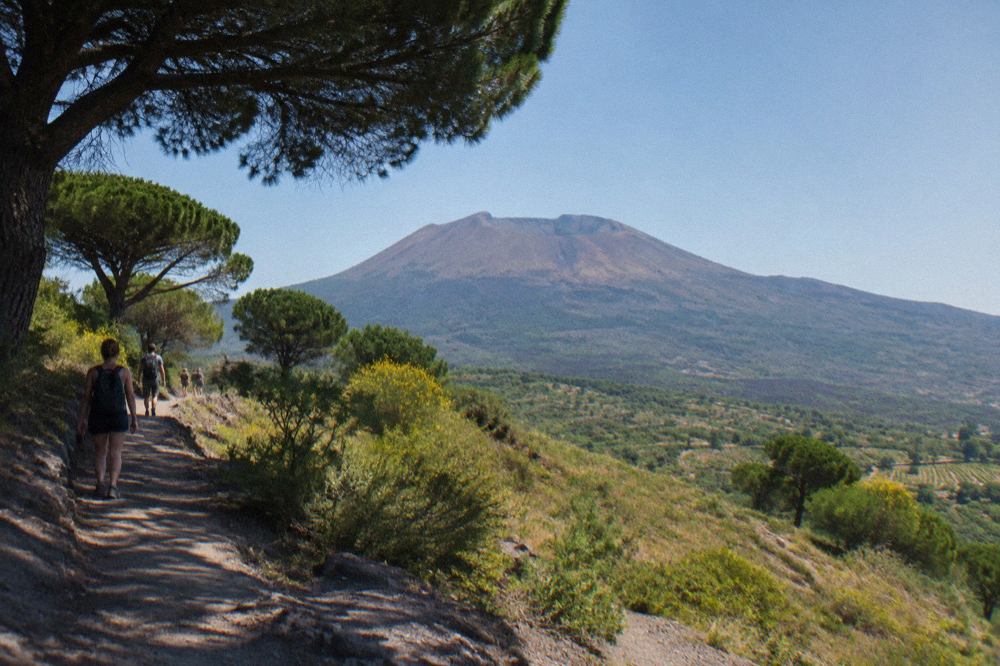
This guide tells that story in full, connects it to the places a visitor can actually stand today, and explains how to build a day around the volcano Pliny the Elder never came back from. The ancient city lies beside the modern town of Pompei, about 24 km by road from Naples, and the park that protects it is open to visitors under the ticket structure described below.
Who Was Pliny The Elder?
Pliny the Elder was a Roman naval commander, naturalist and author who held the post of prefect of the fleet at Misenum, the senior naval base on the Bay of Naples, when Vesuvius erupted in AD 79. He was also one of Rome's most prolific writers of reference works, and his encyclopedia of natural history survives complete. He died during the eruption, on the shore at Stabiae, aged 55, while trying to rescue civilians by sea.
He belongs to a rare category of ancient figure: the man who documented the world and then was killed by it. His Natural History, in 37 books, gathers everything its author could find about plants, animals, metals, medicines, art and the geography of the known world. It is gossipy, credulous in places, and utterly irreplaceable, and it remains a principal source for what Romans believed about the physical world around them. That a man of this intellectual appetite happened to command the fleet nearest an exploding volcano is one of history's stranger coincidences.
The "Elder" tag exists only to separate him from his nephew and adopted son, Pliny the Younger, whose letters supply the eruption narrative. The family connection matters. The younger Pliny was 17 or 18 at the time of the eruption and was staying with his uncle at Misenum. He refused to board the rescue ship, kept studying, and survived. His account of watching the cloud rise, of the earthquakes through the night, and of darkness descending at midday is the document every modern volcanologist still cites when reconstructing the event's phases.
For visitors to Pompeii, Pliny the Elder is not an abstraction. The pumice and ash that fell on the city, layer by layer, are the same material that rained onto his fleet as he steered toward the shore. The plaster casts of the victims, described in the guide to Pompeii's body casts, preserve the human consequences of the phases his nephew described from across the water. Whether his story convinces you the site is worth the journey is a fair question with a clear answer in the is Pompeii worth visiting guide.
What Did Pliny The Younger's Letters Say Happened?
The two letters to Tacitus describe a pine-tree-shaped cloud rising from Vesuvius, Pliny the Elder ordering warships launched for a rescue, ash and pumice falling on the ships as they approached, and the admiral landing at Stabiae, where he died on the beach on the second day, probably from asphyxiation or heart failure. A second letter describes the nephew's own escape as darkness and ash swept Misenum.
The letters are short, composed roughly two decades after the event, and are the reason the eruption has a human face. In the first, the younger Pliny explains that his mother pointed out a cloud of unusual size and shape to his uncle, who was resting in the sun after a bath and lunch. The admiral called for his sandals, climbed to a vantage point, and, seeing the phenomenon deserved closer study, ordered a quadrireme made ready, offering to take his nephew along. The nephew stayed to read. A message from Rectina, whose house sat under the volcano and whose only escape was by sea, turned a scientific excursion into a rescue mission.

What follows is the oldest detailed description of what volcanologists now call a Plinian eruption, named for the man himself. Ash fell hotter and thicker the closer the ships came. Pumice and blackened stones, burned and cracked by fire, landed on the decks. At the helm, the sailors could steer by the glow of the eruption alone; behind them, daylight had gone. The helmsman advised turning back. Pliny answered, in the sentence the letters preserve, "Fortune favours the brave: steer to Pomponianus." Pomponianus was a friend whose household was trapped at Stabiae.
The second letter is the quieter horror. At Misenum, across the bay, the ground shook in repeated violent tremors, buildings swayed, and after midday the darkness became total, so that the younger Pliny writes the darkness was not like a moonless night but like a lamp shut in a sealed room. When light returned on the third day, the world was buried in ash "like snow". Both letters are quoted, paraphrased and argued over in every serious study of the eruption, and the fuller historical context sits in the history of Pompeii guide.
Where Did Pliny The Elder Die?
Pliny the Elder died at Stabiae, the Roman seaside town whose site today forms part of the archaeological park's Stabiae sites at modern Castellammare di Stabiae, south of Pompeii, on the morning after the eruption's opening phase. He had gone ashore to reassure Pomponianus's household, slept through a night of falling pumice, and collapsed on the beach while the group tried to escape by sea.
The identification of Stabiae with the modern Castellammare di Stabiae is secure, and the ancient villas excavated there, the Villa Arianna and the Villa San Marco, are ticketed sites of the same archaeological park as Pompeii. The letters describe the Admiral resting on a spread sailcloth, calling twice for water and drinking it, then, as dawn returned a grey and feeble light, standing with the others on the shore with a pillow tied over his head against the falling ash. Flames and sulphurous fumes drove the group back. Pliny rose leaning on two slaves and immediately fell down dead. His body was found on the third day, unmarked, looking more like a sleeper than a corpse.
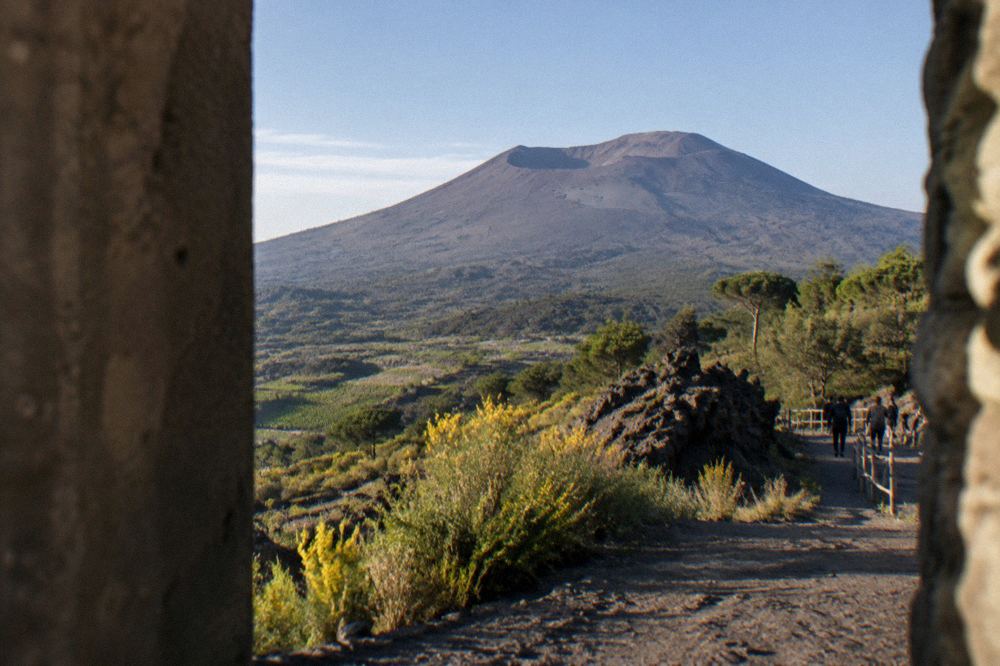
The likely medical explanation, argued by modern physicians, is that a 55-year-old man with a known respiratory complaint, exerting himself while breathing hot ash, died of asphyxiation or cardiac failure. The letters themselves note his build was heavy and that he breathed heavily. Whatever the mechanism, the place of death was the shoreline of Stabiae, in full view of the volcano, and that shoreline is walkable today.
Stabiae is one of the park's less-visited components, and the villa sites there close on Tuesdays, unlike Pompeii itself, which has no weekly closing day. A visit combines naturally with the Stabiae villas guide, or with a wider villas of Vesuvius route. For the practical question of which of the two great buried cities suits you better, the Pompeii versus Herculaneum comparison sets out the trade-offs.
A day built around this story has two natural halves: the buried city where the ash fell, and the volcano it fell from. The featured tour on this page, the Pompeii and Mt Vesuvius Day Tour from Naples with pizza lunch, pairs both halves with a guide and transport, starting from Naples. The tour's own page carries the price, the current rating and the full itinerary; check it before planning, since inclusions differ product to product. Check availability
How Do You Visit The Volcano That Killed Him?
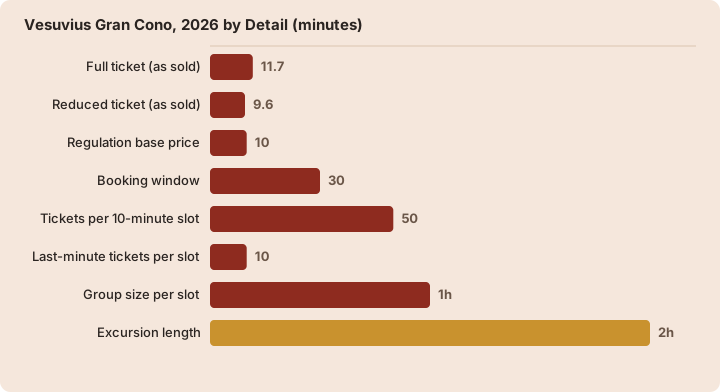
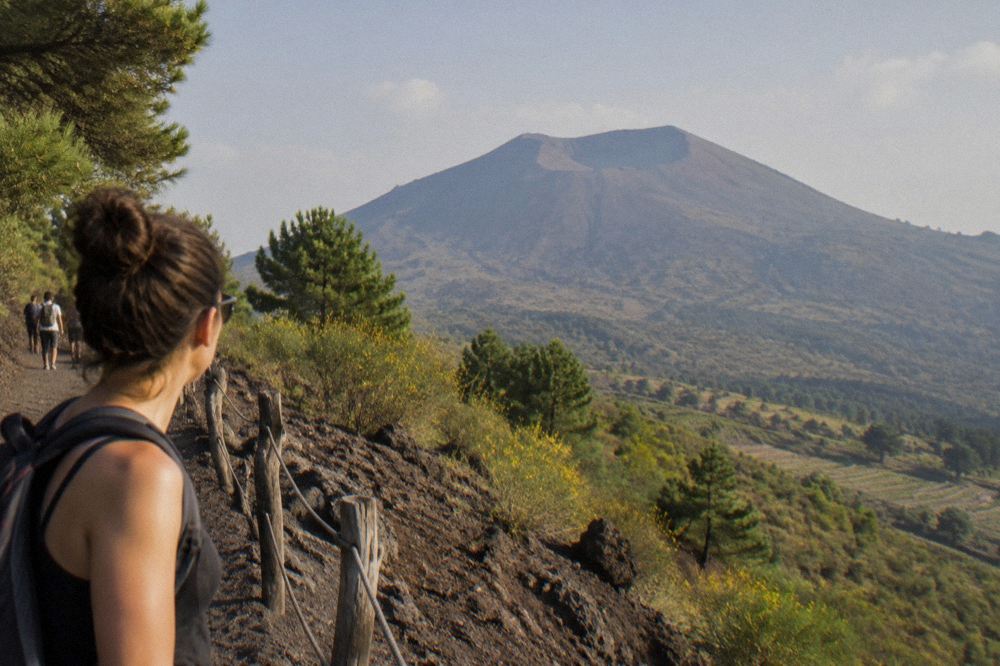
Mount Vesuvius's Gran Cono trail is reached by timed online ticket only, sold through the national park's official ticketing page, at EUR 11.68 full and EUR 9.55 reduced as sold, with 50 tickets released per 10-minute slot up to 30 days ahead and 10 last-minute nominative tickets per slot released 30 minutes before each entry. The climb takes about 2 hours return by the shortest route.
The crater trail is the closest a visitor can get to the vent that produced the cloud Pliny's fleet sailed into. The national park runs a strict slot system: groups of 60 per 10-minute window, in three subgroups of 20, and daily caps running from 2,160 to 3,240 visitors depending on the season. There is no walk-up ticket office sale in the ordinary sense; the online system is the system. Last-minute tickets, released 30 minutes before each slot, have required the visitor's own name since 11 April 2026.
| Vesuvius Gran Cono, 2026 | Detail |
|---|---|
| Full ticket (as sold) | EUR 11.68 |
| Reduced ticket (as sold) | EUR 9.55 |
| Regulation base price | EUR 10 full, EUR 8 reduced |
| Booking window | Up to 30 days ahead |
| Tickets per 10-minute slot | 50 |
| Last-minute tickets per slot | 10, nominative since 11 April 2026 |
| Group size per slot | 60 (three groups of 20) |
| Excursion length | About 2 hours return to 3 hours by the longest route |
Access hours change with the seasons, and the trail shuts automatically when the weather alert reaches orange or higher, with an automatic refund. Children under 6 go free, and reduced rates apply to visitors under 25 and residents of the 13 park municipalities. Full details on seasons and the drive up sit in the guide to Vesuvius tickets and the wider Mount Vesuvius guide.
| Months | Gran Cono Access Hours |
|---|---|
| January, February, November, December | 09:00-15:00 |
| March and October | 09:00-16:00 |
| April, May, June, September | 09:00-17:00 |
| July and August | 09:00-18:00 |
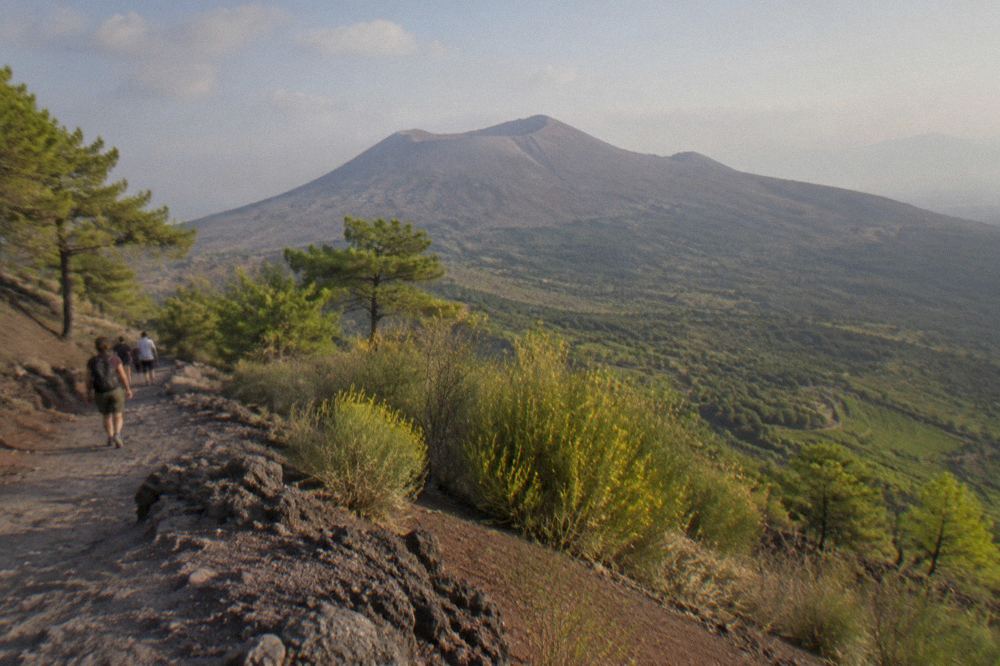
Standing on the crater rim, looking north across the plain to where the fleet would have come from Misenum, is the one moment on any Bay of Naples trip that puts the letters in three dimensions. A small-group alternative that includes lunch is the Exclusive Pompeii and Vesuvius Tour from Naples, which covers both halves of the story in a single day. Check availability
What Does The Eruption's Date Debate Mean For Pliny's Story?
The oldest manuscripts of Pliny the Younger's letters give a date equivalent to 24 August AD 79, but the park's own e-journal states the rival 24 October date has zero evidentiary basis and stems from a 1929 misreading, while also cautioning that 24 August is not necessarily correct either. The honest summary is: the eruption is traditionally dated to 24 August, and scholars still debate it.
A charcoal inscription found in 2018, which many scholars date to mid-October, reopened the question because a harvest-season date would sit awkwardly with an August eruption. What is certain is the letters' internal chronology: a single day of ashfall at Stabiae, a night of tremors, and a grey dawn on which Pliny the Elder died.
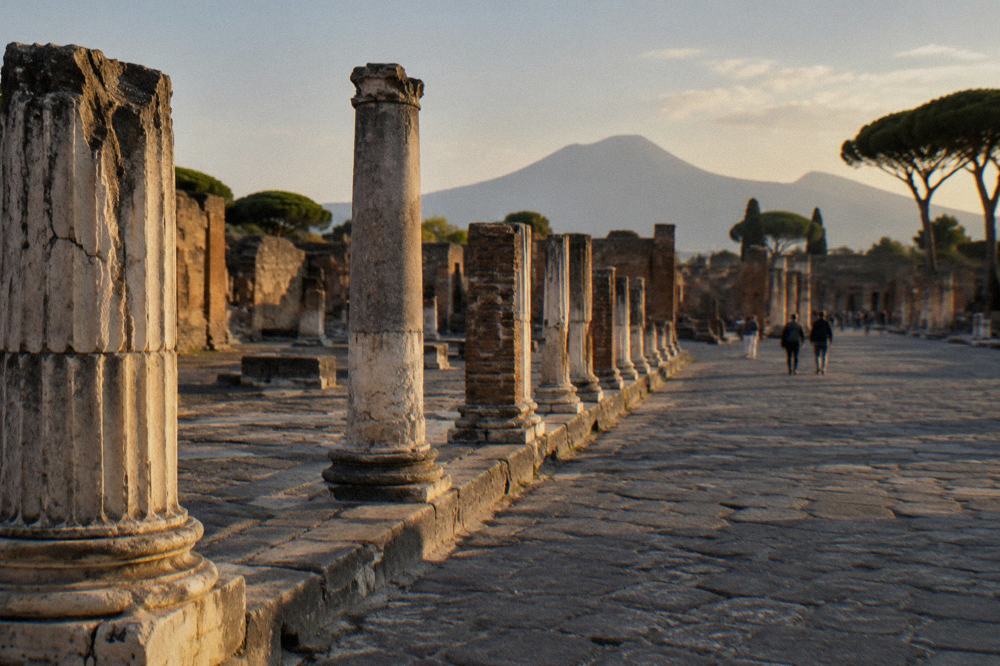
The debate matters for the visitor in one practical way. An October date would mean the vineyards were in harvest, the autumn rains were beginning, and the blankets found on some victims, discussed in the site's material on the eruption, would be seasonal rather than strange. The letters themselves never resolve it; the copyists of late antiquity transmitted the date the manuscripts carry, and the manuscripts are what they are.
For the deeper questions, including whether anyone got out alive and how the city was lost and found again, the site carries dedicated pieces. The story of survivors and of Pliny the Younger's own escape appears in did Pliny survive Pompeii, and the wider narrative of the city's destruction and rediscovery sits in the Pompeii history guide.
What Can You Still See Of His World Today?
At Pompeii itself, the pumice layers, the plaster casts of victims, and the Antiquarium's finds record the ashfall that killed Pliny's world; at Herculaneum the boathouses hold the skeletons of people who did what Rectina asked the fleet to do, wait for rescue by the sea; and at Stabiae the villas stand where the Admiral died. Naples' National Archaeological Museum holds much of what was excavated from all three.
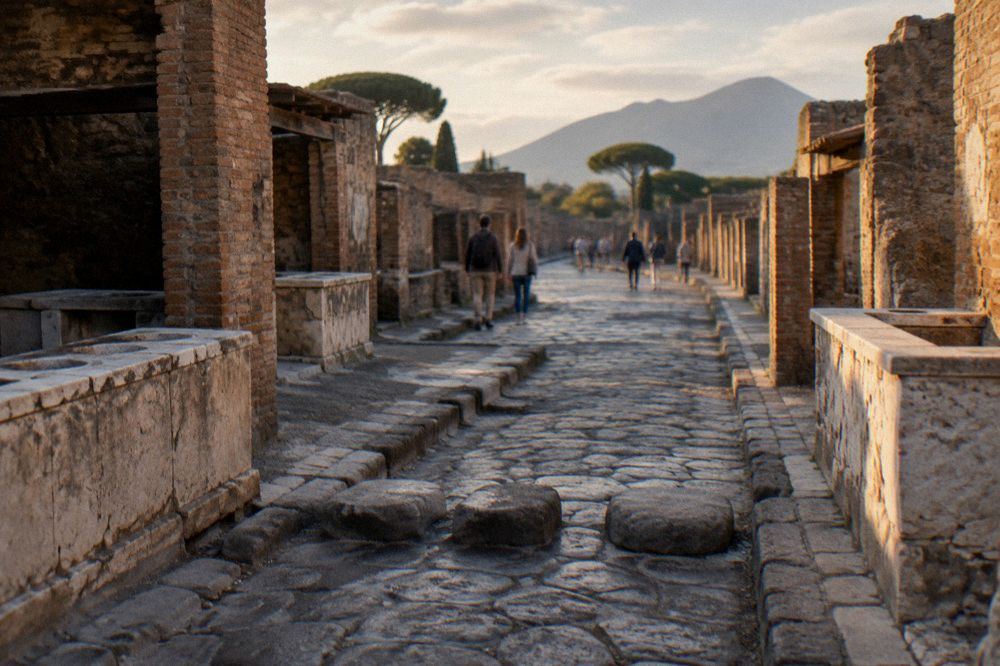
The pieces of the story sit within about 30 km of each other. Pompeii's excavated area covers 44 ha of the 98 ha inscribed UNESCO property, and walking it means walking the same streets that lay under the ashfall of the letters' second day. The Antiquarium at Pompeii displays finds from the excavations and gives the objects a context the streets alone cannot. At Herculaneum, the boat sheds on the ancient shoreline preserve the remains of people who gathered at the water's edge awaiting evacuation, the evacuation Pliny the Elder was commanding when he died.
| Site | Connection To The Letters | Ticket In 2026 |
|---|---|---|
| Pompeii (ancient city) | The city buried by the ashfall of 24-25 August tradition | Pompeii Express EUR 20 |
| Pompeii+ (city, villas, shuttle) | Adds Villa of the Mysteries near the Scavi station | EUR 25 |
| Park 3-day ticket | Adds Oplontis, Stabiae villas and museum, Boscoreale | EUR 30 |
| Stabiae villas (Villa Arianna, Villa San Marco) | Where Pliny the Elder died on the shore | Included in 3-day, or EUR 8 site |
| Herculaneum | The boathouses: people awaiting sea rescue | EUR 16 full, EUR 2 reduced |
The 2026 prices above end on 31 December 2026. From 1 January 2027 a single EUR 25 ticket covers all park sites, valid 30 days with one entry per site, while the three smaller sites stay EUR 8 each and the MyPompeii Card stays EUR 45. Entry is free for under-18s and for everyone on the first Sunday of the month, with EUR 2 reduction for EU citizens aged 18 to under 25. The full rules, including the nominative ticket and the 20,000 daily cap in force since 15 November 2024, are laid out in the Pompeii tickets guide.
Planning the route between the sites is its own task. The train lines and stations are covered in the Circumvesuviana train guide, noting that the Campania Express has been suspended since 1 October 2026, and the driving options in the Naples to Pompeii guide. For the layout on the ground, the Pompeii map and the site-wide map page mark every entrance: Porta Marina, Piazza Esedra and Piazza Anfiteatro for ticket offices, and the Porta Ercolano / Street of the Tombs entrance for the suburban villas route.
When Is The Best Time To Follow This Story?
The shoulder months of April, May, June and September give the best combination of long site hours at Pompeii, full Vesuvius access until 17:00, and rain around 87, 59, 30 and 90 mm per month against November's 180 mm, while July and August bring the highest daytime maxima, about 28.7 and 29.4 C, and November is the wettest month at 180 mm of rain on the 1991-2020 normals for Pompei.
Pompeii's hours are seasonal. From 16 March to 14 October the park opens at 9:00 with last entry at 17:30 and closing at 19:00; from 15 October to 15 March last entry falls to 15:30 and closing to 17:00. Vesuvius's hours, in the table above, shorten in the cold months. A trip that wants both sites needs the longer day, so the March-to-October window is the practical answer, with the peak-summer trade-off being heat on unshaded basalt streets.
| Month | Mean Daily Max (C) | Mean Daily Min (C) | Rain (mm) |
|---|---|---|---|
| April | 17.7 | 10.4 | 87 |
| May | 21.6 | 14.1 | 59 |
| June | 25.8 | 18.2 | 30 |
| July | 28.7 | 21.1 | 16 |
| August | 29.4 | 21.8 | 22 |
| September | 25.3 | 18.6 | 90 |
| October | 21.3 | 15.1 | 129 |
| November | 16.9 | 11.5 | 180 |
These figures are about-right values from 1991-2020 climate normals computed for the Pompei grid point, a reanalysis grid rather than a weather station, and they describe a Mediterranean climate with a dry summer peak and a wet November. Annual rainfall sums to 1,086 mm. The full monthly table and what to do about summer heat sit in the weather and best time to visit guide, and for anyone tackling the crater trail in the hot months, the practical advice is in the summer heat plan.
How Do You Build A Pliny Route In One Or Two Days?
A one-day Pliny route pairs Pompeii in the morning with the Vesuvius crater trail in the afternoon, using Naples or Sorrento as the base, with the Circumvesuviana to Pompei Scavi-Villa dei Misteri station and a pre-booked Vesuvius time slot; a two-day version adds Herculaneum's boat sheds on day one and the Stabiae villas, where the Admiral died, on day two, or moves at the pace of the site's published itineraries.
The single-day version is the popular choice, and organised versions of it, like the From Naples Pompeii and Vesuvius Day Trip with pizza lunch, exist precisely because the logistics of two timed entries in one day are fiddly. The order question, volcano first or city first, is argued both ways in is it better to do Pompeii or Vesuvius first, and the practical answer depends on your Vesuvius slot time and the season's closing hour.
For travellers based in Rome rather than Naples, the story is still reachable, at the cost of a long day; the options are set out in the Rome to Pompeii day trip guide and the Rome to Pompeii by train guide. From Sorrento, the connections are in the Sorrento to Pompeii guide, and from the coast in Amalfi Coast to Pompeii. Cruise passengers working against a ship's clock have a dedicated plan in the cruise ship day guide and the shore excursions overview.
A slower alternative swaps the crater for the wine country on the volcano's slopes, where the same soil that buried the cities now grows the vines. The Lunch and Wine Tasting in the National Park of Mt Vesuvius pairs an organic lunch with tastings in the park itself, a gentler way to spend the volcano half of the day. Check availability
Guided Tour Or Independent Visit For The Pliny Route?
The trade-offs are laid out in full in the guided tour versus self-guided guide. On the guided side, the value of an archaeologist-led walk is in what the stones do not say on their own: the two letters, the ash layers, the phases of the eruption, and the identity of the buildings, all of which a good guide reconstructs street by street. On the independent side, the park's own signage, an audio guide option, and the freedom to follow the story at your own pace appeal to readers who arrive already knowing the letters.
One middle path is the entry ticket and guided tour combination, which bundles admission with an archaeologist-led walk of the core ruins, leaving the rest of the day free for Vesuvius or the villas. Check availability
Common Questions About Pliny The Elder And Vesuvius
Who was Pliny the Elder?
Pliny the Elder was a Roman naval commander, naturalist and author who held the post of prefect of the fleet at Misenum on the Bay of Naples when Vesuvius erupted in AD 79. His encyclopedia, the Natural History, survives complete. He died at Stabiae during the eruption while organising a rescue by sea, aged 55.
How did Pliny the Elder die?
He landed at Stabiae to help a friend's household escape, spent a night under falling pumice, and collapsed and died on the beach the next grey morning, found two days later unmarked, looking, his nephew writes, more like a sleeper than a corpse. Modern physicians generally read this as asphyxiation or cardiac failure in a 55-year-old breathing hot ash.
Did Pliny the Younger survive Pompeii?
Yes. Pliny the Younger stayed at Misenum rather than boarding his uncle's ship, fled with his mother when the tremors and ash reached the naval base, and survived. Decades later he wrote two letters to the historian Tacitus describing the eruption, the only surviving eyewitness account of the disaster.
What date did Vesuvius erupt in AD 79?
The eruption is traditionally dated to 24 August AD 79 from the oldest manuscripts of Pliny the Younger's letters, a date scholars still debate. The archaeological park's own e-journal states the alternative 24 October date has zero evidentiary basis and results from a 1929 misreading, while adding that 24 August is not necessarily correct either.
Can you visit the place where Pliny the Elder died?
The ancient town of Stabiae, where he died on the shore, corresponds to the modern Castellammare di Stabiae, and its excavated villas, the Villa Arianna and Villa San Marco, are ticketed sites of the same archaeological park as Pompeii.
Why are Plinian eruptions named after him?
His nephew's first letter describes the eruption column as a pine tree rising to a great height and spreading branches, the classic form of a sustained explosive eruption. Volcanologists adopted "Plinian" for that eruption style in honour of the man who sailed toward it and the nephew who recorded it.
The letters of the two Plinys remain the reason the world knows, hour by hour, what happened to Pompeii on that debated day in AD 79. Read them on the train out, stand in the forum where the ash fell, climb the crater that made it, and the story closes exactly where it began: with Fortune, a fleet, and the bravest or most reckless decision ever taken on the Bay of Naples, on the site this Pompeii Travel Guide exists to help you reach.