Why Wasn't Naples Destroyed By Vesuvius?
Why the AD 79 eruption of Mount Vesuvius destroyed Pompeii and Herculaneum but left Naples standing: distance, wind direction and the shape of the Bay of Naples explained.
Mount Vesuvius, the volcano on the Bay of Naples in Campania, southern Italy, buried the Roman city of Pompeii and the town of Herculaneum in AD 79, an eruption traditionally dated to 24 August, a date scholars still debate. Naples, a far larger city lying roughly 24 km by road north-west of the excavations at Pompeii, came through the same catastrophe intact and has kept growing ever since, to the point that well over a million people now live on the volcanic plain. Readers of Pompeii Travel Guide ask the Naples question often, usually while planning a trip that pairs the modern city with the ancient one, so this page sets out the geography and the eruptive record plainly.
Why Wasn't Naples Destroyed By Vesuvius?
Pompeii and Herculaneum sat on the volcano's southern and south-western flanks, directly beneath the drifting ash and surges. Naples sat far enough north-west that neither the pumice fall nor the pyroclastic currents reached it. Distance did the first part of the work and wind direction the rest.**
The heart of the explanation is geometry. Vesuvius is not a solitary peak in empty country: it stands at the centre of a semicircle of towns around the Bay of Naples, and in AD 79 that semicircle included Pompeii to the south, Herculaneum to the west and Naples, then Neapolis, to the north-west across the water. An eruption does not radiate destruction evenly in all directions. The towering column of ash and pumice that rose from Vesuvius was pushed sideways by winds in the upper atmosphere, and the fallout drifted over the towns downwind while the opposite side of the bay received little or nothing.
Naples also kept a buffer of open ground between its buildings and the crater. Pompeii stood close enough to the mountain, about 9 km from the summit in straight-line terms along the coast, that ash and pumice accumulated on its roofs to a depth heavy enough to collapse them before the lethal ground-hugging surges arrived. Herculaneum lay closer still, practically on the flank itself, and was hit hardest and fastest. The city shook, darkened and rained ash, but it remained standing and habitable.
That pattern has repeated in a gentler form in every eruption since. Vesuvius erupted many times between AD 79 and today, and the eruptions that followed damaged towns on the flanks, with lava repeatedly reaching the coastal communities on the volcano's lower slopes. Naples, each time, collected ash on its streets and little else. The answer to the question is therefore not that Naples is somehow immune: it is that every recorded eruption has done its damage in the directions the wind and the slopes sent it, and those directions have not pointed at the city.
Where Do Naples, Pompeii And Vesuvius Actually Sit?
Naples lies roughly 24 km by road north-west of the modern town of Pompei, with the archaeological park beside it, and Vesuvius stands between them on the shore of the bay. Driving times from the volcano's area are short: about 22 minutes to Naples, about 37 minutes to Sorrento and about 30 minutes to Salerno. Rome is far beyond day-trip walking range at 234 km by road. The Circumvesuviana railway connects Naples with Pompei Scavi-Villa dei Misteri station in 29 to 35 scheduled minutes.
The bay's geography is easier to hold in your head as a clock face. Put Vesuvius at the centre. Naples sits at roughly eleven o'clock across the water, Herculaneum, today the town of Ercolano, at about nine o'clock on the flank itself, Pompeii at about seven o'clock, Sorrento at six, and Torre Annunziata, the ancient Oplontis, between Herculaneum and Pompeii at eight. The AD 79 destruction ran around the seven-to-nine o'clock arc. The eleven o'clock position, Naples, was outside it.
The distances below come from OpenStreetMap road routing for the driving figures and from EAV's own timetable data for the train times, so treat them as planning figures rather than guarantees.
| Route | Distance | Scheduled Time |
|---|---|---|
| Naples to Pompei Scavi, by road | 24 km | about 22 minutes |
| Naples to Pompei Scavi, Circumvesuviana rail | rail line | 29 to 35 minutes |
| Sorrento to Pompei Scavi, by road | 26 km | about 37 minutes |
| Salerno to Pompei Scavi, by road | 31 km | about 30 minutes |
| Rome to Pompei Scavi, by road | 234 km | about 2 hours 40 minutes |
If you are planning the trip itself, the rail option is the everyday answer: the Circumvesuviana runs from Napoli Garibaldi, downstairs from the main high-speed station, to Pompei Scavi-Villa dei Misteri, the stop for the excavations. Note that the other Vesuvian rail service, the Campania Express, has been suspended since 1 October 2026, so the Circumvesuviana is the train to plan around. Our page on making Pompeii a Naples day trip walks through the timing, and choosing between a Naples or Pompei base covers where to sleep.
Which Places Were Destroyed While Naples Was Spared?
The AD 79 eruption destroyed Pompeii and Herculaneum and badly damaged or buried the villas and farms across the volcano's southern flank, including Oplontis at modern Torre Annunziata and the villa settlements at Stabiae, near Castellammare di Stabiae. Pompeii lay under metres of pumice and ash; Herculaneum, closer to the crater, was filled by the hot surges almost at once. Naples, north-west across the bay, took ash fall and darkness but no burial. The destruction traced the downwind arc, not the whole coastline.
The buried places are now, together with Torre Annunziata, one UNESCO World Heritage property covering an excavated area of 44 ha at Pompeii alone within an inscribed property of 98 ha. Visitors can see the difference in fate with their own eyes. At Pompeii, roofs and upper storeys collapsed under the weight of fallout before the surges arrived, and the site preserves streets, bakeries, brothels and amphitheatres at walking scale. At Herculaneum, the carbonising surge preserved wood, doorframes and foodstuffs that ash never could, which is why the two sites feel so different today, a contrast our Pompeii versus Herculaneum comparison covers in detail.
One practical note for anyone combining the two this year: Herculaneum's Villa dei Papiri and its Ancient Theatre are closed for works, so the comparable open-air experience at Pompeii carries the fuller itinerary. The same applies to the Praedia of Julia Felix at Pompeii itself, closed to the public since 7 September 2026 for maintenance. Neither closure diminishes the central story the ruins tell: a city stopped mid-afternoon by a volcano, and a neighbouring city that kept going.
For travellers who want both sides of the AD 79 story in one outing from Naples, the Pompeii ruins and Mount Vesuvius day tour pairs the excavated city with the crater trail, with Check availability on the operator's live listing showing what is running on your dates.
Has Vesuvius Erupted Since AD 79?
Yes, Vesuvius has erupted repeatedly since AD 79, most recently in 1944, and Naples has survived every one of those eruptions. The volcano stayed active through the medieval and early modern periods, and eruptions in those centuries repeatedly damaged towns on the volcano's flanks. The 1944 eruption ended the continuous activity, and the mountain has been quiet since. Damage in these eruptions fell on the flank towns rather than on Naples, repeating the AD 79 pattern.
The 1944 eruption is the one modern travellers ask about, because it happened within living memory and in the middle of the Second World War. Lava flows and ash damaged towns on the volcano's lower slopes, and photographs from the period show the streets of Naples dusted grey but functioning. That is the clearest modern demonstration of the AD 79 lesson: the closer a town sits to the crater and the downwind flank, the harder it is hit.
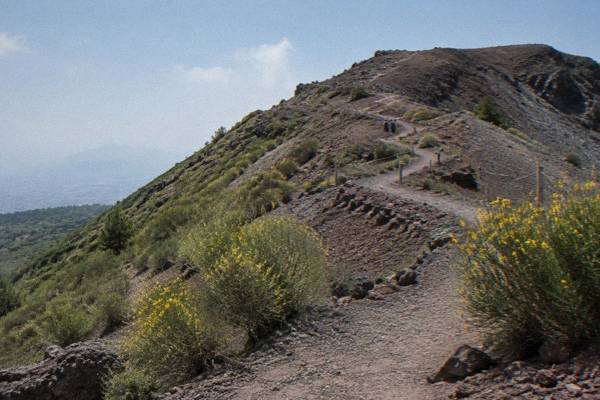
Visiting the crater today is a managed, ticketed walk on a national park trail, not an act of bravado. The park authority sells timed tickets online only, at EUR 11.68 full and EUR 9.55 reduced as sold, and the path closes automatically on an orange weather alert or higher. The shortest route takes about two hours return, the longest about three.
| Vesuvius Gran Cono Access (2026) | Detail |
|---|---|
| Full ticket | EUR 11.68 |
| Reduced ticket | EUR 9.55 |
| Booking window | up to 30 days ahead, 50 tickets per 10-minute slot |
| Last-minute tickets | 10 per slot, from 30 minutes before, nominative since 11 April 2026 |
| Access hours, January, February, November, December | 09:00-15:00 |
| Access hours, March and October | 09:00-16:00 |
| Access hours, April, May, June, September | 09:00-17:00 |
| Access hours, July and August | 09:00-18:00 |
| Walk duration | about 2 to 3 hours return |
If the crater walk is on your list, the practical questions are answered on our pages about the cost of going up Vesuvius, the length of the walk, and whether Vesuvius might erupt again.
Could A Future Eruption Reach Naples?
A future large eruption would threaten towns on Vesuvius's flanks first and hardest, and Naples would face ash fall, disruption and possible evacuation orders rather than the burial that Pompeii suffered in AD 79. The mountain is among the most closely monitored volcanoes on earth, with an evacuation plan built around days or weeks of warning. Planning authorities treat the flank towns as the priority zone.
The honest framing is that the question has shifted since AD 79, not been answered away. What changed is detection and response. Roman Pompeii had no seismographs, no warning and no evacuation route; today the volcano is instrumented continuously, and the civil protection plan for a renewed eruption is organised around moving the population of the red zone, the belt of towns closest to the crater, before the paroxysmal phase. Naples sits largely outside that red belt, though its eastern districts reach toward it.
For a traveller, the risk calculus resembles the one for the region's earthquakes: real, monitored, and small on any given week. The park and the rail operator publish closures when they happen, as with the temporary closure of the Polverificio park access from via P. Vitiello between 1 and 10 October 2026, a side entrance rather than a main gate. Neither that nor anything in the current record points to volcanic trouble, and the site's visitor numbers, 4,000,090 at Pompeii in 2025, reflect a place operating as normal.
Common Questions About Vesuvius And Naples
Why wasn't Naples destroyed by Vesuvius?
Distance and wind direction. Naples lies roughly 24 km north-west of Vesuvius across the Bay of Naples, while the AD 79 eruption cloud was carried over the towns to the south and west of the crater, burying Pompeii and Herculaneum. The fallout and the hot ground-hugging surges never reached the city, which suffered ash fall and darkness but survived.
Which towns were destroyed by Vesuvius in AD 79?
Pompeii and Herculaneum were destroyed, and the villa settlements around them, including Oplontis at modern Torre Annunziata and the villas at Stabiae near Castellammare di Stabiae, were buried or badly damaged. Naples, on the opposite side of the bay, was spared.
When did Vesuvius last erupt?
Vesuvius last erupted in 1944, in the closing years of the Second World War. That eruption damaged towns on the volcano's lower slopes while Naples took ash fall, repeating the geographic pattern of AD 79. The mountain has been quiet since.
Is Vesuvius still active and monitored?
Yes. Vesuvius is an active volcano and one of the most closely monitored in the world, with continuous instrumentation and a civil protection plan for the flank towns.
How far is Naples from Pompeii and Vesuvius?
Naples is about 24 km by road from the modern town of Pompei and the excavations beside it, roughly 22 minutes driving, and the Circumvesuviana rail link runs from Napoli Garibaldi to Pompei Scavi-Villa dei Misteri station in 29 to 35 scheduled minutes. Vesuvius stands between the two, on the shore of the bay.
One of the trio above is deliberately different from the rest: The Original Free Tour of Naples is a free, tip-based walk of Naples' old town run on GuruWalk, and it is a fine way to see the city Vesuvius never managed to touch, with no price to print because the walk runs on tips. Pair it with a crater-and-ruins day and you cover both halves of the AD 79 story: the city that fell and the city that stood.