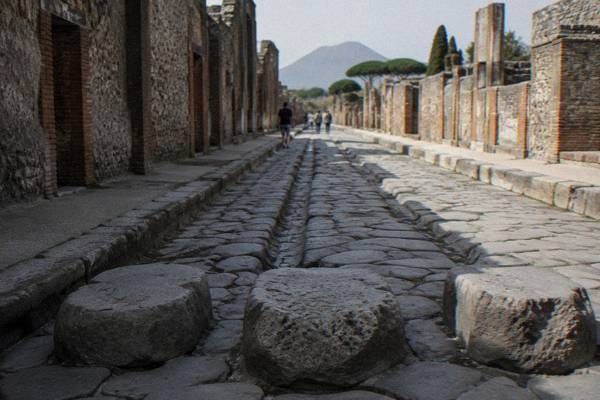
Pompeii Toilets
The archaeological park of Pompeii covers 44 excavated hectares with sparse modern facilities: this guide covers where toilets, luggage storage, food and water sit within the park's own rules for 2026.
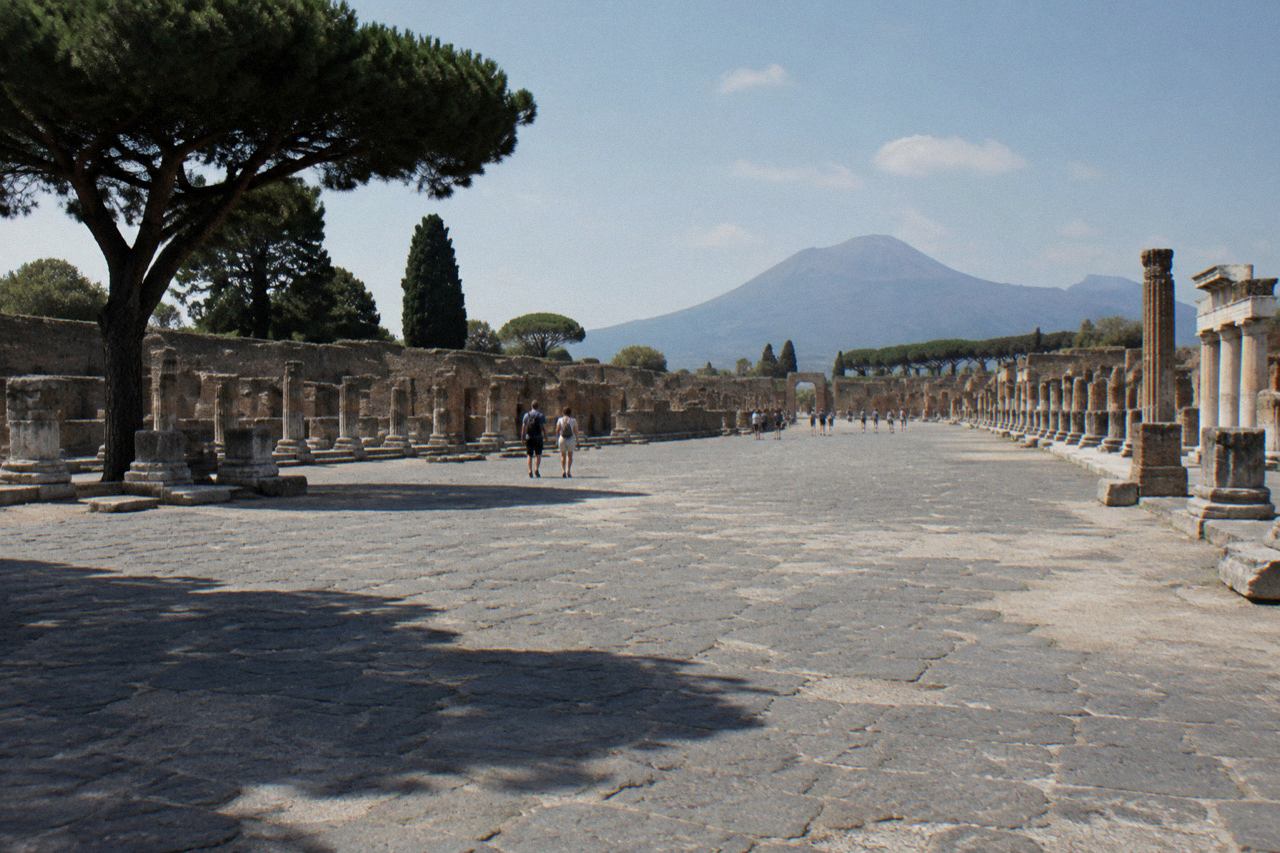
Short answer
Toilets at Pompeii sit at the three ticket-office entrances (Porta Marina, Piazza Esedra, Piazza Anfiteatro) and at service points inside the park, and facilities are basic, squat-style in places and limited for a 44-hectare site. Use the toilet at an entrance before you walk in, carry water, and plan around last-entry times of 15:30 in winter and 17:30 in summer 2026.
The archaeological park of Pompeii, the ancient Roman city buried by the eruption of Mount Vesuvius in AD 79, lies in Campania, southern Italy, beside the modern town of Pompei and about 24 km by road from Naples. It is a 44-hectare excavated site with almost no shade, long stone streets and a strictly limited set of modern conveniences, and the question of where the toilets are is a genuinely practical one: once you are deep inside the ruins, you may be twenty minutes of walking from the nearest facility. This guide covers the park's own 2026 rules on toilets, bags, luggage, food, water and accessibility, and it links the practical pages that answer each sub-question in depth, starting with the direct answers at Are There Toilets In Pompeii?.
Where Are The Toilets At Pompeii?
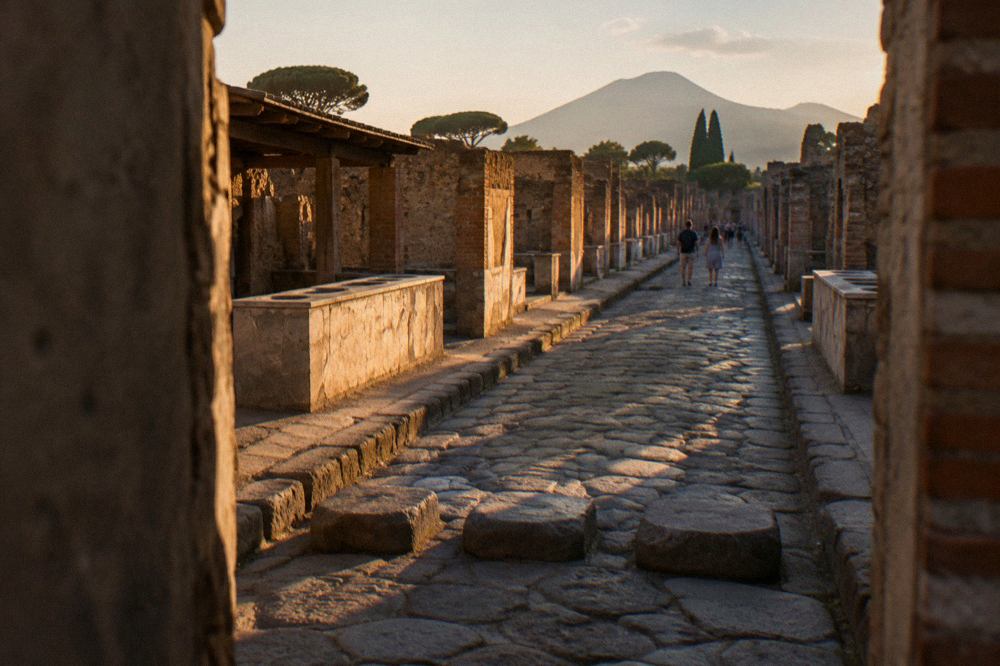
Yes, Pompeii has toilets, and they sit at the three ticket-office entrances, Porta Marina, Piazza Esedra and Piazza Anfiteatro, plus a small number of service points inside the park itself. For a 44-hectare site the coverage is thin: the park's own regulations page covers bags, entry and closures in detail but publishes no map of toilets, so the reliable rule is to use a facility at the entrance before you start walking, and again at the Antiquarium area if your route passes it.
The practical reality is that Pompeii is an archaeological site first and a visitor attraction second. The excavated area recorded by UNESCO is 44 hectares within a 98-hectare inscribed property, and the park's modern services cluster at its edges rather than through the streets. Visitors entering at Porta Marina, the entrance closest to the Pompei Scavi-Villa dei Misteri Circumvesuviana station, find facilities at the entrance complex before the turnstiles. Piazza Esedra and Piazza Anfiteatro, the other two ticket offices, serve the same function at the site's other corners, and the Piazza Anfiteatro side is where the accessible "Pompeii for All" route begins.
Inside the park, facilities appear at service points such as the café areas and the Antiquarium, the park's museum building, rather than along the ancient streets. Distances between them are real distances: crossing the site from Porta Marina to the amphitheatre end is a substantial walk on uneven Roman paving. The site's own visitor regulations page explains the entry rules, and the hours matter for planning toilet stops because they set the last-entry window.
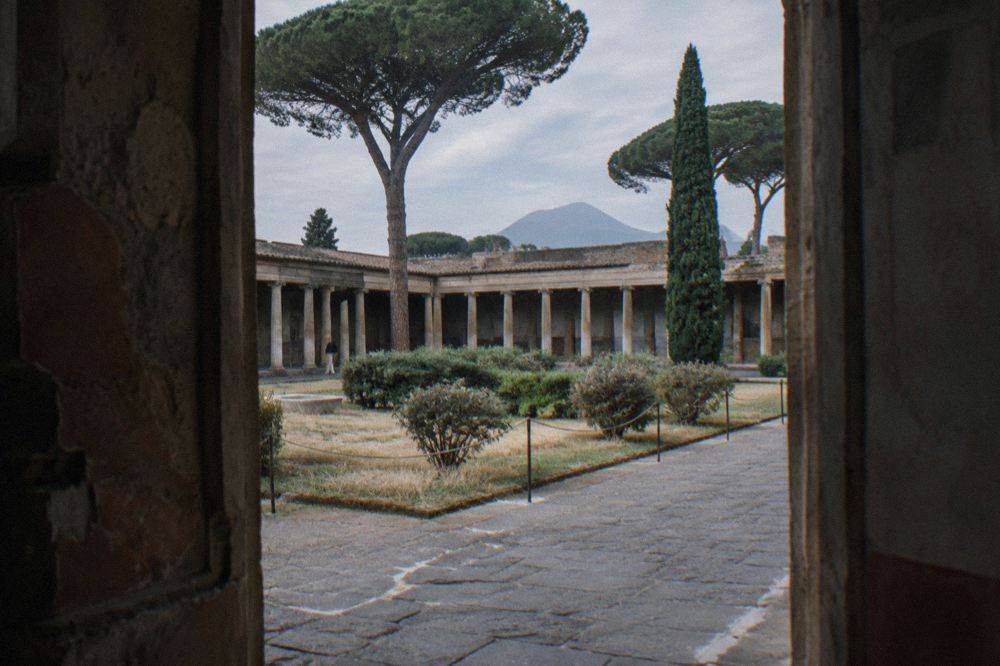
| Pompeii entrance or service point | Ticket office | Role for facilities planning |
|---|---|---|
| Porta Marina | Yes | Entrance nearest the Circumvesuviana station, facilities at the entrance complex |
| Piazza Esedra | Yes | Central-south entrance, start of accessible exit route via the Antiquarium lift |
| Piazza Anfiteatro | Yes | East entrance, start of the "Pompeii for All" accessible route |
| Porta Ercolano / Street of the Tombs | Suburban villas add-on only | Express holders add the villas route here for EUR 8, card payment only |
| Antiquarium area | No | Museum building with service facilities on the accessible route |
How Basic Are The Toilets Inside Pompeii?
The toilets at Pompeii are functional but basic: expect sit-down and squat-style cubicles, bring your own paper and hand sanitiser as supplies are not guaranteed, and expect queues at peak times in summer and on free first Sundays. The park caps entry at 20,000 visitors a day, a limit in force since 15 November 2024, so crowding at facilities tracks the time-slot system, with the morning band far heavier than the afternoon one.
That slot split is the single most useful planning fact on this page. The 9:00-13:00 band carries up to 15,000 of the day's entries and the 13:00-17:30 band up to 5,000 in the 16 March to 14 October season, which means the entrances, the cafés and the toilets all feel it before lunch. A visitor who enters at 13:00 or later walks the same streets with a fraction of the crowd, and the summer closing time of 19:00 with last entry at 17:30 still leaves more than four hours of visiting. The trade-off is afternoon heat in July and August, when the mean daily maximum at the Pompei grid point is about 28.7 and 29.4 degrees respectively, so water and shade stops matter as much as toilet stops.
Visitor numbers explain the queues. The park's official visitor table records 4,000,090 visitors to the Pompeii site in 2025, after 4,069,377 in 2024 and 3,985,424 in 2023, and the monthly pattern concentrates hard: in 2024, May carried 516,923 visitors and October 481,255, against 112,121 in January. A first Sunday in high season is heavier still, since entry is free for everyone on the first Sunday of the month year-round, and the park has recorded more than 36,000 visitors on a single free first Sunday.
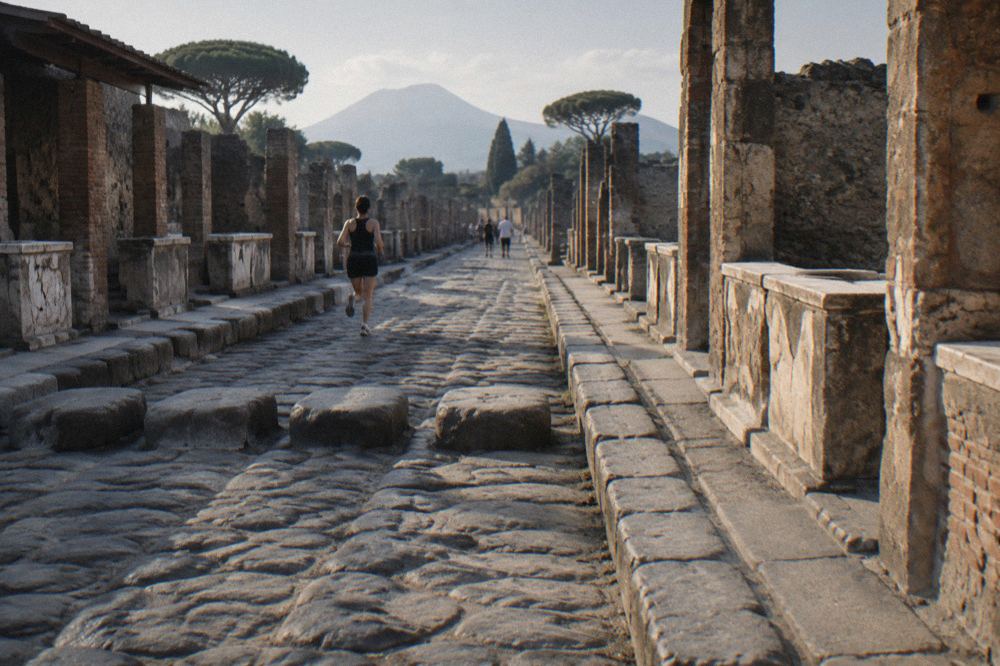
The park's daily cap and nominative tickets, both retained in the 2027 tariff reform, are the reason advance booking matters even for a facilities question: a timed ticket fixes when you join the queue, and the queue is where you will regret not using the entrance toilets first. The full ticket rules and 2027 changes are covered on their own page, and a ticket-plus-guide product bundles the archaeologist-led walk with entry, which is the calmest way to manage a first visit. If you are coming from Naples, a round-trip shuttle removes the return-train timing pressure entirely, and travellers pairing the ruins with the coast can do both in one long day.
What Facilities Does Pompeii Have Besides Toilets?
Pompeii's non-toilet facilities are left luggage, a bag-size limit, café and refreshment points, water fountains at some points, the Antiquarium museum, the Artebus shuttle with luggage storage, and an accessible route called "Pompeii for All". Bags larger than 30 x 30 x 15 cm must go to left luggage under the park's visitor regulations, and the suburban villas add-on is sold only by card at the Porta Ercolano / Street of the Tombs entrance.
The bag rule is enforced and worth taking seriously. The regulations page, in force with the 12 January 2026 prices, permits bags up to 30 x 30 x 15 cm and directs larger items to the left-luggage service, alongside rules banning drones without authorisation and bare chests. In practice that means a small daypack is fine and a cabin suitcase is not: if you are travelling between Naples and Sorrento with luggage, the choice is left luggage at the park, storage services near the station booked through a luggage storage service, or the shuttle option, whose Artebus vehicle has luggage storage on board.
| Facility | What the park's rules say | Planning note |
|---|---|---|
| Bag size limit | Maximum 30 x 30 x 15 cm | Larger bags go to left luggage, allow queue time |
| Left luggage | Provided under the visitor regulations | Busiest at opening and at the 13:00 slot |
| Toilets | At the three entrance areas and service points inside | Use the entrance before starting the walk |
| Artebus shuttle | Has luggage storage, no disabled access | Useful for luggage, not for wheelchairs |
| Accessible route | "Pompeii for All" from Piazza Anfiteatro, exit via Antiquarium lift | See the accessibility section below |
| Suburban villas add-on | EUR 8 at Porta Ercolano / Street of the Tombs, card only | Only for Express ticket holders |
Water and food inside the park are limited to the café points rather than spread through the streets, and the ancient water fountains you will see along the streets are Roman archaeology, not drinking stations. Carrying a bottle is standard advice for a site where the summer mean daily maximum sits near 29 degrees and shade is rare; refill where the café points allow. For the wider question of where to eat before and after, the eating options around Pompeii page covers the modern town's restaurants, and the where to stay near Pompeii page helps if you would rather not do the site as a day trip.
For travellers who prefer to move at their own pace without a live guide, an audio-guide ticket is the natural companion to this facilities-first planning, since it adds nothing to carry beyond a phone.
Can You Eat And Drink Inside The Pompeii Park?
Yes, but only at the park's designated café and refreshment points, not picnic-style across the ruins, and the offering is basic: drinks, snacks and light meals at the service areas near the entrances and the Antiquarium. For a full meal the practical answer is the modern town of Pompei outside the walls, whose restaurants and cafés sit a short walk from the Porta Marina entrance and the Pompei Scavi-Villa dei Misteri station.
A five-hour visit, which is what a relaxed circuit of the forum, the baths, a painted house and the amphitheatre realistically takes, needs a food plan. The café points inside cover a water top-up and a coffee; they are not lunch destinations. Visitors on the standard routes tend either to eat before entry, break at a café point mid-visit, or finish and walk out to Pompei, where the sanctuary and the station area both have eateries. The dedicated food guide for Pompeii lists what to look for, including the pizza tradition of nearby Naples.
Visitors combining Pompeii with wine country have a neat option: the northern slope of Vesuvius produces the lacryma christi wines from vineyards inside the national park, and several products bundle a ruins walk with an organic lunch and tasting on the mountain, which removes the where-to-eat question entirely.
Is Pompeii Accessible For Visitors With Limited Mobility?
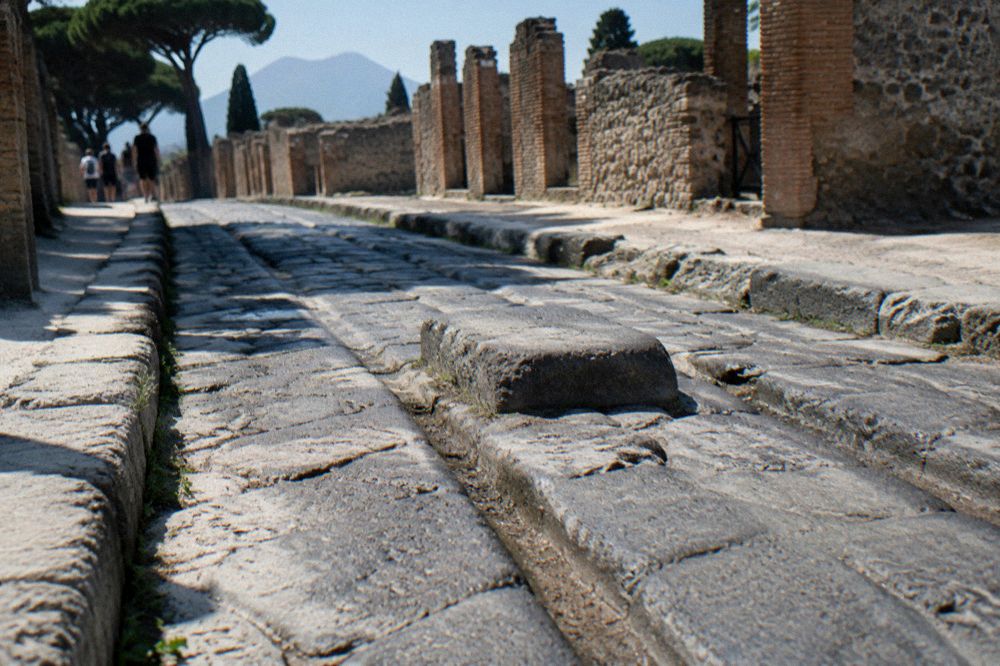
Partly. The park runs a designated accessible route called "Pompeii for All": visitors with mobility difficulties enter at Piazza Anfiteatro and may exit at Piazza Anfiteatro or at Piazza Esedra via the Antiquarium lift, per the park's own regulations page. The rest of the site remains ancient streets with raised stepping-stones, uneven basalt paving and no shade, so the accessible route, not the full 44 hectares, is the realistic promise.
The route's existence is the headline; its limits are the detail. Roman streets were engineered for cart wheels and rainwater, with deep ruts and pedestrian crossing stones, and they have not been smoothed for modern wheels. The Antiquarium lift at the Piazza Esedra end exists precisely because the natural exit path is not navigable, and the Artebus shuttle, while useful for luggage, has no disabled access, so it is not part of the accessible plan. Visitors with prams face the same surfaces: a rugged pram manages the accessible route, a lightweight city pram does not.
For comparison, Herculaneum versus Pompeii matters here: Herculaneum is a far smaller site, though its own closed areas, the Villa dei Papiri and the Ancient Theatre, both shut for works, reduce what is open. Whatever the site, the same facilities advice holds: toilets and services at the edge, ancient surfaces within.
What Should You Bring For A Comfortable Pompeii Visit?
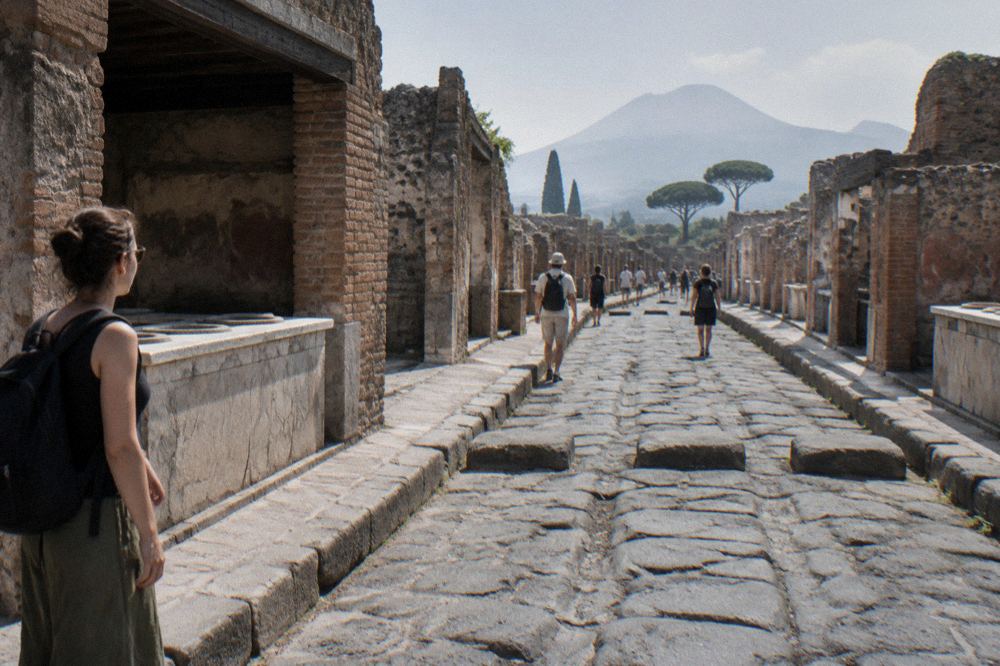
Bring a small bag under 30 x 30 x 15 cm, a filled water bottle, sun protection, worn-in flat shoes with grip, tissue and hand sanitiser for the toilets, and your ID, since nominative tickets mean identification can be checked at every entry. Summer mean daily maxima at Pompei run about 25.8 degrees in June, 28.7 in July and 29.4 in August against mean minima near 21 degrees, so heat, not cold, is the planning problem.
The ID point catches visitors out. Since 15 November 2024 tickets are nominative, non-transferable and non-refundable except for extraordinary closure, and the regulations state that ID may be checked at every entry. A booked ticket in another person's name is not usable. The bag limit interacts with what you carry: a 30 x 30 x 15 cm daypack holds a bottle, tissue, sanitiser, sun cream and a guidebook, and nothing larger is admitted without the left-luggage detour.
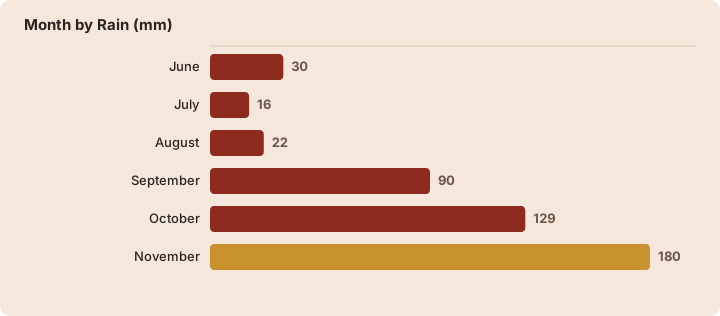
Footwear deserves its own sentence. The streets are original Roman basalt, polished by two millennia of feet, and damp stone after rain is slick. November is the wettest month at the Pompei grid point with about 180 mm of rain on the 1991-2020 normals, and July the driest at about 16 mm, so an autumn or winter visit trades crowds and heat for wet paving. The month-by-month detail, including the rain figures for every month, sits on the Pompeii weather and best time to visit page.
| Month | Mean daily max (C) | Mean daily min (C) | Rain (mm) | Facilities planning note |
|---|---|---|---|---|
| June | 25.8 | 18.2 | 30 | Heat and crowds, morning slot heaviest |
| July | 28.7 | 21.1 | 16 | Hottest dry month, carry full water |
| August | 29.4 | 21.8 | 22 | Highest mean maximum of the year |
| September | 25.3 | 18.6 | 90 | Warm, first rain returns |
| October | 21.3 | 15.1 | 129 | Winter hours from 15 October, last entry 15:30 |
| November | 16.9 | 11.5 | 180 | Wettest month, slick paving |
How Do Tickets, Hours And Toilet Stops Fit Together?
Plan toilet stops around the three fixed points of a Pompeii day: the entrance before you start, a café point or the Antiquarium mid-route, and the entrance again before you leave, because last entry is 15:30 with a 17:00 close in winter and 17:30 with a 19:00 close in summer in 2026. That year the Pompeii Express ticket is EUR 20, Pompeii+ is EUR 25 and the 3-day ticket is EUR 30, with free entry for under-18s and on first Sundays.
The ticket structure matters because it decides which entrances and extras you use. The Express covers the ancient city alone. Pompeii+ adds the suburban villas, the Villa Regina and the Antiquarium at Boscoreale, plus the shuttle. The 3-day ticket extends to Oplontis, the Stabiae villas and museum, and Boscoreale, whose individual tickets are EUR 8 each. An Express holder can add the suburban villas route on the day for EUR 8, card only, at the Porta Ercolano / Street of the Tombs entrance. Reduced entry is EUR 2 for EU citizens aged 18 to under 25.
| 2026 ticket | Price (EUR) | Covers | Facilities relevance |
|---|---|---|---|
| Pompeii Express | 20 | Ancient city | Entrances: all three ticket offices |
| Pompeii+ | 25 | City, suburban villas, Villa Regina, Boscoreale Antiquarium, shuttle | Adds the villas route from Porta Ercolano |
| 3-day ticket | 30 | Pompeii+ plus Oplontis, Stabiae villas and museum, Boscoreale | Split days, smaller sites closed Tuesdays |
| Other sites individually | 8 | Boscoreale, Oplontis, Stabiae museum | Oplontis and Stabiae closed on Tuesdays |
| My Pompeii Card (annual) | 45 | Annual park access, EUR 10 reduced | Repeat visits, same facilities |
| From 1 Jan 2027 | 25 | One ticket, all park sites, 30 days, one entry per site | Replaces the structure above |
| Season (2026) | Opens | Last entry | Closes | Slot split |
|---|---|---|---|---|
| 16 March to 14 October | 9:00 | 17:30 | 19:00 | 9:00-13:00 up to 15,000; 13:00-17:30 up to 5,000 |
| 15 October to 15 March | 9:00 | 15:30 | 17:00 | Shorter day, plan food and toilets around the earlier close |
Pompeii itself has no weekly closing day; only the smaller sites at Oplontis and Stabiae close on Tuesdays, and the whole park closes 25 December and 1 January unless otherwise communicated. The park map and orientation guide shows the entrances against the street grid, which is the fastest way to place the facilities in your head before arrival.
What About The Ancient Roman Toilets You See On The Route?
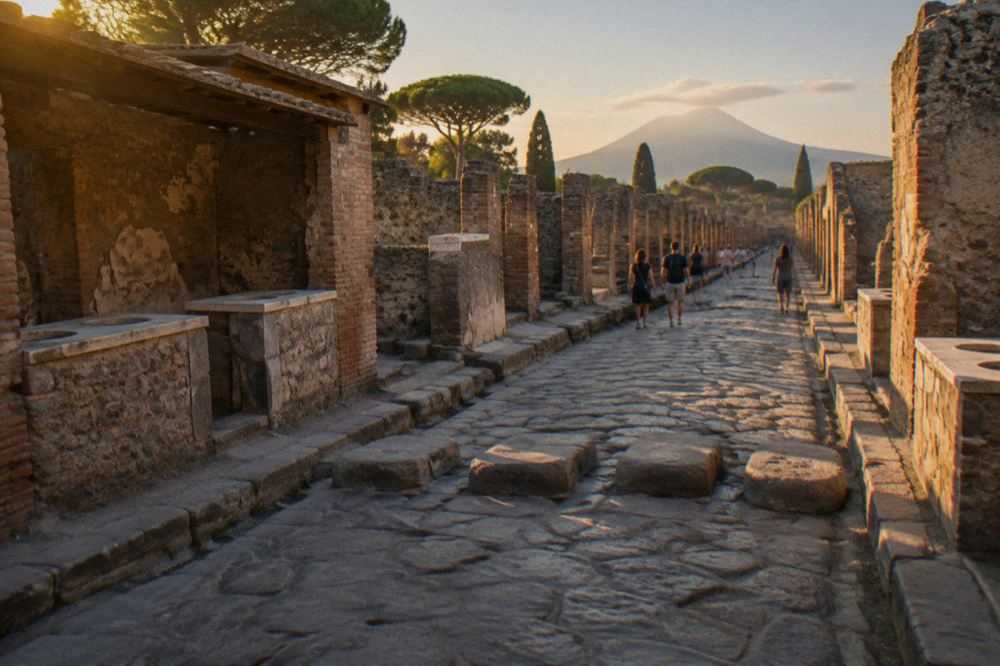
The stone latrines you pass inside Pompeii are the public toilets of the ancient city, multi-seat bench latrines with a single drainage channel beneath, found at points such as the bath complexes, and they are fenced archaeology rather than usable facilities. They answer a historical question, not a practical one: Roman Pompeii had a sophisticated water and drainage system, and the modern park overlays only sparse conveniences on it.
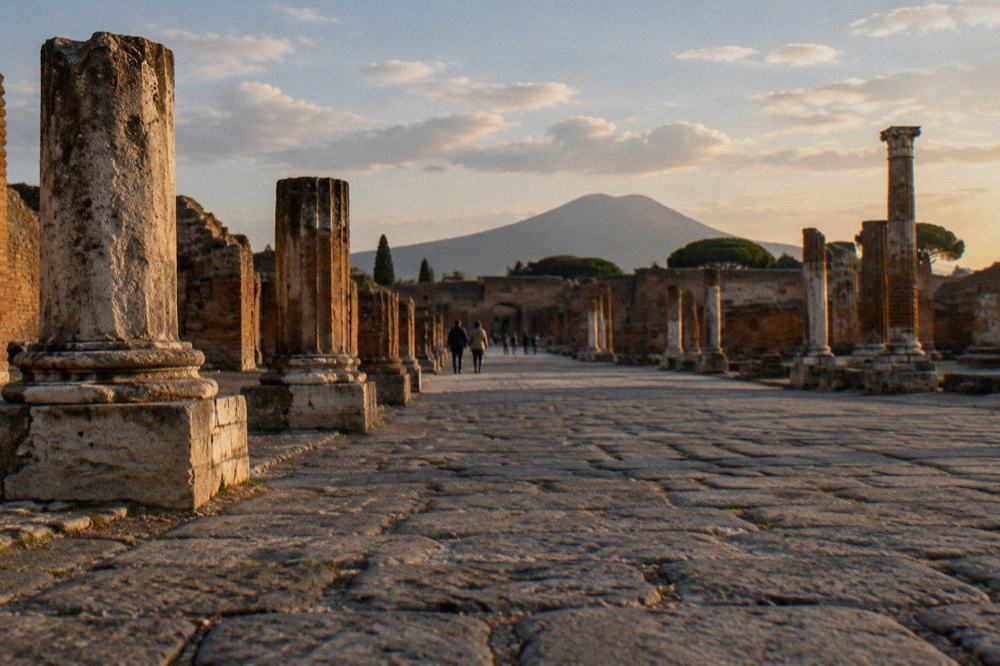
The contrast is worth a moment because it changes how you read the site. The ancient city, destroyed in the eruption traditionally dated to 24 August AD 79, a date the park's own e-journal says is not settled while the alternative 24 October reading has, in the journal's words, no evidentiary basis, ran water through lead pipes and street fountains and flushed its latrines with that system. The modern visitor walks the same 44 hectares with a bottle and three entrance toilet blocks. The history of Pompeii and the deep dives on individual buildings, such as the Stabian Baths, cover the ancient infrastructure properly.
Common Questions About Pompeii Toilets And Facilities
Are there toilets in Pompeii?
Yes. Toilets sit at the three ticket-office entrances, Porta Marina, Piazza Esedra and Piazza Anfiteatro, and at service points inside such as the café areas and the Antiquarium. Coverage is thin for a 44-hectare site, so use the facilities at your entrance before starting the walk.
Do you need to bring toilet paper to Pompeii?
Bring your own tissue or paper and hand sanitiser. Supplies at the park's facilities are not guaranteed, and in high season, with the daily cap at 20,000 visitors and the 9:00-13:00 slot carrying up to 15,000 of them, the facilities run hard.
Can you take a backpack into Pompeii?
Only if it is no larger than 30 x 30 x 15 cm, per the park's visitor regulations in force with the 12 January 2026 prices. Larger bags must go to the left-luggage service, and the Artebus shuttle has luggage storage if you are using it.
Is there anywhere to eat inside the Pompeii park?
Café and refreshment points at the service areas sell drinks, snacks and light meals, but a full meal is better planned in the modern town of Pompei outside the walls. The eating guide linked above covers the options around the Porta Marina entrance and the station.
Is Pompeii accessible for wheelchair users?
Partly, via the "Pompeii for All" route: enter at Piazza Anfiteatro, and exit at Piazza Anfiteatro or Piazza Esedra via the Antiquarium lift. The rest of the site is original Roman paving with stepping-stones, and the Artebus shuttle has no disabled access.
When can you enter Pompeii for free?
Entry is free for everyone on the first Sunday of every month, year-round, and for under-18s at any time. EU citizens aged 18 to under 25 pay a reduced EUR 2. On 2026 pricing the standard Express ticket is EUR 20, and from 1 January 2027 a single EUR 25 ticket covers all park sites.
A final word on how the pieces fit together. The facilities question at Pompeii is really a timing question: the park's own Pompeii Travel Guide exists because a site this large rewards a plan, and the plan that works is an early or 13:00-slot entry, a small bag, water, the entrance toilet before you walk in, and a ticket bought in advance so the nominative-ticket ID check at the gate is the only queue you face. Treat the ruins as the event and the facilities as the logistics, in that order, and the day takes care of itself.