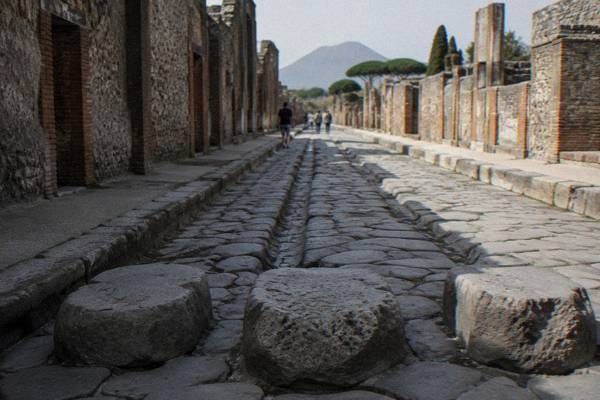
House Of The Faun
The House of the Faun is the grandest residence excavated at Pompeii, a full city block of the ancient city in Campania, Italy, about 24 km from Naples, famous for its dancing faun statue and Alexander Mosaic.
Short answer
The House of the Faun stands in Pompeii, the ancient Roman city buried by Vesuvius in AD 79 and now an archaeological park in Campania, southern Italy. Entry is covered by the park's admission ticket, EUR 20 for the Pompeii Express option in 2026. The house occupies an entire insula of the Via di Nola and holds the copy of the Alexander Mosaic and the bronze dancing faun.
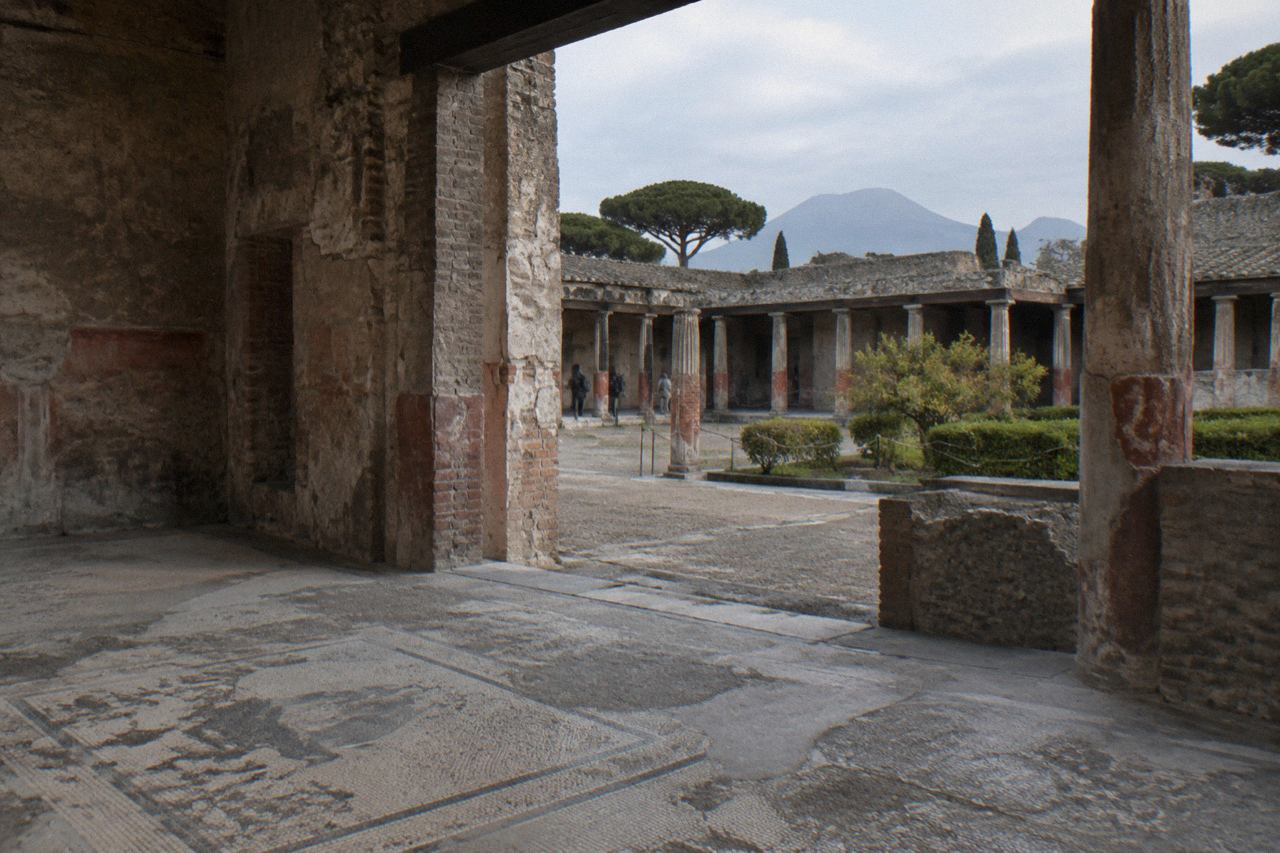
The House of the Faun is the largest and one of the finest residences yet excavated at Pompeii, the ancient Roman city buried by the eruption of Mount Vesuvius in AD 79 and now the Parco Archeologico di Pompei, in Campania, southern Italy, beside the modern town of Pompei and about 24 km by road from Naples. The house fills an entire block, or insula, of the ancient street grid between the Via di Nola and the Via della Fortuna, and visitors reach it on foot inside the park, roughly between the Forum and the amphitheatre quarter. Its modern name comes from the small bronze statue of a dancing faun set in the impluvium of the atrium, a copy of which stands there today. The original Alexander Mosaic, recovered from the house during excavation, is displayed in the National Archaeological Museum in Naples, and a reproduction lies in the room where it was found.
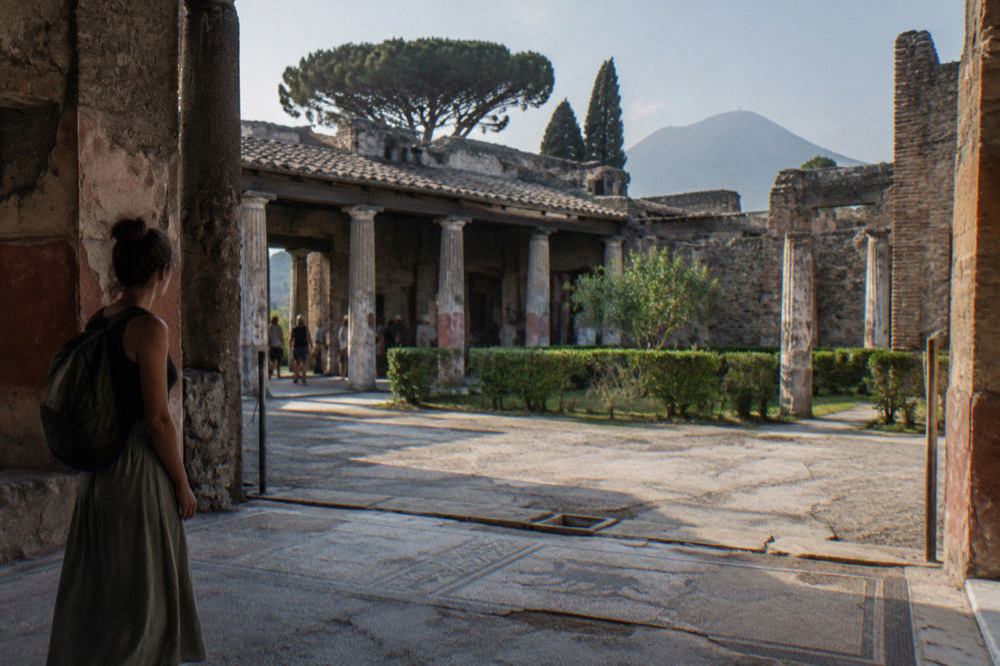
Because the house sits inside the excavated city, everything about visiting it is really a question of visiting Pompeii itself: which ticket, which entrance, how the daily cap works, and how long the walk from the gate takes. This guide covers the house room by room, then the practical side, using only figures published by the park and the operator listings linked below. The essentials are on the Pompeii ticket options guide, and the full park map shows where the house sits relative to each entrance.
What Is The House Of The Faun In Pompeii?
The House of the Faun is the largest domestic building excavated at Pompeii, a Roman town house of the Samnite and early Roman periods that covers a whole insula of the ancient city. It was home to a wealthy family, and it takes its modern name from the bronze dancing faun found in its atrium pool. Its most famous treasure, the Alexander Mosaic, was moved to the National Archaeological Museum in Naples, and a copy now lies in the house.
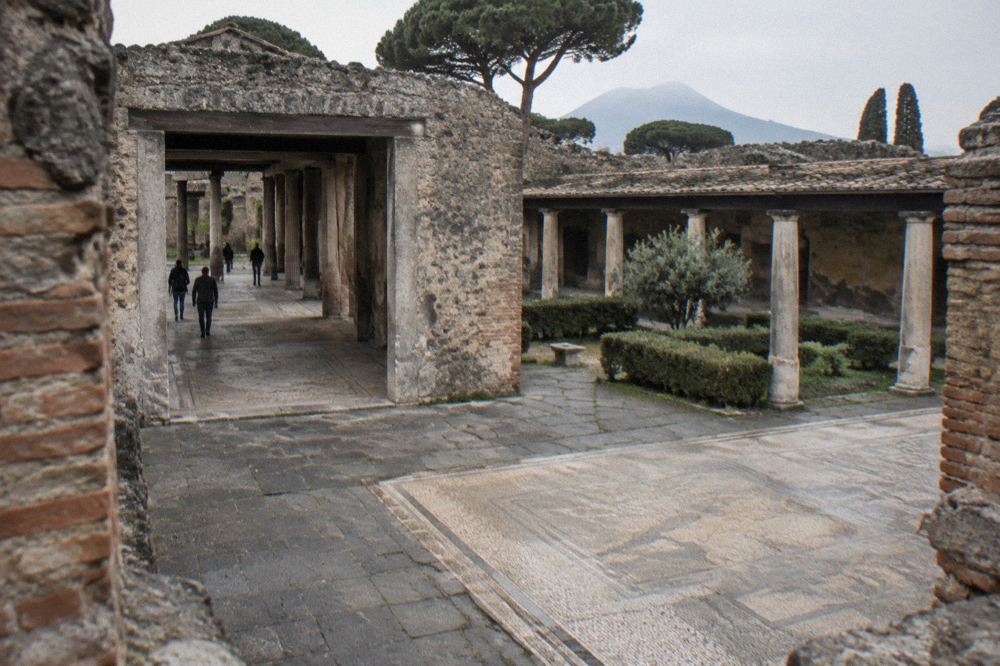
The house was uncovered during the excavations of the buried city, and its scale set it apart immediately from the dwellings around it: where a typical Pompeian house shares its block with neighbours and shops, this one absorbed the entire plot, with two atria, a colonnaded garden, or peristyle, of great size, and service quarters arranged around them. The name inscribed in the pavement at the entrance, a greeting to visitors, survives in situ and is one of the most photographed floors in the city.
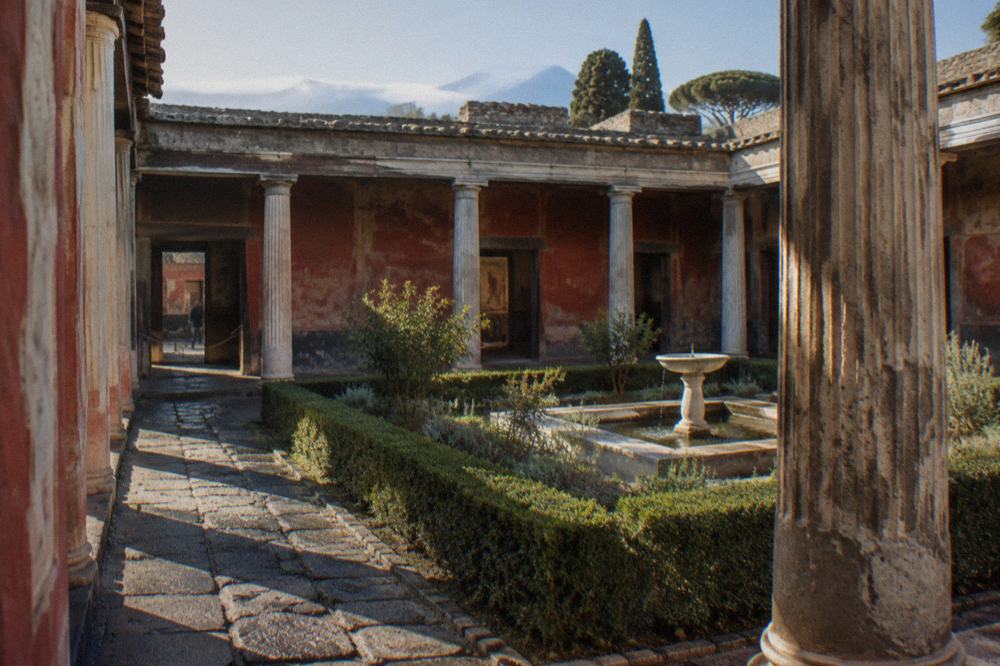
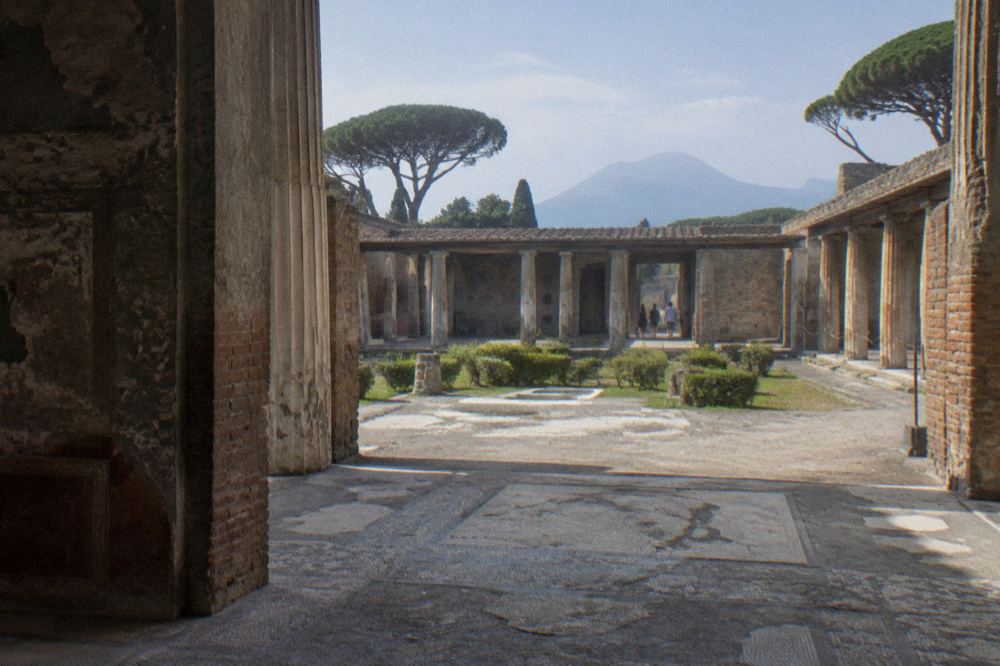
The plan follows the classic Roman sequence of entrance, atrium and tablinum, but doubled and stretched. A visitor in antiquity would have passed from the street through a deep vestibule into the first atrium, where the faun statue danced on a basin pedestal beneath the roof's opening for rainwater; beyond it, a second atrium served the more private family wing; behind everything opened the great peristyle garden. The decoration included first-style stucco panelling in the oldest rooms and, in the rooms of state, mosaic floors of fine workmanship of which the Alexander Mosaic was the summit.
The Alexander Mosaic shows Alexander the Great in battle against the Persian king Darius, and it is celebrated for the fineness of its tesserae and the drama of its composition. The original left Pompeii long before the site became the managed park it is today. The copy in place gives the modern visitor the effect in situ, though for a view of the original itself the museum in Naples is the destination. The Pompeii frescoes and mosaics guide covers that collection in detail.
How Much Does It Cost To See The House Of The Faun?
There is no separate ticket for the house: entry is included in the park's admission ticket. In 2026 the Pompeii Express ticket costs EUR 20 for the ancient city alone, the Pompeii+ ticket costs EUR 25 and adds the suburban villas, and the 3-day ticket costs EUR 30 and adds Oplontis, the Stabiae villas and Boscoreale. From 1 January 2027 a single EUR 25 ticket covers all park sites, valid 30 days with one entry per site.
The park's ticket structure changed on 12 January 2026 and changes again on 1 January 2027, so the table below gives the 2026 prices in force now, with the 2027 replacement noted. Reduced admission of EUR 2 applies to EU citizens aged 18 to under 25, and entry is free for everyone under 18 and for all visitors on the first Sunday of the month. The free-entry Sundays carry no reservation; the park recorded more than 36,000 visitors on one such Sunday, its record, so arriving early matters then.
| Ticket (2026) | Price | What it covers |
|---|---|---|
| Pompeii Express | EUR 20 | The ancient city, including the House of the Faun |
| Pompeii+ | EUR 25 | City plus Villa of the Mysteries, Villa of Diomedes, Villa Regina and the Boscoreale Antiquarium, with shuttle |
| 3-day ticket | EUR 30 | Pompeii+ plus Oplontis, the Stabiae villas and museum, Boscoreale |
| Other park sites (each) | EUR 8 | Oplontis, the Stabiae museum, Boscoreale, individually |
| MyPompeii Card | EUR 45 | Annual pass, EUR 10 reduced |
| From 1 Jan 2027 | EUR 25 | Single ticket, all park sites, 30 days, one entry per site |
Tickets are nominative, carry the holder's name, and may be checked against identification at entry; they are non-transferable and non-refundable except in cases of extraordinary closure. Since 15 November 2024 the park has also operated a cap of 20,000 visitors per day, split into two timed bands, which is the main reason advance booking is worthwhile in spring and summer. The detailed arguments for each ticket are laid out in the ticket types compared guide.
If the visit is part of a day trip, a guided product that bundles the train and the entry is often the simplest route. The Sorrento express tour by train is this site's featured pick for the house, and its live listing carries the current price and departure times:
What Are The Opening Hours For The House Of The Faun?
The house keeps the park's hours: from 16 March to 14 October Pompeii opens at 9:00, admits its last visitor at 17:30 and closes at 19:00; from 15 October to 15 March it opens at 9:00, last entry falls at 15:30 and the site closes at 17:00. Pompeii has no weekly closing day, and the site is closed only on 25 December and 1 January unless the park communicates otherwise.
Individual houses inside the park, including this one, can be temporarily roped off for maintenance or conservation, and the park announces such closures on its official communications pages. One current example elsewhere in the city: the Praedia of Julia Felix has been closed to the public since 7 September 2026 for maintenance, which is worth knowing for anyone routing through the Via dell'Abbondanza. Nothing similar currently affects the House of the Faun, but the park's own page is the authority before a long-planned visit.
| Period | Opens | Last entry | Closes |
|---|---|---|---|
| 16 March to 14 October | 9:00 | 17:30 | 19:00 |
| 15 October to 15 March | 9:00 | 15:30 | 17:00 |
The daily visitor cap is banded by time slot. Between 16 March and 14 October, the 9:00 to 13:00 band carries up to 15,000 visitors and the 13:00 to 17:30 band up to 5,000, so an afternoon entry is normally the quieter choice for photography inside the big houses. Winter afternoons are quieter still, with the trade-off of the earlier 15:30 last entry.
For a visit built around a shore excursion or a tight train day, the cruise ship day planner works through the timing in detail. A guided option that includes entry removes the ticket-office step entirely at the gate.
How Do You Get To The House Of The Faun?
The house stands inside the excavated city, about equidistant from the park's three ticket-office entrances at Porta Marina, Piazza Esedra and Piazza Anfiteatro, and the walk from any of them takes roughly fifteen to twenty-five minutes along the ancient streets. From the Circumvesuviana station Pompei Scavi-Villa dei Misteri the park entrance at Porta Marina is immediately adjacent, and the station is stop 6049 on the Naples to Sorrento line.
The train journey from Naples Garibaldi to Pompei Scavi-Villa dei Misteri takes between 29 and 35 minutes on scheduled times, with a median of 29 minutes, according to the operator's published timetable data. From Sorrento, the scheduled time to Pompei Scavi is 34 to 40 minutes.
| Route | Scheduled time | Notes |
|---|---|---|
| Naples Garibaldi to Pompei Scavi | 29-35 min | Median 29 min, EAV timetable data |
| Sorrento to Pompei Scavi | 34-40 min | Same line, direction Naples |
| Pompei Scavi station to Porta Marina gate | Adjacent | Station stop 6049 |
| Road, Naples to Pompei Scavi | 24 km, about 22 min | Driving distance, mapping estimate |
For visitors arriving from the Sorrento side, the train-and-guide bundle mentioned above covers the rail leg and the entry in one booking, which matters on days when the morning time band is filling. The Sorrento to Pompeii transport guide compares the options, and the Circumvesuviana guide explains the line itself.
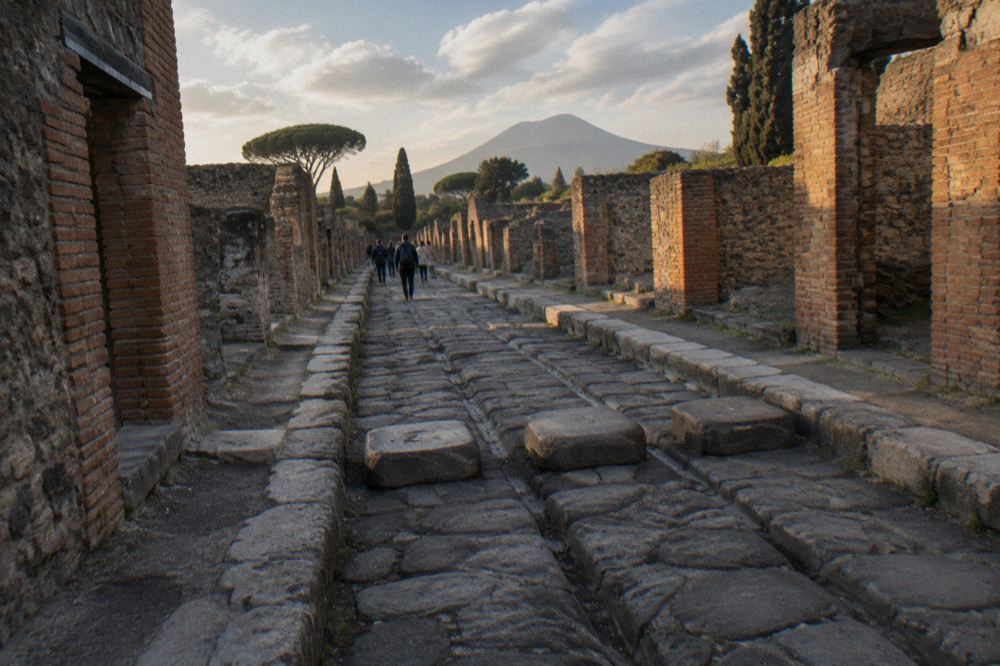
Once inside the park, the house fronts the Via di Nola. Coming from Porta Marina, the route runs straight up towards the Forum and then turns right along the Via di Nola; coming from Piazza Anfiteatro at the other end of the city, the Via di Nola is reached directly and the house appears on the left within the first stretch. The paving is original and uneven, so solid shoes matter; the what to wear guide covers footwear and sun protection.
What Should You Look For Inside The House?
Look for four things: the bronze dancing faun in the atrium pool, the greeting word spelled in the pavement of the entrance, the reproduction of the Alexander Mosaic in the exedra opening off the first peristyle, and the scale of the great peristyle garden itself, the largest domestic garden space in the city. The original mosaic is in the National Archaeological Museum in Naples.
The faun statue, balanced on one foot mid-dance above the basin, gave the house its name and remains its emblem. The original bronze is held by the park; the figure standing in the basin today lets the visitor read the space as its owners intended, with the statue visible through the front doorway from the street, a deliberate display of wealth and taste. Other pages covering the same trip are gathered on Pompeii Travel Guide.
The entrance pavement carries the word HAVE, Latin for "hail" or "welcome", set into the tessellated floor where every caller would see it. It is small, easy to miss at walking pace, and one of the most direct personal voices in the city, the household greeting guests directly across nearly two millennia.
The Alexander Mosaic reproduction lies where the original was found, on the floor of the exedra between the first and second peristyles. The composition shows the moment Alexander presses towards Darius, whose chariot turns in flight. For the original's fineness, and for the other masterworks moved from the city, the museum in Naples holds the collection; the question of seeing it before or after the ruins is argued in the museum timing guide.
How Long Should You Spend At The House Of The Faun?
Allow fifteen to twenty-five minutes for the house itself on a general visit, walking the vestibule, both atria, the Alexander exedra and the great peristyle, and up to forty minutes on a closer look that takes in the second peristyle and the service rooms. On a first visit to Pompeii the house should be one stop within a half-day route, not the whole plan; the site's excavated area covers 44 hectares, and a two-hour visit is possible but hurried.
The park as a whole divides visitors by time budget. A short visit can run the Forum, the Via dell'Abbondanza and a handful of houses; the house-by-house routes are worked through in the two-hour itinerary and the fuller one-day itinerary. The house sits naturally on both, roughly a third of the way along the main axis.
| Visit plan | Time in the house | Time in the park |
|---|---|---|
| Express stop | 15 min | 2 hours |
| Standard stop | 25 min | 4-5 hours |
| Close look | 40 min | Full day |
| With suburban villas | 25 min | Two days recommended |
Crowding shapes the experience more than the clock. The morning band of up to 15,000 visitors concentrates between 9:00 and 13:00, and the narrow atrium of a famous house funnels groups. The summer heat plan suggests the off-peak logic that applies to any busy day: the house's peristyle, with its columns and garden bed, is one of the few places inside the city with shade and a bench-worthy edge to pause on.
Visitors pairing the city with the volcano can compress both into one day; the Pompeii and Vesuvius in one day guide shows the sequence. A guided version of the two-site day from Naples is worth a look if the logistics feel heavy:
How Does The House Compare With Pompeii's Other Famous Houses?
The House of the Faun is the largest and grandest of Pompeii's houses, but the city offers several others that reward comparison: the House of the Vettii for its frescoes, the House of Menander for its silver hoard, the Villa of the Mysteries for its Dionysian fresco cycle outside the walls, and the smaller House of the Tragic Poet, whose mosaic actors and watchdog sit within a short walk of the Faun itself.
Each answers a different question about Roman domestic life. The Faun shows aristocratic scale and display; the Vettii, the villa of two freedmen merchants, shows new money spending on painted decoration; Menander shows a working estate house; the Mysteries shows a villa suburbana given over partly to ritual. The table below groups them.
| House | Best known for | Position |
|---|---|---|
| House of the Faun | Scale, dancing faun, Alexander Mosaic copy | Via di Nola, city centre |
| House of the Vettii | Frescoes, including Priapus | West of the Forum |
| House of Menander | Silver hoard, estate layout | South of the Via dell'Abbondanza |
| House of the Tragic Poet | Actor mosaics, "Cave Canem" mosaic | Via di Nola, near the Faun |
| Villa of the Mysteries | Dionysian fresco cycle | Outside the walls, Porta Ercolano side |
The Houses of the Vettii, the Tragic Poet and Menander each have their own pages in this site's attractions section: the House of the Vettii, the House of the Tragic Poet and the House of Menander. Because the Tragic Poet and the Faun share the same street, the pair take in under half an hour together and make a natural block on any route.
The suburban villas need the Pompeii+ ticket or the EUR 8 add-on bought in person, card only, at the Porta Ercolano or Street of the Tombs entrance, a detail worth remembering when planning. Until 31 December 2026 that is how the Express ticket extends to them; from 1 January 2027 the single EUR 25 ticket includes all park sites and the question disappears.
When Is The Best Time Of Year To Visit The House Of The Faun?
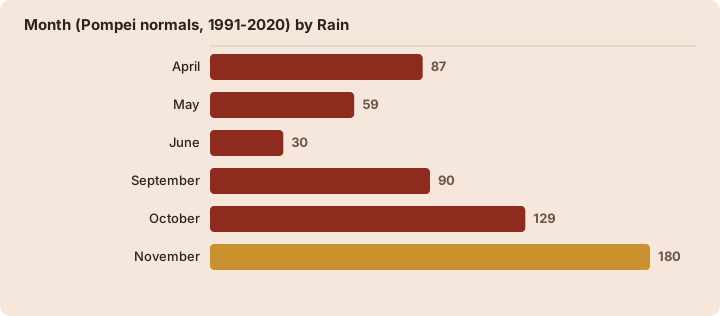
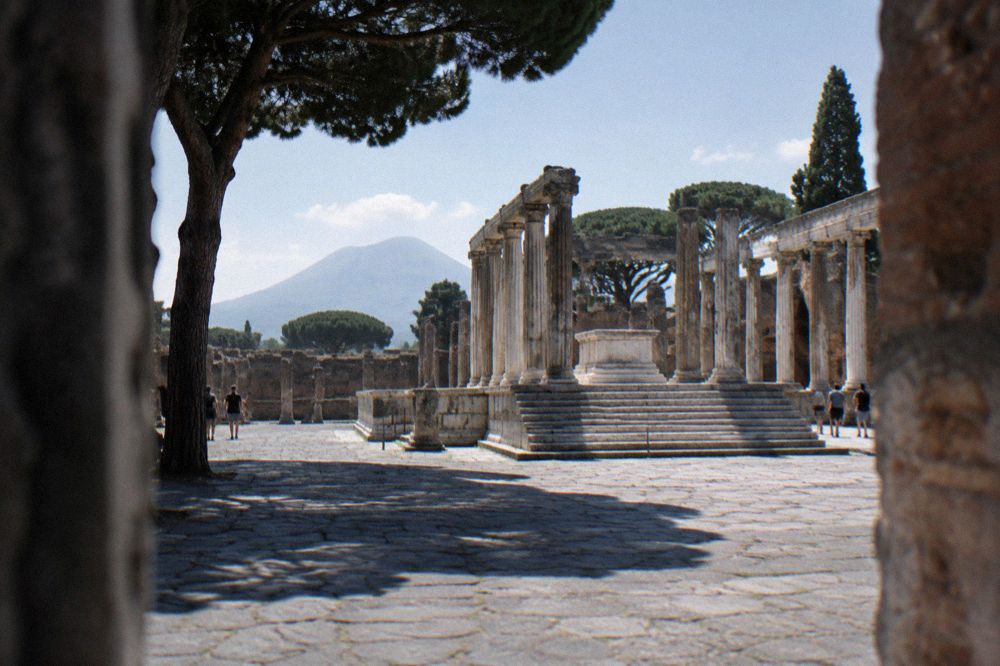
**The best months for the house are April, May, June, September and October, when Pompei's climate normals show mean daily maxima of about 17.7 to 25.8 degrees Celsius and moderate rain, and the park's own monthly counts show high but manageable visitor numbers.
The park publishes monthly visitor counts, and its 2024 figures show the pattern plainly: May was the busiest month at 516,923 visitors, April next at 466,344, and the autumn shoulder of September and October ran at 468,340 and 481,255, roughly level with spring.
| Month (Pompei normals, 1991-2020) | Mean daily max | Mean daily min | Rain |
|---|---|---|---|
| April | about 17.7 C | about 10.4 C | 87 mm |
| May | about 21.6 C | about 14.1 C | 59 mm |
| June | about 25.8 C | about 18.2 C | 30 mm |
| September | about 25.3 C | about 18.6 C | 90 mm |
| October | about 21.3 C | about 15.1 C | 129 mm |
| November | about 16.9 C | about 11.5 C | 180 mm |
The annual totals tell the growth story: the Pompeii site counted 2,972,159 visitors in 2022, 3,985,424 in 2023, 4,069,377 in 2024 and 4,000,090 in 2025. Those numbers are the backdrop to the timed-entry system and the daily cap, and the reason mid-week, mid-afternoon slots in shoulder months give the calmest walk through the big houses.
Is The House Of The Faun Accessible And Family-Friendly?
The house stands on Pompeii's original paving, which is uneven and unsuitable for wheels in its present state, and the park's dedicated accessible route, Pompeii for All, enters at Piazza Anfiteatro and follows a smooth, upgraded path through the eastern city; the House of the Faun's location on the Via di Nola makes it reachable from that route with a short stretch of ancient paving. Visitors with mobility difficulties should consult the park's accessibility route description before planning the walk.
The Pompeii for All route allows entry at Piazza Anfiteatro and exit at either Piazza Anfiteatro or Piazza Esedra via the Antiquarium lift, according to the park's visitor regulations. Full coverage, including what the route passes and where the difficulties lie, is in the site's accessibility guide.
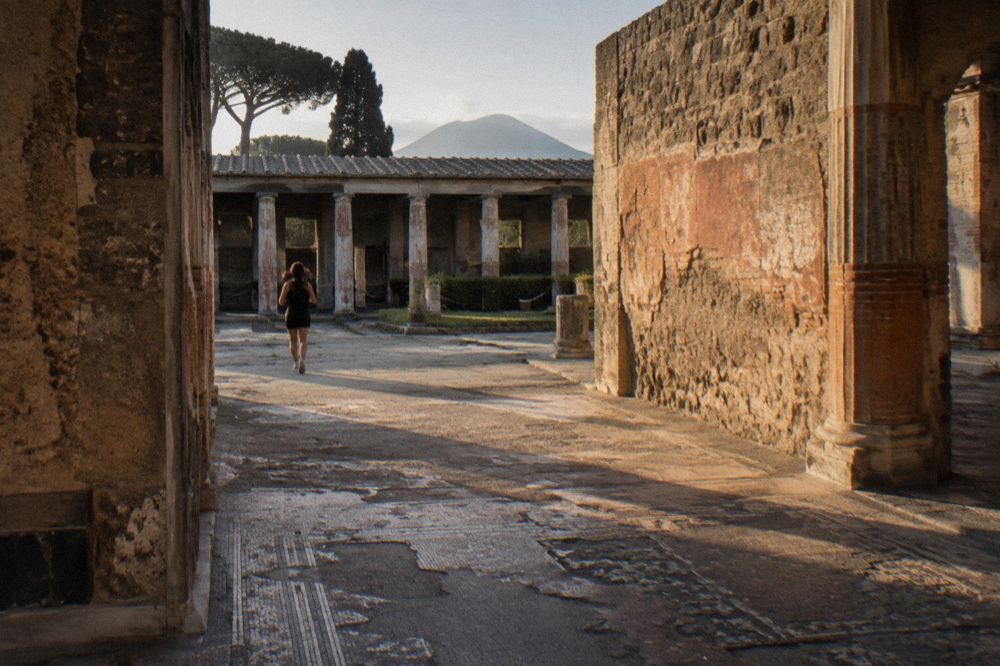
For families, the house works well with children because it is legible: a doorway, a pool with a statue, a garden with columns, a picture on the floor. Longer considerations, from heat to toilets, are gathered in the visiting with kids itinerary. The park's toilet and facility locations are mapped in the facilities guide.
Bag rules affect every visitor, families included: permitted bag size is 30x30x15 cm, and larger bags go to left luggage. Drones require authorisation, and bare chests are not allowed. These come from the park's visitor regulations page and are enforced at the gates; the luggage storage guide covers the options at each entrance.
Common Questions About The House Of The Faun
Is the House of the Faun included in the Pompeii ticket?
Yes. There is no separate ticket; the house is covered by the park's general admission. In 2026 the Pompeii Express ticket at EUR 20 includes it, and from 1 January 2027 the single EUR 25 ticket covers all park sites. Free entry applies on the first Sunday of each month.
Where is the original Alexander Mosaic?
The original Alexander Mosaic is displayed in the National Archaeological Museum in Naples, where it was moved after excavation. A reproduction lies on the floor of the exedra in the House of the Faun, in the position where the original was found.
Is the dancing faun statue in the house the original?
The bronze dancing faun standing in the atrium basin today is the figure visitors see in position; the name of the house comes from the statue found there during excavation. The park holds the excavated material, and the basin placement lets the space be read as it was designed.
How far is the House of the Faun from the park entrance?
The house fronts the Via di Nola in the centre of the excavated city. The walk from Porta Marina, Piazza Esedra or Piazza Anfiteatro takes roughly fifteen to twenty-five minutes along the ancient streets, on original uneven paving.
Can you visit the House of the Faun and Herculaneum on the same day?
Yes, and it is a common pairing, though it needs an early start and the two sites' separate tickets. Herculaneum charges EUR 16 full price in 2026, and the Pompeii and Herculaneum in one day guide sets out the sequence, with a note that Herculaneum's Villa dei Papiri and Ancient Theatre are currently closed for works.
What is the best time of day to see the house?
After 13:00, when the park's afternoon time band caps entries at 5,000 against the morning's 15,000. The narrower rooms and atrium of the house congest badly when groups pass through, so the afternoon band and the shoulder months of April to June and September to October give the calmest visit.
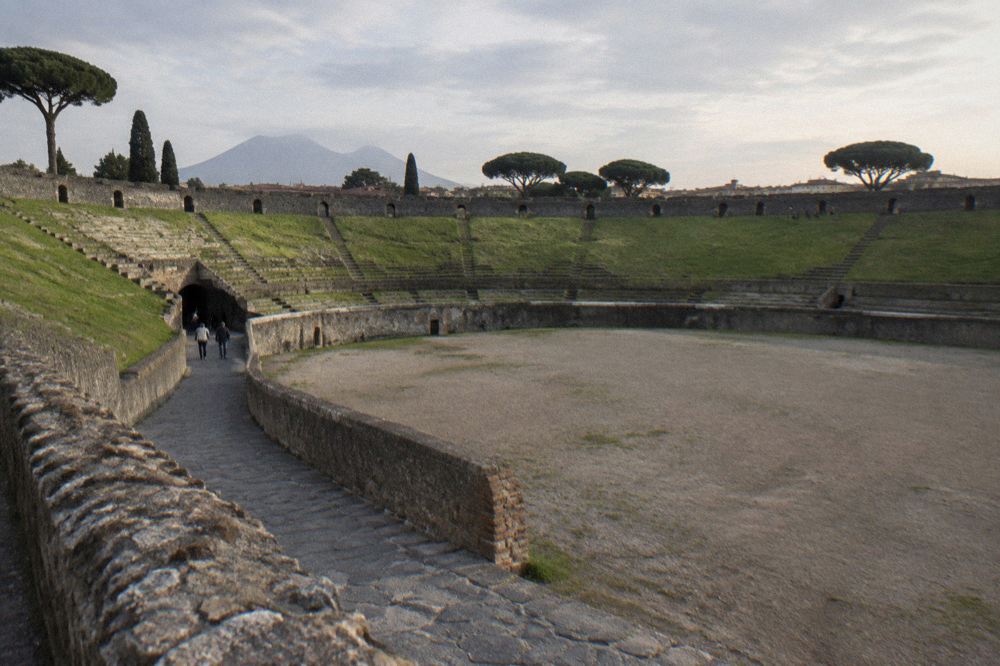
The House of the Faun rewards a slow look more than any other stop in the city, because its story is one of accumulation: a Samnite-era family fortune expressed in a whole city block, doubled atria, a garden built to impress, and a floor laid by craftsmen whose names nobody recorded. Plan the ticket around the 2027 change if the visit slips into next year, arrive in the afternoon band if the day allows, and give the peristyle the last few minutes of the visit, when the light comes low through the columns and the scale of the place finally makes sense.