Why Was Pompeii Lost For So Long?
Why the buried Roman city of Pompeii in Campania, Italy stayed hidden for centuries after the AD 79 eruption of Vesuvius, and how it was found again.
Pompeii, the ancient Roman city beside the modern town of Pompei in Campania, southern Italy, about 24 km by road from Naples, was sealed under volcanic ash and pumice when Mount Vesuvius erupted in AD 79, traditionally dated to 24 August. The burial that destroyed the city also preserved it, and the layer that covered it hid it so completely that the location passed out of living memory. Fields and vineyards eventually covered the ground, and for centuries nobody knew a city lay underneath. That combination, instant burial, deliberate abandonment, and a landscape that healed over the top, is the short answer to why Pompeii stayed lost for so long.
Why Was Pompeii Lost For So Long?
Pompeii stayed lost because the eruption of Mount Vesuvius in AD 79 buried the city under a deep, airtight blanket of pumice and ash rather than burning it to rubble, and because nobody ever rebuilt on the site. Survivors and the Roman authorities walked away from ground that continued to erupt, the buried city left no visible standing ruins to draw attention, and over the following centuries farmland and woodland covered every trace, so its exact location was simply forgotten.
Three things had to happen together for the city to vanish, and all three did. The burial had to be total, which the eruption delivered: successive surges and falls of volcanic material smothered streets, houses and frescoes rather than scattering them. The site then had to be abandoned, and it was, because returning to a district immediately around a volcano that had just destroyed two towns was not a rational move for families or for imperial administrators. Finally, the memory of the place had to fade, which took longer, but centuries of upheaval in Campania did the rest. By the time the medieval town of Pompei grew up nearby, the city under the fields had no name attached to it that anyone could act on.
The irony is that the destruction was also the preservation. A city that burns or is quarried loses its contents. A city that is capped under volcanic material keeps its frescoes, its bread in ovens, its graffiti, even the shapes of its victims. The same sealing layer that made Pompeii impossible to find for centuries is the reason so much of Roman daily life is readable there. Readers curious about the human side of that day can follow the eruption timeline and Vesuvius question or the debate over whether residents knew an eruption was coming.
What Buried Pompeii In AD 79?
The eruption dropped pumice and ash on Pompeii for hours, until the city sat under metres of volcanic debris, and then a series of pyroclastic surges, clouds of gas and fragments moving at devastating speed, finished the destruction and capped the deposit. The material settled, compacted and hardened into a layer that sealed streets, doorways and interiors. Unlike a fire or an earthquake, this kind of destruction leaves objects in place, which is why excavators later found whole rooms with their contents intact.
The written record comes from Pliny the Younger, whose oldest manuscripts date the eruption to 24 August AD 79. That date is tradition rather than settled fact: the park's own e-journal states that the alternative 24 October date has no evidentiary basis and traces it to a misreading made in 1929, while also noting that 24 August itself is not guaranteed correct. A charcoal graffito found in 2018, dated by many scholars to mid-October, has reopened the scholarly debate without settling it. The honest position is that the year is fixed and the day is not.
What matters for the question of loss is the physics of the deposit. Pumice falls first and floats down in a layer people could initially walk on, trying to flee or shelter. The surges that follow deposit denser material and raise the temperature lethally. Questions about how fast death came at Pompeii belong to that second phase. The result was a compacted volcanic blanket across the whole urban footprint, an excavated area today of 44 ha within an inscribed UNESCO property of 98 ha, filled in to rooftop height and beyond.
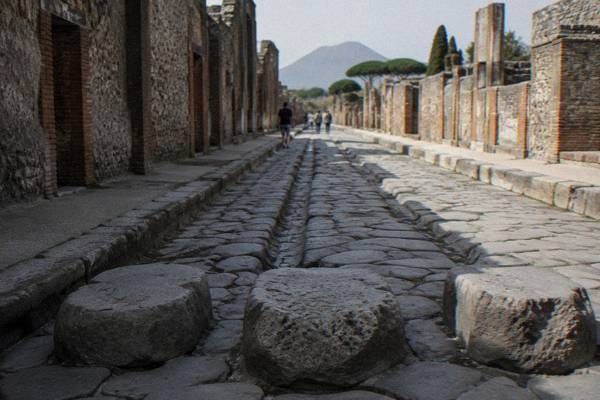
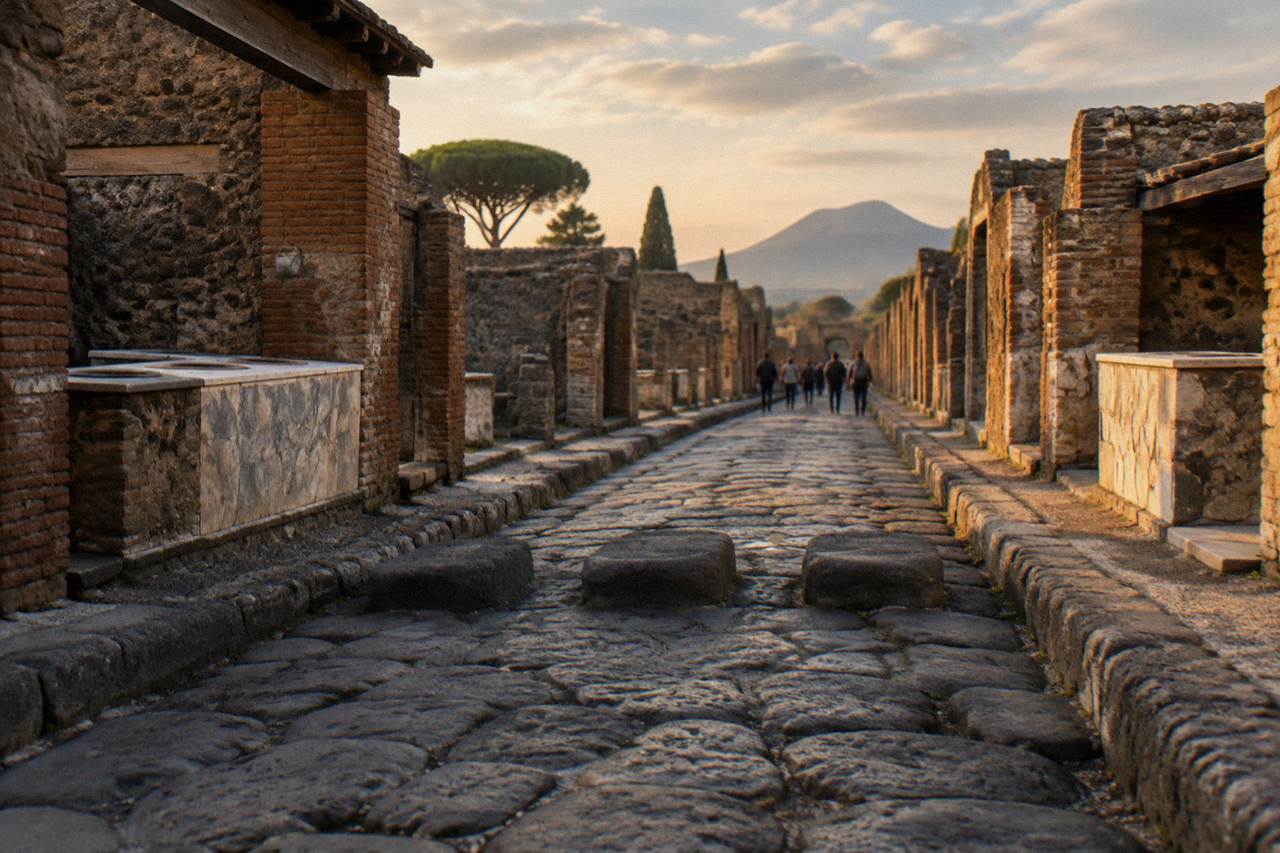
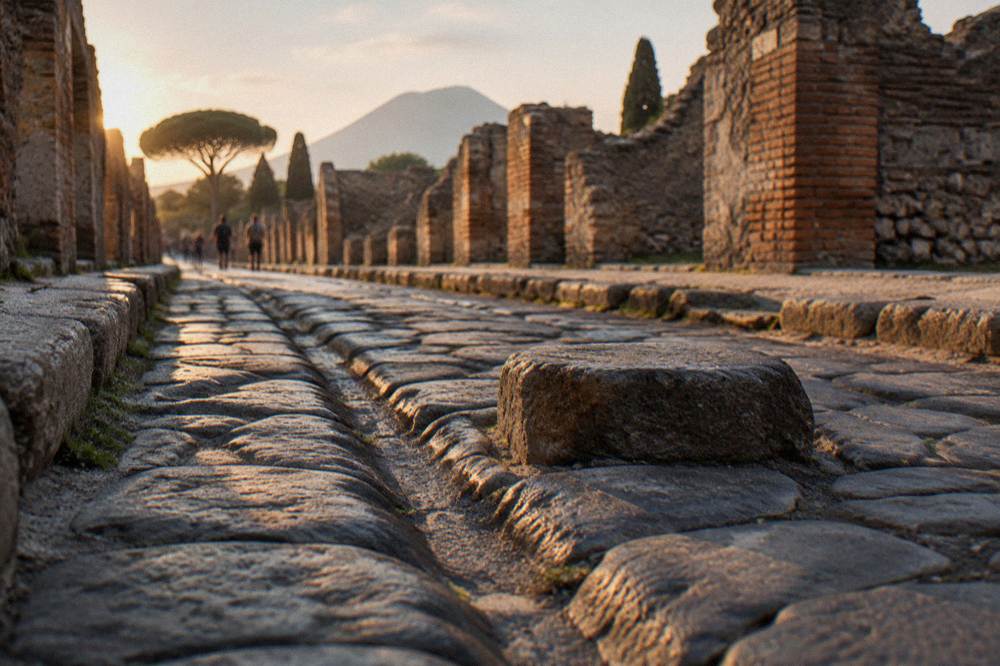
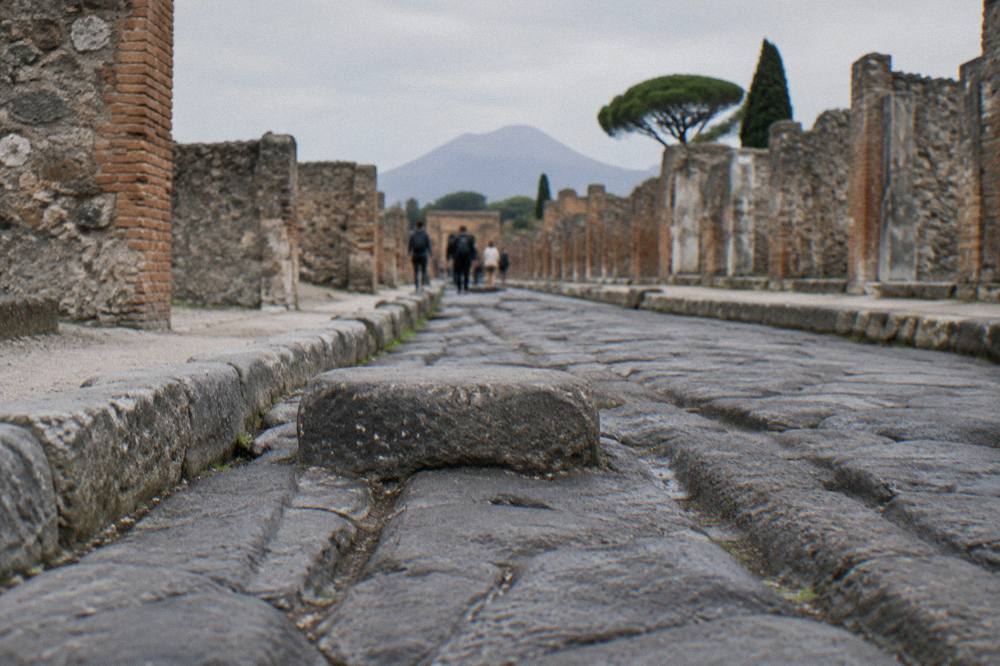
Walking that 44 ha excavated area today gives the scale of what was hidden. It is a full Roman street plan, with wheel-worn paving, stepping stones, fountains and painted shop signs, not a single monument. The time needed to see it properly is a real planning question precisely because the preserved city is so large, and a guided walk is one way to make the buried-and-found story legible on the ground.
Why Did Nobody Return To Rebuild Pompeii?
Romans did not rebuild Pompeii because the eruption made the ground itself dangerous and the deposit unusable for years, because a large share of the population was dead or dispersed, and because the settlement's economic functions, its river port, its markets, its farms, were destroyed or disrupted along with the town. Land around a volcano that had just erupted carried stigma and risk, and the imperial response favoured other priorities. Survival and resettlement, not restoration, drove the years after AD 79.
Survivors existed, and their story is a separate one, covered in what happened to Pompeii's survivors. Some came back to tunnel into the deposit: there is physical evidence that people dug down to reach valuables, statues and building materials in the years after the eruption, and later, driven by the same motive, others tunnelled again. Those digs were looting, not archaeology, and they left no map, no record of the city's extent and no public knowledge that a whole urban fabric lay below. Every tunnel was narrow, dark and aimed at a known house or villa, so the wider city stayed invisible.
There was also nothing visible to reclaim. A standing ruin, a temple column, a theatre wall poking from a hillside invites attention and legend. Pompeii offered none of that. The volcanic layer levelled the profile of the city into something close to the surrounding farmland, and soil formed over it. Campania's later history, with shifting settlement, new powers and repeated eruptions of Vesuvius, kept attention elsewhere. The modern town of Pompei grew up beside, not on, the ancient site, near its Sanctuary, and the ancient city's name and location quietly separated from each other.
For a modern visitor the point is that Pompeii was never a ruin in the classical sense. It is an excavated city, uncovered room by room from under its sealing layer, which is why so many interiors look strangely complete. Travellers based in Sorrento can reach it directly on the Circumvesuviana line to Pompei Scavi-Villa dei Misteri station, and an option such as Check availability on the express tour by train bundles the entry and the guide with the rail journey.
How Was Pompeii Found Again?
Pompeii was found again gradually rather than in a single moment: wells, drainage channels and chance finds of frescoes and inscriptions in the fields above the site gave the first clues, and organised digging, first as treasure hunting through tunnels and later as open excavation following the ancient street lines, slowly exposed the city. No dramatic discovery revealed Pompeii whole. The recovery of the city was an accretion of finds, surveys and campaigns that continues into the present.
The turning point came when diggers stopped tunnelling for objects and started uncovering structures in place. Following walls and streets exposed the urban plan itself, and with it the realisation that this was not a villa or a temple but an entire city, with bakeries, thermopolia, election notices, bath complexes and an amphitheatre. Each generation of excavation asked different questions, from treasure recovery to architecture to social history, and each left its own marks on the site. The story of the site's emergence from the fields is told in more detail in when Pompeii was discovered, and fresh finds still surface, as covered in what was recently found in Pompeii.
The scale of what has been opened is measurable. The park's own published visitor figures show how the once-lost city now draws a crowd its Roman inhabitants would recognise as busy: 2,972,159 visitors in 2022, rising to 3,985,424 in 2023, 4,069,377 in 2024 and 4,000,090 in 2025. The excavated area of 44 ha sits inside a UNESCO inscribed property of 98 ha with a buffer zone of 1,788.79 ha, protecting Pompeii together with Herculaneum and Torre Annunziata under criteria (iii), (iv) and (v).
| Measure | Figure |
|---|---|
| Excavated area of Pompeii | 44 ha |
| UNESCO inscribed property | 98 ha |
| UNESCO buffer zone | 1,788.79 ha |
| Pompeii visitors 2022 | 2,972,159 |
| Pompeii visitors 2023 | 3,985,424 |
| Pompeii visitors 2024 | 4,069,377 |
| Pompeii visitors 2025 | 4,000,090 |
Why Is Part Of Pompeii Still Buried Today?
Part of Pompeii remains buried because full excavation of the remaining area would expose fragile frescoes, plaster and organic remains to weather, pollution and gravity faster than conservators could protect them, and because the buried portions are safer sealed underground. Archaeological practice has shifted from digging everything to preserving what is already open. The unexcavated ground is also structurally valuable, supporting walls and streets already uncovered, so removing it could damage the visible city.
Early archaeology operated on the assumption that digging more equalled knowing more. That view has reversed. Frescoes fade once air and light reach them, painted plaster flakes, wooden elements and food remains decay, and every opened house becomes a permanent conservation liability. The deliberate choice now is to stabilise, study and document the open 44 ha rather than chase the buried remainder, and to excavate only where a specific research question justifies it. What still lies under the soil, and how much of the city that represents, is a question of interpretation as well as area.
The buried city also still yields information without being emptied. New imaging, targeted trenches and the re-study of old archives keep producing results, which is why recent finds continue to make news. In that sense Pompeii is only partly found: the part that mattered for visitors is open, and the part that stays sealed is being kept for methods that do not exist yet.
How To Visit The City That Was Lost
Visiting Pompeii today means entering an archaeological park with named entrances at Porta Marina, Piazza Esedra and Piazza Anfiteatro, and timed entry under a daily cap of 20,000 visitors in force since 15 November 2024. In 2026 the Pompeii Express ticket costs EUR 20, Pompeii+ EUR 25 and the 3-day ticket EUR 30, and from 1 January 2027 a single EUR 25 ticket covering all park sites replaces that structure. Booking ahead and picking one entrance deliberately saves time at the gate.
The ticket change matters for planning. From 1 January 2027 the single EUR 25 ticket is valid 30 days with one entry per site, the smaller sites of Oplontis, the Stabiae museum and Boscoreale stay at EUR 8 individually, and the MyPompeii Card stays at EUR 45. Nominative tickets, meaning tickets tied to a named holder with possible ID checks, remain in force, so entry is personal and non-transferable. Whether advance purchase is worth it, and how the timed slots work, is covered in whether to buy Pompeii tickets in advance.
| Ticket (2026) | Price | Covers | 2027 onwards |
|---|---|---|---|
| Pompeii+ | EUR 25 | City, suburban villas, Boscoreale antiquarium, shuttle | Replaced by single EUR 25 ticket |
| 3-day ticket | EUR 30 | Pompeii+ plus Oplontis, Stabiae villas and museum, Boscoreale | Replaced by single EUR 25 ticket |
| MyPompeii Card | EUR 45 | Annual pass | Stays EUR 45 |
A guided visit is one way to make sense of a city that has no interpretive signage in the Roman sense, just walls. The question of touring Pompeii on your own versus with a guide is a real trade-off, and combining the city with the volcano that buried it in one day is popular from Naples.
Practical comfort notes matter too. The site is exposed stone with little shade, summer highs at Pompei average about 28.7 C in July and 29.4 C in August against 1991-2020 climate normals, and rain is at its monthly low then, about 16 mm in July. Winter visits are quieter but the last entrance moves to 15:30 with closing at 17:00 from 15 October to 15 March. Sensible shoes and water turn a long walk on ancient paving into history rather than endurance.
Common Questions About Why Pompeii Stayed Lost
Why was Pompeii lost for so long?
The eruption of AD 79 buried the whole city under a sealing layer of pumice and ash, survivors and Roman authorities abandoned the dangerous ground, no visible ruins remained above the surface, and centuries of farming covered the last traces, so the location passed out of memory.
Did people in the Middle Ages know a city was buried there?
No record shows they knew a city lay under the fields. Chance finds of marble, fresco fragments and coins occurred when wells and channels cut into the deposit, but those finds pointed to buried objects, not to an entire urban site, so the city's extent stayed unknown.
Could survivors have dug Pompeii out?
Not realistically. Hand digging through metres of compacted volcanic deposit across 44 ha of streets and buildings was beyond any group of returning families, and the material around a just-erupted volcano remained unstable and dangerous for years.
Is the eruption date 24 August or 24 October?
The traditional manuscript date is 24 August AD 79. The park's own e-journal states that 24 October has no evidentiary basis and stems from a 1929 misreading, while 24 August is not guaranteed either, so the date remains an open scholarly debate.
Is all of Pompeii excavated now?
No. The excavated area is 44 ha inside a UNESCO inscribed property of 98 ha, and the remaining buried portion is deliberately left sealed, both to preserve fragile remains underground and to protect the structural stability of what is already open.
Pompeii stayed lost because everything that made it vanish, the depth of the burial, the abandonment, the healing landscape, worked in one direction for centuries, and everything that makes it famous now, the completeness of what was sealed, came from that same burial. Pompeii Travel Guide covers the practical side of seeing it, and the buried city rewards both the traveller who walks it once and the one who returns with questions.