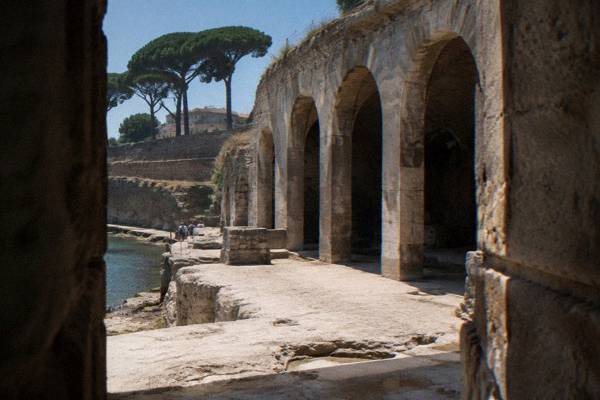
Herculaneum Boat Sheds
The boat sheds are the row of vaulted chambers that once stood at the water's edge of Herculaneum, the Roman town buried by the eruption of Vesuvius in AD 79 and now an archaeological park in Ercolano, on the Bay of Naples in Campania, southern Italy.
Short answer
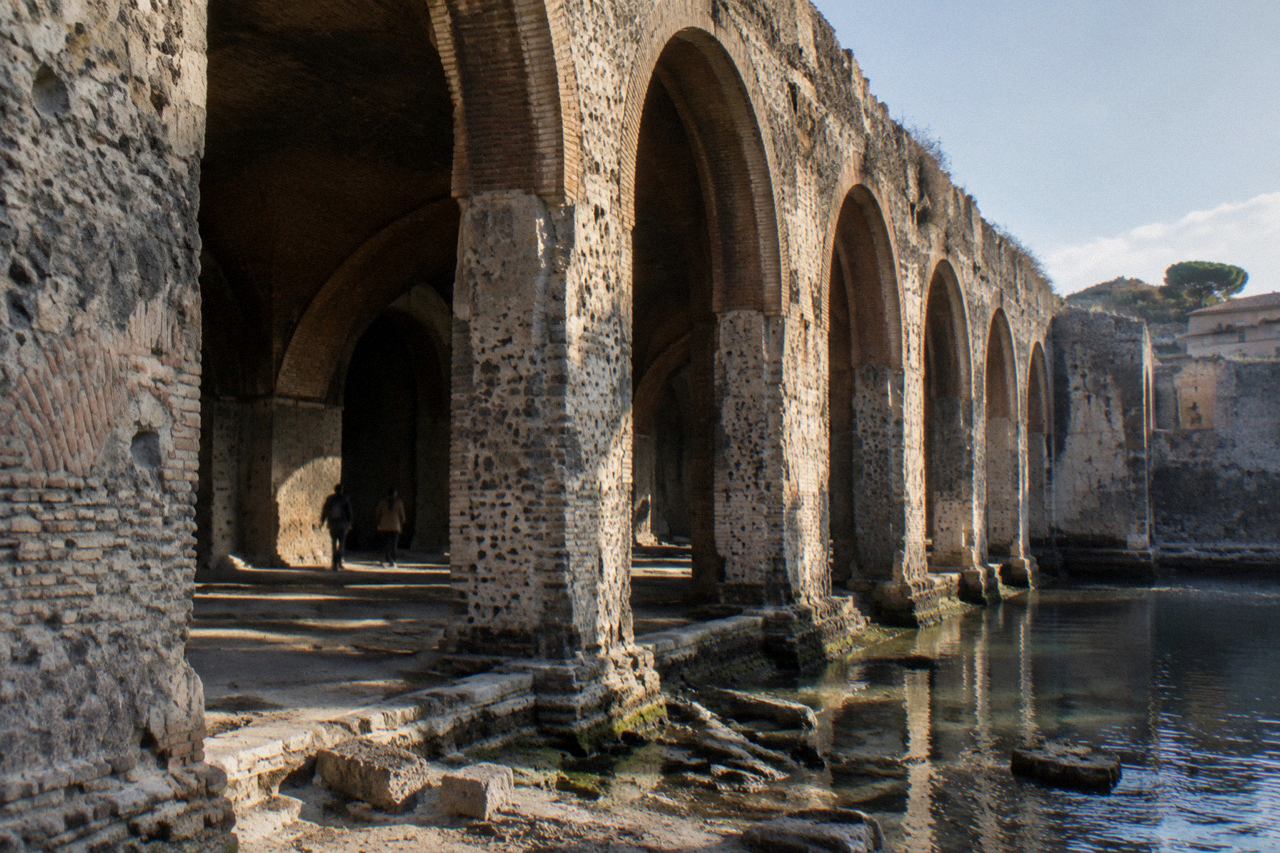
The Herculaneum boat sheds are a line of stone-vaulted chambers at the foot of the excavation, on what was the ancient shoreline of the Roman town of Herculaneum in Ercolano, Italy. Entry is included with a Herculaneum ticket, EUR 16 full price in 2026, and the vaults lie a short walk below the site's terrace at the bottom of the excavated area.
Where Pompeii was destroyed by falling ash and pumice, Herculaneum was sealed by volcanic material that hardened around its buildings, and the boat sheds, at the lowest point of the excavation, show that sealing effect at its starkest. The vaults were built to shelter boats on what was then the town's beach; when the eruption came, people gathered inside and around them in the hope of rescue by sea, and excavations of the chambers later uncovered human remains on the old shoreline. The result is one of the quietest and most affecting corners of any Roman site in Italy, and unlike the showpiece houses it is impossible to mistake for anything else.
What Are The Herculaneum Boat Sheds?
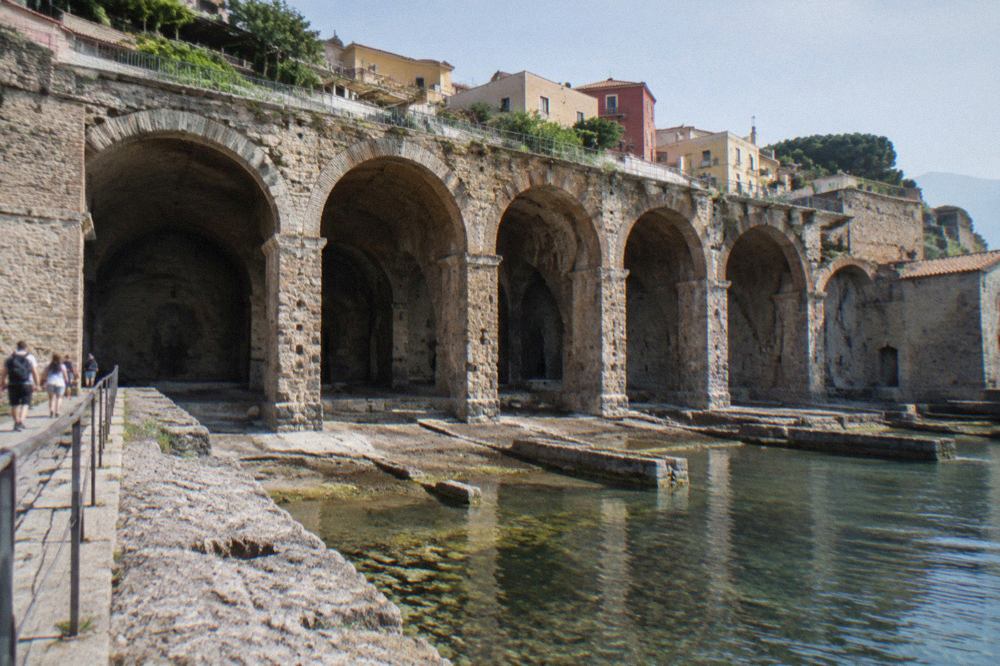
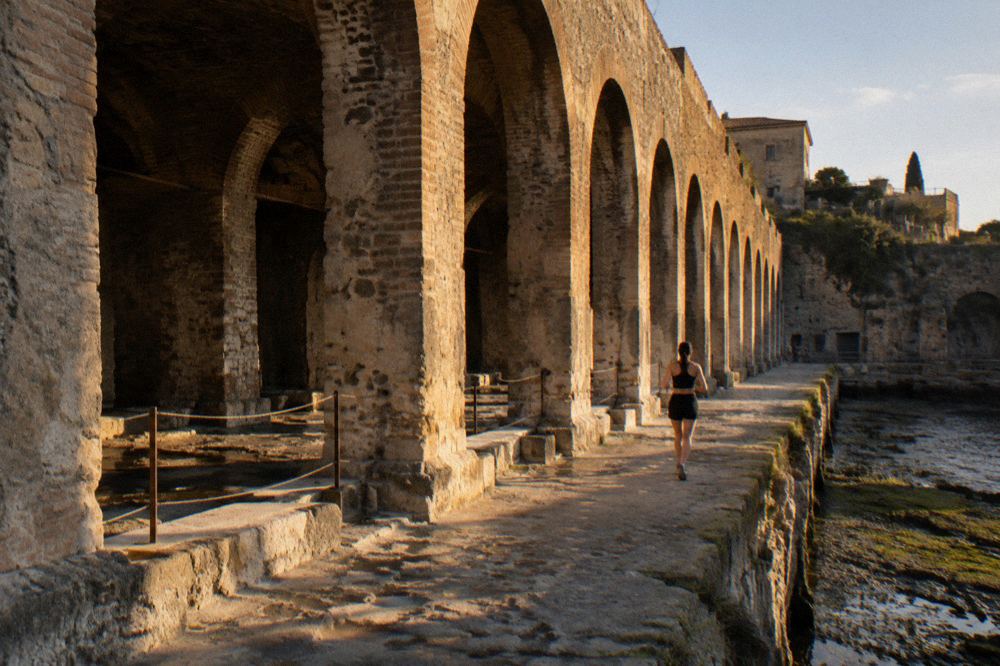
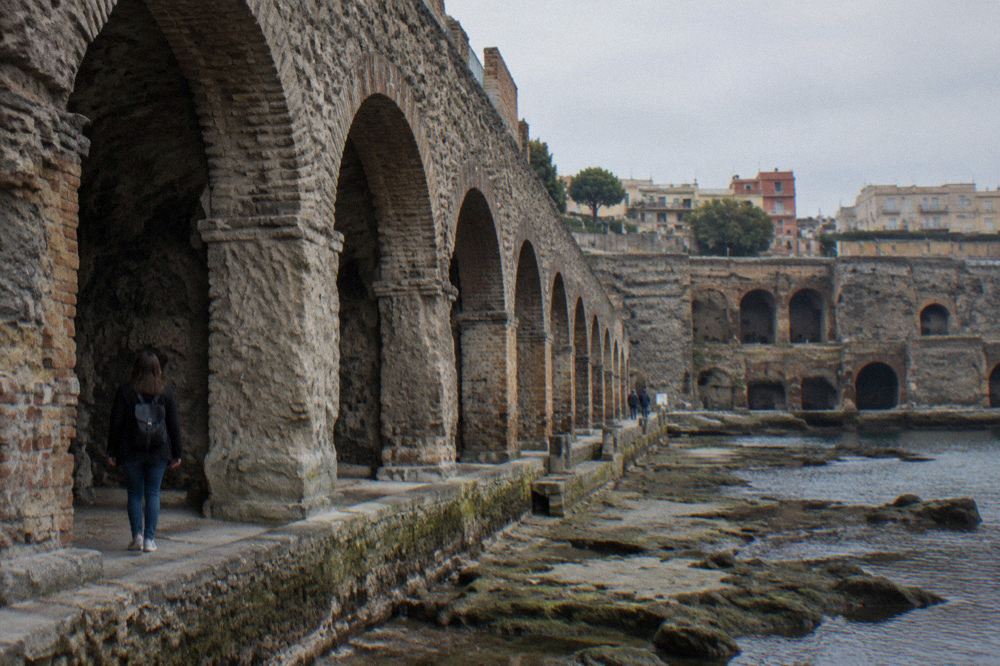
The boat sheds are a series of brick-and-stone vaulted chambers, opening through rounded archways onto what was the beach of Herculaneum before the eruption of AD 79, and they now stand at the lowest level of the archaeological park in Ercolano, Italy. They were built as storage for boats and fishing gear, protecting hulls from sun and weather at a time when the shoreline ran directly beneath the town walls. The eruption changed the coastline itself, pushing the sea back and burying the vaults under a deep mass of volcanic material, which is why the modern town of Ercolano sits well inland of where its Roman predecessor met the water. Excavation reopened the archways and exposed the old beach surface, and the chambers became one of the defining finds of the site, because the people who had taken shelter there were found where the eruption left them. The vaults are permanent parts of the park route and need no separate ticket beyond standard Herculaneum admission.
The architecture itself rewards a slow look. Each chamber is a barrel vault, an arch extended in depth into a tunnel, a technique Roman builders used wherever they needed cheap, strong covered space, from warehouses to bath suites. The masonry has survived two millennia largely because the volcanic deposit that buried it excluded air and moisture, the same mechanism that preserved Herculaneum's wooden doors, screens and rooftops elsewhere in the town. Standing at the mouth of the arches you can read the site's whole story in one glance: the vaults in front of you, the ancient beach underfoot, and above, many metres up, the level of the modern town, a vertical distance that measures exactly how much material Vesuvius deposited here in AD 79.
The sheds also explain something about the town's economy. Herculaneum was a smaller settlement than Pompeii, a coastal town of perhaps a few thousand residents rather than a commercial centre, with a harbour culture to match: fishing boats, small craft, and the everyday tackle of a community that lived beside the Bay of Naples. The chambers are working infrastructure, not a monument, and that ordinary purpose is part of why they matter. For orientation on the town as a whole, the companion page on the Herculaneum archaeological park covers the site entrance, the layout and the houses you pass on the way down.
Where Are The Boat Sheds Inside The Herculaneum Park?
To reach them, follow the main descent through the site from the ticket entrance in Ercolano, Italy, and you will arrive at this lowest level where the sheds are located.** Visitors enter the park at the top of the excavated area and walk down through the streets of the Roman town; the route continues to the bottom of the dig, where the ground surface is the ancient beach and the vaulted chambers open along it. A terrace above the shoreline gives the classic view of the whole row of arches, and it is the point from which photographs of the sheds are usually taken. Allow the descent time in your planning, because everything at Herculaneum involves walking downhill in and uphill out.
The vertical arrangement is the thing to understand before you arrive. The modern town sits at the level the eruption created; the Roman town sits at the bottom of a deep excavation cut into that material. The boat sheds mark the boundary between the two worlds: the last structures of the Roman town before the ancient beach and, beyond it in AD 79, the sea. Information panels along the terrace describe the finds made on the shoreline, and the park has left parts of the beach surface visible so the setting reads clearly. If you want a sense of how deep you are, look back up at the cutting walls behind you as you stand by the arches.
Two current closures shape what you can combine with the shoreline. The Villa dei Papiri, Herculaneum's grandest suburban villa, is closed for works, and the site's Ancient Theatre is closed until further notice, both stated on the official Herculaneum ticketing page in October 2026. Neither closure affects the boat sheds, which remain on the open route, but anyone planning a day around the site should factor them in. The Villa of the Papyri page explains what that villa is and why its closure matters for papyrus scholarship; the theatre and villa can reopen at any time, so check the park's own page before setting expectations.
The viewing arrangements suit a wide range of visitors. The terrace above the sheds is where the panorama opens up, and the arches themselves can be examined closely from the shoreline path.
How Much Do Herculaneum Tickets Cost In 2026 And How Do You Get To The Site?
Herculaneum tickets in 2026 carry a set adult admission price, with reduced and free options for qualifying visitors, and getting to the site is straightforward from Naples by public transport or car; the exact costs and every travel option are covered below.
| Herculaneum ticket (2026) | Price | Who it applies to |
|---|---|---|
| Full | EUR 16 | Standard adult admission |
| Reduced | EUR 2 | Visitors aged 18 to 25 |
| Free | EUR 0 | Under 18 |
| Free days | EUR 0 | First Sunday of the month, 25 April, 2 June, 4 November |
The seasons set the hours rather than the calendar month alone. The park runs a summer and a winter schedule, and last-entry times matter more than closing times when you are planning how much of the site, including the shoreline, you can see.
| Season (Herculaneum) | Opening | Last entry | Closing |
|---|---|---|---|
| 16 March to 14 October | 8:30 | 18:00 | 19:30 |
| 15 October to 15 March | 8:30 | 15:30 | 17:00 |
The site is closed on 1 January and 25 December and otherwise opens daily. Getting there from Naples or Sorrento means the Circumvesuviana line operated by EAV; the stop for the excavations is Ercolano Scavi, and the operator's own timetable, available on the EAV website, is the reference for exact departure times, since published frequencies change with timetable revisions. One transport fact is hard-edged for late 2026: the Campania Express train has been suspended since 1 October 2026 until further notice, with refunds handled through EAV's complaints form or the original ticket seller, so anyone holding an old plan that assumed that service should rebuild it around the ordinary Circumvesuviana trains. The Ercolano area guide and the Circumvesuviana train page cover the practical detail of the line and the town.
For travellers who prefer arriving with a ticket already secured, the related option on this page is an entry ticket with an optional audio guide, sold through the operator's live listing; the listing carries the current price and terms, and booking ahead removes the queue variable on busy days. Check availability.
Why Were Human Remains Found In The Boat Sheds?
Human remains were found in and around the boat sheds because people gathered on Herculaneum's ancient beach during the eruption of AD 79, sheltering under the vaults and waiting near the water for a rescue by sea that never came, and the volcanic surge that reached the shoreline killed them where they stood. The hardened deposit preserved the remains in place on the beach surface, and when excavators reopened the vaults and the shoreline they found them there, in the positions of the eruption itself. Unlike Pompeii, where bodies left voids in the ash later filled with plaster, the Herculaneum shoreline preserved bone directly, a difference in preservation conditions between the two sites.
The reason is the nature of the burial. Herculaneum was inundated by successive flows of volcanic material at a temperature and depth that carbonised organic matter rather than simply burying it, and the deep, compacted mass excluded the air and water that normally destroy bone. The same mechanism kept the town's wooden doors, beams and furniture intact elsewhere on the site. The shoreline, being the lowest ground, collected the people who had fled downhill toward the sea, and the vaults became the strongest shelter available. What the excavators found was, as far as the evidence shows, not a mass grave that anyone dug but a crowd caught in position.
The find reshaped understanding of the eruption's human toll at Herculaneum. Earlier assumptions held that the town's population had largely escaped by sea before the lethal phase; the shoreline remains demonstrated that a substantial number were still present at the end. The question why were no bodies found in Herculaneum untangles the apparent paradox between that assumption and what the vaults contain, and the page on whether the skeletons in Herculaneum are real or fake addresses the rumour directly: they are genuine ancient remains. Some are displayed in contexts away from the beach itself; the where are the bodies from Pompeii now page covers the wider story of how both sites treat their dead.
What Do You Actually See At The Boat Sheds Today?
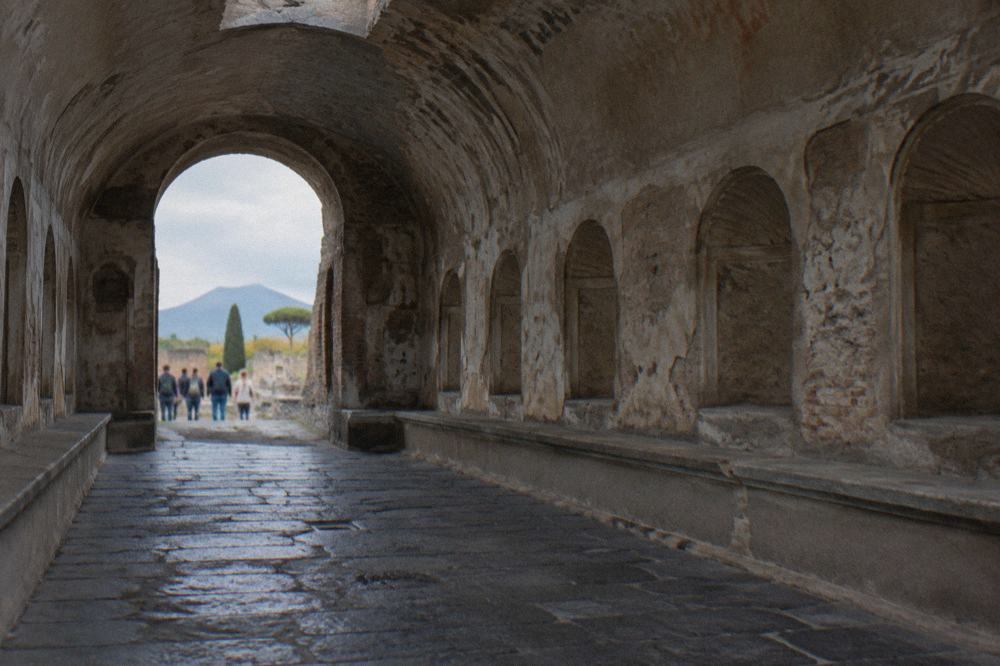
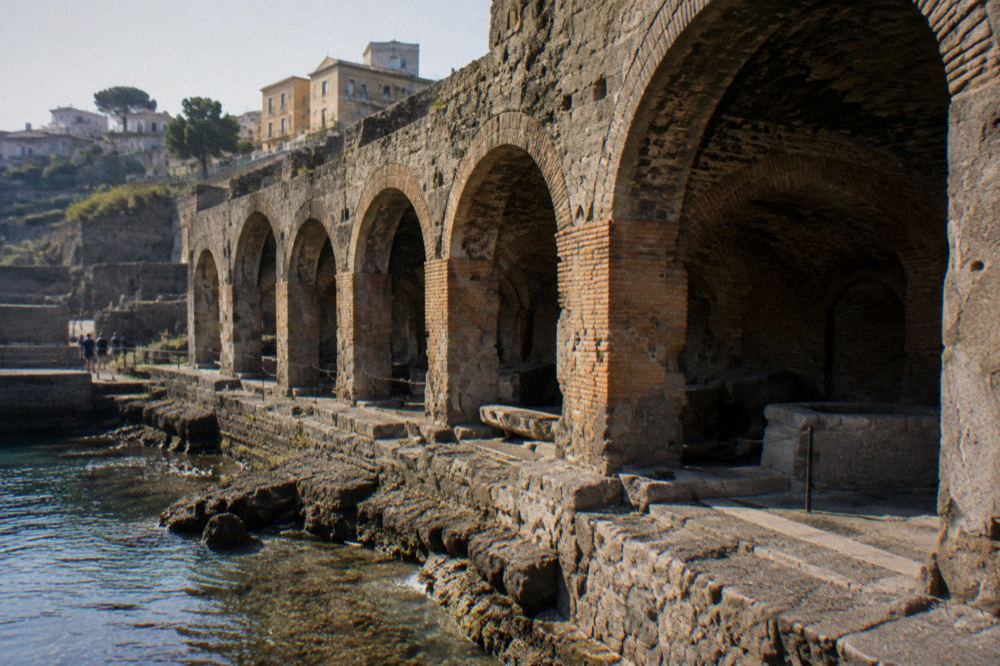
Visitors today see the row of vaulted archways opening onto the excavated ancient beach, viewed either from the terrace above the shoreline or from the path along the old sand surface, together with the cutting walls of the excavation rising behind and the displays that describe the shoreline finds. The arches are substantial masonry, each chamber deep enough to have held a hull, and the visual rhythm of the repeated vaults against the dark volcanic deposit is what makes the spot the photographic anchor of a Herculaneum visit. There is no rope line across the whole shoreline, though barriers protect specific areas, so the experience is close-range rather than distant.
Give the view a few minutes from both levels. From the terrace, the geometry reads best: the line of arches, the flat beach, the vertical scale of the dig. From below, the mass of the vaults and the texture of the ancient surface carry the impression. The light matters more than people expect; the excavation is deep, and in the middle of the day the shoreline sits in strong contrast between sunlit and shaded stretches, while earlier or later in the opening hours the low angle softens the stone. There are no facilities on the beach level itself, so water, shade and rest stops belong to the upper site; the question of are there toilets in Pompeii has a Herculaneum counterpart at the site's own visitor area near the entrance.
The sheds also serve as the natural endpoint of a descent through Herculaneum's streets. The standard route drops past the houses, the baths and the carbonised structures that make this site unlike any other, and arrives at the shoreline with the arches as the finale. Visitors with mobility difficulties should note that the excavation is a deep, stepped environment and the beach level sits at the bottom of it; the park's accessibility provisions are described on its official pages, and anyone with specific needs should confirm current arrangements with the site before visiting. Photography is unrestricted for personal use, and the terrace shot of the vaults is the one image almost every visitor leaves with.
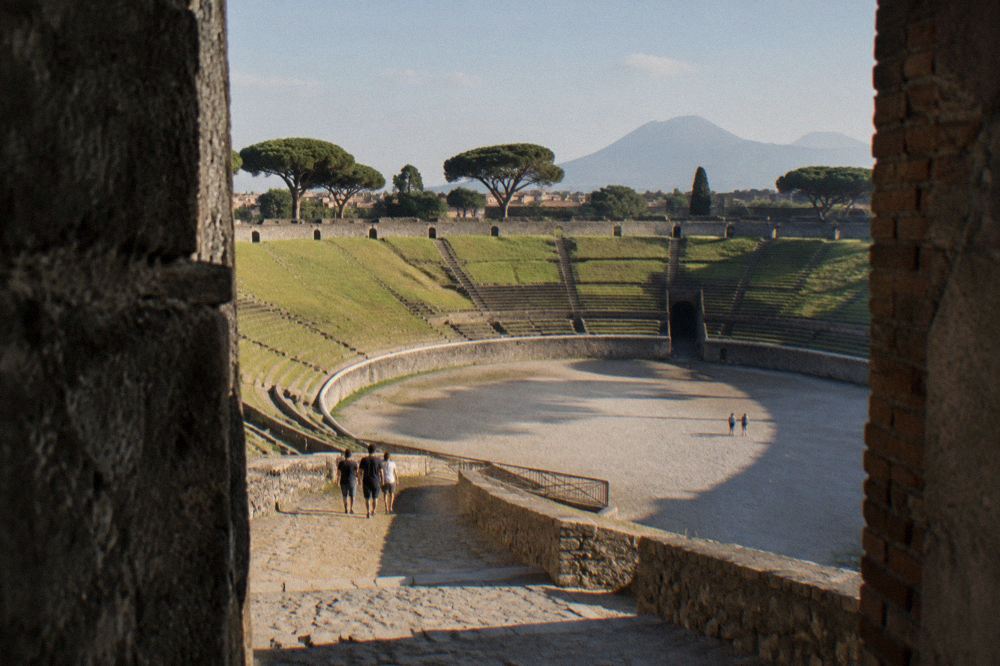
How Do The Boat Sheds Compare With What You See At Pompeii?
The two sites reward a combined visit precisely because they do not repeat each other.
| Feature (2026) | Pompeii | Herculaneum |
|---|---|---|
| Reduced ticket | EUR 2 (EU citizens 18 to under 25) | EUR 2 (ages 18 to 25) |
| Summer last entry | 17:30 (16 Mar to 14 Oct) | 18:00 (16 Mar to 14 Oct) |
| Winter last entry | 15:30 (15 Oct to 15 Mar) | 15:30 (15 Oct to 15 Mar) |
| Free days | First Sunday of the month | First Sunday, 25 Apr, 2 Jun, 4 Nov |
| Character | Large city site, streets and public buildings | Small deep excavation, organic preservation, shoreline |
Two warnings travel with that table. First, Pompeii's 2026 prices end on 31 December 2026: from 1 January 2027 a single EUR 25 ticket covers all park sites, valid 30 days with one entry per site, while the three outlying sites, Oplontis, the Stabiae museum and Boscoreale, stay at EUR 8 individually and the MyPompeii Card stays at EUR 45. Second, Herculaneum's own headline closures, the Villa dei Papiri and the Ancient Theatre, remain in force, so a comparison visit today sees a slightly smaller Herculaneum than guidebooks describe. The full breakdown lives on the Pompeii tickets page and the Herculaneum tickets page, and the detailed site-by-site comparison, including which one to choose if time is short, is in Pompeii vs Herculaneum.
Doing both in a single day is possible and common, with the practical sequencing discussed under can I do Herculaneum and Pompeii in one day. Travellers combining the two under one guide often book a two-site small group tour with an archaeologist; one such option runs from the Pompeii area and covers both excavations with the same specialist guide, and its live listing carries the price, duration and current terms.
When Is The Best Time Of Day And Year To See The Boat Sheds?
The best conditions for the boat sheds are the park's opening hour, from 8:30, when the excavation is quiet and the low light models the vaults, and the shoulder months from April to June and September to October, when Herculaneum's summer schedule runs to a 19:30 close but daytime temperatures in Ercolano, Italy, stay well below the July and August averages of about 28.7 and 29.4 degrees Celsius. Midwinter visits work too, with a 15:30 last entry, though the low sun and short window compress the descent. The vaults themselves are permanent, so the choice is purely about comfort and crowds.
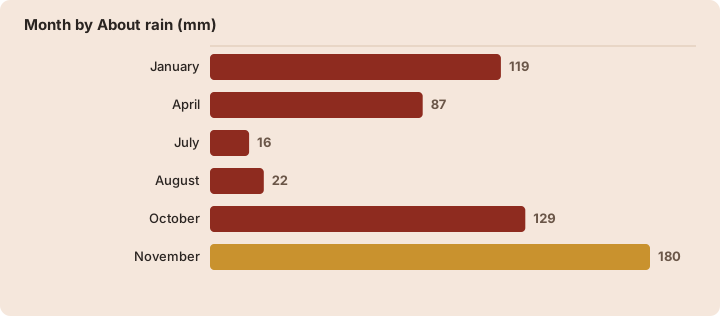
Climate averages for the area, computed from the Open-Meteo historical archive for the 1991 to 2020 period at the Pompei grid point, give the planning picture. These are reanalysis grid figures, not station readings, so treat them as approximate.
| Month | About daily max (C) | About daily min (C) | About rain (mm) |
|---|---|---|---|
| January | 12.2 | 6.6 | 119 |
| April | 17.7 | 10.4 | 87 |
| July | 28.7 | 21.1 | 16 |
| August | 29.4 | 21.8 | 22 |
| October | 21.3 | 15.1 | 129 |
| November | 16.9 | 11.5 | 180 |
November is the wettest month in the averages at about 180 mm, and July the driest at about 16 mm, which inverts the intuition that summer is the risky season; in practice the summer risk at Herculaneum is heat on the unshaded upper site rather than rain. The boat sheds sit at the bottom of the excavation, where the cutting walls give some shade in the later afternoon. The broader monthly picture, including the full monthly table and the reasoning on crowd seasons, is in the Pompeii weather and best time to visit guide, which applies to the whole Vesuvian area.
Crowding follows the free-day cycle. The first Sunday of each month costs nothing at both Herculaneum and Pompeii, and the official record at Pompeii shows a single such free day has drawn more than 36,000 visitors, so first Sundays are the days to avoid for a quiet shoreline. Ordinary summer weekdays are busier than winter ones but manageable at Herculaneum, whose smaller footprint spreads arrivals across the day. Arriving near the 8:30 opening, whatever the season, puts you ahead of the coach groups that reach the site from mid-morning.
Which Tickets And Tours Work Best For A Boat Sheds Visit?
The simplest route is a standard Herculaneum entry ticket, EUR 16 full price in 2026, bought on the day or booked in advance as an entry ticket with optional audio guide, while travellers staying in Naples or combining sites can choose a Herculaneum tour with tickets included or a guided tour led by an archaeologist, each booked through its operator's live listing. No tour is needed to see the boat sheds, since they sit on the open site route, but a guide changes what the arches mean, from a photogenic row of vaults into the best-documented evidence of the eruption's final hours at the shoreline.
| Option for the boat sheds | What it is | Best for |
|---|---|---|
| Entry ticket with optional audio guide | Booked admission plus commentary device | Independent visitors who want context |
| Herculaneum small group tour with an archaeologist | Guided small group, tickets included | Depth on the shoreline finds |
| Two-site Pompeii and Herculaneum tour | Both excavations, one guide, one day | First-time visitors with a full day |
| Herculaneum guided tour from Naples | Transport-linked guided visit with tickets | Visitors based in Naples without a car |
The choice usually reduces to where you are sleeping and how much structure you want. From Naples, the Circumvesuviana makes an independent morning straightforward, and a ticket-only visit is entirely viable. From Sorrento, the arithmetic changes, and many visitors fold Herculaneum or Pompeii into a guided day that handles the trains and the timing; the express guided tour by train from Sorrento is the Pompeii-focused version of that pattern, and there are dedicated Pompeii tours from Sorrento and Pompeii tours from Naples pages for the wider picture. Cruise passengers work to a harder clock, covered in the Pompeii shore excursions guide.
For visitors who want the archaeologist-led treatment at Herculaneum itself, a small group tour with tickets included focuses on this one site and its shoreline, and a guided version from Naples adds the transport link for travellers without a rail pass in hand. Each listing carries its own price, duration and cancellation terms, and those figures belong to the listing rather than to any page that describes it.
What Should You Know Before Visiting The Boat Sheds?
Before visiting, know the essentials: Herculaneum opens 8:30 to 19:30 with last entry 18:00 in summer and 8:30 to 17:00 with last entry 15:30 in winter, a full ticket is EUR 16 in 2026 with EUR 2 for ages 18 to 25, the Villa dei Papiri and Ancient Theatre are closed, and the boat sheds sit at the bottom of a deep excavation, so wear real shoes and allow time for the climb back out. The shoreline is not a detour; it is the natural end of the site's one-way geography, and treating it as an afterthought is how visitors run out of legs before they reach it.
| Current status, checked October 2026 | Detail |
|---|---|
| Herculaneum Villa dei Papiri | Closed for works |
| Herculaneum Ancient Theatre | Closed until further notice |
| Campania Express train | Suspended since 1 October 2026 until further notice |
| Pompeii Praedia of Julia Felix | Closed to the public since 7 September 2026 for maintenance |
| Pompeii ticket structure | Changes to a single EUR 25 ticket on 1 January 2027 |
The practical list is short. Bring water, since the descent and return are real exercise and the deepest parts of the dig hold heat in summer. Keep bags small, as space inside archaeological sites is limited and large luggage belongs to storage at the top. Check the weather before a shoreline visit, because wet stone on the ancient surface and the terrace steps is unforgiving. Confirm hours and closures on the official Herculaneum page in the week you travel, because closures like the theatre's are announced and lifted without much notice. And photograph the terrace view early in your visit rather than saving it, in case the light or the crowds turn against you later.
The boat sheds also carry a visitor etiquette that should go without saying but rarely does. The arches and the beach are a place where people died, and the site presents them that way, with interpretation rather than spectacle. Touching the vaults, climbing on the structures or leaving anything behind is prohibited under the park's regulations, the same framework that bans drones without authorisation at the Vesuvian sites. A quiet fifteen minutes at the arches, with the sea no longer visible but the geometry of the ancient shore still intact, is the right register for the place, and it is the register the park's own presentation asks for.
The boat sheds are, in the end, the single feature that makes Herculaneum more than a miniature Pompeii. The larger site has the forum, the amphitheatre and the famous houses, but no point in it puts you on the actual ground where the eruption's last chapter played out at the water's edge. Any plan for the Vesuvian sites that includes both towns should protect time for the shoreline, and any plan that includes only Herculaneum should build the whole visit around reaching it unhurried. Travellers plotting the combination will find the sequencing worked through in the two days Pompeii Herculaneum Vesuvius itinerary and the wider routes collected by this Pompeii Travel Guide, from the Pompeii and Herculaneum in one day plan to the neighbourhood detail of Ercolano.
Common Questions About The Herculaneum Boat Sheds
Are the Herculaneum boat sheds included in the ticket?
Yes. The boat sheds stand on the open excavation route inside the Herculaneum archaeological park, and a standard admission ticket, EUR 16 full price in 2026, covers them. There is no separate shoreline ticket and no timed slot for the arches specifically.
Can you see the skeletons at the boat sheds?
The shoreline where human remains were found is visible from the terrace and from the beach-level path, and the site's displays describe the finds. Remains are not left lying across the open beach; some are presented in other contexts, and the park's interpretation explains what was found in the vaults and on the sand.
How long does the boat sheds part of a visit take?
Allow around fifteen unhurried minutes for the terrace view, the descent to the arches and a look inside the vault line, on top of the time you spend in the town above. The climb back out of the excavation is the slow part, so budget energy as well as minutes.
Are the boat sheds accessible for visitors with limited mobility?
The terrace above the shoreline gives the panorama of the arches, but the beach level sits at the bottom of a deep, stepped excavation. The park publishes accessibility provisions on its official pages, and visitors with specific needs should confirm current arrangements with the site directly before travelling.
Are the Herculaneum boat sheds open right now?
The boat sheds are on the standard open route and were not affected by the closures listed on the official Herculaneum page in October 2026, which concern the Villa dei Papiri and the Ancient Theatre. Closure status can change, so check the park's own page shortly before your visit.
The arches at the bottom of Herculaneum are the site's quiet argument for why this smaller excavation deserves its own day, or at least its own unhurried hour, beside its vast neighbour up the coast.