Pompeii Luggage Storage
Pompeii, the ancient Roman city buried by Vesuvius in AD 79 and now an archaeological park in Campania, southern Italy, enforces a strict bag-size limit at its entrances. Here is what the official rules say, where larger bags go, and how day-trippers and cruise passengers can plan around it.

Short answer
The Pompeii archaeological park in Italy permits bags up to 30 x 30 x 15 cm and directs larger bags to its left-luggage service. Ticket offices sit at Porta Marina, Piazza Esedra and Piazza Anfiteatro. Day-trippers from Naples, Sorrento or Rome should travel light or use a storage service before arriving, since no private storage address near the park has verified prices or hours.
Pompeii, the ancient Roman city buried by the eruption of Mount Vesuvius in AD 79, is today an archaeological park in Campania, southern Italy, beside the modern town of Pompei and about 24 km by road from Naples. It is a walking site: roughly 44 hectares of excavated streets, houses and public buildings, crossed on foot and largely unshaded. That combination, long distances and hot stone, makes the bag you carry a genuine planning decision rather than an afterthought. The park sets a firm size limit at its entrances and sends anything larger to left luggage, which means a visitor arriving from Naples, Sorrento, Rome or a cruise ship needs to know the rule before the ticket barrier, not at it. This guide sets out what the park's own regulations say, where the named entrances and their ticket offices are, how the rule interacts with day-trip transport, and what the practical strategies are for each kind of traveller.

What Bag Size Limit Applies Inside The Pompeii Archaeological Park?
The park's visitor regulations permit bags no larger than 30 x 30 x 15 cm inside the excavations, and anything exceeding that size must be deposited in the left-luggage facility before entry. The regulation is published on the park's official regulations page alongside the other entry rules, including the nominative ticket system and the ban on drones without authorisation. There is no paid oversized-bag upgrade: the limit is a hard rule applied at the entrances, not a priced tier.
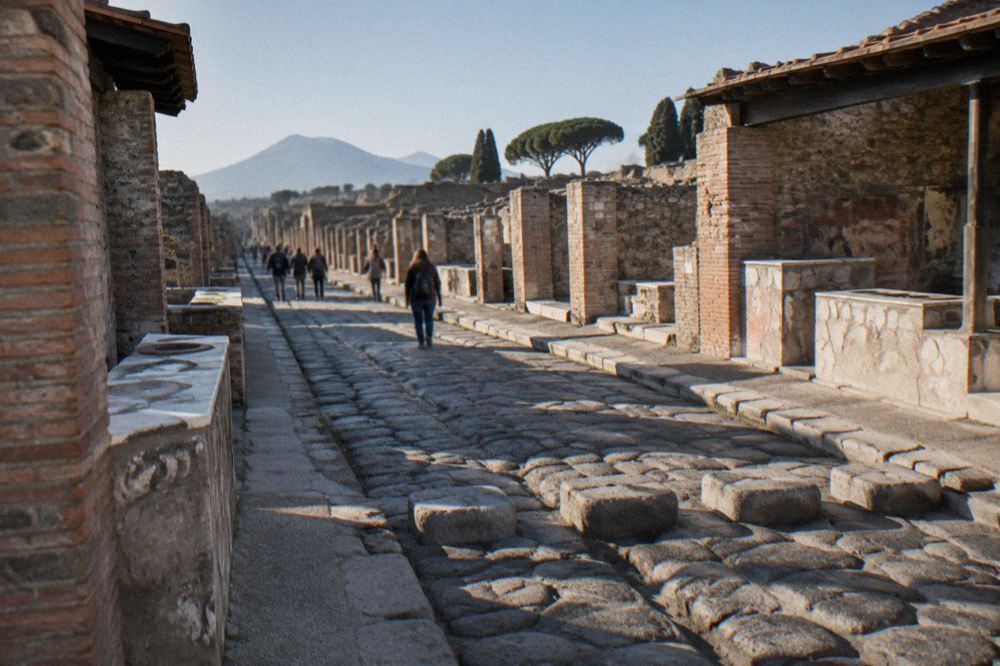
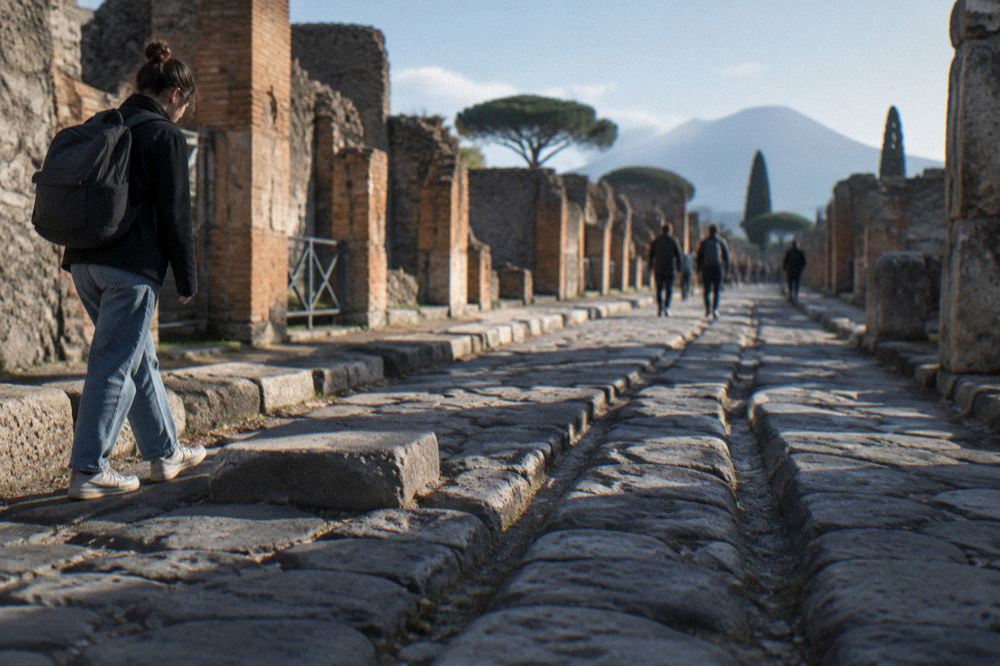
Why 30 x 30 x 15 cm? The park's streets are original Roman paving, crossed by stepping stones at intersections, and many doorways and corridors inside restored houses are narrow. A small daypack or a handbag clears that comfortably; a cabin suitcase, a large camera bag or a beach bag does not. The regulation exists to protect narrow spaces and to keep the flow of visitors moving through houses that were never designed for crowds.
In practice this is one of the few Pompeii rules that is checked consistently, because the measurement is visible at a glance at the ticket gates. Visitors who arrive with a suitcase-sized bag are turned towards left luggage rather than turned away, but the detour costs time, and in the summer timetable the last entrance is 17:30 with closure at 19:00, so late arrivals have little slack to lose. The winter timetable is tighter still: last entrance 15:30, closure 17:00.
The same regulations page covers the park's other practical rules: identification may be checked at every entry because tickets are nominative and non-transferable, drones require authorisation, and bare chests are not permitted. None of these bear on luggage directly, but they share a common thread, which is that the park manages 20,000 visitors a day at most and every entry control is built to keep that flow predictable.
| Rule | What the Official Regulation Says | Practical Effect |
|---|---|---|
| Maximum bag size | 30 x 30 x 15 cm permitted inside | Daypacks and handbags fine, cabin bags sent to left luggage |
| Oversized bags | Directed to left luggage | No oversized-bag entry option, paid or otherwise |
| Ticket identity | Nominative, ID may be checked at entry | Keep passport accessible, not buried in a checked-style bag |
| Drones | Not permitted without authorisation | Applies regardless of bag size |
| Dress | Bare chests not permitted | Relevant for summer visitors packing light |
For the full ticket structure behind these entry checks, see the dedicated guide to Pompeii ticket types and prices, which covers the 2026 tariffs and the single-ticket change coming in 2027.
Where Can You Store Luggage At The Pompeii Park Entrances?
Luggage that exceeds the 30 x 30 x 15 cm limit goes to the park's own left-luggage service, as stated in the visitor regulations. The park has three ticket offices with entrances at Porta Marina, Piazza Esedra and Piazza Anfiteatro, and the suburban villas route is served by the Porta Ercolano / Street of the Tombs entrance. The regulations confirm the left-luggage route exists but publish no fee table, so treat storage at the park as a service to ask about on the day.
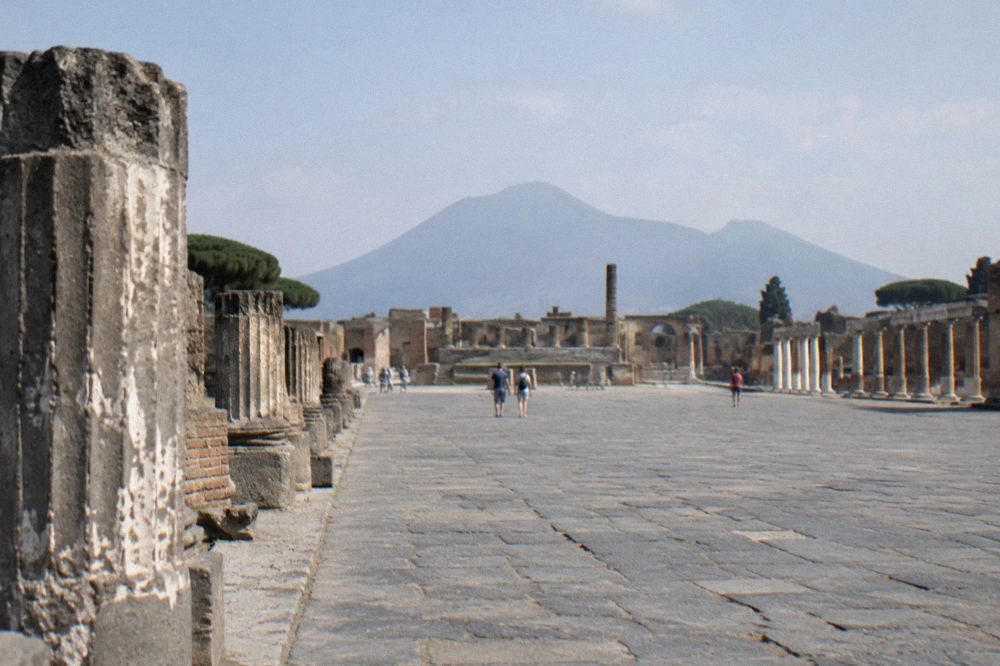
The entrance geography matters more than it first appears. Porta Marina is the entrance closest to the Pompei Scavi-Villa dei Misteri Circumvesuviana station and carries the heaviest flow of arriving day-trippers. Piazza Esedra and Piazza Anfiteatro sit at the eastern side of the site, near the amphitheatre and the modern town, and the Piazza Anfiteatro entrance doubles as the access point for the "Pompeii for All" accessible route. A visitor who enters at one side can exit at another, which is worth knowing before you deposit a bag, because collecting it may mean a walk back across the excavations or a loop around the modern town.
Any service of that kind should be priced and confirmed directly before you rely on it, and a same-day booking made from the Circumvesuviana platform is a gamble in high season.
What can be stated with confidence is the park's own framework: a named left-luggage service for oversized bags, a hard size limit, and three staffed entrance complexes. Everything else about storage around Pompeii is a matter of strategy, which the rest of this guide works through entrance by entrance and trip type by trip type.
| Entrance | Location Relative to the Site | What It Serves |
|---|---|---|
| Porta Marina | Western edge, nearest Pompei Scavi-Villa dei Misteri station | Main flow from the Circumvesuviana, ticket office |
| Piazza Esedra | Eastern side of the excavations | Ticket office, exit point on the accessible route |
| Piazza Anfiteatro | Eastern edge near the modern town and amphitheatre | Ticket office, "Pompeii for All" accessible entry |
| Porta Ercolano / Street of the Tombs | Western side, suburban villas route | Add-on villas route for Express ticket holders at EUR 8 |
If you are weighing a guided option against going alone, the private tour with an official guide is the one product on this site's roster that starts from inside the park itself, which removes the bag-and-transport question entirely for anything you leave at your hotel. It has its own page on this site, and the private tour with an official guide can be checked against the shuttle and day-trip options in the band above. Booking transport as a package is often the cleaner answer for luggage: the round-trip shuttle from Naples carries you and your bags door to door without a station platform in between.
Can You Store Luggage At Pompei Scavi Train Station?
What is verified is the station itself, stop 6049 on the Circumvesuviana Napoli-Pompei Scavi-Sorrento line, with scheduled runs from Napoli Garibaldi taking 29 to 35 minutes. Treat the station as a place you pass through with everything you brought, and arrange storage on the Naples or Sorrento end instead.**
This is the honest version of an answer many pages fudge. Station left-luggage counters have been disappearing across Italy for years, and an unverified listing on an aggregator is not a plan. The strategy that works is asymmetric: store bags at the origin, not the destination. Naples Centrale and the Sorrento terminals are the two ends of the line with the widest range of services, and a bag stored at your hotel or at a verified city service stays put while you ride out light with only the permitted daypack.
The Circumvesuviana itself deserves a mention here because it changes the packing calculus. The trains are local, the Napoli Garibaldi to Pompei Scavi run is short, and in summer the carriages fill with visitors carrying exactly the kind of bag the park will refuse. Travelling with a cabin suitcase on that line and then queueing at a left-luggage counter uses the tightest hours of a Pompeii day. The dedicated Circumvesuviana line guide covers the route in full, and the Campania Express status page matters even more now: that service has been suspended since 1 October 2026 until further notice, so anyone whose plan assumed its luggage-friendly airport-adjacent routing needs a replacement.
One verified detail helps day-trippers: EAV announced on 16 September 2026 a plan with ten new trains and a new timetable for the Vesuvian lines.

| Storage Point | Status per Verified Facts | Recommendation |
|---|---|---|
| Park left luggage (inside entrances) | Named in official regulations, no published fee | The only on-site option; ask at the ticket office |
| Pompei Scavi-Villa dei Misteri station | No verified facility, price or hours | Do not plan on it; store at origin |
| Naples end of the line | Not detailed in the facts for storage specifically | Store at your hotel or a city service you confirm yourself |
| Sorrento end of the line | Not detailed in the facts for storage specifically | Same: confirm the service directly before relying on it |
How Do Day Trips From Naples, Sorrento And Rome Handle The Luggage Problem?
The cleanest luggage plan for a Pompeii day trip is to store bags where your trip starts: at a Naples hotel or station service, at a Sorrento base, or, for Rome travellers, to leave luggage in Rome entirely, since Rome to Pompei is about 234 km by road. Package day trips dodge the problem differently, because coaches carry your bag in the hold while you tour. Independent travellers on the Circumvesuviana enjoy no such hold and should pack down to the permitted daypack before boarding.
Start with the geometry. Naples sits about 24 km from Pompei Scavi by road, Sorrento about 26 km, and the drive times computed on the road network are 22, 37 and 30 minutes respectively from Naples, Sorrento and Salerno. These are driving figures, not rail promises, but they frame the day: every origin is close enough that returning mid-trip for a forgotten bag is possible yet wasteful, and far enough that nobody wants to do it.
Rome is a different animal. At about 234 km and around 159 minutes of driving, a Rome-based visitor is committing a full day, and the roster's Rome products reflect that with 11 to 13-hour itineraries. Nobody should carry a suitcase through that. The two strategies that work are leaving luggage at the Rome accommodation, covered in detail in the Rome to Pompeii day trip guide and the Rome to Pompeii by train guide, or booking a coach day trip where the hold does the storing. The band at the end of this article includes a long Rome day-trip option for exactly that reader.
For Naples-based visitors, the Naples to Pompeii routes guide compares the ways out to the site, and the Sorrento to Pompeii guide does the same from the peninsula. Both matter for bags: a shuttle or coach product with a hold is a luggage answer in itself, while the train is only an answer if you board light. Travellers arriving from the coast can also consult the Amalfi Coast to Pompeii routes guide, where the same hold-versus-platform logic applies with more winding road in the equation.
The shuttle above is the budget-format illustration of the principle: a round-trip bus product means your daypack rides with you and nothing else needs to ride at all. Contrast that with the train-plus-storage plan, which needs a confirmed service at the Naples end and nothing but hope at the Pompei end. When a coach product and a rail journey cost a comparable morning of effort, the luggage edge alone can decide it.
| Origin | Road Distance to Pompei Scavi | Driving Time | Luggage Strategy |
|---|---|---|---|
| Naples | 24 km | about 22 min | Store at origin; shuttle products carry a hold |
| Sorrento | 26 km | about 37 min | Store at hotel; train light or coach |
| Salerno | 31 km | about 30 min | Store at origin before travelling |
| Rome | 234 km | about 159 min | Leave bags in Rome; coach day trip or nothing |
What Should Cruise Passengers Do With Bags On A Pompeii Stop?
Cruise passengers do not need to solve storage at Pompeii at all, because the ship is the storage: bags stay in the cabin and only the permitted daypack comes ashore. The verified shore-excursion products on this roster run around five hours from Naples with a guide, timed to a port day. The one warning is timing, since the port of Naples to Pompei is a 24 km road link and port departure times do not negotiate with park closing hours.
The port logic is simple and worth stating plainly because it inverts the usual day-trip problem. A hotel lets you store bags and return; a ship lets you store bags and sail away. Everything therefore reduces to the clock. The two park timetables make the point: from 16 March to 14 October the site opens at 9:00, takes its last entrance at 17:30 and closes at 19:00, giving even an afternoon port departure a real chance, while from 15 October to 15 March the last entrance falls at 15:30 and closure at 17:00, a timetable hostile to late risers. A cruiser with a morning in port should be through an entrance well before noon on either schedule.
The roster's shore-excursion entries are built around exactly this constraint, and the dedicated Pompeii shore excursions guide on this site compares them in depth. Their shared advantage for this article's topic is that the operator manages the transfer, so the only bag question is the small one at the gate. A cruiser who books independently rather than through the ship should apply the same test used by every other traveller in this guide: does the transport carry the bag for me, or do I carry the bag to a barrier that refuses it?
How Do Ticket Rules And Time Slots Affect Visitors Carrying Bags?
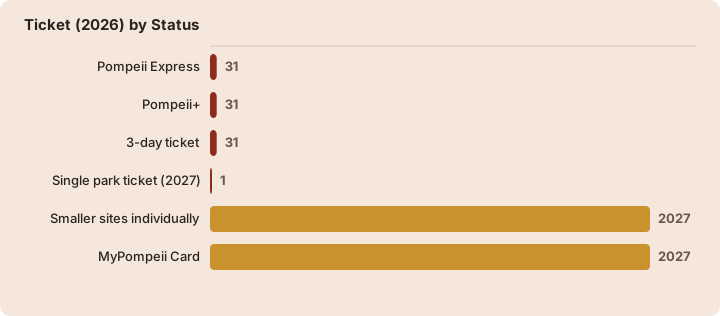
A nominative ticket, a daily cap of 20,000 visitors and time-slot bands of 9:00-13:00 (max 15,000) and 13:00-17:30 (max 5,000) shape the day far more than the bag rule does, but they interact: every minute spent resolving an oversized bag is a minute of your slot. In 2026 the Express ticket costs EUR 20 and the Pompeii+ EUR 25, and from 1 January 2027 a single EUR 25 ticket covers all park sites for 30 days, one entry per site.
The time-slot arithmetic is the part first-time visitors miss. The morning band admits up to 15,000 people and the afternoon band up to 5,000, which means the queue risk is not spread evenly across the day. A visitor who arrives mid-morning with a suitcase, discovers the limit, walks to left luggage, walks back and rejoins the entry flow has spent a slice of the busiest band on logistics. The same visitor arriving with a compliant daypack goes straight to the gate, where ID may be checked against the nominative ticket, so the passport belongs in a pocket rather than at the bottom of the bag.
The 2027 change is worth flagging while planning any trip across the New Year. From 1 January 2027 the Express, Pompeii+ and 3-day structure is replaced by a single EUR 25 ticket valid 30 days with one entry per site; Oplontis, the Stabiae museum and Boscoreale stay EUR 8 individually, and the MyPompeii Card stays EUR 45. The nominative ticket and the 20,000 daily cap are retained. For luggage planning the relevant constant is that entry controls, ID checks included, survive the price reform.
| Ticket (2026) | Price | Covers | Status |
|---|---|---|---|
| Pompeii Express | EUR 20 | Ancient city only | Ends 31 December 2026 |
| Pompeii+ | EUR 25 | City, suburban villas route, Boscoreale additions | Ends 31 December 2026 |
| 3-day ticket | EUR 30 | Pompeii+ plus Oplontis, Stabiae villas, Boscoreale | Ends 31 December 2026 |
| Single park ticket (2027) | EUR 25 | All park sites, 30 days, one entry per site | From 1 January 2027 |
| Smaller sites individually | EUR 8 | Oplontis, Stabiae museum, Boscoreale | Continues into 2027 |
| MyPompeii Card | EUR 45 | Annual | Continues into 2027 |
Free and reduced rules also matter to the budget side of the same trip: entry is free for under-18s and for everyone on the first Sunday of the month, and EU citizens aged 18 to under 25 pay a EUR 2 reduced rate. The free entry days at Pompeii guide covers that calendar in full, with the warning worth repeating here: the park has recorded more than 36,000 visitors on a single free first Sunday, which is a day when every queue, including any bag-related one, is at its longest.
How Do You Handle Bags When Combining Pompeii With Vesuvius Or Herculaneum?
Combination days multiply the bag problem, because Vesuvius and Herculaneum are separate sites with their own rules and their own transport legs. Vesuvius Gran Cono tickets are online-only, sold in 10-minute slots, and the shortest return excursion is about two hours on foot; Herculaneum charges EUR 16 full and EUR 2 reduced for 18 to 25-year-old EU citizens, with Villa dei Papiri and the Ancient Theatre closed for works. Plan one compliant daypack across all sites and store everything else at the origin.
The Vesuvius leg is the one that punishes overpacking hardest. The access hours shift by month, 9-15 in January, February, November and December, stretching to 9-18 in July and August, and the path closes automatically on an orange weather alert or above, with an automatic refund if weather shuts the gate. The Vesuvius tickets guide covers the online-only system, the 50 tickets per 10 minutes release and the nominative last-minute tickets in force since 11 April 2026.
Herculaneum, about which this site keeps a full Pompeii versus Herculaneum comparison, is smaller and closer to a normal museum-style visit, but its closures matter to route planning: Villa dei Papiri is closed for works and the Ancient Theatre is closed until further notice.
The combination products on the roster exist precisely because a two-site or three-site day is hard to self-manage with transit and a bag. The Pompeii and Herculaneum small-group product with an archaeologist is one example, as is the full three-site day from Naples covering Pompeii, Herculaneum and Vesuvius in a single eight-hour itinerary. When a coach or minibus links the sites, the luggage question collapses into the same hold-versus-platform choice described for day trips.
| Combined-Day Component | Entry Figure | Practical Constraint |
|---|---|---|
| Vesuvius Gran Cono | EUR 11.68 full / EUR 9.55 reduced as sold | Online-only timed slots, 2-3 h walking excursion |
| Herculaneum | EUR 16 full / EUR 2 reduced (18-25 EU) | Villa dei Papiri and Ancient Theatre closed |
| Pompeii Express add-on villas route | EUR 8, card only | Add at Porta Ercolano / Street of the Tombs entrance |
| First Sunday of the month | Free at Pompeii and Herculaneum | Peak crowds, longest queues |
What Should You Pack For A Day In Pompeii Itself?
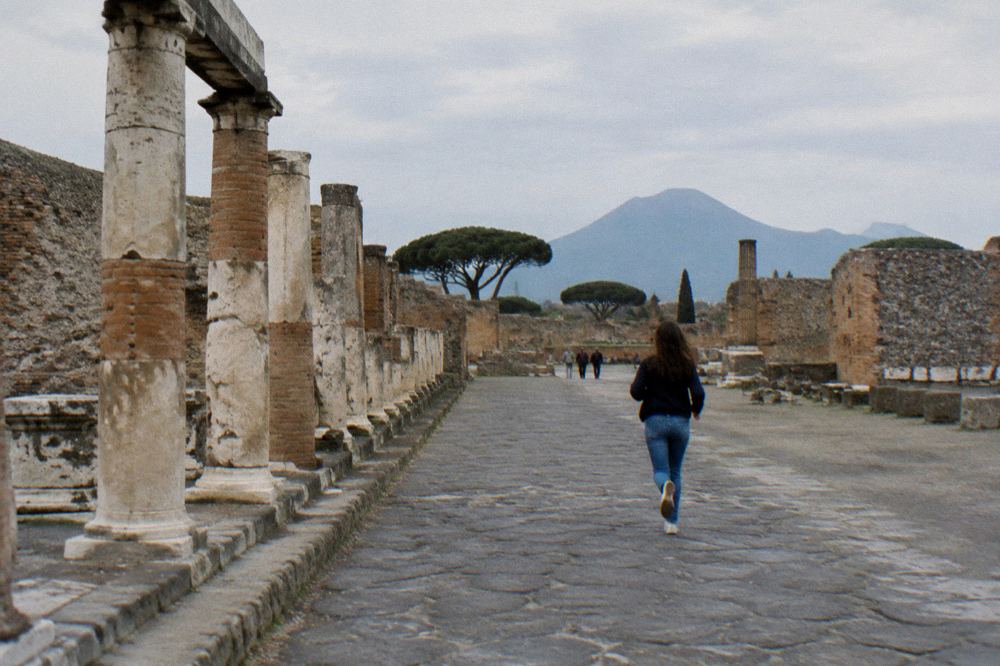
Pack for a hot, exposed, two-to-four-hour walk on uneven Roman paving: water, sun protection, closed shoes with grip, and the park's permitted 30 x 30 x 15 cm daypack holding little else. Pompei's climate is Mediterranean, and the 1991-2020 normals for the local grid point show August mean daily maxima of about 29.4 C and July rainfall of about 16 mm, while November is the wettest month at about 180 mm. The bag limit is the park telling you what the site already demands.
The seasonal spread is worth reading off the figures. The Pompeii weather and best time to visit guide expands on this, and the summer heat plan applies it to a route. The luggage angle is that weather gear changes size: a summer kit is a bottle and a hat, a winter kit is a rain layer that still has to fit the permitted dimensions.
Footwear deserves its own sentence because the paving is the site. Stepping stones cross every major street, surfaces are original and uneven, and the walk between the far entrances is a crossing of the whole excavated city. What to wear, including shoe choices, has its own page at what to wear to Pompeii, and the broader accessibility picture, including the "Pompeii for All" route entering at Piazza Anfiteatro with the Antiquarium lift exit, is covered in the Pompeii accessibility guide.
One dated closure belongs in any packing-and-planning paragraph: the Praedia of Julia Felix has been closed to the public since 7 September 2026 for maintenance, until further notice, so no itinerary built around it should assume access. Checking the park's own comunicati before a visit costs a minute and prevents a wasted walk.
Which Storage Strategy Fits Which Traveller?
Hotel-based travellers store at the base and travel with a compliant daypack; coach and shuttle travellers let the vehicle hold carry the load; independent train travellers must be strict, because the Pompei Scavi end has no verified storage to fall back on; and private-tour buyers start inside the park and only ever carry the small bag. The common rule underneath all four is the same 30 x 30 x 15 cm limit at Porta Marina, Piazza Esedra and Piazza Anfiteatro, with left luggage for everything bigger.
Mapping traveller to tactic gives the clearest summary of this whole guide. A Rome day-tripper books a coach product or leaves everything in Rome. A Naples or Sorrento hotel guest checks out, stores at the desk, rides light and collects on return. A cruiser brings only a daypack ashore, full stop. A family should note that children under 18 enter free and EU 18 to 24-year-olds pay EUR 2, but every member still carries their own compliant bag. A photographer should accept that a body and two lenses is the realistic ceiling, since a full kit bag exceeds the limit and there is no photographer's exemption in the regulations.
The guided-versus-independent question also has a luggage dimension, argued in full at guided tour versus self-guided at Pompeii and, for the wider debate, is Pompeii worth visiting. A guide does not change the bag rule, but a booked product changes who owns the transport, and transport ownership is what actually solves luggage at this destination.
The cooking class above is the final illustration of the principle from the other direction: a food experience in Naples needs no bag strategy at all, which is exactly why it pairs well with a morning at the excavations. Plan the heavy walking first, eat afterwards, and let the day's logistics shrink to a single small pack.
For orientation once inside, the site's own Pompeii map page and the fuller map guide show the entrance geography this article has relied on, and the wider planning picture lives on the Pompeii Travel Guide homepage, including the where to stay in Pompei area guide for anyone turning a day trip into an overnight.
Common Questions About Pompeii Luggage Storage
What bag size limit applies inside the Pompeii archaeological park?
Bags up to 30 x 30 x 15 cm are permitted inside the excavations; anything larger must go to the park's left-luggage service before entry. The rule is published in the park's official visitor regulations.
Where can you store luggage at the Pompeii park entrances?
The park's own left-luggage service takes oversized bags, available from the entrance complexes at Porta Marina, Piazza Esedra and Piazza Anfiteatro. The regulations name the service but publish no fee table, so ask at the ticket office on the day.
Can you store luggage at Pompei Scavi train station?
No storage facility at Pompei Scavi-Villa dei Misteri has verified prices or hours in the confirmed facts for this destination. The reliable plan is to store bags at your origin in Naples or Sorrento and travel with only a compliant daypack.
How do day trips from Naples, Sorrento and Rome handle the luggage problem?
Store bags where the trip starts. Naples is 24 km and Sorrento 26 km from Pompei Scavi by road, close enough for a light round trip; Rome is 234 km, so leave luggage there and take a coach day trip whose hold carries everything.
What should cruise passengers do with bags on a Pompeii stop?
Leave bags in the cabin and bring only the permitted daypack ashore. Shore-excursion products from Naples run around five hours with a guide, and the winter timetable's 15:30 last entrance makes an early start essential.
How do ticket rules and time slots affect visitors carrying bags?
Time-slot bands, a 20,000 daily visitor cap and nominative tickets mean ID checks at entry, so keep your passport reachable. In 2026 the Express ticket is EUR 20 and Pompeii+ EUR 25; from 1 January 2027 a single EUR 25 ticket covers all park sites for 30 days.
Pompeii rewards travellers who arrive light: the bag rule, the walking distances and the exposed streets all push in the same direction, and every storage strategy in this guide, from hotel desks to coach holds, exists to get you through Porta Marina, Piazza Esedra or Piazza Anfiteatro with nothing heavier than a small daypack.