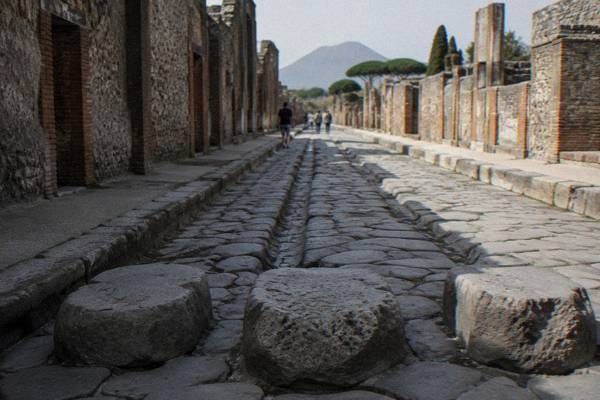
Pompeii Bakery
The Bakery of Modestus is the best known of the bread bakeries uncovered in the ancient city of Pompeii, in Campania, southern Italy, beside the modern town of Pompei and about 24 km from Naples. Carbonised loaves were found in its oven, still in the shape Romans ate every day.
Short answer
The Bakery of Modestus sits inside the Pompeii archaeological park, which costs EUR 20 (Pompeii Express ticket) in 2026, rising to a single EUR 25 ticket from 1 January 2027. The bakery needs no separate ticket: it stands on the standard city route. Allow a few minutes on any circuit that crosses it, and combine it with the Forum and the thermopolium nearby.
The Bakery of Modestus stands inside the ancient Roman city of Pompeii, the archaeological park in Campania, southern Italy, that Vesuvius buried in the eruption of AD 79, traditionally dated to 24 August. The park lies beside the modern town of Pompei, about 24 km by road from Naples, and the bakery is one of the clearest windows in the whole site onto ordinary working life: a commercial bread operation, complete with millstones, a wood-fired oven and loaves that were still inside that oven when the excavators opened it. For anyone planning a visit around the themes of Roman food, the bakery belongs on the same shortlist as the thermopolium counters and the Forum, and the full practical picture of the park is covered on the Pompeii Travel Guide homepage.
What Is The Bakery Of Modestus In Pompeii?
The Bakery of Modestus is a commercial Roman bakery inside the excavated ancient city of Pompeii, in Campania, southern Italy, where bread was ground on stone mills and baked in a large wood-fired oven for sale to the public. It is the bakery in which carbonised loaves were discovered in its oven, and it is included with ordinary park admission, with no separate ticket. It sits within a city whose excavated area covers 44 hectares of a 98 hectare inscribed UNESCO property.
Bread was the backbone of the Roman diet, and Pompeii, a busy commercial town on the Bay of Naples, supported numerous bakeries to feed it. A bakery of this kind worked as a production line under one roof: grain came in, enslaved workers and donkeys turned the hourglass-shaped stone mills to grind it, the dough was kneaded and shaped on stone counters, and the loaves went into an oven fired from below and behind. The Modestus bakery preserves that chain of equipment unusually completely, which is why it draws the crowds it does.
The loaves themselves are the reason this bakery, rather than any other, is the famous one. The round, segmented loaves found inside the oven were carbonised by the heat of the eruption exactly in the position in which they were set out to bake. Their shape, round and scored into wedge segments, matches the bread depicted in Roman art and mentioned in Roman writing, and it confirms that the bakery was in full production at the moment the city stopped. Those original loaves are conserved by the park; what the oven in the building shows today tells the same story to visitors standing in the room.
The building is also a reminder that the eruption date is a live scholarly question rather than a settled fact. Pliny the Younger's oldest manuscripts give 24 August AD 79, while the park's own e-journal states that the alternative 24 October date has no evidentiary basis, arising from a misreading of the manuscript tradition, and adds that 24 August is not necessarily correct either. Bread in the oven tells of a working day, but it does not settle the calendar question, and no page on this site should.
Where Is The Bakery Of Modestus Inside The Pompeii Archaeological Park?
Visitors entering at Piazza Anfiteatro reach it fastest. The park's full layout, with entrances and landmarks marked, is on a dedicated map page that makes the walk easy to plan.**
The map page lives at the Pompeii site map, and it is worth a glance before you choose a door. Pompeii is large, and the entrance you choose shapes your whole day. Porta Marina, at the western end, is the classic entrance nearest the Forum and closest to the Pompei Scavi-Villa dei Misteri rail station, but it puts the bakery at the far end of your walk. Piazza Anfiteatro, at the eastern end, reverses that: the bakery, the Pompeii Amphitheatre and the Large Palaestra cluster close together, and you finish at the Forum rather than starting there. Piazza Esedra sits between the two and serves the northern circuits.
Time-slot rules matter as much as the choice of door. Under the current slotting, the 9:00 to 13:00 band carries up to 15,000 visitors and the 13:00 to 17:30 band up to 5,000, so an afternoon arrival means a noticeably thinner site, at the cost of less time before the last entrance. The park caps entries at 20,000 visitors per day, a limit in force since 15 November 2024, and tickets are nominative, so carry the ID you booked with: it may be checked at every entry.
| Entrance | Position | Best For | Nearest Cluster |
|---|---|---|---|
| Porta Marina | Western end | Forum, Basilica, rail arrivals | Forum of Pompeii, Temple of Apollo |
| Piazza Esedra | North-central | Northern circuits, balanced walks | Large Theatre and Odeon |
| Piazza Anfiteatro | Eastern end | Bakery, amphitheatre, fast bakery access | Bakery of Modestus, Large Palaestra |
If the suburban villas are on your plan, note that the villas route uses the Porta Ercolano / Street of the Tombs entrance, and a Pompeii Express holder can add the suburban villas route for EUR 8, card payment only, at that entrance. That route covers the Villa of the Mysteries and Villa Diomedes; the Villa of the Mysteries guide covers what those frescoed rooms hold.
Opening hours through the year are simple: from 16 March to 14 October the park opens at 9:00 with last entrance at 17:30 and closes at 19:00; from 15 October to 15 March last entrance falls at 15:30 and the park closes at 17:00. The ancient city itself has no weekly closing day, and the site closes only on 25 December and 1 January unless otherwise communicated.
A guided small-group visit is the easiest way to make sure the bakery and its neighbours are actually on your route rather than missed in the sprawl. The operator's live listing carries current dates and availability.
What Can You See At The Bakery Of Modestus Today?
Visitors see the bakery's intact working equipment: the stone mill batteries in the milling room, the long stone counters where dough was worked, and the great domed brick oven with its loading mouth, together with the stable area where the mill animals were kept. The building is viewable from the walking route, and photography is permitted under the park's general rules. Nothing here needs a supplement beyond the park ticket.
The mills are what stop people first. Roman bakers used hourglass-shaped mills of hard stone, an upper catillus turning over a lower meta, driven by human or animal power, and the bakery preserves several of them in place in the room where they worked. The wear on the stones, the confined space and the adjacent animal quarters explain at a glance why ancient baking was considered among the hardest of trades: the milling rooms were windowless, flour-dust filled, and powered by relentless circular labour.
The oven is the second landmark. Domed, brick-built and fired with wood, it is recognisably the ancestor of the ovens that still turn out pizza and bread across Campania, and its survival in working position is rare. The loaves found within it are conserved elsewhere by the park, but the oven tells their story by itself: a full commercial batch, loaded and abandoned mid-bake when the eruption of AD 79, traditionally dated to 24 August, overtook the city.
Around the bakery, the food trail of Pompeii continues at other stops worth folding into the same walk. The Thermopolium of Vetutius Placidus on the Via dell'Abbondanza shows the fast-food counter where hot food was served from embedded dolia, the Roman answer to street food, with a lararium painting still visible at the rear. The Forum of Pompeii a short walk west holds the commercial and civic heart where that bread and that lunch were sold.
| Feature at the Bakery | What It Is | What It Shows |
|---|---|---|
| Stone mills | Hourglass-shaped basalt mill batteries in situ | How grain was ground on site before baking |
| Dough counters | Long stone working surfaces | Where loaves were shaped before loading |
| Domed oven | Large brick wood-fired oven | Commercial-scale production; loaves found in situ |
| Animal quarters | Stable area beside the milling room | Where donkeys that turned the mills were housed |
Bags are worth planning here as everywhere in the park: the permitted bag size is 30x30x15 cm, and anything larger must go to left luggage before you enter. Drones need authorisation, bare chests are not allowed, and the walking surfaces everywhere are ancient, uneven stone, so solid shoes matter more than at almost any other European site.
After standing in front of the oven, many travellers want to try the living version of the region's dough craft. A pizza dough and tiramisu cooking class in Naples pairs naturally with the bakery visit, and the class runs on the operator's live listing with dates and cancellation terms shown there: Check availability.
Do You Need A Ticket To See The Bakery Of Modestus?
No separate ticket exists for the bakery: it is covered by the standard Pompeii admission, which in 2026 is the EUR 20 Pompeii Express ticket for the ancient city, or the EUR 25 Pompeii+ ticket that adds the suburban villas and Boscoreale, or the EUR 30 three-day ticket. From 1 January 2027 a single EUR 25 ticket replaces all three, valid 30 days with one entry per site. Entry is free for under-18s and for everyone on the first Sunday of the month.
The 2026 tariff, in force since 12 January 2026, is straightforward once you know the pieces. Reduced admission of EUR 2 applies to EU citizens aged 18 to under 25, and also to non-EU holders of an Italian residence permit. First-Sunday free entry runs year-round under the Domenica al Museo scheme, with no reservation and tickets collected on the day, though the park has recorded more than 36,000 visitors on a single free Sunday, so arrive early or expect the busiest conditions of the month.
| Ticket (2026) | Price | What It Covers |
|---|---|---|
| Pompeii Express | EUR 20 | The ancient city only |
| Pompeii+ | EUR 25 | City, suburban villas, Boscoreale villa and Antiquarium, shuttle |
| 3-day ticket | EUR 30 | Pompeii+ plus Oplontis, the Stabiae villas and museum, Boscoreale |
| Other park sites (Oplontis, Stabiae museum, Boscoreale) | EUR 8 each | Single outlying sites |
| My Pompeii Card (annual) | EUR 45 (EUR 10 reduced) | Annual park access |
Tickets are nominative, non-transferable and non-refundable except in the case of extraordinary closure, and the ticket offices sit at Porta Marina, Piazza Esedra and Piazza Anfiteatro, with online sales through the vivaticket channel linked from the park's own ticketing page. Tickets also carry 30-day validity for the free partner sites at Buccino, Lettere, Poggiomarino and Terzigno, a detail few guidebooks mention.
If a guided entry suits you better than queuing at a window, an entry-ticket-plus-archaeologist option is one of the roster's most-booked ways into the park and lands you with a guide who knows where the bakery sits on the route: Check availability.
One planning note for anyone combining the bakery morning with a food experience afterwards: the cookery sessions in Naples run on fixed daily schedules, so it is worth checking the times on the live listing before you lock your park slot, since the afternoon entry band closes at 17:30.
How Do You Get To The Pompeii Archaeological Park?
The nearest rail stop to the ancient city is Pompei Scavi-Villa dei Misteri on the Circumvesuviana line from Naples, at stop 6049, with scheduled times of 29 to 35 minutes from Napoli Garibaldi as computed from the operator's own timetable data. By road, Pompei Scavi lies about 24 km from Naples, 26 km from Sorrento and 31 km from Salerno. The Campania Express service has been suspended since 1 October 2026.
The Circumvesuviana remains the everyday route from both directions, Naples and Sorrento, and the Scavi station sits moments from the Porta Marina entrance. For fares and departure times, consult the operator EAV's timetable directly, since timetables were being revised in the autumn of 2026 following the operator's announcement of 16 September 2026 about new trains and a new schedule for the Vesuvian lines. The Campania Express premium service should not be part of any plan: it has been suspended since 1 October 2026 until further notice, with refunds available through the EAV complaints form or the original seller.
Driving is practical but parking needs the usual planning; the getting to Pompeii picture on the tickets page notes how ticketing, entrances and arrival choices interact. Distances by road from the main origins are fixed and worth knowing before you commit:
| Origin | Road Distance to Pompei Scavi | Driving Time |
|---|---|---|
| Naples | 24 km | 22 min |
| Sorrento | 26 km | 37 min |
| Salerno | 31 km | 30 min |
| Rome | 234 km | 159 min |
Coming from Sorrento, the same line that serves commuters serves you: Pompei Scavi to Sorrento takes 34 to 40 minutes on scheduled runs, and a train-based guided excursion from Sorrento is the simplest way to fold the bakery into a Sorrento stay without thinking about connections.
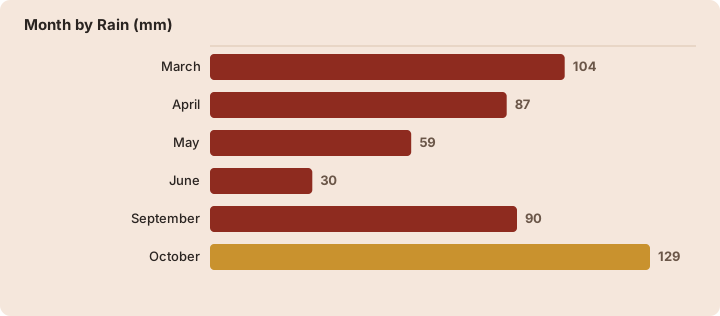
When to go matters as much as how. The Pompei grid point, in Open-Meteo 1991-2020 normals, shows a Mediterranean climate: about 29.4 C mean daily maximum in August, about 6.5 C mean nightly minimum in February, with November the wettest month at about 180 mm of rain and July the driest at about 16 mm.
| Month | Mean Daily Max (C) | Mean Daily Min (C) | Rain (mm) |
|---|---|---|---|
| March | 14.9 | 8.1 | 104 |
| April | 17.7 | 10.4 | 87 |
| May | 21.6 | 14.1 | 59 |
| June | 25.8 | 18.2 | 30 |
| September | 25.3 | 18.6 | 90 |
| October | 21.3 | 15.1 | 129 |
How Does The Bakery Of Modestus Compare With Other Pompeii Food Stops?
The bakery is the park's clearest production site, showing how bread was made; the thermopolia show how food was sold hot over the counter; and the Forum shows where goods changed hands wholesale. Together they cover the full arc of Roman food economy in a single walk. No other stop in the excavated city offers the bakery's combination of intact equipment and a documented batch of loaves.
A sensible food-themed circuit runs from the Porta Marina entrance along the Via dell'Abbondanza, pausing at the thermopolium counters, crossing to the Forum and Basilica, then continuing east to the bakery and amphitheatre cluster before returning. The House of the Faun and Garden of the Fugitives sit close enough to this line to add without doubling your distance. Walkers with limited time should know that the park is big, surfaces are ancient basalt, and shade is scarce in summer, so a plan beats ambition.
| Stop | Food Role | What Survives |
|---|---|---|
| Bakery of Modestus | Bread production | Mills, counters, oven, loaves found in situ |
| Thermopolium of Vetutius Placidus | Hot food retail | Counter with embedded dolia, lararium painting |
| Forum | Market and civic exchange | Temple and colonnade architecture |
| Amphitheatre quarter | Entertainment district | Amphitheatre, Large Palaestra, bakery cluster |
Visitors with mobility difficulties have a dedicated "Pompeii for All" route, entering at Piazza Anfiteatro with exit options at Piazza Anfiteatro or Piazza Esedra via the Antiquarium lift, which puts the bakery's end of the park within reach of a wheelchair-friendly circuit. Anyone weighing the eastern entrance for that reason alone is making a sound choice.
Which Food And Wine Experiences Pair Well With The Bakery Visit?
The strongest pairings are the pizza and tiramisu cooking class in Naples, an organic lunch and wine tasting inside the Vesuvius National Park, and a Pompeii tour combined with lunch and wine tasting, each extending the bakery's bread story into living Campanian food culture. The three sit at different price points and durations, all of which the operator listings display. What follows describes each experience; every figure comes from the live listing rather than this page.
The cooking class is the direct descendant of the story the bakery tells. Working dough by hand, firing it in a hot oven and sitting down to eat the result is the unbroken thread between the mills of Modestus and the pizzerias of Naples, and the class puts you on the inside of it. The full tours hub lists every food and wine option alongside the archaeological ones, so the pairing can be planned in one place.
Wine belongs in the same story, because the slopes of Vesuvius have grown vines for as long as the plain below has grown grain. Lunch and wine tasting in the national park takes you up among those vineyards, on the same volcano that buried the bakery, while the Pompeii tour with lunch and wine tasting experience combines the ruins morning with the winery afternoon in a single booking. The bakery gives those tastings their context: this is a food landscape two millennia deep, not a scenic add-on.
The options compare like this, with all prices and ratings rendered by the live listings:
For travellers basing themselves in Naples rather than Sorrento, the same logic applies from that end of the line, and the wider theatre quarter, covered on the Large Theatre and Odeon page, sits on the walk between the Forum and the bakery. Whichever way you assemble the day, keep the bakery's closing lesson in mind: the loaf in that oven never came out, so leave time to see it properly.
Common Questions About The Bakery Of Modestus
Do you need a separate ticket for the Bakery of Modestus?
No. The bakery is inside the standard Pompeii admission. In 2026 that is the EUR 20 Pompeii Express ticket, the EUR 25 Pompeii+ ticket or the EUR 30 three-day ticket; from 1 January 2027 a single EUR 25 ticket covers all park sites.
How long should you spend at the Bakery of Modestus?
The bakery itself is a stopping point on a wider route rather than a half-day destination: a short visit to read the mills, counters and oven fits within any circuit of the eastern side of the park, alongside the amphitheatre and palaestra.
Where were the carbonised loaves found?
They were found inside the bakery's own oven, still in their baking positions, carbonised by the heat of the eruption of AD 79, traditionally dated to 24 August. The originals are conserved by the park.
Is the Bakery of Modestus accessible to wheelchair users?
The park's "Pompeii for All" route enters at Piazza Anfiteatro, on the same eastern side as the bakery, with exit at Piazza Anfiteatro or Piazza Esedra via the Antiquarium lift, bringing this quarter within an accessible circuit.
When is entry to Pompeii free?
Entry is free for visitors under 18 and for everyone on the first Sunday of the month, year-round. Reduced admission of EUR 2 applies to EU citizens aged 18 to under 25.
What else should you see near the bakery?
The amphitheatre and Large Palaestra stand in the same quarter, and a walk west reaches the thermopolium counters of the Via dell'Abbondanza and the Forum, completing the food and civic story of the city.
The Bakery of Modestus rewards a slow look in a park that rewards a plan: choose your entrance with the bakery's eastern position in mind, book a slot in the thinner afternoon band if your schedule allows, and pair the visit with the food stops and the wineries that keep the same traditions alive around the bay.