Forum Of Pompeii
The Forum of Pompeii was the civic, religious and commercial centre of the ancient Roman city buried by Vesuvius in AD 79, in Campania, southern Italy, about 24 km from Naples. This guide covers what stands there, which entrance serves it, the 2026 ticket prices, opening hours, and how much time to allow.
Short answer
The Forum of Pompeii is the large paved civic square at the crossroads of the ancient city's main streets, inside the Parco Archeologico di Pompei. A 2026 Pompeii Express ticket costs EUR 20, a Pompeii+ ticket EUR 25, and entry is free on the first Sunday of each month. Allow roughly 30 to 45 minutes on a first visit, longer with a guide.
The Forum of Pompeii is the great open square that served as the civic, religious and administrative heart of the ancient Roman city of Pompeii, in Campania, southern Italy, beside the modern town of Pompei and about 24 km by road from Naples. When Vesuvius erupted in AD 79, on the date the manuscripts of Pliny the Younger traditionally give as 24 August, the city was buried and its Forum was sealed under volcanic debris along with everything around it. Excavation has since exposed an excavated area of 44 ha within a UNESCO-inscribed property of 98 ha, and the Forum sits at the centre of it all: the place where the city's politics, law courts, markets and temples rubbed shoulders two thousand years ago.
For a visitor planning a day at the archaeological park, the Forum is the natural anchor of any route. It connects, by short walks, to the Temple of Apollo, the Basilica of Pompeii, the public baths, and the long spine of the decumanus streets that lead out towards the Amphitheatre of Pompeii. This page explains what the Forum is, where it sits relative to the park entrances, what there is to see in and around it, and the practicalities: tickets, hours, timing and tour options.
What Is The Forum Of Pompeii?
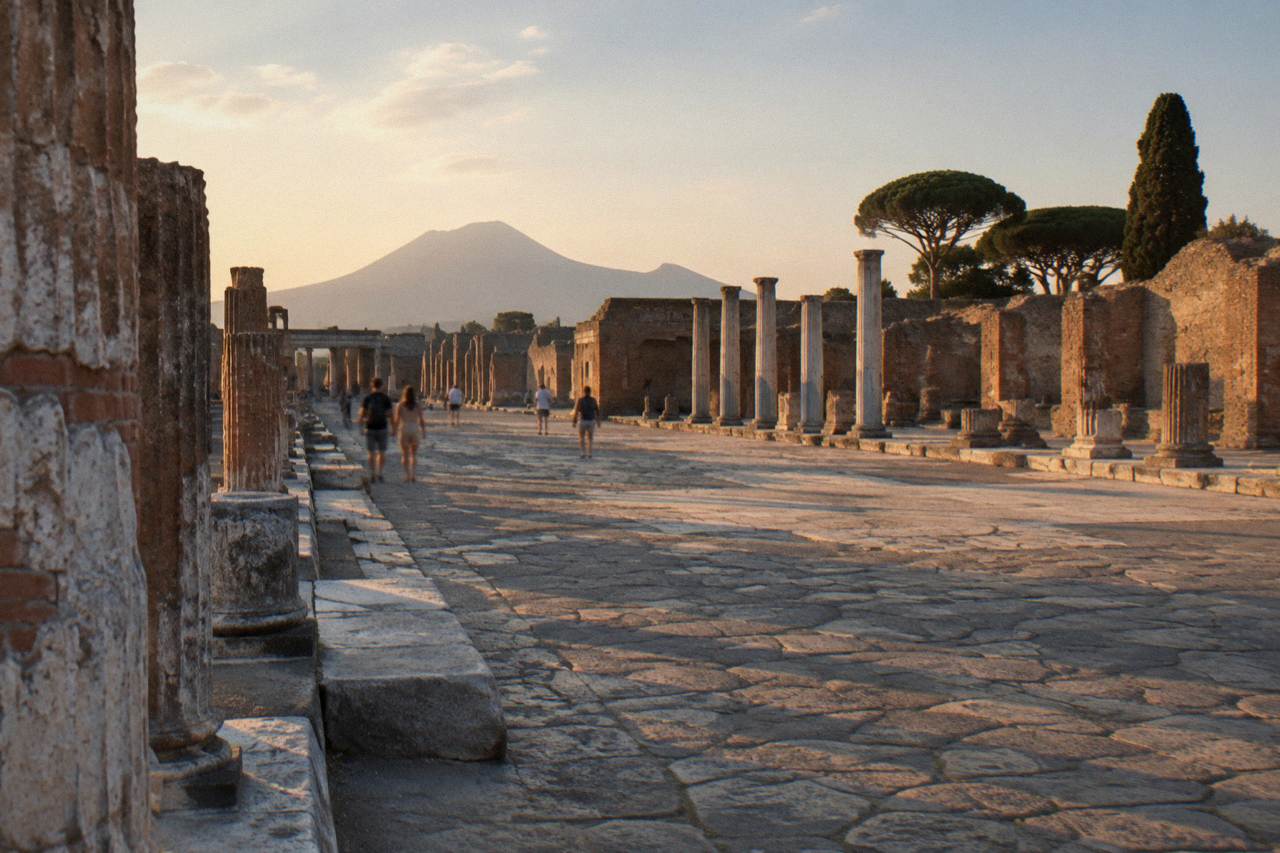
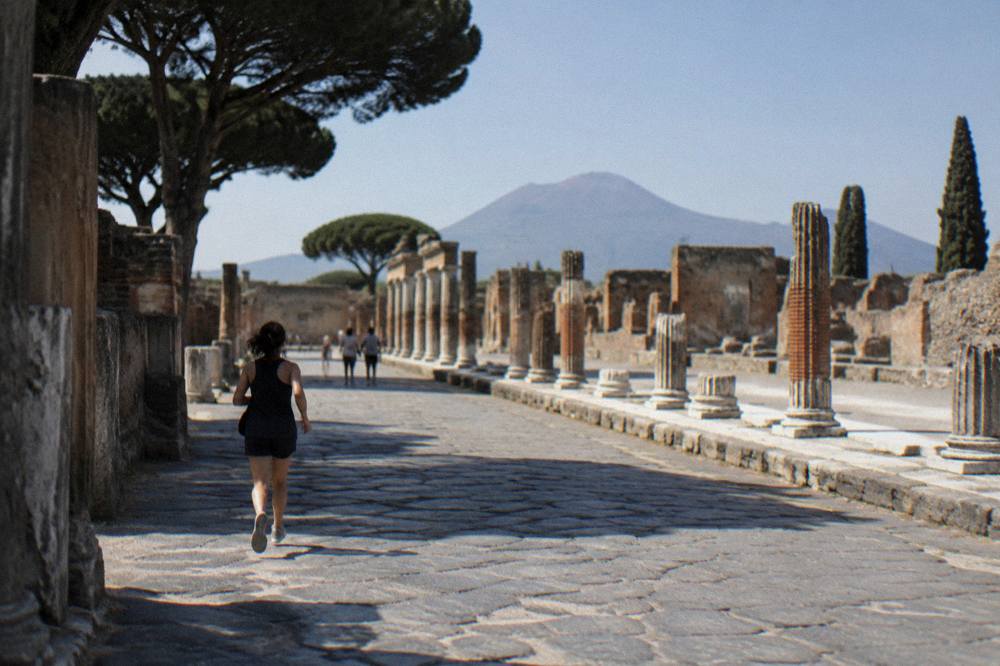
The Forum of Pompeii is the main public square of the ancient city of Pompeii in Campania, Italy: a long paved rectangle ringed by the ruins of colonnades, law courts, temples and civic buildings, which functioned as the city's centre for politics, commerce, justice and religion before the eruption of Vesuvius in AD 79. Every Roman city of consequence had one, and Pompeii's is unusually well preserved because the eruption sealed it rather than smashing it. Today it is one of the largest and most recognisable open spaces inside the Parco Archeologico di Pompei, and the view from its paving, with the silhouette of Vesuvius behind the columns, is among the park's signature sights.
The square's role was deliberately multi-purpose. Along and around it stood the buildings a Roman citizen needed: the basilica where legal business was heard, temples where the city's gods were honoured, municipal offices, and market buildings where goods changed hands. The Forum was where elections were announced, where public notices were posted, and where the city's monumental civic architecture put its wealth on display. Walking it today, you are standing in the one space every resident of the city would have known.
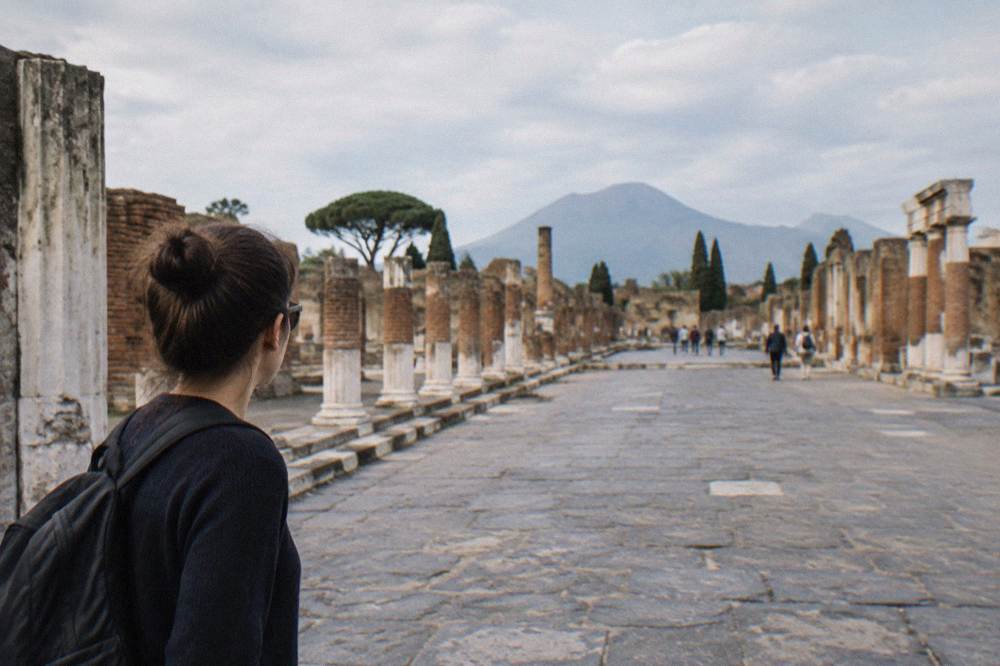
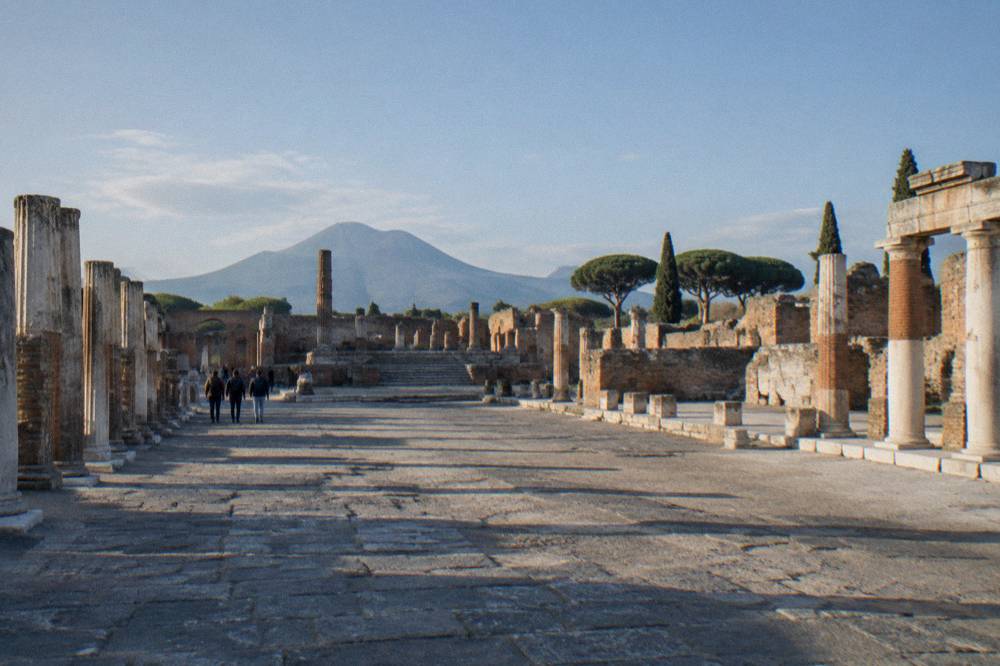
Two features strike visitors first. The first is scale: the paved open area is large enough that even with a busy park it rarely feels cramped, and the surrounding column stumps give a strong sense of enclosure. The second is the backdrop. Vesuvius sits behind the Forum's northern edge when you look along its length, a reminder that the mountain that destroyed the city also froze it in time. Photographers value the square early and late in the day for exactly that combination, and our page on photography tips for the park covers where the light works best.
The Forum also works as an orientation tool. Because it was the city's hub, the main streets converge on or pass near it, so a visitor who plants the Forum in their mental map can strike out confidently in several directions: north towards the baths and the Street of Tombs villas, east towards the amphitheatre and palaestra, or south towards the port-side quarter. The park's own signage marks it clearly, and the free park map shows it at the junction of the principal routes.
Where Is The Forum And Which Entrance Is Closest?
The Forum sits roughly at the centre of the excavated ancient city, and the closest ticketed entrance is Porta Marina, the entrance nearest the Pompei Scavi-Villa dei Misteri Circumvesuviana station; the other ticket offices are at Piazza Esedra and Piazza Anfiteatro, both of which also reach the Forum on foot along the ancient streets. The park has exactly these three ticket offices, plus the Porta Ercolano / Street of the Tombs entrance used for the suburban villas route. Visitors with mobility difficulties enter at Piazza Anfiteatro on the "Pompeii for All" route.
From Porta Marina, the walk to the Forum follows the steep ancient street up from the sea gate and then opens onto the square, and the Forum is commonly the first major monument a visitor sees on that route. From Piazza Anfiteatro at the eastern end, the route runs west through the city past the amphitheatre and the Large Theatre and Odeon before the Forum appears; that entrance pairs naturally with the accessible route, which allows exit at Piazza Anfiteatro or Piazza Esedra via the Antiquarium lift.
Choosing an entrance is mostly a question of your transport and your route. Rail arrivals at Pompei Scavi-Villa dei Misteri step out beside Porta Marina, so that entrance is the default for anyone coming on the Circumvesuviana line from Naples or Sorrento; scheduled times computed from EAV's own timetable data put Napoli Garibaldi to Pompei Scavi at 29 to 35 minutes. Drivers and coach groups often use Piazza Esedra, and visitors combining the park with the accessible route or the amphitheatre quarter do well at Piazza Anfiteatro. The park map page shows all three entrances and the Forum's position relative to each.
The table below summarises the three ticket offices and what each suits.
| Entrance (ticket office) | Nearest transport | Best for | Forum on foot |
|---|---|---|---|
| Porta Marina | Pompei Scavi-Villa dei Misteri station (Circumvesuviana) | Rail arrivals, first-time visitors, the Forum as a first stop | Short walk up from the sea gate |
| Piazza Anfiteatro | Local access on the east side | The "Pompeii for All" accessible route, amphitheatre-first routes | Walk west past theatre quarter |
One route note for visitors adding the suburban villas: Express ticket holders can add the villas route for EUR 8, card payment only, at the Porta Ercolano / Street of the Tombs entrance. That entrance is not a general ticket office, so it does not replace the three above.
For anyone weighing up how to spend a first day at the park, the three options below are the formats that pair best with a Forum-centred visit: a small-group archaeologist tour of Pompeii itself, its Herculaneum counterpart, and a full-day Pompeii and Vesuvius tour with lunch from Naples.
What Can You See In And Around The Forum?
Around the Forum of Pompeii stand the ruins of the buildings that ran Roman civic life: the Basilica, the Temple of Apollo, the temple platforms on the square's northern end, the municipal offices, the food market buildings, and the public baths a short walk away, together with the commemorative statue bases and honorific monuments that lined the colonnades. Nothing else in the park concentrates this many building types in one field of view, which is why guides gather their groups here to explain how a Roman city actually worked.
The Temple of Apollo, on the west side of the square, is one of the park's most recognisable religious buildings, and its dedicated page covers what remains, including the altar and the column stumps of the precinct. Facing it across the square, the Basilica, entered from the Forum's south-west corner, is the city's great law court, whose vast interior hall gives the clearest sense in the park of Roman monumental interior space. Both are covered in depth on their own pages, linked above, and both are stop-one and stop-two on nearly every guided route through the city.
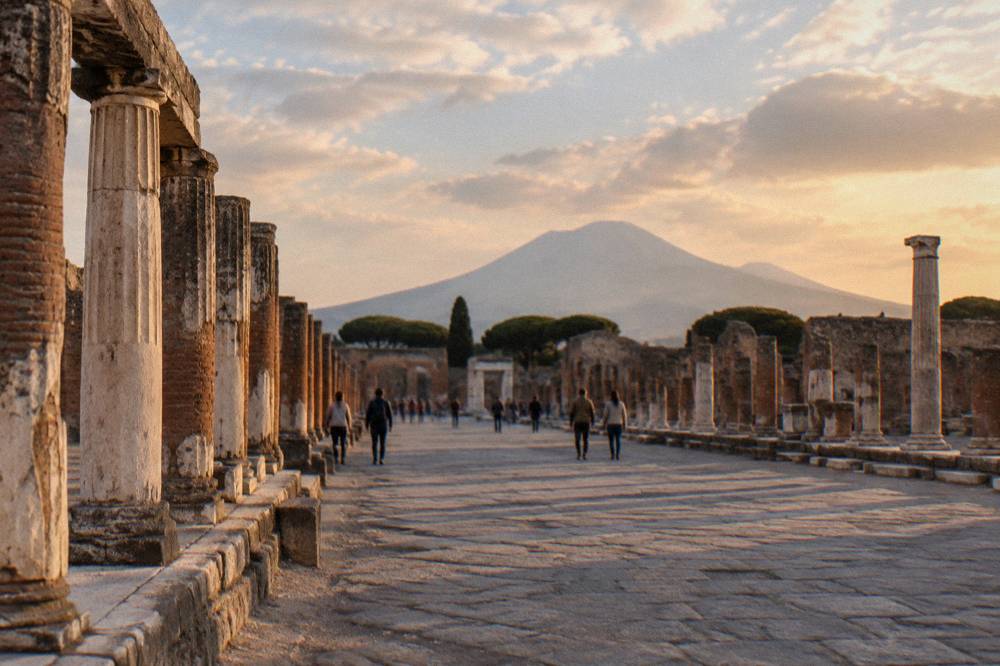
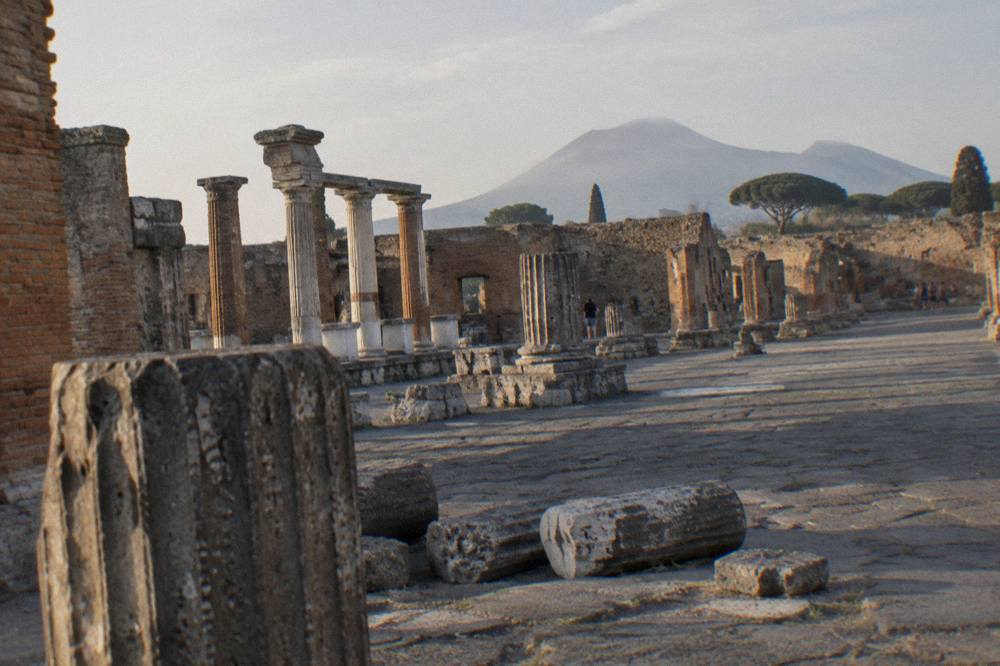
Along the square's flanks ran two-storey colonnades fronting market and civic buildings. On the east side, the market buildings housed stalls and civic offices; the ground floors still show where shopfronts opened onto the portico. At the northern end, the raised temple platforms closed the square with a monumental architectural backdrop, the standard Roman arrangement that gave the Forum its theatrical setting. Statue bases and equestrian monument plinths remain in place, empty now, marking where the city honoured its worthies.
Step out of the square and the density continues. The Forum Baths lie immediately to the north, one of the park's best-preserved bathing complexes; the Stabian Baths are a short walk south. East of the Forum, the food market and the municipal buildings cluster near the start of the main decumanus, while further east lie the theatres and, beyond them, the amphitheatre. Westward, the route drops towards Porta Marina and the Villa of the Mysteries beyond it, covered on our Villa of the Mysteries page. A visitor who spends an hour in and around the Forum touches religion, law, commerce, hygiene and entertainment in a single loop.
For depth on the domestic side of the city, the grand houses pair well with the Forum's public world: the House of the Faun, the House of the Vettii and the House of Menander show how the city's wealthy lived, a deliberate contrast with the civic architecture of the square.
How Much Time Do You Need At The Forum?
Allow 30 to 45 minutes at the Forum itself on a first visit: enough to walk the square, enter the Basilica, view the Temple of Apollo precinct and read the site panels; allow an hour or more with a guide or if you plan to photograph the colonnades in detail. The Forum is a hub rather than a full day's destination, and the park's standard short itineraries treat it as the centrepiece of a two-hour circuit, a format our Pompeii in 2 hours guide lays out stop by stop.
The rest of the day spreads out from it. Weather changes the arithmetic: in summer heat the exposed Forum paving offers no shade, so the timing advice in our summer heat plan recommends early-entry visits that reach the square before the hottest hours.
A guided small-group tour with an archaeologist, one of the formats featured above, walks the Forum among the park's principal monuments with the entry ticket included; you can Check availability on the operator's live listing alongside the tour's own page on this site. Self-guided visitors move at their own pace but miss the building-by-building explanations that make the square legible rather than picturesque.
The table below gives realistic time budgets for the Forum itself and for the loops that include it.
| Visit format | Time at the Forum | Total park time | Suits |
|---|---|---|---|
| Express pass-through | 15-20 min | About 2 hours | Rail connections, short stopovers |
| Standard first visit | 30-45 min | Half day | First-time visitors |
| Guided small-group tour | 45-60 min | About 2 hours plus free time | Visitors wanting interpretation |
| Full-day circuit | 45-60 min plus return visits | Full day | Photographers, enthusiasts, accessible routes |
What Are The 2026 Ticket Prices And Opening Hours?
In 2026 the Pompeii Express ticket, covering the ancient city including the Forum, costs EUR 20; the Pompeii+ ticket costs EUR 25; and the 3-day ticket costs EUR 30, with reduced EUR 2 entry for EU citizens aged 18 to under 25, free entry for under-18s, and free entry for everyone on the first Sunday of each month. These 2026 prices end on 31 December 2026. From 1 January 2027 a single EUR 25 ticket covers all park sites, valid 30 days with one entry per site, while Oplontis, the Stabiae museum and Boscoreale stay EUR 8 individually and the MyPompeii Card stays EUR 45.
Opening hours run in two seasons. From 15 October to 15 March the park opens at 9:00, last entrance is at 15:30 and the site closes at 17:00. From 16 March to 14 October it opens at 9:00, last entrance is at 17:30 and closing is at 19:00. Pompeii itself has no weekly closing day, though Oplontis, the Stabiae villas and museum are closed on Tuesdays, and the park closes on 25 December and 1 January unless otherwise communicated. Full ticket detail, including where the named-entry rules and the daily visitor cap fit in, sits on our Pompeii tickets explained page.
| 2026 ticket | Price (2026) | Covers |
|---|---|---|
| Pompeii Express | EUR 20 | The ancient city, including the Forum |
| Pompeii+ | EUR 25 | City plus suburban villas route and partner sites |
| 3-day ticket | EUR 30 | Pompeii+ plus Oplontis, Stabiae and Boscoreale |
| Other park sites (Oplontis, Stabiae museum, Boscoreale) | EUR 8 each | Each site individually |
| MyPompeii Card (annual) | EUR 45 | Annual pass; EUR 10 reduced |
Since 15 November 2024 the park has used nominative tickets and a 20,000 visitors-per-day cap, so a ticket is personal, non-transferable and non-refundable except in extraordinary closure, and identity documents may be checked at entry. Time-slot capacity from 16 March to 14 October splits the day at 13:00: the 9:00-13:00 window allows a maximum of 15,000 entries and the 13:00-17:30 window a maximum of 5,000. Bags are limited to 30x30x15 cm, with larger items left at left luggage, under the park's visitor regulations. Other pages covering the same trip are gathered on Pompeii Travel Guide.
When Is The Best Time Of Day And Year To See The Forum?
The best time of day at the Forum is the first hour after the 9:00 opening, when the square is quietest, the stones are cool underfoot and the light rakes low across the columns; the last two hours before final entrance are the next best choice. The square is fully exposed, so in the warmer months the difference between a 9:00 arrival and a midday arrival is the difference between comfortable walking and hot paving, and the time-slot system means morning entries are also the scarcer commodity under the daily cap.
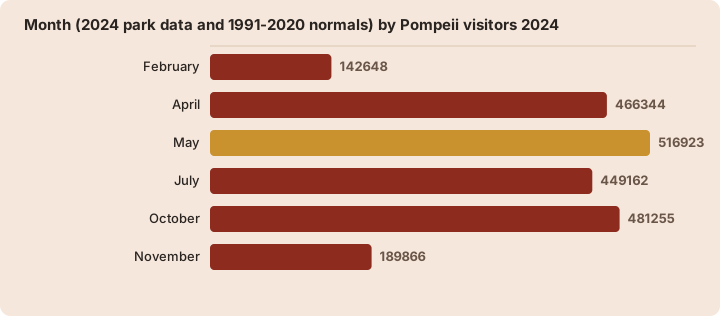
Across the year, the park's own monthly figures for 2024 show the shape of the seasons: May was the busiest month at 516,923 visitors, October followed at 481,255 and September at 468,340, while January counted 112,121 and February 142,648. Late autumn and winter therefore trade longer shadows and shorter days for dramatically thinner crowds, and the 15:30 last entrance of the winter season still leaves a workable window for a Forum-first circuit.
Climate supports the same calculus. Open-Meteo's 1991-2020 reanalysis normals for the Pompei grid point show August with the highest mean daily maximum at about 29.4 C and July the driest month at about 16 mm of rain, while November is the wettest at about 180 mm. April, May and October sit in the comfortable middle, combining daytime maxima of about 17.7 C, 21.6 C and 21.3 C with moderate rainfall, which is why shoulder-season mornings are the reliable sweet spot for photography and unhurried viewing.
| Month (2024 park data and 1991-2020 normals) | Pompeii visitors 2024 | Mean daily max (about) | Rain mm (about) | |---|---|---| | February | 142,648 | 12.6 C | 103 | | April | 466,344 | 17.7 C | 87 | | May | 516,923 | 21.6 C | 59 | | July | 449,162 | 28.7 C | 16 | | October | 481,255 | 21.3 C | 129 | | November | 189,866 | 16.9 C | 180 |
Free-entry first Sundays deserve a special note. Entry is free for everyone on the first Sunday of the month year-round, which makes those days attractive and busy in equal measure, and no reservation system applies to Herculaneum's equivalent free days, where tickets are collected at the office on the day. If a first Sunday is your plan, arrive ahead of the 9:00 opening and go to the Forum first, before the square fills.
Should You Take A Guided Tour Of The Forum?
A guided tour earns its keep at the Forum because the square's value is interpretive rather than visual: the stones are columns and plinths, and a guide's building-by-building narrative is what turns them into a law court, a temple precinct and a market hall; the small-group archaeologist tours sold on this site include the entry ticket and cover the Forum among the highlights. Visitors who prefer independence do fine with the park's signage, and an audio-guide ticket is a workable middle path.
The strongest guided format for a Forum-centred visit is the entry-ticket-plus-archaeologist tour, which walks the square as part of a highlights circuit. It suits visitors who want the interpretive layer without committing to a full day.
A second strong option, for visitors short on time or arriving late in the day, is the skip-the-line archaeologist-led tour, which also runs as a small group and front-loads the queueing question. It covers the same core monuments, the Forum included, in a compact window.
The debate between going guided and going alone has real arguments on both sides, and our guided tour vs self-guided page sets them out, including where an audio guide fits. The short version: the Forum rewards interpretation more than any other single zone of the park, because its monuments are architectural rather than pictorial. Self-guided visitors can partly close the gap with a good guidebook, a subject our Pompeii guidebooks page covers, or with the audio-guide ticket formats available on the tours hub.
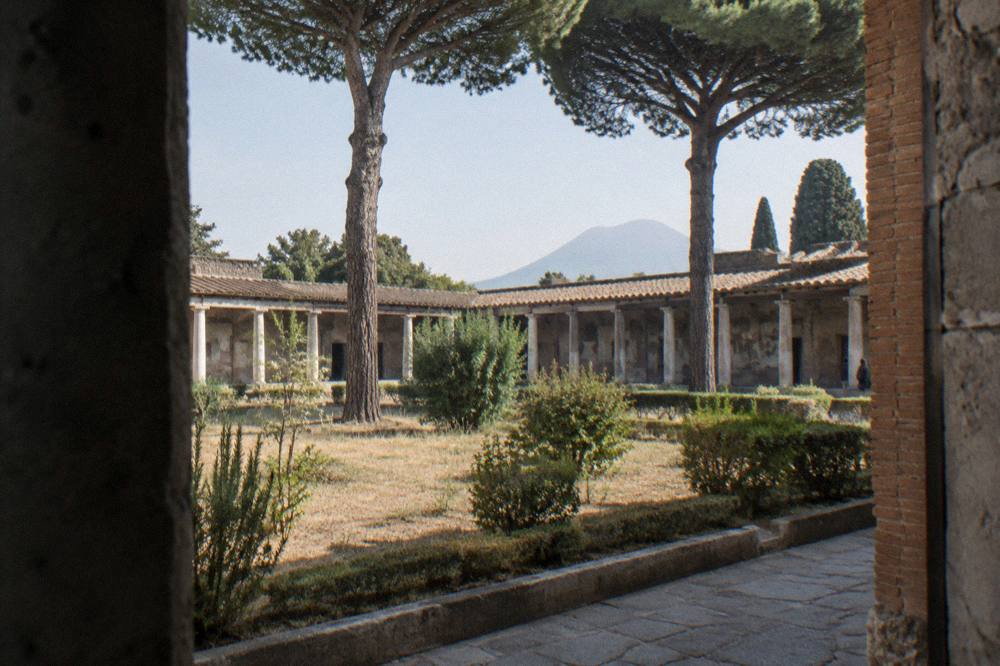
| Way to see the Forum | What you get | Trade-off |
|---|---|---|
| Small-group guided tour | Archaeologist narrative, entry ticket, fixed route | Fixed start time, group pace |
| Skip-the-line guided tour | Same interpretation, queue priority | Shorter at the square itself |
| Audio-guide ticket | Recorded commentary, own pace | No questions answered |
| Self-guided with map and guidebook | Full freedom, own timing | Interpretation is entirely your own work |
How Does The Forum Fit Into A Bigger Pompeii Route?
The Forum works best as the hinge of a route rather than a destination on its own: pair it with the Basilica and Temple of Apollo at the square itself, the Forum Baths immediately north, the theatres to the east, and the Villa of the Mysteries at the far western end for the classic full-day arc. On a two-hour visit, the Forum, the baths, one grand house and the theatre quarter form a realistic loop; on a full day, add the amphitheatre quarter, the Garden of the Fugitives and the suburban villas.
Visitors adding Vesuvius to the same day face a sequencing question, and our page on Pompeii and Vesuvius in one day resolves it: the crater's own access hours are seasonal, running 9-15 in January, February, November and December, 9-16 in March and October, 9-17 in April, May, June and September, and 9-18 in July and August, with online-only timed tickets sold 30 days ahead. Morning-in-the-crater, afternoon-in-the-city is the pattern that fits both sets of hours in the hotter months, which puts the Forum in the afternoon light rather than the dawn light.
For a two-site day, our Pompeii and Herculaneum in one day guide covers the pairing, and the Herculaneum page details the smaller, better-sheltered site, where the Villa dei Papiri and the Ancient Theatre are currently closed for works. A half-day at each is the standard split, and the Forum belongs unambiguously to the Pompeii half.
The Villa of the Mysteries tour below is the deeper-cut guided option for visitors who want the Forum's civic world and the western suburban villa in one interpreted walk, and it suits repeat visitors and archaeology-minded travellers especially.
| Route | Forum's place in it | Total time |
|---|---|---|
| highlights loop | Central stop, first major monument | About 2 hours |
| Half-day circuit | Hub stop, plus baths and one grand house | About 4 hours |
| Full-day city circuit | Mid-morning hub, return visits for photos | Full day |
| Pompeii plus Vesuvius | Afternoon stop when the crater comes first | Full day |
Is The Forum Accessible For Visitors With Limited Mobility?
The accessible "Pompeii for All" route enters at Piazza Anfiteatro and reaches a defined circuit of the park's principal monuments, with exit options at Piazza Anfiteatro or Piazza Esedra via the Antiquarium lift; the ancient paving around the Forum itself is uneven, with deep wheel ruts and stepping stones, so the accessible route's official itinerary is the reliable guide to what is reachable. The park's visitor regulations are the source for the route, and its details, plus practical advice on surfaces, rest points and assistance, are gathered on our Pompeii accessibility page.
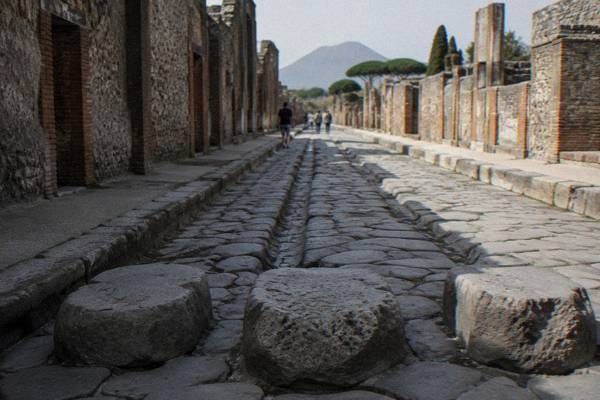
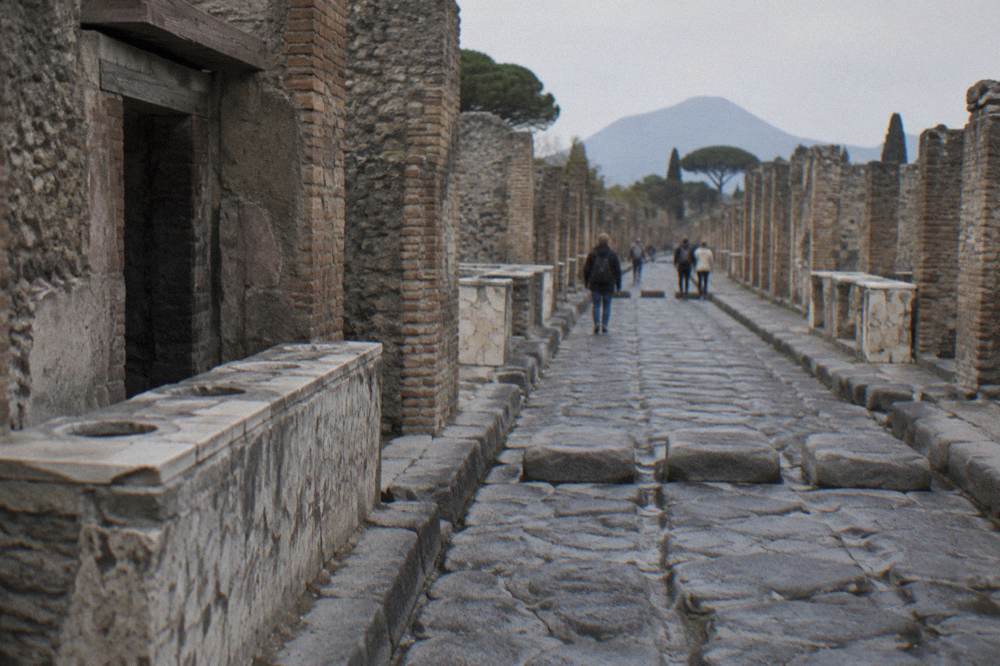
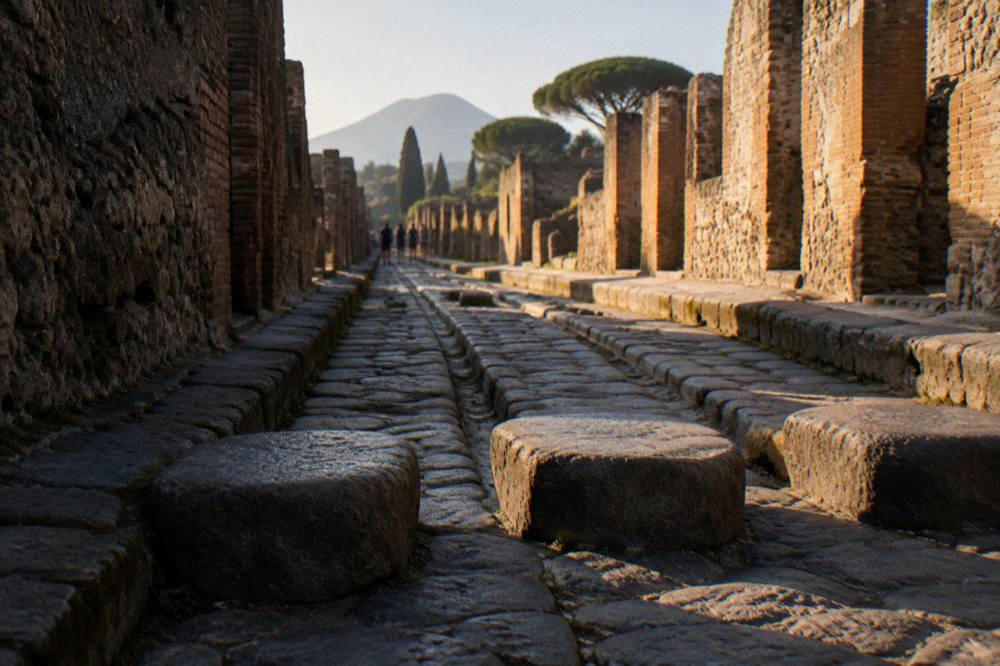
The Forum square's own surface is a factor for every visitor, not only for wheelchair users. Two thousand years of wear have left the paving irregular, and the surrounding streets combine cobble-sized stones with high stepping stones at crossings. Sturdy shoes are the standing advice, and our what to wear to Pompeii page covers footwear, sun protection and the rest of the kit list. Visitors who find long distances difficult benefit from the Artebus shuttle's luggage storage, though the shuttle itself has no disabled access, a limitation worth knowing when planning gear.
Water, shade and toilets are the other practicalities that shape a Forum visit. The square has no shade at all, so in summer each pass across it is a sun-exposed leg; the facilities situation, including where the toilets and water points sit relative to the square, is covered in full on our toilets and facilities page, so it is not repeated here. Combining that knowledge with the entrance choice above, an accessible or heat-sensitive plan usually runs Piazza Anfiteatro in, theatres and Forum, then out via the Antiquarium lift at Piazza Esedra.
Common Questions About The Forum Of Pompeii
What is the Forum of Pompeii?
The Forum of Pompeii is the main public square of the ancient Roman city of Pompeii in Campania, Italy: a large paved rectangle ringed by the ruins of colonnades, the Basilica law court, the Temple of Apollo and other civic and religious buildings, which served as the city's centre for politics, commerce and religion before the eruption of Vesuvius in AD 79.
How much does it cost to see the Forum of Pompeii?
The Forum is part of the general Pompeii ticket, not a separate purchase. In 2026 the Pompeii Express ticket costs EUR 20, Pompeii+ EUR 25 and the 3-day ticket EUR 30, with EUR 2 reduced entry for EU citizens aged 18 to under 25, free entry for under-18s, and free entry for everyone on the first Sunday of the month. From 1 January 2027 a single EUR 25 ticket covers all park sites.
Which entrance is closest to the Forum of Pompeii?
Porta Marina, the entrance beside the Pompei Scavi-Villa dei Misteri Circumvesuviana station, is the closest to the Forum, and the square is commonly the first major monument on the route from it. The other ticket offices are at Piazza Esedra and Piazza Anfiteatro, and the Porta Ercolano / Street of the Tombs entrance serves the suburban villas route.
How long should I spend at the Forum of Pompeii?
Allow 30 to 45 minutes at the Forum on a first visit: enough to cross the square, enter the Basilica, view the Temple of Apollo precinct and absorb the setting. Allow an hour or more with a guide or for photography, and plan the wider park visit around it, from about two hours for a highlights loop to a full day.
Is the Forum of Pompeii accessible?
The park's "Pompeii for All" route enters at Piazza Anfiteatro and allows exit at Piazza Anfiteatro or Piazza Esedra via the Antiquarium lift. The Forum's ancient paving is uneven everywhere, so the official accessible itinerary is the reliable guide to what is reachable, and the park's visitor regulations are the primary source for the route.
When is the best time to visit the Forum of Pompeii?
The first hour after the 9:00 opening is the best time: the square is quietest, the stones are cool and the low light suits photography. Across the year, spring and autumn mornings combine comfortable temperatures with moderate crowds; July is the driest month at about 16 mm of rain and August the hottest at a mean daily maximum of about 29.4 C, while November is the wettest at about 180 mm.
The Forum of Pompeii is the single best place in the park to understand what the buried city was: a working Roman municipality with its law court, temples, market halls and monuments arranged around one open square, all within a short walk of the baths, the theatres and the grand houses that fill out the rest of the site. Plan an entrance, a ticket and a time of day around it, and the rest of the ancient city arranges itself naturally from there.