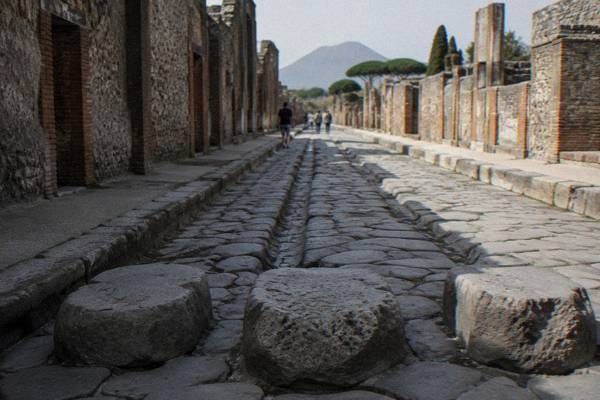
Pompeii Theatre
The theatre district of the ancient city of Pompeii pairs the Large Theatre, the city's main venue for plays, with the smaller roofed Odeon, and this guide covers how to find them, what ticket covers them and when to go.
Short answer
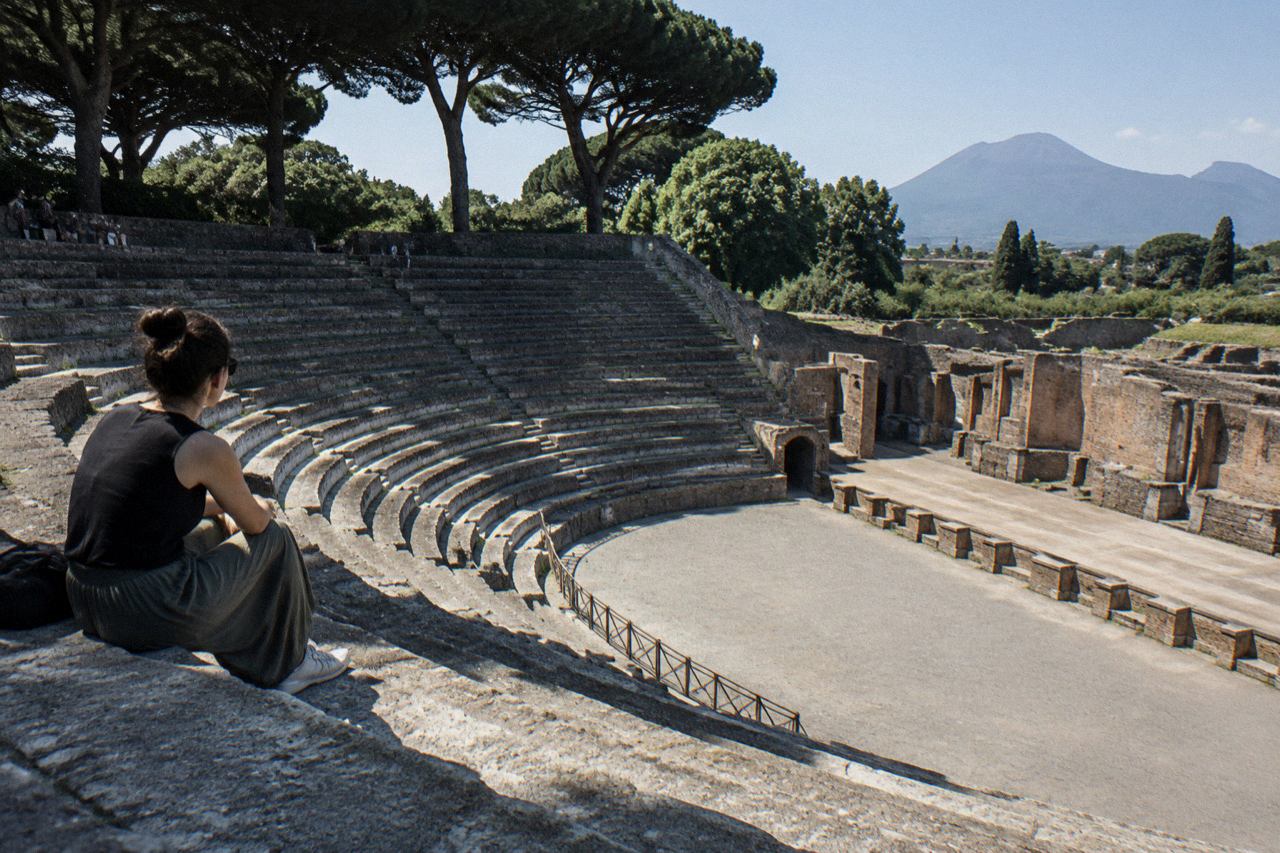
The Pompeii theatre district sits in the south-central part of the ancient city, inside the archaeological park of Pompei in Campania, Italy, about 24 km from Naples. Entry is covered by the standard park ticket, which in 2026 is EUR 20 for the ancient city only. Allow roughly an hour for the theatres themselves within a wider circuit of the ruins.
Pompeii, the ancient Roman city buried by the eruption of Mount Vesuvius in AD 79, lies beside the modern town of Pompei in Campania, southern Italy, about 24 km by road from Naples, and its theatre district is one of the most atmospheric corners of the whole archaeological park. Two performance buildings stand a short walk apart: the Large Theatre, the open-air playhouse cut into the natural slope of the hill, and the smaller Odeon beside it. This guide from Pompeii Travel Guide covers what each building was, how the park's ticket system covers them, and how to fit them into a realistic day on the site.
What Are The Large Theatre And The Odeon Of Pompeii?
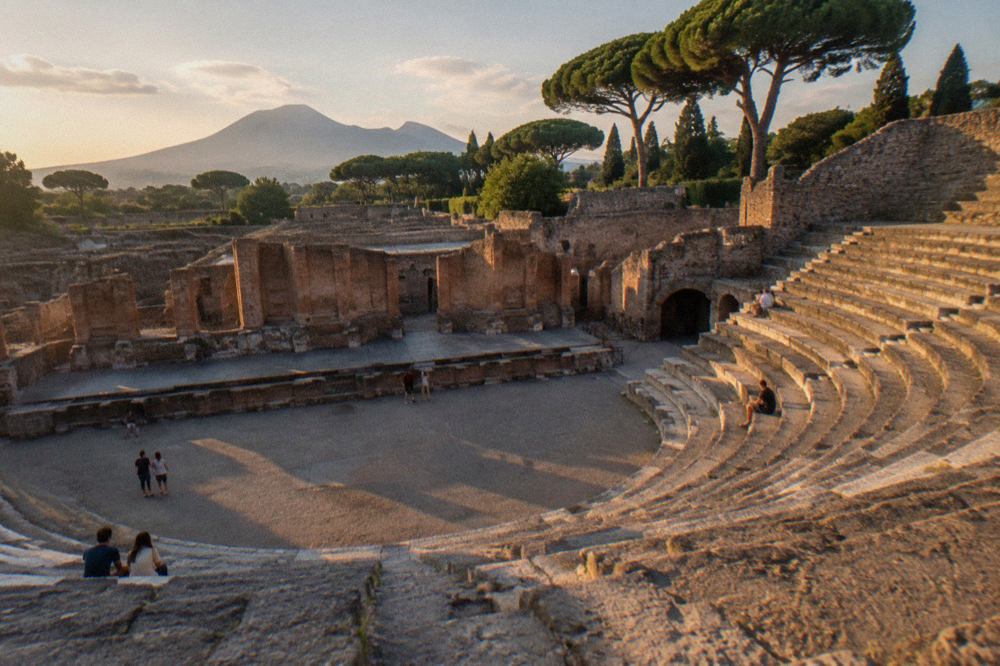
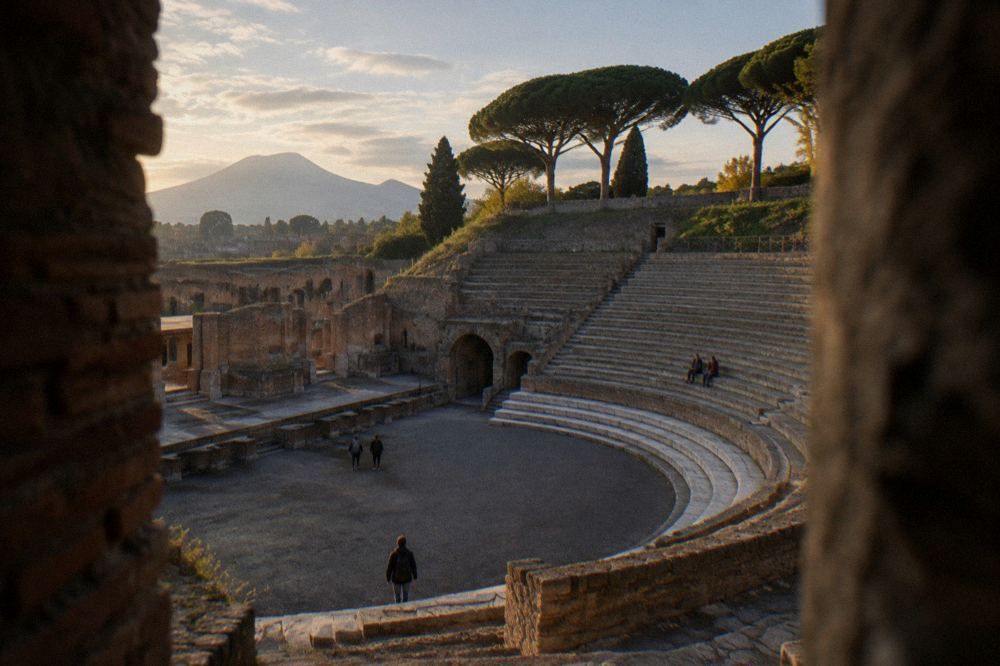
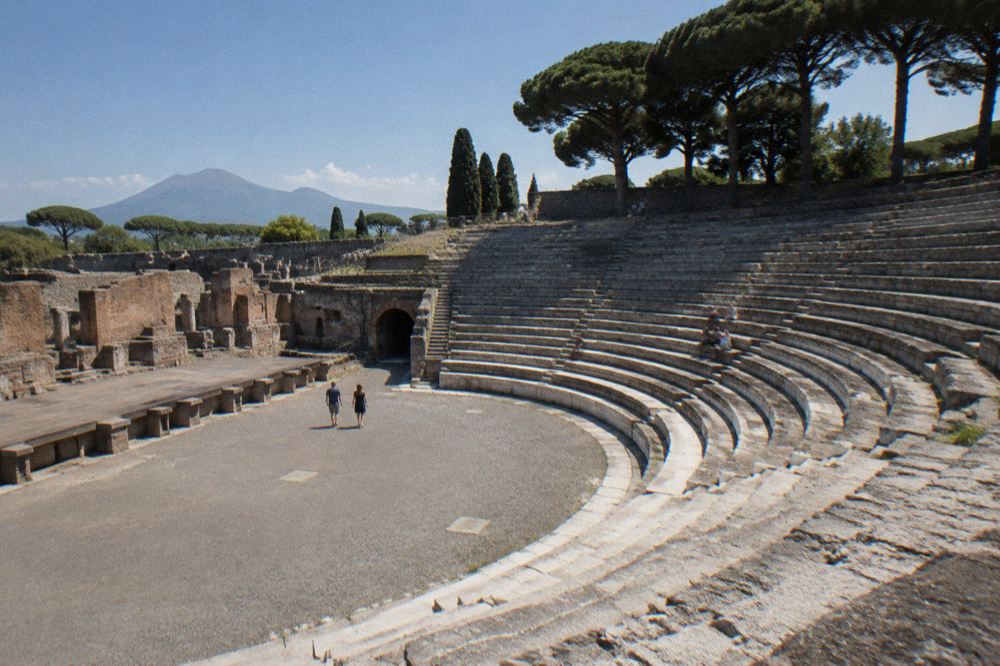
The Large Theatre of Pompeii is the ancient city's principal open-air performance space, built against the natural slope so that the seating rises in banks of stone tiers, while the Odeon immediately beside it is a smaller, originally roofed hall used for music, recitals and meetings rather than large-scale drama. Both were buried by the eruption of AD 79, traditionally dated to 24 August, and both stand today within the excavated 44-hectare area of the archaeological park.
The pairing of a large theatre and an odeon follows a pattern found in Greek and Roman cities across the Mediterranean: one building for the big crowd-pleasing dramas, one for quieter, more formal occasions. At Pompeii the Large Theatre took advantage of the hillside, hollowing the cavea into the slope so spectators looked down on a stage wall that would once have carried painted scenery and architectural decoration. The Odeon, sometimes called the Small Theatre, sits a few paces to the north-east and was designed for a covered, intimate acoustic, the kind of space where a speaker's voice carried without amplification.
The excavation of 44 hectares, out of a UNESCO-inscribed property of 98 hectares, has left the theatres among the most complete public entertainment buildings visible anywhere in the ancient city. Walking them in sequence, first the tight tiers of the Odeon and then the wider sweep of the Large Theatre's seating, gives a clear sense of how Roman Pompeii graded its entertainment from private recital to mass spectacle. For the even larger world of arena blood sport, a different building again served the city, covered in the Pompeii amphitheatre attraction guide.
The two buildings also tell a story about how the city's elite competed for public favour. Large performance venues across the Roman world were funded by wealthy citizens as civic gifts, and the theatre district of Pompeii reflects that culture of competitive generosity, with inscriptions recording benefactors whose names were attached to the seating they paid for. Reading the district as a political landscape as much as an entertainment one adds a layer that a bare visit misses: the seats nearest the stage were the seats of honour, and the social order of the city was written directly into the architecture.
How Do You Reach The Theatre District Inside The Ruins?
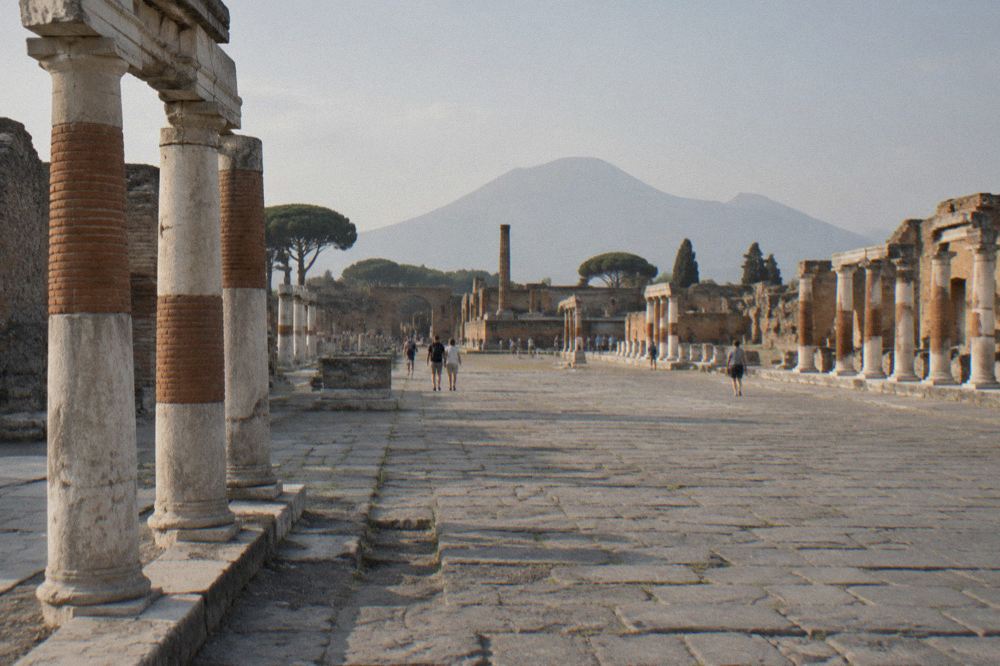
The theatre district sits in the southern part of the ancient city, and the practical route for nearly every visitor is to enter at Porta Marina, the entrance closest to the Pompei Scavi-Villa dei Misteri Circumvesuviana station, walk east along the main decumanus towards the Forum, then turn south into the steep lane that drops to the theatres. Ticket offices operate at Porta Marina, Piazza Esedra and Piazza Anfiteatro, and any of the three admits you to the district.
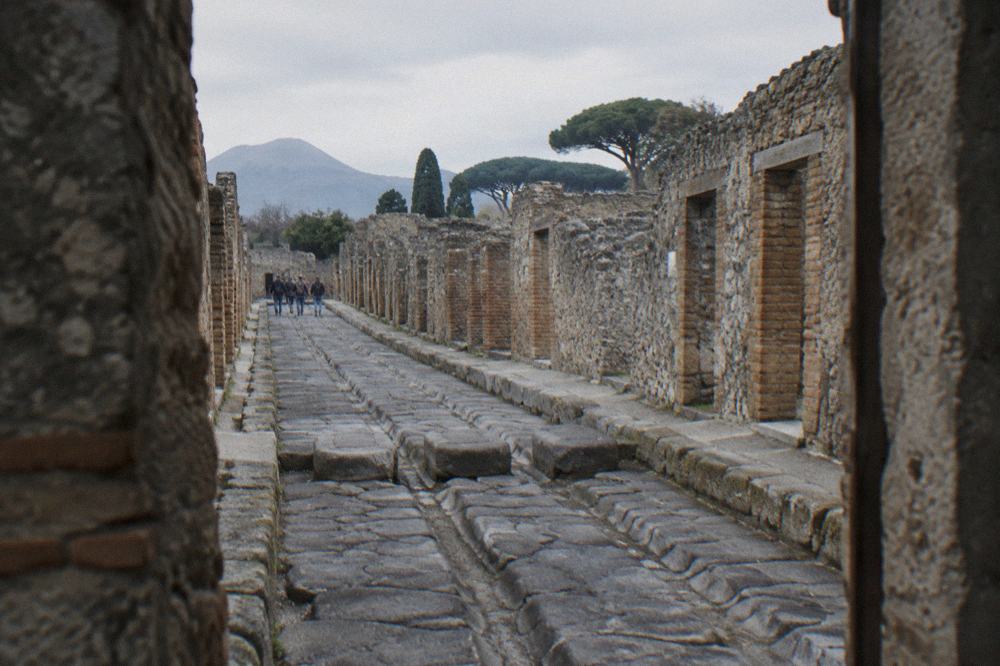
The descent to the theatres is one of the memorable approaches in the park: the street narrows, the hillside drops away, and the upper tiers of the Large Theatre appear above the rooftops of the ancient quarter. Visitors coming the other way, entering at Piazza Anfiteatro in the east of the site, reach the theatres late in a circuit rather than early, which is worth knowing when planning a route. The Forum of Pompeii guide marks the waypoint between the two: the Forum sits roughly between Porta Marina and the theatre quarter, and its colonnades make an obvious orientation stop.
For anyone arriving by train, the station name to look for is Pompei Scavi-Villa dei Misteri, and Porta Marina is the entrance that pairs with it. Scheduled running times computed from the operator EAV's own timetable data put the Circumvesuviana journey from Napoli Garibaldi to Pompei Scavi at 29 to 35 minutes, with the Sorrento leg from Pompei Scavi taking 34 to 40 minutes. One transport note matters for autumn 2026: the Campania Express service has been suspended since 1 October 2026 until further notice, so the regular Circumvesuviana trains are the rail option that remains.
Drivers have a different calculation, since the three ticketed entrances sit at different points around the walls and the choice of parking spot should follow the planned route rather than fight it. The Pompeii parking guide covers where to leave a car for each entrance, and the Pompeii entrances guide compares the three gates in detail. Whichever way you arrive, the theatres reward being reached on a full stomach of Forum sightseeing rather than as a rushed first stop, because the district reads best when the public buildings around it are already in your head.
A guided option saves the route-planning entirely. A small-group archaeologist tour of the city runs two hours and covers the theatre district among the headline buildings, and an express option by train from Sorrento handles both the rail and the routing for visitors based on the peninsula.
What Ticket Do You Need To See The Pompeii Theatre?
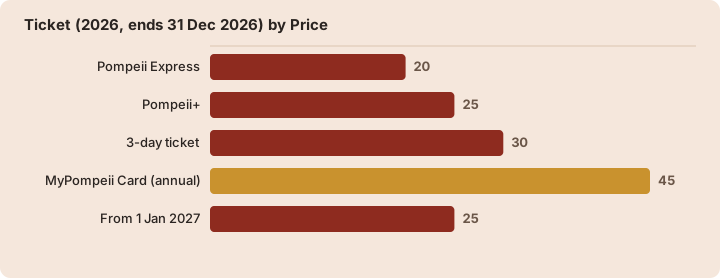
In 2026, the ticket that covers the theatre district is the Pompeii Express at EUR 20, which admits you to the ancient city itself; the Pompeii+ at EUR 25 adds the suburban villas and shuttle, and the 3-day ticket at EUR 30 extends to Oplontis, the Stabiae sites, the Stabiae museum and Boscoreale. From 1 January 2027 the Express and Plus structure ends and a single EUR 25 ticket covers all park sites, valid 30 days with one entry per site.
The 2026 prices, in force since 12 January 2026, are tied to that calendar year and should never be read as permanent. The change confirmed by the park on 14 September 2026 collapses the tiered system into one ticket, while the three smaller sites, Oplontis, Boscoreale and the Stabiae museum, stay at EUR 8 each individually and the MyPompeii annual card stays at EUR 45. Nominative tickets, introduced on 15 November 2024 together with a 20,000-visitors-per-day cap, are retained under the new system, so bring identification.
| Ticket (2026, ends 31 Dec 2026) | Price | What it covers |
|---|---|---|
| Pompeii Express | EUR 20 | The ancient city, including the theatre district |
| Pompeii+ | EUR 25 | City plus suburban villas, Villa Regina, Antiquarium Boscoreale and shuttle |
| 3-day ticket | EUR 30 | Pompeii+ plus Oplontis, Villa Arianna, Villa San Marco, Stabiae museum, Boscoreale |
| MyPompeii Card (annual) | EUR 45 | Annual pass, EUR 10 reduced |
| From 1 Jan 2027 | EUR 25 | One ticket, all park sites, 30 days, one entry per site |
Reductions and free entry follow the park's own rules. Entry is free for everyone under 18 and for all visitors on the first Sunday of the month, and EU citizens aged 18 to under 25 pay a reduced EUR 2. An Express holder can also add the suburban villas route later for EUR 8, card payment only, at the Porta Ercolano / Street of the Tombs entrance, which is a useful escape hatch if a half-day visit turns into a full one. The Pompeii tickets guide carries the full breakdown, and the Pompeii free entry days guide explains how the first-Sunday rule works in practice, including the crowd consequences.
One group deserves a special note. The Praedia of Julia Felix, a large excavated property elsewhere in the city, has been closed to the public since 7 September 2026 for maintenance, so any itinerary that assumed it should be re-cut, and the theatre district is a natural beneficiary of the recovered time. A second dated closure matters for anyone combining the theatre visit with the other Vesuvian sites: at Herculaneum, the Villa dei Papiri is closed for works and the Ancient Theatre is closed until further notice, so a plan built around seeing a second ancient theatre on the same day will not work until those reopenings are announced.
When Are The Theatres Open, And When Should You Go?
From 16 March to 14 October the park opens at 9:00 with last entrance at 17:30 and closing at 19:00; from 15 October to 15 March last entrance is 15:30 and the site closes at 17:00. Pompeii has no weekly closing day, and the only fixed closures are 25 December and 1 January unless the park communicates otherwise. The afternoon slot, capped at 5,000 visitors against the morning's 15,000, is the calmer window for the theatre tiers.
Those caps come from the live time-slot rules on the park's ticketing page, and they shape the day more than any other single number. A morning arrival competes with three times the crowd of the afternoon, and the theatre district, being a natural midpoint of a Porta Marina circuit, tends to fill up by late morning in the high season. Arriving for the 13:00 window trades an hour of daylight for markedly thinner queues on the tier staircases.
| Season | Opens | Last entrance | Closes |
|---|---|---|---|
| 16 March to 14 October | 9:00 | 17:30 | 19:00 |
| 15 October to 15 March | 9:00 | 15:30 | 17:00 |
Weather should shape the choice too. Climate normals for the Pompei grid point, computed from the Open-Meteo archive for 1991-2020, put August's mean daily maximum at about 29.4 C and February's mean minimum at about 6.5 C, so a summer visit rewards the shade of the later afternoon and a winter visit rewards the middle of the day. The stone tiers of the Large Theatre hold heat in August and hold cold in January, and there is little shelter in either season.
| Month | Mean daily max (C) | Mean daily min (C) | Rain (mm) |
|---|---|---|---|
| February | about 12.6 | about 6.5 | 103 |
| May | about 21.6 | about 14.1 | 59 |
| August | about 29.4 | about 21.8 | 22 |
| November | about 16.9 | about 11.5 | 180 |
The monthly pattern also argues for shoulder seasons. May combines a mean maximum of about 21.6 C with only 59 mm of rain across the whole month, and the spring light on the stage wall of the Large Theatre is at its kindest before the summer build-up. November, the wettest month at 180 mm, is the one to approach with a rain plan, since the tier staircases become slick quickly and the descent lane back to the Forum is exposed. The Pompeii weather and best time to visit guide works through all twelve months.
How Long Should You Spend At The Two Theatres?
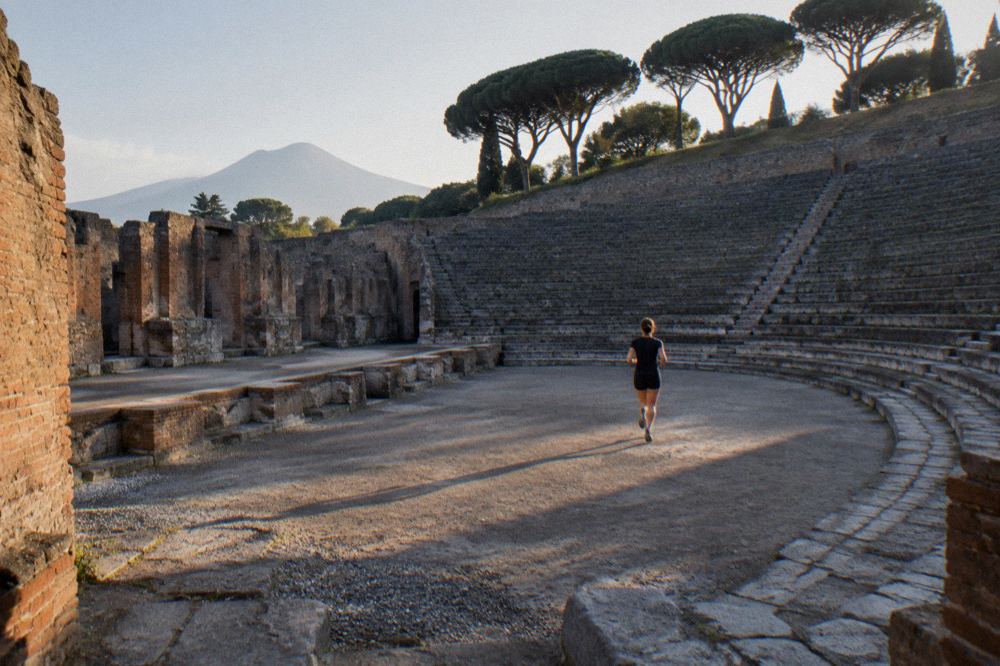
A realistic allowance for the Large Theatre and the Odeon together is 45 minutes to an hour: enough to climb the tiers of each, read the stage area and leave, without turning it into the whole visit. The theatre district rewards a slower pace than a checklist stop, because the acoustic of the Odeon only makes sense when you sit in it, and the view from the upper tiers of the Large Theatre is one of the best sightlines over the southern quarter of the ancient city.
Everything around the theatres compounds the stop. The Quadriporticus behind the Large Theatre, once a colonnaded space associated with the neighbouring gladiarial quarters, extends the walk, and the steep street that returns you towards the Forum passes shops and houses worth pausing at. Visitors deciding between a rushed two-hour dash and a fuller day can weigh the options in the how long to spend in Pompeii guide, while those pairing the theatre district with the suburban villas will find the routing in the Villa of the Mysteries attraction guide, reached in 2026 via the Pompeii+ ticket or the EUR 8 add-on at Porta Ercolano.
Practical constraints from the park's visitor regulations apply throughout: bags larger than 30x30x15 cm must go to left luggage, identification may be checked at every entry because tickets are nominative, and tickets are non-transferable and non-refundable except in cases of extraordinary closure. None of this is theatre-specific, but the tier staircases are exactly the place an oversized bag becomes a problem, and the Pompeii luggage storage guide covers where a case can be left for the day.
What Else Sits Near The Pompeii Theatre District?
A circuit that strings these together is the single most efficient way to see the southern half of the ancient city.**
The House of Menander, covered in its own attraction guide, is the natural next stop after the theatres for anyone interested in domestic architecture, and the Stabian Baths show the bathing culture that complemented the city's entertainment buildings. The House of the Vettii, with its frescoed interiors, lies a little further north and pairs well with a Forum loop. Visitors with a full day can extend east to the amphitheatre quarter and, in the opposite direction, out to the Villa of the Mysteries at the city's edge.
For a change of register entirely, the park sits in wine country. The slopes of Vesuvius, whose crater and trail are covered in the Mount Vesuvius attraction guide, produce the wines poured at tastings a short drive from the walls, and a combined tour with lunch and wine from Naples is one way to book the pairing without hiring a car.
Is The Theatre District Good For A Guided Tour?
A guided tour serves the theatre district well, because the buildings answer questions a bare stone shell cannot: what the roof of the Odeon was made of, how the Large Theatre's acoustics worked, and how the entertainment quarter related to the politics of the Forum next door. The site's roster includes archaeologist-led small-group tours, skip-the-line options and entry-plus-audio-guide products, and the choice between them is mostly a choice of depth versus freedom.
The audio-guide route suits independent travellers who want to set their own pace through the tiers and the surrounding lanes. Guided small groups trade that freedom for narrative, and the archaeologist-led formats in particular are built around exactly the kind of building history the theatre district raises. The Pompeii guided tour versus self-guided guide sets out the trade-offs in full, and the cruise-ship crowd has its own timing constraints covered in the Pompeii cruise ship day guide.
One caution carries over from the wider site: the eruption date is genuinely debated. Pliny the Younger's oldest manuscripts give 24 August AD 79, while the park's own e-journal states that the alternative 24 October date has no evidentiary basis, tracing it to a 1929 misreading, while also noting that 24 August is not necessarily settled either. Any guide who flattens that debate into a single confident date is oversimplifying what the park itself presents as open.
What Should You Know Before You Go?
Bring identification for the nominative ticket check, keep bags within 30x30x15 cm, and plan water for the tiers, which have no shade; the theatres are reached on foot from any of the three ticketed entrances, Porta Marina, Piazza Esedra and Piazza Anfiteatro, and visitors with mobility difficulties should know that the Pompeii for All route enters at Piazza Anfiteatro, on the far side of the site from the theatres.
The mobility point deserves honesty: the theatre district occupies a slope, and its staircases are original stone. The accessible route described in the park's regulations, entering at Piazza Anfiteatro with an exit option at Piazza Esedra via the Antiquarium lift, serves the eastern half of the site better than the deep south, and the Pompeii accessibility guide covers what is realistic. Footwear advice follows the same terrain logic and is set out in the what to wear to Pompeii guide.
Food and water need planning too, since the theatre tiers sit a long walk from the site's cafés and the summer heat is real. The Pompeii food in the park guide maps what can be bought inside the walls, and the where to eat in Pompei guide covers the modern town just outside, where the full range of Campanian cooking waits a short walk from the Porta Marina exit.
Common Questions About The Pompeii Theatre
Is the Pompeii theatre included in the standard ticket?
Yes. In 2026 the Pompeii Express at EUR 20 covers the ancient city including the theatre district, and from 1 January 2027 the single EUR 25 ticket covering all park sites includes it too.
Can you go inside the Large Theatre and the Odeon?
Yes, both buildings can be entered and their seating tiers climbed during normal opening hours, subject to any temporary closure the park announces on its official channels.
How long does the theatre district take to visit?
Allow 45 minutes to an hour for both theatres at a comfortable pace, longer if you sit in the tiers and take in the acoustics and the views over the southern quarter.
Which entrance is closest to the theatres?
Porta Marina is the entrance that pairs with the standard arrival from the Pompei Scavi-Villa dei Misteri station, with the theatres reached via the Forum; Piazza Anfiteatro lies at the opposite end of the site.
Is the Pompeii theatre the same as the amphitheatre?
No. The Large Theatre staged plays in a semicircular seating arrangement, while the amphitheatre east of the centre is an oval arena for gladiatorial spectacle, a separate building covered in its own guide on this site.
The theatre district rewards exactly the kind of unhurried visit the park's slot system makes possible in the afternoon: an hour among the tiers of the Odeon and the Large Theatre, a slow climb back up to the Forum, and a sense of Roman Pompeii as a city that planned its entertainment as carefully as its politics.