Pompeii Highlights
The Forum, the Villa of the Mysteries, the Lupanar, the Garden of the Fugitives: the essential half-day route through Pompeii, in the order that actually works on the ground.
Short answer
Pompeii's half-day highlights are the Forum, the Basilica, the Stabian Baths, the House of the Faun area, the Lupanar and the Garden of the Fugitives, walked in roughly that order from Porta Marina. The 2026 Pompeii Express ticket costs EUR 20 and covers the ancient city alone; from 1 January 2027 a single EUR 25 ticket covers all park sites.
Pompeii, the ancient Roman city buried by the eruption of Mount Vesuvius in AD 79, sits in Campania, southern Italy, beside the modern town of Pompei and about 24 km by road from Naples. Its excavated area covers 44 ha, and nobody sees all of it in half a day. What a half day does allow is a coherent walk through the city's centre of power, its baths, its most famous houses and its most sobering memorial, ending at an entrance with a train station or a shuttle within reach. This page lays out that walk stop by stop, with the 2026 ticket structure, the hours, the entrances and the seasonal realities that decide whether the route takes three hours or five.
Which Ticket Do You Need For The Pompeii Highlights?
For the ancient city's core highlights in half a day, the 2026 Pompeii Express ticket at EUR 20 is the right product, because everything on this route lies inside the excavated city itself, from the Forum and the baths to the Garden of the Fugitives and the Amphitheatre. The Pompeii+ ticket at EUR 25 adds the suburban villas (the Villa of the Mysteries and Villa diomedes), Villa Regina and the Antiquarium at Boscoreale with a shuttle, worth it only if you can stretch past half a day. The 3-day ticket at EUR 30 adds Oplontis, the Stabiae villas and museum, and Boscoreale. Entry is free for under-18s and for everyone on the first Sunday of the month, and EU citizens aged 18 to under 25 pay a reduced EUR 2. One structural change matters for planning: from 1 January 2027 the Express/Plus/3-day structure ends and a single EUR 25 ticket covers all park sites, valid 30 days, one entry per site, with Oplontis, the Stabiae museum and Boscoreale staying at EUR 8 each.
The ticket detail trips up visitors who arrive by train at Pompei Scavi-Villa dei Misteri. The Villa of the Mysteries, one of the route's finales below, sits outside the Express ticket's coverage: Express holders can add the suburban villas route for EUR 8, card payment only, at the Porta Ercolano / Street of the Tombs entrance.
| Ticket (2026, until 31 Dec 2026) | Price | What it covers |
|---|---|---|
| Pompeii Express | EUR 20 | The ancient city only |
| Pompeii+ | EUR 25 | City plus suburban villas, Villa Regina, Boscoreale Antiquarium, shuttle |
| 3-day ticket | EUR 30 | Pompeii+ plus Oplontis, Stabiae villas and museum, Boscoreale |
| Suburban villas add-on | EUR 8 | For Express holders, card only, at Porta Ercolano / Street of the Tombs |
| Other park sites (each) | EUR 8 | Oplontis, Stabiae museum, Boscoreale individually |
| My Pompeii Card (annual) | EUR 45 | Annual pass, EUR 10 reduced |
Tickets are nominative and identity documents can be checked at entry; they are non-transferable and non-refundable except for extraordinary closure. A daily cap of 20,000 visitors has applied since 15 November 2024, and in the 16 March to 14 October season the park splits the day into time bands: 9:00-13:00 admits up to 15,000 visitors and 13:00-17:30 up to 5,000. The full detail on timed entry and free days is covered on the Pompeii tickets explained page.
If the whole business of routes and time bands sounds like work you would rather not do on a holiday morning, a guided product does the sequencing for you. The Sorrento skip-the-line express tour runs this exact problem to ground: train from Sorrento, entry handled, guide-led walk through the core, and you can Check availability on the operator's live listing.
Where Should A Half-Day Walk Of Pompeii Start?
The suburban villas route uses the Porta Ercolano / Street of the Tombs entrance, reached through the city, not from outside. There is no wrong entrance for this route, but there is a wrong direction: starting at the far end near the Amphitheatre means walking the longest leg first with the least shade.
Scheduled run times computed from EAV's own timetable data put the Circumvesuviana from Napoli Garibaldi to Pompei Scavi-Villa dei Misteri at 29 to 35 minutes, and from Pompei Scavi to Sorrento at 34 to 40 minutes. Road distances to the Scavi station, measured on OpenStreetMap routing, are 24 km from Naples, 26 km from Sorrento and 31 km from Salerno. The station-to-entrance walk from Pompei Scavi to Porta Marina is short and signposted; the guide to the Scavi station covers the arrival logistics in detail.
What Are The Essential Stops In The City Centre?
The unmissable centre is a four-stop sequence: the Forum with its Temple of Apollo and the Basilica, the Stabian Baths, the House of the Faun, and the Lupanar, linked by the Via dell'Abbondanza, the city's main east-west street. Each stop rewards a different kind of attention: the Forum for scale and politics, the Basilica for Roman engineering, the baths for everyday social life, and the House of the Faun for the richest house on the route. A half day adds the western and southern quarters, the plaster casts and, with the right ticket, the Villa of the Mysteries at the end.
The Forum was the city's civic heart, an open rectangular square framed by public buildings with Vesuvius rising directly behind it. The Temple of Apollo, one of the oldest religious buildings in the city, and the Basilica, the law court whose vast brick arcades still stand, anchor its short ends. From the Forum the route turns onto the Via dell'Abbondanza and heads east; the street's full length and its shopfronts, including the famous thermopolium counters, are described on the Via dell'Abbondanza page.
| Stop | What it is | Why it makes the cut |
|---|---|---|
| The Forum | Civic and religious square | The city's centre of power, with the temple and Basilica at its ends |
| The Basilica | Roman law court | The clearest standing architecture of public Roman Pompeii |
| Stabian Baths | Oldest bath complex in the city | Intact changing rooms, palaestra and hypocaust system |
| House of the Faun | Grandest private house excavated | Home of the Alexander Mosaic findspot and the dancing faun statue |
| The Lupanar | Purpose-built brothel | Frescoed rooms and the famous graphic signage |
| Garden of the Fugitives | Cast memorial site | Thirteen plaster casts of victims where they fell |
The Stabian Baths predate the other bath complexes of the city and show the full machinery of Roman bathing in a compact footprint: the palaestra for exercise, the sequence of hot, warm and cold rooms, and the raised floor that carried the underfloor heating. A circuit takes fifteen to twenty minutes at a reading pace. The House of the Faun then delivers the domestic spectacle, occupying an entire insula and named for the small bronze faun dancing in its impluvium; the Alexander Mosaic was found here and is now in Naples, a fact worth knowing so the floor copy does not disappoint. The Lupanar completes the central run: small, stark and heavily visited, it needs ten minutes, not more.
Practical notes collected on the route: bags larger than 30x30x15 cm must go to left luggage, per the visitor regulations, and bare chests are prohibited. There is no shade to speak of between the Forum and the eastern stops, which is why the seasonal planning section below matters more than any packing list.
How Do You Reach The Garden Of The Fugitives And The Amphitheatre?
The casts are the emotional centre of a Pompeii visit for many travellers: they are not skeletal remains but plaster poured into voids left in the ash, a technique developed in the excavation era, and the display is deliberately restrained.
The Garden of the Fugitives page explains how the casts were made and what the room-by-room display shows. Piazza Anfiteatro is also the accessible entrance: the "Pompeii for All" route starts here, and visitors with mobility difficulties enter at this piazza and may exit at Piazza Anfiteatro or Piazza Esedra via the Antiquarium lift.
Do not build a route around it. The full index of guides sits on Pompeii Travel Guide.
Should The Villa Of The Mysteries End The Walk?
Yes, if you have the Pompeii+ ticket or the EUR 8 add-on and roughly forty minutes left, the Villa of the Mysteries is the strongest possible finale, because it lies beyond the Porta Ercolano gates on the way back toward Porta Marina and the train station, closing the loop without backtracking. The villa carries the finest figurative fresco cycle surviving from the site, a continuous frieze of life-sized figures around a single grand room, and it stands outside the crowded city core, so the last hour of the day is often its calmest. Express holders buy the add-on with a card at the Porta Ercolano / Street of the Tombs entrance itself.
The walk out through Porta Ercolano passes the Street of the Tombs, the necropolis where the city's dead lined the road outside the walls, a striking inversion of the domestic interiors you have just left. The Villa of the Mysteries page covers the fresco cycle in depth, and the Pompeii necropolis guide the tombs. If the clock or the ticket says no, skip the villa and exit through Porta Marina directly; the station is minutes away and the modern town's cafés closer still, as the where to eat in Pompei guide sets out.
For visitors measuring the day against Herculaneum or Vesuvius rather than against a train timetable, the honest comparison is that a half day fits the Pompeii highlights alone, and a second half day is what a two-site plan needs. The Pompeii and Herculaneum in one day itinerary and the Pompeii and Vesuvius in one day itinerary each sequence that bigger day, and both start from the same entrance logic described above.
How Long Does The Full Highlights Route Take?
The full route, Porta Marina to Forum to baths to House of the Faun to Lupanar to Garden of the Fugitives to Amphitheatre and back through Porta Ercolano with the Villa of the Mysteries, takes about four to five hours at a steady walking pace with short stops, which is what a half day actually means here. Cutting the Amphitheatre leg shortens it to about three hours; adding Herculaneum or Vesuvius makes it a full day and needs its own plan. The variable that moves the number most is not fitness but crowding: the Forum and the Lupanar bottleneck in the middle of the day, and a 9:00 entry moves every queue.
The park's own numbers show why early matters. Monthly visitor counts for the Pompeii site in 2024 peaked at 516,923 in May, with April at 466,344 and October at 481,255, against 112,121 in January; the annual total was 4,069,377, and 2025 finished at 4,000,090. Those spring and autumn peaks arrive with cruise-transfer waves and school groups, and the 13:00-17:30 band's smaller cap of 5,000 makes afternoons structurally quieter once the morning wave has been absorbed.
| Route variant | Time on site | What you keep | What you drop |
|---|---|---|---|
| Two-hour core | About 2 hours | Forum, Basilica, Stabian Baths, House of the Faun, Lupanar | Casts, Amphitheatre, villas |
| Half-day highlights (this route) | About 4-5 hours | Everything above plus Garden of the Fugitives, Amphitheatre, Villa of the Mysteries | Boscoreale, Oplontis, Stabiae |
| One-day full city | A full day | The half-day route plus western and northern quarters | Only the outlying park sites |
The deeper itineraries are sequenced on their own pages: the one-day Pompeii itinerary, the two-day Pompeii, Herculaneum and Vesuvius plan and the cruise-ship day itinerary for visitors whose half day is fixed by a ship's departure. Families walking with children have a dedicated Pompeii with kids itinerary that shortens this same spine and adds the stops that hold small attention spans.
When Should You Walk The Route?
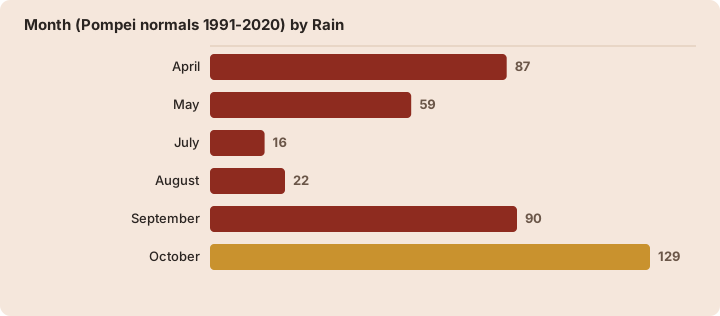
The best months for this walk are April, May, late September and October, when Pompei's 1991-2020 climate normals show about 15-22 C daily highs and modest rain, and the worst are July and August, when mean daily maxima reach about 28.7 C and 29.4 C with almost no rain and little shade on the route. November is the wettest month at about 180 mm of rain against July's 16 mm, and February has the lowest mean daily minimum at about 6.5 C. These figures come from the Open-Meteo historical archive for the Pompei grid point, a reanalysis grid rather than a weather station, so treat them as planning ranges. The weather and best-time guide carries the full twelve months.
| Month (Pompei normals 1991-2020) | Mean daily max | Mean daily min | Rain |
|---|---|---|---|
| April | About 17.7 C | About 10.4 C | About 87 mm |
| May | About 21.6 C | About 14.1 C | About 59 mm |
| July | About 28.7 C | About 21.1 C | About 16 mm |
| August | About 29.4 C | About 21.8 C | About 22 mm |
| September | About 25.3 C | About 18.6 C | About 90 mm |
| October | About 21.3 C | About 15.1 C | About 129 mm |
Summer walkers should invert the instinct to linger: enter at 9:00, do the exposed Forum and Amphitheatre legs before midday, and leave the Villa of the Mysteries, which is partly indoors, for the early afternoon. The Pompeii in summer heat plan sequences exactly that day, with water and shade points marked. What to wear on the uneven basalt paving, beyond the obvious "no bare chests" the regulations state, is covered on the what to wear page.
What Hours And Entrances Govern The Half Day?
Your half day is governed by the site's posted opening hours and the entrance you pick: the main gate generally offers the longest access and sits closest to the top highlights, while side entrances often run limited hours and may close earlier, so time your arrival around the main gate's opening, verify the current schedule, and plan your route from there.
| Period (2026 schedule) | Opens | Last entrance | Closes |
|---|---|---|---|
| 16 March to 14 October | 9:00 | 17:30 | 19:00 |
| 15 October to 15 March | 9:00 | 15:30 | 17:00 |
One transport fact belongs in this section rather than buried elsewhere: the Campania Express train service has been suspended since 1 October 2026 until further notice, with refunds handled through EAV's complaints form or the original seller. Anyone planning around that line should plan around the Circumvesuviana instead, whose station Pompei Scavi-Villa dei Misteri serves the Porta Marina entrance. The Circumvesuviana guide has the operational detail.
Is A Guide Worth It On This Route?
A guide earns its place on exactly the stops where a label cannot carry the meaning, above all the Forum, the Stabian Baths and the Villa of the Mysteries fresco cycle, while the open streets between stops are self-explanatory; a small-group archaeologist-led walk costs from USD figures shown on the live listings and covers the same spine described above. The debate is laid out honestly on the guided tour versus self-guided page: the site is walkable alone with a good map or audio guide, but the interpretive layer on the highlights is where guides add the difference between seeing rubble and reading a city. The interactive map covers the self-guided case.
A visitor with one half day and no guide spends part of it orienteering; the same visitor with a guide spends all of it looking. The products below are the ones whose formats match this route most directly, and each card carries its own price, rating and review count from the live listing.
The same logic extends outward. Travellers based in Naples tend toward day products that bundle transport with the guide, a category the tours from Naples page surveys; Sorrento-based travellers have their own set on the tours from Sorrento page, and cruisers a dedicated shore excursions guide. Whichever base applies, the walk underneath is still this one: Forum, baths, houses, casts, amphitheatre, villa.
Common Questions About The Pompeii Highlights Route
Can I see the Pompeii highlights in half a day?
Yes. The Forum, Stabian Baths, House of the Faun, Lupanar, Garden of the Fugitives and Amphitheatre form a walkable four-to-five-hour circuit, and cutting the Amphitheatre leg brings it to about three hours. The Villa of the Mysteries fits at the end with the Pompeii+ ticket or the EUR 8 add-on.
Which entrance is best for the highlights route?
Porta Marina, the entrance nearest the Pompei Scavi-Villa dei Misteri station, starts the route at the Forum end. Piazza Esedra and Piazza Anfiteatro are the other ticket offices; the suburban villas route uses the Porta Ercolano / Street of the Tombs entrance.
Is the Villa of the Mysteries included in the 2026 ticket?
The 2026 Pompeii Express at EUR 20 covers the ancient city only. Pompeii+ at EUR 25 adds the suburban villas, or Express holders can pay EUR 8 by card at the Porta Ercolano / Street of the Tombs entrance. From 1 January 2027 a single EUR 25 ticket covers all park sites.
What is the best time of day to start?
9:00, at opening. The morning time band carries the larger visitor cap, the shade is longer before midday, and the exposed Forum and Amphitheatre legs are best walked early, especially from June to August when mean daily maxima are about 29 C.
Are the body casts on this route?
Yes. The Garden of the Fugitives displays thirteen plaster casts under a shelter on the southern leg between the Via dell'Abbondanza and the Amphitheatre. They are plaster reproductions of voids in the ash, not skeletal remains.
Is anything on the route currently closed?
The Praedia of Julia Felix has been closed to the public since 7 September 2026 for maintenance, until further notice, so it is not part of any current plan. Check the park's own comunicati page in the week you travel for any newer closure.
Where Does This Route Leave You At The End?
The route ends either at Porta Marina, minutes from the Pompei Scavi-Villa dei Misteri station and the modern town's cafés, or at the Villa of the Mysteries' side of Porta Ercolano with a short walk back to the same station, so the end point feeds directly into a train, a shuttle or a late lunch without crossing the site twice. That asymmetry is the quiet advantage of this direction of travel over its reverse: the longest exposed legs come early, the shade and the seats come late, and the exit is the one with the transport attached. From here the day either ends in the modern town or grows: the day trip guides to Naples and the Amalfi Coast pick up the thread for travellers with the whole region on the ticket.
Walk it early, carry water, buy the ticket for what you will actually see, and the highlights of this city deliver more in half a day than most sites manage in two.