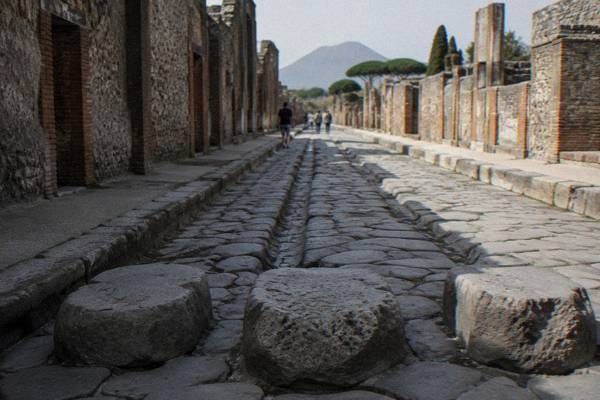
House Of The Vettii
The House of the Vettii is one of the most richly decorated houses open inside the archaeological park of Pompeii in Campania, southern Italy, about 24 km from Naples. This guide covers what to see, which ticket covers it and how to time the visit.
Short answer
The House of the Vettii stands inside the ancient city of Pompeii, included in every Pompeii park ticket: the 2026 Pompeii Express costs EUR 20 and Pompeii+ costs EUR 25, with a single EUR 25 ticket for all park sites from 1 January 2027. Opening is 9:00 to 19:00 in the summer season and 9:00 to 17:00 in winter, with a 20,000 visitors per day cap.
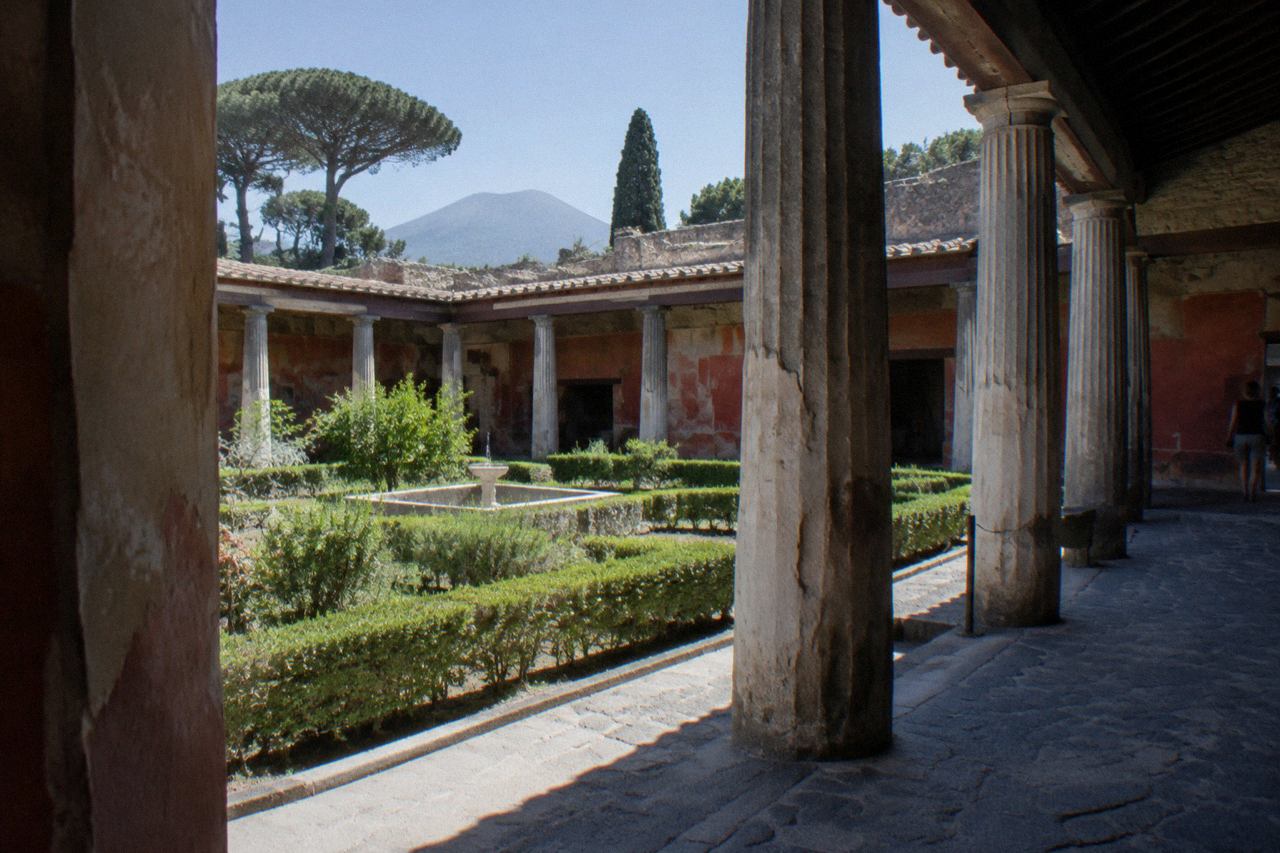
The House of the Vettii stands inside the archaeological park of Pompeii, the ancient Roman city buried by the eruption of Mount Vesuvius in AD 79 and now a state archaeological park (Parco Archeologico di Pompei) in Campania, southern Italy, beside the modern town of Pompei and about 24 km by road south-east of Naples on the Bay of Naples. The house is known for the richness of its surviving wall paintings, and it sits on a central street of the excavated city, a short walk from the Forum and from several of the other celebrated houses. It is included in every ticket that admits a visitor to the ancient city itself, so no separate or special pass is needed.
Planning a visit around one house means planning around the whole park: its timed entry slots, its daily cap of 20,000 visitors and its two seasonal schedules. The excavated area covers 44 ha within a 98 ha inscribed UNESCO property shared with Herculaneum and Torre Annunziata, so a route that reaches the Vettii comfortably needs a little thought. The sections below answer the questions visitors actually ask: what the house contains, which ticket to buy, when to arrive, how long to allow and what to combine it with.
Where Is The House Of The Vettii In Pompeii?
The house stands in the centre of the excavated ancient city of Pompeii, on the street running west from the Forum towards the oldest city gate, and it is reached on foot from any of the three park ticket offices: Porta Marina, Piazza Esedra and Piazza Anfiteatro. Porta Marina is the closest entrance for visitors arriving by train at the Pompei Scavi-Villa dei Misteri station, which lies just outside that gate. From Porta Marina the walk runs uphill through the ancient streets towards the Forum and then continues a few blocks further into the residential quarter where the Vettii house stands. The site is level enough for a slow walk but the ancient paving is uneven, so solid shoes matter more than speed.
The modern town of Pompei, spelled with a single final letter i, grew up around the Sanctuary and the railway stations and is a separate place entirely from the archaeological park. Visitors staying in modern Pompei reach the park on foot or by a short transfer to one of the three ticket offices. Visitors arriving from Naples or Sorrento by train use the Circumvesuviana line and get off at Pompei Scavi-Villa dei Misteri, the stop closest to the Porta Marina entrance; scheduled running times from Napoli Garibaldi to that station run between 29 and 35 minutes, and the onward walk from the gate into the city centre is part of the visit itself. The Pompeii Travel Guide homepage collects the planning basics, and the detailed Pompeii entrances explained guide is the companion page for choosing a gate.
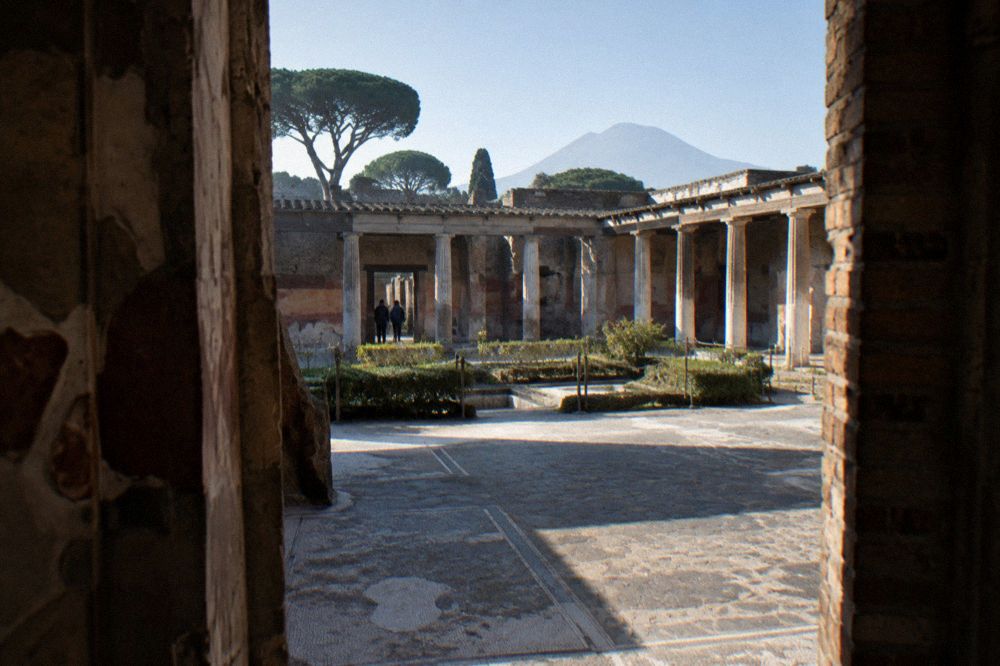
Orientation inside the park is straightforward once the Forum is in sight, because that open plaza anchors the whole city grid. The Vettii house lies in the block of fine residences close to the Forum's western side, in the same quarter as the House of the Tragic Poet and a short stroll from the Forum Baths. A printed or digital plan helps: the interactive Pompeii map page marks the entrances, the principal houses and the route between them, and the park's own signage carries street names and region numbers on panels at junctions.
What To See Inside The House Of The Vettii?
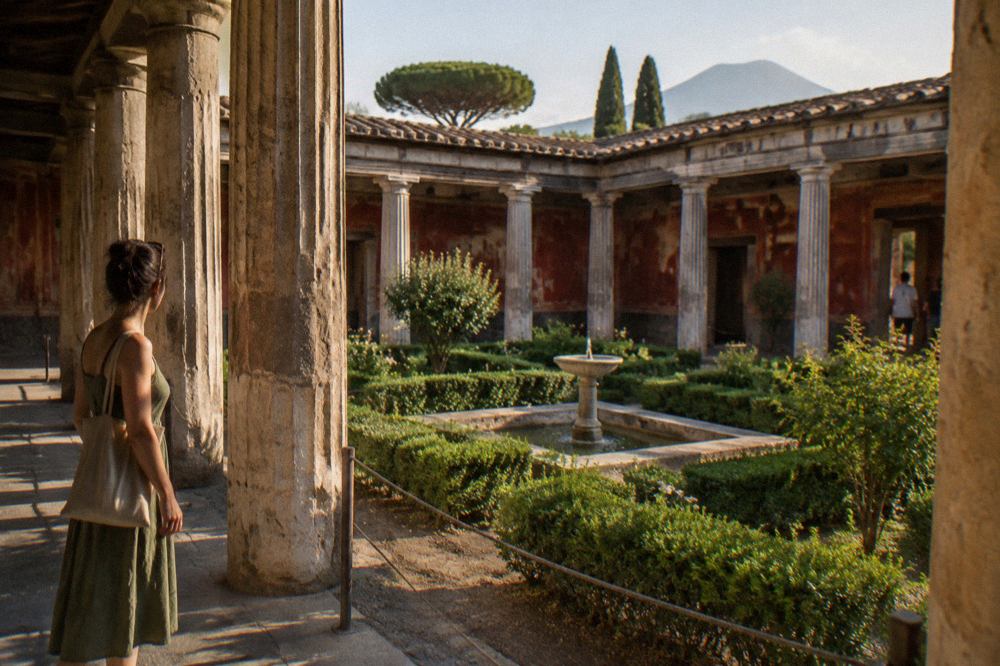
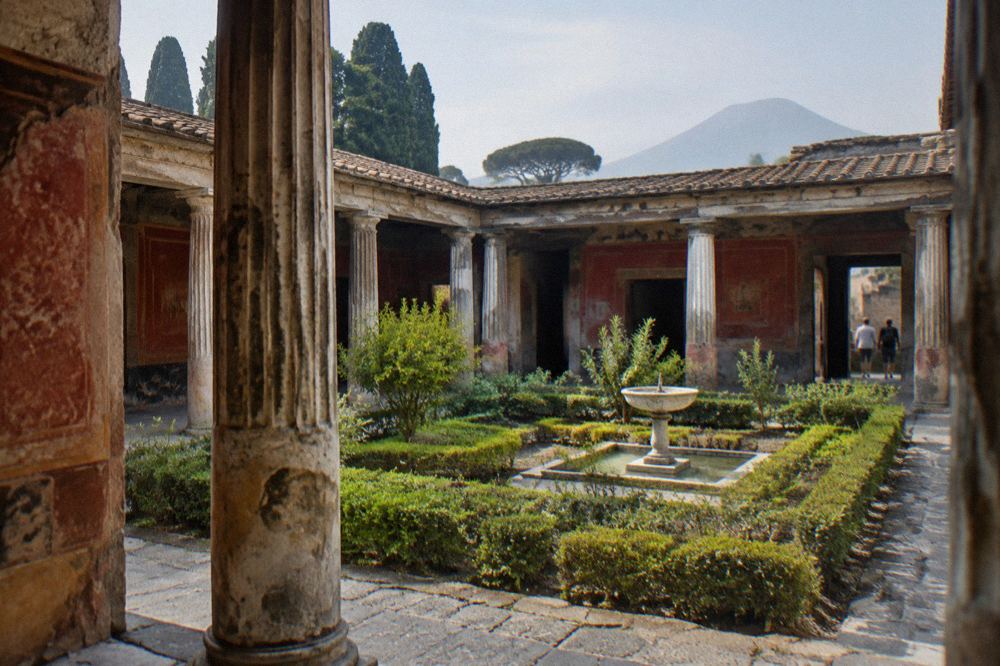
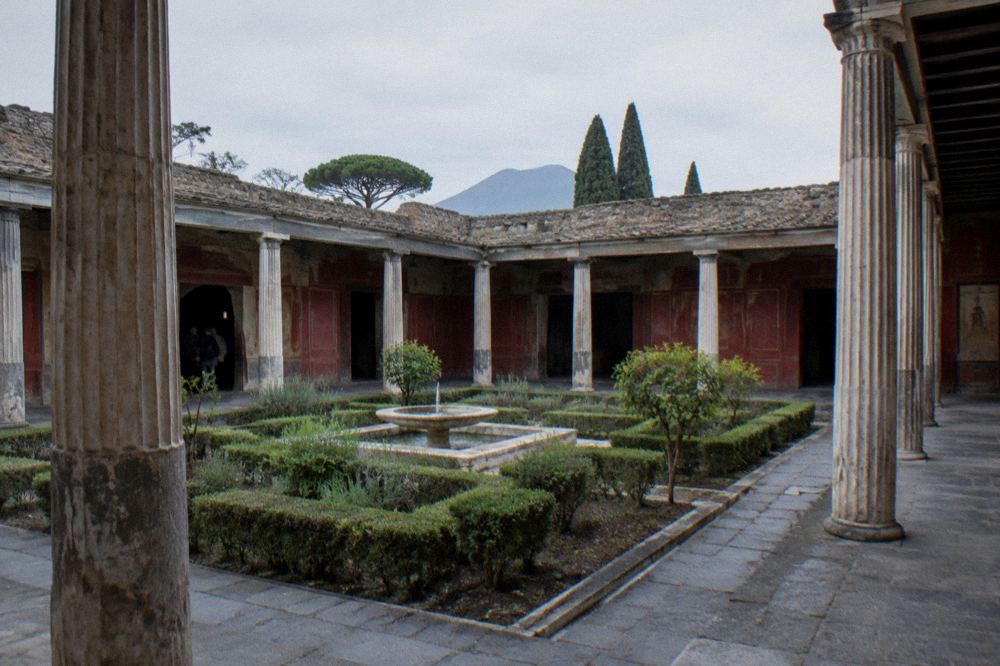
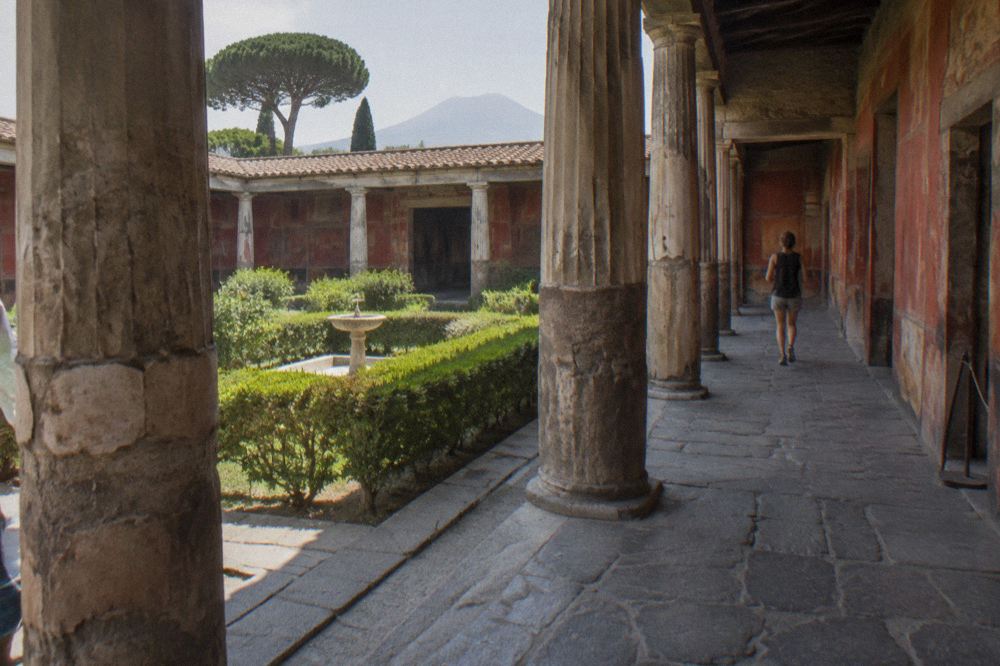
The red and black panels that give the house its character are the pigment surfaces visitors remember, and the rooms around the garden atrium hold the richest of them. Nothing in the house is behind glass, so the paintings are seen as the excavators found them, at eye level and in daylight.
The visit itself is short in minutes and long in detail. A slow circuit of the house takes in the entrance corridor, the atrium with its rainwater pool, the reception rooms with the principal frescoes and the colonnaded garden at the rear. Visitors who want the paintings explained rather than merely seen get a great deal from a guided walk: the Villa of the Mysteries tour led by an archaeologist covers the suburban villa whose paintings are the closest parallel to the Vettii's, and the same guiding approach is available for the city houses. The neighbouring houses reward the same pace: the House of the Faun for the largest private residence in the city, the House of the Tragic Poet for its mosaics, and the House of Menander for its scale and silver hoard.
The table below sets the Vettii beside the other central houses so a route can be planned around what each does best.
| House | What it is known for | Character of the visit |
|---|---|---|
| House of the Vettii | Richly preserved wall paintings in red and black | Compact, indoor, close to the Forum |
| House of the Faun | Largest house in the city, famous mosaics | Spread out, formal layout |
| House of the Tragic Poet | Mosaic floors and painted panels | Small, dense, quick circuit |
| House of Menander | Grand scale, silver hoard found on site | Long walk through many rooms |
| House of the Chaste Lovers | Bakery and dining rooms under one roof | Domestic and working spaces combined |
Because the house is small and popular, timing matters. Mid-morning brings the tour groups that arrive with the first trains from Naples and Sorrento, while the last two hours before the entry cut-off are calmer, and in the summer season entry runs until 17:30 with closing at 19:00. A visit that pairs the Vettii with one or two neighbours rather than the whole city keeps the frescoes enjoyable rather than a shuffle.
Which Pompeii Ticket Covers The House Of The Vettii?
Every ticket that admits a visitor to the ancient city covers the House of the Vettii with no supplement: in 2026 the Pompeii Express costs EUR 20, the Pompeii+ costs EUR 25 and the 3-day ticket costs EUR 30, and from 1 January 2027 a single EUR 25 ticket covers all park sites, valid 30 days with one entry per site. The 2026 Express covers the ancient city alone. The 2026 Pompeii+ adds the suburban villas route, the Villa Regina and the Antiquarium at Boscoreale with the connecting shuttle. The 3-day ticket adds Oplontis, the Stabiae villas and museum, and Boscoreale. The three smaller sites, Oplontis, the Stabiae museum and Boscoreale, also sell their own EUR 8 individual tickets, and the annual MyPompeii Card costs EUR 45. Full detail sits on the Pompeii tickets guide.
Reductions and free days follow the park's own rules and are worth knowing before buying. Entry is free for everyone on the first Sunday of each month, and free for visitors under 18 on every day. EU citizens aged 18 to under 25 pay a reduced EUR 2. On the free first Sundays the park has recorded more than 36,000 visitors in a single day, so a house dependent on close viewing is better visited on a paid day if frescoes are the reason for the trip.
| Ticket (2026 prices, in force to 31 December 2026) | Price | What it covers |
|---|---|---|
| Pompeii Express | EUR 20 | Ancient city only, including the House of the Vettii |
| Pompeii+ | EUR 25 | City, suburban villas route, Villa Regina, Boscoreale Antiquarium, shuttle |
| 3-day ticket | EUR 30 | Pompeii+ plus Oplontis, Stabiae villas and museum, Boscoreale |
| Individual smaller-site ticket | EUR 8 | Oplontis or Stabiae museum or Boscoreale, singly |
| MyPompeii Card (annual) | EUR 45 | Annual pass, EUR 10 reduced |
The change arriving on 1 January 2027 simplifies all of this: one EUR 25 ticket for every park site, valid 30 days, one entry per site, with the smaller sites staying at EUR 8 each and the MyPompeii Card staying at EUR 45. Nominative tickets and the 20,000 visitors per day cap are both kept under the new system. For a visitor whose target is the Vettii and the central houses, the change matters little in practice, because any of these tickets admits the visitor to the house.
Booking ahead is the practical answer to the cap and the slot system. The park sells tickets online through the vivaticket service linked from its official page, and tickets are nominative, with identity possibly checked at entry, non-transferable and non-refundable except in extraordinary closure. An audio-guide ticket bought through an operator works the same way: Check availability on the operator's live listing for a chosen date. The tours hub collects every bookable option in one place.
What Are Pompeii's Opening Hours And Time Slots?
Pompeii is open from 9:00 to 19:00 between 16 March and 14 October, with last entrance at 17:30, and from 9:00 to 17:00 between 15 October and 15 March, with last entrance at 15:30, and the park has no weekly closing day, closing only 25 December and 1 January unless otherwise communicated. The two seasonal schedules swap in the same week each October and March, so a late-October visit falls under the winter hours even in mild weather. There is no Monday closure at Pompeii itself; only the smaller outlying sites, Oplontis and the Stabiae villas and museum, close on Tuesdays. Arriving before the 9:00 opening, or after 15:00 in the summer season, are the two reliable ways to see the central houses with fewer people.
Entry is further shaped by timed slots introduced alongside the daily cap. Between 16 March and 14 October the 9:00 to 13:00 slot admits up to 15,000 visitors and the 13:00 to 17:30 slot up to 5,000, so the afternoon is structurally the quieter half of the day. The same slots cap the suburban-villas tickets in proportion. A visitor who books the afternoon slot for the Vettii and the central houses, then uses the following morning for the villas or for Herculaneum, has the smoothest two-day shape.
| Season | Opening | Last entrance | Closing | Daily slot caps |
|---|---|---|---|---|
| 16 March to 14 October | 9:00 | 17:30 | 19:00 | 9:00-13:00 up to 15,000; 13:00-17:30 up to 5,000 |
| 15 October to 15 March | 9:00 | 15:30 | 17:00 | Under the same 20,000 daily cap |
Two practical rules from the park's visitor regulations affect the visit directly. Bags larger than 30x30x15 cm are not allowed inside and must go to left luggage, which matters for visitors carrying luggage between hotels. Identity documents should match the name on the nominative ticket, at any entrance. Neither rule changes the house itself, but both have turned visitors away at the gate, and the Pompeii opening hours guide keeps the full detail.
How Long Should You Spend At The House And The Streets Around It?
The house itself rewards 20 to 30 unhurried minutes, but the walk to it, the neighbouring houses and the return to an entrance make a realistic half-day circuit, and visitors who add the Forum, the baths and one more quarter should plan four hours inside the park. A two-hour circuit of the city can include the Vettii only as a fast pass, and the Pompeii in 2 hours guide exists precisely for that constraint. A full day, planned on the Pompeii in one day route, lets the central houses be seen at the pace the paintings deserve, with a lunch stop and the villas or the amphitheatre folded in.
The deciding factor is usually the season and the heat rather than interest. The summer months push the midday streets to their warmest, and the painted rooms offer shade the open roads do not. Water, a hat and shoes with grip are the three pieces of kit that decide whether a four-hour visit ends well; the paving stones are polished by two millennia of feet, and there is little shade on the main decumanus. The what to wear to Pompeii guide covers the practicalities in full.
Visitors combining Pompeii with Herculaneum, which lies a separate short journey away towards Naples, are the group that benefits from a guided two-site product rather than two independent tickets. The Pompeii and Herculaneum in one day plan sets out the timing, and a small-group option with an archaeologist is the format that explains both sites in one booking.
When Is The Best Time Of Year To Visit The Vettii?
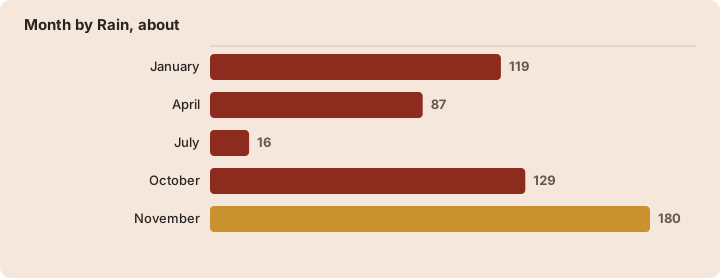
The months of April, May, September and October combine the warm end of the visiting calendar with lighter crowds than midsummer, and October's 21.3 C mean daily maximum and April's 17.7 C make them the comfortable shoulder for a walking-heavy day among the houses. The climate at Pompei is Mediterranean, and the 1991-2020 normals computed from the Open-Meteo historical archive at the local grid point show the shape of the year: about 29.4 C mean daily maxima in August, about 12.2 C in January, and a wet season concentrated between October and February, with November the wettest month at about 180 mm of rain and July the driest at about 16 mm.
Rain matters more here than at an indoor museum, because the house's garden court and the streets between the entrances are open to the sky. A wet day softens the crowds but turns the paving slick, and the fresco rooms themselves, roofed and enclosed, become the natural focus of the visit.
| Month | Mean daily max, about | Mean daily min, about | Rain, about |
|---|---|---|---|
| January | 12.2 C | 6.6 C | 119 mm |
| April | 17.7 C | 10.4 C | 87 mm |
| July | 28.7 C | 21.1 C | 16 mm |
| October | 21.3 C | 15.1 C | 129 mm |
| November | 16.9 C | 11.5 C | 180 mm |
The summer-heat plan is a subject of its own, and the Pompeii in summer heat guide handles it. The short version for a fresco-focused visit is to arrive at 9:00, do the open streets while the morning is kind, and save the Vettii and its roofed neighbours for the warmest hours, when their interiors are the most comfortable rooms in the city.
How Do You Get To Pompeii For The House Of The Vettii?
Train is the simplest route: the Circumvesuviana line runs from Napoli Garibaldi to Pompei Scavi-Villa dei Misteri in a scheduled 29 to 35 minutes, and the station sits beside the Porta Marina entrance, from which the house is a short walk into the excavated city. The same line continues to Sorrento in a scheduled 64 to 75 minutes from Naples, and Pompei Scavi to Sorrento takes 34 to 40 minutes, so the house works as a day visit from either base. The Campania Express service that once offered a semi-fast alternative has been suspended since 1 October 2026, with refunds available through the operator's complaints form or the original seller, so all rail arrivals now use the ordinary Vesuvian lines.
Drivers face a different calculation. Parking sits close to the entrances, and the Pompeii parking guide names the areas and the walking distances. Cruise passengers docking at Naples have a separate set of timings, covered on the Pompeii cruise ship day guide.
| Route | Distance by road | Scheduled driving time |
|---|---|---|
| Naples to Pompei Scavi | about 24 km | about 22 minutes |
| Sorrento to Pompei Scavi | about 26 km | about 37 minutes |
| Salerno to Pompei Scavi | about 31 km | about 30 minutes |
| Rome to Pompei Scavi | about 234 km | about 159 minutes |
The Naples to Pompeii guide and the Sorrento to Pompeii guide carry the station-by-station detail for each base, including the notes on buying tickets and validating them before boarding. For a first visit built around the central houses, the train plus Porta Marina entrance combination is the one that involves the fewest decisions.
Which Nearby Houses And Sights Pair Best With It?
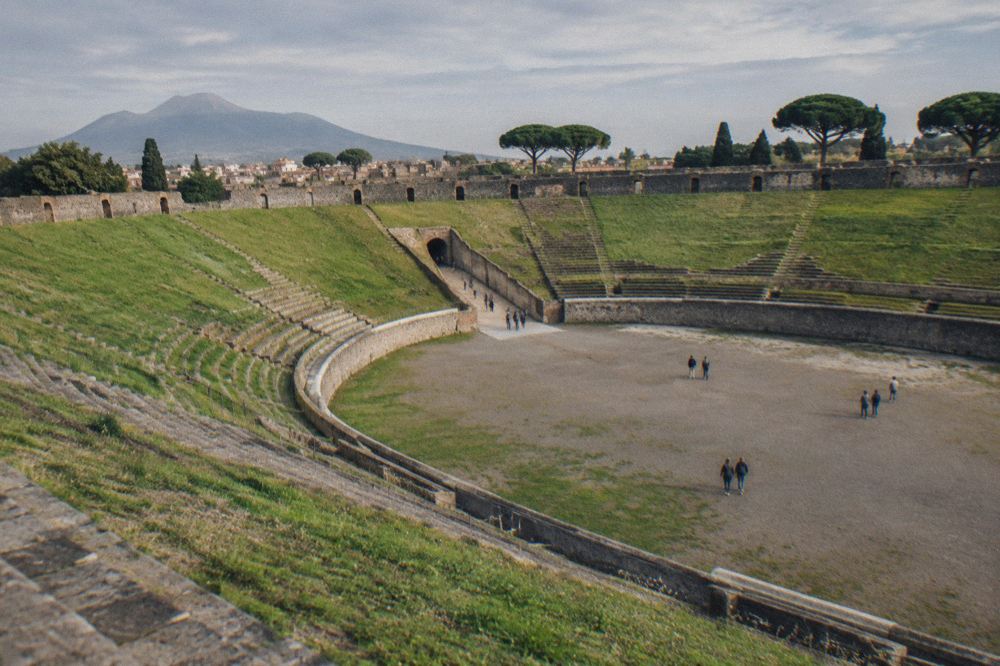
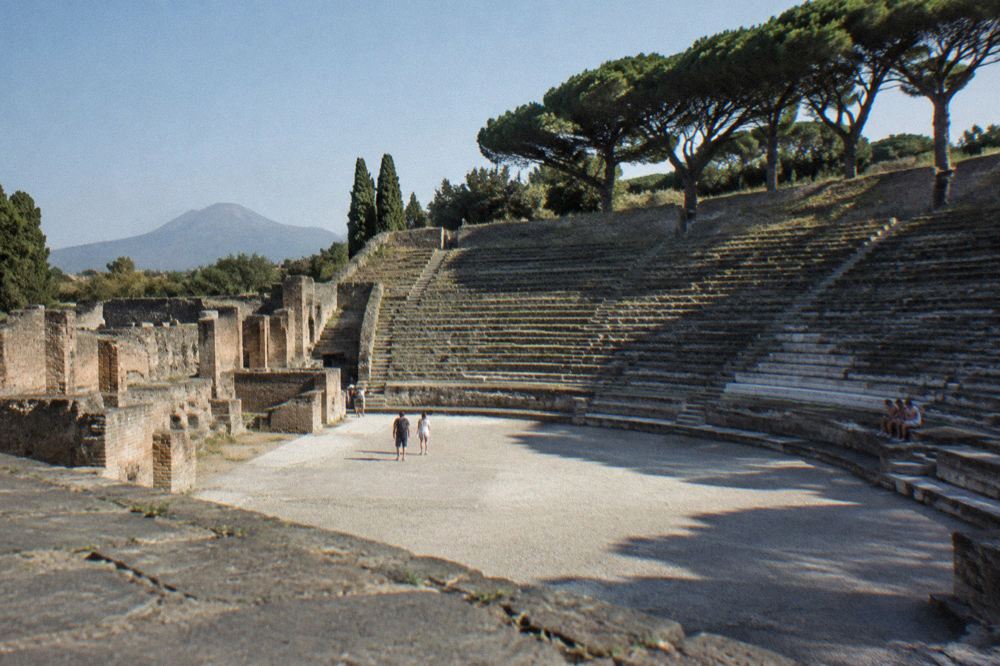
The strongest pairings are the houses within a few minutes' walk of the Vettii, the Forum and its temples at the centre of the city, and one contrast elsewhere in the park: the Villa of the Mysteries on the suburban villas route, the Lupanar for its social-history weight, or the Amphitheatre at the far eastern end. The Forum of Pompeii gives the public architecture that frames the private wealth of the houses; the Villa of the Mysteries shows what the suburban villa painters achieved in the same tradition as the Vettii's frescoes; and the Lupanar and the Garden of the Fugitives carry the harder evidence of the eruption itself, a subject the Pompeii body casts page treats with the care it deserves.
Visitors with a second day, or a single long one, can extend outward to the other Vesuvian sites. Oplontis, the Villa Poppaea at Torre Annunziata, is the closest parallel in scale and decoration; the Stabiae villas and the Boscoreale Villa Regina complete the 3-day ticket's circuit; and Herculaneum is the site whose own visitor numbers and painted houses make the natural companion, with the practical warning repeated on its official tickets page that the Villa dei Papiri and the Ancient Theatre are closed for works. The Pompeii versus Herculaneum comparison settles the choice for visitors who must pick one.
| Pairing | Where | Why it pairs with the Vettii |
|---|---|---|
| House of the Faun and House of the Tragic Poet | Central city, minutes away | Same quarter, complementary mosaics and paintings |
| Forum and Basilica | Centre | The public stage behind the private wealth |
| Villa of the Mysteries | Beyond Porta Ercolano | The grandest painted villa of the same tradition |
| Herculaneum | Separate site towards Naples | A second buried city, smaller and darker-painted |
| Oplontis | Torre Annunziata | Villa decoration at imperial scale |
Visitors pairing the mountain with the city should know the crater has its own ticketing: the Gran Cono trail at Mount Vesuvius sells online-only timed tickets with 50 tickets per 10 minutes released 30 days ahead and 10 nominative last-minute tickets per slot from 30 minutes before, and the path closes automatically on an orange weather alert or above. The Mount Vesuvius guide and the Mount Vesuvius tickets page carry the full rules, and the trail itself is described on the Vesuvius crater trail guide.
Is A Guided Tour Or An Audio Guide Better For The Vettii?
A guided small-group tour led by an archaeologist suits visitors who want the paintings read as evidence, an audio-guide ticket suits independent walkers who want to set their own pace between houses, and a private guide suits families and tight schedules, with every format covering the house under the same park admission. The difference is depth against freedom: a guide points out the jokes, the workshop graffiti and the painted illusions a casual eye walks past, while the audio guide moves at the visitor's own rhythm and waits patiently while a fresco is photographed. The question is argued out fully, with the trade-offs listed, on the guided tour versus self-guided page.
The formats available on this site span the range. An entry ticket with audio guide is the lightest option. A small-group archaeologist tour is the step up in depth. A two-site Pompeii and Herculaneum small-group tour fits visitors with one full day for both parks. Skip-the-line products bundle the guide with priority entry, which matters on the free first Sundays and on the peak spring days the visitor table shows: May 2024 recorded 516,923 visitors to Pompeii against February 2024's 142,648, and that pressure is felt at the gates.
| Format | Best for | Admission |
|---|---|---|
| Entry ticket with audio guide | Independent walkers | Park ticket included in the product |
| Small group with an archaeologist | Depth on the paintings and city | Ticket included in the product |
| Two-site small group | Pompeii and Herculaneum in one day | Both admissions in the product |
| Private official-guide tour | Families, tight schedules, per group | Booked per group up to 14 |
Whatever the format, the house repays preparation. Knowing that the painted panels were room decoration, not gallery art, changes what the eye does with them; knowing that the household ran businesses from the premises explains the strongboxes and the commercial quarter outside the door. The Pompeii history guide and the account of Pliny the Elder and Vesuvius give the eruption its documented frame, including the point that the traditional date, 24 August AD 79, comes from the oldest manuscripts of Pliny the Younger, while the park's own journal holds that the rival October date has no evidentiary basis: the debate stays open and the park has not settled it.
Common Questions About The House Of The Vettii
Is the House of the Vettii included in the Pompeii ticket?
Yes. Every ticket that admits visitors to the ancient city covers the house: the 2026 Pompeii Express at EUR 20, Pompeii+ at EUR 25 and the 3-day ticket at EUR 30, and from 1 January 2027 the single EUR 25 ticket covering all park sites. No supplement and no separate booking exist for the house itself.
How long does a visit to the House of the Vettii take?
The house itself rewards 20 to 30 unhurried minutes. Reaching it from an entrance, visiting one or two neighbouring houses and returning makes a realistic half-day, and a full circuit of the central city with the Forum and a further quarter runs to about four hours inside the park.
When is the best time of day to see the frescoes?
The afternoon entry slot is structurally quieter: between 16 March and 14 October the 9:00 to 13:00 slot admits up to 15,000 visitors and the 13:00 to 17:30 slot up to 5,000. The last two hours before the 17:30 last entrance are the calmest for close viewing of the painted rooms.
Is the House of the Vettii accessible for visitors with limited mobility?
The ancient paving throughout the city is uneven, and the house is entered across original thresholds. The park's Pompeii for All route, entered at Piazza Anfiteatro with an exit option at Piazza Esedra via the Antiquarium lift, serves visitors with mobility difficulties, and the full accessibility detail sits on the park's regulations page.
Can you visit the House of the Vettii on the free first Sunday?
Yes, entry is free for everyone on the first Sunday of each month, and the house needs no separate ticket. The park has recorded more than 36,000 visitors on one free first Sunday, so anyone visiting chiefly for the frescoes should weigh the crowds against the saving.
The House of the Vettii earns its place on any Pompeii itinerary because it compresses what the whole park offers, art, domestic life and the sudden end of AD 79, into a few painted rooms a short walk from the Forum. Buy the ticket that matches the rest of the plan, arrive against the flow of the morning slot, and give the panels the half hour they repay many times over.