Pompeii Heat
Pompeii in Campania, southern Italy, is an excavated Roman city with almost no shade, and summer afternoons push stone surfaces to punishing temperatures. This plan uses verified opening hours, climate data and entrance logic to keep a hot-day visit workable.
Short answer
Pompeii is an open-air archaeological park with roughly 44 hectares of exposed stone, about 24 km from Naples, where August averages about 29.4 C. The workable plan is to enter at 09:00 from Porta Marina or Piazza Anfiteatro, tour until early afternoon, and retreat to shade, the Antiquarium or Herculaneum's later hours. Summer hours run to 19:00 with last entry 17:30.
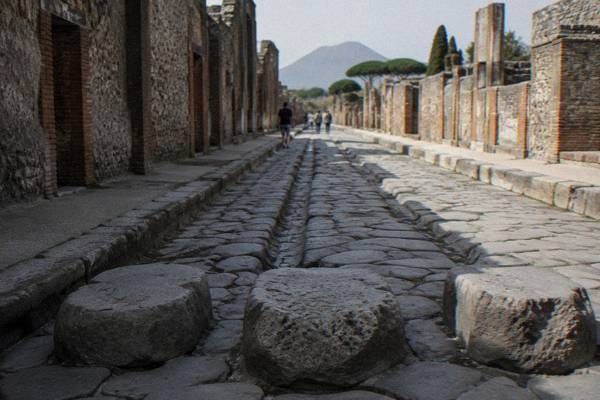
Pompeii, the ancient Roman city buried by the eruption of Vesuvius in AD 79 and now an archaeological park beside the modern town of Pompei in Campania, southern Italy, is one of the least shaded heritage sites in Europe. The excavated area covers about 44 hectares of stone streets, plastered walls and open squares, roughly 24 km by road south-east of Naples, and in high summer the site offers almost nowhere to hide from the sun. That does not make a July or August visit a bad idea. It makes it a planning problem, and this itinerary is the plan: which hours to use, which entrance to start from, where the shade actually falls, and how to fold the surrounding sites into the hottest part of the day.
The numbers behind the plan are worth stating plainly. At the Pompei grid point, 1991-2020 climate normals from the Open-Meteo historical archive show July averaging about 28.7 C by day and dropping only to about 21.1 C at night, with about 16 mm of rain across the whole month. August is warmer still, about 29.4 C on average by day. The park's summer schedule, 16 March to 14 October, opens at 09:00, admits visitors until 17:30 and closes at 19:00, which means the site gives you a long morning if you take it.
How Hot Is Pompeii In Summer, Really?
Pompeii's summer heat is a sun-and-stone problem rather than an extreme-temperature problem: about 28.7 C average daily maximum in July and about 29.4 C in August, with July the driest month at about 16 mm of rain, per 1991-2020 normals for the Pompei grid point. The difficulty comes from unshaded basalt streets, midday sun and a site large enough that a wrong turn adds hundreds of metres of walking.
Those averages come from the Open-Meteo historical archive, an ERA5 reanalysis grid rather than a weather station, so treat them as "about" figures rather than forecasts. They describe the climate, not any particular day. A given August afternoon can run well above the average, and the stone of the Roman streets holds that heat into the evening.
What the averages hide is exposure. The site is an open grid of streets with high walls but few trees, and the routes people most want to see, the Forum, the Via dell'Abbondanza axis and the amphitheatre quarter, are the most exposed stretches of all. Water fountains exist inside the park but are spread thin relative to its size, and the park's visitor regulations set a 30x30x15 cm bag limit, which rules out the large cooler backpacks some travellers assume they can bring.
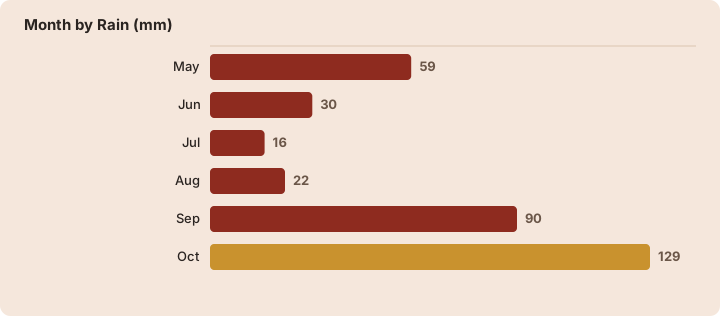
The seasonal picture, month by month, looks like this. The table uses the 1991-2020 normals for the Pompei grid point: mean daily maximum, mean daily minimum, and total monthly rainfall.
| Month | Mean daily max (C) | Mean daily min (C) | Rain (mm) |
|---|---|---|---|
| May | 21.6 | 14.1 | 59 |
| Jun | 25.8 | 18.2 | 30 |
| Jul | 28.7 | 21.1 | 16 |
| Aug | 29.4 | 21.8 | 22 |
| Sep | 25.3 | 18.6 | 90 |
| Oct | 21.3 | 15.1 | 129 |
September deserves a special word. Its average maximum, about 25.3 C, sits three degrees below August's, but its rainfall, about 90 mm, is triple July's. Early September often behaves like August; late September can deliver the first real storms of autumn. October cools further to about 21.3 C by day and carries about 129 mm of rain, making it a shoulder-season month where heat is a smaller risk than weather.
What Time Should You Enter Pompeii On A Hot Day?
Enter at 09:00, the moment the ticket offices at Porta Marina, Piazza Esedra and Piazza Anfiteatro open, and treat 13:00 as your internal deadline for exposed walking. Summer hours run 09:00 to 19:00 with last entrance 17:30, but the value of those hours is heavily front-loaded: the morning slot admits up to 15,000 people while the afternoon slot admits only 5,000, and the sun, not the gate, sets your real limit.
The two-band entry system is the single most useful planning fact on the park's timetable page. Between 09:00 and 13:00 the site can admit up to 15,000 visitors, split between up to 12,000 on the Express ticket and 3,000 on the Plus ticket. From 13:00 to 17:30 the ceiling drops to 5,000. Practically, this means the midday hours are both the hottest and the emptiest: a visitor who books a 13:00 slot walks the Forum quarter with a fraction of the morning crowd, if they can stand the sun.
That trade is worth making for part of the day, not all of it. The plan this itinerary recommends is a morning entry, serious sightseeing until about 13:00, then a deliberate break: leave for lunch in modern Pompei or use the shaded indoor spaces inside the park, and return for a quieter late-afternoon loop only if your legs and the temperature allow. The 17:30 last entry gives you a genuine second window in the cooler end of the day.
Ticket choice matters here too. In 2026 the Pompeii Express ticket covers the ancient city at EUR 20, and Pompeii+ adds the suburban villas, Boscoreale and the shuttle for EUR 25; from 1 January 2027 these merge into a single EUR 25 ticket valid 30 days across all park sites, one entry per site. Free entry applies to under-18s and to everyone on the first Sunday of the month, and EU citizens aged 18 to under 25 pay a EUR 2 reduced rate. Full ticket details live on the Pompeii ticket types explained page.
| Period | Opens | Last entry | Closes | Notes |
|---|---|---|---|---|
| 16 Mar to 14 Oct | 09:00 | 17:30 | 19:00 | Morning band 09:00-13:00, up to 15,000 visitors |
| 25 Dec and 1 Jan | Closed | Closed | Closed | Closure dates stated by the park |
Note the table's row logic: the second row's "afternoon band" note belongs to the summer schedule, listed there because the winter row's shorter day is the alternative visitors compare against. Pompeii itself has no weekly closing day; only Oplontis, the Stabiae villas and the Stabiae museum close on Tuesdays.
If a guided morning is what you want, the roster's early-start options all pair well with a heat plan. The best tour options for Pompeii page lays out the formats side by side.
One of those three belongs to this itinerary's core idea.
Which Pompeii Route Has The Most Shade?
No Pompeii route is genuinely shaded, but the highest-value summer loop runs from Porta Marina to the Forum, along the Via dell'Abbondanza axis to the Stabian Baths, and out at Piazza Esedra, using bath buildings, the Antiquarium and domus interiors as your shade stops rather than walking them in one exposed push. Starting instead at Piazza Anfiteatro reverses the logic and puts the amphitheatre and Large Palaestra into the cool first hour.
The classic mistake is treating Pompeii as a single linear walk. It is a grid, and in heat the grid is your friend: you can string indoor and semi-indoor stops together so that no stretch of open street lasts more than a few minutes. The Forum has colonnades; the bath buildings have vaulted, cool interiors; the houses have roofed rooms. The route that visits the Forum of Pompeii, the Stabian Baths and one or two major houses in between spends far less time in raw sun than the route that beelines between famous names.
Two named houses earn their place on a hot-day loop. The House of the Faun is vast, with long covered passages and interior rooms, and the House of the Vettii keeps its frescoed rooms under roof. Between them and the Forum you can arrange a walk where shelter is never more than one street away. The Villa of the Mysteries sits at the far north-western edge and is a longer, more exposed commitment, which is why this itinerary gives it its own slot later in the day.
The amphitheatre quarter argues for the opposite entrance. Piazza Anfiteatro is the eastern ticket office, and entering there at 09:00 puts the Pompeii Amphitheatre and the Large Palaestra in your first, coolest hour, when their terraces are still in shadow. It is also the accessible entrance: the park's "Pompeii for All" route starts at Piazza Anfiteatro and allows visitors with mobility difficulties to exit at Piazza Esedra via the Antiquarium lift. On a heat plan, that lift is not only an accessibility feature; it is a legitimate way to end a western loop without retracing streets in the midday sun.
| Route element | Exposure | Best hour | Notes |
|---|---|---|---|
| Forum colonnades | Partial shade | Any | Central hub, water stop nearby |
| Via dell'Abbondanza stretch | Full sun | Before 11:00 | Long axis, no shade |
| Stabian Baths interior | Indoors | Midday | Vaulted, cool rooms |
| House of the Faun | Mixed | Midday | Roofed rooms and passages |
| Amphitheatre terraces | Full sun | 09:00-10:00 | Enter at Piazza Anfiteatro |
| Villa of the Mysteries route | Full sun | After 16:00 | Reached via Porta Ercolano area |
The full one-day itinerary is the cold-weather version of the same ambition.
A question worth asking before you lock the day: where will you actually be at 13:00? If the honest answer is "still walking the ruins", the plan above is not yet a plan. The midday break is the difference between a good hot-day visit and a miserable one, and everything after this section assumes you take it.
What Should You Wear And Carry For Pompeii In Heat?
Wear closed walking shoes with grip, a hat, sunglasses and loose light-coloured clothing, and carry a small bag within the park's 30x30x15 cm limit containing a refillable bottle, sunscreen and, in July and August, more water than feels reasonable. Stone streets radiate heat upward, Roman cobbles punish thin soles, and the site's size makes any shoe or kit compromise expensive.
The bag rule catches visitors out. The park's visitor regulations permit bags up to 30x30x15 cm, with larger items directed to left luggage, so the enormous beach-style kit many travellers picture for a hot day is simply not an option inside the walls. Plan around it: a one-litre bottle, sunscreen, a hat and a light long-sleeve layer fit inside the limit, and the fountains inside the site allow refills.
Footwear deserves more emphasis than any clothing choice. The ancient paving is irregular basalt, worn smooth in places and stepped in others, and dry-season dust sits on top of it. A twisted ankle two kilometres from the nearest exit defines a bad day. The same logic applies to pacing: heat exhaustion at Pompeii usually announces itself as headache and nausea before anything dramatic, and the correct response is to stop, find shade, drink and, if it does not pass, leave through the nearest gate.
Timing your clothing to the season is straightforward with the normals in hand. May and October days around 21 C ask for layers you can shed; June, July and August ask for maximum coverage in light fabric, since covering skin from direct sun often beats exposing it. The what to wear to Pompeii guide expands the kit list, and there is no dress code beyond the park's own rule against bare chests.
| Kit item | Why it matters on a heat day | Fits the 30x30x15 cm rule |
|---|---|---|
| Refillable water bottle | Fountains are spread thin across 44 ha | Yes |
| Hat with brim | No tree cover on the main axes | Yes |
| Sunscreen | July averages about 16 mm rain, so skies stay clear | Yes |
| Closed grip shoes | Worn basalt cobbles and dust | Worn, not carried |
| Light long-sleeve layer | Covers skin from direct sun | Folded, yes |
| Snack or salt replacement | Long walking in heat depletes both | Yes |
One caution on logistics: the Campania Express train service has been suspended since 1 October 2026 until further notice, so any plan built around it should be rebuilt around the Circumvesuviana line and its Pompei Scavi-Villa dei Misteri station, or around the shuttle and transfer options in the roster. The Circumvesuviana guide covers the line in detail.
How Do You Build A Full Hot-Day Plan Around Pompeii?
A complete hot day pairs a 09:00 Pompeii entry with a shaded midday break indoors or in Naples, a late-afternoon return for the quiet 13:00-17:30 band or the Villa of the Mysteries, and an evening activity, dinner or a food walk, once temperatures fall. Summer hours to 19:00, Herculaneum's hours to 19:30 in the same season, and the small site of Boscoreale each give the day somewhere cool to be at every hour.
The shape of the day, hour by hour, is the table below. It assumes summer opening hours (16 March to 14 October), a Porta Marina start and a willingness to leave the site at midday rather than push through.
| Time | Where | What and why |
|---|---|---|
| 09:00-11:00 | Pompeii, Forum quarter | Coolest hours on the most exposed stones |
| 11:00-13:00 | Pompeii, baths and domus | Indoors as the sun climbs |
| 13:00-16:00 | Break: Naples, modern Pompei or the Antiquarium | The dead zone, spent in shade |
| 16:00-17:30 | Pompeii, amphitheatre quarter or Villa of the Mysteries | Afternoon band, only 5,000 visitors |
| 17:30-19:00 | Close-out or transfer | Site closes 19:00 |
| Evening | Naples or a Vesuvius-side dinner | Temperatures ease after sunset |
The midday break has three good versions. The ambitious one puts you on the Circumvesuviana into Naples for a shaded afternoon; the Naples Archaeological Museum holds the frescoes and mosaics lifted from Pompeii, and the Naples day-trip guide frames the city. The relaxed one keeps you in modern Pompei, whose town guide covers lunch options and the Sanctuary. The efficient one stays inside the park and uses the Antiquarium, the site's museum pavilion, which is exactly the kind of indoor, seated, air-moving hour a hot afternoon wants.
The evening deserves planning too, because southern Italian summer evenings are the reward for surviving the afternoon. A food-and-wine dinner on the slopes of Vesuvius turns the coolest hours of the day into the best part of it, and pairs naturally with a day whose morning was given to ruins. The broader wine picture is on the Vesuvius wine tasting page.
Families have a specific version of this problem, and the Pompeii with kids itinerary handles it, including the short-attention-span logic that heat amplifies. Cruisers face the opposite constraint, a fixed midday arrival, and the cruise-ship day plan is built around it. Two-day visitors can split heat across mornings on the two-day Pompeii, Herculaneum and Vesuvius plan.
Should You Pair Pompeii With Herculaneum Or Vesuvius On A Hot Day?
Pair Pompeii with Herculaneum rather than Vesuvius if heat is your main worry: Herculaneum keeps summer hours of 08:30 to 19:30, is roughly a quarter of the walking, and its roofs and shade structures give midday relief Pompeii cannot. Vesuvius, by contrast, is a two-to-three-hour exposed excursion on a crater trail with automatic closure on orange weather alerts, so it belongs in the morning or a separate, cooler day.
Herculaneum's own figures make the case. Summer hours run 08:30-19:30 with last entry 18:00; the site is open daily, closed only 1 January and 25 December, and free entry applies on the first Sunday of the month plus 25 April, 2 June and 4 November. Note two closures that matter for planning: Herculaneum's Villa dei Papiri is closed for works and the Ancient Theatre is closed until further notice. The Herculaneum guide and the Pompeii vs Herculaneum comparison cover the sites side by side.
Vesuvius in summer is a different calculation. The Gran Cono trail is sold as online-only timed tickets, 50 per 10 minutes, bookable 30 days ahead, with access hours that run 09:00-18:00 in July and August, and the excursion is 2 hours return on the shortest route to 3 hours on the longest. The trail and ticket office close automatically on an orange weather alert or above, with automatic refund if weather closes the park. Heat does not close it, but it makes the climb harder: the crater trail is fully exposed. The Mount Vesuvius guide and the how to visit Vesuvius page carry the details, and the Pompeii and Vesuvius in one day itinerary exists for those who accept the exposure.
| Site | Summer hours | Heat profile | Fit in the day |
|---|---|---|---|
| Pompeii | 09:00-19:00, last entry 17:30 | 44 ha of unshaded stone | Morning, then late afternoon |
| Herculaneum | 08:30-19:30, last entry 18:00 | Compact, partially roofed | Midday or second morning |
| Vesuvius Gran Cono | Jul-Aug 09:00-18:00 | Fully exposed climb | Cool morning only |
| Boscoreale | Smaller park site, EUR 8 in 2026 | Small, quick | Any spare hour |
The combined Pompeii and Herculaneum in one day itinerary is the cooler-weather version of the pairing; in high summer, the same pairing works better as Pompeii morning, break, Herculaneum late afternoon, using Herculaneum's 18:00 last entry to trade the worst hours for shade.
What Closures And Changes Affect A Summer 2026 Or 2027 Visit?
Three dated changes shape current plans: the Praedia of Julia Felix has been closed to the public since 7 September 2026 for maintenance, the Campania Express has been suspended since 1 October 2026, and the whole ticket structure changes on 1 January 2027, when a single EUR 25 ticket covering all park sites, valid 30 days, replaces the 2026 Express, Plus and 3-day tickets.
The ticket change is the one with the longest shadow. In 2026, Pompeii Express costs EUR 20, Pompeii+ costs EUR 25, the 3-day ticket costs EUR 30, and the smaller sites, Boscoreale, Oplontis and the Stabiae museum, cost EUR 8 each, with the My Pompeii Card at EUR 45. From 1 January 2027 the single EUR 25 ticket covers all park sites for 30 days with one entry per site, the three smaller sites stay EUR 8 individually, and the My Pompeii Card stays EUR 45. Nominative tickets and the 20,000 daily cap are retained. Express holders in 2026 can still add the suburban villas route for EUR 8, card only, at the Porta Ercolano / Street of the Tombs entrance, which is the entrance the Villa of the Mysteries belongs to.
| Ticket (2026) | Price | Covers | Change from 1 Jan 2027 |
|---|---|---|---|
| Pompeii+ | EUR 25 | City, villas, Boscoreale, shuttle | Replaced by single EUR 25 ticket |
| Smaller sites | EUR 8 each | Boscoreale, Oplontis, Stabiae museum | Stay EUR 8 individually |
| My Pompeii Card | EUR 45 | Annual | Stays EUR 45 |
Two more operational notes belong here. The Polverificio park access from via P. Vitiello, on the Scafati side, was closed temporarily from 1 to 10 October 2026; it is a side access, not one of the three main ticketed entrances, but anyone planning that edge of the park should check the park's comunicati before relying on it. And on eruption history, note that the traditional date of the destruction is 24 August AD 79 from the oldest manuscripts of Pliny the Younger, while the park's own e-journal states the 24 October alternative has no evidentiary basis; the date debate remains open scholarship, and no page on this site settles it.
Common Questions About Pompeii Heat
How hot does Pompeii get in summer?
Average daily maxima reach about 28.7 C in July and about 29.4 C in August at the Pompei grid point, per 1991-2020 normals, with nights around 21 C. The felt temperature on unshaded stone is higher, and the site's size, roughly 44 hectares excavated, multiplies the exposure through distance walked.
What is the best time of day to visit Pompeii in summer?
Enter at 09:00 and finish exposed walking by about 13:00, then use the 16:00-17:30 window if you want more. Summer hours run 09:00 to 19:00 with last entry 17:30. The afternoon entry band is capped at 5,000 visitors, so late-day Pompeii is also the quietest Pompeii.
Is there shade inside Pompeii?
There is no meaningful tree shade on the main axes. Shade comes from colonnades at the Forum, vaulted bath interiors and roofed rooms in the houses, so a heat-aware route strings those together instead of walking between famous open-air stops in one push.
Can you bring water into Pompeii?
Yes, and you should. Bags are limited to 30x30x15 cm, so carry a refillable bottle rather than a cooler pack, and refill at the fountains inside the site. Water points are spread thin relative to the site's size, so plan refills into your route.
Is Pompeii too hot for children in summer?
It is manageable with an early start, a midday exit and short loops. The Pompeii with kids itinerary applies the same logic as this heat plan, and the "Pompeii for All" accessible route from Piazza Anfiteatro offers a way to shorten walking for anyone who needs it.
Is Herculaneum cooler than Pompeii in summer?
Herculaneum is smaller and partially roofed, with summer hours of 08:30 to 19:30, so it functions well as the midday or late-afternoon half of a hot-day plan. Note that its Villa dei Papiri and Ancient Theatre are closed for works.
How Do You Turn This Into A Booking Plan?
Book two things ahead: a timed entry or a guided morning for the 09:00-13:00 window, and an evening or midday activity that makes the dead hours feel deliberate rather than wasted. Leave the 13:00-16:00 block unbooked and shaded, and let the summer closing times, 19:00 at Pompeii and 19:30 at Herculaneum, decide how much day you want back.
The core of the whole approach is one sentence: treat Pompeii's summer heat as a schedule constraint, not a reason to stay away. A site that averages about 29 C in August and stays open until 19:00 rewards visitors who arrive at opening, hide at midday and come back for the quiet afternoon band. The routes, the entrances, the shade stops and the pairings above are the working parts of that schedule, and every figure in them comes from the park's published hours and ticket pages rather than from weather folklore.
For the wider planning picture, the Pompeii Travel Guide homepage collects the ticket, transport and itinerary pages in one place, and the site map and layout page helps you match the loop described here to the ground before you go. Whatever you book, book the morning, and let the hottest hours of the day find you somewhere with a roof.