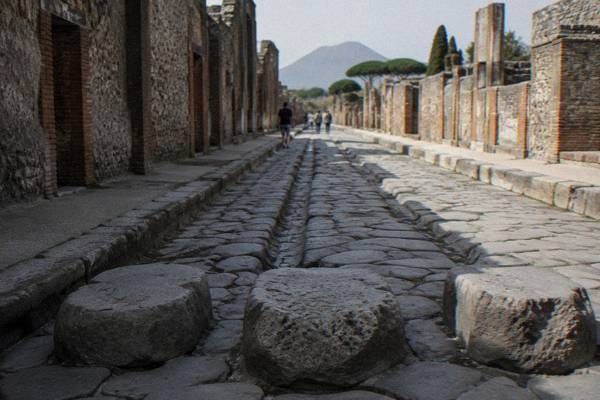
House Of Menander
The House of Menander is one of the grandest residences excavated in Pompeii, the Roman city buried by Vesuvius in AD 79, standing beside the modern town of Pompei in Campania, southern Italy, about 24 km from Naples.
Short answer
The House of Menander stands in the ancient city of Pompeii, an archaeological park in Campania, southern Italy, reached with a standard Pompeii ticket costing EUR 20 in 2026. A single EUR 25 ticket covering all park sites replaces the current structure from 1 January 2027. The house is famous for its frescoes, its private bath suite and the silver treasure found in its cellar.
The House of Menander is a large aristocratic residence in Pompeii, the ancient Roman city buried by the eruption of Mount Vesuvius in AD 79 and now the Parco Archeologico di Pompei, an archaeological park in Campania, southern Italy. It stands beside the modern town of Pompei, about 24 km by road south-east of Naples on the Bay of Naples, and it is included in the standard park ticket: no separate entry fee applies. This guide explains what the house is, what you can see inside it, what a visit costs in 2026 and what changes on 1 January 2027, and how to fold it into a day at the park.

What Is The House Of Menander In Pompeii?
The House of Menander is a large, richly decorated Roman house, or domus, inside the excavated ancient city of Pompeii in Italy, buried by Vesuvius in AD 79 and excavated in stages over the past three centuries. It takes its name from a fresco of the Greek playwright Menander found inside, and it is unusual among Pompeian houses for combining a full residential wing with a private bath complex and substantial service quarters, all opened under one standard park ticket.
The eruption that sealed the house is traditionally dated to 24 August AD 79, the date carried by the oldest manuscripts of Pliny the Younger's letters. That date is not settled: the park's own e-journal states that the rival 24 October date has no evidentiary basis and results from a 1929 misreading, while adding that 24 August is not necessarily correct either. The honest position is that the destruction happened in AD 79, that the traditional date is 24 August, and that scholars continue to debate the details. The park currently leans away from the October reading.
The house is named for a wall painting of Menander, the celebrated Athenian playwright of Greek comedy, placed in the portico facing the entrance. In older guidebooks the building also appears under the name of its owner's family, and the identity of that owner remains an open question in the scholarship. What is not in question is the scale of the property: alongside the reception rooms arranged around the atrium and peristyle, the house includes a private bath suite of the kind otherwise associated with villas, and a deep cellar that held one of the most significant finds made in the city.
That find, a hoard of silver tableware discovered in the cellar during excavation, gave the house a second nickname in the literature, the House of the Silver Treasure. The hoard is discussed below, together with the frescoes that make the building a stop worth planning for.
Where Is The House Of Menander Within The Archaeological Park?
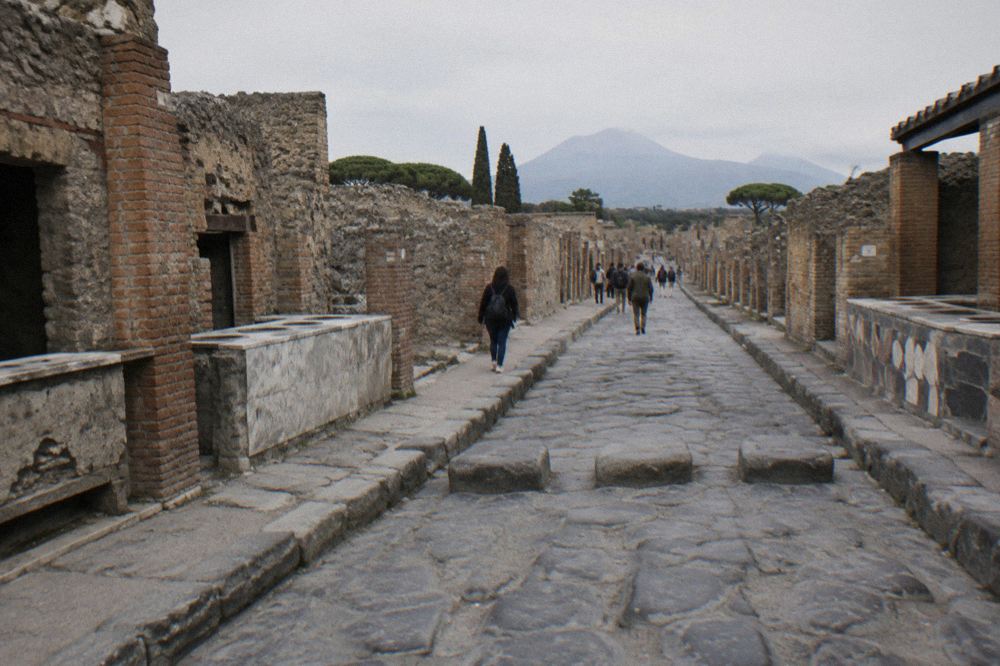
The house stands in the southern part of the excavated city of Pompeii in Italy, on the rise behind the large theatre quarter, a short walk uphill from the Forum and within easy reach of three of the park's named entrances. Visitors arriving at Porta Marina or Piazza Esedra reach it in a few minutes of walking through the civic centre, and those entering at Piazza Anfiteatro approach it from the eastern side of the ruins via the amphitheatre and the large palaestra.
The park operates ticket offices at Porta Marina, Piazza Esedra and Piazza Anfiteatro, and the Porta Ercolano / Street of the Tombs entrance serves the suburban villas route. The theatre district, where the house sits, is one of the natural hubs of any route through the ruins: the large theatre and the odeon sit immediately downhill, the Garden of the Fugitives lies a little further south, and the Forum lies to the north. For orientation before you go, the site's Pompeii map page shows how the districts connect.
Because the house sits mid-way between two entrances, it fits both a short visit and a full day. Travellers following a highlights route from Porta Marina usually reach it after the Forum and the Stabian Baths; travellers arriving from Piazza Anfiteatro usually see it after the amphitheatre and before descending to the civic centre. Neither approach involves backtracking, which matters in a site where the summer heat and the stone paving make every extra kilometre count.

How Much Do Pompeii Tickets Cost In 2026 And What Changes In 2027?
A Pompeii Express ticket, covering the ancient city including the House of Menander, costs EUR 20 in 2026, with the Pompeii+ ticket at EUR 25 and the 3-day ticket at EUR 30. Entry is free for everyone under 18 and for all visitors on the first Sunday of the month, and EU citizens aged 18 to under 25 pay EUR 2 reduced. From 1 January 2027 a single EUR 25 ticket valid 30 days, one entry per site, replaces this structure for all park sites.
The 2026 prices were set on 12 January 2026 and end on 31 December 2026. The smaller park sites outside the ancient city, meaning Oplontis, the Stabiae museum and Boscoreale, cost EUR 8 each, and the MyPompeii annual card costs EUR 45, or EUR 10 reduced. An Express holder can add the suburban villas route for EUR 8, card payment only, at the Porta Ercolano / Street of the Tombs entrance. Full detail on ticket types, nominative tickets and the daily cap of 20,000 visitors is on the site's Pompeii tickets guide.
| Ticket (2026 prices) | Price | What it covers |
|---|---|---|
| Pompeii Express | EUR 20 | The ancient city, including the House of Menander |
| Pompeii+ | EUR 25 | City plus suburban villas route and Antiquarium Boscoreale |
| 3-day ticket | EUR 30 | Pompeii+ plus Oplontis, Stabiae villas and museum, Boscoreale |
| Other sites individually | EUR 8 | Oplontis, Stabiae museum or Boscoreale |
| MyPompeii Card | EUR 45 | Annual pass, EUR 10 reduced |
From 1 January 2027 the Express, Plus and 3-day structure disappears. A single EUR 25 ticket will cover all park sites, valid 30 days with one entry per site; the three smaller sites stay EUR 8 each and the MyPompeii Card stays EUR 45. Nominative tickets and the 20,000 visitors-per-day cap, both in force since 15 November 2024, are retained. Any price you read for 2027 before that date should be checked against the park's own ticketing page, because the change was announced on 14 September 2026 and detail is still being published.
Several ways of visiting the park suit the House of Menander, and the selection below covers a guided entry-and-tour option with an archaeologist, an independent Herculaneum ticket if you are pairing sites, and a full-day Pompeii and Vesuvius tour from Naples with lunch.
The guided entry tour with an archaeologist is the natural fit for this house: the frescoes and the bath suite reward explanation, and the tour includes your entry ticket. You can also Check availability and read the details on the operator's live listing before committing.
What Are Pompeii's Opening Hours And Time-Slot Limits?
Pompeii opens at 9:00 every day and has no weekly closing day, with last entrance at 17:30 and closure at 19:00 from 16 March to 14 October, and last entrance at 15:30 and closure at 17:00 from 15 October to 15 March. The park closes only on 25 December and 1 January unless otherwise communicated, and a 20,000-visitor daily cap applies, split across two time bands in the summer season.
The time bands matter when you plan a day around the House of Menander. From 16 March to 14 October, the 9:00 to 13:00 band carries up to 15,000 entries, of which 12,000 are Express and 3,000 Plus, and the 13:00 to 17:30 band carries up to 5,000, split 3,000 Express and 2,000 Plus. Arriving for the afternoon band is one way to see the theatre quarter in thinner company, at the cost of the midday heat in summer. On free first Sundays the park has recorded more than 36,000 visitors in a single day, a figure the park itself released in November 2024, so those days reward an early start or an alternative date.
| Season | Opens | Last entrance | Closes |
|---|---|---|---|
| 16 March to 14 October | 9:00 | 17:30 | 19:00 |
| 15 October to 15 March | 9:00 | 15:30 | 17:00 |
Two further rules from the visitor regulations shape a visit to any house, this one included. Tickets are nominative, non-transferable and non-refundable except in extraordinary closure, and identity documents may be checked at entry. Bags larger than 30x30x15 cm must be left in the left luggage facility, which matters here because the house's narrower service corridors give little room for large backpacks.
What Can You See Inside The House Of Menander?
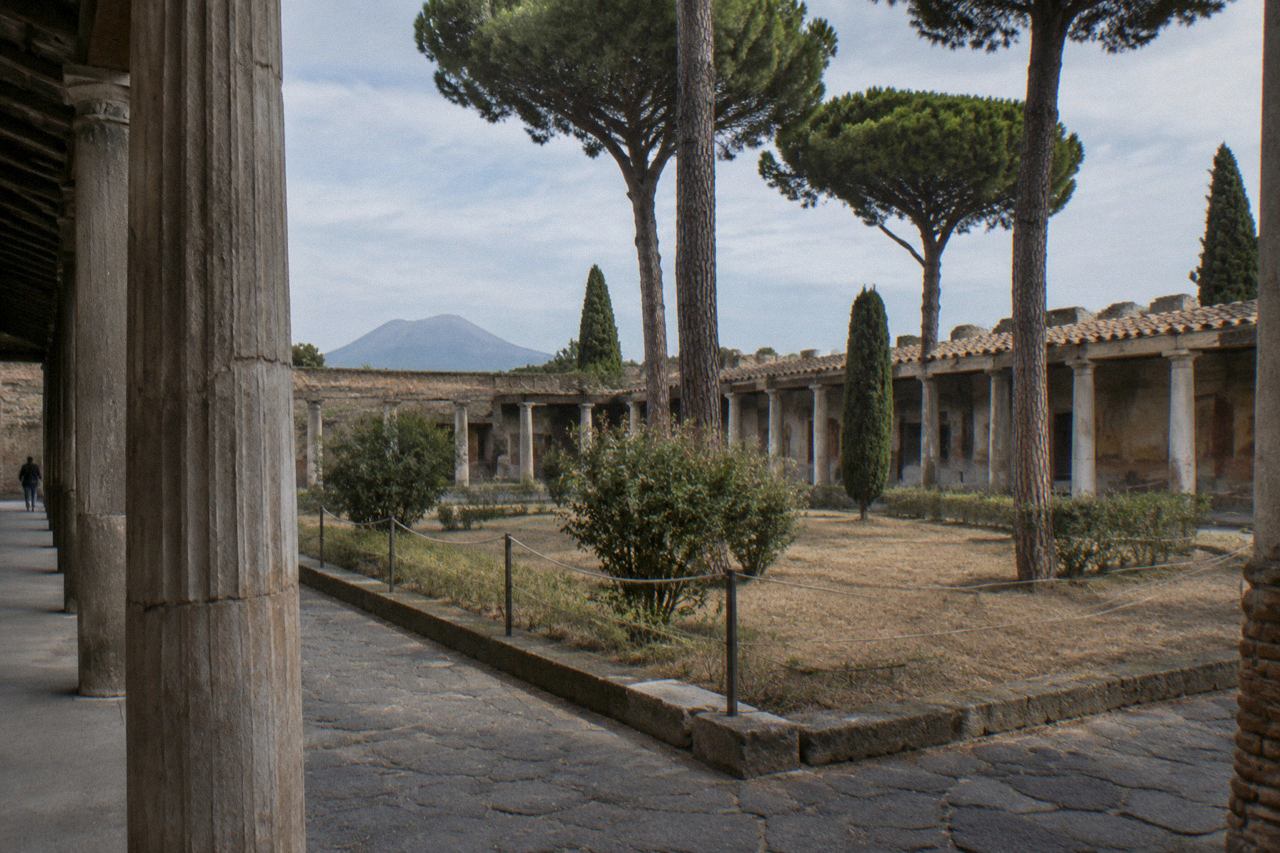
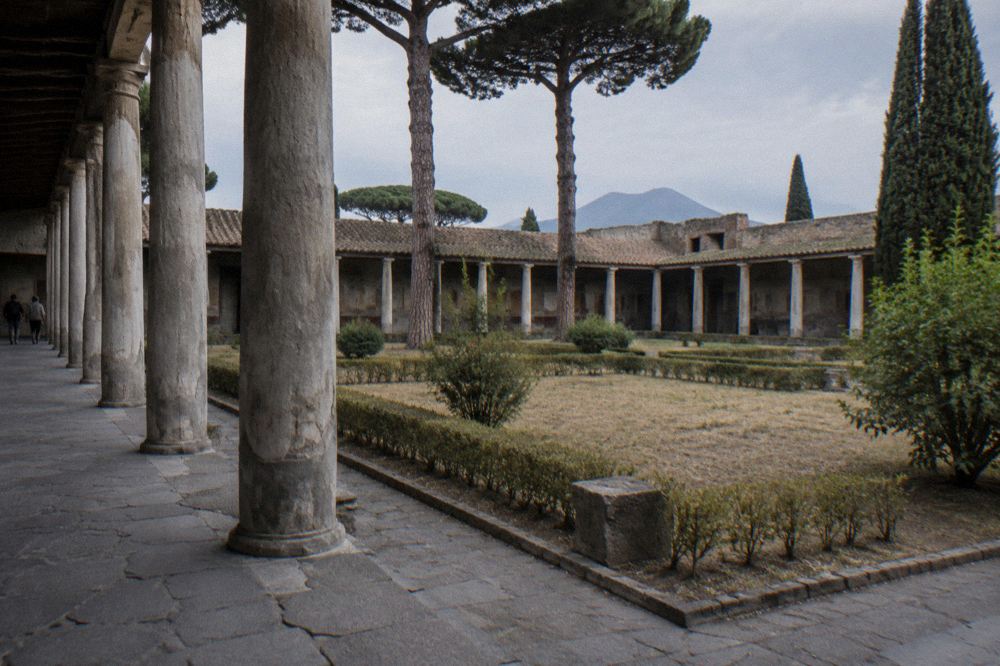
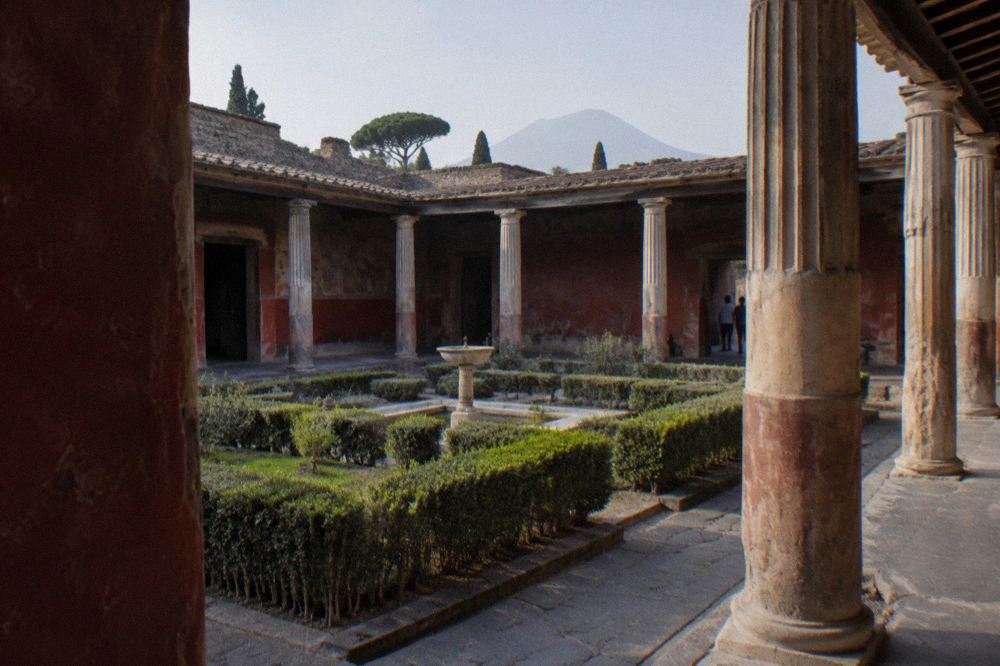
Inside the House of Menander you can see the atrium with its rainwater basin, the large colonnaded peristyle, the fresco of the playwright Menander that gives the house its name, a private bath suite with hot and cold rooms, extensive service and storage quarters, and the cellar where a hoard of Roman silver tableware was found during excavation. The painted decoration is among the richest surviving in a single Pompeian residence.
The frescoes are the first thing any visitor notices. The portrait of Menander himself, in the portico, is matched by mythological scenes and architectural painting through the reception rooms, executed in the styles that date the final decoration of the house to the decades before the eruption. The paintings survive in situ, so you see them as the household saw them, framed by the same doorways and lit from the same courtyards. Details of how these paintings fit into the wider corpus are on the site's overview of Pompeii frescoes and mosaics.
The private bath suite is the house's structural surprise. Where a townhouse typically had to do without baths, relying on the public establishments such as the nearby Stabian Baths, this property built its own suite with the standard Roman sequence of changing room, warm room and hot room. The hypocaust arrangement, the raised floor that carried the heat, is still readable in the fabric, and the contrast with the public bathing culture is one of the reasons archaeologists single the house out.

Then there is the cellar. Excavation uncovered a chest of silver tableware, plates and cups of worked silver hidden below the service quarters, apparently placed there by a household expecting to return. The treasure itself is held in museum collections rather than the house, so what you see on site is the cellar and the service corridor system, but the find gives the building its second name in the older literature, the House of the Silver Treasure, and it connects this address to the wider story of what Pompeii's residents carried, hid and lost in AD 79.
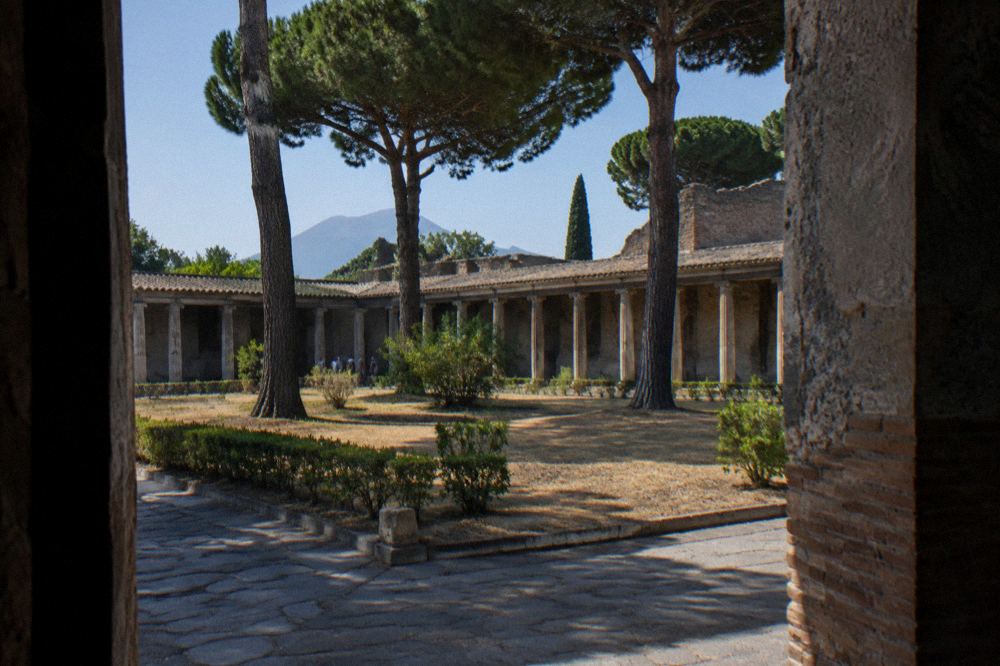
The service quarters reward the walk as well. Storerooms, a stable area and quarters for the household staff sit behind the grand rooms, and walking the full sequence from the street door to the cellar shows the social gradient of a Roman household compressed into one building. Very few properties in the city let you read that gradient so clearly, which is why this house anchors a discussion of domestic slavery and household economy in the park's own publications.
How Does The House Of Menander Compare With Other Great Houses Of Pompeii?
The House of Menander is one of a small group of grand Pompeian residences that reward a dedicated visit, alongside the House of the Faun, the House of the Vettii and the House of the Tragic Poet. It differs from them in combining a private bath suite and deep service quarters with fine painting, where the others are celebrated principally for a mosaic, for restored frescoes, or for a famous pavement mosaic respectively.
The comparison matters when time is short. The House of the Faun, on the Via della Fortuna side of the city, is the grandest single property by footprint and holds the Alexander mosaic's setting; the House of the Vettii reopened to public view as the most extensively restored fresco cycle in the city; the House of the Tragic Poet is small but carries the "Cave Canem" mosaic and some of the best-known mythological panels. The House of Menander's distinctive draw is completeness: house, baths, storerooms and cellar in one architectural walk-through.
| House | Celebrated for | District |
|---|---|---|
| House of Menander | Scale, private baths, silver-treasure cellar, Menander fresco | Theatre quarter, south of the city |
| House of the Faun | Alexander mosaic setting and grandest footprint | North of the Forum |
| House of the Vettii | Restored fresco cycle throughout | West-central, near the Forum |
| House of the Tragic Poet | Cave Canem mosaic and mythological panels | Street of Abundance quarter |
A reasonable half-day route strings several of these together, and the site's Pompeii half day highlights route shows one ordering that works from Porta Marina. If your interest is domestic architecture rather than public monuments, pairing this house with the Villa of the Mysteries outside the walls, reached on the suburban villas route, gives you the townhouse and the country villa in one ticket type.

How Do You Get To Pompeii And The House Of Menander?
Pompeii sits about 24 km by road south-east of Naples, 26 km from Sorrento and 31 km from Salerno, with the Circumvesuviana railway the standard public-transport link: scheduled times from Napoli Garibaldi to the Pompei Scavi-Villa dei Misteri station take 29 to 35 minutes. The station stands beside the Porta Marina entrance, from which the house is a walk through the Forum and the theatre quarter.
The Circumvesuviana's Napoli to Sorrento line serves the station called Pompei Scavi-Villa dei Misteri, at the park's western edge. Computed from the operator EAV's own timetable data, the scheduled run from Napoli Garibaldi to Pompei Scavi takes 29 to 35 minutes with a median of 29, and the onward run from Pompei Scavi to Sorrento takes 34 to 40 minutes. Fares and exact frequencies should be checked on the operator's timetable, and one warning is essential for 2026: the Campania Express service has been suspended since 1 October 2026 until further notice, so any older guide promising that train between Naples and Sorrento is out of date.
| Route to Pompei Scavi | Road distance | Driving time (OSM estimate) |
|---|---|---|
| From Naples | 24 km | about 22 min |
| From Sorrento | 26 km | about 37 min |
| From Salerno | 31 km | about 30 min |
| From Rome | 234 km | about 159 min |
Driving is workable if you plan parking, and the site's Pompeii parking guide covers the options around the entrances. Cruise passengers calling at Naples have a separate set of considerations, covered on the site's page on Pompeii shore excursions, and the station-to-ruins walk, including where the entrances sit relative to the platforms, is explained in the guide to the Pompei Scavi station.
For travellers who prefer not to manage trains and tickets themselves, a full-day organised option from Naples pairs Pompeii with Vesuvius and lunch.
Independent travellers pairing a second site in the same trip can consider Herculaneum, whose entry ticket with optional audio guide is a separate purchase from the Pompeii ticket.
When Is The Best Time Of Year To Visit The House Of Menander?
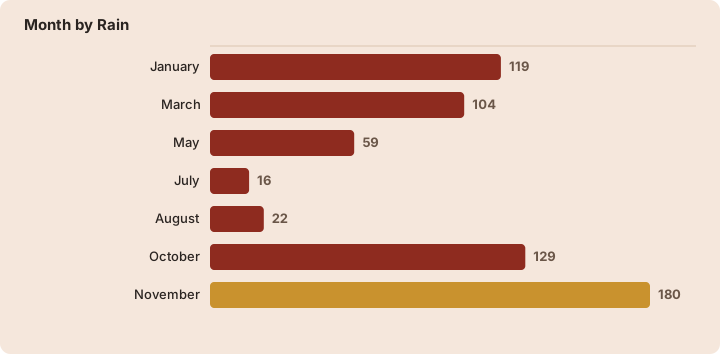
The most comfortable months to visit Pompeii are April, May, October and, with an early start, June and September, based on 1991-2020 climate normals for the Pompei grid point that show daily maxima of about 17.7 to 21.6 C in the shoulder months against about 29.4 C in August. November is the wettest month at about 180 mm of rain and July the driest at about 16 mm.
The park's summer hours run only to 14 October, so spring and autumn combine gentler heat with full opening hours. The normals below are computed from the Open-Meteo historical archive, a reanalysis grid rather than a weather station, so every figure is "about". What they show is a classic Mediterranean pattern: hot, dry summers and mild, wetter winters, with the rain concentrated from October through January. For a site that is almost entirely outdoors and unshaded, those numbers translate directly into comfort. The site's fuller Pompeii weather and best time guide develops the same data into month-by-month advice.
| Month | Mean daily max | Mean daily min | Rain |
|---|---|---|---|
| January | about 12.2 C | about 6.6 C | about 119 mm |
| March | about 14.9 C | about 8.1 C | about 104 mm |
| May | about 21.6 C | about 14.1 C | about 59 mm |
| July | about 28.7 C | about 21.1 C | about 16 mm |
| August | about 29.4 C | about 21.8 C | about 22 mm |
| October | about 21.3 C | about 15.1 C | about 129 mm |
| November | about 16.9 C | about 11.5 C | about 180 mm |
Crowd pressure follows a pattern of its own. The park's official visitor table records 4,000,090 visitors to the Pompeii site in 2025, following 4,069,377 in 2024 and 3,985,424 in 2023, and the monthly breakdown for 2024 shows October, at 481,255 visitors, ahead of even August, at 421,255. April and May were likewise heavy, at 466,344 and 516,923. The practical reading: shoulder-season weather and shoulder-season crowds do not coincide neatly, and the house's enclosed rooms make it a genuinely useful stop in the midday heat of a high-summer visit.
Should You Take A Guided Tour Of The House Of Menander?
A guided tour adds real value at this house, because the frescoes, the bath suite and the cellar find are easy to walk past without explanation, and the entry-ticket-plus-guide products on the operator listings pair the archaeologist-led walk with your admission. Independent visits work well too, since signage covers the basics and the audio-guide ticket option suits travellers who prefer to move at their own pace through the theatre quarter.
The choice is really about depth. A guided group walk keeps its focus on the headline monuments but the guides' archaeological training shows in the domestic detail, and the comparison between houses in the section above is exactly the kind of context a guide supplies on the spot. Independent walkers should budget time honestly: the site's guide to how long to spend in Pompeii is candid about what two hours, half a day and a full day each buy you.
One practical point in favour of a guided product: tickets are nominative and the daily cap is real, so an entry-included tour removes the two steps, buying a timed ticket and joining the right queue, that trip up independent plans in peak weeks. Whatever you choose, book before you travel in April, May, October and on first Sundays.
Beyond the park gates, the modern town of Pompei offers lunch stops and the Shrine of the Virgin of the Rosary, and the site's overview of where to eat in Pompei covers the realistic options near the entrances rather than the tourist traps further out. More context on the city's story is in the site's Pompeii history guide, which the Pompeii Travel Guide maintains alongside this attractions section.
Common Questions About The House Of Menander
Do I need a separate ticket for the House of Menander?
No. The house is inside the ancient city of Pompeii and is covered by the standard park ticket, which costs EUR 20 for the Express option in 2026 and becomes a single EUR 25 ticket covering all park sites from 1 January 2027.
Who was Menander?
Menander was a celebrated Athenian playwright of Greek comedy whose works were admired in Rome. A fresco of him in the house's portico gave the building its modern name; the identity of the Roman owner remains debated.
Where is the silver treasure found in the house?
The hoard of silver tableware was found in the house's cellar during excavation and is held in museum collections, not on display in the house. On site you see the cellar and service quarters where it was hidden.
Is the House of Menander accessible for visitors with limited mobility?
The park's "Pompeii for All" route, entered at Piazza Anfiteatro with exit options at Piazza Anfiteatro or Piazza Esedra via the Antiquarium lift, serves visitors with mobility difficulties. The house's interior, with its level changes and service corridors, is only partly reachable on that route.
How far is the house from the train station?
The Circumvesuviana station Pompei Scavi-Villa dei Misteri stands beside the Porta Marina entrance. From there the house is reached by walking east through the Forum and the theatre quarter; scheduled trains from Napoli Garibaldi take 29 to 35 minutes to the station.
Is the House of Menander open every day?
The park opens daily and has no weekly closing day for the ancient city, closing only on 25 December and 1 January unless otherwise communicated. Individual houses can close temporarily for conservation, so check the park's announcements before a long trip.
Three formats suit a visit built around this house: the archaeologist-led entry tour, the Herculaneum ticket for a two-site trip, and the full-day Pompeii and Vesuvius tour from Naples with lunch included.
Whichever way you visit, the House of Menander repays the extra twenty minutes beyond the headline monuments: it is the place in Pompeii where a single walk-through takes you from the painted reception rooms of a wealthy family, through their private baths, down into the cellar where they hid their silver and waited for an eruption they did not survive.