Pompeii Guided Tour Or Go It Alone: How To Choose
Pompeii, the ancient Roman city buried by Vesuvius in AD 79 and now an archaeological park in Campania, southern Italy, is a maze of silent streets, and the choice between a guided tour and a self-guided visit shapes everything about your day: what you understand, what you reach, and what it costs.

Short answer
A guided tour of Pompeii suits first-time visitors who want context: the park has three ticket offices, a EUR 20 Express ticket in 2026, and streets that are hard to read without explanation. Self-guiding suits confident walkers who prepare. In 2026 entry costs EUR 20 for the ancient city, EUR 25 for Pompeii+, and from 1 January 2027 a single EUR 25 ticket covers all park sites.
Pompeii, the ancient Roman city buried by the eruption of Mount Vesuvius in AD 79, stands beside the modern town of Pompei in Campania, southern Italy, about 24 km by road south-east of Naples, and it is one of the few places where the choice between a guide and a map genuinely changes the visit. The park is not a museum with labels. It is a spread of excavated streets, houses, shops and bathhouses, an excavated area of 44 hectares inside a UNESCO-inscribed property of 98 hectares, and without interpretation a great deal of it reads as beautiful rubble. With a guide, the same stones turn back into a city: a bakery, a betting den, a fast-food counter, a laundry. This guide sets out, plainly and with the park's own published figures, what a Pompeii guided tour gives you, what self-guiding gives you, and how to decide in about five minutes of reading.
The honest summary is this: a guided tour is the better fit for a first visit of two to four hours, and self-guiding is the better fit for a second visit, a slow full day, or a traveller who enjoys preparing. Ticket prices are identical either way, because a guide fee sits on top of your entry, and several tours bundle the ticket in. The park's own rules apply to everyone alike: nominative tickets, a 20,000-visitor daily cap in force since 15 November 2024, and a bag size limit of 30x30x15 cm. Neither option skips those rules. What differs is interpretation, pace and route, and that is what the rest of this page weighs up. For the full ticket picture, including what changes on 1 January 2027, see the dedicated Pompeii Ticket Types Explained page.
What Does A Guided Tour Of Pompeii Actually Give You?
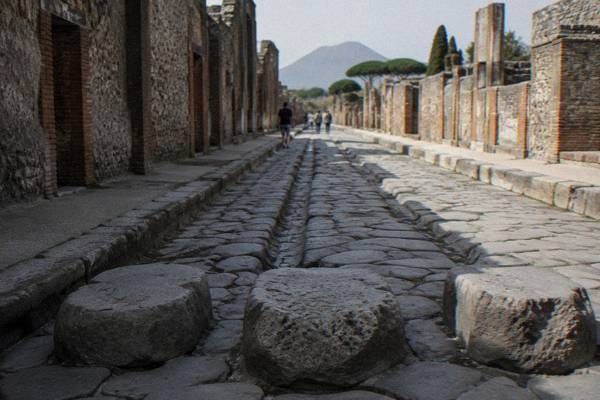
A guided tour of Pompeii gives you three things a map cannot: decoded buildings, an efficient route through a 44-hectare excavated area, and a filter for the enormous site, and it packs them into a walk of typically around two hours. A guide points out the ruts cut by cart wheels, explains what a thermopolium counter served, and tells you which fresco is a political advertisement rather than decoration. Tours generally cover the Forum, the main streets and a selection of houses, so you spend your time looking rather than orienting. The trade-off is pace: you move with a group and cannot linger. For a question-by-question look at the value, the site's Is a Guided Tour of Pompeii Worth It page works through the honest cases for both sides.
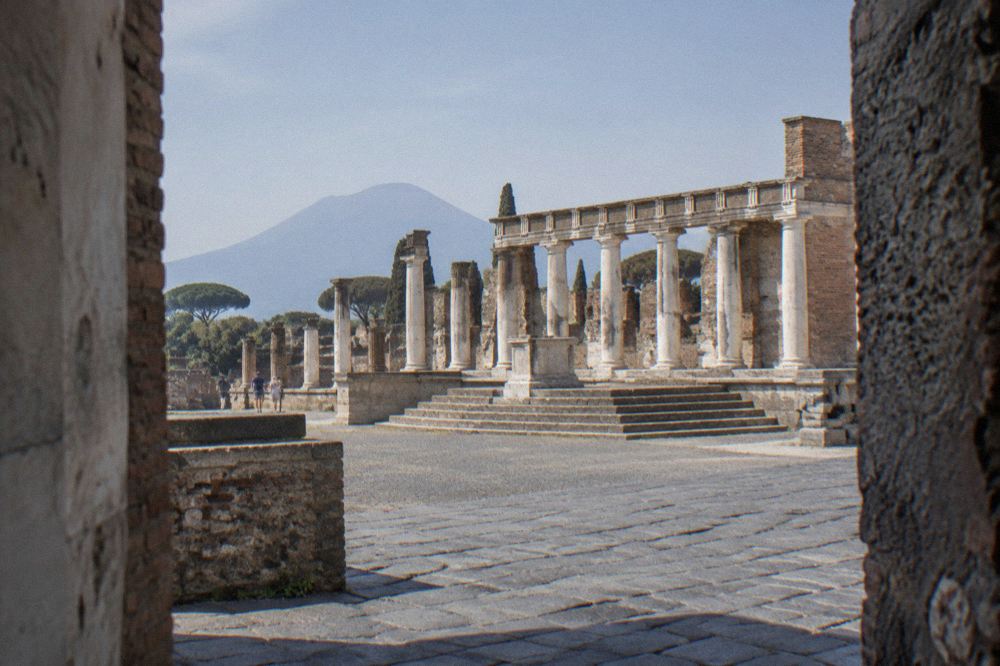
The interpretation gap is real and well documented by how the site is built. Nothing on a Pompeii street explains itself. The Forum is a field of columns and thresholds; the brothel's famous frescoes make sense only with context; the Garden of the Fugitives plaster casts, which hold the shapes of people caught by the eruption, are moving in any framing, but the rest of the park often is not. A guide who can read a Roman city turns a two-hour walk into an experience of daily life in AD 79: elections scratched on walls, bread baking in carbonised ovens, business advertised in paint. Self-guided visitors who skip the preparation frequently report the opposite feeling, that the site blurred into stones.
The route matters as much as the words. Pompeii's three ticket offices sit at Porta Marina, Piazza Esedra and Piazza Anfiteatro, and the distance between them is a real walk in summer heat. A guided tour solves this silently: the route is fixed in advance, tested, and timed against the park's hours, which in the 16 March to 14 October season run from 9:00 to a 19:00 close with last entrance at 17:30, and from 15 October to 15 March from 9:00 to a 17:00 close with last entrance at 15:30. If you go alone and plan badly, you can lose an hour to backtracking alone.
Tours also vary more than their names suggest. An archaeologist-led small group walks differently from a large coach group off a bus, and a private guide can tailor a route to, say, a family with children. The site's Pompeii Tours From Naples and Pompeii Tours From Sorrento pages sort the options by starting point, which is often the single most useful filter, because transport to the park is half the logistics of any visit.
If you already know you want a guide, three formats cover the range: a standard archaeologist-led visit with the entry ticket included, a guided day that adds Herculaneum with tickets handled, and a full-day outing that pairs the ruins with horse riding on Vesuvius and lunch.
Can You Tour Pompeii On Your Own, And Does It Work?
Yes, you can absolutely tour Pompeii on your own, and for many visitors it works very well. The site is enormous, so give yourself several hours, grab a map at the entrance or download one beforehand, and consider an audio guide or guidebook for context. Arrive early to beat the biggest crowds, buy tickets in advance to skip the lines, and wear comfortable shoes, since the ancient stone streets are uneven and dusty.
What self-guiding buys you is freedom and endurance. You can spend a full day, from opening at 9:00 to the last entrance window, and you can visit at your own pace: an hour in the House of the Faun, a long stop at the amphitheatre, a rest whenever you want one. Nobody hurries you past a mosaic you want to study. The site's ready-made routes help enormously here: the Pompeii in One Day itinerary and the shorter Pompeii Half Day Highlights Route both exist precisely because self-guided visitors need a spine to hang the day on.
The weaknesses are equally plain. Pompeii has little in-site signage and almost no shade, and the summer visit needs a real plan: the Pompeii in Summer Heat Plan page covers timing, water and shade. The stones are uneven, kerbs are high, and stepping stones cross every intersection; the terrain question is dealt with honestly in How Difficult Is It to Walk in Pompeii. And a self-guided visitor with no preparation at all, no route and no audio guide, is the person who leaves disappointed. That outcome is common enough that it is worth saying directly: the failure mode of self-guiding is not cost, it is blankness.
A middle path exists and works well: the entry ticket bundled with an audio guide. You keep your own pace and pay only for a voice in your ear. The tile below is that format; figures render on the listing.
What Does Each Option Cost At Pompeii In 2026?
In 2026 the entry ticket costs the same whether you guide or not: EUR 20 Express, EUR 25 Pompeii+, EUR 30 three-day, with EUR 8 each for Oplontis, the Stabiae museum and Boscoreale, and free entry for under-18s and for everyone on the first Sunday of the month. A guided tour adds a service fee on top of entry, and tour prices vary by format and group size, so those figures belong to each tour's live listing rather than to this page. The important planning fact is the change ahead: from 1 January 2027 the park replaces the Express/Plus/3-day structure with a single EUR 25 ticket valid 30 days, one entry per site, while the three smaller sites stay EUR 8 individually and the MyPompeii Card stays EUR 45. A tour booked for 2027 includes that ticket structure automatically.
| Item (2026) | Guided visit | Self-guided visit |
|---|---|---|
| Pompeii Express ticket (ancient city) | EUR 20, often bundled | EUR 20 |
| Pompeii+ (adds suburban villas) | EUR 25, on some tours | EUR 25 |
| 3-day ticket (adds Oplontis, Stabiae, Boscoreale) | EUR 30 | EUR 30 |
| Suburban villas add-on for Express holders | EUR 8, card only, at Porta Ercolano | EUR 8, card only, at Porta Ercolano |
| Reduced (EU 18 to under 25) | EUR 2 | EUR 2 |
| Under 18 | Free | Free |
| First Sunday of the month | Free for everyone | Free for everyone |
From 2027 the table simplifies: one EUR 25 ticket, every park site, thirty days of validity, one entry per site. The nominative-ticket rule and the 20,000-per-day cap both remain. What does not change is the arithmetic of guiding: the guide or tour fee is additional to, or bundled with, entry, and the What Is the Best Pompeii Ticket to Get question deserves its own read if you are choosing between ticket types.
The bundled ticket is where the guided option quietly earns its keep. Several tours include the entry ticket in their price, which means no queue at the office, no risk of the day's allocation selling out under the cap, and one transaction instead of two. The flagship archaeologist-led format below is exactly that, a ticket-plus-guide product; the listing carries the live figures.
For visitors weighing the same question at the park's sister site, the Pompeii vs Herculaneum comparison covers which site rewards a guide more, and the Herculaneum Tickets page has that site's own EUR 16 entry and its current closures: the Villa dei Papiri and the Ancient Theatre are both closed for works.
Which Format Fits Which Traveller?
Choose a guided tour if this is your first visit, your time is under four hours, or you want the ruins explained rather than discovered; choose self-guiding if you are returning, if you like preparing, if your day is long and slow, or if your budget stops at the ticket. Families with children sit somewhere in the middle: a two-hour guided walk can hold a child's attention where a six-hour solo wander cannot, and the site's Pompeii With Kids page works through the specifics, from the "Pompeii for All" accessible route, which enters at Piazza Anfiteatro, to pacing. Cruisers are a distinct case with a hard clock: the Pompeii Cruise Ship Day and Pompeii Shore Excursions pages cover the timing maths of getting from the port at Naples to the park and back.
| Traveller | Better fit | Why |
|---|---|---|
| First visit, half a day | Guided tour | Context in limited time; fixed route |
| First visit, full day | Guided morning, solo afternoon | Guide decodes, then revisit alone |
| Second visit | Self-guided | You know what you want to see |
| Family with children | Short guided tour | Two hours of story beats six of stones |
| Cruiser on a schedule | Shore excursion with guide | Transport and timing handled together |
| Photographer | Self-guided | Light and lingering beat pace |
| Budget traveller | Self-guided | Ticket-only cost |
The hybrid pattern in that table deserves its own sentence, because it is genuinely the best of both for a full-day visitor: take a guided morning, then keep the ticket and walk back over the ground alone in the afternoon. Entry is once per ticket for the ancient city, so you simply stay inside. The morning gives you the decoding; the afternoon gives you the freedom.
How Do Routes Differ Between Guided And Self-Guided Visits?
Guided visits follow a preset route planned by the tour operator, with a guide leading the group along fixed stops in a set order and timeframe. Self-guided visits leave the route entirely up to you, so you can start where you like, spend longer at places that interest you, skip others, and set your own pace from start to finish.
Closures shape every route, guided or not, and the park's announcements are the only reliable source. The Praedia of Julia Felix has been closed to the public since 7 September 2026 for maintenance, with no reopening date published. A guide will route around such closures automatically; a self-guided visitor with an outdated printed walk may not. Checking the park's own news page the week of your visit is the honest advice.
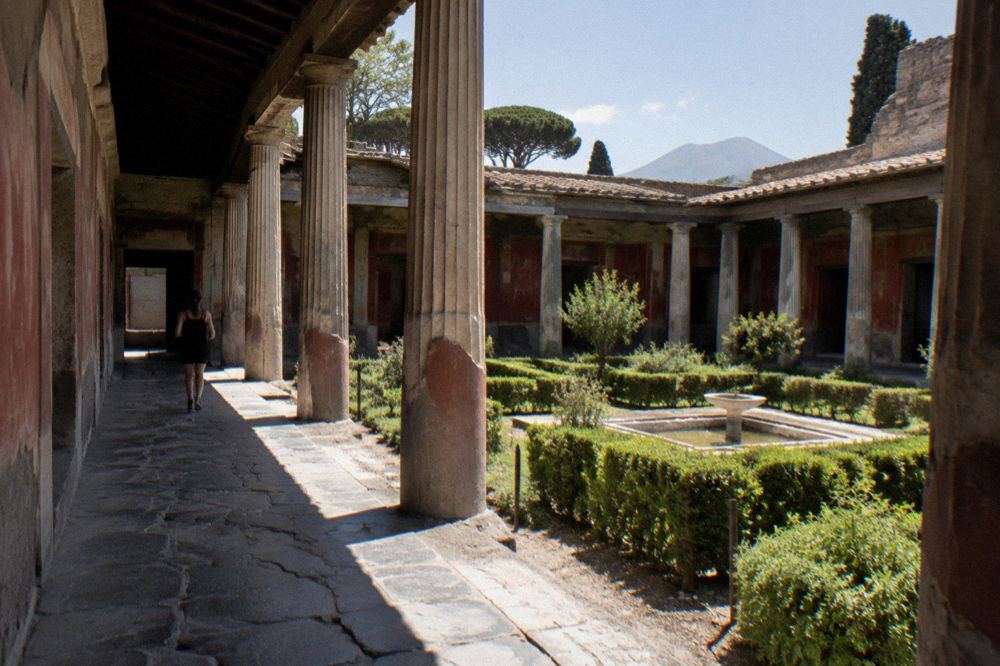
The suburban villas route is a separate decision again. It leaves from the Porta Ercolano / Street of the Tombs entrance and covers the Villa of the Mysteries and Villa Diomedes, plus Villa Regina and the Antiquarium at Boscoreale on the Pompeii+ ticket. Express holders can add it for EUR 8, card payment only, at that entrance. Guided tours of the villas exist as a distinct product, including a three-hour archaeologist-led Villa of Mysteries walk, and they suit visitors who have already seen the city core.
| Route choice | Typical length | Entry point | Best for |
|---|---|---|---|
| Guided classic walk | About 2 hours | Porta Marina | First visit |
| Self-guided one-way line | 3 to 5 hours | Porta Marina to Piazza Anfiteatro | Full-day walkers |
| Amphitheatre-first loop | 3 to 4 hours | Piazza Anfiteatro | Avoiding the crowds at opening |
| Suburban villas route | 2 to 3 hours | Porta Ercolano / Street of the Tombs | Second visit, Pompeii+ holders |
| "Pompeii for All" accessible route | Variable | Piazza Anfiteatro | Mobility difficulties, prams |
What About Getting To Pompeii In The First Place?
Getting to Pompeii is the same problem whatever you choose inside the park, and in 2026 the answer needs care: the Campania Express train has been suspended since 1 October 2026, so the working rail option from Naples or Sorrento is the Circumvesuviana line to the Pompei Scavi-Villa dei Misteri station. Scheduled run times computed from the operator EAV's own timetable data put Napoli Garibaldi to Pompei Scavi at 29 to 35 minutes, and Pompei Scavi to Sorrento at 34 to 40 minutes. Many guided tours from Naples and Sorrento include transport, which quietly removes this entire problem; a self-guided visitor owns it. The dedicated pages, Naples to Pompeii, Sorrento to Pompeii and the Circumvesuviana Train guide, cover the detail, and the station-side practicalities are on the Pompeii Scavi Train Station page.
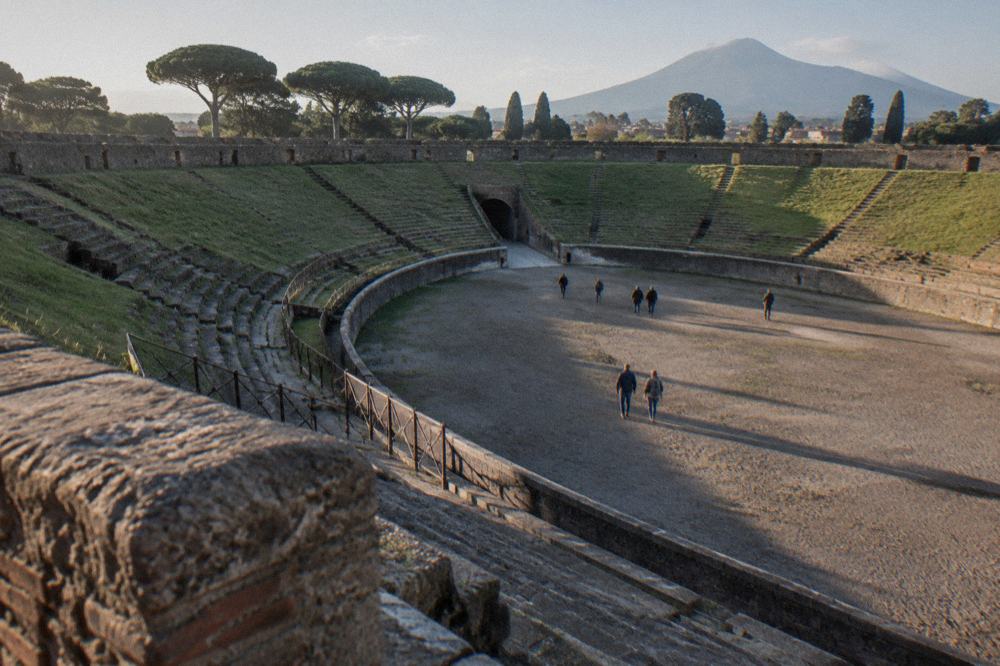
Visitors arriving from farther afield have the same inside-the-park choice but a different transport layer. From Rome, the journey is a high-speed train to Naples plus the local line, or a coach-based day tour that handles everything; the Rome to Pompeii Day Trip and Rome to Pompeii by Train pages split the two approaches, and from the Amalfi Coast the Amalfi Coast to Pompeii page does the same for that direction. On a 12-to-13-hour day out of Rome, a tour with transport is usually the saner format; independent travel from Rome for a two-hour visit is a long day for thin reward.
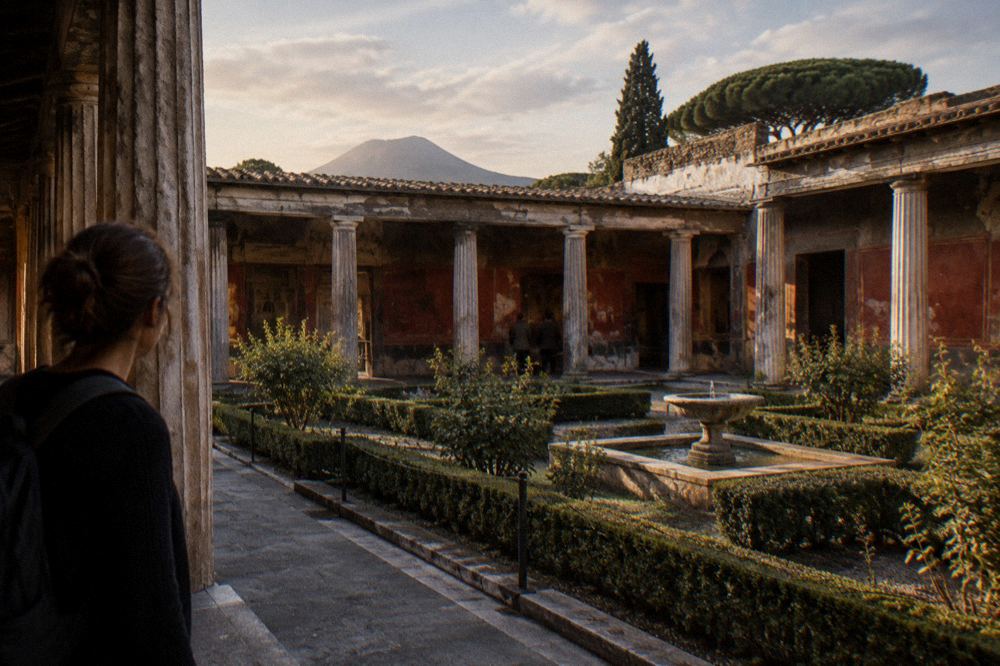
Driving visitors should not be forgotten: road distances to the Pompei Scavi area are about 24 km from Naples, 26 km from Sorrento and 31 km from Salerno, according to route data computed on OpenStreetMap. Parking, luggage and the bag-size rule (30x30x15 cm, larger bags to left luggage) are covered on the Pompeii Parking and Pompeii Luggage Storage pages.
| Starting point | Road distance to Pompei Scavi | Road time (computed) | Guided tours with transport |
|---|---|---|---|
| Naples | 24 km | About 22 min | Many, city and day-trip formats |
| Sorrento | 26 km | About 37 min | Several, train and coach based |
| Salerno | 31 km | About 30 min | Limited; rail is the usual route |
| Rome | 234 km | About 159 min | Day trips, 11 to 13 hours |
How Do Weather And Season Affect The Choice?
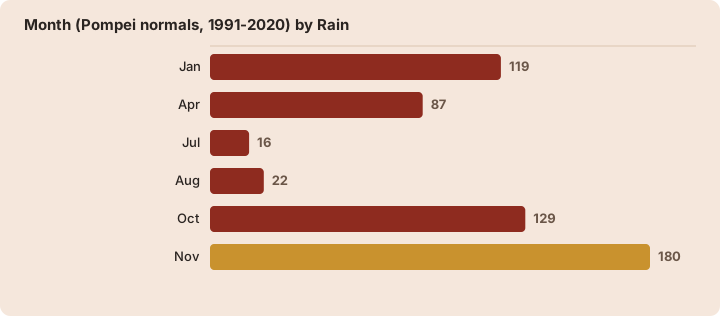
Heat pushes the decision toward guided tours, and shoulder seasons pull it back toward self-guiding: Pompei's July mean daily maximum is about 28.7 C and August's about 29.4 C, with barely 16 to 22 mm of rain across those two months, while November averages about 180 mm of rain, the wettest month of the year. Those figures are 1991-2020 climate normals for the Pompei area computed from the Open-Meteo historical archive, a reanalysis grid rather than a weather station, so treat them as "about". A two-hour guided walk in August is a bounded, survivable commitment; an open-ended self-guided day in the same heat needs the discipline of an early start, because last entrance in the summer season is 17:30 and the sensible hours are the first three after the 9:00 opening.
| Month (Pompei normals, 1991-2020) | Mean daily max | Mean daily min | Rain |
|---|---|---|---|
| Jan | About 12.2 C | About 6.6 C | 119 mm |
| Apr | About 17.7 C | About 10.4 C | 87 mm |
| Jul | About 28.7 C | About 21.1 C | 16 mm |
| Aug | About 29.4 C | About 21.8 C | 22 mm |
| Oct | About 21.3 C | About 15.1 C | 129 mm |
| Nov | About 16.9 C | About 11.5 C | 180 mm |
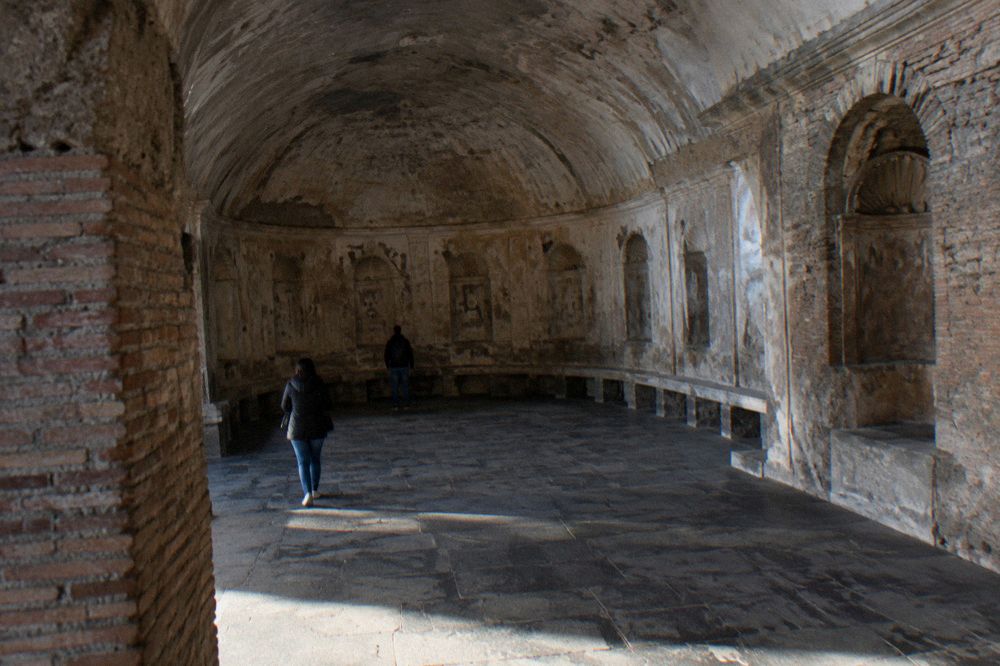
Rain changes the calculus differently. Pompeii's ancient streets drain badly by modern standards and become slick quickly, and a wet-weather day shortens any visit; a pre-booked guided tour keeps you committed and moving, which is arguably the better outcome than drifting toward an early exit. The fuller picture, month by month, is on the Pompeii Weather and Best Time to Visit page. Crowds follow the same curve: the park's own visitor statistics show 2025 attendance at 4,000,090 for the Pompeii site, and in 2024 the three busiest months were May at 516,923 visits, October at 481,255 and September at 468,340. In those months a guide's fixed route and a pre-booked time slot are worth more than in deep winter.
The 20,000-visitor daily cap, in force since 15 November 2024, bites hardest on free first Sundays: the park has recorded more than 36,000 visitors on one such Sunday before the cap applied. On those days, structure of any kind, guided or a disciplined self-guided plan, beats improvisation.
What Are The Alternatives To A Standard Guided Walk?
Beyond the standard two-hour guided walk, Pompeii tours come in several distinct formats: ticket-plus-audio-guide for solo walkers, private guides booked per group, two-site days combining Pompeii with Herculaneum, and full-day experiences pairing the ruins with Vesuvius, wine or horse riding. Each answers a different traveller. The private format suits families and anyone who wants questions answered at their own pace; the two-site day suits visitors with one full day for both Vesuvian cities; the Vesuvius pairings suit visitors who want the volcano and the city in a single story, which is, after all, the actual story of this place: the eruption traditionally dated to 24 August AD 79, a date the park's own e-journal treats as debated while stating that the alternative 24 October reading has no evidentiary basis.

Pairing Pompeii with Vesuvius deserves special mention because it reverses the usual advice. As a standalone question, which to do first is argued on the Is It Better to Do Pompeii or Vesuvius First page, but on a paired tour the operator solves the order, the transport and the lunch. That matters at the crater: Vesuvius Gran Cono tickets are online-only timed entries sold at EUR 11.68 full and EUR 9.55 reduced, bookable 30 days ahead in slots of 50 tickets per 10 minutes, and the path closes automatically on an orange weather alert with automatic refund. Handling that machinery is a real advantage of a paired guided day, as the How to Visit Mount Vesuvius page explains.
Wine-based formats are the other growing family: vineyards on Vesuvius's slopes pour wines grown on the volcano's own soil, often with lunch, and the Pompeii Wine and Vesuvius Wine Tasting page covers the territory. The horse-riding format below is the most distinctive of these, pairing the guided ruins walk with riding on the volcano and lunch; its figures render on the listing.
Common Questions About Pompeii Guided Tours Vs Self-Guided Visits
Is a guided tour of Pompeii worth it?
For a first visit of under four hours, generally yes: the park has little in-site interpretation, and a guide converts anonymous ruins into a legible Roman city while running an efficient route through a 44-hectare excavated area. For returning visitors, slow full-day walkers and travellers who enjoy preparing their own route, a self-guided visit with an audio guide delivers a similar experience at the ticket price alone.
Can you visit Pompeii without a tour?
Yes. Entry requires only a ticket, which in 2026 costs EUR 20 for the ancient city, EUR 25 for Pompeii+ and EUR 30 for the three-day version, with free entry for under-18s and for everyone on the first Sunday of the month. Buy online in advance, bring identification for the nominative ticket, and arrive with a route or audio guide, because the site itself explains very little.
Do Pompeii tours include the entry ticket?
Some do and some do not, and the only reliable source is each product's own listing. Several archaeologist-led formats bundle the entry ticket, which removes both the ticket-office queue and the risk of the day's allocation selling out under the park's 20,000-visitor daily cap. Never assume inclusion from the tour's name.
How long does a guided tour of Pompeii last?
The common formats run about two hours, covering the Forum, the main streets and selected houses. Longer products exist, including a three-hour Villa of Mysteries walk and full-day pairings with Herculaneum or Vesuvius. A two-hour guided walk plus independent wandering afterwards is a well-established hybrid that works within a single entry.
Is Pompeii better with a guide or audio guide?
A live guide answers questions, reads the crowd and adjusts the route; an audio guide keeps your own pace and costs far less. First-time visitors with limited hours tend to get more from a live guide, while full-day and repeat visitors often prefer the audio format. Both beat wandering with nothing at all, which is the one genuinely poor option.
Does a guided tour skip the line at Pompeii?
Tours with tickets included remove the ticket-office queue at Porta Marina, Piazza Esedra and Piazza Anfiteatro, but the park's security checks and nominative-ticket identification apply to everyone, guided or not. Nothing bypasses the entry procedures themselves. Booking any ticket online in advance achieves much the same time saving for a self-guided visitor.
The decision rarely needs more thought than this page has given it. If Pompeii is a once-only, time-boxed visit, book a guide and spend your hours looking at a city someone can explain; if the day is long, the season kind and the preparation enjoyable, buy the ticket, take the map from the Pompeii Travel Guide homepage, and walk it yourself. Either way, enter early, carry water, and let the stones say what they have been saying since AD 79.