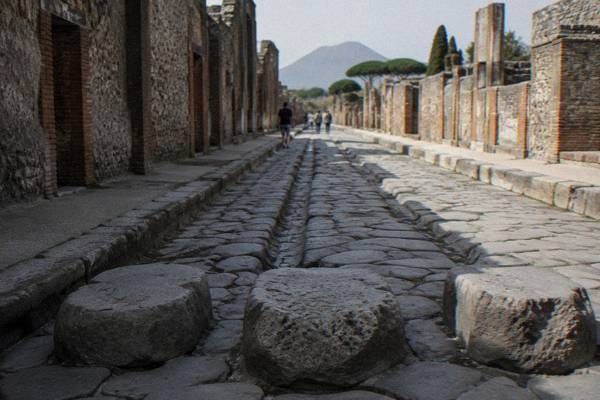
Pompeii Brothel
The Lupanar is the building in Pompeii, the Roman city buried by Vesuvius in AD 79 and now an archaeological park in Campania, southern Italy, that guidebooks sell as the ancient city's purpose-built brothel: a small two-storey structure whose painted interiors and scratched graffiti draw long queues.
Short answer
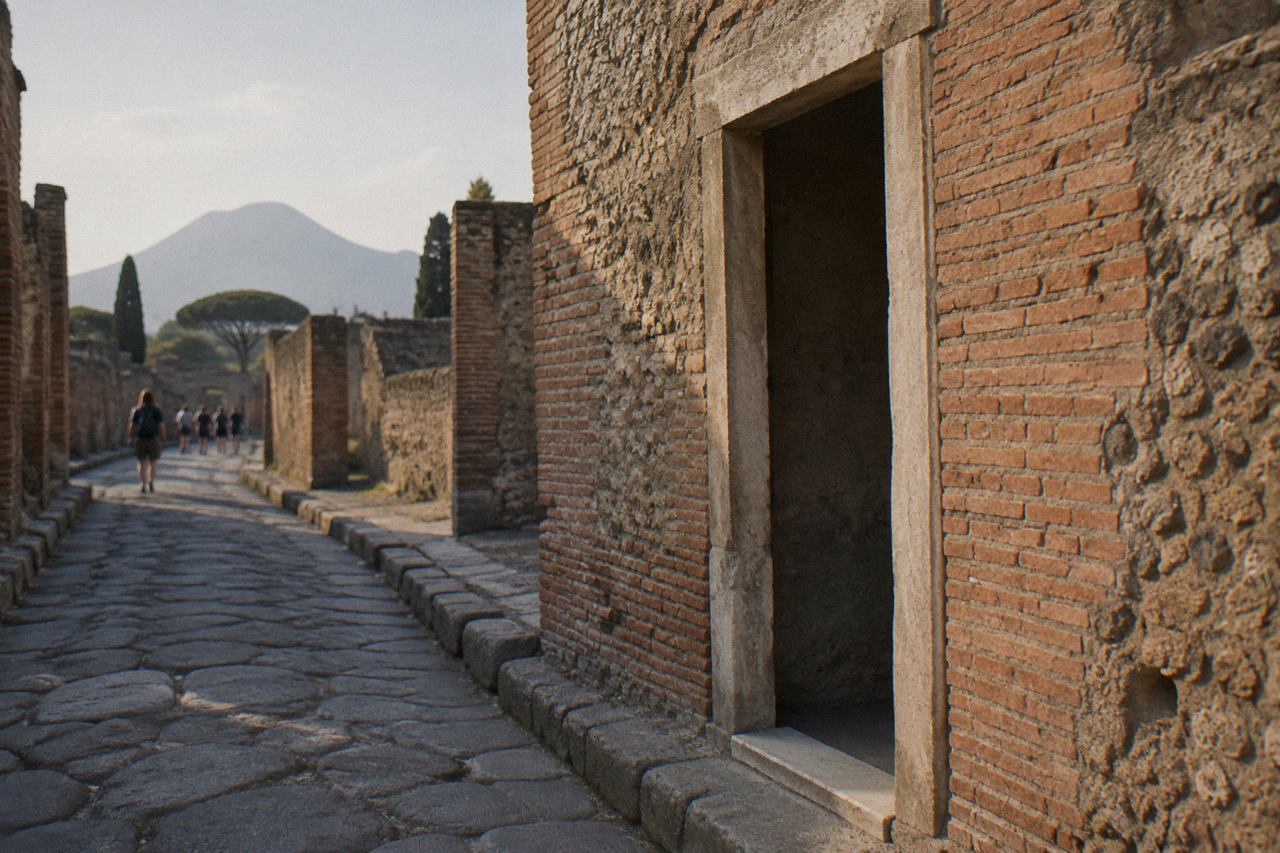
The Lupanar sits in the heart of Pompeii, about 24 km from Naples, inside a park that charges EUR 20 for the 2026 Express ticket, rising to a single EUR 25 ticket for all sites from 1 January 2027. There is no separate brothel ticket: you see it on your park entry, best with a guide because the graffiti are easy to miss unaided.
The Lupanar is the building in Pompeii, the Roman city buried by the eruption of Mount Vesuvius in AD 79 and now an archaeological park in Campania, southern Italy, beside the modern town of Pompei and about 24 km by road from Naples, that guidebooks and tours market as the ancient city's purpose-built brothel. It is a compact structure: a ground floor of small stone-lined rooms opening off a central corridor, a now-closed upper storey reached by its own stair, and interior walls carrying small painted panels above the doorways together with a dense scatter of scratched graffiti. Its name comes from the Latin for wolf, lupa, the slang word of the Roman world for a prostitute, and the building sits on a side street a short walk from the heart of the excavations. This guide covers what the building actually is and is not, what you can see inside, the graffiti and frescoes that give it its reputation, and the practical layer: tickets for 2026 and the change coming in 2027, hours, the queue problem and how a guided visit changes the experience.
What Is The Lupanar Of Pompeii?
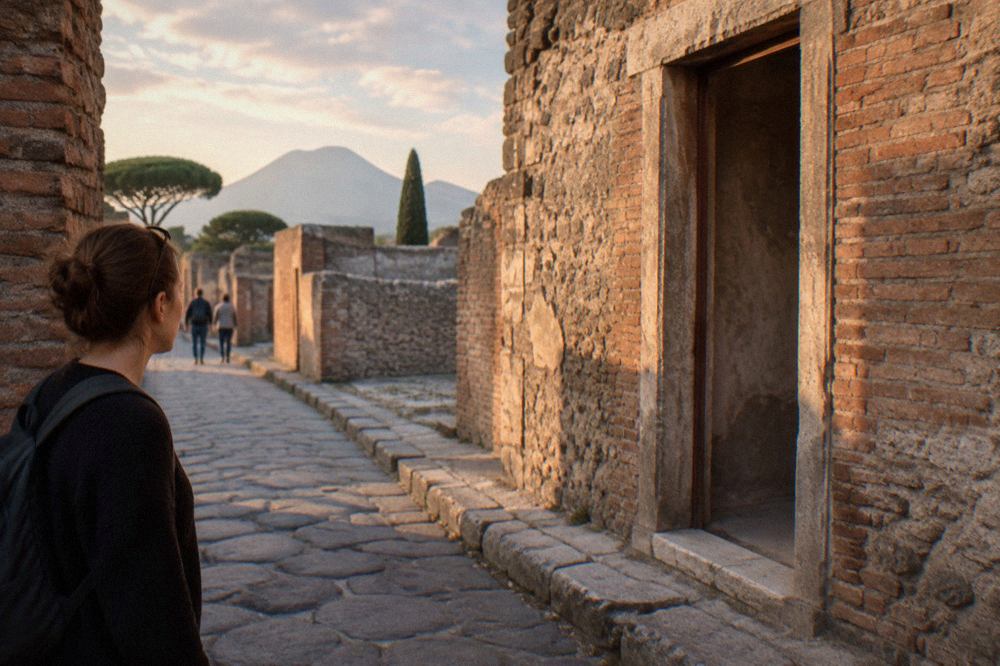
The Lupanar of Pompeii is a small two-storey building in the central district of the excavated city, identified by the park as a purpose-built brothel and the only structure so labelled in Pompeii; its name comes from lupa, Latin slang for a prostitute. Modest in scale, it is best known not for its architecture but for its small erotic painted panels and the graffiti scratched by workers and clients. The identification rests on that combination of layout, decoration and written records rather than on a single sign, and archaeologists have debated how many buildings in the city served the same trade; similar symbols and paintings appear at other addresses, and this page's target, the building on the central crossroads, is the one the park presents to visitors as the purpose-built example.
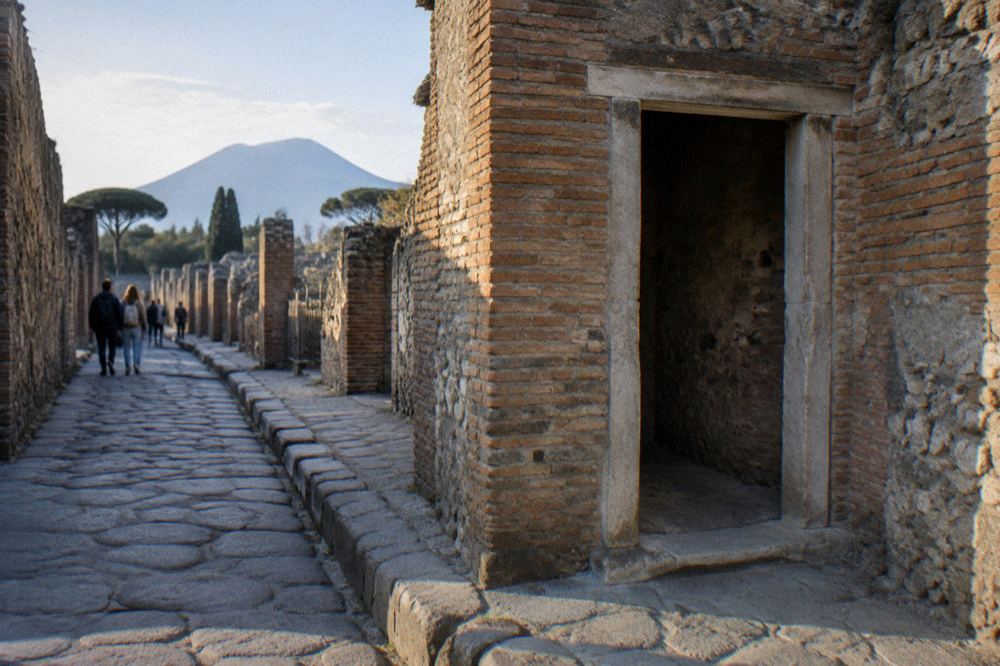
The building is easy to find once you know the street pattern, but easy to walk past otherwise. It lies in the block between the Forum area and the Stabian Baths district, close to the Stabian Baths, which is a useful landmark because that vast bathing complex appears on every orientation map and on the park's own signage. Visitors coming up from Porta Marina, the entrance closest to the Circumvesuviana station at Pompei Scavi-Villa dei Misteri, typically reach the baths before the Lupanar, so a natural route takes in both. The park map page on this site carries the full street plan.
The upper floor is closed to visitors, and the lower rooms are viewed from the corridor or threshold, which is why crowding is the building's main practical problem. The painted panels sit at a height that rewards a slow look, and the graffiti, most of it faint, reward a guide who can point to the best-preserved examples and translate them. Everything else you need about getting in, prices and timing follows in the sections below.
Is The Pompeii Brothel Worth Seeing?
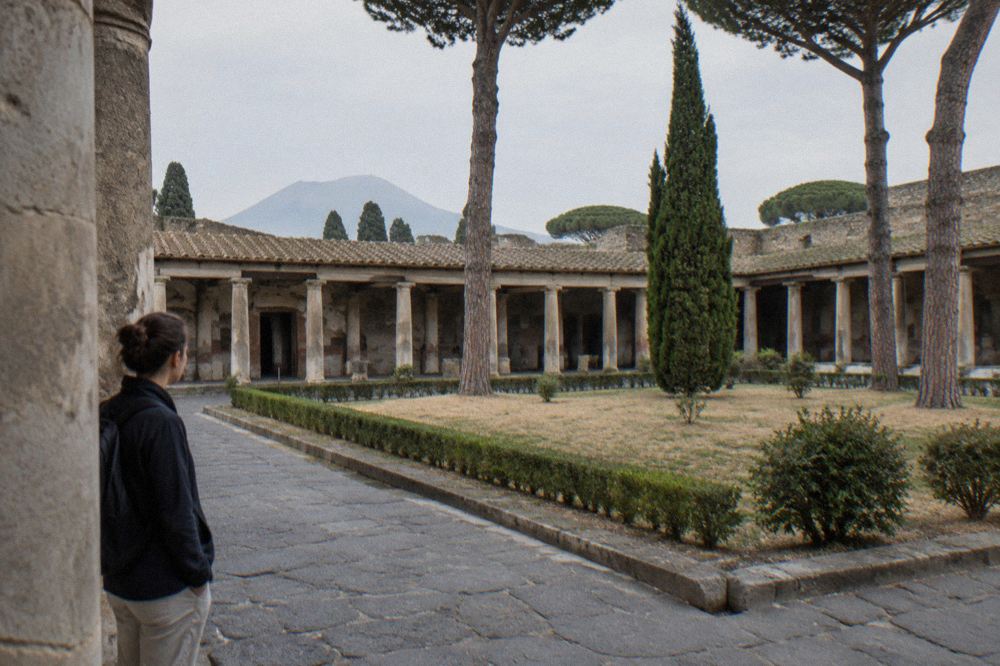
Yes, the Lupanar is worth seeing, because it is one of the few buildings in Pompeii where the function, decoration, and written voices all survive together, and it is among the most requested stops on guided routes. Go in with the right expectations though: the interior is small, dim, and crowded at peak hours, so it rewards a guide or good audio guide far more than a walk-through alone.
The case for going is the density of evidence in one small footprint. The painted panels above the doorways are among the most reproduced images from the site, and the graffiti, scratched rather than painted, are primary documents of everyday Roman life in a way few monuments anywhere match: names, prices, boasts and complaints, written by the people the building served. The park leaves the walls largely as excavated, so what you see is the surviving surface rather than a reconstruction.
The case against is practical. The corridor is narrow, the rooms are viewed from outside, and at busy times a queue forms at the doorway and the dwell time per visitor drops to seconds. The building is unshaded, and in the hotter months the surrounding streets radiate heat; the summer heat plan guide on this site covers timing and shade strategy. If your time in the city is short, a highlights route that includes the Lupanar, the House of the Faun and the Forum gives a fuller picture of Pompeii than lingering only here.
For visitors weighing a guided day against independent wandering, the choice comes down to whether a guide's translations and route knowledge are worth the price. On the evidence of the building itself, they are: the graffiti are illegible to a non-Latinist and unlabelled in place. A structured day trip is one way to bundle that expertise.
What Do The Frescoes And Graffiti In The Pompeii Brothel Show?
The frescoes are small erotic panels painted above the doorways of the ground-floor rooms, each showing a couple in a different position, and their traditional reading is a menu of services advertised to an illiterate clientele; the graffiti, by contrast, are scratched texts left by clients and by the women who worked there, recording names, conquests, earnings and grievances. Neither set is large in area, both are fragile, and both are best understood with translation. The panel-above-the-door reading is the standard one given by guides, though scholars caution that Roman erotic art served multiple purposes and the menu interpretation is a hypothesis rather than a documented fact.
The graffiti deserve their reputation. Unlike official inscriptions, they were written by ordinary people, and their tone is blunt: declarations of affection, crude boasts, rivalries and money notes. They were scratched into the plaster with a stylus or sharp point, which is why they read as thin lines rather than painted letters, and why lighting and angle matter when viewing them. Guides usually point out two or three of the clearest examples; independent visitors without a guide walk straight past them. The wider story of written walls across the city is covered in the Pompeii graffiti guide.
For the frescoes, context matters too. Erotic imagery was not confined to this building: comparable scenes appear in houses and at street corners elsewhere in the city, and the Villa of the Mysteries, a suburban villa reached on the villas route, carries a famous figurative cycle of its own that repays comparison. Seeing the Lupanar's panels as part of a broader visual culture, rather than an isolated curiosity, is the single biggest upgrade a visitor can make to their understanding of the building.
How Do You Get Into The Lupanar And What Does It Cost?
You don't buy a separate ticket for the Lupanar: it's covered by standard Pompeii park entry, which in 2026 means the Pompeii Express ticket at EUR 20, the Pompeii+ ticket at EUR 25, or the 3-day ticket at EUR 30, with free entry for under-18s and all visitors on the first Sunday of each month, and EUR 2 for EU citizens aged 18 to under 25; from 1 January 2027 a single EUR 25 ticket covers all park sites, valid 30 days with one entry per site.
The table below sets out the 2026 prices and who pays what.
| Ticket (2026) | Price | What it covers |
|---|---|---|
| Pompeii Express | EUR 20 | The ancient city, including the Lupanar |
| Pompeii+ | EUR 25 | The city plus the suburban villas, Villa Regina, Boscoreale Antiquarium and shuttle |
| 3-day ticket | EUR 30 | Pompeii+ plus Oplontis, the Stabiae sites and Boscoreale |
| Other park sites (Oplontis, Stabiae museum, Boscoreale) | EUR 8 each | Each site individually |
| MyPompeii Card (annual) | EUR 45 (EUR 10 reduced) | Annual pass |
| Reduced (EU citizens 18 to under 25) | EUR 2 | Applies to the tickets above |
| Under 18 | Free | Proof of age may be asked |
The 2027 change is the biggest pricing shift in years, announced by the park on 14 September 2026, so a visit planned across New Year needs both numbers.
| Element | Until 31 December 2026 | From 1 January 2027 |
|---|---|---|
| Ticket structure | Express / Pompeii+ / 3-day | One ticket, all park sites |
| Price for the ancient city | EUR 20 (Express) | EUR 25 |
| Validity | Single entry to the city | 30 days, one entry per site |
| Outlying sites | EUR 8 each | EUR 8 each, unchanged |
| MyPompeii Card | EUR 45 | EUR 45, unchanged |
| Nominative ticket and 20,000 daily cap | In force | Retained |
Tickets are nominative, identity may be checked at entry, and the park caps visitors at 20,000 per day, a limit in force since 15 November 2024. Ticket offices sit at Porta Marina, Piazza Esedra and Piazza Anfiteatro, and online purchase runs through the vivaticket link on the park's own page. Bags are limited to 30x30x15 cm, with larger items left at left luggage; the full detail is in the Pompeii tickets guide on this site. Express holders can add the suburban villas route for EUR 8, card payment only, at the Porta Ercolano / Street of the Tombs entrance.
When Is The Pompeii Brothel Open And When Should You Go?
The Lupanar follows the Pompeii park's schedule: from 16 March to 14 October it opens at 9:00 with last entry at 17:30 and closing at 19:00, while from 15 October to 15 March it opens at 9:00, last entry 15:30, closing 17:00, and it shuts on 25 December and 1 January unless the park says otherwise. Go in the first hour after opening or the last two hours before closing, midweek outside Italian holiday periods, since midday crowds jam the corridor.
| Season | Opens | Last entry | Closes |
|---|---|---|---|
| 16 March to 14 October | 9:00 | 17:30 | 19:00 |
| 15 October to 15 March | 9:00 | 15:30 | 17:00 |
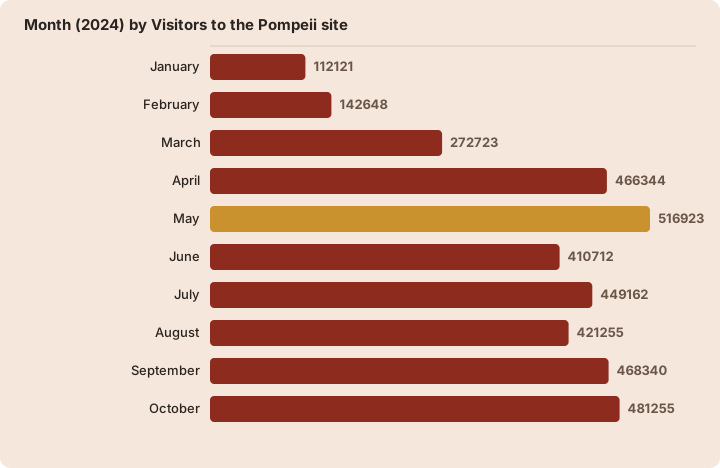
Crowding has a season as well as a daily rhythm. Translated into planning: late October mornings are beautiful and packed, mid-winter weekdays are near-empty but short on daylight, and the shoulder months of April and May trade longer days against heavier flow.
| Month (2024) | Visitors to the Pompeii site |
|---|---|
| January | 112,121 |
| February | 142,648 |
| March | 272,723 |
| April | 466,344 |
| May | 516,923 |
| June | 410,712 |
| July | 449,162 |
| August | 421,255 |
| September | 468,340 |
| October | 481,255 |
| November | 189,866 |
| December | 138,028 |
Weather shapes the visit as much as the calendar. The 1991-2020 climate normals for the Pompei grid point, computed from the Open-Meteo historical archive, give about 29.4 C mean daily maxima in August against about 12.2 C in January, with November the wettest month at about 180 mm of rain and July the driest at about 16 mm. The Lupanar's corridor and the streets around it offer little shade and less shelter, so a wet or very hot day changes the experience more here than in the covered museum spaces. The weather and best time to visit guide carries the full month-by-month table.
Can You Visit The Lupanar On A Guided Tour?
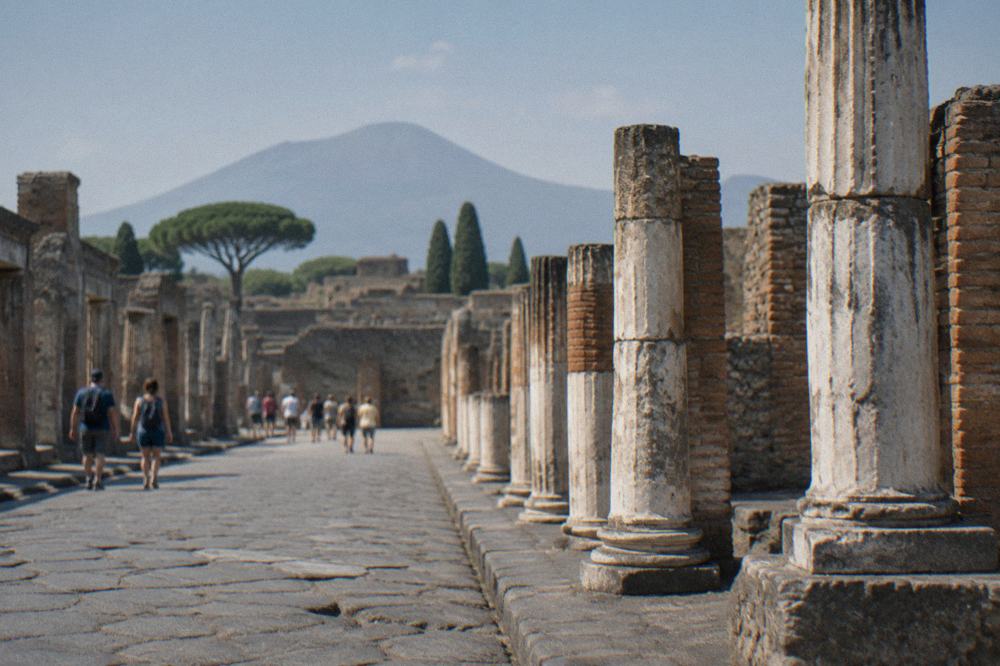
Yes, guided tours are the recommended way to see the Lupanar: guided routes through Pompeii routinely include the building, and a guide solves the two problems an independent visitor faces here, reading the graffiti and managing the crowd. Options range from small-group archaeologist-led walks starting inside the park to full-day trips from Naples or Sorrento bundling transport, skip-the-line entry and a guided route; our featured pick is a half-day trip from Naples with skip-the-line tickets and a guide, linked below.
The featured tour runs from Naples, pairs transport with priority entry and a guided walk, and suits visitors basing themselves in the city; the Check availability link shows live dates and pricing from the operator's listing. Booking terms, including free cancellation windows, are stated on that listing rather than here, because they change with season and demand.
Two alternatives suit different plans. For a deeper single-site visit, a small-group tour with an archaeologist spends its whole time inside the city and typically gives the graffiti more attention:
For visitors who want the volcano in the same day, a combined Pompeii and Vesuvius trip with lunch covers the eruption's cause and its effect in one outing, at the cost of a shorter stay in the city itself. How to split that decision is covered in the Pompeii and Vesuvius in one day guide.
How Long Should You Spend At The Pompeii Brothel?
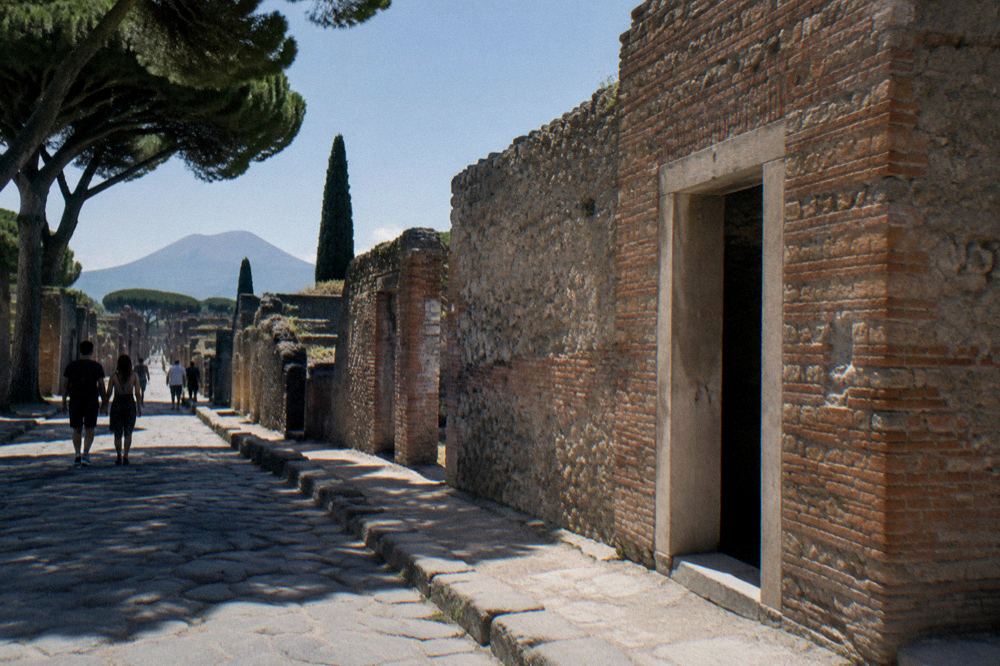
Ten to fifteen unhurried minutes is the realistic maximum inside the building itself: the corridor is short, the rooms are viewed from the threshold, and once the panels and the clearest graffiti have been found there is little more to see. The building earns its place as a stop of five to ten minutes on a guided hour in the surrounding district, pairing naturally with the Stabian Baths, the Forum and the streets between. Budget the visit as a highlight stop, not a destination.
Crowding is the variable that breaks that estimate. At peak, visitors are funnelled through in a moving line and ten minutes becomes two; at opening, the same corridor can be held in near silence. This is the strongest argument for the early-entry strategy in the timing section above. It is also the reason the building pairs well with a guide, who arrives with the group at a planned time rather than joining the back of a queue.
The rest of the district rewards the time saved. Visitors with a full day can add the northern quarters and the Amphitheatre, using the route ideas in the Pompeii in one day guide on this site.
Is The Pompeii Brothel Suitable For Children?
Yes, in the plain sense that children enter the park free under 18 and there is no age restriction at the building, but parents should know what is on the walls: the painted panels are explicitly erotic and the graffiti translations, when a guide gives them, are frank. Families with primary-age children commonly walk the corridor quickly or skip it; those with teenagers often find it becomes the most-discussed stop of the day. The decision is parental, not regulatory.
Practically, the building sits on a mainstream circuit, so a family skipping it loses nothing in route terms; the surrounding streets continue to the baths and the Forum regardless. For families planning a whole day with children, the Pompeii with kids guide on this site covers routes, shade and facilities, and the park's accessibility provisions, including the "Pompeii for All" route entering at Piazza Anfiteatro for visitors with mobility difficulties, are described in the dedicated accessibility guide.
Worth adding: the erotic material is not hidden elsewhere in the city, and the park's own museums display comparable finds; the Pompeii Antiquarium and the National Archaeological Museum in Naples, covered in the Naples National Archaeological Museum guide, hold material from the excavations that puts the Lupanar's panels in context. Preparing that context before the visit is the difference between embarrassment and a genuinely interesting conversation.
What Should You Not Believe About The Pompeii Brothel?
Three myths travel with this building: that it proves licensed, state-run prostitution in a dedicated civic building, that its frescoes are a literal service menu, and that the building is untouched evidence frozen exactly as the eruption left it. Each is a modern shorthand. The identification rests on cumulative evidence; the menu reading is one interpretation among several; and the building has been excavated, consolidated and partly restored over the history of the dig, like every structure open to the public.
The dating myth deserves its own line, because it follows visitors around the site. The eruption that buried Pompeii is traditionally dated to 24 August AD 79 from the oldest manuscripts of Pliny the Younger, but the park's own e-journal states that the competing 24 October date has no evidentiary basis, while adding that 24 August is not necessarily correct either. The date is an open scholarly question, and any guide who settles it definitively is going beyond what the park itself claims. The fuller story is in the When did Vesuvius erupt guide.
A final correction concerns scale. The excavated area of Pompeii covers 44 hectares within a UNESCO-inscribed property of 98 hectares, a site large enough that no single building, however famous, defines it. The Lupanar is a five-minute building in a five-hour city, and visitors who plan around that ratio leave happiest. This Pompeii Travel Guide site's route pages exist precisely to help you build that bigger picture.
Where Does The Lupanar Fit In A Bigger Pompeii Itinerary?
Put it mid-route: entering at Porta Marina, visitors reach the Stabian Baths district and the Lupanar after the Forum and before either the theatre district or the northern quarters, which makes it the natural hinge of a half-day circuit. Cruise passengers and day-trippers on tight schedules should guard at least an hour for the surrounding blocks rather than sprinting between famous names; the building rewards the streets you walk through to reach it.
The standard pairings work well. A morning route of Forum, Basilica, Stabian Baths and Lupanar covers the civic heart and the famous stop in one connected walk; an afternoon extension adds the theatres and, for those on the Pompeii+ ticket, the suburban villas route from the Porta Ercolano / Street of the Tombs entrance. Visitors staying overnight in the modern town, a question weighed in the Naples vs Sorrento base guide, can use the quieter first hour far more easily than day-trippers bound by train or coach schedules.
For the two-site ambition, Pompeii in the morning and Herculaneum in the afternoon is a long but workable day, and the trade-offs, including Herculaneum's own EUR 16 ticket and its current closures of the Villa dei Papiri and the Ancient Theatre, are laid out in the Pompeii and Herculaneum in one day guide. A combined guided version of that day looks like this:
What Are The Practical Rules Inside The Pompeii Brothel?
The park's visitor regulations apply as everywhere: bags no larger than 30x30x15 cm, no drones without authorisation, no bare chests, tickets nominative and non-transferable with ID checkable at entry, and non-refundable except for extraordinary closure. Inside the building, common sense adds its own limits: no touching the plaster or the graffiti, no flash where signage asks, and no lingering in the doorway, because the corridor blocks quickly behind you.
The graffiti are the fragile item. Scratched plaster survives because it is not touched, and the park's stewarding of the corridor, whatever its reputation for crowds, exists to keep hands off the walls. Photography is generally welcome across the site; the dedicated photography tips guide covers light, angles and etiquette, and the low interior light of the Lupanar is exactly the case where a guide's pause beats a rushed phone shot.
Facilities near the building are limited, as they are across the whole ancient city; water points, toilets and shade are marked on the park's signage and covered in the toilets and facilities guide. Nothing about the building requires special equipment beyond water, sun protection in the warmer months, and the sturdy footwear the whole site demands, a point developed in the what to wear guide.
Common Questions About The Pompeii Brothel
Is the Pompeii brothel included in the ticket?
Yes. Entry to the Lupanar is covered by the standard park ticket; in 2026 that is the EUR 20 Express ticket for the ancient city, the EUR 25 Pompeii+ ticket or the EUR 30 3-day ticket, and from 1 January 2027 a single EUR 25 ticket covering all park sites. There has never been a separate charge for this building.
Why is it called the Lupanar?
From the Latin word lupa, meaning wolf, which was Roman slang for a prostitute; a lupanar was the standard Latin word for a brothel. The modern name applied to the building follows that vocabulary rather than any ancient sign found on the spot.
Can you see the erotic frescoes?
Yes. The painted panels sit above the doorways of the ground-floor rooms and are visible from the corridor, though they are small, faded and best viewed with a pause. A guide who positions the group and explains the iconography changes the experience considerably.
How long do people spend at the Pompeii brothel?
About ten to fifteen minutes at an uncrowded hour, less at peak times when the corridor funnels visitors through. It works best as one stop on a guided circuit of the surrounding district rather than as a standalone destination.
Is the building suitable for children?
Children under 18 enter the park free and there is no age restriction, but the wall panels are explicitly erotic and graffiti translations are frank. Skipping the building costs nothing in route terms for families who prefer to.
Is the Lupanar the only brothel in Pompeii?
It is the only building the park presents as purpose-built for the trade. Erotic imagery and related symbols appear at other addresses across the city, and scholars debate how many premises served the same function, so the honest answer is that it is the identified example, not the only candidate.
The Lupanar earns its fame honestly: a small building where paint, scratch-marks and floor plan together tell one of the plainest human stories the eruption preserved. Visit it early or late, bring someone who can read the walls, and let it open the rest of the city rather than close your list.