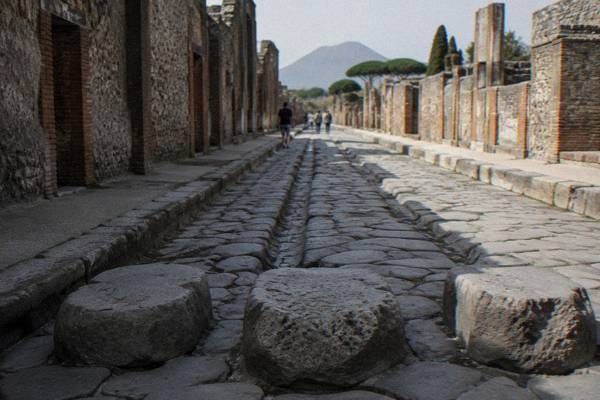
History Of Pompeii
Pompeii was a living Roman city on the Bay of Naples until Mount Vesuvius buried it in AD 79; its excavation, 44 hectares of it so far, turned it into the most visited archaeological park in Italy.
Short answer
Pompeii was a Roman city in Campania, southern Italy, buried by the eruption of Mount Vesuvius in AD 79, traditionally dated to 24 August, a date scholars still debate. Ash preserved the city so completely that excavation has uncovered 44 hectares of streets, houses and frescoes. Today the site draws over four million visitors a year, capped at 20,000 a day.
Pompeii, the ancient Roman city in Campania, southern Italy, beside the modern town of Pompei and about 24 km by road from Naples, holds a strange double life in the record: a prosperous Bay of Naples town one morning, a sealed ash tomb the next, and today an archaeological park that more than four million people walk through each year. Its story is usually told in three chapters, the city that grew, the eruption of Mount Vesuvius in AD 79 that stopped it dead, and the slow uncovering that continues now.
What Was Pompeii Before The Eruption Of AD 79?
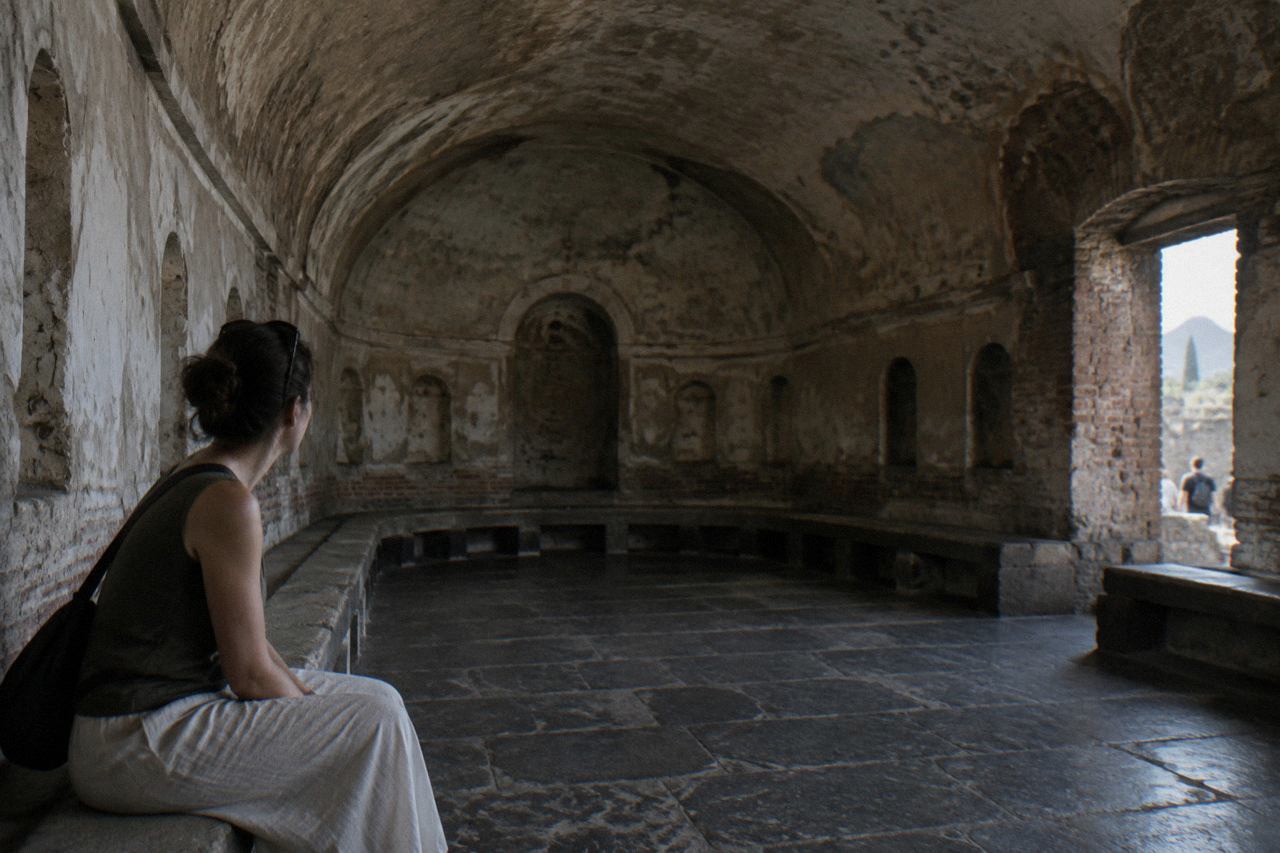
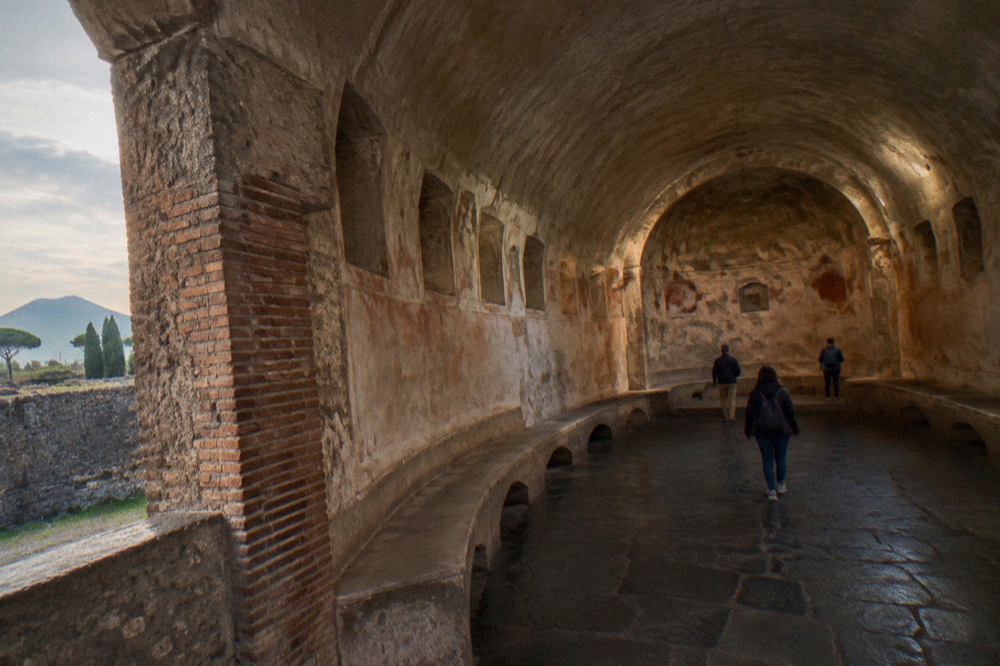
**Before Vesuvius buried it, Pompeii was a substantial Roman city on the Bay of Naples, complete with a forum, an amphitheatre, baths, bakeries, taverns and richly decorated houses. What the ruins make plain is the range of ordinary life: the forum served politics and commerce, thermopolia served hot food from counters set with jars, bakeries turned grain into bread with stone mills and wood-fired ovens, and suburban villas lined the roads out of town among the tombs of the dead. The same city also kept dogs, painted election notices and jokes on its walls, and built an aqueduct-fed bath culture that survives in the Stabian Baths and the Forum Baths.
The houses tell the story best. The House of the Faun and the House of the Vettii show the ambition of the city's wealthier families, with courtyards, fountains and painted reception rooms, while the smaller houses packed along the side streets show everyone else. The wall decoration itself has become a field of study, and the site's painted and mosaic work is covered in detail in the guide to Pompeii frescoes and mosaics.
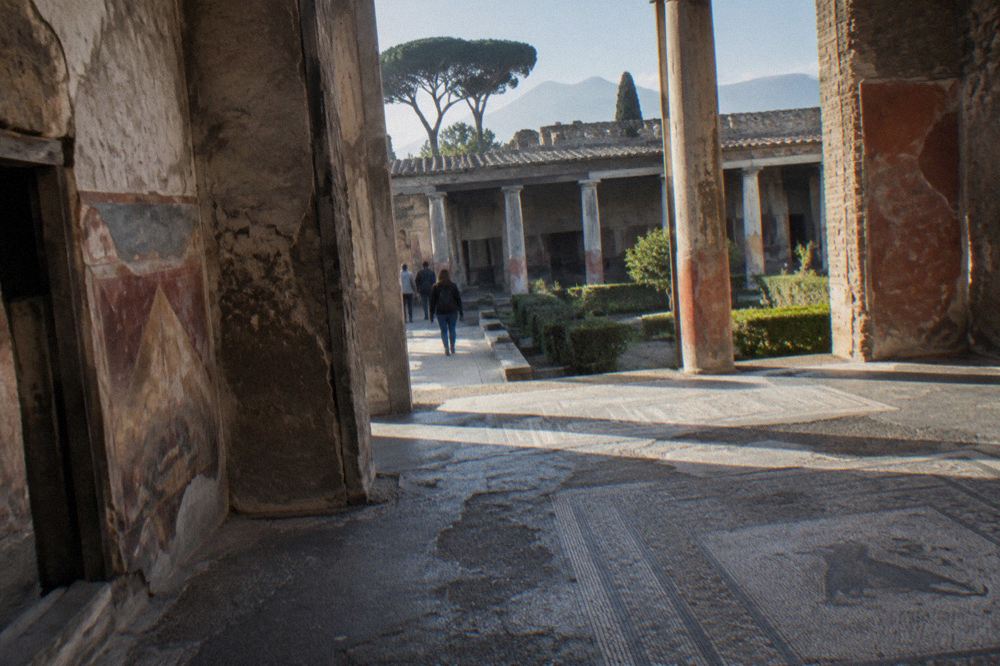
What is safe to say is that by the time of the eruption the city was old, built up over centuries, thoroughly Roman in institutions and thoroughly Campanian in setting, with fertile volcanic soil on its doorstep and the sea close by. Its economy ran on that combination: wine and produce from the countryside, trade through the port, and the traffic of a coastal road network.
That abundance had a source, and the source was the volcano. The same mountain that fed the vineyards ended the city in a single catastrophic day, and the two facts belong in the same sentence. Vesuvius rises directly behind the ruins, and visitors can see it from the excavated streets; the full account of the mountain's behaviour and its recorded eruptions is in when Vesuvius erupted.
What Happened On The Day Vesuvius Buried Pompeii?
On a day traditionally dated to 24 August AD 79, a date scholars still debate, Mount Vesuvius erupted and buried Pompeii under volcanic ash and pumice, ending the city's life in a matter of hours and preserving it exactly as it fell. The eruption is known in unusual detail because a Roman who watched it, Pliny the Younger, described it in two letters, and his oldest manuscripts give the date as nonum kal. Septembres, which works out to 24 August. That manuscript date is the tradition, not a certainty. The park's own e-journal, discussing the question openly, states that the rival date of 24 October "has zero evidentiary basis" and results from a 1929 misreading, while also conceding that 24 August is not necessarily correct either.
The debate was fed in part by a charcoal graffito found in 2018, which many scholars read as dated to mid-October, after the traditional August date. What is not debated is the mechanism: the city was first pelted with pumice falling from the eruption column, which collapsed roofs and drove people to shelter, and was then struck by surges of hot gas and ash that killed those still in the city and sealed everything under metres of deposit.
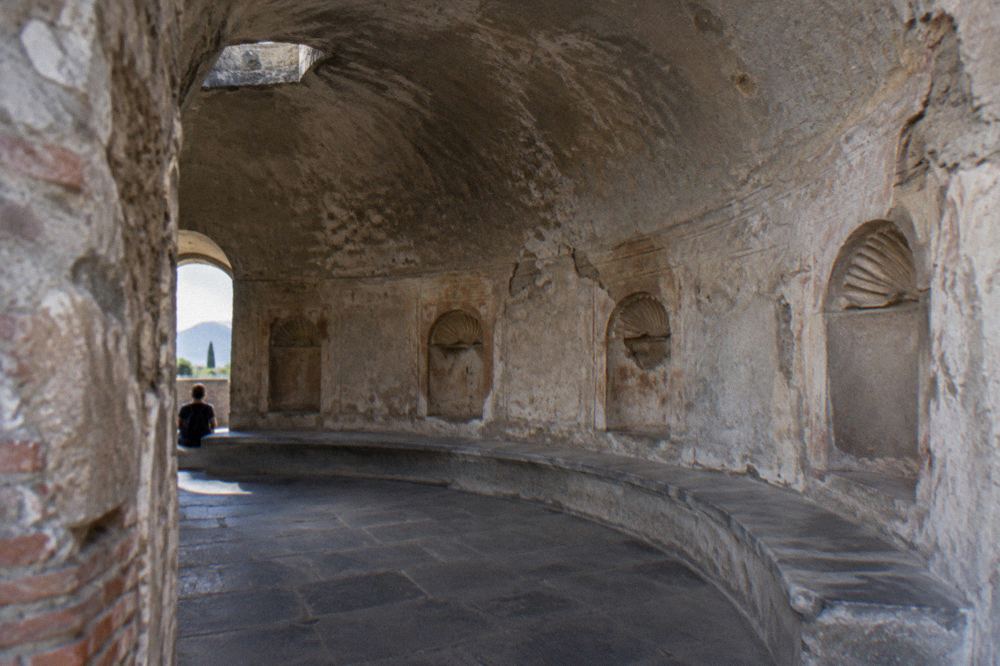
The human evidence of that day, the voids the ash left where bodies decayed and the plaster poured into them, is one of the reasons the world knows Pompeii by name. How those casts were made and where they can be seen today is covered in the guide to the body casts of Pompeii.
| Question about the date | What the verified record says |
|---|---|
| Traditional date | 24 August AD 79, from the oldest manuscripts of Pliny the Younger |
| Manuscript wording | nonum kal. Septembres |
| The 24 October claim | "Has zero evidentiary basis", a 1929 misreading, per the park's e-journal |
| The 2018 charcoal graffito | Dated by many scholars to mid-October |
| Honest summary | Traditionally dated to 24 August AD 79, a date scholars still debate |
Neighbouring towns shared the fate, each differently. Herculaneum, closer to the mountain, was sealed by finer material that preserved wood and fabric; the contrast between the two sites is drawn in Pompeii vs Herculaneum.
How Was The Buried City Found And Excavated?
Pompeii lay buried and largely forgotten until excavation began to expose the ancient city, a process that has so far uncovered 44 hectares of streets and buildings and that still continues, with new finds announced by the park's excavation unit in the Regio V area. The dig is not finished: a substantial share of the ancient city still lies under the modern ground surface, and the open question of how much of Pompeii remains underground is treated honestly elsewhere on this site. What matters for a visitor is that the park you walk is a working archaeological site, not a finished museum, and areas open and close as research and conservation demand.
One current example is the Praedia of Julia Felix, a grand property on the Via dell'Abbondanza closed to the public since 7 September 2026 for maintenance until further notice. Closures like this are normal in the park's rhythm, and the park announces them on its own site. Another kind of change is administrative: since 15 November 2024, entry tickets are nominative, tied to the holder's identity and checked at the entrances, and the park applies a cap of 20,000 visitors per day, a response to crowding that also reshaped the time-slot system into morning and afternoon bands.
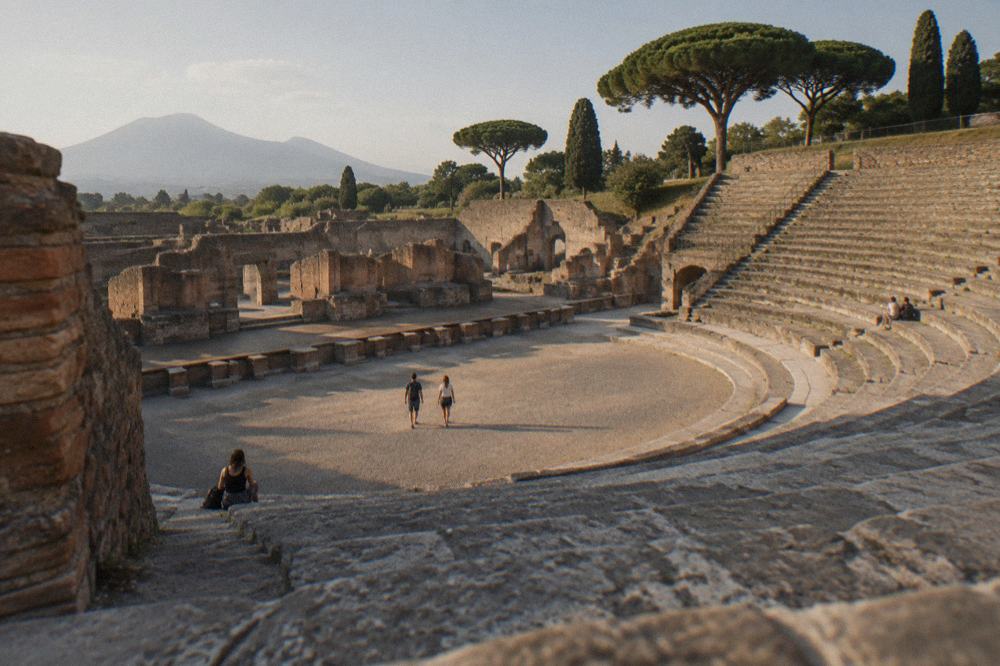
The excavation's scale is measurable, and the park publishes the numbers. The UNESCO inscription records an excavated area of 44 hectares inside a 98-hectare inscribed property, meeting criteria (iii), (iv) and (v) for cultural value. The Roman street grid, the amphitheatre, the two theatres, the baths, the bakeries and the brothel all came out of that work, and the Pompeii map guide shows how the accessible city is laid out today.
For travellers who want the excavation story explained in place rather than read in advance, a guided walk is the practical route. A good middle option is the Pompeii and Herculaneum small group tour led by an archaeologist, which pairs the two buried cities in one itinerary.
A different format again is the from-Naples day tour covering the Pompeii ruins and Mount Vesuvius together, which suits visitors who want both the city and the volcano that destroyed it in a single day.
Why Is Pompeii So Well Preserved Compared With Other Roman Sites?
Pompeii is exceptionally well preserved because the eruption sealed the whole city at once under ash and pumice before it could decay, be dismantled or be built over, leaving streets, walls, frescoes, food and even the victims' final positions locked in place for excavation to uncover centuries later. Ordinary Roman cities were lived in, quarried and rebuilt for centuries after antiquity; Pompeii's clock stopped in AD 79. The deposit that killed the city protected it, excluding air and moisture from organic material to a degree almost unknown elsewhere, which is why carbonised bread, wooden doorframes and painted walls survive here at all.
The plaster cast technique deserves its own line in the story. Excavators found that ash had hardened around bodies that had decayed, leaving human-shaped voids; filling those voids with plaster produced the casts the world associates with the site. That practice, and the ethics of displaying the dead, are covered in the body casts guide linked above.
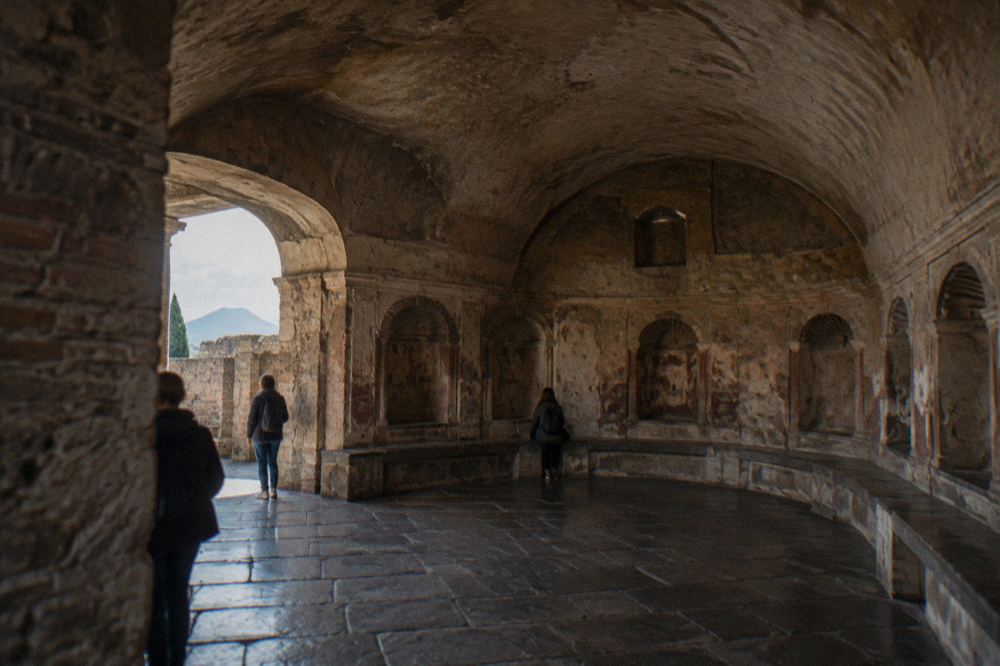
Preservation is uneven, and that has a practical side for visitors. Roofs are largely gone, because the pumice fall collapsed them, so the site is mostly open to the sun; shade is scarce and summer walking is hard work, which the site's summer planning guide treats in full. Painted surfaces survive indoors, behind modern protective roofs on some houses, and access to the fragile houses rotates. The House of the Vettii and the Villa of the Mysteries, the latter reachable by the suburban villas route from the Porta Ercolano / Street of the Tombs entrance, are the classic examples.
The same completeness that preserves the city also preserves its language. Thousands of painted and scratched inscriptions, election slogans, adverts, jokes and insults, survive on the walls, and the site's graffiti record is one of the richest bodies of everyday Roman writing anywhere. Graffiti, frescoes, mosaics and the amphitheatre each have their own guide pages on this site, linked from the map above.
How Did Pompeii Become The Modern Archaeological Park?
The excavated city is now the Parco Archeologico di Pompei, a state archaeological park in Campania, southern Italy, that admitted 4,000,090 visitors to the Pompeii site in 2025 and manages visitation through nominative tickets, a 20,000-per-day cap and timed entry bands. Growth has been steep: the park's own published figures show 2,972,159 visitors in 2022, 3,985,424 in 2023, 4,069,377 in 2024 and 4,000,090 in 2025 at the Pompeii site alone, with the wider park's sites adding more. That scale is why the park introduced the daily cap and the nominative ticket on 15 November 2024, and why timed slots now split the day.
| Year | Pompeii site visitors | All park sites total |
|---|---|---|
| 2022 | 2,972,159 | n/a |
| 2023 | 3,985,424 | 4,079,235 |
| 2024 | 4,069,377 | 4,177,753 |
| 2025 | 4,000,090 | 4,118,926 |
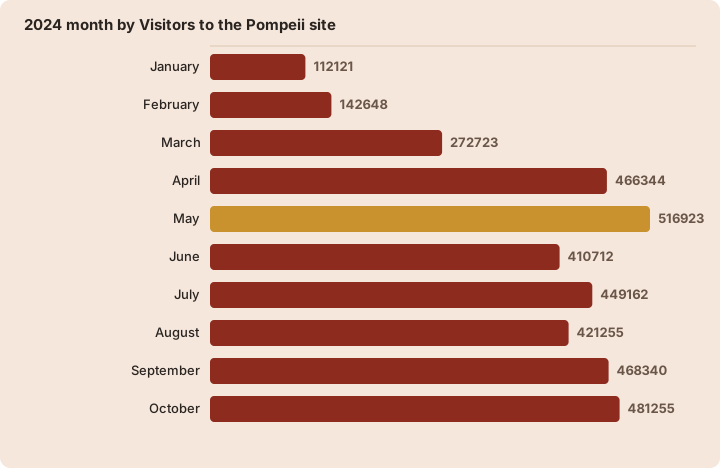
The monthly pattern behind those totals shows the seasonality every visitor should know. In 2024, the park's data shows May as the heaviest month at 516,923 visitors, October close behind at 481,255 and September at 468,340, while February counted just 142,648 and December 138,028. Summer is busy but spring and early autumn are busier still, relative to capacity, because the heat of July and August moderates demand while the shoulder months fill with tour groups.
| 2024 month | Visitors to the Pompeii site |
|---|---|
| January | 112,121 |
| February | 142,648 |
| March | 272,723 |
| April | 466,344 |
| May | 516,923 |
| June | 410,712 |
| July | 449,162 |
| August | 421,255 |
| September | 468,340 |
| October | 481,255 |
| November | 189,866 |
| December | 138,028 |
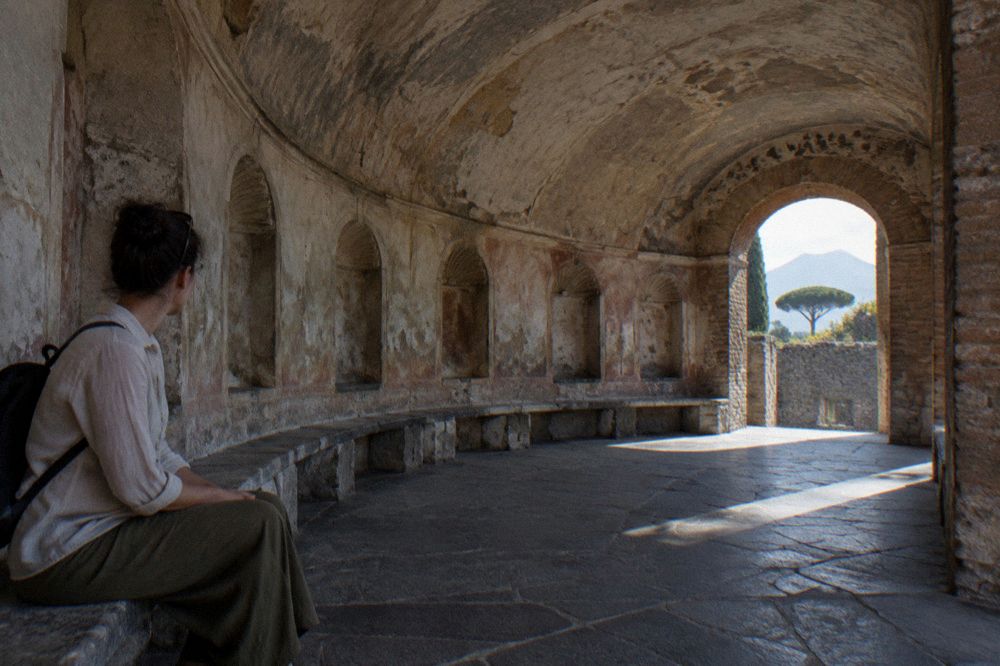
Managing four million people a year across a fragile ruin is the park's central problem, and the rulebook reflects it. Bags are limited to 30x30x15 cm, with larger items left at the left luggage; identity may be checked at entry because tickets are personal and non-transferable; and tickets are non-refundable except in extraordinary closure. The visitor regulations page sets all of this out, and the practical side, which ticket to buy, which entrance to use and how the time bands work, is covered in the Pompeii tickets guide.
What Do The 2026 Tickets And The 2027 Change Mean For Visitors?
In 2026 the park sells Pompeii Express at EUR 20 for the ancient city, Pompeii+ at EUR 25 including the suburban villas route, and a 3-day ticket at EUR 30 covering Oplontis, the Stabiae villas and museum and Boscoreale; from 1 January 2027 this structure ends and a single EUR 25 ticket covers all park sites, valid 30 days with one entry per site. The three smaller sites, Oplontis, the Stabiae museum and Boscoreale, stay at EUR 8 bought individually, and the annual MyPompeii Card stays at EUR 45. Entry is free for under-18s and for everyone on the first Sunday of the month, and EU citizens aged 18 to under 25 pay a EUR 2 reduced rate.
| Ticket, 2026 | Price | Covers |
|---|---|---|
| Pompeii Express | EUR 20 | The ancient city only |
| Pompeii+ | EUR 25 | City plus suburban villas (Mysteries, Diomedes), Villa Regina, Antiquarium Boscoreale and shuttle |
| 3-day ticket | EUR 30 | Pompeii+ plus Oplontis, Villa Arianna, Villa San Marco, Stabiae museum, Boscoreale |
| Other sites individually | EUR 8 | Oplontis, Stabiae museum, Boscoreale |
| MyPompeii Card (annual) | EUR 45 | Annual pass, EUR 10 reduced |
The 2027 change, announced by the park on 14 September 2026, keeps the nominative ticket and the 20,000-per-day cap and replaces the tiered structure with one EUR 25 ticket valid 30 days, one entry per site. Anyone comparing a 2026 trip against a 2027 trip should note that the express option at EUR 20 disappears after 31 December 2026, and the full-park access that cost EUR 30 in 2026 drops to EUR 25 in 2027.
| Item | 2026 | From 1 January 2027 |
|---|---|---|
| Ancient city entry | EUR 20 Express | Included in the single ticket |
| Single ticket price | EUR 25 (Plus tier only) | EUR 25, all park sites |
| Validity | Per ticket type | 30 days, one entry per site |
| Small sites individually | EUR 8 | EUR 8 (unchanged) |
| MyPompeii Card | EUR 45 | EUR 45 (unchanged) |
| Daily cap and nominative tickets | In force | Retained |
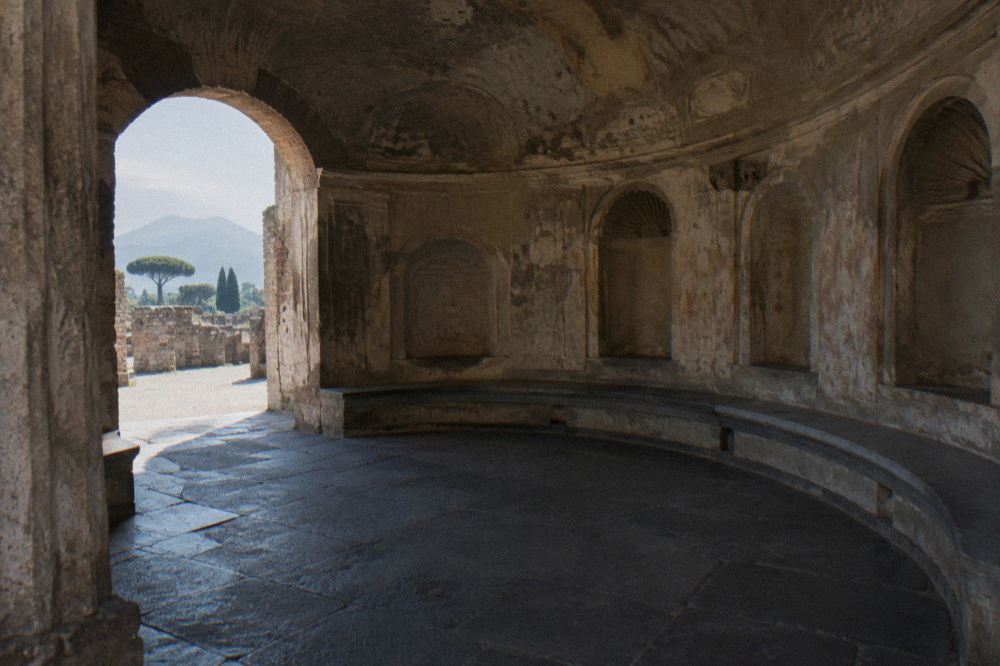
Ticket offices sit at Porta Marina, Piazza Esedra and Piazza Anfiteatro, and the suburban villas route is served by the Porta Ercolano / Street of the Tombs entrance, where Express holders can add the villas for EUR 8, card payment only. Hours matter too: from 15 October to 15 March the park opens at 9:00 with last entry at 15:30 and closing at 17:00, while from 16 March to 14 October last entry runs to 17:30 and closing to 19:00, split into the 9:00-13:00 and 13:00-17:30 time bands under the cap.
How Do You Visit Pompeii Today: Entrances, Timing And Tours?
Visiting Pompeii today means choosing one of three ticketed entrances, Porta Marina, Piazza Esedra or Piazza Anfiteatro, arriving inside a booked time band under the 20,000-per-day cap, and deciding between exploring independently, an audio guide or a guided tour, with the Circumvesuviana stopping at Pompei Scavi-Villa dei Misteri beside the Porta Marina side of the park. The scheduled journey from Napoli Garibaldi to Pompei Scavi-Villa dei Misteri takes 29 to 35 minutes on the Circumvesuviana, and from Sorrento to Pompei Scavi 34 to 40 minutes, per the operator's own timetable data; the Campania Express, which once offered a faster alternative, has been suspended since 1 October 2026 with no restart date announced. The train options are compared in the Circumvesuviana guide and the Naples to Pompeii guide.
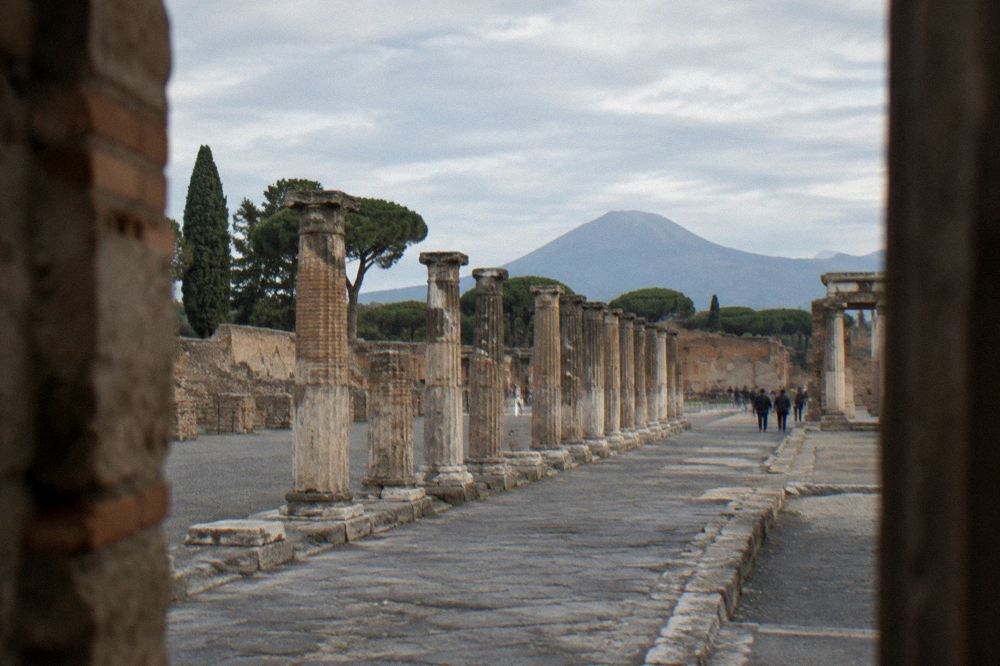
The tour decision is genuinely open, and the honest framing is practical rather than absolute: the ruins are walkable alone with a good map and preparation, but the density of the site rewards explanation. The trade-offs are set out in the guide comparing a guided tour with self-guided visiting, and the fuller arguments for and against are laid out in the answer to whether Pompeii is worth visiting. Weather should shape the calendar: at the Pompei grid point, Open-Meteo 1991-2020 normals show about 28.7 C mean daily maxima in July and about 29.4 C in August, with about 180 mm of rain in November against about 16 mm in July, so late spring and early autumn combine bearable heat with the year's heaviest crowds.
For Sorrento-based travellers the Pompeii Express guided tour by train handles both the rail leg and the guiding in one package, and it can be booked through Check availability on the operator's live listing.
Another option pairs the entry ticket with an archaeologist-led walk, a format that suits visitors arriving independently who still want expert interpretation on the ground.
Common Questions About Pompeii History
What destroyed Pompeii?
Mount Vesuvius, the volcano that rises directly behind the city, destroyed Pompeii with a catastrophic eruption in AD 79, traditionally dated to 24 August, a date scholars still debate. Falling pumice collapsed roofs and then hot ash surges buried the city, sealing it under metres of volcanic deposit.
When did Vesuvius erupt and destroy the city?
The eruption is traditionally dated to 24 August AD 79, from the oldest manuscripts of Pliny the Younger's letters. The park's own e-journal states that the alternative date of 24 October has zero evidentiary basis and stems from a 1929 misreading, while noting that 24 August is not necessarily correct either, so the date remains an open scholarly question.
How much of Pompeii has been excavated?
The excavated area measures 44 hectares, inside a UNESCO-inscribed property of 98 hectares. A substantial part of the ancient city still lies buried, and excavation and conservation work continue in the park today.
How many people visit Pompeii each year?
The park's published figures show 4,000,090 visitors to the Pompeii site in 2025, 4,069,377 in 2024, 3,985,424 in 2023 and 2,972,159 in 2022. Visitation is capped at 20,000 people per day since 15 November 2024.
Are the body casts real people?
The casts preserve the shapes of victims whose bodies decayed inside hardened ash, leaving voids that excavators later filled with plaster. They record real people who died in the eruption, and no verified count of the casts exists in the published record.
Can you still see the ruins today?
Yes, the excavated city is open to visitors as the Parco Archeologico di Pompei, entering at Porta Marina, Piazza Esedra or Piazza Anfiteatro, with hours, time bands and the daily cap explained in this site's ticket guide.
Pompeii's history is still being written in two directions at once: excavators keep uncovering more of the buried city, and the park keeps adapting how four million annual visitors encounter it, from the 2024 visitor cap to the single-ticket system that starts on 1 January 2027. Walk it once and the place reads like a paused frame of ordinary Roman life, the bread in the oven, the paint still on the walls, the last words still scratched at the door, which is exactly why it stays worth the journey from Naples, Sorrento or Rome. For more help planning, the Pompeii Travel Guide homepage collects the site's full route, ticket and tour coverage in one place.