Pompeii Photography
Photographing Pompeii, the buried Roman city beside modern Pompei in Campania, southern Italy, rewards planning: the light changes fast, some ruins close early, and the rules on bags and tripods shape what you can carry.
Short answer
Pompeii photography works best in the first two hours after the 9:00 opening and in the last hour before the 17:30 final entry in summer. A 2026 Pompeii Express ticket costs EUR 20, hours run 9:00 to 19:00 from 16 March to 14 October, and bags are limited to 30x30x15 cm, which shapes your camera kit.
The ancient city of Pompeii, buried by the eruption of Mount Vesuvius in AD 79 and now an archaeological park in Campania, southern Italy, about 24 km by road from Naples, is one of the most photographed places in the Mediterranean. Four million people passed through in 2025, and every one of them carried a camera of some kind. Getting pictures worth keeping is a different matter. The site is large, the excavated area alone covers 44 ha, the midday sun flattens the streets into white glare, and the rules on bags and equipment quietly shape what a photographer can actually bring through the gates.
This guide covers the parts of a photography trip that are decided before you raise the camera: the hours and entrances, the light at each time of day, the gear that survives the bag-size limit, the spots photographers return to, and the ticket that fits a slow, picture-led visit. The Pompeii Travel Guide homepage covers the wider trip; this page stays on the pictures.
What Makes Pompeii Photography Different From Other Ruins?
Pompeii photography is different because the site is a whole Roman city, not a single monument: streets, shops, baths, amphitheatres and villas survive together, excavated across 44 ha of a 98 ha inscribed UNESCO property. The eruption of Vesuvius, traditionally dated to 24 August AD 79, sealed plaster, fresco and graffiti alongside the stone, so the frames carry colour and daily life that bare stone ruins cannot. The trade-off is scale and sun: streets run long and unshaded, so light planning matters.
A Greek temple survivor photograph beautifully; Pompeii photographs like a documentary subject. You can stand in a bakery with its ovens intact, walk a street still showing wheel ruts, then climb to the Large Theatre, all inside one ticket. The variety is what drains camera batteries. Photographers who plan two or three focused sessions, one early, one in the amber hour, one inside the villas, consistently come away with stronger sets than those who shoot everything at noon.
The buried context matters too. Because the city was sealed rather than abandoned, pigment survives on walls in ways that surprise first-time visitors, and the frescoes and mosaics of Pompeii give close-up work that needs different settings from the wide streets. Treat the site as two shoots in one: an architectural one and a detail one.
When Is The Best Time Of Day For Pompeii Photos?
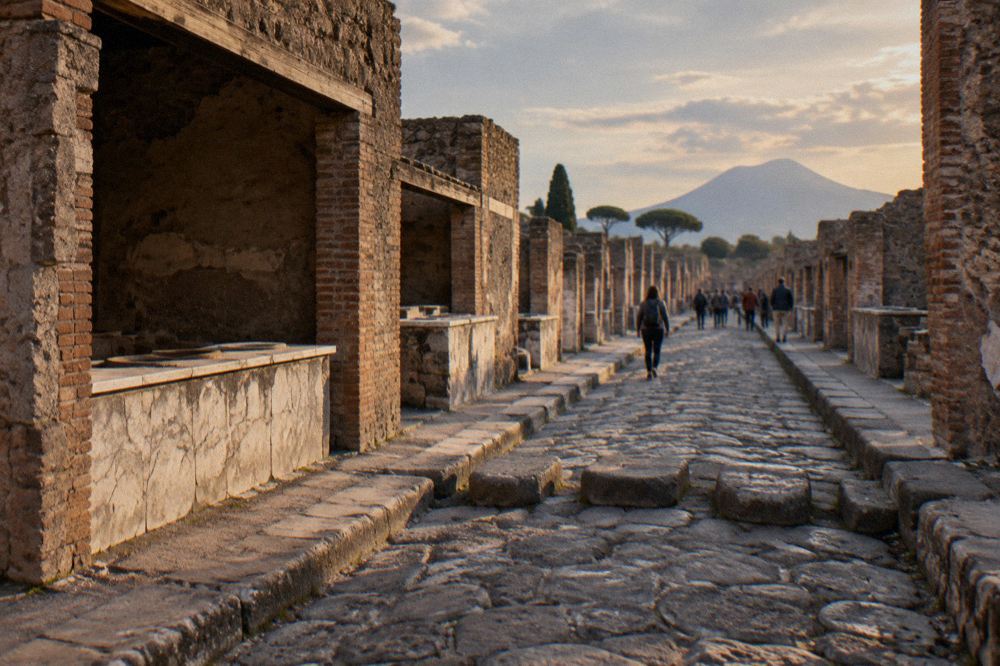
The best light falls in the first two hours after the 9:00 opening and the last ninety minutes before the final entry, which is 17:30 in the summer season and 15:30 in winter. At opening, the streets near Porta Marina are quiet, shadows are long and raking across the basalt paving, and interiors like the Villa of the Mysteries hold cool ambient light. Midday, from about 12:00 to 15:00, is the worst window: glare, crowds and flat contrast.
Pompeii opens at 9:00 year-round. In the high season, 16 March to 14 October, the last entry is 17:30 and the park closes at 19:00, which gives a real evening session in the warmer months; from 15 October to 15 March the last entry is 15:30 and closing is 17:00, so the whole visit sits inside daylight. The park also manages flow with time bands: between 9:00 and 13:00 entry is capped at 15,000 visitors, and between 13:00 and 17:30 at 5,000. For photographers, the arithmetic points one way: the afternoon bands are thinner, and the light from late afternoon is warmer.
| Time window (summer season) | Light character | Crowd level | Best subjects |
|---|---|---|---|
| 9:00-11:00 | Long shadows, raking light on streets | Moderate at gates, thinning inside | Street views, Forum, stepping stones |
| 11:00-13:00 | Bright, contrast climbing | Building toward the peak | Interiors, frescoes, shaded alleys |
| 13:00-15:00 | Harsh top light, deep black shadows | Thinning after the 13:00 band change | Lunch break, the Antiquarium, detail work |
| 15:00-17:30 | Warm, low, directional | Light | Amphitheatre area, long streets, walls in gold light |
| 17:30-19:00 | Amber into blue hour | Very light inside | Wide scenics, silhouettes against Vesuvius |
Free first Sundays, when entry costs nothing, have produced a recorded peak of more than 36,000 visitors in a single day; that is a day for people photography, not quiet ruins. The weather and season guide breaks the year down month by month.
An audio-guide ticket suits photographers precisely because it removes the clock pressure of a group: you linger where the light is, and the commentary fills in what you are shooting. The token above carries the live price and review figures for that product and for two very different days out, including a Herculaneum tour from Naples and a full day that pairs the ruins with horse riding on Vesuvius.
What Camera Gear Should You Bring To Pompeii?
Bring one body with a wide-to-telephoto zoom, a polarising filter, spare batteries and water; leave the tripod, the drone and the big bag at the hotel. The park permits bags no larger than 30x30x15 cm, larger bags go to left luggage, drones require authorisation, and bare walking plus stone dust punish gear. A single standard zoom covering wide scenics through to fresco detail does the work, and a circular polariser rescues the midday glare off polished ancient paving.
The 30x30x15 cm bag limit is the number that decides your kit. A mirrorless body plus one standard zoom fits inside it; a second body, three lenses and a flash rig does not. There is no shade to speak of on the streets, batteries drain faster in heat than you expect, and the site is worn basalt and gravel: comfortable shoes matter more than any accessory. The what to wear at Pompeii question is really a walking question.
Rules worth knowing before you pack: drones cannot be flown without authorisation, tickets are nominative and non-transferable, and ID may be checked at entry. If your plan needs a tripod for night or blue-hour work, note that no evening openings are currently confirmed on official pages, so plan around the 19:00 summer closing instead. For those weighing a guide against going alone, the guided versus self-guided comparison lays out the trade-offs.
| Item | Bring it? | Why |
|---|---|---|
| One camera body, standard zoom | Yes | Fits the 30x30x15 cm bag limit, covers the range |
| Circular polarising filter | Yes | Cuts glare off stone and deepens sky over Vesuvius |
| Spare battery | Yes | Heat and walking drain batteries faster |
| Wide prime lens | Optional | Fits the bag, sharp street scenics |
| Tripod | No practical use | No confirmed after-hours access; crowds in the day |
| Drone | No | Requires authorisation from the park |
| Large camera backpack | No | Exceeds the bag limit, goes to left luggage |
| Flash unit | No | Interiors are lit by ambient light; frescoes are fragile |
Which Locations In Pompeii Give The Best Photographs?
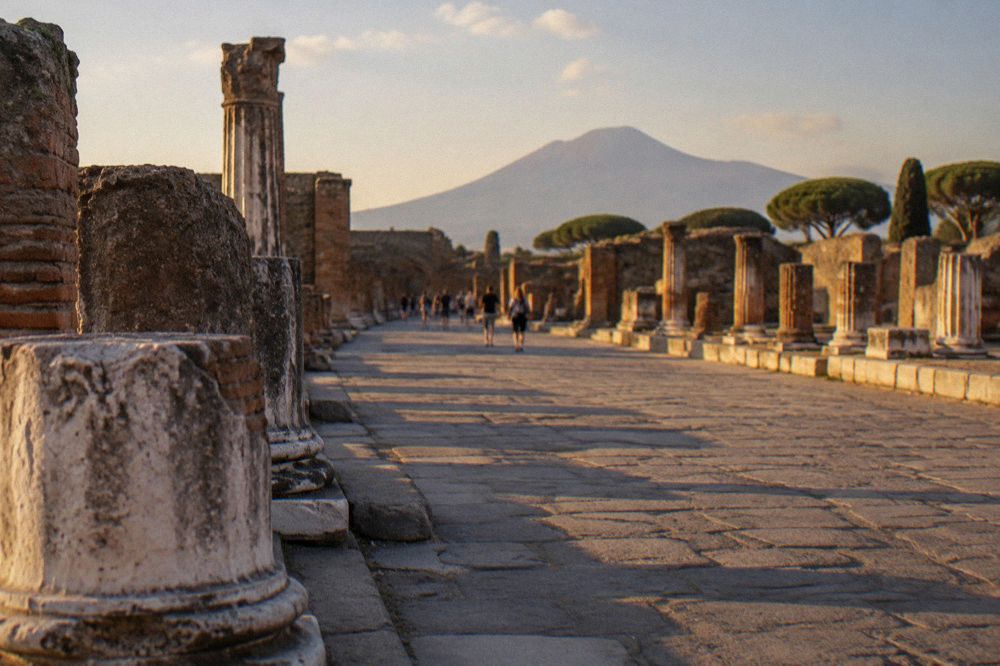
The strongest frames come from the Forum with Vesuvius behind the columns, the stepping stones on Via dell'Abbondanza, the amphitheatre at Piazza Anfiteatro, and the frescoed interiors of the Villa of the Mysteries. The Forum is the signature wide shot, the streets give the documentary texture, and the villa interiors, reached through the suburban villas route, hold the site's deepest colour. Each needs different timing.
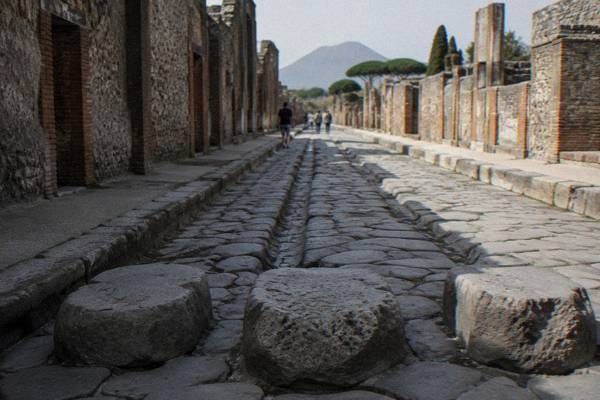
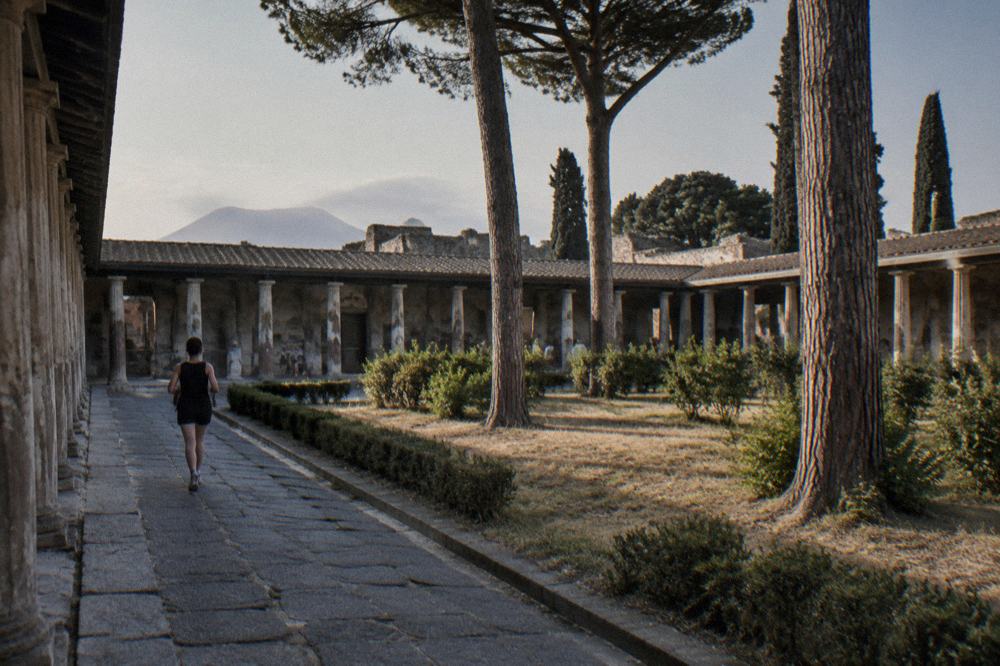
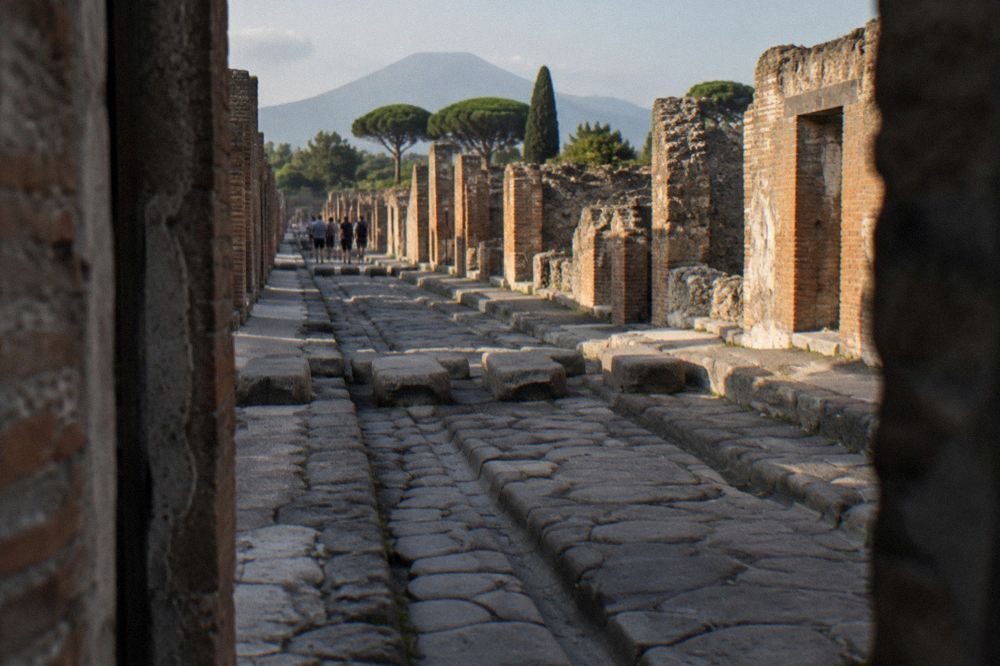
Start at the Forum if you enter at Porta Marina: the colonnade frames Vesuvius directly, and in the first hour the mountain is often clear before haze builds. The stepping stones and wheel ruts along the main streets photograph best with low side light, either early or late. The amphitheatre and the Large Palaestra sit at the far end of the site, so schedule them into the warm afternoon window; the ellipse of seating reads beautifully in raking light. Interior work is a midday task: the Villa of the Mysteries and the painted houses hold their own ambient coolness while the streets outside glare.
| Location | Signature frame | Best light | Notes for photographers |
|---|---|---|---|
| The Forum | Columns with Vesuvius behind | First two hours after opening | Haze builds by late morning |
| Via dell'Abbondanza | Stepping stones, wheel ruts | Early or late, low side light | People-free frames need patience midday |
| Large Theatre | Cavea from the stage | Afternoon | Steep steps, watch the gear |
| Amphitheatre, Piazza Anfiteatro | Full ellipse of seating | Mid to late afternoon | Also the accessible-entrance side of the park |
| Villa of the Mysteries | Red fresco panels | Midday, ambient interior | On the suburban villas route |
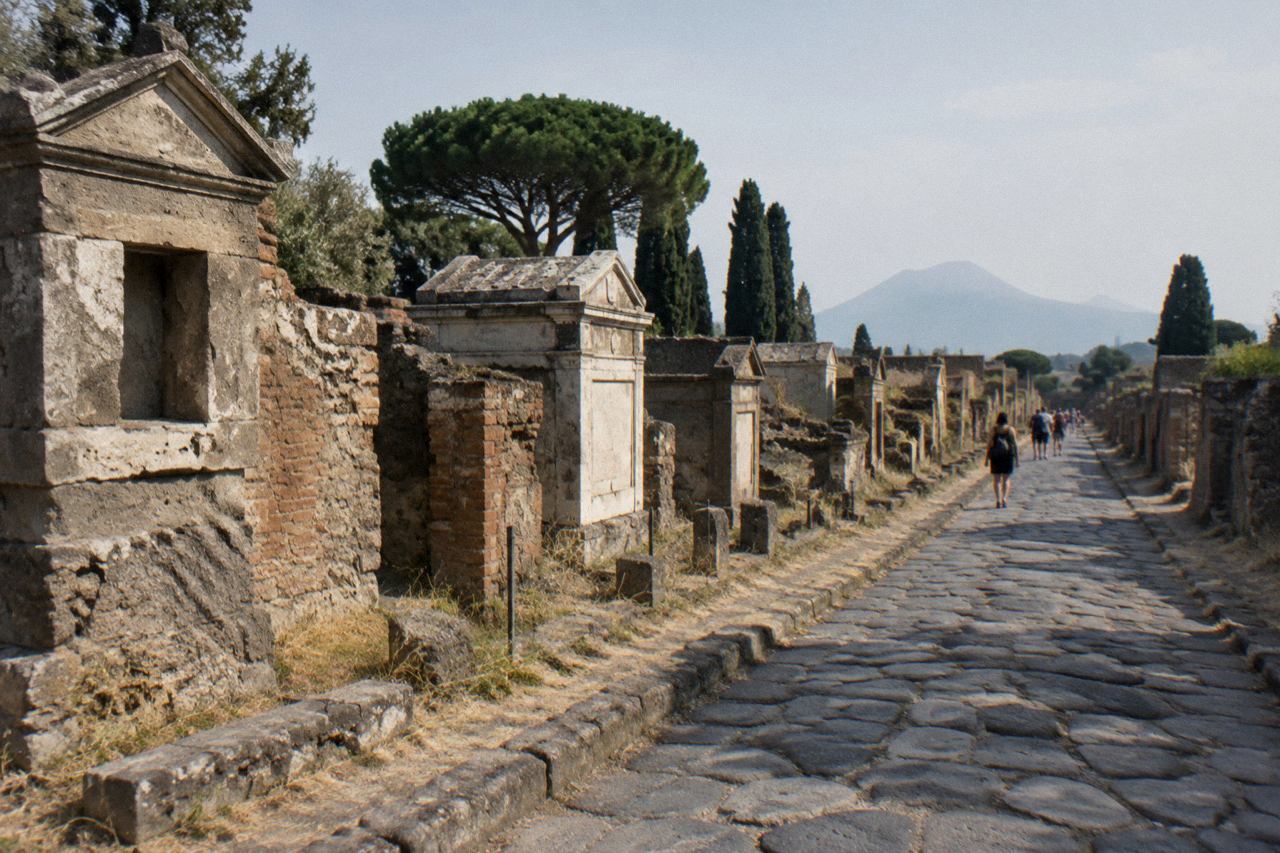
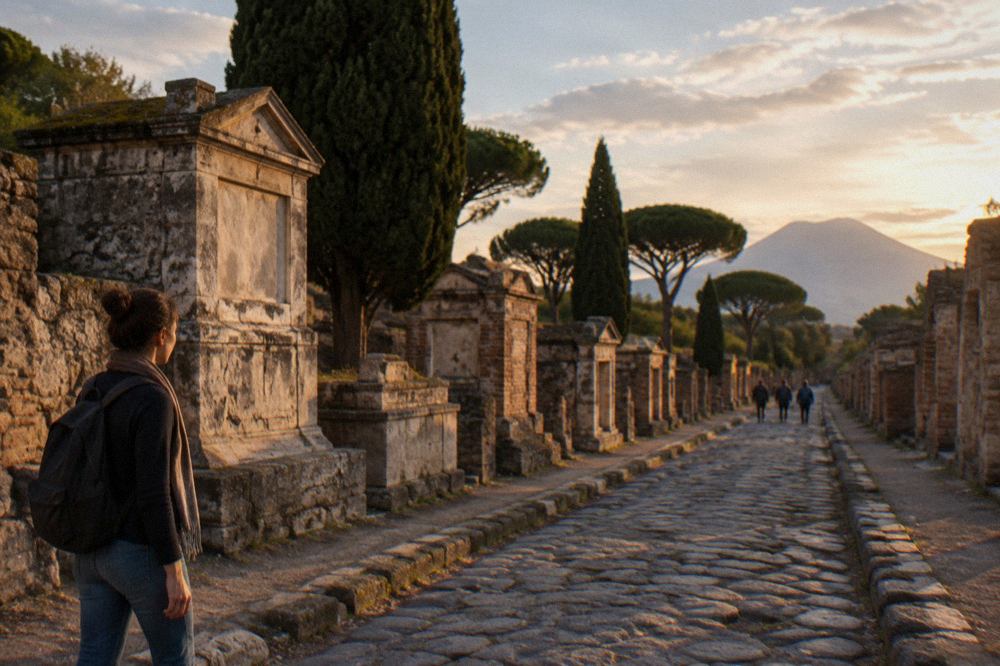
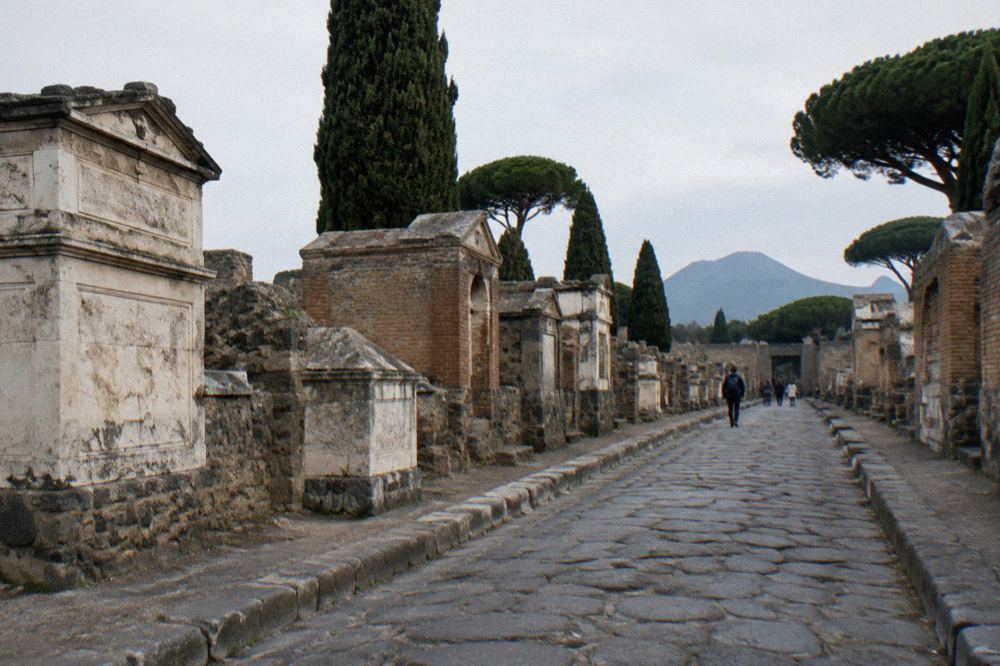
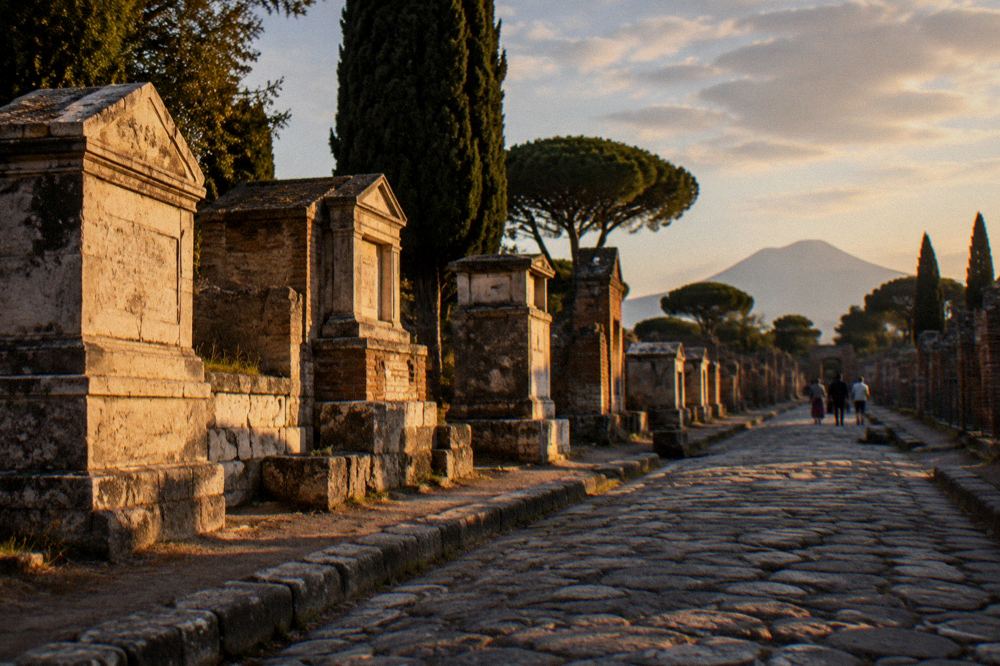
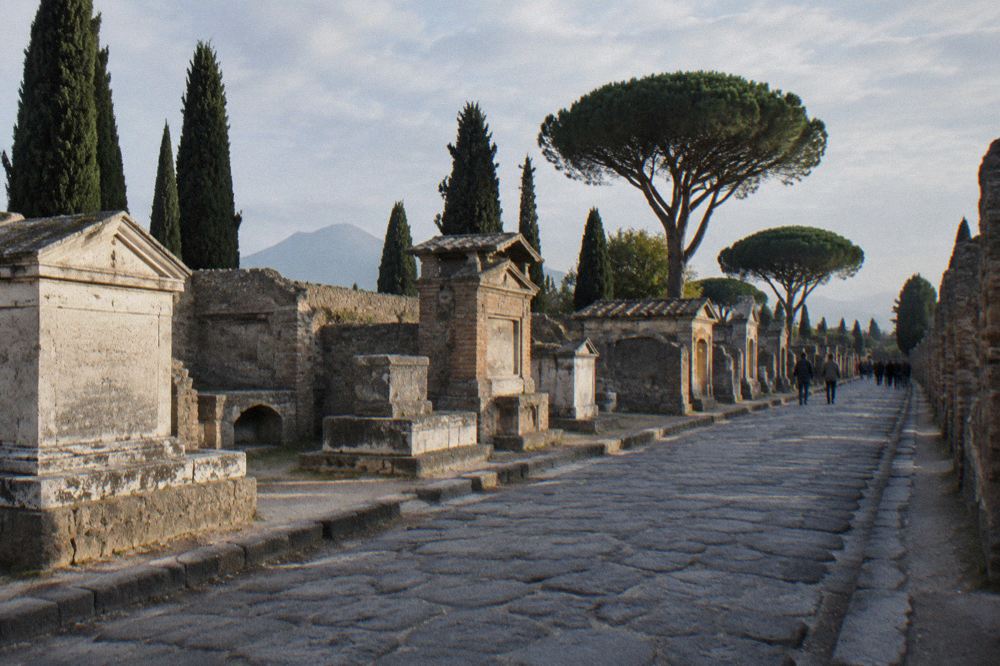
| Street of the Tombs | Funerary monuments | Late afternoon | Reached from the Porta Ercolano side |
Two honest cautions from the official record. The Praedia of Julia Felix has been closed to the public since 7 September 2026 for maintenance, so plan around it. And if you are extending the trip to Herculaneum, note that its Villa dei Papiri and Ancient Theatre are closed for works, though the rest of that site, the smaller, darker, in some ways more atmospheric neighbour, repays the lens; the Pompeii versus Herculaneum comparison helps you choose.
How Do Tickets And Entrances Affect A Photography Visit?
In 2026 a Pompeii Express ticket costs EUR 20 and covers the ancient city; Pompeii+ at EUR 25 adds the suburban villas route including the Villa of the Mysteries; the 3-day ticket is EUR 30. From 1 January 2027 a single EUR 25 ticket replaces all three, valid 30 days with one entry per site. Ticket offices sit at Porta Marina, Piazza Esedra and Piazza Anfiteatro, and the suburban villas route is served from Porta Ercolano at the Street of the Tombs.
For a photography visit the ticket choice is really a geography choice. The fresco interiors photographers want sit partly on the suburban villas route, and an Express holder can add that route for EUR 8, card payment only, at the Porta Ercolano entrance. Under-18s enter free, EU citizens aged 18 to under 25 pay a EUR 2 reduced rate, and everyone enters free on the first Sunday of the month, which trades cost for crowds. Entry is capped at 20,000 visitors per day and tickets are nominative, so booking ahead matters in peak months. The full breakdown lives on the Pompeii tickets page.
| Ticket (2026, ends 31 Dec 2026) | Price | Covers |
|---|---|---|
| Pompeii Express | EUR 20 | Ancient city only |
| Pompeii+ | EUR 25 | City, suburban villas route, Boscoreale additions |
| 3-day ticket | EUR 30 | Pompeii+ plus Oplontis, Stabiae villas and museum, Boscoreale |
| Suburban villas add-on for Express holders | EUR 8 | Card only, at Porta Ercolano |
| Reduced (EU 18 to under 25) | EUR 2 | Same coverage, ID required |
| Under 18 | Free | All tickets |
| From 1 Jan 2027 | EUR 25 | Single ticket, all park sites, 30 days, one entry per site |
Your entry point also sets your first hour of shooting. Porta Marina delivers you to the Forum side fast; Piazza Anfiteatro starts you at the far, quieter end; and it is also the entrance for the Pompeii for All accessible route. The map of the site is worth studying before you commit to a direction.
Before moving on, a practical note on arrival logistics. The Circumvesuviana line serves the Pompei Scavi-Villa dei Misteri station beside the Porta Marina entrance, with scheduled run times from Napoli Garibaldi of 29 to 35 minutes; the Campania Express, by contrast, has been suspended since 1 October 2026. Route detail is on the Naples to Pompeii and Sorrento to Pompeii pages.
How Does The Weather And Season Change Pompeii Photography?
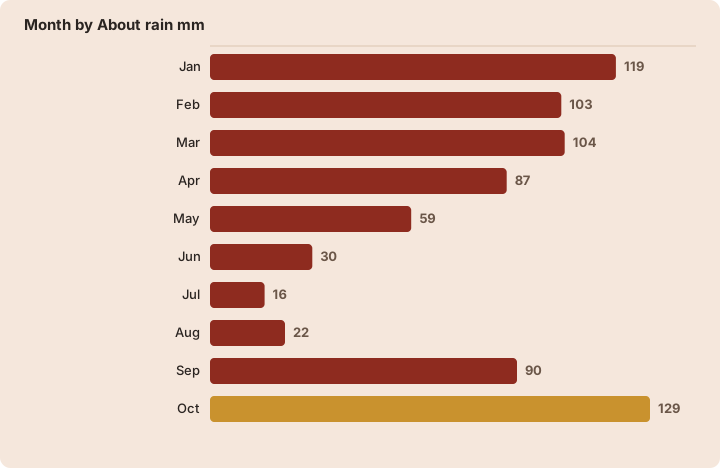
The Pompei climate is Mediterranean, and the 1991-2020 normals for the grid point show why spring and autumn are the photographer's seasons: April averages about 17.7 C daytime maximum with about 87 mm of rain, October about 21.3 C with about 129 mm, while July and August are dry but hot at about 28.7 C and 29.4 C respectively. November is the wettest month at about 180 mm of rain, which kills a shoot day more surely than heat.
These figures come from the Open-Meteo historical archive for the 40.75 N, 14.49 E grid point, a reanalysis rather than a weather station, so treat them as about right rather than exact. The pattern is clear: summer gives reliable blue sky and harsh light, winter gives soft light and short days that fit the reduced 9:00 to 17:00 opening, and the shoulder months balance the two. February has the lowest overnight minimum at about 6.5 C, warm enough for dawn-to-dusk comfort with layers.
| Month | About Tmax C | About Tmin C | About rain mm |
|---|---|---|---|
| Jan | 12.2 | 6.6 | 119 |
| Feb | 12.6 | 6.5 | 103 |
| Mar | 14.9 | 8.1 | 104 |
| Apr | 17.7 | 10.4 | 87 |
| May | 21.6 | 14.1 | 59 |
| Jun | 25.8 | 18.2 | 30 |
| Jul | 28.7 | 21.1 | 16 |
| Aug | 29.4 | 21.8 | 22 |
| Sep | 25.3 | 18.6 | 90 |
| Oct | 21.3 | 15.1 | 129 |
| Nov | 16.9 | 11.5 | 180 |
| Dec | 13.2 | 8.0 | 147 |
One more seasonal note from the visitor data: September and October 2024 each drew well over 400,000 visitors to the site, September 468,340 and October 481,255, both ahead of July that year, so autumn light comes with real crowds. Arriving at 9:00, or entering in the 13:00 band, keeps your frames clear.
Which Tours Work Well For Photographers?
Photographers generally do best with products that include the entry ticket and impose no fixed group pace: the entry ticket with audio guide, small-group archaeologist tours that reach areas a first-timer would miss, and day trips that add a second photographic subject such as Herculaneum or Vesuvius. Tours cannot override park rules, but they remove queueing and navigation, which buys shooting time. The token below carries the live figures for the audio-guide product.
The audio-guide route is the flexible baseline. When a day is meant to produce pictures rather than tick boxes, though, some photographers prefer a guide who can name a house, a fresco cycle or a viewpoint on request. A Herculaneum option from Naples with tickets included makes a strong second day: that site's darker, boat-shed atmosphere and carbonised wood contrast with Pompeii's bleached streets, and the token below shows the current price and reviews for the small-group version.
For something that gives the volcano itself a starring role in the frame, there are tours pairing the ruins with time on Vesuvius, from bus-based days to a distinctive option on horseback. The horse-riding day, listed below, is the one photographers tend to remember: elevated angles across the national park are not available from the standard trail.
If your base decides the itinerary rather than the other way round, the tours from Naples and tours from Sorrento round-ups compare the realistic options from each city, and the shore excursions page covers the cruiser's compressed timetable.
How Do You Shoot Pompeii Without The Crowds?
Shoot the far end first: enter at Piazza Anfiteatro at 9:00, work the amphitheatre and eastern streets while the crowd pours in at Porta Marina toward the Forum, then drift west as the morning bands fill. In the afternoon the 13:00 band admits at most 5,000 visitors against the morning's 15,000, so after about 14:00 the streets thin sharply. The final hour before the 17:30 last entry is the quietest shooting window of the summer day.
The band structure is your friend. Between 9:00 and 13:00 the park allows up to 15,000 entries; between 13:00 and 17:30, only 5,000. Lunch hours empty the wide streets further, and tour groups cluster around a short list of highlights, the Forum, the baths, the Villa of the Mysteries, which leaves long stretches of Regio streets nearly empty. A short walk off the spine road usually buys you a people-free frame.
| Strategy | Why it works | Timing to aim for |
|---|---|---|
| Enter at Piazza Anfiteatro | Crowd enters mainly at Porta Marina | 9:00 sharp |
| Shoot west-to-east in reverse | Tour groups flow Forum-first | Morning |
| Use the 13:00 band change | Afternoon cap is 5,000 vs 15,000 | From 13:00 |
| Long-lens compression | Turns distant figures into scale, not clutter | Any time |
| Last-entry window | Thinnest crowds of the day | 16:00-17:30, summer |
The single exception is the free first Sunday, when entry costs nothing and the record peak exceeded 36,000 in one day. On those days, arrive before opening and treat the visit as street photography among travellers rather than architecture in solitude.
What Should You Know About Respect, Rules And Sharing Pompeii Photos?
Shoot respectfully: the plaster casts of victims are human remains, the site prohibits drones without authorisation, and tickets are nominative and checked with ID, while nothing in the regulations forbids ordinary still photography for personal use. When sharing, do not claim or stage false contexts, and if a picture includes other visitors, ordinary courtesy and local privacy norms apply. The park's rules exist to protect a fragile site, not to police hobbyists.
The visitor regulations are short and readable: bags at 30x30x15 cm, no drones without authorisation, no bare chests, tickets non-transferable. Nothing in them restricts handheld photography. The body casts deserve a moment of thought before the shutter: they are the voids of real people filled with plaster, and many photographers choose tighter, more abstract frames, or none. The body casts of Pompeii page covers their history in full.
One recurring question is whether the eruption's date belongs in a caption. It does, with care: the traditional manuscript date is 24 August AD 79, and the park's own e-journal states the alternative 24 October has no evidentiary basis, while leaving the debate open. Caption honestly, and let the pictures carry the argument instead.
Common Questions About Pompeii Photography
Can you use a tripod inside Pompeii?
The visitor regulations do not single out tripods, but there is no confirmed evening or night access to justify one: in the summer season the park closes at 19:00, and in winter at 17:00. Handheld work, a fast lens and image stabilisation cover the site's light.
Are drones allowed at Pompeii?
No, not without authorisation from the park. The regulations state that drones require authorisation, and the airspace over an archaeological park is not a casual flying zone. Aerial-style frames are best made from the upper levels open to visitors, such as the amphitheatre seating.
How big a camera bag can I bring into Pompeii?
The permitted bag size is 30x30x15 cm. Larger bags must go to left luggage, so build your kit around a single body and one or two small lenses, plus spare batteries and water.
Is photography allowed everywhere in Pompeii?
Handheld still photography for personal use is not restricted by the visitor regulations. Some individual rooms may be closed for conservation at any time; the Praedia of Julia Felix, for example, has been closed to the public since 7 September 2026 for maintenance.
What is the best month for Pompeii photography?
April, May, late September and October balance light, temperature and rain. April averages about 17.7 C daytime maximum with about 87 mm of rain, October about 21.3 C with about 129 mm. July and August are the driest but the harshest for midday shooting.
Which entrance is best for photographers?
Porta Marina reaches the Forum fastest, which suits a classic first-hour wide shoot. Piazza Anfiteatro starts you in the quiet eastern end and is also the entrance for the accessible route. The suburban villas route is served from Porta Ercolano at the Street of the Tombs.
The short version of everything above: enter early or after 13:00, carry a small bag, put the Forum and the villa interiors on opposite ends of the day, and book a ticket that lets you linger. Pompeii has been photographed for nearly two centuries and it has not run out of frames; what it asks of a photographer is patience with the light and honesty with the subject. Plan the hours, respect the rules, and the buried city does the rest.