Salerno To Pompeii: Every Way To Make The Trip
Salerno sits about 31 km by road from the archaeological park of Pompeii, making it one of the closer bases on the Bay of Naples for visiting the buried Roman city in Campania, southern Italy.
Short answer
Salerno lies about 31 km by road from Pompeii, roughly a 30-minute drive. There is no verified direct rail time from Salerno to Pompei in the park's transport data, so the road route, or a tour with transport included, is the dependable plan. Pompeii Express entry costs EUR 20 in 2026, and a single EUR 25 ticket for all park sites starts on 1 January 2027.
Salerno is a port city on the southern shore of the Bay of Naples, and from its waterfront the archaeological park of Pompeii, the ancient Roman city buried by the eruption of Mount Vesuvius in AD 79, lies about 31 km away by road in Campania, southern Italy. That short hop makes Salerno a genuinely practical base for the site, closer by road than Rome could ever be and comparable in distance to Naples and Sorrento. The ancient city is spelled Pompeii; the modern town beside it, where the Circumvesuviana stop Pompei Scavi-Villa dei Misteri stands, is Pompei.
How Do You Get From Salerno To Pompeii?
The road route from Salerno to the Pompeii archaeological park covers about 31 km and takes roughly 30 minutes of driving, per route data computed on OpenStreetMap. The park's three ticket offices sit at Porta Marina, Piazza Esedra and Piazza Anfiteatro, and parking choices around them are covered in full on the site's dedicated parking guide.
Those road figures come from a routing calculation rather than an operator's timetable, so treat them as planning numbers, not promises. The A3 motorway corridor between Salerno and Naples is the spine of the drive, with the modern town of Pompei signed from the motorway exits. Traffic around Naples and along the bay builds sharply in summer, and the same 31 km can take considerably longer in July and August, the months with the highest daily maximum temperatures of about 28.7 and 29.4 degrees respectively in the Pompei area.
Rome is a different order of journey entirely, and no day trip from there should be described as short; the site's Rome to Pompeii day trip guide covers that route separately.
| Origin | Road distance to Pompei Scavi | Driving time (computed) |
|---|---|---|
| Naples | 24 km | 22 min |
| Sorrento | 26 km | 37 min |
| Salerno | 31 km | 30 min |
| Rome | 234 km | 159 min |
If you would rather not drive, the practical alternatives are a tour that includes transport, a private transfer arranged with your accommodation, or the rail network via the connections covered in the next section. Each of these has trade-offs in cost and flexibility, and the right answer depends on whether Pompeii is your whole day or one stop of several.
Is There A Train From Salerno To Pompeii?
The Circumvesuviana network's core timing runs from the Naples side: Napoli Garibaldi to Pompei Scavi-Villa dei Misteri takes 29 to 35 minutes on scheduled times, and the Campania Express service has been suspended since 1 October 2026.
The Circumvesuviana is the narrow-gauge railway run by EAV that stitches together the towns around Vesuvius. Its Pompeii stop is Pompei Scavi-Villa dei Misteri, immediately beside the Porta Marina entrance. The verified scheduled times from EAV's own timetable data: Napoli Garibaldi to Pompei Scavi 29 to 35 minutes with a median of 29, Napoli Garibaldi to Sorrento 64 to 75 minutes, and Pompei Scavi to Sorrento 34 to 40 minutes.
| Circumvesuviana journey | scheduled time |
|---|---|
| Napoli Garibaldi to Pompei Scavi-Villa dei Misteri | 29 to 35 min |
| Napoli Garibaldi to Sorrento | 64 to 75 min |
| Pompei Scavi-Villa dei Misteri to Sorrento | 34 to 40 min |
Two caveats matter for anyone planning around these trains. First, the Campania Express, the premium limited-stop service on the coastal line, has been suspended from 1 October 2026 until further notice, with refunds handled through EAV's complaints form or the original seller; any itinerary or search result that still shows it as running is out of date. Check EAV's own pages for the timetable actually in force on your travel date.
Travellers coming up the coast by rail typically connect through Naples or through the Sorrento-side line; for the full picture of the Naples approach, including the station mechanics, read the Naples to Pompeii guide. For travellers based the other way along the coast, the Sorrento to Pompeii guide covers that approach.
A tour with transport bundled in sidesteps the rail question entirely. The selection above spans a full-day option with an optional Vesuvius ascent and pizza lunch, a private tour with an official guide priced per group, and a cruiser-focused shore excursion, and each listing shows its own price, rating and inclusions at the point of booking.
What Do Pompeii Tickets Cost In 2026?
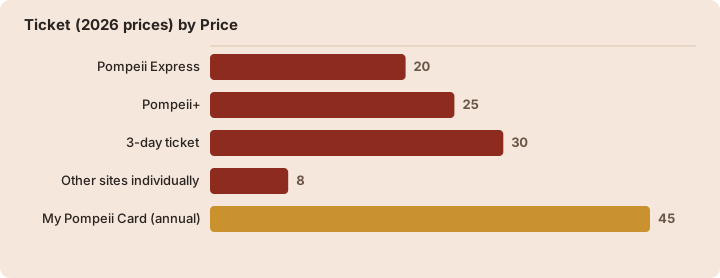
In 2026 the Pompeii Express ticket for the ancient city costs EUR 20, Pompeii+ costs EUR 25 and the 3-day ticket costs EUR 30, per the park's pricing in force since 12 January 2026. From 1 January 2027 the whole structure changes: a single EUR 25 ticket covers all park sites, valid 30 days with one entry per site, while the three smaller sites stay EUR 8 individually and the MyPompeii Card stays EUR 45.
That end-date on the current prices is not a footnote; it is the single most important planning fact for anyone visiting across the New Year. The park announced the new structure in its release of 14 September 2026, and it retains both the nominative ticket system and the 20,000 visitors-per-day cap introduced on 15 November 2024. Nothing about the 2026 ladder should be copied into a 2027 itinerary.
| Ticket (2026 prices) | Price | Covers |
|---|---|---|
| Pompeii Express | EUR 20 | The ancient city only |
| Pompeii+ | EUR 25 | City plus suburban villas route, Villa Regina, Antiquarium Boscoreale and shuttle |
| 3-day ticket | EUR 30 | Pompeii+ plus Oplontis, the Stabiae villas and museum, Boscoreale |
| Other sites individually | EUR 8 | Boscoreale, Oplontis, Stabiae museum |
| My Pompeii Card (annual) | EUR 45 | Annual pass, EUR 10 reduced |
Reductions and free entry follow clear rules. Entry is free for everyone under 18, and for everyone on the first Sunday of the month under the Domenica al Museo scheme, which the park states applies year-round. EU citizens aged 18 to under 25 pay a reduced EUR 2, as do non-EU holders of an Italian residence permit. Express holders who decide on the day to add the suburban villas route can do so for EUR 8, card payment only, at the Porta Ercolano / Street of the Tombs entrance.
The cap and the time-slot system shape the day more than prices do. Under the slot structure in force from 16 March to 14 October, the 9:00-13:00 window admits up to 15,000 visitors and the 13:00-17:30 window up to 5,000. One free first Sunday drew more than 36,000 people, the park's record peak, which is why arriving early or pre-booking matters most on those days. The site's detailed Pompeii ticket options page unpacks the fine print, and the free entry days guide is its natural companion.
Which Pompeii Entrance Should You Use From Salerno?
All three, Porta Marina, Piazza Esedra and Piazza Anfiteatro, are staffed ticket offices. The suburban villas route uses the separate Porta Ercolano / Street of the Tombs entrance.**
Which entrance serves you best depends on your first stop inside. The site's Pompeii entrances guide maps all of them, and the full site map page shows how the internal streets connect the sectors.
Visitors with mobility difficulties should plan around the "Pompeii for All" route: entry is at Piazza Anfiteatro, with exit possible at Piazza Anfiteatro or at Piazza Esedra via the Antiquarium lift. That makes the eastern entrances the natural choice for accessible itineraries, and the dedicated accessibility guide covers the route in detail.
| Entrance | Side of site | Nearest highlights |
|---|---|---|
| Porta Marina | West | Forum, Forum Baths, rail station |
| Piazza Esedra | East | Amphitheatre approach, Antiquarium lift |
| Piazza Anfiteatro | East | Amphitheatre, Large Palaestra, Pompeii for All route |
| Porta Ercolano / Street of the Tombs | West | Suburban villas route add-on (EUR 8, card only) |
Bag rules catch many visitors out. The permitted bag size is 30x30x15 cm; anything larger goes to left luggage. Drones need written authorisation, and bare chests are not permitted, which in August heat is a rule worth knowing before you set off. The park's visitor regulations page carries the full list, and identity documents may be checked at any entry because tickets are nominative, non-transferable and non-refundable except in extraordinary closure.
Booked tours change the entrance calculation, because operators designate their own meeting points and usually handle tickets under the group's name. Whichever entrance you end up at, the walk from the eastern side to the Forum end is a real distance across Roman paving, so build your route before you arrive rather than improvising in the sun.
Is A Guided Tour Worth It From Salerno?
A guided tour makes sense from Salerno when you value context over independence: the site is an excavated area of 44 hectares within a 98-hectare inscribed UNESCO property, and two hours with an archaeologist covers a coherent route that self-guided visitors often assemble haphazardly. Whether a tour includes entry, lunch or transport appears only on its own live listing, never in general advice.
The case for a guide at Pompeii is structural, not sentimental. The city's streets run in blocks and the signage, improved as it is, still leaves first-time visitors standing at junctions guessing. A small-group tour led by an archaeologist moves through the Forum, the baths and the painted houses with a narrative that ties the plaster casts to the eruption that made them; the story of those casts is told fully in the body casts guide. The wider question of guided versus independent, with the honest trade-offs on both sides, is argued out in the guided tour versus self-guided comparison.
One pattern holds across the verified roster: options exist at several commitment levels. A small-group archaeologist tour of the kind running daily from beside the site suits independent travellers arriving under their own steam from Salerno. The rest of the planning pages sit on Pompeii Travel Guide.
For groups or families who want the itinerary bent around their own interests, a private tour with an official guide is the other pole: one price for the whole group, your pace, your questions. The listing carries the current per-group figure and availability.
Travellers combining Pompeii with Vesuvius in a single day from Salerno should read the Pompeii and Vesuvius in one day itinerary before booking anything, because the crater has its own online-only timed-ticket system with daily caps and automatic closure on orange weather alerts. Vesuvius entry is a separate purchase from the archaeological park, EUR 11.68 full as sold online, and it cannot be folded into a Pompeii ticket.
How Long Should A Salerno Day At Pompeii Take?
Plan on four to six hours inside the ancient city for a first visit, plus about 30 minutes of driving each way from Salerno, which makes a comfortable full day door to door. Opening hours bound the plan: from 16 March to 14 October the site opens at 9:00 with last entrance 17:30 and closes at 19:00; from 15 October to 15 March last entrance is 15:30 and closing is 17:00.
Those hours are the park's own published schedule, and the winter version compresses the day hard: a 15:30 last entrance means a winter visit needs a morning start from Salerno, not an afternoon one after a slow lunch. Pompeii itself has no weekly closing day; only the smaller satellite sites at Oplontis and Stabiae are closed on Tuesdays. The site shuts on 25 December and 1 January unless otherwise communicated. The full schedule detail lives in the opening hours guide.
| Period | Opens | Last entrance | Closes |
|---|---|---|---|
| 16 March to 14 October | 9:00 | 17:30 | 19:00 |
| 15 October to 15 March | 9:00 | 15:30 | 17:00 |
Inside the walls, distance is the budget that matters. Two focused hours reach the Forum and a handful of houses; a half-day adds the Amphitheatre end, the Garden of the Fugitives and time to linger. The site's ready-made routes, including the Pompeii in 2 hours plan and the fuller one day itinerary, translate the hours into street-by-street walks. For eating, options inside and around the modern town are laid out in the where to eat in Pompeii guide, and note that the park's own food offering is limited, so a packed plan beats an empty stomach.
One closure to check before you go: the Praedia of Julia Felix has been closed to the public since 7 September 2026 for maintenance, until further notice. If a guidebook itinerary promises it, that itinerary predates the closure.
What Can You Pair With Pompeii From Salerno?
Herculaneum is the strongest pairing from Salerno, a separate buried town at Ercolano with entry at EUR 16 full and EUR 2 reduced for EU citizens aged 18 to under 25, open daily and free on the first Sunday of the month. The Vesuvius crater, reached by road, is the second. Both sit within the same half-hour road radius of Salerno as Pompeii itself.
Herculaneum rewards the second half of a two-site day because it is compact and partly shaded, where Pompeii is vast and largely exposed. The comparison between the two sites, and the honest answer to which one deserves your single available day, is worked through in the Pompeii versus Herculaneum guide. Two closures currently affect Herculaneum: the Villa dei Papiri and the Ancient Theatre are both closed for works, so check the official ticketing page before promising either to your party. Tickets and hours for that site are detailed in the Herculaneum tickets guide.
Cruise passengers have a distinct calculation, since port time is fixed and late return is not an option. Salerno is itself a cruise port, and shore excursion products built around Pompeii exist precisely for that constraint; the cruiser-focused excursion below includes the ticket and guide, with its current figures shown on the live listing.
The wider geography is worth sketching. The Amalfi Coast runs west of Salerno, and many visitors try to fold it and Pompeii into one day; whether that works, and how, is examined in the Amalfi Coast to Pompeii guide. For a full regional template that strings the sites together across two days, the two days Pompeii, Herculaneum and Vesuvius itinerary is the ready-made plan.
When Is The Best Time Of Year For The Trip?
The Pompei area's climate normals for 1991-2020 show July and August with mean daily maxima of about 28.7 and 29.4 degrees and almost no rain, about 16 and 22 mm respectively, while November is the wettest month at about 180 mm and February the coolest with mean minima about 6.5 degrees. April, May, October and the September shoulder offer the best balance of warmth and walkable conditions.
Those figures come from the Open-Meteo historical archive for the Pompei grid point, a reanalysis of the 1991-2020 period rather than a weather station, so they are stated as "about". They describe climate, not any particular day. What they do establish is the shape of the year: a hot, dry core from June to August, a wet autumn peak in November, and mild springs with rain of about 87 to 104 mm per month from March to April. The full month-by-month table and what it means for planning are in the weather and best time to visit guide, and the summer heat plan addresses the specific problems of a July or August visit, when stone streets hold the day's heat well into the evening.
| Season | Mean daily max / min (C) | Monthly rain (mm) |
|---|---|---|
| March to May | about 14.9 to 21.6 / 8.1 to 14.1 | about 104 to 59 |
| June to August | about 25.8 to 29.4 / 18.2 to 21.8 | about 30 to 22 |
| September to November | about 25.3 to 16.9 / 18.6 to 11.5 | about 90 to 180 |
| December to February | about 12.2 to 13.2 / 6.5 to 6.6 | about 147 to 103 |
Crowd patterns follow the heat and the school calendar. The park's own monthly figures for 2024 show October, at 481,255 visitors, and September, at 468,340, outdrawing July and August, at 449,162 and 421,255. The same year, December and January fell to 138,028 and 112,121. Shoulder-season travel from Salerno therefore buys both milder walking weather and measurably fewer fellow visitors, without the winter's shortened last-entrance window.
What Should You Not Miss Once Inside?
The Forum, the Amphitheatre, the Villa of the Mysteries and the Garden of the Fugitives anchor a first visit, and the site's excavated area of 44 hectares means every one of them is a real walk from the last. Choosing a route before arrival matters more here than at almost any other archaeological site in Italy, because the distances defeat improvisation.
The Forum was the city's civic heart, bounded by the temples and the basilica, and it is the natural orientation point from Porta Marina. The Amphitheatre, at the opposite eastern end, is the oldest surviving Roman amphitheatre structure of its kind and gives the Large Palaestra and Gladiator Barracks their context. Between them run the business streets and the houses whose frescoes and mosaics fill the museums of Naples; the Naples National Archaeological Museum guide explains why the finest pieces are there rather than on site, a question every visitor eventually asks. The Villa of the Mysteries lies beyond the walls near Porta Ercolano, reached through the suburban villas route, and the Villa of the Mysteries guide makes the case for walking the extra distance for its fresco cycle.
With children in tow, the calculation changes: open spaces, shade stops and a shorter route win over completeness. The Pompeii with kids itinerary is built around exactly that trade-off. Whatever the party, carry water and plan the day around the hours above, because the last-entrance clock, not enthusiasm, decides how much of the city you see.
The three options above span the realistic range for a Salerno-based traveller: a full-day trip with an optional Vesuvius ascent and pizza lunch, a private tour with an official guide at a per-group price, and a shore excursion built around a cruiser's fixed port hours. Each live listing carries its own price, rating, review count and cancellation terms at the moment of booking.
Common Questions About Salerno To Pompeii
How far is Salerno from Pompeii?
About 31 km by road, roughly 30 minutes of driving per route data computed on OpenStreetMap. That makes Salerno one of the closer bases for the archaeological park, alongside Naples at 24 km and Sorrento at 26 km.
How much do Pompeii tickets cost in 2026?
The Pompeii Express ticket costs EUR 20, Pompeii+ costs EUR 25 and the 3-day ticket EUR 30 in 2026. From 1 January 2027 the park replaces all three with a single EUR 25 ticket valid 30 days across all park sites, with one entry per site.
Can I visit Pompeii and Herculaneum in one day from Salerno?
Yes, both sit within the same road radius of Salerno, and Herculaneum's compact size suits a two-site day. Note the Villa dei Papiri and the Ancient Theatre at Herculaneum are closed for works, and entry there costs EUR 16 full, EUR 2 reduced for EU citizens aged 18 to under 25.
When is Pompeii free to enter?
Entry is free for everyone on the first Sunday of the month under the Domenica al Museo scheme, which the park states applies year-round, and free every day for visitors under 18. One free first Sunday drew more than 36,000 visitors, the park's record, so arrive early on those days.
Salerno's position on the bay turns Pompeii from an expedition into a short hop, and the decisions that actually shape the day are the ones made before setting out: the ticket tier, the entrance, the hour of arrival, and whether the walk is your own or an archaeologist's. Nail those down against the 2027 price change and the published hours, and the rest of the day belongs to the city Vesuvius froze in AD 79, whose destruction is traditionally dated to 24 August, a date the park's own scholarship keeps open rather than settled.