Regio V Excavations At Pompeii
Excavation at Pompeii never stopped. This page covers what the Regio V work is, what the finds say about the eruption date, and which closures and ticket changes shape a visit in 2026 and 2027.
Short answer
The Regio V excavations at Pompeii, the ancient Roman city in Campania, Italy, keep producing finds from the roughly half of the 98 ha UNESCO property never yet dug, including a charcoal inscription that reopened the eruption-date debate. The Praedia of Julia Felix has been closed since 7 September 2026, and a single EUR 25 all-sites ticket replaces the 2026 range from 1 January 2027.
Pompeii, the ancient Roman city buried by the eruption of Mount Vesuvius in AD 79, sits in Campania, southern Italy, beside the modern town of Pompei and about 24 km by road from Naples. What travellers photograph on the Forum or the Street of Abundance is only the excavated part: the UNESCO listing records a 44 ha excavated area inside a 98 ha inscribed property, and excavation continues. The work in Regio V, a district between the Porta Ercolano side of the city and the unexcavated northern stretches, is where the newest material has come out of the ground, and where several finds have reopened old arguments about the city and its destruction.
This page gathers what is actually confirmed about the new discoveries: where the excavation sits, what the charcoal graffito did to the eruption-date debate, which houses and areas are closed right now, and how the 2026 ticket structure, and its replacement from 1 January 2027, shape a visit built around the fresh material. Where a claim is not settled, it is presented as open.
What Is Regio V And Why Do The New Excavations Matter?
Regio V is one of the numbered districts into which archaeologists divide the ancient city of Pompeii, and its unexcavated northern stretch is where the park has opened new ground in recent years. The work matters because roughly half of the inscribed property has never been dug, so every trench adds streets, houses and objects unseen since AD 79. Finds from this district have fed current debates, including the argument over the eruption date itself.
The city is mapped in regiones and insulae, numbered blocks laid out like a grid, and the park uses those numbers in its own releases and signage. If you want that system explained street by street, the companion page on how Pompeii's regions are laid out covers it in detail. Regio V sits toward the north of the city, in the band of ground that was still buried when the great campaigns of the past stopped, which is why it could produce new material at all.
The deeper point for a visitor is that "new discoveries" at Pompeii are not a marketing phrase. The park's own visitor statistics record continuous, heavy public interest in the whole site: 4,069,377 people came through the Pompeii excavations in 2024 and 4,000,090 in 2025. An archaeological park running at that scale, with active trenches, is a place where the guidebook you bought two years ago may already be wrong about what is open.
Where The New Excavations Sit And How To Reach Them?
The new excavations sit inside the same park boundary as the rest of Pompeii, so you reach them with a standard entrance ticket rather than any separate pass. You can enter through any of the site's three ticket offices at Porta Marina, Piazza Esedra or Piazza Anfiteatro, then walk to the new areas from there.
Distances inside the city are real. The excavated area alone covers 44 ha, and the walk from Porta Marina to the Amphitheatre end is a proper hike over ancient paving. Anyone building a day around the northern districts should plan the entrance accordingly, and the itinerary page for seeing Pompeii in one day sketches the loop that makes sense. Visitors with mobility difficulties enter at Piazza Anfiteatro on the park's accessible route and can exit at Piazza Anfiteatro or Piazza Esedra via the Antiquarium lift.
The suburban villas route, Villa of the Mysteries and Villa diomedes included, is reached through the Porta Ercolano / Street of the Tombs entrance, and a Pompeii Express holder can add that route for EUR 8, card payment only, at that entrance. That route and the Regio V ground are at opposite ends of the city, so a single visit usually has to choose an emphasis.
What Has Actually Been Found In The New Digging?
What is confirmed is narrower than the internet suggests: the park has not announced any newly opened or reopened house on an official page, so no specific domus can honestly be described as a fresh opening. What the new campaigns have produced instead is fresh evidence, including a charcoal inscription that reopened the eruption-date debate, alongside the routine archaeological yield of streets, walls and small objects. The park's own communications are the only safe source for what is open.
That last sentence is worth dwelling on. Travel content repeatedly names houses as "newly opened" at Pompeii, and the park's releases do not support those claims. What the releases do support is closures: the Praedia of Julia Felix has been closed to the public since Monday 7 September 2026, until further notice, for maintenance. A visitor who plans a route around a house a blog called open may arrive at a barrier.
For the finds themselves, the honest frame is this: Pompeii is a working archaeological site, the trenches in the buried districts feed a steady stream of material into the park's e-journal and exhibitions, and the single find with the widest scholarly echo is the charcoal graffito discussed below. The companion guide on Pompeii's new discoveries tracks the confirmed items in more depth.
The distinction between a find and an opening matters for planning. A find gives a museum case, a journal article, a news cycle. An opening gives you a door to walk through. In 2026 the confirmed public facts about doors are almost all closures, listed further down this page, and the confirmed facts about finds are best absorbed in the Antiquarium or through a guide who follows the literature.
| Category | Status | What It Means for a Visitor |
|---|---|---|
| Newly opened domus | None confirmed on an official park page | Do not build a route around a "newly reopened" house from a blog |
| Praedia of Julia Felix | Closed since 7 September 2026, until further notice | A major Regio II house is off the itinerary |
| Charcoal graffito find | Confirmed as a real find, dated by many scholars to mid-October AD 79 | Central to the eruption-date debate, not viewable as a fixed exhibit claim |
| Villa dei Papiri (Herculaneum) | Closed for works | Affects Herculaneum, not Pompeii |
| Ancient Theatre (Herculaneum) | Closed until further notice | Affects Herculaneum, not Pompeii |
Did The Charcoal Graffito Change The Eruption Date?
It changed the debate, not the answer. The traditional date rests on Pliny the Younger's oldest manuscripts, which give 24 August AD 79, while a charcoal inscription found in the new excavations, dated by many scholars to mid-October of that year, has been read as evidence for an autumn eruption. The park's own e-journal states that the 24 October date has zero evidentiary basis and results from a 1929 misreading, while adding that 24 August is not necessarily correct either. The question is open.
This is one of the genuinely interesting stories to come out of the Regio V work. A charcoal note, apparently a worker's casual memo, was found in a context that many scholars read as written in mid-October AD 79, weeks after the traditional August date. If that reading is right, the eruption happened in the autumn. Sceptics point out that the traditional manuscript date is itself unstable, and the park's journal article, which is the closest thing to an official position, refuses to settle the matter in either direction.
A visitor takeaway: any guide, book or documentary that states a single certain date is overstating. Say "traditionally dated to 24 August" and you are on solid ground. The full discussion, including Pliny the Elder's death in the eruption, sits on the page covering when Vesuvius erupted.
How Much Of Pompeii Is Still Buried Under The Ground?
The excavated area covers 44 ha, while the UNESCO inscribed property covers 98 ha, which means a large share of the ancient city inside the protected boundary has never been dug. The figures come from the UNESCO listing for property 829, which covers Pompeii, Herculaneum and Torre Annunziata under criteria (iii), (iv) and (v). That buried share is exactly why new discoveries remain possible, and why the trenches keep producing material.
This is the arithmetic behind every "new discovery" headline. A city mostly emptied of its archaeology would have nothing left to find; a city half buried has room for surprises indefinitely. The practical consequence for visitors is that the park is a construction site as much as a museum in places, with fenced trenches, temporary closures, and routes that shift between visits.
The buried share is also the answer to a question the site hears often: why not just dig it all up? The standard archaeological position, which the park shares, is that ground not yet excavated is ground preserved, since exposing frescoes and organic material starts a clock of decay the moment the spade hits them. Future techniques may read a wall without destroying it. Today's patience is tomorrow's data.
| Measurement | Figure | Source Context |
|---|---|---|
| Excavated area of Pompeii | 44 ha | UNESCO listing, property 829 |
| Inscribed property area | 98 ha | UNESCO listing, property 829 |
| Buffer zone | 1,788.79 ha | UNESCO listing, property 829 |
| Inscribed sites | Pompeii, Herculaneum, Torre Annunziata | UNESCO property 829 |
| Criteria | (iii), (iv), (v) | UNESCO listing text |
Which Closures And Changes Affect A Visit In 2026 And 2027?
Three dated changes matter right now: the Praedia of Julia Felix has been closed since 7 September 2026 for maintenance, the Campania Express train has been suspended since 1 October 2026 until further notice, and the whole ticket structure changes on 1 January 2027, when a single EUR 25 ticket for all park sites replaces the 2026 range. None of these should be stated as permanent facts of the site, because each one carries its own date.
The train suspension is the one that catches people out. Travellers who read older content about a comfortable express service between Naples and Sorrento need to know the Campania Express has been suspended since 1 October 2026 until further notice, with refunds handled through the operator's complaints form or the original seller. The Circumvesuviana line is the railway that serves the excavations directly, stopping at Pompei Scavi-Villa dei Misteri, a short walk from the Porta Marina entrance; the page on the Circumvesuviana train covers the line and the station.
At Herculaneum, the Villa dei Papiri and the Ancient Theatre are closed for works, which matters to anyone combining the two parks on one day. The combination is well worth doing, and the itinerary for Pompeii and Herculaneum in one day accounts for realistic timings.
| Change | Effective Date | Detail |
|---|---|---|
| Praedia of Julia Felix closed | 7 September 2026 | Until further notice, maintenance |
| Campania Express suspended | 1 October 2026 | Until further notice; refunds via operator form or original seller |
| Single EUR 25 all-sites ticket | 1 January 2027 | Valid 30 days, one entry per site; smaller sites stay EUR 8 individually |
| MyPompeii Card under new system | 1 January 2027 | Stays EUR 45 |
| Herculaneum Villa dei Papiri closed | For works | Reopening date not stated |
What Do Pompeii Tickets Cost In 2026, And What Changes In 2027?
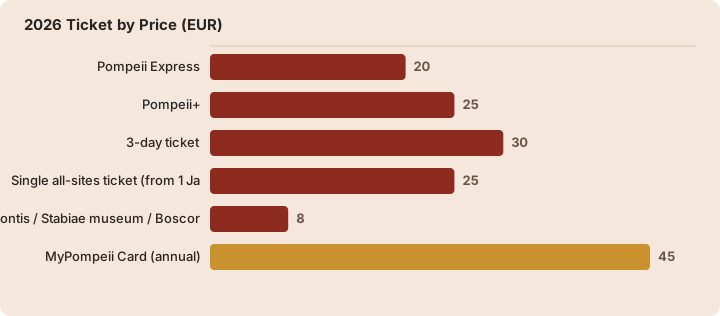
In 2026 the park sells Pompeii Express at EUR 20 for the ancient city only, Pompeii+ at EUR 25 including the suburban villas route, and a 3-day ticket at EUR 30 adding Oplontis, the Stabiae villas and museum, and Boscoreale; the smaller sites cost EUR 8 each, and the annual MyPompeii Card is EUR 45. From 1 January 2027 a single EUR 25 ticket covers all park sites, valid 30 days with one entry per site, while the smaller sites stay EUR 8 and the card stays EUR 45.
Two discount rules sit beside those prices. Entry is free for everyone under 18, and free for all visitors on the first Sunday of the month. EU citizens aged 18 to under 25 pay a EUR 2 reduced rate, as do non-EU holders of an Italian residence permit. The first-Sunday rule deserves respect in the calendar: the park has recorded more than 36,000 visitors on a single free first Sunday, against a daily cap of 20,000 in normal operation.
The nominative ticket system and the 20,000 visitors per day cap have applied since 15 November 2024, and both are retained under the 2027 structure. In practice that means your ticket carries your name, identification may be checked at every entry, and tickets are non-transferable, with refunds only for extraordinary closure. The full breakdown, including the time-slot split, lives on the page covering Pompeii tickets.
| 2026 Ticket | Price (EUR) | Covers |
|---|---|---|
| Pompeii Express | 20 | Ancient city only |
| Pompeii+ | 25 | City, suburban villas route, Villa Regina and Antiquarium Boscoreale, shuttle |
| 3-day ticket | 30 | Pompeii+ plus Oplontis, Villa Arianna, Villa San Marco, Stabiae museum, Boscoreale |
| Single all-sites ticket (from 1 Jan 2027) | 25 | All park sites, 30 days, one entry per site |
| Oplontis / Stabiae museum / Boscoreale | 8 each | Individual smaller sites |
| MyPompeii Card (annual) | 45 | Annual pass, EUR 10 reduced |
When Is The Best Time To See The Site And Its New Areas?
November is the wettest month at about 180 mm of rain against about 16 mm in July, the driest. Opening hours also matter: from 15 October to 15 March the last entrance is 15:30, against 17:30 in the summer season.**
Those climate figures come from 1991-2020 normals computed for the Pompei grid point from the Open-Meteo historical archive, a reanalysis grid rather than a weather station, so treat them as "about" rather than gospel. They still describe the year honestly: a Mediterranean pattern of dry, hot summers and mild, wet winters, with October and November both wetter than any spring month.
| Month | Mean Daily Max (C) | Mean Daily Min (C) | Rain (mm) |
|---|---|---|---|
| January | 12.2 | 6.6 | 119 |
| April | 17.7 | 10.4 | 87 |
| July | 28.7 | 21.1 | 16 |
| August | 29.4 | 21.8 | 22 |
| November | 16.9 | 11.5 | 180 |
Crowd pressure follows its own calendar. The park's published monthly figures for 2024 show May as the heaviest month at 516,923 visitors, with September at 468,340 and October at 481,255, while January drew 112,121. Anyone wanting the northern districts relatively to themselves should read those numbers as a steer: the same stones, half the company, in the months the Mediterranean rain gauge says to pack a coat.
Which Tours Work Best Around The Excavation Areas?
The tour that fits this page's subject best is an archaeologist-led small group visit with the entry ticket included, running from inside Pompeii, because a guide trained in the material is the difference between looking at trenches and understanding them. The same operator family covers Herculaneum with tickets included, and a full-day option from Sorrento pairs Pompeii with Mount Vesuvius for visitors based on the Sorrento peninsula. Every price, rating and duration renders on the operator's live listing, not on this page.
The featured pick on this site is the Pompeii entry ticket and guided tour with an archaeologist, which bundles the entry with a specialist guide, a sensible combination under a nominative-ticket regime where entry slots are capped. Check availability on the live listing for your date.
For the buried-city theme pushed further, Herculaneum is the natural second site: smaller, better preserved in its organic material, and covered by a Herculaneum small group tour with tickets and an archaeologist. Visitors staying in Sorrento can reach both worlds in one ticket-free day of planning through the priority access Pompeii and Vesuvius full-day tour from Sorrento, which handles the logistics of the volcano as well as the city.
For travellers who want the deep-cut city walk, a skip-the-line guided tour of Pompeii led by an archaeologist covers the core city with the same specialist standard. Anyone torn between the city and the crater should read the comparison on whether to do Pompeii or Vesuvius first before committing a day.
How Do You Plan A Day Around The New Discovery Zones?
Enter at Piazza Esedra or Piazza Anfiteatro rather than Porta Marina, give the northern districts the first half of the day while legs are fresh, and hold the Forum and the western houses for the afternoon loop. Check the park's own announcements before you travel, because the open area shifts with the trenches, and closures like the Praedia of Julia Felix, shut since 7 September 2026, can remove a planned stop. Allow a full day rather than a morning if the villas route is also on the list.
Bag rules and identity checks are the two practical frictions. Permitted bag size is 30x30x15 cm, with larger bags left at the left luggage facility, and identification may be checked at entry because tickets are nominative. Drones need authorisation, and bare chests are not permitted, per the park's visitor regulations. None of this is onerous, but each item has stopped somebody at a gate.
The wider context is worth a sentence. The park's other sites, Oplontis at Torre Annunziata, the villas at Castellammare di Stabiae, and the Herculaneum excavations at Ercolano, reward anyone with a second day, and the modern town of Pompei, covered on the page about modern Pompei town, holds the Sanctuary and a calmer evening than Naples. The interactive Pompeii map page helps with orientation before arrival.
A closing note on expectations. The trenches themselves are working archaeology, and some will be fenced, tarped or staffed by people with trowels rather than open to stroll through. That is the point: the new discoveries at Pompeii are a live process, not a new wing of a museum. Bring the standard highlights, the Amphitheatre, the Forum, the Villa of the Mysteries, and treat whatever open ground the northern districts offer on the day as the bonus it is.
Common Questions About Pompeii New Discoveries
What Has recently been found in Pompeii?
The confirmed headline find from the new excavations is a charcoal inscription that many scholars date to mid-October AD 79, reopening the debate over the eruption date. Beyond it, the trenches yield streets, walls and objects continuously, but the park has confirmed no newly opened or reopened house on an official page, so no specific domus should be described as a new opening.
Is any part of Pompeii still buried?
Yes. The excavated area covers 44 ha while the UNESCO inscribed property covers 98 ha, so a large share of the ancient city inside the protected boundary has never been dug, and the active work in Regio V and the northern districts continues to open new ground.
Can you visit the Regio V excavations?
The new districts are inside the same park boundary and covered by the standard Pompeii ticket, with the three ticket offices at Porta Marina, Piazza Esedra and Piazza Anfiteatro. There is no separate admission, though specific trenches or houses may be fenced off depending on the state of the work.
When did Vesuvius erupt and destroy Pompeii?
The eruption is traditionally dated to 24 August AD 79 from Pliny the Younger's oldest manuscripts. The park's own e-journal states the 24 October alternative has no evidentiary basis, while adding that 24 August is not necessarily correct either, so the date remains an open scholarly debate.
Do Pompeii ticket prices change in 2027?
Yes. From 1 January 2027 a single EUR 25 ticket covers all park sites, valid 30 days with one entry per site, replacing the 2026 structure of EUR 20 Express, EUR 25 Plus and EUR 30 three-day tickets. Oplontis, the Stabiae museum and Boscoreale stay EUR 8 individually, and the MyPompeii Card stays EUR 45.
The buried half of Pompeii is the quiet guarantee behind this whole subject: as long as ground lies unexcavated inside the 98 ha property, the park will keep producing finds that rewrite guidebooks, and a visit planned around the park's own announcements, an archaeologist's commentary and a named-entrance strategy will catch the site as it actually is, not as a three-year-old article left it. The editorial desk behind Pompeii Travel Guide keeps this page aligned with the park's releases as they appear.