Pompeii Map
The excavated ancient city of Pompeii, beside the modern town of Pompei in Campania, southern Italy, covers an excavated area of 44 hectares within a UNESCO-inscribed property of 98 hectares. This page explains how that ground is organised, which entrance serves which part, and how to read the site before arrival.
Short answer
Pompeii is an excavated ancient Roman city of 44 hectares inside a 98-hectare UNESCO property, entered at Porta Marina, Piazza Esedra or Piazza Anfiteatro. In 2026 the Pompeii Express ticket costs EUR 20 and Pompeii+ EUR 25; from 1 January 2027 a single EUR 25 ticket covers all park sites. The Forum sits central, with the amphitheatre east and the Villa of the Mysteries beyond Porta Ercolano.
The ancient city of Pompeii, in Campania, southern Italy, is an excavated Roman urban landscape of 44 hectares sitting inside a UNESCO World Heritage property of 98 hectares, beside the modern town of Pompei and about 24 km by road from Naples. Reading the layout before arrival changes the visit. The site is not a single ruin but a whole city grid of streets, houses, baths, theatres and a suburban villa quarter, and the difference between a frustrating day and a rewarding one is usually knowing which entrance to use and which quarter holds the things you came for. The park's own cartography, and the fuller interactive version on the Pompeii site map page, divides the excavated city into named regions crossed by two long decuman streets, with the Forum at the centre of the grid.
How Is The Ancient City Of Pompeii Laid Out On The Ground?
The excavated city of Pompeii is a walled Roman street grid covering 44 hectares, structured around two main east-west streets crossed by a network of north-south lanes, with the civic Forum placed at the apparent centre of town, the amphitheatre and Large Palaestra in the eastern quarter, the theatres in the south, and the suburban villas outside the walls beyond Porta Ercolano. The surrounding UNESCO property measures 98 hectares and includes ground still unexcavated. The modern visitor sees this as a sequence of neighbourhoods rather than one monument, and the excavated area is a fraction of the full property: ancient Pompeii extends under the soil beyond what is open today. Orientation is easiest if you treat the Forum as the anchor, since the principal streets of the ancient city radiate from and run toward it.
The ancient city is commonly described by archaeologists in numbered regions, and the park's excavation history lives in those labels. The Regio V new excavations area is one such quarter, lying toward the north-east of the city between the Porta di Nola direction and the unexcavated belt. The regions are a scholarly tool more than a wayfinding system, and on the ground visitors navigate by landmarks: the Forum, the Via dell'Abbondanza running toward the amphitheatre, the theatre district in the south, and the Street of the Tombs leading out to the villas.
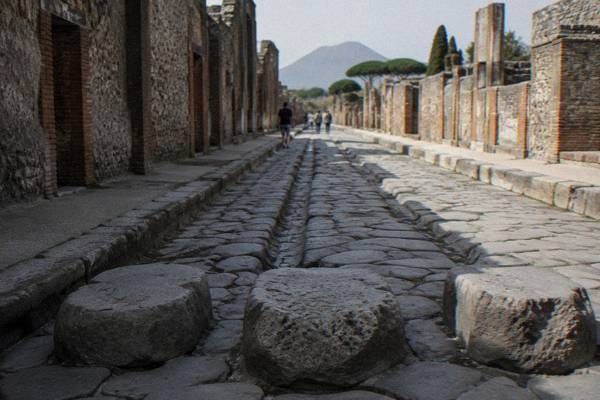
What surprises first-time visitors is the scale of the ordinary. Streets of small houses and shops, snack counters, fountains and crossing stones make up the bulk of the open city, with the famous monuments scattered through it. A realistic mental picture is a town you walk through, not a museum you stand in. The Via dell'Abbondanza, the main decuman of the eastern half, functions as the practical spine of a visit: it links the Forum area toward the Stabian Baths, the theatres and, further east, the amphitheatre quarter around Piazza Anfiteatro.
| Quarter of the ancient city | What defines it on the ground | Anchor sight | Practical note for visitors |
|---|---|---|---|
| Forum and civic centre | Colonnaded public square, temples, basilica | Forum of Pompeii | Central crossroads of any route |
| Eastern quarter | Amphitheatre, Large Palaestra, gladiatorial buildings | Pompeii Amphitheatre | Closest quarter to Piazza Anfiteatro entrance |
| Southern theatre district | Large Theatre, Odeon, quadriporticus | Large Theatre and Odeon | Reached most directly from Porta Marina and Piazza Esedra |
| Residential heart | House of the Faun, House of the Vettii, lupanar | House of the Faun | Densest concentration of decorated houses |
| Suburban villa quarter | Street of the Tombs, villas outside the walls | Villa of the Mysteries | Served by the Porta Ercolano entrance |
The suburban quarter deserves its own sentence because it sits outside the ancient walls and is often missed by visitors who never reach the western edge. The Pompeii necropolis along that road is part of the same suburban fabric, and the Pompeii+ ticket exists precisely to cover this outer route together with the shuttle-linked outlying sites.
Which Entrance Should You Use For Each Part Of Pompeii?
Pompeii has three ticket-office entrances, Porta Marina, Piazza Esedra and Piazza Anfiteatro, plus the Porta Ercolano / Street of the Tombs entrance used for the suburban villas route, and the right choice depends on your priority: Porta Marina serves the Forum and western city, Piazza Esedra sits near the theatres and the central grid, and Piazza Anfiteatro is the entrance for the amphitheatre quarter and the "Pompeii for All" accessible route. The Porta Ercolano entrance is not a general starting point; the park lists it specifically as the place where holders of the Express ticket can add the suburban villas route for EUR 8, card payment only. Choosing deliberately saves back-tracking across a 44-hectare site.
Arrival by Circumvesuviana shapes the decision. The trains from Naples and Sorrento stop at Pompei Scavi-Villa dei Misteri, the station named for the villa a short walk from the western edge of the ancient city, and the natural pairing is Porta Marina or Porta Ercolano from there. Scheduled running times computed from the operator EAV's own timetable data give 29 to 35 minutes from Napoli Garibaldi to Pompei Scavi-Villa dei Misteri. Visitors arriving from the modern town of Pompei, described on the modern Pompei town page, more often approach from the east and start at Piazza Anfiteatro.
| Entrance | Ticket office | Best for | Notes |
|---|---|---|---|
| Porta Marina | Yes | Forum, western city, theatre district | Closest to the Circumvesuviana Pompei Scavi station |
| Piazza Esedra | Yes | Theatres, central residential grid | Connects to the Antiquarium lift route |
| Piazza Anfiteatro | Yes | Amphitheatre, Large Palaestra, eastern city | Start of the "Pompeii for All" accessible route |
| Porta Ercolano / Street of the Tombs | Suburban villas route only | Villa of the Mysteries, necropolis | Express holders add the villas route here for EUR 8, card only |
Accessibility also runs through the entrances. The park's "Pompeii for All" route is designed for visitors with mobility difficulties, entered at Piazza Anfiteatro, with exits possible at Piazza Anfiteatro or Piazza Esedra via the Antiquarium lift. The terrain elsewhere is genuine ancient paving, worn and rutted, which the Pompeii accessibility guide covers in detail. Luggage is a separate constraint: the permitted bag size inside the park is 30x30x15 cm, and larger bags go to left luggage, a policy worth checking against the Pompeii luggage storage advice before you pack.
If your priority is a guided walk rather than self-direction, a small-group archaeologist tour starts inside this same geography and removes the map-reading burden entirely.
A guide who works the site daily also absorbs the practical frictions: the time-slot system, the distances between quarters, and the houses that are open on a given day. For the 2026 season the park splits entries into two bands, 9:00-13:00 with a cap of 15,000 and 13:00-17:30 with a cap of 5,000, so morning entry is the fuller, busier window.
Where Are The Key Sights Within The Pompeii Street Grid?
The headline sights cluster in three zones: the Forum with its temples and basilica at the centre, the decorated houses of the residential heart, including the House of the Faun and the House of the Vettii, on the streets north of the Via dell'Abbondanza, and the amphitheatre and Large Palaestra at the eastern edge, while the plaster casts at the Garden of the Fugitives sit in the south-eastern quarter and the Villa of the Mysteries lies outside the walls to the west. Walking between zones is the real cost in time and energy, not the queueing. A plan that groups neighbouring sights beats a plan that chases a list across the whole grid.
The residential quarter rewards the most time. The House of the Vettii and the House of the Faun, the latter holding the space where the famous Alexander mosaic was found, sit within a few streets of each other, and the Lupanar is close by. The Garden of the Fugitives, with its preserved plaster casts, lies further east and often becomes the emotional centre of a visit. Daily-served food within the park is limited, so the Pompeii food in the park guide is worth reading before a long day on the stones.
One closure matters for route-planning in the current season: the Praedia of Julia Felix has been closed to the public since Monday 7 September 2026 for maintenance, until further notice, so no route should depend on it. No newly opened or reopened house has been confirmed on an official park page, and the Pompeii new discoveries page is the place this site tracks excavation news. Otherwise the open city is stable: the amphitheatre, both theatres, the Forum buildings and the suburban villas all operate on the normal seasonal schedule.
| Key sight | Quarter | Closest general entrance | Typology |
|---|---|---|---|
| Forum and basilica | Civic centre | Porta Marina | Public architecture |
| House of the Faun | Residential heart | Piazza Esedra | Elite residence |
| House of the Vettii | Residential heart | Piazza Esedra | Elite residence |
| Large Theatre and Odeon | Southern district | Piazza Esedra | Performance buildings |
| Amphitheatre | Eastern quarter | Piazza Anfiteatro | Spectacle building |
| Garden of the Fugitives | South-east | Piazza Anfiteatro | Casts, vineyard site |
| Villa of the Mysteries | Suburban, outside walls | Porta Ercolano route | Rural villa |
Deciding between covering this ground alone or with a guide is a genuine fork. The site's comparison of a Pompeii guided tour versus self-guided visit lays out the trade-offs, and the short version is that a guide compresses orientation time on a first visit. The small-group archaeologist tour is the option to weigh first.
Between the map and the morning slot, the practical sequence for a self-guided day is simple: pick the entrance that faces your top two sights, walk one long axis rather than zig-zagging, and leave the suburban villas for the end if you are starting east. The two-hour and full-day itineraries below are built on exactly that logic.
What Do The 2026 Tickets Cover Across The Pompeii Regions?
Under-18s enter free, EU citizens aged 18 to under 25 pay a EUR 2 reduced rate, and entry is free for everyone on the first Sunday of the month.
The map logic of the tickets is what matters here. Express buys you the walled city. The step up to Pompeii+ buys the western suburban strip and the Boscoreale shuttle, which is the difference between seeing the Villa of the Mysteries or not, for many travellers. The 3-day ticket is really a regional ticket in disguise: it reaches across the Bay of Naples geography to Oplontis at Torre Annunziata, the villas at Castellammare di Stabiae, and Boscoreale. Full detail lives on the Pompeii tickets page.
| Ticket, 2026 | Price | Coverage | After 1 Jan 2027 |
|---|---|---|---|
| Pompeii Express | EUR 20 | Ancient city only | Replaced by single ticket |
| Pompeii+ | EUR 25 | City, suburban villas route, Boscoreale with shuttle | Replaced by single ticket |
| 3-day ticket | EUR 30 | Pompeii+ plus Oplontis, Stabiae sites, Boscoreale | Replaced by single ticket |
| Outlying sites individually | EUR 8 each | Oplontis, Stabiae museum, Boscoreale | EUR 8 each, retained |
| My Pompeii Card, annual | EUR 45 | Annual park access | EUR 45, retained |
For travellers who want the map and the narration together, the entry ticket with audio guide is the bare-bones option, and it suits visitors who already know their route through the regions. The tile below renders the current price and rating from the operator's live listing. The wider set of guides lives on Pompeii Travel Guide.
A note on timing the purchase: tickets are nominative, identity may be checked at every entry, and the daily cap of 20,000 visitors has applied since 15 November 2024. On free first Sundays the site has recorded peaks above 36,000 visitors in a single day, which is worth knowing before choosing one for a relaxed map-reading visit.
How Do The Pompeii Regions Connect To The Other Vesuvian Sites?
The other major archaeological sites sit in a ring around Vesuvius and are treated on this site as separate destinations: Herculaneum is in the modern town of Ercolano, Oplontis at Torre Annunziata, the Stabiae villas and museum at Castellammare di Stabiae, and road distances from the Pompei Scavi station area run about 24 km from Naples, 26 km from Sorrento, 31 km from Salerno and 234 km from Rome. The Circumvesuviana railway ties the closer sites together, with scheduled times from EAV's own timetable data of 29 to 35 minutes from Napoli Garibaldi to Pompei Scavi-Villa dei Misteri and 34 to 40 minutes from Pompei Scavi on to Sorrento. Herculaneum's own entry costs EUR 16 full and EUR 2 reduced for EU citizens aged 18 to under 25.
Herculaneum is the comparison everyone makes, and the geography explains it: a smaller, deeper-buried town to the north-west, covered by a different volcanic deposit that preserved wood and upper storeys. The Pompeii versus Herculaneum comparison and the Ercolano area page cover the choice in full. Two current closures matter for Herculaneum route-planning: the Villa dei Papiri and the Ancient Theatre there are closed for works, so neither belongs in a 2026 itinerary. Vesuvius itself, with its Gran Cono trail sold online-only at EUR 11.68 full, is the third point of the triangle and has its own Mount Vesuvius coverage on this site.
| Site | Modern location | Road distance from Pompei Scavi area | Rail connection fact from EAV timetable data |
|---|---|---|---|
| Naples | Naples | About 24 km | Napoli Garibaldi to Pompei Scavi 29-35 min |
| Sorrento | Sorrento | About 26 km | Pompei Scavi to Sorrento 34-40 min |
| Salerno | Salerno | About 31 km | Not on this Circumvesuviana route |
| Rome | Rome | About 234 km | Connect via Naples |
One transport fact deserves its date attached: the Campania Express train service has been suspended since 1 October 2026 until further notice, with refunds handled through the operator EAV's complaints form or the original seller. The Circumvesuviana train guide tracks the detail.
The block below carries its live figures.
When Are The Quietest Hours And Months Across The Pompeii Regions?
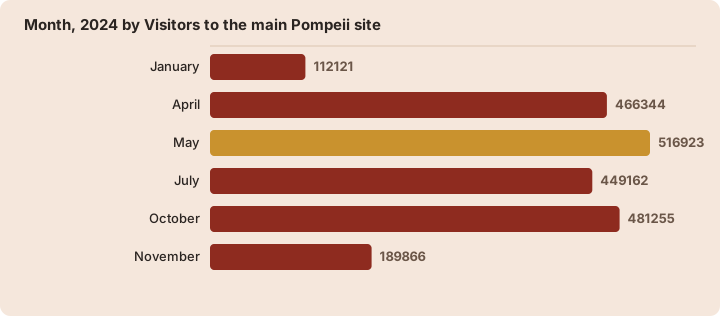
The park splits each day into two entry bands, 9:00-13:00 capped at 15,000 entries and 13:00-17:30 capped at 5,000 in the summer season, so the afternoon is structurally quieter, while the monthly visitor record for 2024 shows October at 481,255 visitors as the second-busiest month behind May at 516,923, with the deepest trough in January at 112,121. Winter opening runs 9:00 to last entry at 15:30 and closing at 17:00 between 15 October and 15 March, against 9:00 to last entry 17:30 and close 19:00 between 16 March and 14 October. The ancient city has no weekly closing day, and closes only 25 December and 1 January unless otherwise communicated.
The monthly pattern rewards attention because it is not the pattern people assume. The official visitor table for the main site shows 2024 peaking in May at 516,923, holding high through September at 468,340 and October at 481,255, then falling to November at 189,866 and December at 138,028. Weather interacts with that: Open-Meteo 1991-2020 climate normals for the Pompei grid point show November as the wettest month at about 180 mm of rain against about 16 mm in July, and August with the highest mean daily maximum at about 29.4 C. The full picture, including what to wear, sits on the Pompeii weather and best time to visit and what to wear to Pompeii pages.
| Month, 2024 | Visitors to the main Pompeii site | Mean daily max / min, 1991-2020 normals |
|---|---|---|
| January | 112,121 | About 12.2 C / 6.6 C |
| April | 466,344 | About 17.7 C / 10.4 C |
| May | 516,923 | About 21.6 C / 14.1 C |
| July | 449,162 | About 28.7 C / 21.1 C |
| October | 481,255 | About 21.3 C / 15.1 C |
| November | 189,866 | About 16.9 C / 11.5 C |
Heat changes the map itself. On summer days the exposed eastern quarter around the amphitheatre and the unshaded Via dell'Abbondanza are the hardest stretches, and shade is scarce everywhere on the stones, which is why the site maintains a dedicated Pompeii in summer heat plan. Toilets and water points are limited and clustered near the entrances and the Forum area, a detail the Pompeii toilets and facilities guide maps out.
How Do You Plan A Route Through The Pompeii Regions?
Route-planning at Pompeii comes down to matching an entrance to a time budget: the two-hour routes run Porta Marina to the Forum and the theatre district or Piazza Anfiteatro to the amphitheatre and Garden of the Fugitives, the full-day route threads the Via dell'Abbondanza from the Forum to the amphitheatre and finishes with the suburban villas at Porta Ercolano, and any multi-day plan should put the outlying Vesuvian sites on their own day. The excavated 44 hectares are walkable end to end, but repeated crossings are what exhaust visitors. One axis per half-day is the rule that works.
The itineraries on this site are built on that spine. The Pompeii in 2 hours route is the minimum-viable circuit; Pompeii in one day covers the full grid plus the villas. Combination days exist for a reason: the Pompeii and Vesuvius in one day and Pompeii and Herculaneum in one day plans trade depth for reach, and both work only because the Circumvesuviana ties the sites together. Cruise passengers face the tightest version of the problem, covered on the Pompeii cruise ship day page, and families have a dedicated Pompeii with kids itinerary.
| Time budget | Recommended entrance | Regions covered | Sample anchor sights |
|---|---|---|---|
| 2 hours | Porta Marina | Forum, theatre district | Forum, Basilica, Large Theatre |
| Half day | Piazza Esedra | Central grid, residential heart | House of the Faun, House of the Vettii |
| Full day | Porta Marina, exit Porta Ercolano | Whole city plus villas | Forum, amphitheatre, Villa of the Mysteries |
| Two days | Split across entrances | City day, then outlying sites | Day two at Oplontis, Stabiae or Herculaneum |
The eruption date, which the map cannot help but evoke, is itself a mapped debate: the traditional manuscript date is 24 August AD 79, while the park's own e-journal states that a 24 October date has no evidentiary basis and resulted from a 1929 misreading, without settling that August is correct either. The geography, though, is not debated at all. Vesuvius dominates every view from the streets, and the city's regions lie exactly where the ash left them, from the Forum at the centre to the villas on the old road out of town.
For anyone whose day includes a guide, a ticket for a neighbouring site, or a Vesuvius excursion, these three options are the pairing this site recommends for the full regional circuit.
Common Questions About The Pompeii Map
How Is the Ancient City of Pompeii Laid Out on the Ground?
Pompeii is a 44-hectare excavated Roman street grid inside a 98-hectare UNESCO property, with the Forum at the centre, the amphitheatre quarter in the east, the theatres in the south, and the suburban villas beyond Porta Ercolano outside the walls.
Which Entrance Should You Use for Each Part of Pompeii?
Use Porta Marina for the Forum and western city, Piazza Esedra for the theatres and central grid, Piazza Anfiteatro for the amphitheatre and the accessible route, and the Porta Ercolano / Street of the Tombs entrance for the suburban villas route.
Where Are the Key Sights Within the Pompeii Street Grid?
The Forum, basilica and temples sit centrally; the House of the Faun and House of the Vettii lie in the residential heart; the Garden of the Fugitives is in the south-east; the amphitheatre anchors the east; and the Villa of the Mysteries lies outside the walls to the west.
What Do the 2026 Tickets Cover Across the Pompeii Regions?
In 2026, Express at EUR 20 covers the city, Pompeii+ at EUR 25 adds the suburban villas and Boscoreale, and the 3-day ticket at EUR 30 adds Oplontis, Stabiae and Boscoreale. From 1 January 2027 a single EUR 25 ticket covers all park sites for 30 days.
When Are the Quietest Hours and Months Across the Pompeii Regions?
The afternoon entry band from 13:00 to 17:30 is capped at 5,000 against 15,000 in the morning. Official 2024 figures show May as the peak month at 516,923 visitors and January as the quietest at 112,121.
How Do You Plan a Route Through the Pompeii Regions?
Match the entrance to your time budget: a two-hour visit covers the Forum and one quarter, a full day threads the Via dell'Abbondanza to the amphitheatre and ends at the villas, and multi-day plans should give the outlying Vesuvian sites their own day.
The map of Pompeii is ultimately a walking plan, and every figure on this page, from the 44 excavated hectares to the 13:00 entry split and the 2027 ticket change, exists to make that plan concrete before you stand at a gate. Pick the entrance that faces your priorities, buy the ticket that matches the regions you actually want, and let the grid do the rest.