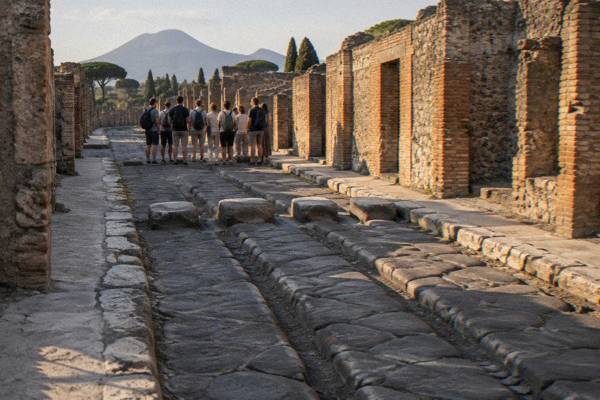
Pompeii With Kids Itinerary
Pompeii, the ancient Roman city buried by Mount Vesuvius in AD 79, sits beside the modern town of Pompei in Campania, southern Italy, about 24 km from Naples, and it is a strikingly good place to take children provided the route is short, the timing is right and everyone has water.
Short answer
Pompeii works well with children from about age six up, with a 2026 Pompeii Express ticket at EUR 20 for adults, free entry for under 18s and EUR 2 for EU citizens aged 18 to under 25. A focused two-hour route through the Forum, the baths and the Garden of the Fugitives beats attempting the whole 44 ha excavated area, and the park caps entries at 20,000 visitors a day, so arriving early matters.
Pompeii, the ancient Roman city buried by the eruption of Mount Vesuvius in AD 79, lies in Campania, southern Italy, beside the modern town of Pompei and about 24 km by road from Naples, and taking children there rewards a certain amount of planning. The site is vast, largely unshaded and walked on two thousand year old stones, three things that defeat an ambitious family itinerary quickly. The good news is that a short, well-chosen route delivers the drama of the city without the meltdowns, that children under 18 enter free, and that the infrastructure, from left luggage to the accessible "Pompeii for All" route, is better than many visitors expect. This itinerary sets out what actually works: the right age, the right season, a two-hour route, the 2026 ticket structure, where the water and toilets are, and how to bolt on Mount Vesuvius if the family has more energy than the ruins alone can absorb.
Is Pompeii Suitable For Kids?
Yes, Pompeii suits children, best from around age six upward, because the site is an open-air city rather than a glass-case museum: children can stand in a real amphitheatre, see casts of people caught by the eruption, and read ancient graffiti on the walls. The excavated area covers 44 ha, with an inscribed UNESCO property of 98 ha shared with Herculaneum and Torre Annunziata, so no family sees it all, and nobody should try. Entry is free for under 18s, and EU citizens aged 18 to under 25 pay a reduced EUR 2 on 2026 pricing, which makes a family day cheaper than a theme-park car park. The constraints are physical: little shade, uneven Roman paving, and distances that feel long on small legs.
Whether it lands depends less on the ruins than on the plan. A two-hour route with a gelato stop at the end is a completely different experience from a five-hour trudge covering twenty insulae. The park's own rules help families in quiet ways: bags larger than 30x30x15 cm must go to left luggage, which forces a light pack, and the daily cap of 20,000 visitors, in place since 15 November 2024, keeps the densest crush within bounds even in peak months. Visitor numbers back up the scale of the place: the park counted 4,069,377 visitors to the Pompeii site in 2024 and 4,000,090 in 2025.
Age shapes what you can honestly promise. A six-year-old will remember the plaster casts and the stepping stones; a ten-year-old can add the bakery and the amphitheatre; a teenager can carry the narrative of the eruption itself, traditionally dated to 24 August AD 79, a date the park's own e-journal treats as debated rather than settled. The table below sets out realistic expectations by age.
| Age group | What works | Realistic visit length | Watch-outs |
|---|---|---|---|
| Under 6 | Pushchair-friendly "Pompeii for All" route, wide spaces, short stops | 45-60 minutes | Roman paving defeats small wheels off the accessible route |
| 6-9 | Forum, casts, stepping stones, amphitheatre | 2 hours | Heat and boredom after the second hour |
| 10-13 | Add bakery, baths, graffiti, a guide's stories | 2-3 hours | Wants food constantly; carry snacks |
| 14+ | Full highlights route, Vesuvius add-on | 3-4 hours | Phone battery, not stamina, is the limit |
For a broader look at what the site holds, the Pompeii With Kids planning guide covers age-by-age preparation in more depth, and the half-day highlights route is the natural upgrade once children are older.
What Is The Best Age And Season For A Family Visit?
The best window for Pompeii with children is April, May, June, late September or October, when the Pompei grid point's 1991-2020 climate normals show mean daily highs of about 17.7 to 21.6 C in spring and about 21.3 C in October, against about 29.4 C in August. July is the driest month at about 16 mm of rain and November the wettest at about 180 mm, so the trade-off in autumn is a small risk of showers against walkable temperatures. Winter visits are perfectly possible, with the park open from 9:00 and last entrance at 15:30 between 15 October and 15 March, and they are quiet, though the site closes at 17:00 and the light goes early.
Summer needs honest handling rather than avoidance. Families locked into August should start at 9:00, when the 16 March to 14 October time bands open, finish by early afternoon, and treat the middle of the day as food and shade time. The summer heat plan on this site, surviving Pompeii in summer heat, is built around exactly that problem. What no plan fixes is the first-Sunday-of-the-Month effect: entry is free for everyone on the first Sunday, the park has recorded more than 36,000 visitors on one such free day, and that is a crowd a family with children should deliberately avoid.
Timing inside the day matters as much as the month. The current time-slot system splits entries into 9:00-13:00, capped at 15,000 visitors, and 13:00-17:30, capped at 5,000, which makes the afternoon slot genuinely quieter, a real option for children who sleep late on holiday. The monthly picture below helps pick the week.
| Month (Pompei normals, 1991-2020) | Mean daily max | Mean daily min | Monthly rain | Family verdict |
|---|---|---|---|---|
| Apr | about 17.7 C | about 10.4 C | 87 mm | Excellent |
| May | about 21.6 C | about 14.1 C | 59 mm | Excellent |
| Jun | about 25.8 C | about 18.2 C | 30 mm | Good, go early |
| Jul | about 28.7 C | about 21.1 C | 16 mm | Early start only |
| Aug | about 29.4 C | about 21.8 C | 22 mm | Early start only |
| Sep | about 25.3 C | about 18.6 C | 90 mm | Good |
| Oct | about 21.3 C | about 15.1 C | 129 mm | Excellent, some rain |
If the family day is anchored in Naples, a guided option that bundles transport and skip-the-line entry removes two of the three things that tire children out before the ruins even start; the related tour on this page does exactly that, and the tours hub lists the full range for comparison.
The Two-Hour Family Route Through Pompeii
Enter at Piazza Esedra, walk straight to the Forum for the big reveal of Vesuvius over the columns, then take in the Forum Baths, the Bakery of Modestus, the thermopolium of Vetutius Placidus and the Garden of the Fugitives, exiting past the Large Palaestra toward Piazza Anfiteatro: roughly two hours, one drinks stop, and the three things children remember forever. The route works because it front-loads the spectacle, keeps the walking between short set pieces, and ends at the amphitheatre side where the accessible route runs. Porta Marina, Piazza Esedra and Piazza Anfiteatro are the three ticket offices, and Piazza Esedra is the calmer start with children.
The Forum is the anchor. Standing columns, an open plaza and the volcano itself in the frame, it is the single view that explains the whole story to a child in one glance; the Forum of Pompeii guide details what each building was. From there the Forum Baths deliver the "they had underfloor heating" moment, and the Stabian Baths are the alternative if the route runs the other way. The Bakery of Modestus, with its bread ovens and millstones, and the thermopolium of Vetutius Placidus, a Roman snack bar with painted counter jars, are the two stops that reliably delight children, because food is a language they already speak.
The Garden of the Fugitives, holding the plaster casts of people caught by the eruption, is the emotional core of the visit and the point at which parents should decide how much their children are ready to see. It is presented plainly and without melodrama, and children generally meet it with more curiosity than distress, but the accompanying explanation belongs to the adults. End at the amphitheatre, where running off some energy in the arena is quietly tolerated and the scale lands viscerally. If the family has more time than two hours, the Pompeii in 2 hours and Pompeii in one day itineraries extend this same spine.
| Route stop | What children notice | Rough time | Theme |
|---|---|---|---|
| Forum | Columns, the volcano in view | 20 min | The big story |
| Forum Baths | Hot rooms, hollow floors | 15 min | Roman comfort |
| Bakery of Modestus | Ovens, donkey mills | 10 min | Roman food |
| Thermopolium of Vetutius Placidus | Painted counter jars | 10 min | Roman fast food |
| Garden of the Fugitives | The plaster casts | 15 min | The eruption's cost |
| Large Palaestra and Amphitheatre | Open arena, space to run | 25 min | Games and crowds |
A guided small-group walk built around the archaeologist-led format keeps a route like this moving without a parent narrating from a phone; one such option below is a strong fit for families with children around eight and up.
Tickets, Queues And Pushchairs In 2026
The 2027 change is worth knowing before you plan: the Express/Plus/3-day structure ends on 31 December 2026, and from 1 January 2027 one EUR 25 ticket covers all park sites with one entry per site over 30 days, while Oplontis, the Stabiae museum and Boscoreale stay EUR 8 individually and the MyPompeii Card stays EUR 45. For full detail, the Pompeii tickets guide is the dedicated page, and free entry days at Pompeii covers the first-Sunday rules.
| 2026 ticket | Price | Covers | Family fit |
|---|---|---|---|
| Pompeii Express | EUR 20 | Ancient city only | Best for a first family visit |
| Pompeii+ | EUR 25 | Adds Villa of the Mysteries, Villa of Diomedes, Boscoreale and shuttle | For confident walkers |
| 3-day ticket | EUR 30 | Adds Oplontis, Stabiae villas and museum, Boscoreale | Only for a multi-day base |
| MyPompeii Card | EUR 45 (EUR 10 reduced) | Annual | For residents or repeat visits |
| Children under 18 | Free | All sites | The quiet bargain |
Pushchairs are the recurring question. The park's "Pompeii for All" accessible route runs from Piazza Anfiteatro, with exit options at Piazza Anfiteatro or Piazza Esedra via the Antiquarium lift, and it is the correct answer for wheelchairs and, in practice, for sturdy pushchairs; off that route the ancient paving stones and their wheel ruts make light strollers hard work and babies in carriers the easier answer. Bags larger than 30x30x15 cm cannot enter and go to left luggage, so pack accordingly; the left-luggage and planning detail sits on the Pompeii luggage storage page.
Would a guided day trip with entry handled be simpler than going alone? For a first visit with children, the case is strong: skip-the-line entry, transport from Naples and a guide who knows where the shade is.
Food, Water And Toilets Inside The Park
Pompeii has toilets near the main entrances and at the Antiquarium, water fountains at points around the site running free and cold, and a café area, but the reliable family strategy is to carry water and snacks in bags under the 30x30x15 cm limit and to plan the main meal in the modern town of Pompei after the visit. The site is not a place to improvise lunch: shade is scarce in the middle hours, and the walking itself consumes more energy than the distance suggests. The where to eat in Pompei guide covers the town's restaurants, and food and drink inside the park covers what exists within the walls.
Water deserves emphasis. The fountains inside the site are drinkable and genuinely welcome in June to August, but a child should not depend on finding the next one at the right moment: one filled bottle per person at Porta Esedra is the floor, two in July and August. Snacks that survive heat, fruit and bread rather than chocolate, keep the second half of the route on track. The toilet question is answered honestly on a dedicated page, toilets and facilities at Pompeii, because it is the question parents actually type.
One timing note ties everything together: between 16 March and 14 October last entrance is 17:30 and the site closes at 19:00, while from 15 October to 15 March last entrance is 15:30 with a 17:00 close, so a winter family visit is a morning project, full stop. Combine that with the 13:00-17:30 afternoon slot's lower 5,000-visitor cap and the tactical picture for a quiet afternoon with children writes itself. The full index of guides sits on Pompeii Travel Guide.
Adding Mount Vesuvius To A Family Day
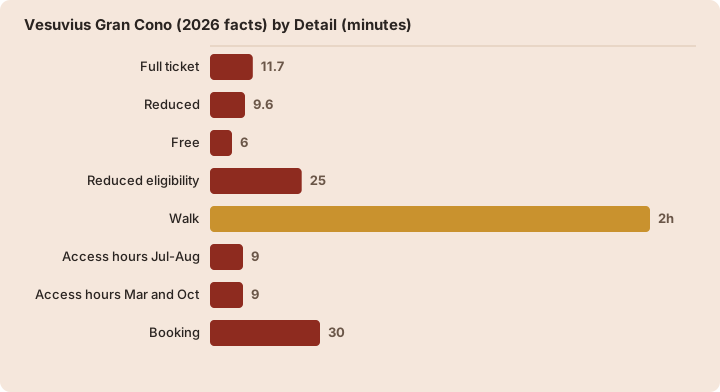
Yes, Vesuvius can be added to a Pompeii family day, with a short option of a two-hour return walk on the shortest Gran Cono route, tickets sold online only at EUR 11.68 full and EUR 9.55 reduced as sold, children under 6 free, and access hours that run 9:00-18:00 in July and August but only 9:00-15:00 in January, February, November and December. The crater trail is a gravel path with a steady climb, doable for children of about eight and up who are used to walking, ambitious below that. The full pairing plan, transport and all, lives on the Pompeii and Vesuvius in one day itinerary.
The ticketing has quirks worth knowing in advance. Vesuvius Gran Cono entry is online-only, released with 50 tickets per 10 minutes and bookable 30 days ahead, with 10 nominative last-minute tickets per slot from 30 minutes before, nominative since 11 April 2026. The path and ticket office close automatically on an orange weather alert or above, with automatic refunds when that happens, so a weather-driven cancellation is not a disaster, just a disappointment to pre-brief. Daily caps run between 2,160 and 3,240 depending on the month. The how to visit Mount Vesuvius guide carries the detail, and the Vesuvius crater trail page describes the walk itself.
| Vesuvius Gran Cono (2026 facts) | Detail |
|---|---|
| Full ticket | EUR 11.68 as sold (regulation base EUR 10) |
| Reduced | EUR 9.55 as sold (regulation base EUR 8) |
| Free | Children under 6 |
| Reduced eligibility | Under 25s and residents of the 13 Park municipalities |
| Walk | 2 h return shortest route, 3 h longest |
| Access hours Jul-Aug | 9:00-18:00 |
| Access hours Mar and Oct | 9:00-16:00 |
| Booking | Online only, 30 days ahead, nominative last-minute tickets |
What To Pack And What To Skip
Pack for Pompeii as for a hot, dusty hike: closed shoes with grip, one to two litres of water per person, sun hats and high-factor sun cream, snacks, a small first-aid patch kit for the inevitable stone-stubbed toe, and nothing in a bag bigger than 30x30x15 cm, because larger bags are turned away to left luggage. Sandles with smooth soles are the classic error: the basalt paving is polished by two millennia of feet and is slick when wet. The dedicated what to wear to Pompeii page covers clothing and footwear in detail, including the park rule against bare chests.
What to skip matters as much. Skip the suburban villas route on a first family visit; the Villa of the Mysteries is magnificent, but it adds distance and the Express ticket only reaches it with a EUR 8 add-on bought by card at the Porta Ercolano / Street of the Tombs entrance, an option for a second visit rather than a first. Skip the Praedia of Julia Felix, closed to the public since 7 September 2026 for maintenance with no reopening date. And skip any plan that strings Pompeii, Herculaneum and Vesuvius into a single day with children: the two days Pompeii, Herculaneum and Vesuvius itinerary exists precisely because the one-day version breaks families.
Skip, too, the temptation to see the plaster casts everywhere at once. The casts are powerful exactly once per visit; the Pompeii body casts page explains where they come from, and telling that story well at the Garden of the Fugitives beats hunting every display in the park. Children remember a story told by a parent at the right moment longer than any additional ruin.
Arriving By Train With Children
The family-friendly arrival is the Circumvesuviana line from Napoli Garibaldi to the Pompei Scavi-Villa dei Misteri station, a scheduled 29 to 35 minute run whose stop sits at the Porta Marina entrance, with no fare, frequency or first-hand comfort claim needed beyond that: the line's own timetable is the reference for the day. The station is stop 6049 on the EAV network, and the walk from platform to ticket office is short. Parents coordinating a broader rail trip should note that the Campania Express has been suspended since 1 October 2026 until further notice, so no plan should assume it.
Families arriving from Sorrento face a scheduled 34 to 40 minutes from Pompei Scavi in the other direction, and the Sorrento to Pompeii guide covers that corridor. Those starting in Rome should read the Rome to Pompeii day trip planning page, and the Naples to Pompeii guide handles the main inbound route including arrival from the cruise port, where the Pompeii cruise-ship day itinerary applies its own tighter clock.
| Arrival route | Scheduled time (EAV timetable data) | Arrives at |
|---|---|---|
| Napoli Garibaldi to Pompei Scavi | 29-35 min | Pompei Scavi-Villa dei Misteri, by Porta Marina |
| Sorrento to Pompei Scavi | 34-40 min | Same station |
| Pompei Scavi to Sorrento (return) | 34-40 min | Sorrento |
| Campania Express | Suspended since 1 Oct 2026 | Not operating |
One last logistics point: parking exists at the site edges for driving families, and the Pompeii parking page maps the options, while the site map of Pompeii page helps pre-visualise the route so children can be shown the plan before arrival, a small trick that measurably improves cooperation.
For families who would rather the whole day be someone else's problem, a guided pairing of ruins and volcano with lunch is the single most legible option in the roster below, alongside a Naples-skip-the-line day and a Rome departure for those basing in the capital.
Common Questions About Pompeii With Kids
Is Pompeii suitable for young children?
Partly. Under sixes manage 45 to 60 minutes on the "Pompeii for All" accessible route from Piazza Anfiteatro, while children of six and up can enjoy a two-hour highlights route. Entry is free for under 18s in 2026, so a short visit costs nothing beyond the day's logistics.
Is Pompeii free for children?
Yes. Everyone enters free on the first Sunday of the month, though the park has recorded more than 36,000 visitors on one free day, so families may prefer a paid, quieter date.
Can you take a pushchair into Pompeii?
Sturdy pushchairs work on the "Pompeii for All" accessible route, which starts at Piazza Anfiteatro and can exit at Piazza Esedra via the Antiquarium lift. Off that route the ancient paving stones and wheel ruts make carriers far easier than strollers for babies.
How long should a family spend in Pompeii?
About two hours for children of six to nine, covering the Forum, the baths, the bakery, a thermopolium and the Garden of the Fugitives. Families with teenagers can extend to three or four hours, or add Vesuvius, whose shortest crater route is a two-hour return walk.
Are there toilets and water at Pompeii?
Toilets sit near the main entrances and at the Antiquarium, and drinking fountains run at points around the site. Carry one to two bottles per person anyway, since shade is scarce in summer and the bag limit of 30x30x15 cm forces a light but deliberate pack.
What should children wear at Pompeii?
Closed shoes with real grip, because the basalt paving is polished and slick when wet, plus sun hats and sun cream. Bare chests are against the park regulations, and anything larger than a 30x30x15 cm bag goes to left luggage rather than through the gate.
A family day at Pompeii rewards the family that plans it as a short story rather than an encyclopedia: one entrance, one route, one meal afterwards in modern Pompei, and the volcano either in the view from the Forum or underfoot in the afternoon. Pack the water, respect the stones, and let the city do the rest.