Pompeii Exhibition
Pompeii artefacts have been travelling to museums outside Italy for generations, and touring shows of frescoes, casts and everyday objects still draw crowds far from Campania. This guide explains what actually leaves the park, what a Pompeii exhibition abroad can never reproduce, and how to plan a visit to the ancient city itself, about 24 km from Naples in southern Italy.
Short answer
Pompeii exhibitions abroad show frescoes, mosaics, household objects and body casts loaned mainly from Italian state collections. The archaeological park received 4,069,377 visitors in 2024 and limits entry to 20,000 a day. Tickets in 2026 run EUR 20 for the Express option to EUR 30 for three days, and a single EUR 25 ticket for all park sites starts on 1 January 2027.
Pompeii, the ancient Roman city buried by the eruption of Mount Vesuvius in AD 79, stands today as an archaeological park in Campania, southern Italy, beside the modern town of Pompei and about 24 km by road from Naples. Its artefacts, meanwhile, have long travelled far beyond Italy. Frescoes detached from walls, silver tableware, carbonised bread and the famous body casts have appeared in museums across Europe, North America and Asia, and touring shows marketed under the Pompeii name arrive somewhere in the world almost every year. This guide covers both halves of that story: what a Pompeii exhibition abroad can genuinely offer, and what it can never replace, a walk through roughly 44 hectares of excavated streets that UNESCO lists, with Herculaneum and Torre Annunziata, as a World Heritage property under criteria (iii), (iv) and (v).
Where Can You See Pompeii Artefacts Outside Italy?
The permanent home of the finest portable Pompeii finds is the National Archaeological Museum in Naples, and travelling exhibitions abroad draw on loans negotiated with Italian state collections, chiefly the Pompeii park and the Naples museum. No exhibition reproduces the site itself: the excavated city covers about 44 hectares within a 98 hectare inscribed property, and that scale stays in Campania. The park counted 4,069,377 visitors in 2024, a figure no hall of showcases can absorb.
A distinction matters before you buy any ticket. Objects excavated at Pompeii belong to the Italian state, and the park's own collection plus the Naples museum hold the core of them. Touring shows assembled abroad typically combine a handful of genuine loans, fresco panels, amphorae, tools, jewellery, with casts, replicas and reconstruction sets that fill the room. That is not a fraud: a well-labelled exhibition tells you which objects are original. But a visitor who arrives expecting a condensed Pompeii often leaves having seen a display case of small finds and a projected reconstruction of a villa.
The pattern is old. Detached frescoes and the earliest casts circulated through European capitals in the era of the Grand Tour, feeding the fascination that made Pompeii a fixture on that route. Modern loans are stricter, and fragile frescoes travel rarely. When a major show does move intact wall paintings, it usually draws on storage objects rather than stripping the site further. For the story of how the burial preserved these objects at all, the companion page on Pompeii history and the AD 79 eruption covers the sequence in detail, and the contested date of the eruption, traditionally 24 August, is examined on when Vesuvius erupted.
The site's pull keeps growing, which is part of why the loans matter to the park's finances and profile. Official visitor figures show the climb:
| Year | Pompeii site visitors | All park sites combined |
|---|---|---|
| 2022 | 2,972,159 | n/a |
| 2023 | 3,985,424 | 4,079,235 |
| 2024 | 4,069,377 | 4,177,753 |
| 2025 | 4,000,090 | 4,118,926 |
Why Do Frescoes And Mosaics From Pompeii Leave The Site?
Because the excavators of the past detached them. Frescoes and mosaics were physically removed from Pompeii's walls and floors during earlier phases of excavation and moved into museum storage in Naples, and it is those stored panels, not the walls still standing in the park, that Italian authorities can lend abroad. What remains in situ at Pompeii stays there: the park does not send its standing architecture anywhere, and a plaster wall cannot be packed into a crate.
The practice reflects a conservation philosophy that has changed completely. Archaeology in earlier periods prioritised recovery of art objects; a painted wall was a container to be emptied. Today the park's approach inverts that logic, stabilising walls where they stand and, in several houses, returning copies to the original position while the originals rest in controlled conditions. A visitor walking the Villa of the Mysteries sees its famous frieze exactly where the Dionysian scenes were painted, which is the single experience no travelling show can stage.
This is also why exhibition catalogues matter more than usual. A well-researched show reconstructs provenance: which house an object came from, when it left the ground, where it has been stored since. The honest framing here is simpler than any marketing: the object list, not the banner, tells you whether a show is a loans exhibition or a themed experience. Where you want depth rather than breadth, an archaeologist-led walk of the site itself goes further than any glass case; the option below is the one this site features.
Between the site and the showcase sits a third category: the body casts. The plaster forms of victims and of a dog, made by pouring plaster into voids left in the ash, are the most requested loans in the park's collection, and some casts have travelled to exhibitions abroad. The ethical framing has shifted over the decades, from spectacle toward memorial, and modern shows generally present them that way. The full story of how the casts were made and where they came from is on the Pompeii body casts explained page.
Which Objects Travel And Which Never Leave Pompeii?
Portable finds travel: tableware, coins, jewellery, surgical tools, carbonised food, loaves of bread, amphorae and detached fresco or mosaic panels from storage. What never leaves: standing architecture, in situ wall paintings, the streets themselves, the garden sites, and the suburban villas along the Street of the Tombs. The park's entrance points, Porta Marina, Piazza Esedra and Piazza Anfiteatro, control access to all of it, and no exhibition replaces a ticket through them.
A practical sorting helps set expectations before you book anything:
| Category | Travels abroad? | Typical form in an exhibition |
|---|---|---|
| Detached fresco panels | yes, rarely and under strict conditions | single walls in climate-controlled crates |
| Mosaics removed in the past | yes | floor sections mounted upright |
| Household objects, tools, coins | yes | display cases by theme |
| Carbonised food, bread, wood | yes, in sealed cases | small finds |
| Body casts | selected loans | central gallery, memorial framing |
| Standing houses and streets | never | photographs, projections, replicas |
| In situ decoration | never | shown as film or facsimile |
The gap between the two columns is the honest sales pitch for going to Campania yourself. A projection of the House of the Faun's Alexander mosaic is impressive on a ten-metre screen; the real floor was designed to be seen from the doorway of the house, at a distance and angle the architect calculated. Scale, light and sequence, walking from the dark entrance corridor into the atrium's opening to the sky, are architectural effects, and architecture does not travel. Whether an in-person visit rewards the journey is a fair question, and the site's own page on whether Pompeii is worth visiting weighs it directly.
If you decide the site is the main event, an archaeologist-led small group walk is the strongest format for reading it. One option is featured here, with entry handled skip-the-line:
How Do You Plan A Trip Around The Pompeii Park In Italy?
Fly into Naples, reach the modern town of Pompei by the Circumvesuviana railway to the Pompei Scavi-Villa dei Misteri station, and enter at Porta Marina, Piazza Esedra or Piazza Anfiteatro. The park caps entry at 20,000 visitors a day, tickets are nominative, and ID may be checked at every entry. Pompeii has no weekly closing day; it closes only 25 December and 1 January unless the park communicates otherwise.
Planning data first, feelings later. The time-slot system splits the day into two bands:
| Time band (16 Mar to 14 Oct 2026) | Max visitors | Express allocation | Plus allocation |
|---|---|---|---|
| 9:00-13:00 | 15,000 | 12,000 | 3,000 |
| 13:00-17:30 | 5,000 | 3,000 | 2,000 |
The afternoon band is the quieter one by design, and last entrance in the summer season is 17:30 with closure at 19:00. From 15 October to 15 March the park opens at 9:00, takes its last entrance at 15:30 and closes at 17:00. Two seasonal rhythms matter more than legend suggests. Rain in Pompei is heaviest in November, averaging about 180 mm across the 1991-2020 normals, and lightest in July at about 16 mm; August has the highest mean daily maximum at about 29.4 C. The full picture is in Pompeii weather and the best time to visit.
Getting there is covered in dedicated pages: the Circumvesuviana train explained for the railway from Naples, the Naples to Pompeii route for the capital region, Sorrento to Pompeii from the peninsula, the Amalfi Coast to Pompeii journey for coastal bases, and the Rome to Pompeii day trip and Rome to Pompeii by train pages for the long haul from the capital. Where to sleep is covered in where to stay in Pompei, and the broader decision between a guide and going alone in guided tour versus self-guided.
One transport fact deserves a flag because it changes plans silently: the Campania Express service has been suspended since 1 October 2026 until further notice. Anyone holding an old itinerary that assumes that train should check the operator's own page before travelling, and refunds are handled through the operator's complaints form or the original seller.
What Can A Pompeii Exhibition Abroad Never Show You?
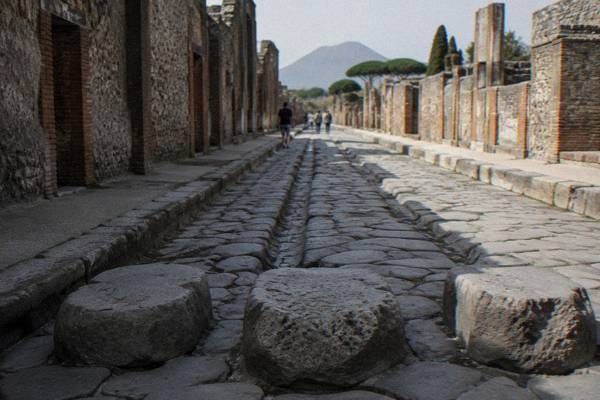
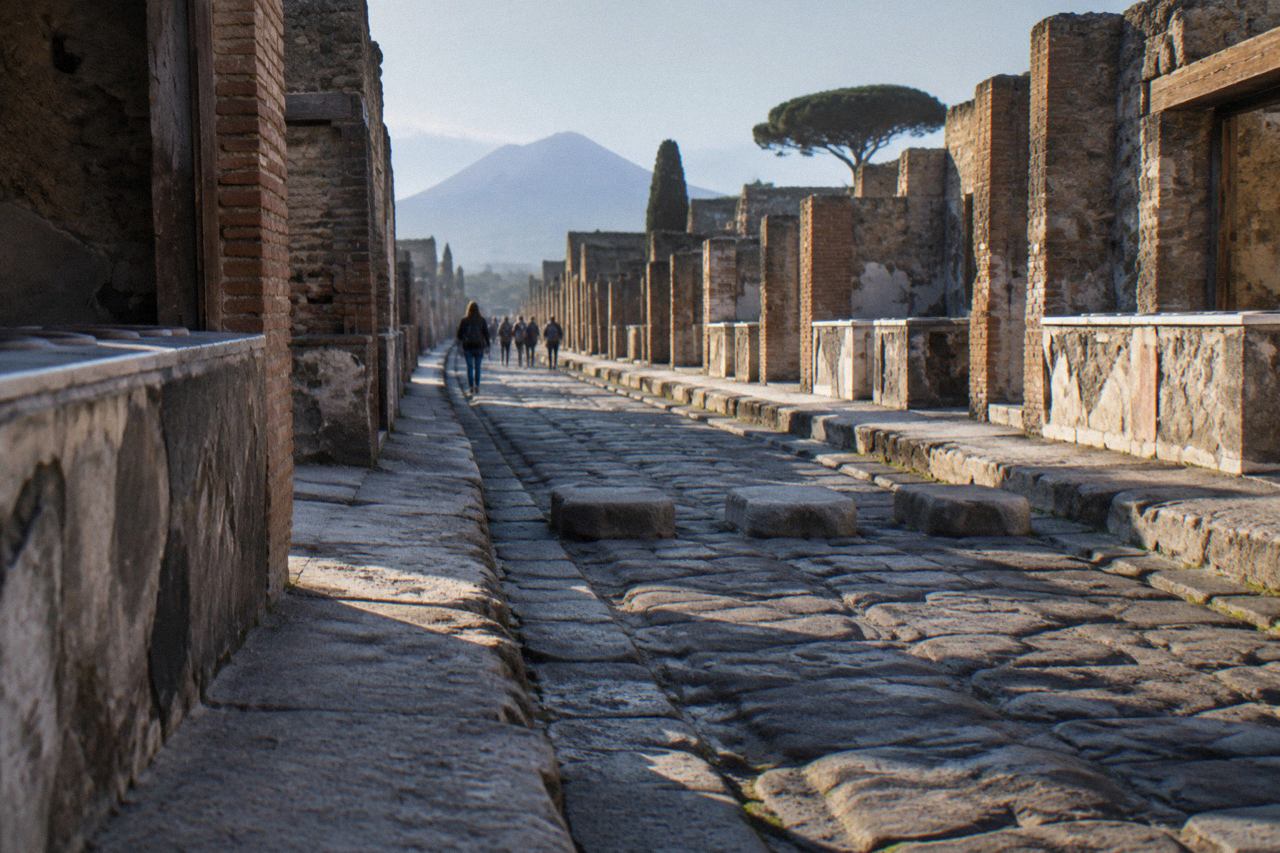
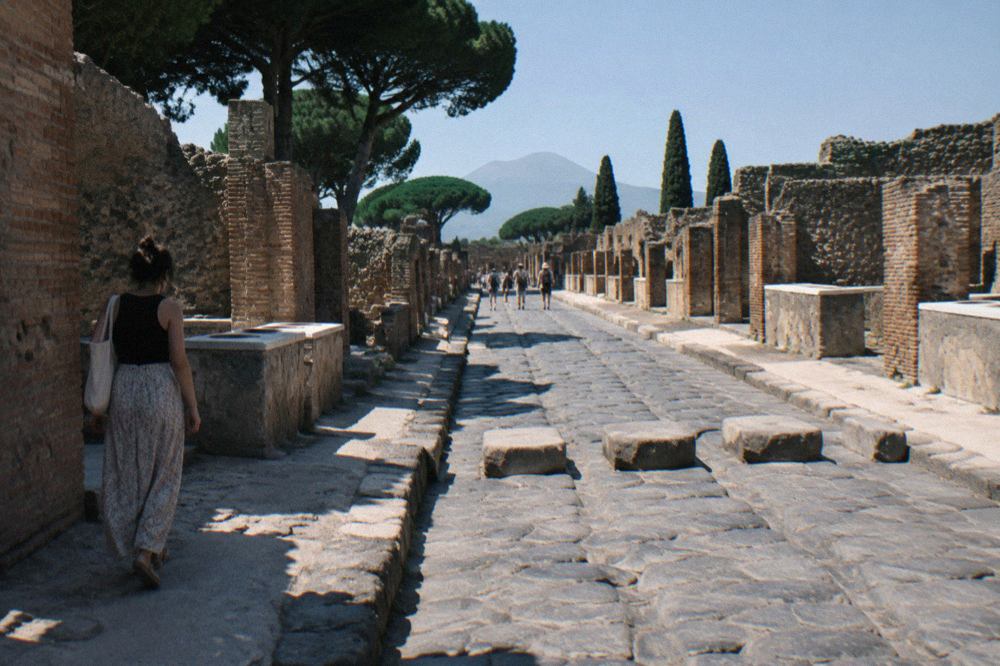
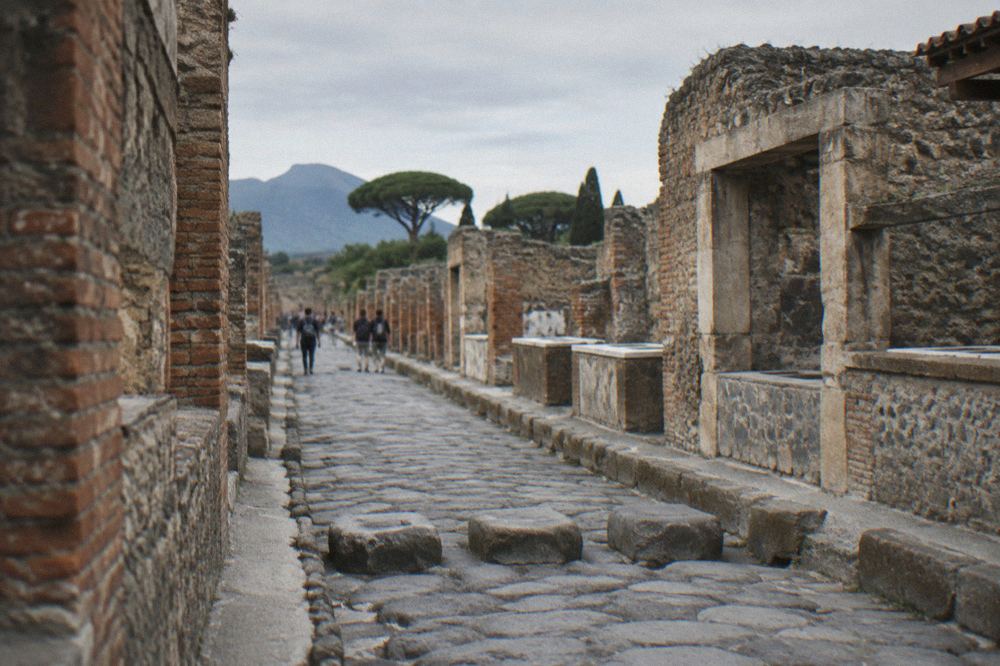
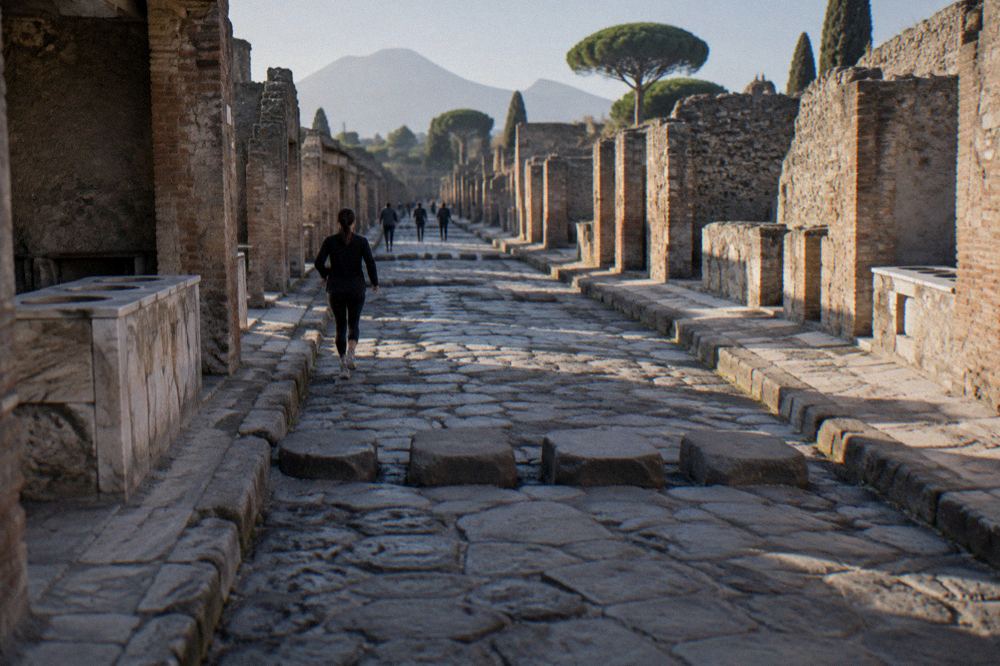
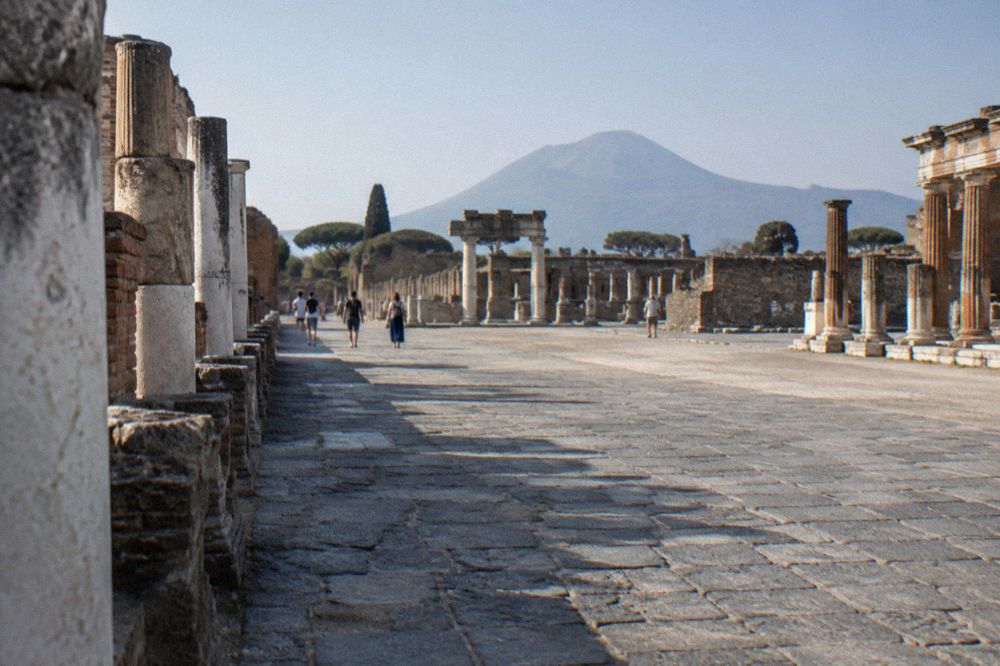
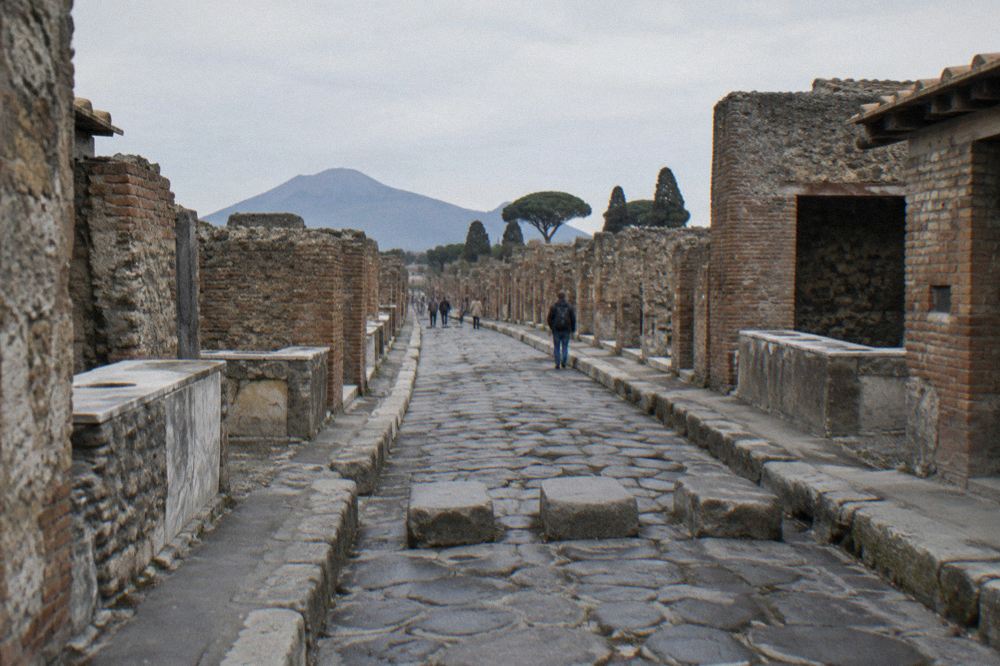
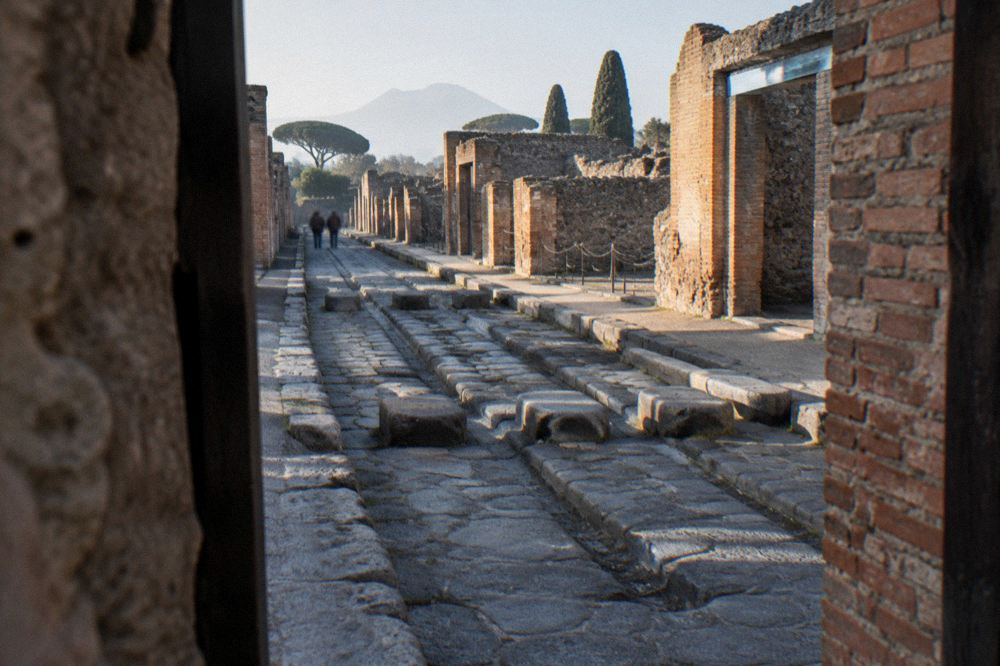
The street network, the scale and the atmosphere. An exhibition can show a fresco, a coin, a cast; it cannot show the moment a visitor steps from the roar of the Forum into a silent alley, or follows the worn ruts of cart wheels down a Roman road toward the amphitheatre. The excavated area of about 44 hectares is a city, with intersections, fountains, stepping stones and shaded corners, and a city is the one exhibit that cannot be crated.
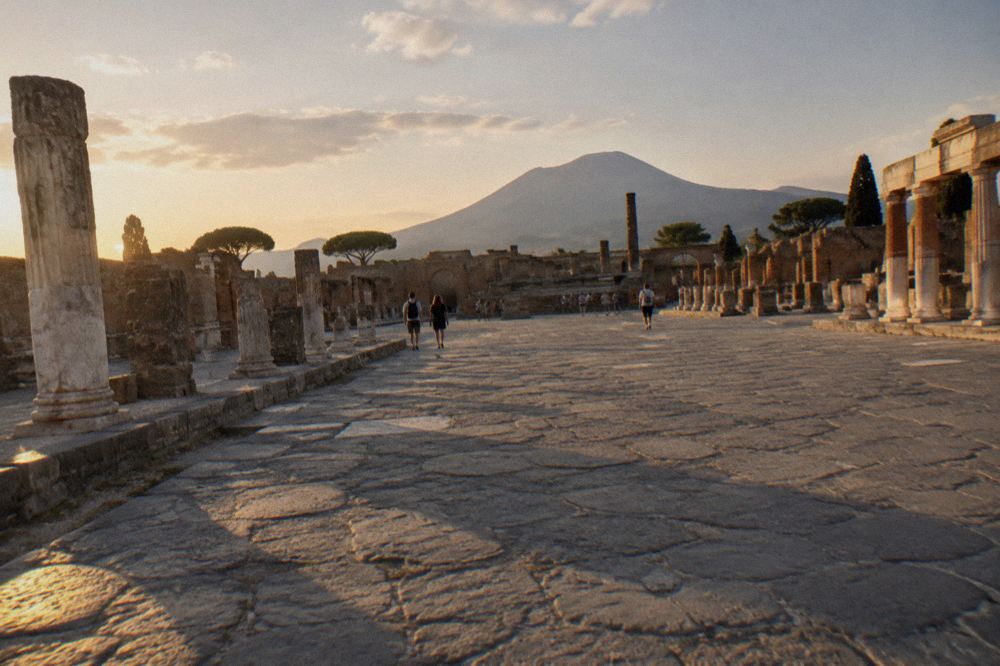
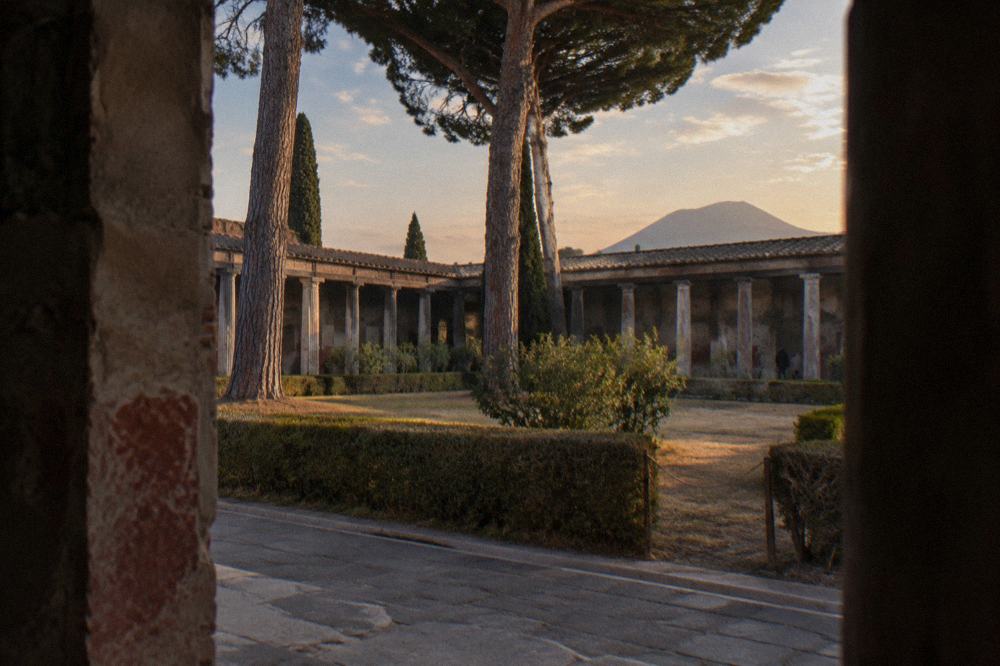
Three specific losses are worth naming. First, adjacency: in the park, a thermopolium stands next to a house, which stands next to a bakery, and daily life reads as a street scene rather than a vitrine. Second, weather and light: the same garden looks like two different places at 9 am and 5 pm, and seasonal change is part of the site's effect. Third, the presence of Vesuvius on the skyline, the cause of everything, visible from inside the ruins.
| Experience | Travelling exhibition | Archaeological park |
|---|---|---|
| Original small finds | yes | some in the Antiquarium |
| In situ frescoes | no | yes |
| Body casts | selected loans | yes |
| Walking a Roman street | no | yes |
| Vesuvius on the skyline | no | yes |
| Climate control and seating | yes | no, open air |
| Time needed | about 1-2 hours in a hall | half a day or more |
That last row cuts both ways. An exhibition is a comfortable, weatherproof, wheelchair-friendly hour; the park is a demanding half-day on uneven stones in the open. Footwear and water are the two consistent recommendations, and the site's planning pages treat them at length. For depth on one route that no show reproduces, the suburban villas, the Villa of the Mysteries guide is the reference.
What Do Pompeii Tickets Cost In 2026 And In 2027?
In 2026 the park sells three tickets: Pompeii Express at EUR 20 for the ancient city only, Pompeii+ at EUR 25 adding the suburban villas and Boscoreale, and a 3-day ticket at EUR 30 covering Oplontis and the Stabiae sites too. From 1 January 2027 this structure ends: one EUR 25 ticket covers every park site, valid 30 days, one entry per site. Oplontis, Stabiae and Boscoreale stay EUR 8 individually, and the My Pompeii Card stays EUR 45.
The full 2026 structure, verified on the park's own ticketing pages:
| 2026 ticket | Price | Covers |
|---|---|---|
| Pompeii Express | EUR 20 | ancient city only |
| Pompeii+ | EUR 25 | city, suburban villas, Villa Regina, Antiquarium Boscoreale, shuttle |
| 3-day ticket | EUR 30 | Pompeii+ plus Oplontis, Villa Arianna, Villa San Marco, Stabiae museum, Boscoreale |
| Oplontis / Stabiae museum / Boscoreale | EUR 8 each | single site |
| My Pompeii Card (annual) | EUR 45, EUR 10 reduced | annual pass |
| Suburban villas add-on for Express holders | EUR 8 | at the Porta Ercolano / Street of the Tombs entrance, card payment only |
Reductions are narrow and generous where they apply: free for everyone under 18 and for all visitors on the first Sunday of the month, EUR 2 for EU citizens aged 18 to under 25. Express holders who decide at the gate that they want the suburban villas route can add it for EUR 8, by card only, at the Porta Ercolano / Street of the Tombs entrance. The change coming on 1 January 2027, announced by the park on 14 September 2026, keeps nominative tickets and the 20,000 daily cap; it simplifies everything else. Every figure above belongs to the park's own pages, and the detailed companion guide on Pompeii ticket options walks through choosing between them.
When Is The Best Time To See Pompeii Itself?
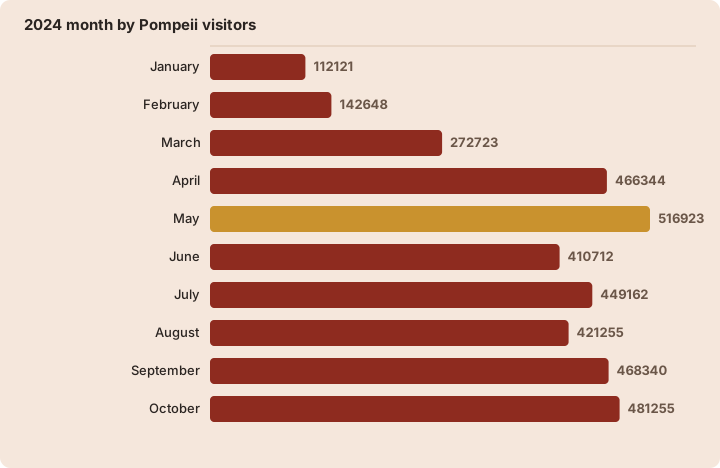
Spring and autumn, with April, May and October as the standout months. The park's own monthly figures for 2024 show May as the busiest month at 516,923 visitors, while November recorded 189,866 and December 138,028. Rain peaks in November at about 180 mm per the 1991-2020 normals, and August heat averages about 29.4 C in daily maximum, so the shoulder seasons balance crowds, weather and opening hours better than any other window.
The monthly spread tells the story plainly:
| 2024 month | Pompeii visitors |
|---|---|
| January | 112,121 |
| February | 142,648 |
| March | 272,723 |
| April | 466,344 |
| May | 516,923 |
| June | 410,712 |
| July | 449,162 |
| August | 421,255 |
| September | 468,340 |
| October | 481,255 |
| November | 189,866 |
| December | 138,028 |
September and October hold visitor numbers close to the May peak but with milder normals: October averages about 21.3 C in daily maximum against August's 29.4 C. February is the quietest full month, and its normals, about 12.6 C by day and 6.5 C by night, make it viable for anyone dressed for it, with the short winter hours, last entrance 15:30, as the real constraint. Anyone combining the park with the volcano should also check how to visit Mount Vesuvius, since the crater's access hours shift by month and its timed tickets sell online only.
Should You Combine A Pompeii Tour With The Exhibition Habit?
Yes, if the tour starts from where you actually are. Travellers based in Naples have small-group two-site and three-site options that pair Pompeii with Herculaneum or Vesuvius in a single day; travellers based in Rome need a full day, roughly twelve hours door to door, and should pick a tour with transport included. The site's featured walk, an archaeologist-led small-group tour with skip-the-line entry, suits visitors already in or near Pompei.
The decision map is short. From Sorrento, the express train-and-tour options in Pompeii tours from Sorrento fit a morning in the ruins around an afternoon on the coast. From Rome, the pages on tours from Naples and the Rome routes above carry the detail. Cruise passengers have their own timing constraints, handled in Pompeii shore excursions.
Common Questions About Pompeii Exhibitions Abroad
Are Pompeii exhibitions abroad worth seeing?
Yes, as a complement rather than a substitute. A good loans exhibition displays original frescoes, mosaics and everyday objects in climate-controlled conditions, with labelling that explains provenance. It cannot reproduce the roughly 44 hectares of excavated streets, the in situ decoration or Vesuvius on the skyline, so treat it as preparation for the park rather than a replacement.
Do Pompeii body casts travel to exhibitions?
Selected casts do travel, and they are among the most requested loans from the park's collection. Modern exhibitions generally present them in a memorial framing rather than as spectacle. The story of how the casts were made, and where they can be seen, is covered on the site's body casts page.
Where are the real Pompeii artefacts kept?
The core collections are held in Italy by the archaeological park itself and by the National Archaeological Museum in Naples. Objects excavated at Pompeii belong to the Italian state, and loans abroad are negotiated with those institutions, which is why travelling shows mix genuine loans with replicas and reconstructions.
Can an exhibition abroad replace visiting Pompeii?
No. The park is an entire city: an excavated area of about 44 hectares within a 98 hectare World Heritage property, entered at Porta Marina, Piazza Esedra or Piazza Anfiteatro. Walking its streets, stepping stones and houses is an architectural experience that no hall of display cases can stage.
Do I need a ticket for Pompeii if I have seen an exhibition?
Yes, entry to the archaeological park always requires its own ticket. In 2026 that means the EUR 20 Express, EUR 25 Pompeii+ or EUR 30 three-day option, and from 1 January 2027 a single EUR 25 ticket covering all park sites. Entry is free for under 18s and for everyone on the first Sunday of the month.
How crowded is Pompeii compared with an exhibition?
The park capped daily entry at 20,000 visitors when nominative tickets were introduced on 15 November 2024, with 15,000 allocated to the morning band and 5,000 to the afternoon. The site received 4,069,377 visitors across 2024, so an off-peak month or an afternoon slot is the quietest way in.
For travellers who catch a Pompeii exhibition abroad first, the usual result is the itch to see the source. That instinct is sound. The exhibition teaches you what the objects were; the park teaches you where they lived. Together they make the strongest case there is for the journey to Campania, and this Pompeii Travel Guide exists to make that journey straightforward, from tickets and trains to the streets themselves.