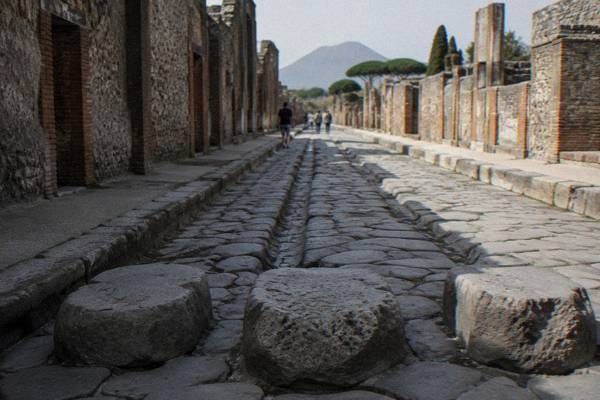
Palaestra Pompeii
The Large Palaestra is Pompeii's big open-air exercise ground, sitting beside the amphitheatre in the eastern half of the ancient city in Campania, southern Italy, about 24 km by road from Naples.
Short answer
The Large Palaestra (Palestra Grande) is a colonnaded exercise ground in the eastern part of Pompeii, next to the amphitheatre and reached most easily through the Piazza Anfiteatro entrance. A 2026 Pompeii Express ticket costs EUR 20 and covers it. It lies on the park's accessible 'Pompeii for All' route, which enters at Piazza Anfiteatro.
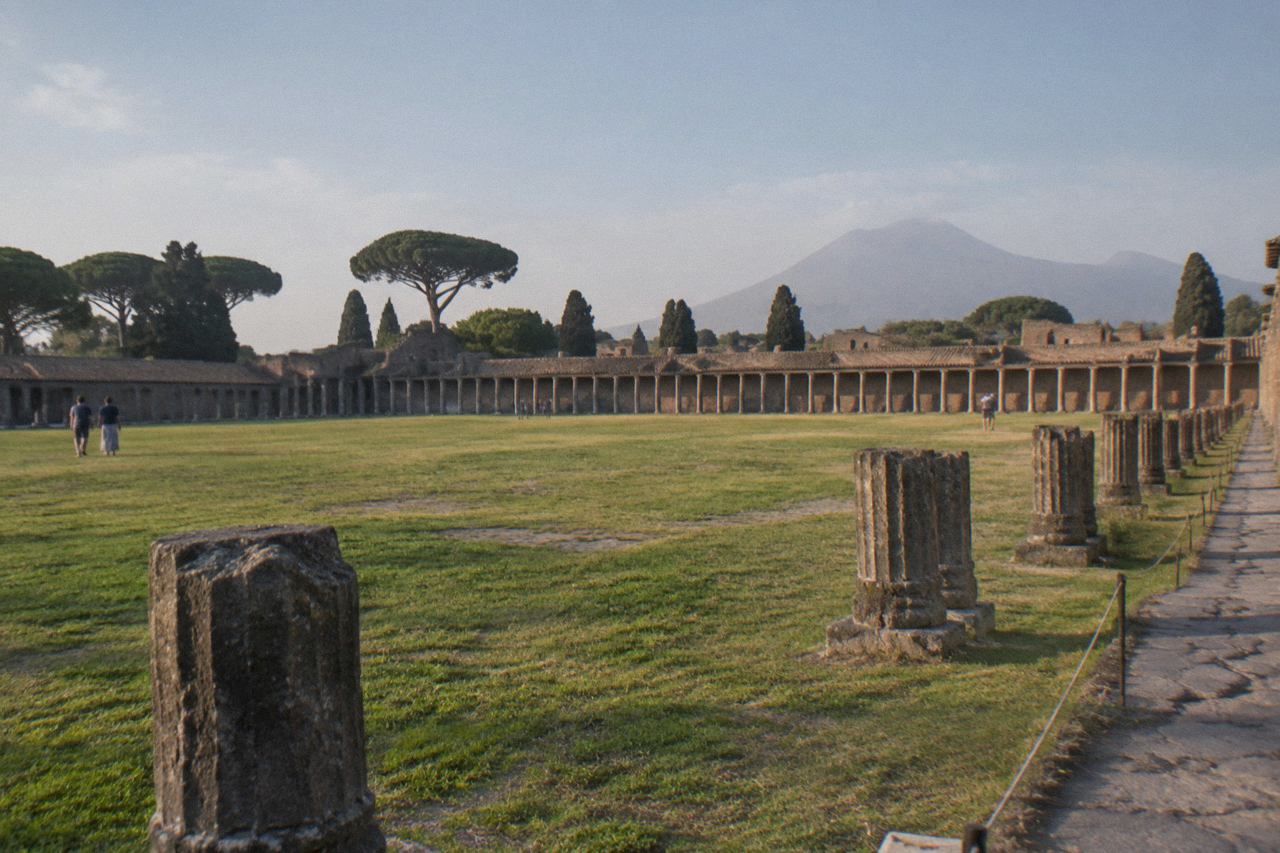
The Large Palaestra of Pompeii is a vast rectangular exercise ground edged by porticoes, standing in the eastern half of the ancient Roman city buried by the eruption of Mount Vesuvius in AD 79, in Campania, southern Italy, beside the modern town of Pompei and about 24 km by road south-east of Naples. Today it forms part of the Parco Archeologico di Pompei, a short walk from the amphitheatre, and its open field, tree-shaded perimeter and central basin make it one of the quietest and pleasantest spaces in the whole excavated area. This guide sets out what the palaestra was, exactly where it sits, which ticket covers it under the 2026 pricing, and how to fold it into a route through the eastern city.
What Is The Large Palaestra In Pompeii?
The Large Palaestra in Pompeii is a spacious athletic ground that served the training and social life of the city's youth rather than spectacle or commerce. That role shaped its location, placing it away from the forum and beside the amphitheatre at the city's eastern edge.
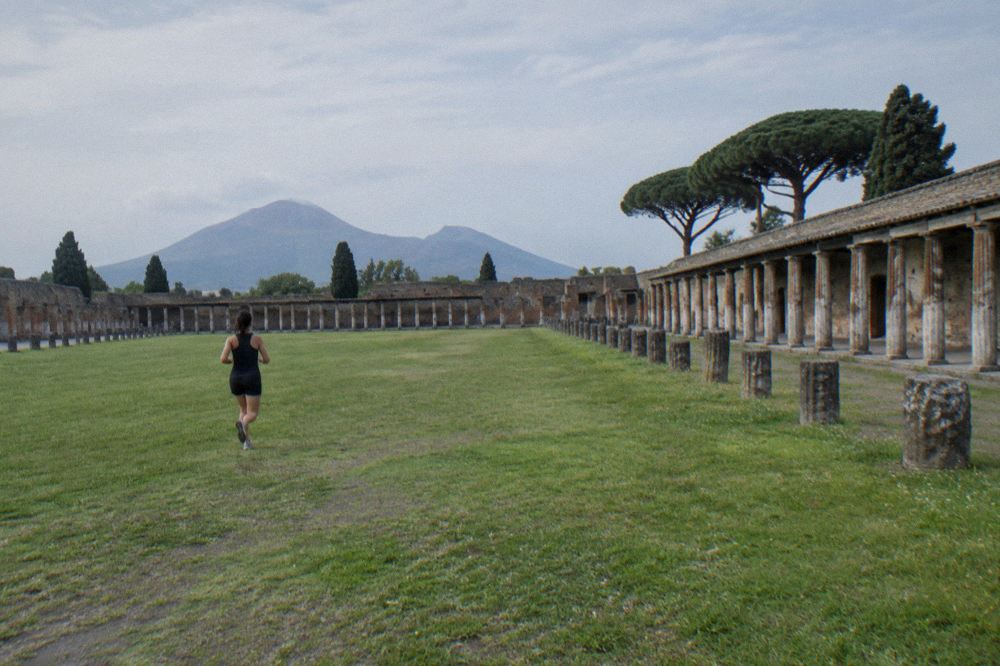
A palaestra, in the Roman world, was a wrestling and training courtyard. The word itself is Greek, and the building type travelled from Greek gymnasia into Roman towns. Pompeii's version is unusually generous in scale: a full field of open ground, not a cramped courtyard tucked behind baths. The portico that rings it gave runners and wrestlers a covered strip for exercise in rain or strong sun, and the central pool, rectangular and stepped, held water for washing after training. A large plane tree stands beside the basin, and the roots of others remain visible in the ground, evidence that the enclosure was planted deliberately, a green space in a dense city.
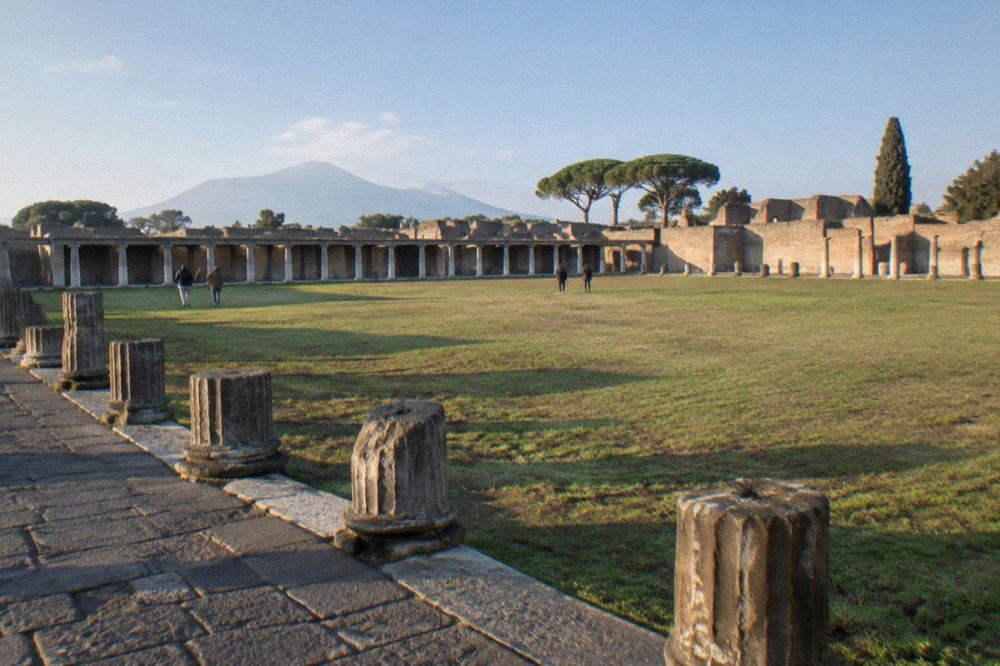
Visitors arriving today find the space functioning almost as the park's biggest open room. After the narrow streets and roofless houses of the central city, the palaestra reads as airy and calm. The surrounding colonnade is partly reconstructed, and the contrast between the tall columns, the flat green field and the distant shoulder of Vesuvius makes it a favourite stopping point on an eastern loop. For anyone interested in how Romans of the town kept fit, gathered and taught their children, this building answers the question more directly than any single house does.
The building sits in a sporting quarter.
Where Is The Palaestra Inside The Archaeological Park?
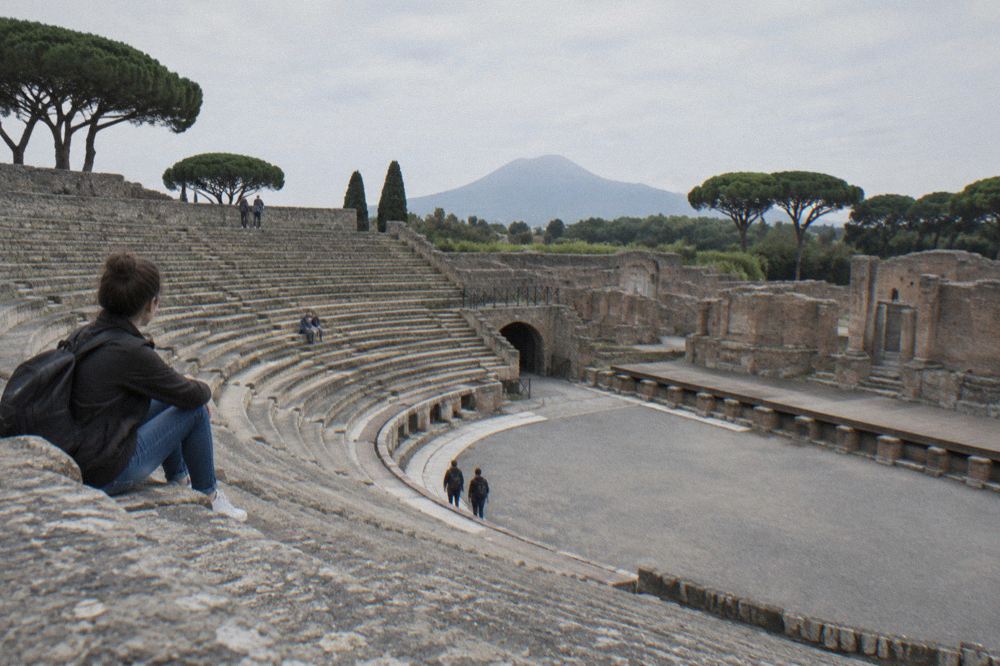
The Large Palaestra stands in the eastern part of the excavations, directly beside the amphitheatre and close to the Piazza Anfiteatro entrance, one of the park's three ticket offices. From Piazza Anfiteatro it is the nearest major monument after the amphitheatre itself, which makes it far easier to reach from that side than from Porta Marina, the western entrance that the Circumvesuviana station serves.
The park's three ticket offices sit at Porta Marina, Piazza Esedra and Piazza Anfiteatro. Travellers arriving by train at Pompei Scavi-Villa dei Misteri normally enter at Porta Marina, on the opposite, western side of the city, and face the longest walk to the palaestra. Travellers coming from the modern town, from a coach drop-off or from the Piazza Anfiteatro car park can start at the eastern end and meet the palaestra within minutes. The park's own map of entrances, routes and monuments is collected on the Pompeii map page, which is the practical companion to this guide.
For orientation, the sequence of major monuments along the eastern side runs amphitheatre, then palaestra, then the Sarno Baths area, with the Great Theatre further west. A visitor working from east to west can begin with the palaestra when the morning is still cool and finish at the forum and Porta Marina for exit. The reverse order is the one the train-borne crowd naturally follows, and it is one reason the palaestra is calmer in the morning than the forum will ever be.
Several bookable products reach this part of the park comfortably, and a small-group walk with an archaeologist is the format that suits the eastern city well, because the open ground and the amphitheatre reward explanation rather than silent viewing.
Each of those three serves a different plan: a small-group archaeologist walk of Pompeii itself, a ticket-and-digital-guide product for the villa at Oplontis if the wider park interests you, and a combined day from Naples that pairs Pompeii with Mount Vesuvius and lunch. The operator's live listing carries the current price, dates and cancellation terms for each.
Which Pompeii Ticket Covers The Palaestra In 2026?
In 2026 the Large Palaestra is covered by every ticket that enters the ancient city: the Pompeii Express ticket at EUR 20, the Pompeii+ ticket at EUR 25, and the 3-day ticket at EUR 30. Entry is free for everyone under 18 and for all visitors on the first Sunday of the month, and EU citizens aged 18 to under 25 pay a reduced EUR 2. These prices are in force only until 31 December 2026.
That is the essential pricing picture, and it comes with a dated warning. The park announced on 14 September 2026 that from 1 January 2027 the Express, Pompeii+ and 3-day structure is replaced by a single EUR 25 ticket covering all park sites, valid 30 days, with one entry per site. The smaller outlying sites, Oplontis, the Stabiae museum and Boscoreale, stay EUR 8 each, and the MyPompeii annual card stays EUR 45. Nominative tickets and the 20,000 visitors-per-day cap are retained. Anyone comparing a 2026 guide with a 2027 one will see different numbers, and the difference is real, not an error.
| Ticket (2026, until 31 Dec) | Price | What it covers |
|---|---|---|
| Pompeii Express | EUR 20 | The ancient city, including the palaestra |
| Pompeii+ | EUR 25 | City plus suburban villas route, Villa Regina and Antiquarium Boscoreale, shuttle |
| 3-day ticket | EUR 30 | Pompeii+ plus Oplontis, Stabiae villas and museum, Boscoreale |
| Other park sites individually | EUR 8 | Boscoreale, Oplontis or the Stabiae museum |
| MyPompeii Card (annual) | EUR 45 | Annual access, EUR 10 reduced |
| First Sunday of the month | Free | Everyone, collected under the Domenica al Museo scheme |
Tickets are nominative, tied by name to the holder, and identification may be checked at entry. They are non-transferable and non-refundable except in cases of extraordinary closure. The 20,000-per-day cap has applied since 15 November 2024, and during the 16 March to 14 October season the park splits entries into time bands: up to 15,000 people between 9:00 and 13:00 and up to 5,000 between 13:00 and 17:30. Buying ahead through the official ticketing channel therefore matters most for a morning entry in that season.
If the ticket landscape feels dense, the site's dedicated Pompeii ticket guide works through every combination, including the free first-Sunday scheme and the reduced fares, in one place.
For the palaestra specifically, no upgrade is ever needed: it is part of the core ancient-city entry. The choice of Express, Plus or 3-day turns entirely on whether the suburban villas near the Porta Ercolano and Street of the Tombs entrance or the outlying villas of the wider park are on your plan, as the villa of the Mysteries and Oplontis pages describe.
What Will You See At The Large Palaestra?
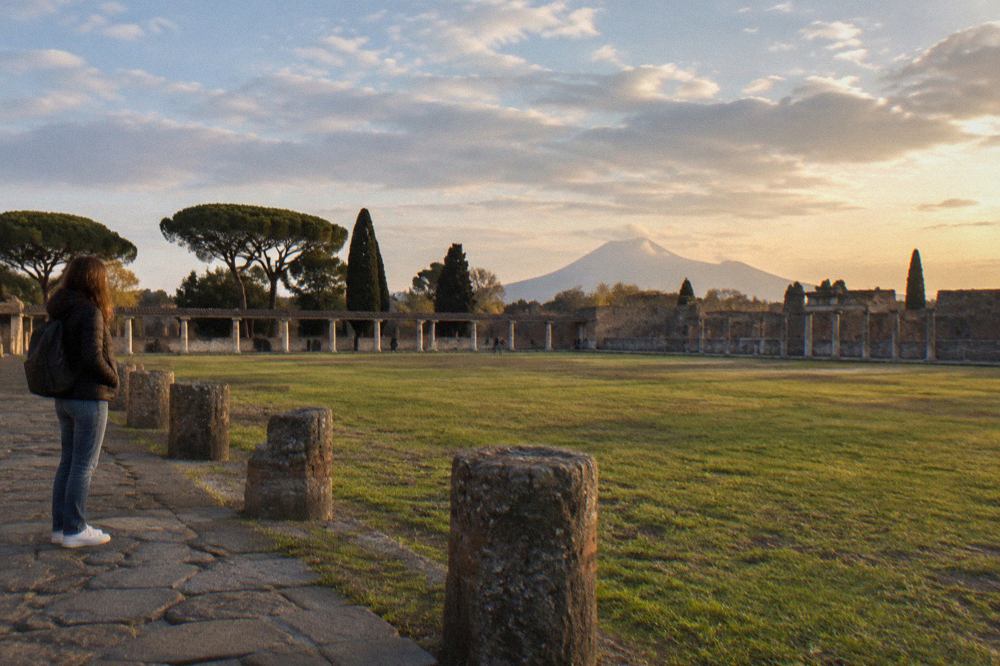
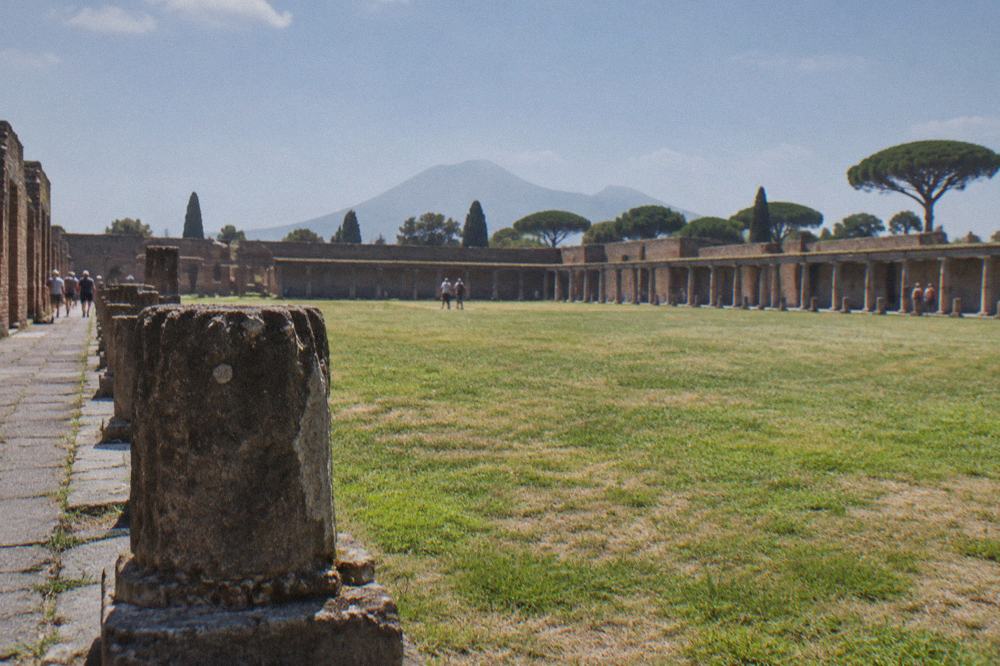
Visitors see a vast rectangular enclosure framed by porticoes on all four sides, a stone-lined central basin, bench seating along the inner colonnade, and the roots and stumps of the plane trees that once shaded the training ground. The scale is the point: the field reads as a public park, and the surrounding columns and the stepped basin are the two features everyone stops to photograph.
Walk the perimeter under the colonnade first. The covered walkway gives the clearest sense of the building's function, a sheltered lap for running and calisthenics, and from its corners the whole geometry of the court resolves at once. The columns are substantial, the spacing regular, and reconstruction work means some stretches read cleaner than the battered street-fronts elsewhere in the city. Benches run along sections of the inner wall, and their placement beside the exercise strip tells you where trainers and spectators sat.
The central basin is the second focal point. Rectangular, stepped and lined in stone, it once held the water that trainees used for washing, in an era when the palaestra's bath facilities were the practical partner to exercise. Today it stands dry, and its crisp outline against the flat field is what distinguishes the palaestra visually from every other open space in Pompeii. Beside it, the plane tree and the visible root hollows of earlier trees show that shade was designed into the enclosure from the start.
Interpretation on site is limited, and the open ground invites questions that a bare visit leaves unanswered: who trained here, at what ages, under whose supervision, and how the space related to the neighbouring amphitheatre. A guided format answers those questions on the spot. The skip-the-line archaeologist-led tour of Pompeii is one such product, covering the city's monuments with an archaeologist as guide, and it can be checked on the operator's live listing alongside the site's own tour page at skip-the-line archaeologist tour.
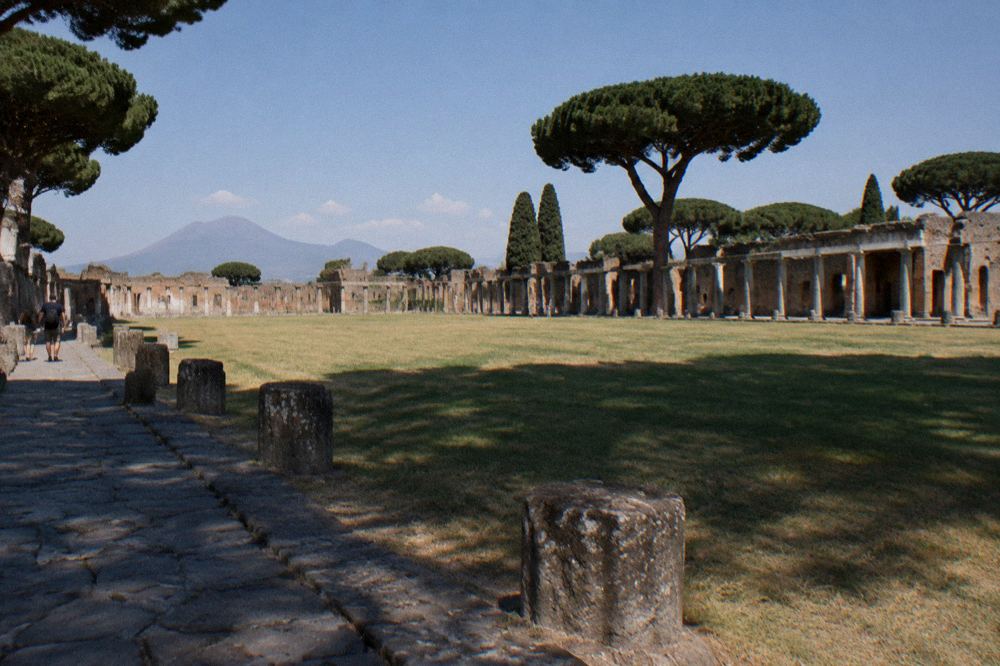
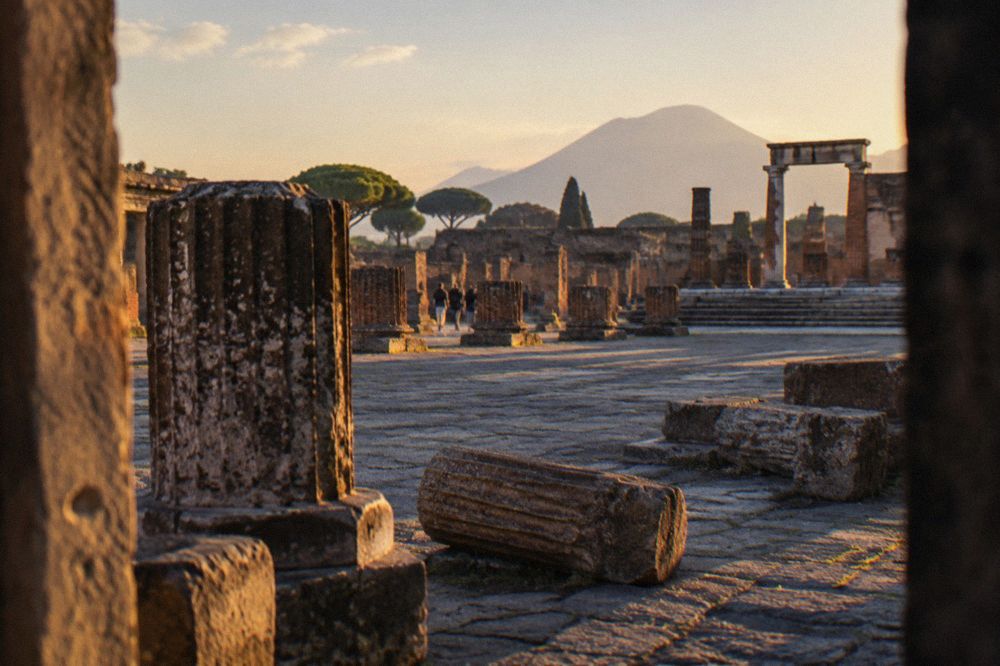
Photographically, the enclosure rewards early or late light, when the colonnade throws long shadows across the field and Vesuvius rises behind the eastern wall. Midday flattens the space, and in summer the shade of the portico and the plane tree becomes the difference between a pleasant stop and an overheated one, a point the summer heat plan for Pompeii treats in full.
How Does The Palaestra Fit A Half-Day Or Full-Day Route?
For a half-day visit, the palaestra anchors an eastern loop entered at Piazza Anfiteatro: amphitheatre, palaestra, then west through the Sarno Baths area to the Great Theatre and Odeon before exiting. For a full day, the same eastern start continues west through the forum and ends with the suburban villas, or pairs Pompeii with Vesuvius in a single combined day booked from Naples.
The eastern entrance changes the shape of a visit. Entering at Piazza Anfiteatro puts the two big eastern monuments, the amphitheatre and the palaestra, in the first hour, when legs are fresh and light is low. The route then runs naturally westward. A half-day version follows the line of monuments to the Great Theatre and Odeon and exits. A full-day version continues to the forum, the baths and the celebrated houses, then, if the ticket is Pompeii+ or a 3-day, finishes at the Porta Ercolano and Street of the Tombs entrance for the suburban villas route, which an Express holder can add on site for EUR 8.
| Route | Entrance used | Key stops | Suits |
|---|---|---|---|
| Eastern half-day | Piazza Anfiteatro | Amphitheatre, palaestra, Sarno Baths area, Great Theatre and Odeon | Train day-trippers wanting depth over coverage |
| East-to-west full day | Piazza Anfiteatro, exit Porta Marina | Eastern loop plus forum, baths, major houses | First visit with a full day |
| City plus villas | Any, villas via Porta Ercolano | Core city plus suburban villas route | Pompeii+ and 3-day holders |
| Pompeii plus Vesuvius | Organised day trip from Naples | City highlights plus the crater trail | Visitors pairing the city with the volcano |
The amphitheatre next door deserves its own stop, and the site's Pompeii amphitheatre guide covers it, including how the two buildings worked as a pair, spectacle beside training. Further west, the Garden of the Fugitives and the great houses such as the House of the Faun carry the emotional weight of the city, and pacing matters: the palaestra is best placed early, as open ground that needs no reading of frescoes or mosaics, while the houses are better with remaining attention.
One refinement worth considering on the full route is the Villa of the Mysteries, at the far western suburban end. A dedicated longer walk with an archaeologist covers the villa and its famous fresco cycle, and it pairs naturally with an eastern start because the two ends of the park balance each other across the day.
When Is The Best Time Of Day And Year To Visit The Palaestra?
The palaestra is best visited early in the day and outside the summer peak: opening is 9:00 year-round, and from 16 March to 14 October the last entrance is 17:30 with closing at 19:00, while from 15 October to 15 March the last entrance is 15:30 with closing at 17:00. Morning light suits the colonnade, and July and August, with mean daily maxima of about 28.7 and 29.4 degrees, are the hardest months for open ground.
The hours deserve precision because they shift with the seasons. In the summer timetable the park runs 9:00 to 19:00; in the winter timetable it runs 9:00 to 17:00 with the earlier last entry. Pompeii itself has no weekly closing day, and the site closes only 25 December and 1 January unless otherwise communicated. That makes the palaestra reachable on any day of a Campanian week, unlike the outlying villas at Oplontis and Stabiae, which the park marks as closed on Tuesdays.
| Season | Opens | Last entrance | Closes |
|---|---|---|---|
| 16 March to 14 October | 9:00 | 17:30 | 19:00 |
| 15 October to 15 March | 9:00 | 15:30 | 17:00 |
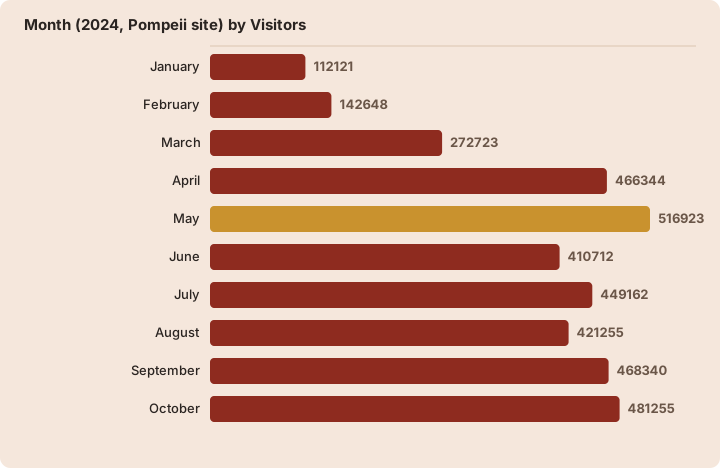
Crowding follows the time bands described earlier, with the morning band the busier one, and follows the calendar too. The park's own monthly figures for 2024 show the quietest months as January with 112,121 visitors and December with 138,028, against May's 516,923 and September's 468,340. The shoulder months of April, May, October and September combine workable weather with long days; winter weekdays offer near-empty streets but the shorter 17:00 close.
| Month (2024, Pompeii site) | Visitors |
|---|---|
| January | 112,121 |
| February | 142,648 |
| March | 272,723 |
| April | 466,344 |
| May | 516,923 |
| June | 410,712 |
| July | 449,162 |
| August | 421,255 |
| September | 468,340 |
| October | 481,255 |
| November | 189,866 |
| December | 138,028 |
Weather planning can lean on the climate record. At the Pompei grid point, Open-Meteo's 1991-2020 normals show November as the wettest month at about 180 mm of rain and July the driest at about 16 mm, with August carrying the highest mean daily maximum at about 29.4 degrees and February the lowest mean minimum at about 6.5 degrees. For an unshaded field like the palaestra, those numbers argue for April, May, early June, late September and October, when daytime maxima sit between about 17.7 and 25.3 degrees and rain is moderate. The site's fuller weather and best-time guide works through the whole year.
Is The Large Palaestra Accessible For Visitors With Limited Mobility?
Yes, the palaestra lies on the park's accessible route: visitors with mobility difficulties enter at Piazza Anfiteatro, the same entrance that serves the building, and may exit at Piazza Anfiteatro or at Piazza Esedra via the Antiquarium lift. Because the enclosure is a flat open field with a surrounding portico, it is among the easier major monuments in Pompeii to view and rest at.
The park's published route, named Pompeii for All, is designed around exactly this geography. The eastern entrance avoids the steep ramp that climbs from Porta Marina into the city, and the ground between Piazza Anfiteatro, the amphitheatre and the palaestra is comparatively level. The Antiquarium, the park's museum building, provides the lift connection for the western exit, so an accessible visit can still take in a stretch of the city rather than a single monument.
Practical notes matter here as they do everywhere in the park. Bags larger than 30x30x15 cm must be left in left luggage, a rule the park applies at all entrances, and comfortable shoes matter more than anywhere because the ancient paving is uneven throughout the streets. The Artebus shuttle within the park offers luggage storage but no disabled access, a distinction worth knowing when planning. The site's dedicated accessibility guide sets out the full route, the lift and the shuttle in one place.
Rest points are the palaestra's quiet advantage. Benches along the portico and the shade of the plane tree make it a natural recovery stop on a long circuit, and many guided groups use it exactly that way after the amphitheatre. Families with children find the same qualities useful, and the Pompeii with kids itinerary builds on the open spaces of the eastern city for precisely this reason.
Which Tours Take In The Palaestra Side Of Pompeii?
Any guided walking product that covers the amphitheatre and the eastern city passes the palaestra, and small-group archaeologist tours are the format that most reliably includes it, because their route is built around monuments rather than a fixed timed circuit. Day trips from Naples that pair Pompeii with Vesuvius usually cover the eastern highlights, while short express tours from Sorrento concentrate on the central city and may pass it by.
The choice of product should follow your route ambitions. If the eastern city and the villas of the wider park are the goal, a small-group archaeologist walk plus a separate ticket product for Oplontis covers both. If the volcano matters as much as the city, a combined Pompeii and Vesuvius day from Naples with lunch folds the crater into one booking, and the pairing questions, which first and in what order, are treated in the guide to Pompeii tours from Naples. Travellers based on the peninsula can compare formats on the Pompeii tours from Sorrento page instead.
| Starting point | Typical product type | Eastern coverage to expect |
|---|---|---|
| Inside the park or Pompei | Small-group archaeologist walk | Amphitheatre and palaestra on the standard eastern loop |
| Naples | Combined city-plus-Vesuvius day | Eastern highlights plus crater trail |
| Naples | City-only half day | Highlights-led; coverage of the palaestra depends on the route |
| Sorrento | Express tour by train | Central-city focus, shorter route |
| Cruise port | Shore excursion | Timed circuit, usually highlights-first |
For visitors whose appetite extends beyond Pompeii itself, Herculaneum makes the strongest companion site, and a small-group tour there led by an archaeologist mirrors the Pompeii format at a site where the domestic buildings are the draw, as the Herculaneum guide explains.
One warning worth carrying: booking platforms come and go, and the figures that matter, price, rating and cancellation terms, live on the operator's own live listing. The related tour for this page, the small-group archaeologist tour, is described on its own site page here, and availability is best checked directly: Check availability. That link, and the honest Pompeii Travel Guide homepage behind this article, carry the current terms without this page having to freeze them in print.
Common Questions About The Large Palaestra
Is the Large Palaestra included in the standard Pompeii ticket?
Yes. In 2026 the palaestra is covered by the Pompeii Express ticket at EUR 20, by Pompeii+ at EUR 25 and by the 3-day ticket at EUR 30. Entry is free for under-18s and for everyone on the first Sunday of the month, and EU citizens aged 18 to under 25 pay EUR 2. From 1 January 2027 the structure changes to a single EUR 25 ticket for all park sites.
How long should I spend at the Large Palaestra?
The enclosure itself rewards about fifteen to twenty minutes: one circuit of the portico, a look at the central basin and the plane tree, and a rest on the benches. Visitors pairing it with the neighbouring amphitheatre usually give the two buildings about an hour together at the start of an eastern route.
Which entrance is closest to the Large Palaestra?
Piazza Anfiteatro, one of the park's three ticket offices. The palaestra stands immediately beside the amphitheatre in the eastern part of the city, so an eastern entry saves the long crossing from Porta Marina that train arrivals otherwise face.
Is the palaestra suitable for visitors with mobility difficulties?
Yes. It sits on the park's Pompeii for All route: visitors with mobility difficulties enter at Piazza Anfiteatro and can exit at Piazza Anfiteatro or at Piazza Esedra via the Antiquarium lift. The enclosure is flat and open, with bench seating along the portico.
What was the central pool in the palaestra used for?
The rectangular stepped basin held water for washing after exercise, in keeping with the building's function as a training ground. It stands dry today, but its stone lining and steps are clearly visible at the centre of the field.
Is the palaestra crowded?
The eastern city is calmer than the forum and the central streets, and the palaestra is one of the most spacious stops in the park. The park's monthly figures show the quietest months are January with 112,121 visitors in 2024 and December with 138,028, against May's 516,923, so an off-peak morning gives the enclosure at its emptiest.
The Large Palaestra holds a particular place in Pompeii: it is the one great building in the city that was built for the body rather than the gods, commerce or spectacle, and its open field beside the amphitheatre still does quietly today what it did before the eruption of Vesuvius, traditionally dated to 24 August AD 79, gave the town a watching public it never asked for. Enter from Piazza Anfiteatro, give it the first cool hour of the morning, and it will repay you with the calmest wide space in Campania's most crowded archaeological park.