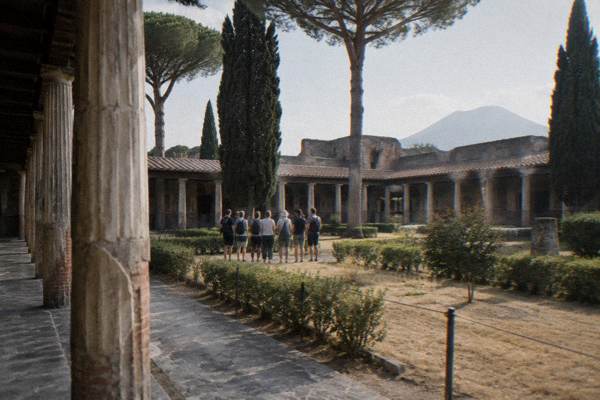
Pompeii Dogs
Dogs are one of the quiet threads running through Pompeii, the ancient Roman city buried by the eruption of Mount Vesuvius in AD 79 and now an archaeological park in Campania, southern Italy, beside the modern town of Pompei and about 24 km from Naples: mosaics warn visitors at doorways, casts and bones record real animals, and strays still patrol the edges of the ruins.
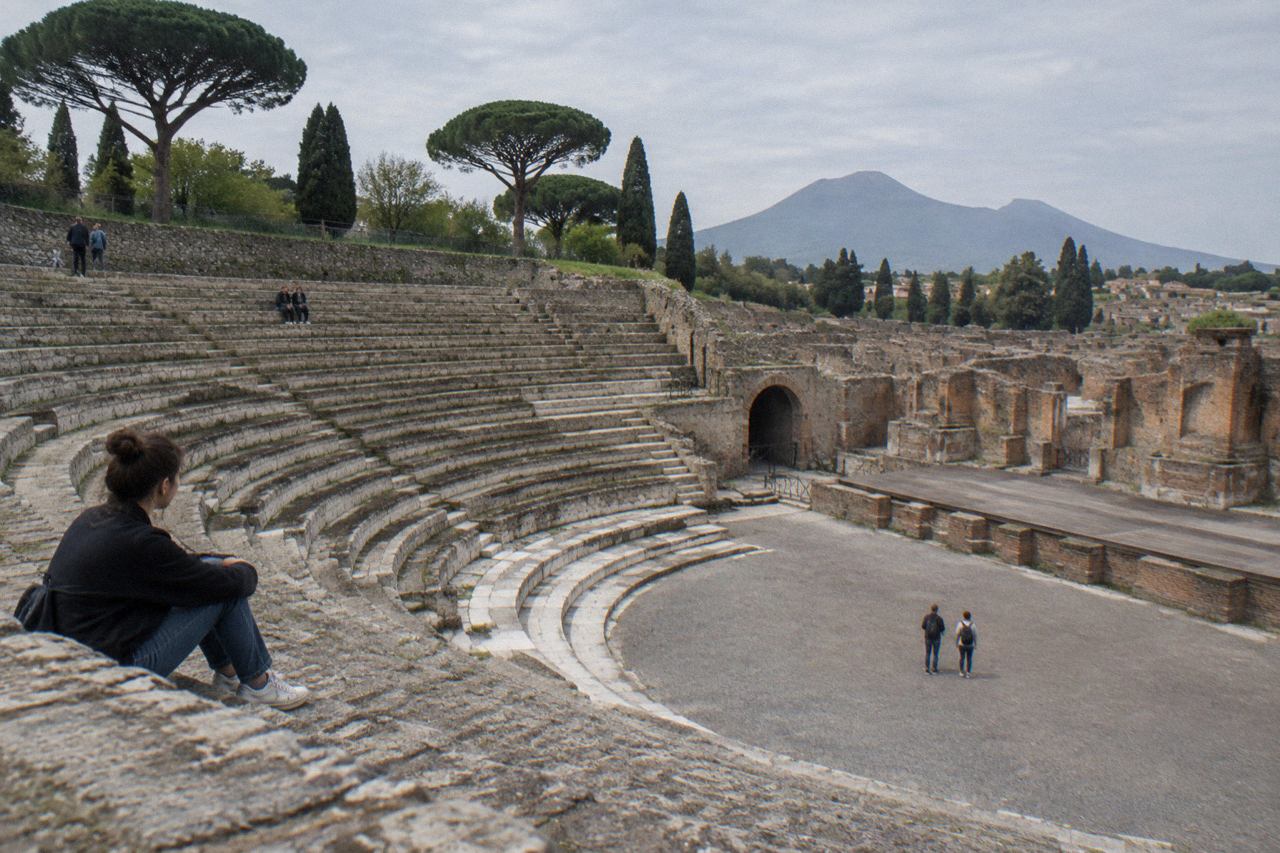
Short answer
Pompeii, the ancient city in Campania, Italy, is full of dogs in three senses: mosaic watchdogs at house doorsteps, the remains of real dogs caught by the AD 79 eruption, and stray dogs that live around the modern park entrances. This guide explains where the dog imagery is, what the park permits, and how to plan a visit around it.
Dogs have lived beside the people of Pompeii for as long as the city has stood. Pompeii is the ancient Roman city buried by the eruption of Mount Vesuvius in AD 79, now the Parco Archeologico di Pompei in Campania, southern Italy, sitting beside the modern town of Pompei about 24 km by road south-east of Naples on the Bay of Naples. Within its 44 hectare excavated area, dogs appear in three distinct ways: as mosaic watchdogs laid into pavements at house entrances, as the remains of real animals overwhelmed by the eruption, and as the stray dogs that still wander the modern fringes of the park. Each of those threads rewards a different kind of visitor, and this guide takes them in turn, with the practical ticket, entrance and timing facts you need to build a day around them.
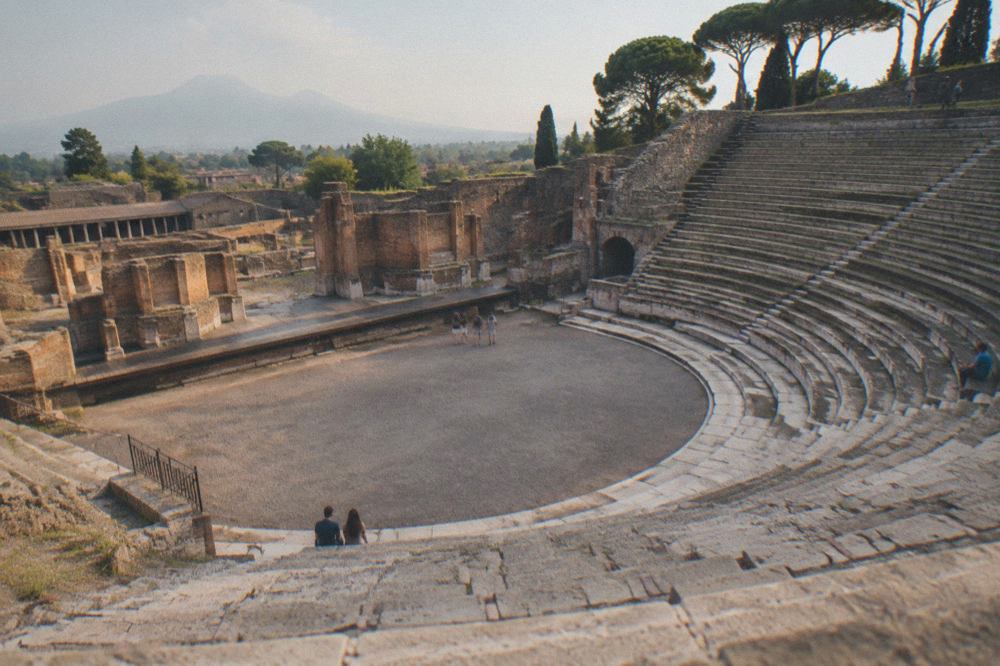
Are There Dogs At Pompeii Today?
Yes, in two senses. Inside the excavated ancient city you will meet dogs frozen in mosaic and plaster, images left by Roman householders who kept dogs and wanted visitors to know it, while around the modern edges of the park, in the car parks, ticket queues and streets of the modern town of Pompei, stray and semi-stray dogs still live, cared for in varying degrees by local volunteers and animal welfare groups, though neither is a formal signposted attraction.
The strays around the archaeological park are a long-standing feature of the modern town rather than of the ancient ruins themselves. Italy has a national no-kill policy for stray dogs, which means animals without owners are registered, sterilised and returned to live out their lives on the streets rather than put down. That legal framework is why you can see collared, ear-tagged dogs dozing near the station at Pompei Scavi-Villa dei Misteri or near the Porta Marina entrance without anyone rounding them up. Volunteers in the Naples area feed and monitor them, and visitors are asked to treat them as you would any unfamiliar animal: admire from a distance, never feed them at the gate queues, and do not let children rush at them.
The ancient dogs are the reason this page exists. Roman Pompeii was a city of courtyards and open doorways, and householders used dogs exactly as people use guard dogs now: kept awake at the threshold, chained where they could be seen and heard. When Vesuvius erupted, those animals died with their households, and the ash that preserved the city preserved them too. The plaster cast technique that recorded the human victims of the eruption also recorded dogs, and several of those casts are among the exhibits that travel the world and stand in park display areas. For the human side of that story, our companion piece on the Pompeii body casts explains how the casts were made and where the idea came from.
Put simply: if you arrive at Pompeii expecting to meet a dog, you almost certainly will, whether it is a two-thousand-year-old mosaic one, a cast of a real one, or a live one asleep under a bench outside Porta Marina. Which of the three you care about most shapes the route you walk, and the rest of this guide is organised around that choice.
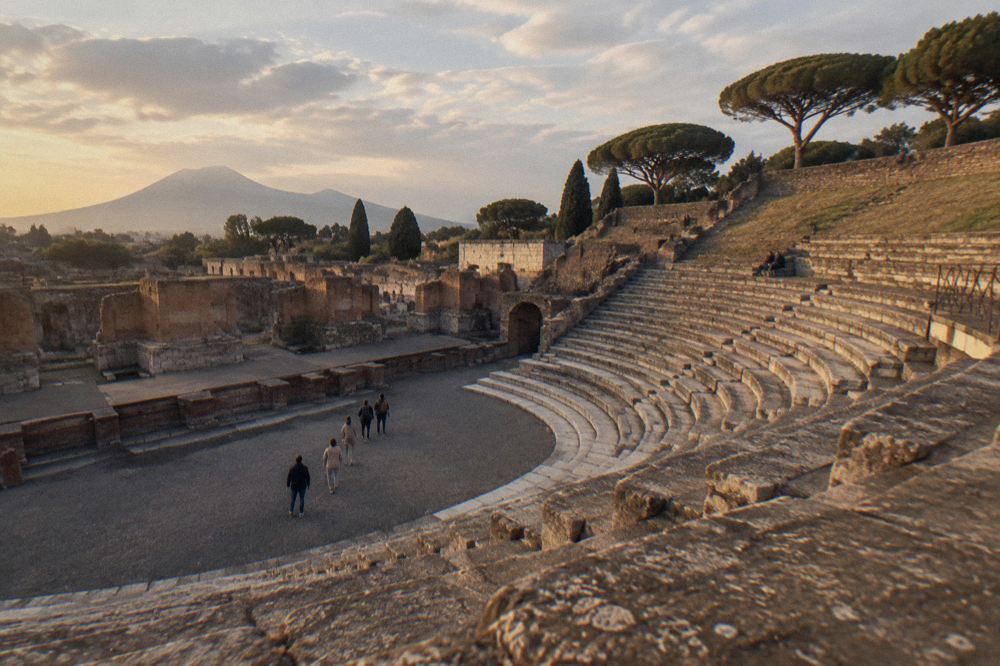
Where Do Dogs Appear In The Ancient City Of Pompeii?
Dogs appear across Pompeii in several distinct settings: most famously as the Cave Canem ("beware of the dog") mosaic, a chained watchdog rendered in tesserae at a house threshold so that arriving visitors literally stepped over the warning, with the most celebrated example at a doorway on the Via dell'Abbondanza axis; and beyond such mosaics, in wall decoration, in shopfronts, and as casts and skeletal remains in the site's display areas.
The Cave Canem motif is the single most reproduced piece of Pompeian dog imagery, and it works as a piece of domestic security theatre: the mosaic says, in effect, that this house keeps a dog and you have been warned. Some households apparently paired the image with a real animal, others relied on the image alone, and either way the message to a stranger at the door was the same. Look for the figure of a chained dog, muscles taut, mouth open, rendered in dark stone against a pale ground. It is one of the most reliable crowd-pleasers on any guided walk of the city, and guides routinely build a pause at it into their route.
The second place dogs appear is in the record of the eruption itself. Dogs died at Pompeii alongside their owners, and because the pyroclastic deposits hardened around organic material that decayed away, voids remained in the ash that excavators could fill with plaster. The result is a small number of animal casts, including dogs caught in the destruction traditionally dated to 24 August AD 79. That traditional date deserves a note: the park's own e-journal states that the alternative 24 October date has no evidentiary basis and results from a 1929 misreading of the manuscripts, while also acknowledging that 24 August is not guaranteed either. The scholarly debate remains open, and any guide who tells you otherwise is overclaiming. The eruption itself, and the destruction of the city, are not in dispute.
The third appearance is the humblest: dog bones in the archaeological record, from animals that were pets, guards and, in a city of shop counters, occasionally part of the food chain. You will not necessarily see these on a walking route, but they underpin the exhibitions and the research that keep Pompeii in the news. The park is an active excavation, not a frozen museum, and new finds continue to emerge from the parts of the city still buried; if you are curious about how much remains underground and how the digging works, the Pompeii history guide covers the discovery and excavation of the city in depth.
If dog-spotting is your aim, the practical advice is simple: walk the main axis, enter the key houses that are open on the day of your visit, and go with a guide who knows which doorways currently hold the best-preserved thresholds. House openings rotate as conservation work proceeds, and one closure to know about is that the Praedia of Julia Felix has been closed to the public since 7 September 2026 for maintenance, until further notice. An archaeologist-led tour with the entry ticket included removes the guesswork, and the operator's live listing shows what is running: Check availability. The same tour is a good companion to our broader comparison of a guided tour versus self-guided Pompeii.
What Are The Rules If You Meet, Or Bring, An Animal At Pompeii?
The park's published visitor regulations cover bags, drones and dress, and they say nothing that grants animals entry, so the working assumption for anyone hoping to bring a pet is no: assistance animals are a different matter and should be arranged with the park in advance. The bag rule matters for every visitor, including animal lovers carrying treats and water: the maximum permitted bag size is 30x30x15 cm, and anything larger must go to left luggage. Tickets are nominative and non-transferable, and identification may be checked at every entry.
The official regulations page of the park sets out the practical limits of a visit. Alongside the bag limit, drones may not be flown without authorisation and bare chests are not permitted inside the excavations. None of that mentions dogs, because the regulations were written for the human problems of crowds, litter and photography, not the animal ones. What follows for visitors is common sense: the ancient streets are uneven stone, hot in summer, and crowded in the middle of the day, and none of that is a kind environment for a pet even where rules allowed it.
For the strays around the entrances, the etiquette is the same as anywhere in southern Italy. Do not feed them in the queue, because feeding at the gates concentrates animals where the crowd pressure is highest. Do not chase, pick up or photograph at close range an unfamiliar dog, however friendly it looks. If you see an animal in obvious distress, the realistic options are the local volunteers and veterinary practices of the modern town of Pompei rather than the park's own staff, whose remit is the ruins.
For visitors whose own animal is an assistance dog, contact the park before you travel and get the answer in writing. The park does run an accessibility programme: the "Pompeii for All" route lets visitors with mobility difficulties enter at Piazza Anfiteatro and exit at Piazza Anfiteatro or Piazza Esedra via the Antiquarium lift, and the same entrance logic is where any accessibility conversation with the park should start. The full detail is on our Pompeii accessibility companion pages for family and access planning, and the park's own visiting-info pages carry the current wording.
Which Tickets And Entrances Do You Need For A Dog-Themed Walk At Pompeii?
For a dog-themed walk in 2026 you only need the Pompeii Express ticket at EUR 20, because every dog mosaic and cast sits inside the ancient city; the EUR 25 Pompeii+ and EUR 30 3-day tickets add suburban villas, Boscoreale, Oplontis, Stabiae and its museum, none of which the dogs require. From 1 January 2027 a single EUR 25 ticket covers all park sites, valid 30 days with one entry per site, and you can buy it at Porta Marina, Piazza Esedra or Piazza Anfiteatro.
The 2026 prices were set on 12 January 2026 and run only to 31 December 2026, so if you are reading this with a 2027 trip in mind, plan against the new structure, not the old one. Under the new system the three smaller sites, Oplontis, the Stabiae museum and Boscoreale, remain EUR 8 individually and the My Pompeii Card annual pass remains EUR 45. The nominative ticket, introduced on 15 November 2024 together with the 20,000 visitors per day cap, is retained, which means your ticket carries your name and your identification may be checked at the gate.
| Ticket (2026 prices, until 31 December 2026) | Price | What it covers |
|---|---|---|
| Pompeii Express | EUR 20 | The ancient city only |
| Pompeii+ | EUR 25 | City, suburban villas route, Villa Regina, Antiquarium and shuttle |
| 3-day ticket | EUR 30 | Pompeii+ plus Oplontis, Stabiae villas and museum, Boscoreale |
| Express holders adding villas route | EUR 8 | At the Porta Ercolano / Street of the Tombs entrance, card only |
| Other sites individually (Oplontis, Stabiae museum, Boscoreale) | EUR 8 | One site each |
| My Pompeii Card (annual) | EUR 45 | Annual pass, EUR 10 reduced |
Two further ticket facts do real work for a dog-themed day. Entry is free for everyone on the first Sunday of the month, and it is free for under 18s at all times, with a EUR 2 reduced rate for EU citizens aged 18 to under 25. The free first Sundays are popular: the park has recorded a single-day peak of more than 36,000 visitors on one such Sunday, which is a number worth sitting with before you choose a date. If quiet thresholds and unhurried mosaic viewing are the goal, a paid weekday serves you better than a free Sunday, whatever the saving.
The entrance choice matters less for the dogs than for your legs. Time-slot rules apply in high season: from 16 March to 14 October the site opens at 9:00 with last entrance at 17:30 and closing at 19:00, and from 15 October to 15 March the last entrance is 15:30 with a 17:00 close. The full detail, including the slot caps, is in our Pompeii tickets guide.
| Entrance | Role for this visit |
|---|---|
| Porta Marina | Ticket office, classic arrival from Pompei Scavi-Villa dei Misteri station |
| Piazza Esedra | Ticket office, eastern city, exit point of the accessible route |
| Piazza Anfiteatro | Ticket office, amphitheatre quarter, entry point of the "Pompeii for All" route |
| Porta Ercolano / Street of the Tombs | Where Express holders buy the EUR 8 suburban villas add-on |
When Is The Best Time Of Year To Walk Pompeii's Streets?
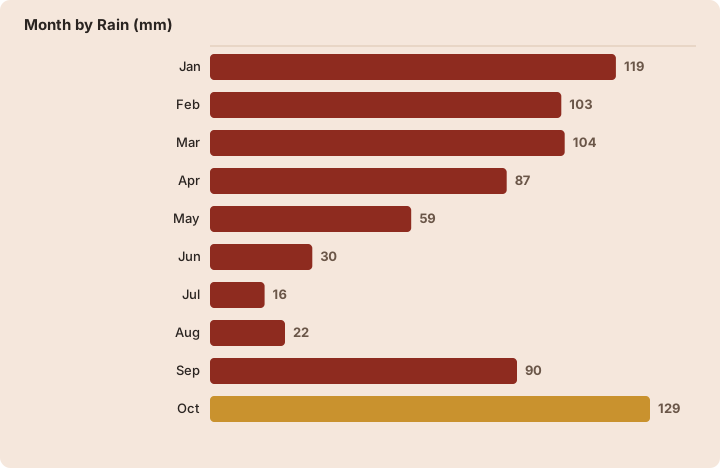
The best time to walk Pompeii's streets is April, May, June, September, or October, when 1991-2020 climate normals show mean daily maxima of roughly 17.7 to 25.8 C and about 30 to 90 mm of rain per month. July and August climb to about 28.7 and 29.4 C, and November is the wettest month at about 180 mm; because the ancient stones hold heat and offer no shade, pack water and a hat within the 30x30x15 cm bag allowance.
The figures below are computed from the Open-Meteo historical archive at the Pompei grid point, a reanalysis grid rather than a weather station, so every number is "about" rather than exact. Even so the pattern is clear and it matches the park's own visitor counts: the busiest months of 2024 were May with 516,923 visitors, September with 468,340 and October with 481,255, while February drew 142,648. People vote with their feet for the shoulder season, and the pavements explain why.
| Month | Mean daily max (C) | Mean daily min (C) | Rain (mm) |
|---|---|---|---|
| Jan | about 12.2 | about 6.6 | about 119 |
| Feb | about 12.6 | about 6.5 | about 103 |
| Mar | about 14.9 | about 8.1 | about 104 |
| Apr | about 17.7 | about 10.4 | about 87 |
| May | about 21.6 | about 14.1 | about 59 |
| Jun | about 25.8 | about 18.2 | about 30 |
| Jul | about 28.7 | about 21.1 | about 16 |
| Aug | about 29.4 | about 21.8 | about 22 |
| Sep | about 25.3 | about 18.6 | about 90 |
| Oct | about 21.3 | about 15.1 | about 129 |
| Nov | about 16.9 | about 11.5 | about 180 |
| Dec | about 13.2 | about 8.0 | about 147 |
For the dogs of the modern town, the same numbers apply with extra force. Pavement heat and thirst are hard on animals that live outdoors year-round, and the depth of winter, with a February mean minimum of about 6.5 C, is its own challenge. If your visit falls in the hot months, arriving for the 9:00 opening is the single best decision you can make, both for the mosaics and for the animals asleep in whatever shade the gate area offers. The seasonal detail, including what to wear and carry, is expanded in our Pompeii weather and best time to visit guide.
Can You Combine Pompeii's Dogs With Vesuvius And Herculaneum?
Yes. Pairing Pompeii's dogs with Vesuvius and Herculaneum is the natural upgrade once you have seen the city, because the volcano is the agent of the whole story and Herculaneum is its second act; the Gran Cono trail sells timed tickets online only at EUR 11.68 full and EUR 9.55 reduced, bookable 30 days ahead, while Herculaneum charges EUR 16 full and EUR 2 reduced for EU citizens aged 18 to under 25, though its Villa dei Papiri and Ancient Theatre remain closed for works.
The Vesuvius side is the more dog-relevant of the two, in a grim way: the volcano that ended the city's life in AD 79 also ended the lives of the dogs you have been looking at, and standing on the crater rim gives the geometry of that event a clarity no site map provides. Tickets for the Gran Cono are sold online only, 50 tickets per 10-minute slot, with 10 last-minute nominative tickets per slot released from 30 minutes before each departure, a rule in force since 11 April 2026. Access hours shift through the year and the trail closes automatically on an orange weather alert or above, with an automatic refund if weather shuts the path. Full ticket detail sits in our Mount Vesuvius tickets guide.
| Vesuvius Gran Cono (2026) | Detail |
|---|---|
| Full ticket, as sold | EUR 11.68 |
| Reduced ticket, as sold | EUR 9.55 |
| Sales channel | Online only, timed slots |
| Advance booking window | 30 days |
| Last-minute tickets | 10 per slot, nominative, from 30 minutes before |
| Walk | 2 h return shortest route to 3 h longest route |
| Weather closure | Automatic on orange alert or above, with refund |
Herculaneum rewards a different mood: smaller, darker, better sheltered, and buried deeper in the volcanic material than Pompeii, which is why its organic remains, timber and textiles among them, survived so well. For a dog-themed trip it is the sister site where the destruction of the eruption is at its most concentrated. Note the closures before you build a day around it: the Villa dei Papiri is closed for works and the Ancient Theatre is closed until further notice, per the site's own ticketing page. Our head-to-head, Pompeii versus Herculaneum, breaks the choice down for travellers who only have time for one.
Doing all three in a single day is a big day, and the packaged tours that attempt it are honest about the pace. A three-site day trip from Naples bundles Pompeii, Herculaneum and Vesuvius with transport handled, which is the part of that itinerary that exhausts independent travellers first.
Between the two, if a leisurely pace with a proper lunch matters more than the third site, a small-group Pompeii and Vesuvius day with lunch included is the gentler shape, and it pairs naturally with an evening back in Naples.
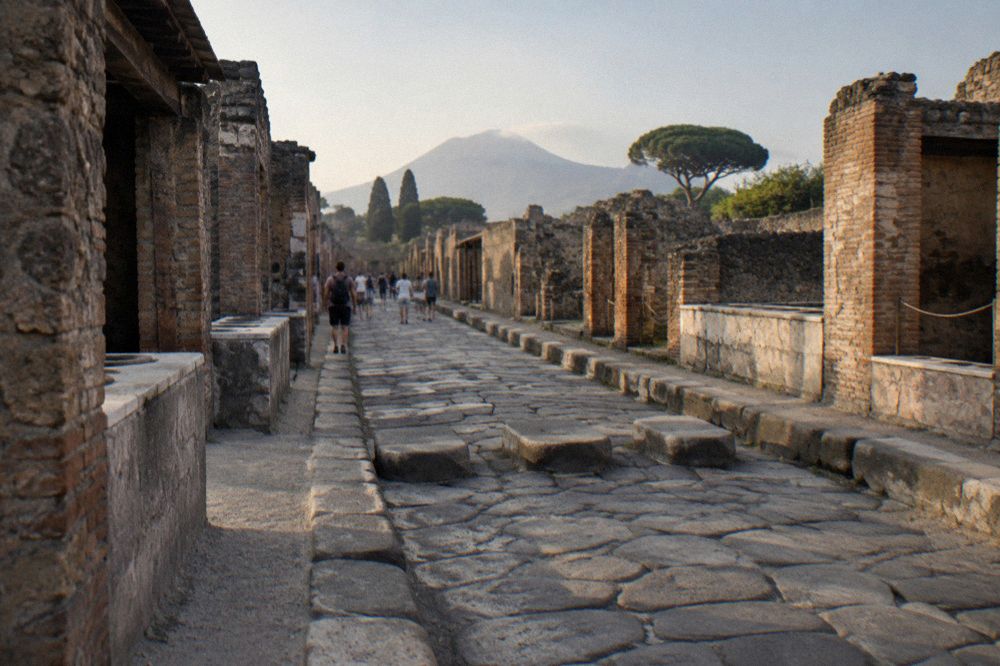
How Do You Get To Pompeii To See The Dogs?
The Circumvesuviana railway is the workhorse route, and its own timetable data shows scheduled runs of 29 to 35 minutes from Napoli Garibaldi to Pompei Scavi-Villa dei Misteri, and 34 to 40 minutes from Pompei Scavi onward to Sorrento; the Campania Express premium service has been suspended since 1 October 2026, so the ordinary line is currently the rail option. By road, the driving distances to Pompei Scavi are about 24 km from Naples, about 26 km from Sorrento and about 31 km from Salerno.
The station name matters, because there is more than one Pompei: you want Pompei Scavi-Villa dei Misteri, the stop beside the excavations, not the town-centre station that serves the Sanctuary. Alight at Scavi and the Porta Marina entrance is a short walk away. The Circumvesuviana line is the Sorrento peninsula's artery and it serves the Amalfi side too, so the same planning applies whichever base you choose; our Circumvesuviana train guide covers the line in detail, and the Campania Express page explains the suspension and the refund route for anyone holding affected tickets.
| Route to Pompei Scavi (2026) | Figure |
|---|---|
| Napoli Garibaldi to Pompei Scavi-Villa dei Misteri, scheduled | 29 to 35 minutes |
| Pompei Scavi to Sorrento, scheduled | 34 to 40 minutes |
| Napoli to Pompei Scavi, driving | about 24 km |
| Sorrento to Pompei Scavi, driving | about 26 km |
| Salerno to Pompei Scavi, driving | about 31 km |
| Campania Express | suspended since 1 October 2026 |
Base yourself according to the pace you want. Naples is the transport hub and the food city; Sorrento is the gentler base for a coast-first trip, covered in our Sorrento to Pompeii and Naples to Pompeii pages; the Amalfi Coast side has its own route in, on our Amalfi Coast to Pompeii page. Rome-based travellers should read the Rome to Pompeii day trip planning page before committing to the long day. Where to sleep near the site itself, with the plain facts about which side of the tracks each neighbourhood sits on, is in where to stay in Pompei.
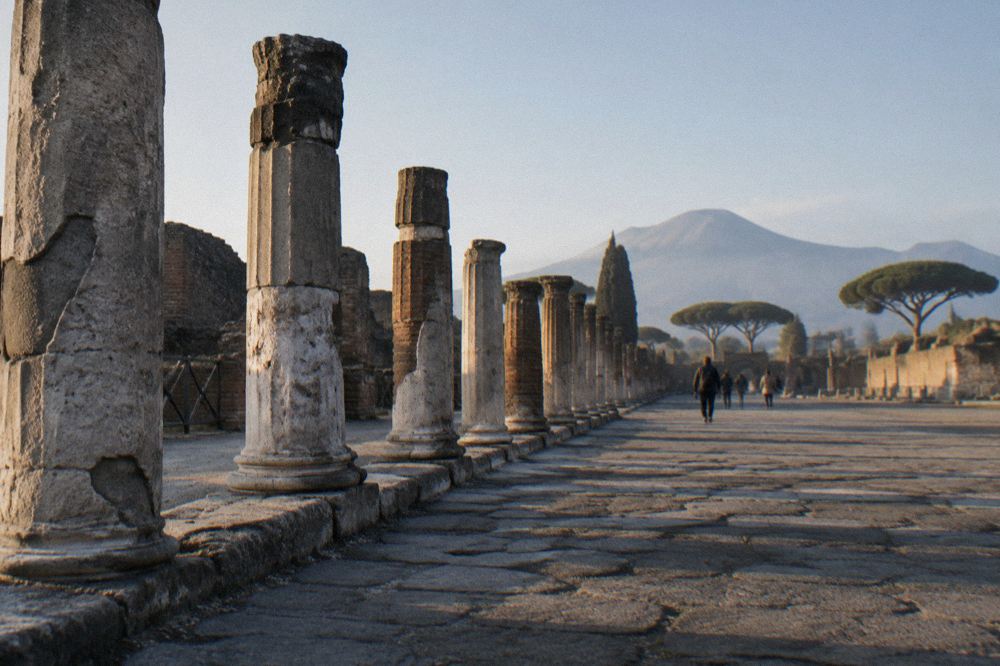
Why Do The Dogs Of Pompeii Stay With You Longer Than The Temples?
Because the dog images are the point in the ruins where an entire ancient city stops being architecture and becomes a household. A temple column tells you a civilisation was powerful; a chained watchdog mosaic at a doorstep tells you somebody was afraid of burglars, and a cast of a real dog tells you the animal did not get out. That switch of scale, from empire to threshold, is what visitors describe long after the visit, and it is why the Cave Canem threshold outlives the marble in memory.
There is also a modern continuity that few World Heritage sites can claim. The dogs in the mosaics were property, guards and companions; the dogs of the modern town of Pompei are registered strays living under a national no-kill law; and between the two stands the eruption that killed the first group and made the second group's town what it is. Few places let you stand between those three facts within a hundred metres, which is what a dog-themed walk at Pompeii actually delivers.
The numbers give the setting its weight. The excavated area of 44 hectares sits inside an inscribed UNESCO property of 98 hectares with a buffer zone of 1,788.79 hectares, shared with Herculaneum and Torre Annunziata. The site drew 4,000,090 visitors in 2025, following 4,069,377 in 2024 and 3,985,424 in 2023, and the whole park across all its sites passed 4 million in each of those years. Those are crowds at the scale of a small city arriving to walk a dead one, and the 20,000 daily cap that has applied since 15 November 2024 exists precisely because of it.
| Year | Pompeii site visitors | All park sites |
|---|---|---|
| 2022 | 2,972,159 | n/a |
| 2023 | 3,985,424 | 4,079,235 |
| 2024 | 4,069,377 | 4,177,753 |
| 2025 | 4,000,090 | 4,118,926 |
For turning the theme into a full plan, the practical next stops on this site are the Pompeii map for orientation, the Pompeii entrances detail for gate choice, and the homepage of Pompeii Travel Guide for the full picture of the site and its region. If a half-day is all you have, the small-group archaeologist tour that covers the highlights with the ticket included is the most direct way to reach the threshold mosaics with someone who can read them aloud in context.
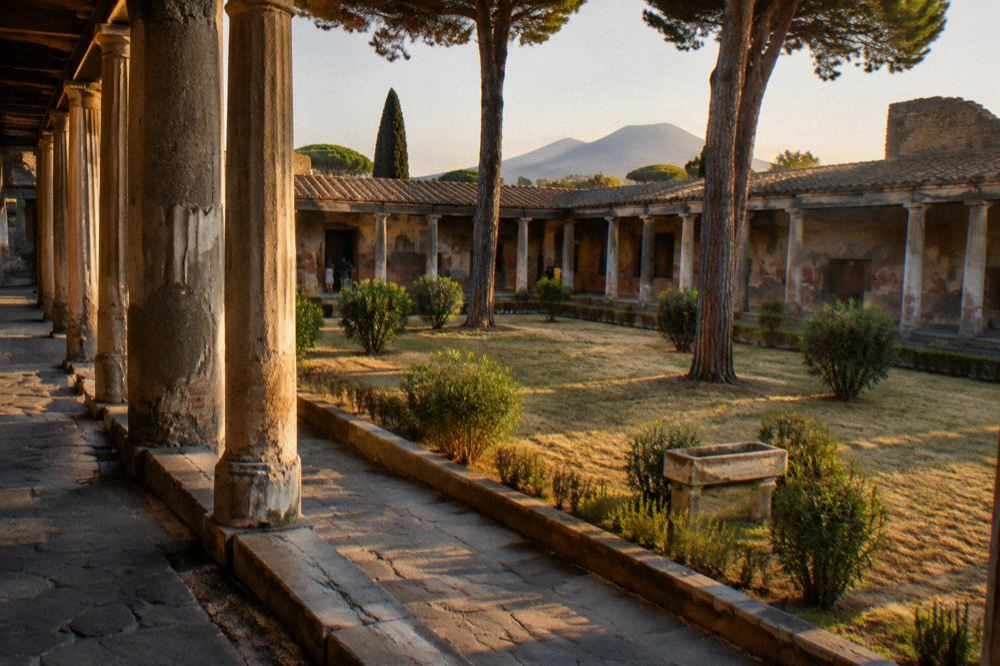
Common Questions About Pompeii Dogs
Are there live dogs at Pompeii?
Yes, around the modern edges of the archaeological park and the town of Pompei you can see registered stray dogs, living under Italy's national no-kill policy and monitored by local volunteers. Inside the excavations the dogs you meet are ancient: mosaic images at house thresholds and casts of animals that died in the AD 79 eruption.
What does the Cave Canem mosaic at Pompeii mean?
Cave Canem is Latin for "beware of the dog", and the mosaic shows a chained watchdog at a house threshold so that anyone stepping over it received the warning. It is the most reproduced piece of dog imagery from the ancient city and sits within the standard walking circuit of the key houses.
Can I bring my pet dog into the excavations at Pompeii?
The park's published visitor regulations do not grant animals entry, so the working assumption is no, with assistance animals arranged separately and in advance with the park. The regulations that clearly apply to everyone are the 30x30x15 cm bag limit, the ban on drones without authorisation and the dress rules.
Is it safe to touch or feed the stray dogs near the entrances?
Treat them as you would any unfamiliar animal: admire from a distance, do not feed them in the gate queues, and do not let children rush at them. Animals in obvious distress are a matter for the local volunteers and veterinary practices of modern Pompei rather than the park's staff.
Which ticket do I need to see the dog mosaics at Pompeii?
In 2026 the Pompeii Express at EUR 20 covers the ancient city, which is where the mosaics and casts are. From 1 January 2027 a single EUR 25 ticket covers all park sites, valid 30 days with one entry per site, with Oplontis, the Stabiae museum and Boscoreale at EUR 8 each.
Did real dogs die in the eruption of AD 79?
Yes. Dogs kept as guards and companions died with their households in the eruption, traditionally dated to 24 August AD 79, and the plaster-cast technique used on human victims also recorded animals, leaving casts that are among the site's most affecting exhibits.
However you build the day, the dogs of Pompeii are the thread that ties the visit together: the mosaic at the threshold, the cast in the ash, the stray asleep by the gate. Walk slowly past the doorways, carry water in the permitted bag, and let the site do what it has done to travellers for centuries, which is to shrink two thousand years down to the width of a doorstep.